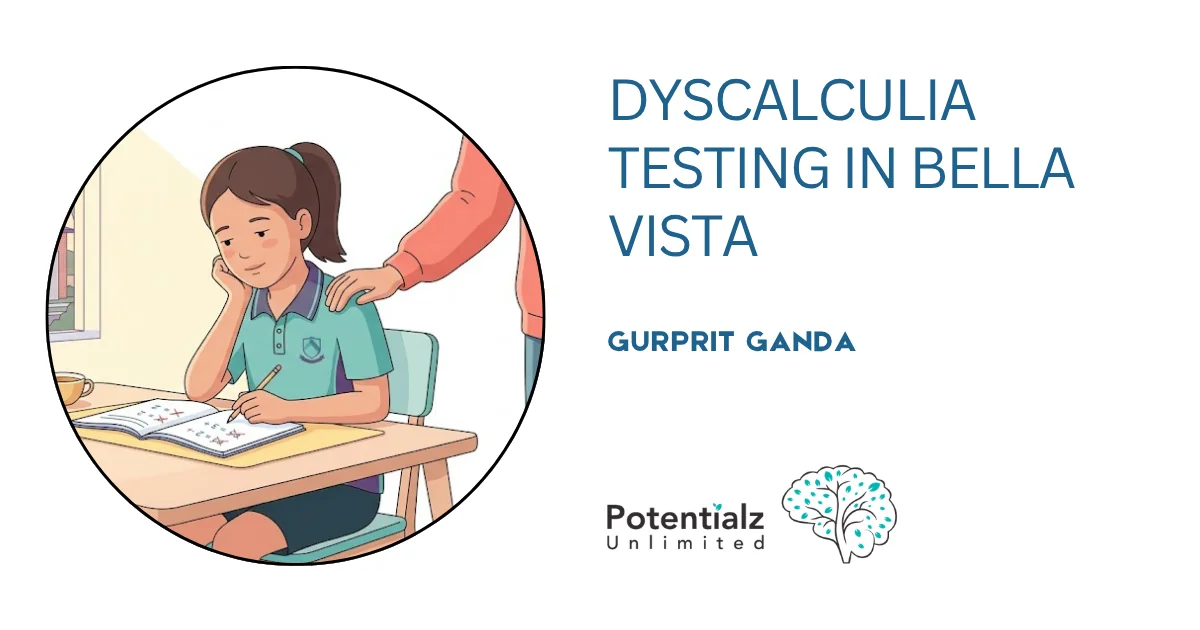
She Practised Her Times Tables Every Night — and Still Got Them Wrong the Next Morning
Mia is 9. She is bright, funny, and reads above her year level. But when the maths book opens, something shifts. She stares at the page. She counts on her fingers when other kids in her Year 4 class do it in their head. She practises her times tables every night with her dad, and the next morning the answers seem to have vanished from her brain.
Her teachers say she just needs more practice. Her parents wonder if she is lazy, or if she has ADHD. But Mia is not lazy. And she is not lacking practice. She has worked harder than most of her classmates. There may be a different reason.
Mia might have dyscalculia — a specific learning difficulty with numbers and maths. And a clear assessment can tell her family what is going on and how to help.
What Is Dyscalculia?
Dyscalculia is a specific learning difficulty that affects the way a person understands and works with numbers. It is sometimes called a maths learning disability. It is not about effort, intelligence, or how hard a child tries. It is about how the brain processes number information (Butterworth et al., 2011).
People with dyscalculia often have trouble with things most of us take for granted — knowing that 7 is bigger than 5 without thinking about it, remembering basic maths facts, telling the time on an analogue clock, or understanding how money works. The brain regions used for numbers, especially the intraparietal sulcus, work differently in dyscalculia (Kucian & von Aster, 2015).
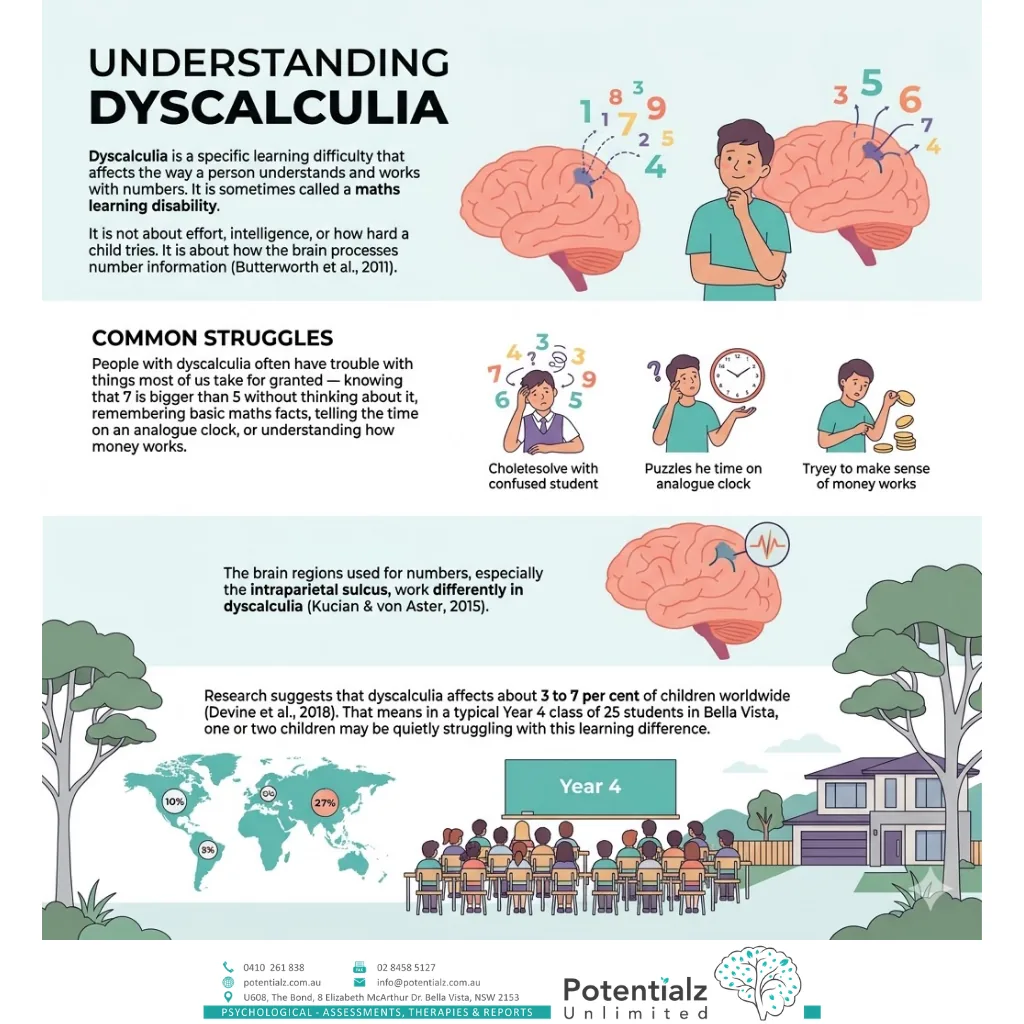
Research suggests that dyscalculia affects about 3 to 7 per cent of children worldwide (Devine et al., 2018). That means in a typical Year 4 class of 25 students in Bella Vista, one or two children may be quietly struggling with this learning difference.
How Is Dyscalculia Different from “Bad at Maths”?
A lot of children struggle with maths at some point. Many do better with patient teaching, more time, or a different approach. So how do you tell the difference between a normal wobble and dyscalculia?
The clearest signal is the gap. A child with dyscalculia usually performs well in other areas — they may be a strong reader, an excellent storyteller, or a creative thinker. But when it comes to numbers, there is a persistent and unexpected difficulty that does not get better with practice (Geary, 2013).
Some early signs parents and teachers may notice include:
- Counting on fingers long after classmates have stopped
- Trouble remembering basic addition and times tables, even after months of practice
- Difficulty telling left from right, or reading a clock face
- Confusion with money — adding up small change is hard
- Trouble understanding maths word problems even when the words are simple
- Anxiety, tears, or avoidance whenever maths is mentioned
- A clear gap between the child’s reading and language skills and their maths skills
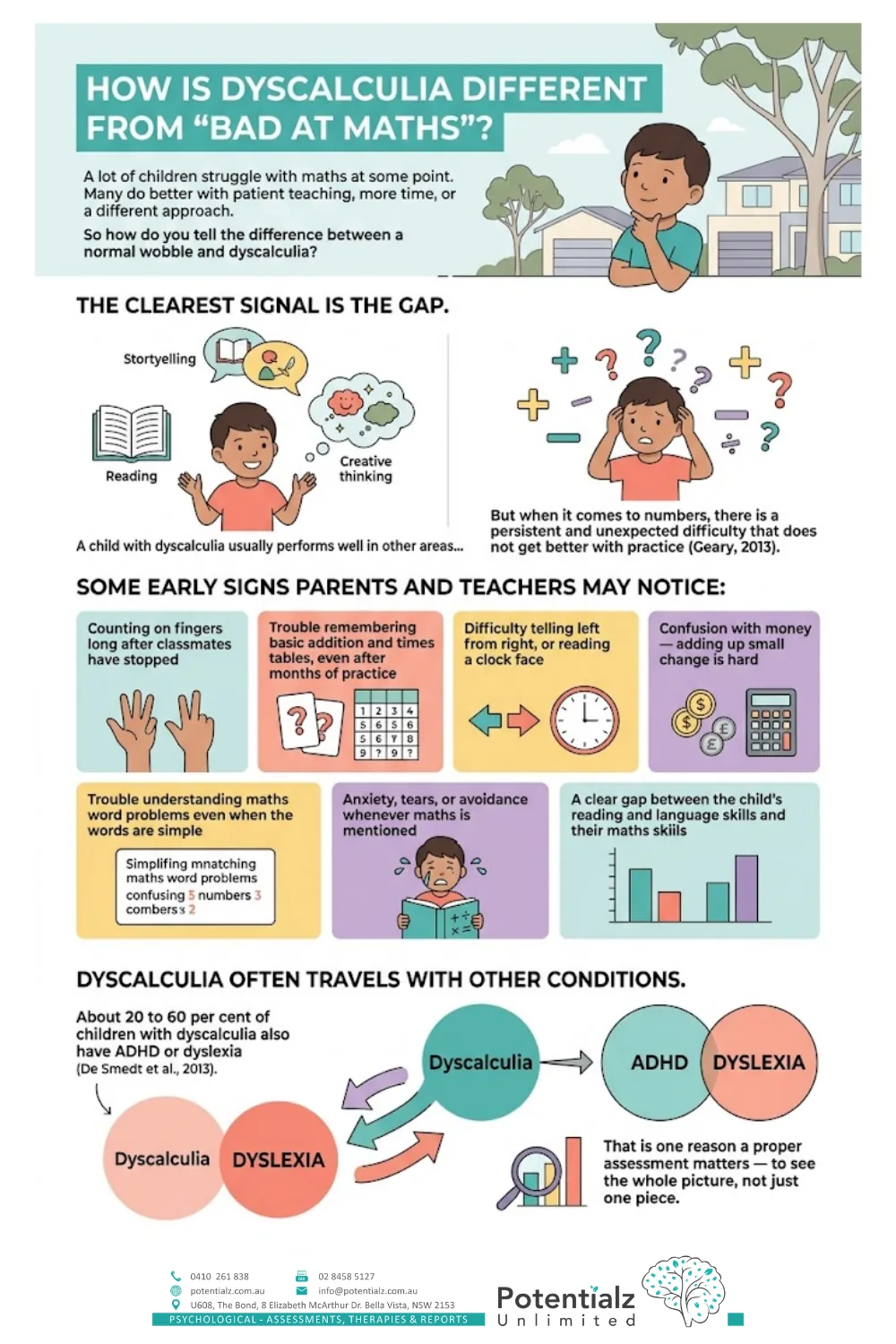
Dyscalculia often travels with other conditions. About 20 to 60 per cent of children with dyscalculia also have ADHD or dyslexia (De Smedt et al., 2013). That is one reason a proper assessment matters — to see the whole picture, not just one piece.
Why a Proper Dyscalculia Assessment Matters
When a child struggles with maths year after year, the consequences add up. Many children with undiagnosed dyscalculia develop maths anxiety — a learned fear of numbers that makes the difficulty even worse (Devine et al., 2018). Some begin to believe they are “just not a maths person,” which can dent self-esteem and affect choices about school subjects, career pathways, and life skills like budgeting.
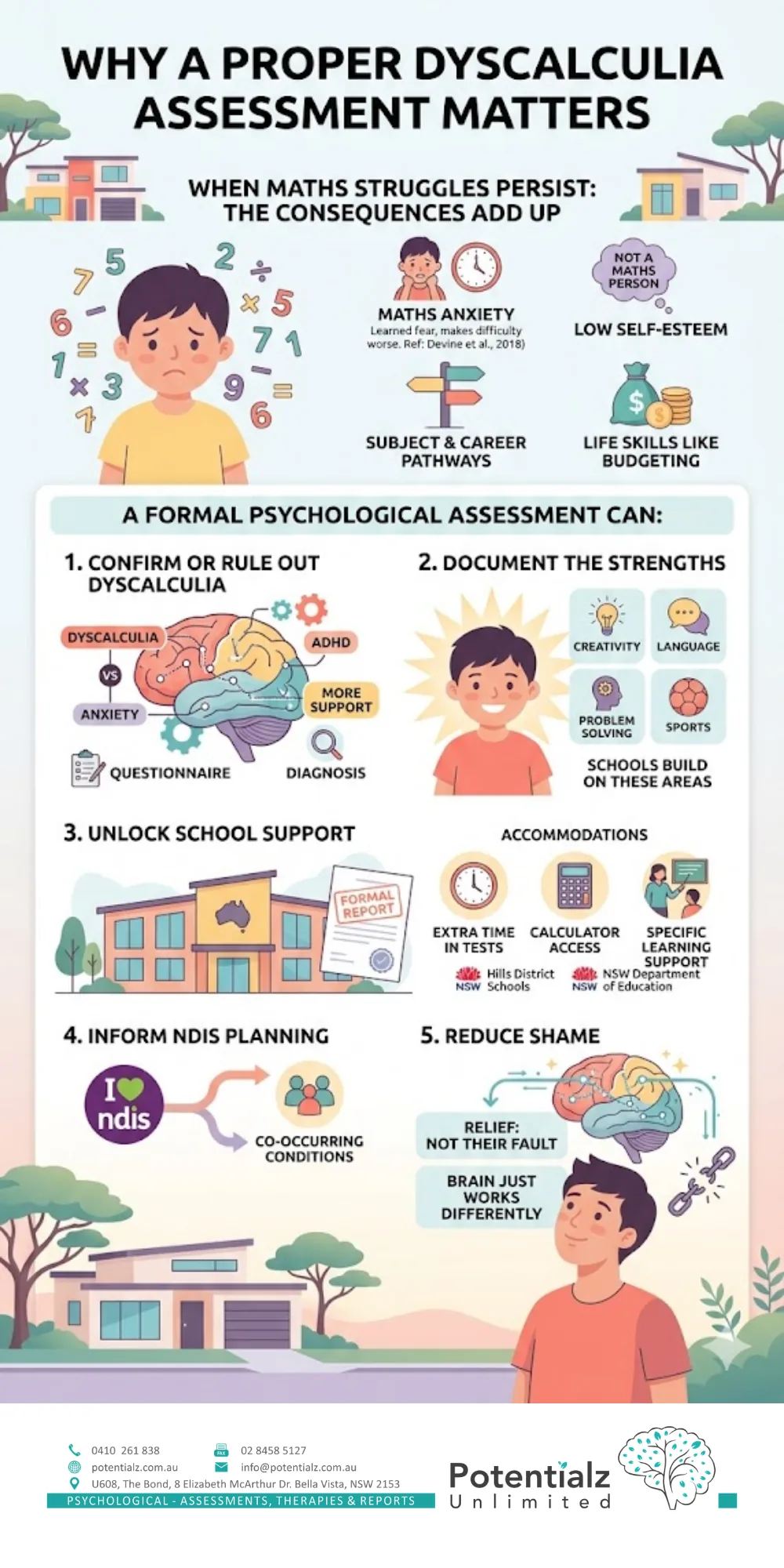
A formal psychological assessment can:
- Confirm or rule out dyscalculia — separating it from anxiety, ADHD, or simply needing more teaching support
- Document the strengths — most children with dyscalculia have areas where they shine, and a report helps a school build on those
- Unlock school support — Hills District schools and NSW Department of Education can offer accommodations like extra time in tests, calculator access, or specific learning support, but they usually need a formal report
- Inform NDIS planning if other conditions are present
- Reduce shame — children often feel relief when they learn their brain just works differently, and it is not their fault
How We Test for Dyscalculia at Potentialz Unlimited in Bella Vista
A proper dyscalculia testing process is more than a single short test. At Potentialz Unlimited in Bella Vista, an assessment usually involves four to six hours of testing spread across one or two sessions, plus parent and school questionnaires.
A typical assessment includes:
- A clinical interview with the parent or guardian to understand developmental history, school experiences, and family context
- A measure of overall cognitive ability — usually the WISC-V (Wechsler Intelligence Scale for Children — Fifth Edition), which gives a picture of verbal, visual-spatial, working memory, and processing speed strengths (Wechsler, 2014)
- A measure of academic achievement — usually the WIAT-III (Wechsler Individual Achievement Test — Third Edition), which assesses maths fluency, numerical operations, and maths problem-solving in detail. See our guide to the WIAT-III
- A focused look at number sense — comparing quantities, estimating, and recognising number patterns
- A check on related areas: attention, working memory, and reading, so other conditions can be identified or ruled out
- Parent and teacher questionnaires to see how the child functions outside the testing room
Once the testing is done, the family receives a detailed written report and a feedback session that explains the findings in plain language. The report includes practical recommendations for home, school, and any further support.
What Happens After the Diagnosis
A dyscalculia diagnosis is not a label that limits a child — it is a key that unlocks support. Most schools in the Hills District, Bella Vista, Norwest, Castle Hill, Kellyville, and Baulkham Hills will work with a psychological report to put adjustments in place. These can include:
- Multi-sensory maths teaching — using physical objects, drawings, and games to make number ideas concrete
- Extra time in maths tests and assignments
- Allowing the use of times-table charts and calculators in class
- Breaking word problems down into small steps
- Working with a specialist tutor or learning support teacher
- Building confidence first by celebrating non-maths strengths
For older students preparing for the HSC, a documented learning difficulty can support an application for HSC Disability Provisions — extra time, rest breaks, or other allowances during exams.
At home, parents can help by keeping calm, avoiding pressure during homework, using visual tools like number lines and arrays, and praising effort rather than answers. The aim is to keep maths-related anxiety low while building skills slowly. Our guide to parents as emotion coaches offers practical ways to support a child through maths-related frustration.
Cultural and Family Context in Bella Vista and the Hills District
The Hills District is home to many families where academic achievement is a strong cultural value. For families from South Asian, Chinese, and other backgrounds where maths performance is closely tied to identity and family pride, a child’s maths difficulties can feel especially confusing or distressing. Parents may worry that their child is “letting the family down” or that the difficulty reflects something they did or did not do.
This is one of the reasons a proper assessment is so helpful. A clinical report turns a vague worry into a clear picture. Parents often describe relief at finally understanding what is happening, and at seeing their child as a whole person — not just a maths grade. Many cultural and faith communities in the Hills District respond very supportively once they understand the difficulty is brain-based, not effort-based.
When to Book a Dyscalculia Assessment
Most families in our practice book a dyscalculia assessment when:
- Maths struggles have been clear for at least 6 to 12 months despite extra help
- A teacher has raised concerns or recommended an assessment
- The school is asking for a report before offering formal learning support
- The child is becoming anxious or avoiding maths altogether
- A sibling has a similar difficulty (dyscalculia tends to run in families)
- The child is approaching Years 7–8 and the maths gap is widening
- HSC Disability Provisions need to be applied for ahead of senior years
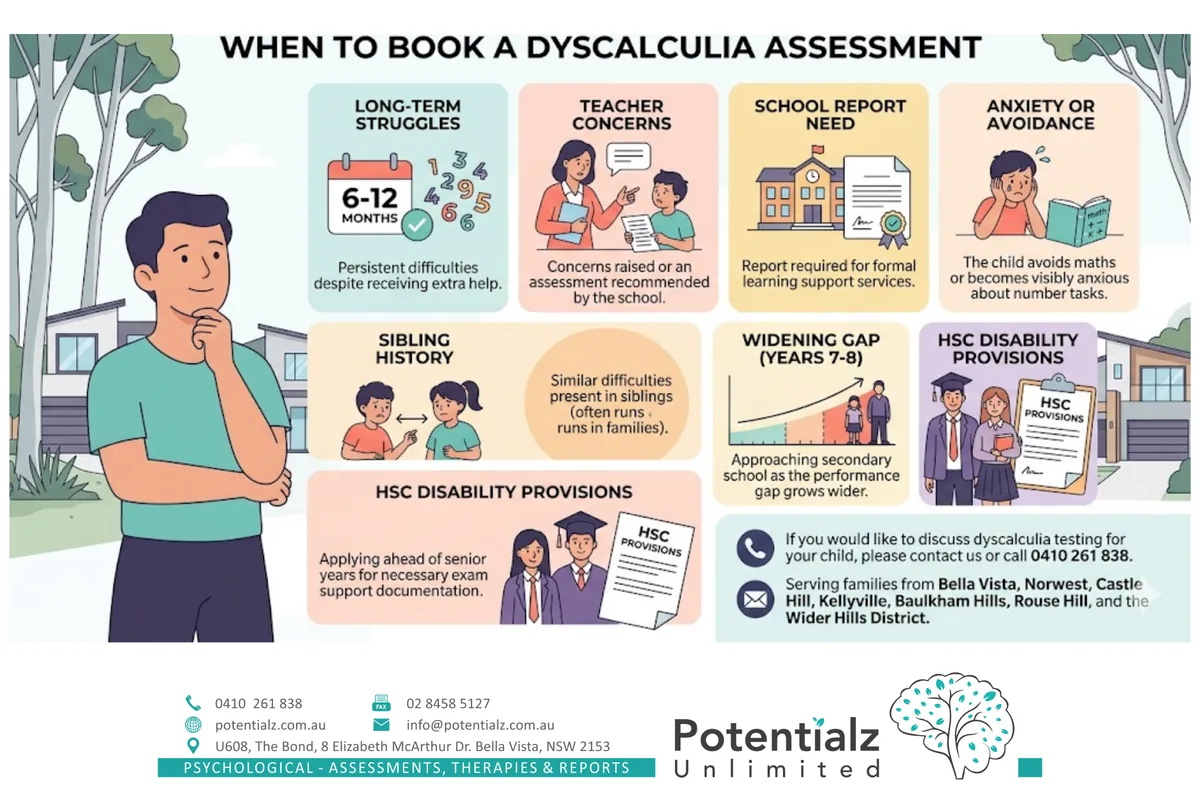
If you would like to discuss whether dyscalculia testing is right for your child, please contact us or call 0410 261 838. We see families from Bella Vista, Norwest, Castle Hill, Kellyville, Baulkham Hills, Rouse Hill, and across the wider Hills District.
References (APA 7th Edition)
Butterworth, B., Varma, S., & Laurillard, D. (2011). Dyscalculia: From brain to education. Science, 332(6033), 1049–1053. https://doi.org/10.1126/science.1201536
De Smedt, B., Noël, M.-P., Gilmore, C., & Ansari, D. (2013). How do symbolic and non-symbolic numerical magnitude processing skills relate to individual differences in children’s mathematical skills? A review of evidence from brain and behavior. Trends in Neuroscience and Education, 2(2), 48–55. https://doi.org/10.1016/j.tine.2013.06.001
Devine, A., Hill, F., Carey, E., & Szűcs, D. (2018). Cognitive and emotional math problems largely dissociate: Prevalence of developmental dyscalculia and mathematics anxiety. Journal of Educational Psychology, 110(3), 431–444. https://doi.org/10.1037/edu0000222
Geary, D. C. (2013). Early foundations for mathematics learning and their relations to learning disabilities. Current Directions in Psychological Science, 22(1), 23–27. https://doi.org/10.1177/0963721412469398
Kucian, K., & von Aster, M. (2015). Developmental dyscalculia. European Journal of Pediatrics, 174(1), 1–13. https://doi.org/10.1007/s00431-014-2455-7
Wechsler, D. (2014). Wechsler Intelligence Scale for Children — Fifth Edition (WISC-V). Pearson.
Related Reading on potentialz.com.au
- Guide to the Wechsler Individual Achievement Test (WIAT-III)
- Identifying and Supporting Learning Disabilities in Children
- Enhancing Academic Abilities Through Comprehensive IQ Assessments
- The Role of Assessments in ADHD Treatment
- IQ Testing in Bella Vista
- Our Team
- Contact us
Knowledge Check Quiz
Test what you have just read. Choose your answer for each question, then submit to reveal the answers and your score.
Need Professional Support?
If you're experiencing mental health concerns, our team is here to help.