“I spent forty years thinking I was just broken”
A few months ago, a woman in her early forties sat in my Bella Vista consulting room and said something I hear often: “I spent forty years thinking I was just broken.”
She had a good job, a family, and friends. From the outside, her life looked fine. But she described a lifetime of exhaustion — of rehearsing conversations in her head, of forcing eye contact, of coming home from social events so drained she could not speak. She had been treated for anxiety and depression more than once. Nothing had quite explained the whole picture.
When we completed her assessment, she met the criteria for autism. Her response was not distress. It was relief. For the first time, the pieces fit.
Stories like hers are becoming more common. Many adults — especially women — are recognising autism in themselves for the first time, often after a child, a friend, or an article prompts the question: could this be me? This guide explains what autism is, why so many adults are diagnosed late, and what an adult autism assessment in Bella Vista actually involves.
Jump to a related post:
- Adult autism diagnosis in Australia: the national guideline
- Navigating the meltdown: strategies for autistic adults
- Sensory integration therapy for autism: does it work?
- Our autism assessment service in Bella Vista
What autism actually is
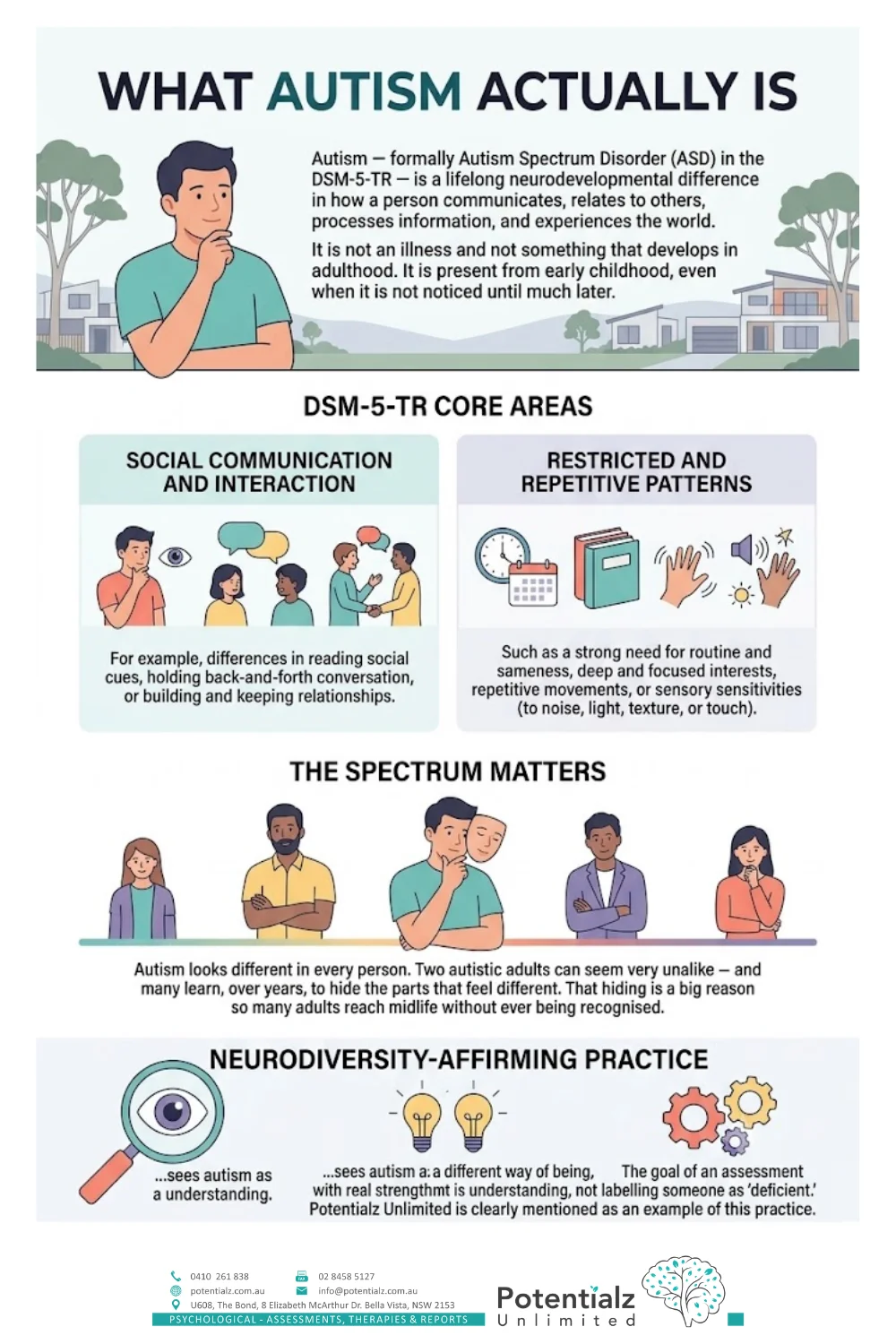
Autism — formally Autism Spectrum Disorder (ASD) in the DSM-5-TR — is a lifelong neurodevelopmental difference in how a person communicates, relates to others, processes information, and experiences the world. It is not an illness and not something that develops in adulthood. It is present from early childhood, even when it is not noticed until much later.
The DSM-5-TR describes autism across two core areas:
- Social communication and interaction — for example, differences in reading social cues, holding back-and-forth conversation, or building and keeping relationships.
- Restricted and repetitive patterns — such as a strong need for routine and sameness, deep and focused interests, repetitive movements, or sensory sensitivities (to noise, light, texture, or touch).
The word spectrum matters. Autism looks different in every person. Two autistic adults can seem very unalike — and many learn, over years, to hide the parts that feel different. That hiding is a big reason so many adults reach midlife without ever being recognised.
Neurodiversity-affirming practice — the approach we take at Potentialz Unlimited — sees autism as a different way of being, with real strengths as well as genuine challenges. The goal of an assessment is understanding, not labelling someone as “deficient.”
Why so many adults are diagnosed late
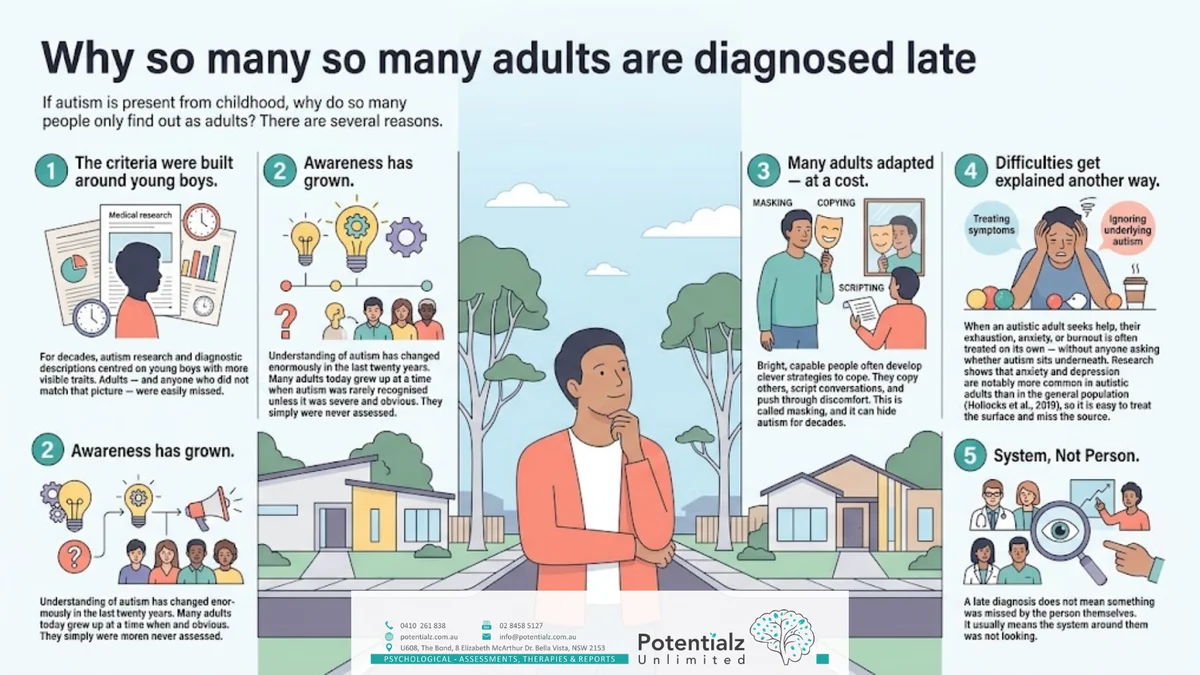
If autism is present from childhood, why do so many people only find out as adults? There are several reasons.
The criteria were built around young boys. For decades, autism research and diagnostic descriptions centred on young boys with more visible traits. Adults — and anyone who did not match that picture — were easily missed.
Awareness has grown. Understanding of autism has changed enormously in the last twenty years. Many adults today grew up at a time when autism was rarely recognised unless it was severe and obvious. They simply were never assessed.
Many adults adapted — at a cost. Bright, capable people often develop clever strategies to cope. They copy others, script conversations, and push through discomfort. This is called masking, and it can hide autism for decades.
Difficulties get explained another way. When an autistic adult seeks help, their exhaustion, anxiety, or burnout is often treated on its own — without anyone asking whether autism sits underneath. Research shows that anxiety and depression are notably more common in autistic adults than in the general population (Hollocks et al., 2019), so it is easy to treat the surface and miss the source.
A late diagnosis does not mean something was missed by the person themselves. It usually means the system around them was not looking.
Masking and camouflaging: the hidden effort
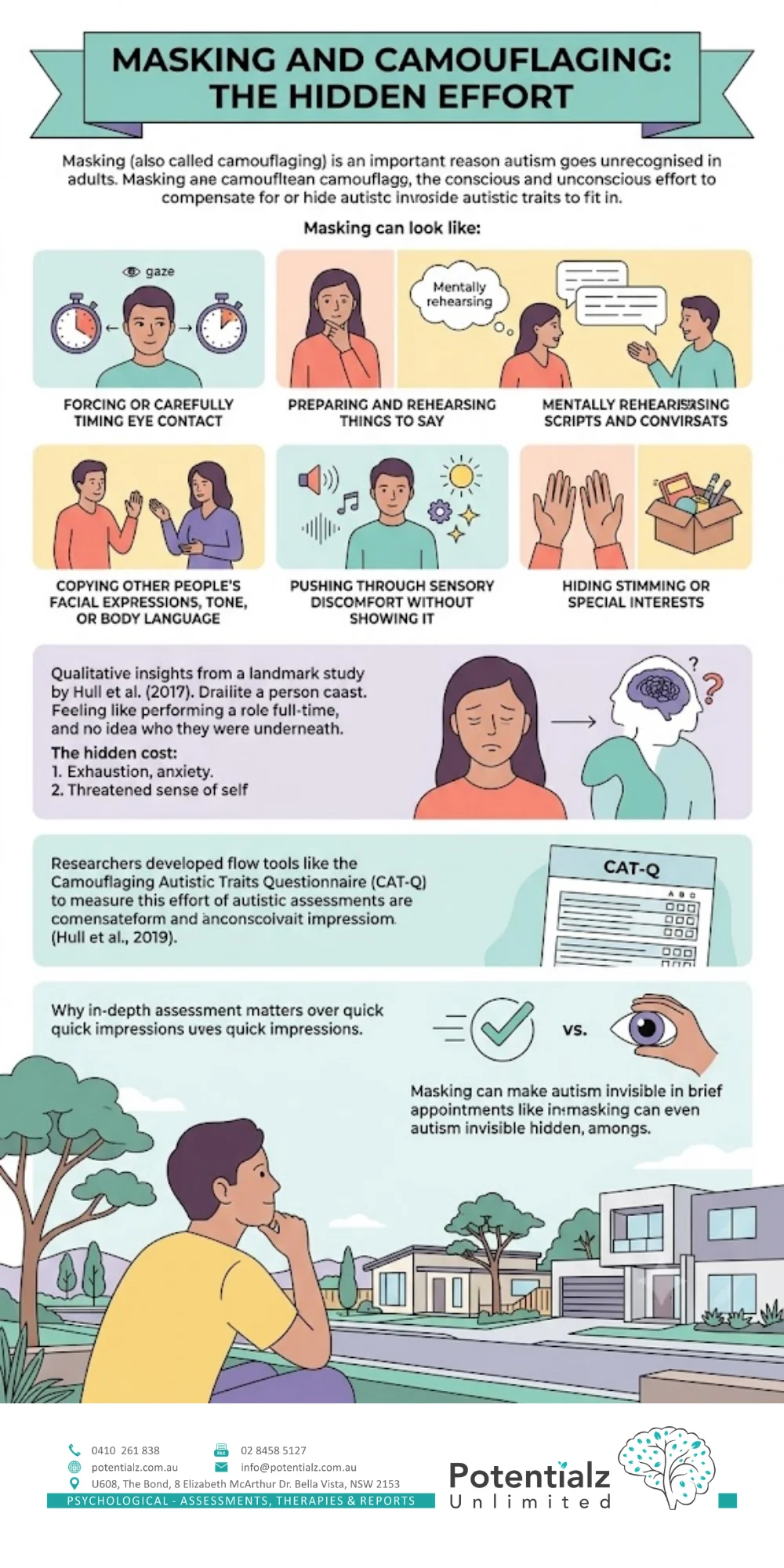
Masking (also called camouflaging) is one of the most important reasons autism goes unrecognised in adults. It describes the conscious and unconscious effort to compensate for or hide autistic traits in order to fit in.
Masking can look like:
- Forcing or carefully timing eye contact
- Preparing and rehearsing things to say before a conversation
- Copying other people’s facial expressions, tone, or body language
- Pushing through sensory discomfort without showing it
- Hiding stimming (self-soothing movements) or special interests
In a landmark qualitative study, Hull and colleagues (2017) described masking as a combination of compensation and masking strategies — and found that the consequences included exhaustion, anxiety, and a threatened sense of self. People described feeling like they were performing a role full-time, with no idea who they were underneath.
Researchers have since developed tools such as the Camouflaging Autistic Traits Questionnaire (CAT-Q) to measure this effort (Hull et al., 2019). Crucially, masking can make autism almost invisible in a brief appointment — which is exactly why a careful, in-depth assessment matters more than a quick impression.
How autism can present in women
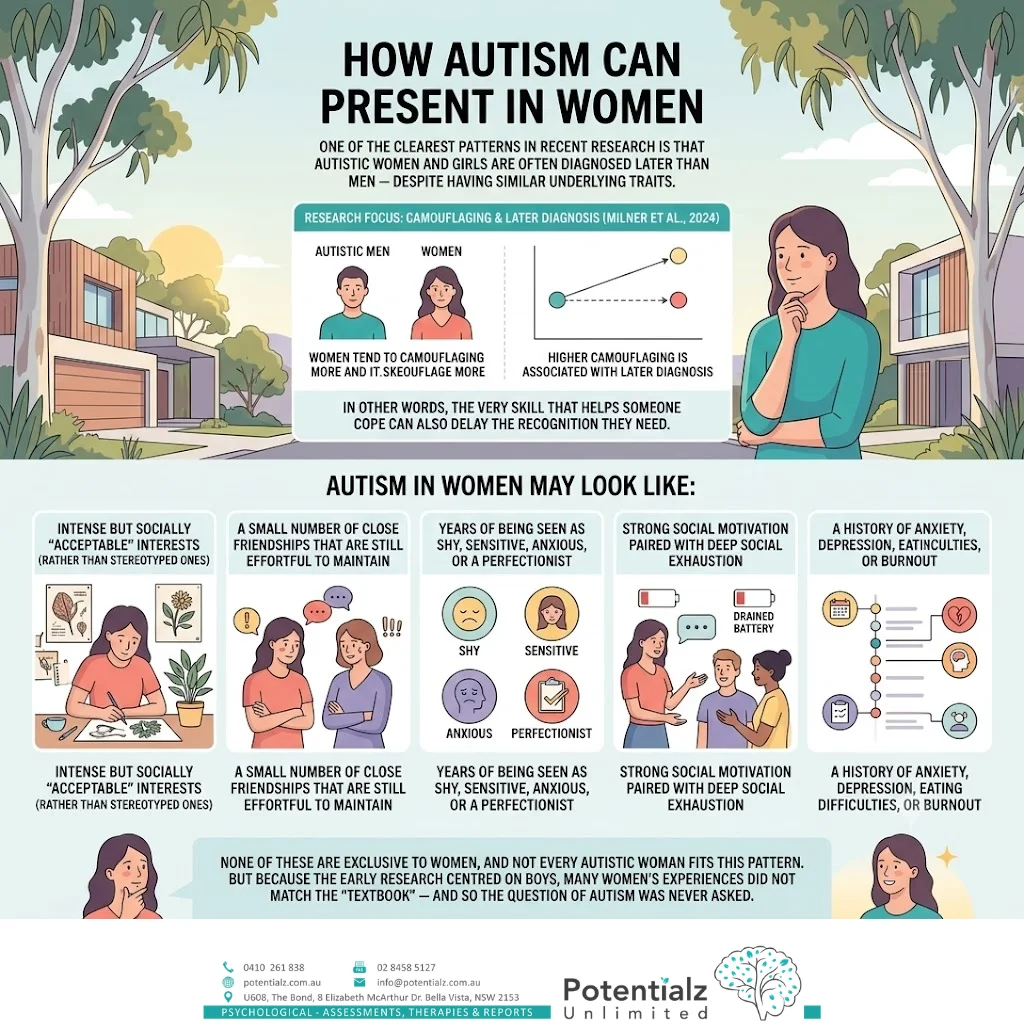
One of the clearest patterns in recent research is that autistic women and girls are often diagnosed later than men — despite having similar underlying traits.
Milner and colleagues (2024) examined whether camouflaging predicts age at diagnosis, comparing autistic men and women. They found that women tend to camouflage more, and that higher camouflaging was associated with later diagnosis. In other words, the very skill that helps someone cope can also delay the recognition they need.
Autism in women may look like:
- Intense but socially “acceptable” interests (rather than stereotyped ones)
- A small number of close friendships that are still effortful to maintain
- Years of being seen as shy, sensitive, anxious, or a perfectionist
- Strong social motivation paired with deep social exhaustion
- A history of anxiety, depression, eating difficulties, or burnout
None of these are exclusive to women, and not every autistic woman fits this pattern. But because the early research centred on boys, many women’s experiences did not match the “textbook” — and so the question of autism was never asked.
Signs adults notice in themselves
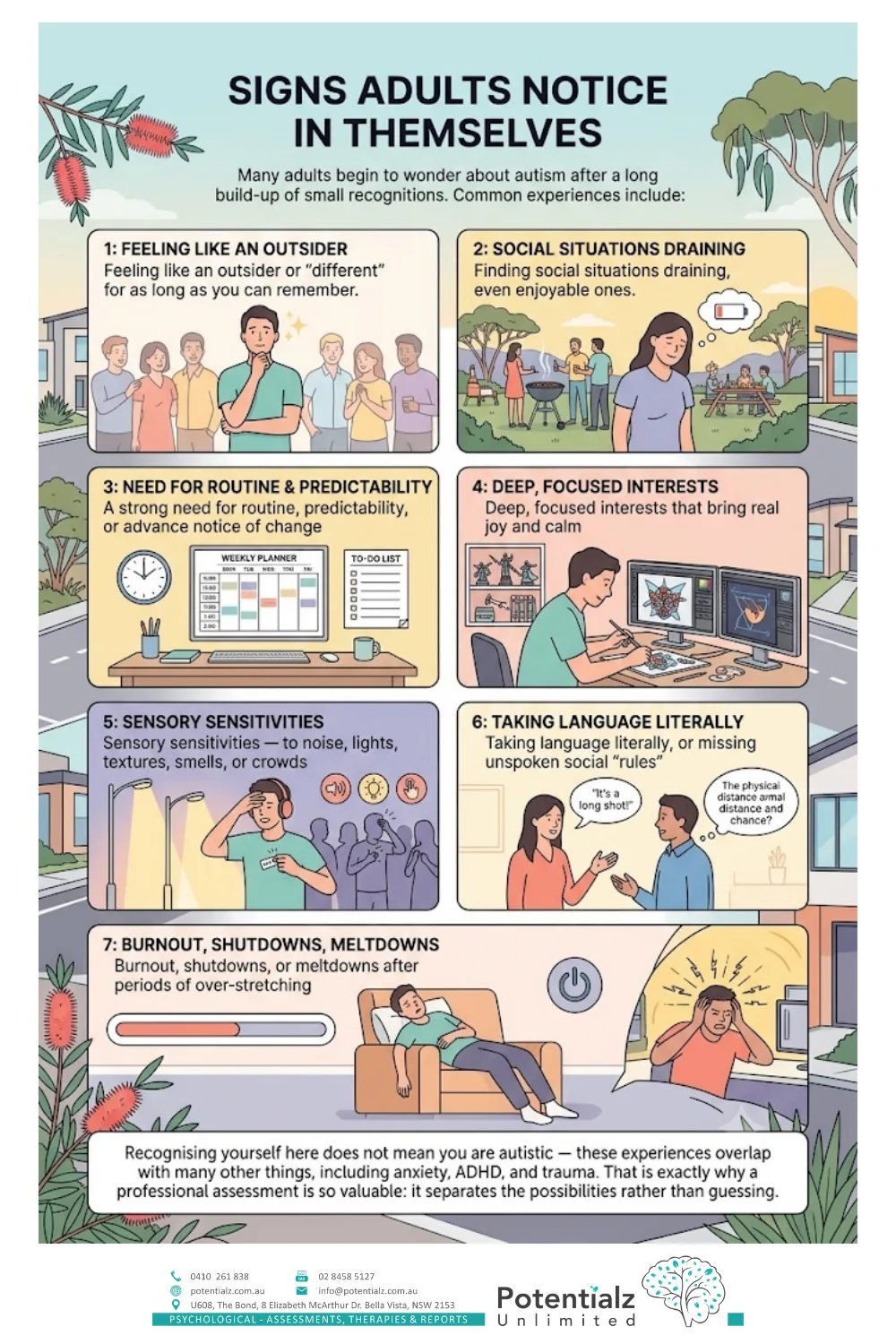
Many adults begin to wonder about autism after a long build-up of small recognitions. Common experiences include:
- Feeling like an outsider or “different” for as long as you can remember
- Finding social situations draining, even enjoyable ones
- A strong need for routine, predictability, or advance notice of change
- Deep, focused interests that bring real joy and calm
- Sensory sensitivities — to noise, lights, textures, smells, or crowds
- Taking language literally, or missing unspoken social “rules”
- Burnout, shutdowns, or meltdowns after periods of over-stretching
Recognising yourself here does not mean you are autistic — these experiences overlap with many other things, including anxiety, ADHD, and trauma. That is exactly why a professional assessment is so valuable: it separates the possibilities rather than guessing.
What an adult autism assessment involves
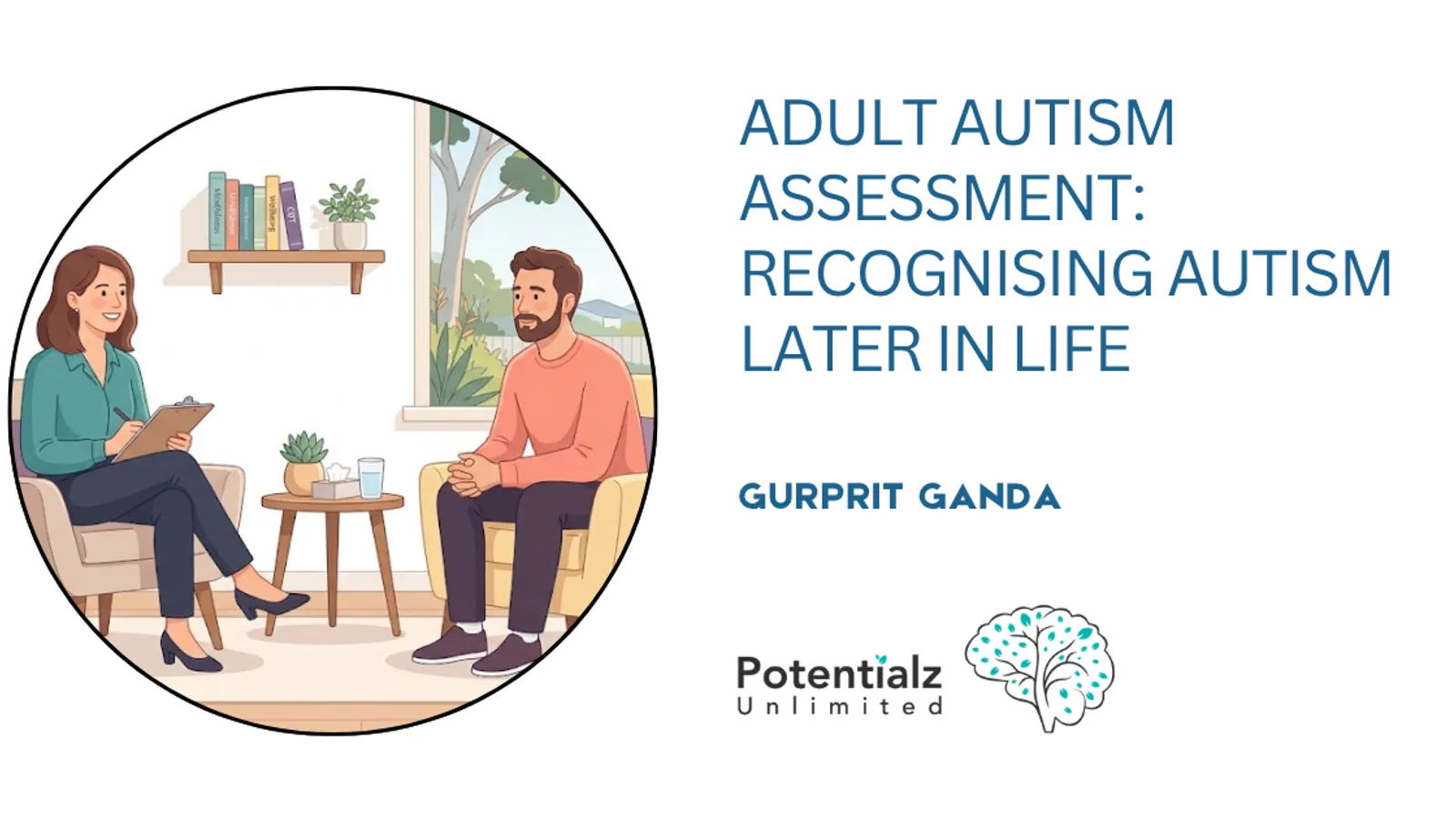
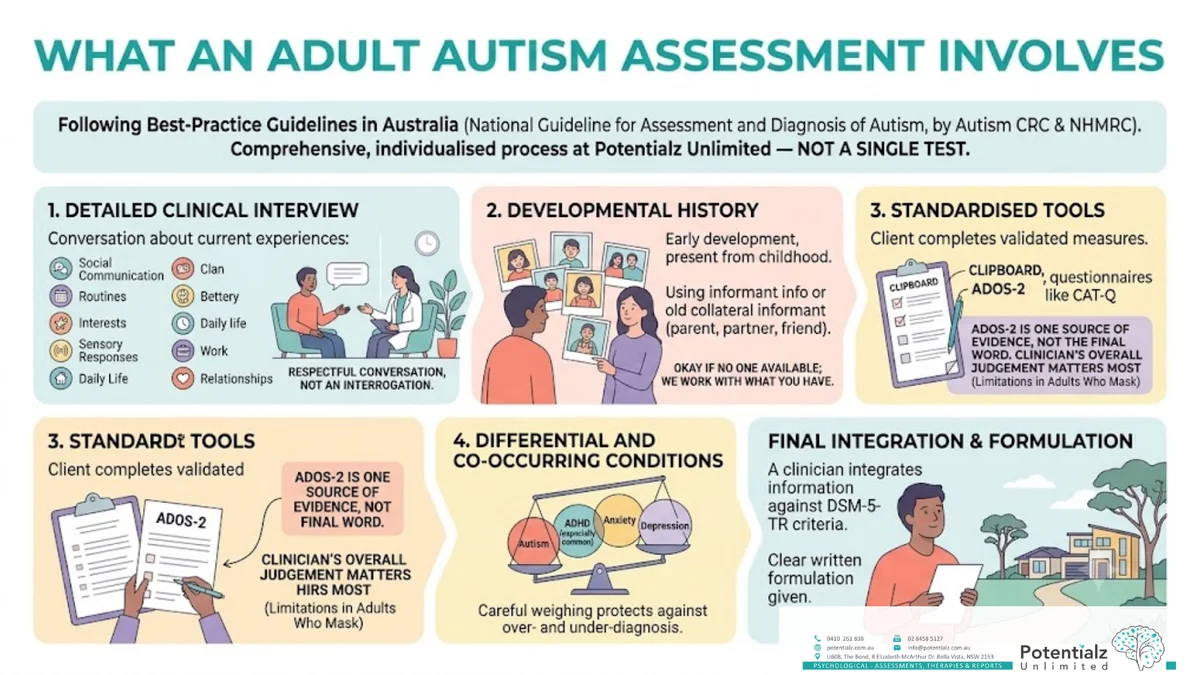
In Australia, best-practice assessment follows the National Guideline for the Assessment and Diagnosis of Autism, developed by the Autism CRC and approved by the National Health and Medical Research Council (NHMRC). The guideline emphasises a comprehensive, individualised assessment — not a single test. A thorough adult autism assessment at Potentialz Unlimited usually includes the following.
1. A detailed clinical interview. We talk through your current experiences across social communication, routines, interests, sensory responses, and the impact on daily life, work, and relationships. This is a respectful conversation, not an interrogation.
2. A developmental history. Because autism is present from childhood, we explore your early development. Where possible, this includes information from someone who has known you a long time — a parent, partner, or close friend (a collateral informant). Old school reports or photos can help. If no one is available, that is okay; we work with what you have.
3. Standardised tools. We use validated measures, which may include the Autism Diagnostic Observation Schedule, Second Edition (ADOS-2) — a structured, internationally recognised tool — alongside questionnaires such as the CAT-Q. Importantly, the ADOS-2 is treated as one source of evidence, not the final word. It has known limitations in adults who mask well, which is why the clinician’s overall judgement matters most.
4. Differential and co-occurring conditions. Autism often sits alongside other things — ADHD is especially common, and anxiety and depression frequently co-occur (Hollocks et al., 2019). We also consider whether another explanation fits better. This careful weighing is what protects against both over- and under-diagnosis.
Finally, the clinician integrates everything against the DSM-5-TR criteria and gives you a clear, written formulation — what was found, what it means, and what comes next.
What a diagnosis can offer
For many adults, a diagnosis is not about a label. It is about understanding.
- Self-understanding and self-compassion. A lifetime of “why am I like this?” finally has a kinder answer. Many people describe relief and a softening of years of self-blame.
- Better mental health care. When anxiety or depression is treated without recognising autism, therapy can miss the mark. Knowing the full picture lets treatment address masking, sensory overload, and burnout — not just the symptoms on top.
- Practical adjustments. A diagnosis can support reasonable adjustments at work or study, and help you design a life that fits how your brain actually works.
- Connection. Many adults find community and belonging among other autistic people for the first time.
A diagnosis is a beginning, not an endpoint. Whether or not you choose to pursue formal assessment is a personal decision, and there is no single right answer.
Support after a diagnosis
Recognition is the first step; what follows is just as important. Support after an adult autism diagnosis can include:
- Psychological therapy adapted for autistic adults — focused on burnout, anxiety, identity, relationships, and unmasking safely
- Practical strategies for sensory needs, routines, and energy management
- Workplace or study adjustments and, where relevant, written recommendations
- Connecting with autistic-led communities for peer understanding
You can read more about managing overwhelm in our guide on navigating the meltdown, and about sensory needs in our article on sensory integration therapy.
Adult autism assessment in Bella Vista and the Hills District
At Potentialz Unlimited in Bella Vista, we provide neurodiversity-affirming adult autism assessments for clients across the Hills District — including Norwest, Castle Hill, Baulkham Hills, Kellyville, Rouse Hill, and Glenwood. We know that walking into an assessment as an adult can feel daunting, so our approach is unhurried, respectful, and led by your experience.
Dr Gurprit Ganda is a Clinical Psychologist with over 25 years of experience and offers sessions in English, Hindi, Punjabi, and Urdu. Assessments draw on the Autism CRC national guideline and the DSM-5-TR, with careful attention to masking and the ways autism can present in women and in adults who have spent a lifetime adapting.
How to get assessed
Getting started is simple:
- Get in touch. Call 0410 261 838 or contact us to ask any questions. There is no pressure to commit.
- Book an initial appointment. Book online at live.potentialz.com.au or over the phone. A GP referral is not required to begin, though it can help with some funding pathways.
- Complete the assessment. We will explain each step in advance, including the clinical interview, developmental history, and any standardised tools.
- Receive your results. You will get a clear written report and a feedback session, plus guidance on support and next steps.
If you have spent years wondering whether autism explains your experience, an assessment can give you a real answer — and a way forward. You can explore our autism assessment service or reach out whenever you are ready.
References
- American Psychiatric Association. (2022). Diagnostic and statistical manual of mental disorders (5th ed., text rev.). https://doi.org/10.1176/appi.books.9780890425787
- Hollocks, M. J., Lerh, J. W., Magiati, I., Meiser-Stedman, R., & Brugha, T. S. (2019). Anxiety and depression in adults with autism spectrum disorder: A systematic review and meta-analysis. Psychological Medicine, 49(4), 559–572. https://doi.org/10.1017/S0033291718002283
- Hull, L., Mandy, W., Lai, M.-C., Baron-Cohen, S., Allison, C., Smith, P., & Petrides, K. V. (2019). Development and validation of the Camouflaging Autistic Traits Questionnaire (CAT-Q). Journal of Autism and Developmental Disorders, 49(3), 819–833. https://doi.org/10.1007/s10803-018-3792-6
- Hull, L., Petrides, K. V., Allison, C., Smith, P., Baron-Cohen, S., Lai, M.-C., & Mandy, W. (2017). “Putting on my best normal”: Social camouflaging in adults with autism spectrum conditions. Journal of Autism and Developmental Disorders, 47(8), 2519–2534. https://doi.org/10.1007/s10803-017-3166-5
- Milner, V., Colvert, E., Hull, L., Cook, J., Ali, D., Mandy, W., Happé, F., & Hallett, V. (2024). Does camouflaging predict age at autism diagnosis? A comparison of autistic men and women. Autism Research, 17(3), 626–636. https://doi.org/10.1002/aur.3059
- Trembath, D., Varcin, K., Waddington, H., Sulek, R., Bent, C., Ashburner, J., Eapen, V., Goodall, E., Hudry, K., Roberts, J., Silove, N., & Whitehouse, A. (2023). National guideline for the assessment and diagnosis of autism in Australia (2nd ed.). Autism CRC. https://www.autismcrc.com.au/best-practice/assessment-and-diagnosis
Related Reading
Knowledge Check Quiz
Test what you have just read. Choose your answer for each question, then submit to reveal the answers and your score.
Need Professional Support?
If you're experiencing mental health concerns, our team is here to help.