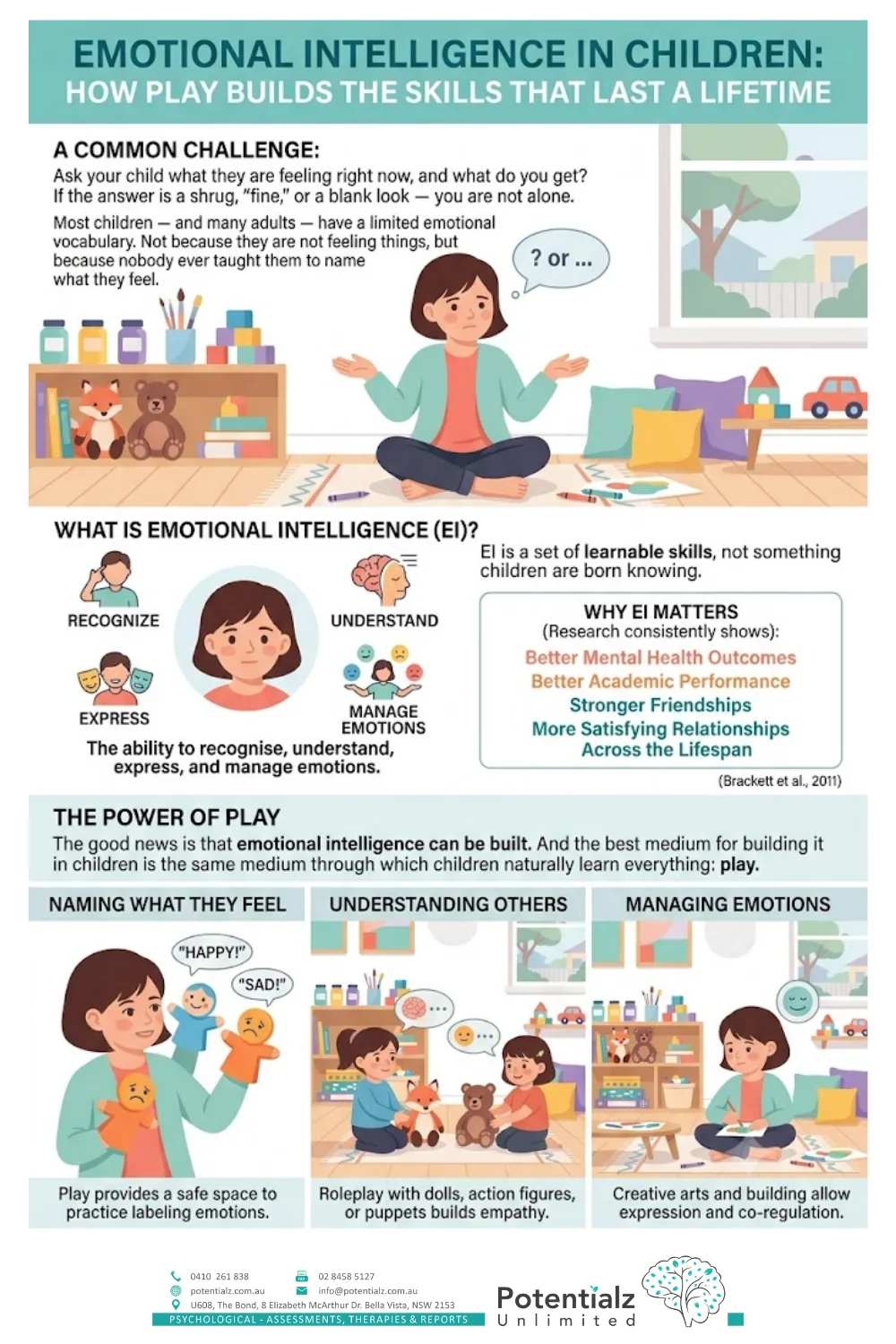
Ask your child what they are feeling right now, and what do you get? If the answer is a shrug, “fine,” or a blank look — you are not alone. Most children — and many adults — have a limited emotional vocabulary. Not because they are not feeling things, but because nobody ever taught them to name what they feel.
Emotional intelligence — the ability to recognise, understand, express, and manage emotions — is not something children are born knowing. It is a set of learnable skills. And the research on why these skills matter is remarkably consistent: children with stronger emotional intelligence have better mental health outcomes, better academic performance, stronger friendships, and more satisfying relationships across the lifespan (Brackett et al., 2011).
The good news is that emotional intelligence can be built. And the best medium for building it in children is the same medium through which children naturally learn everything: play.
What Emotional Intelligence Actually Means
The term “emotional intelligence” was popularised by psychologist Daniel Goleman, who identified five key domains: self-awareness, self-regulation, motivation, empathy, and social skills (Goleman, 1995). In the context of children, these domains are often discussed in terms of:
Emotional literacy — the ability to identify and name one’s own emotions and the emotions of others. “I feel angry” rather than “I feel bad.” “She looks sad” rather than “she looks weird.”
Emotional regulation — the ability to manage the intensity and expression of emotions. Not suppression (which tends to amplify), but the capacity to tolerate a feeling without being overwhelmed by it, and to choose how to express it.
Empathy — the ability to recognise and share the feelings of another person. This requires both cognitive perspective-taking (“what is this person experiencing?”) and affective resonance (“I can feel something of what they feel”).
Social awareness and skills — understanding social contexts, reading cues, navigating relationships, managing conflict, and repairing ruptures. These are the same capacities that underpin children’s friendships and social skills.
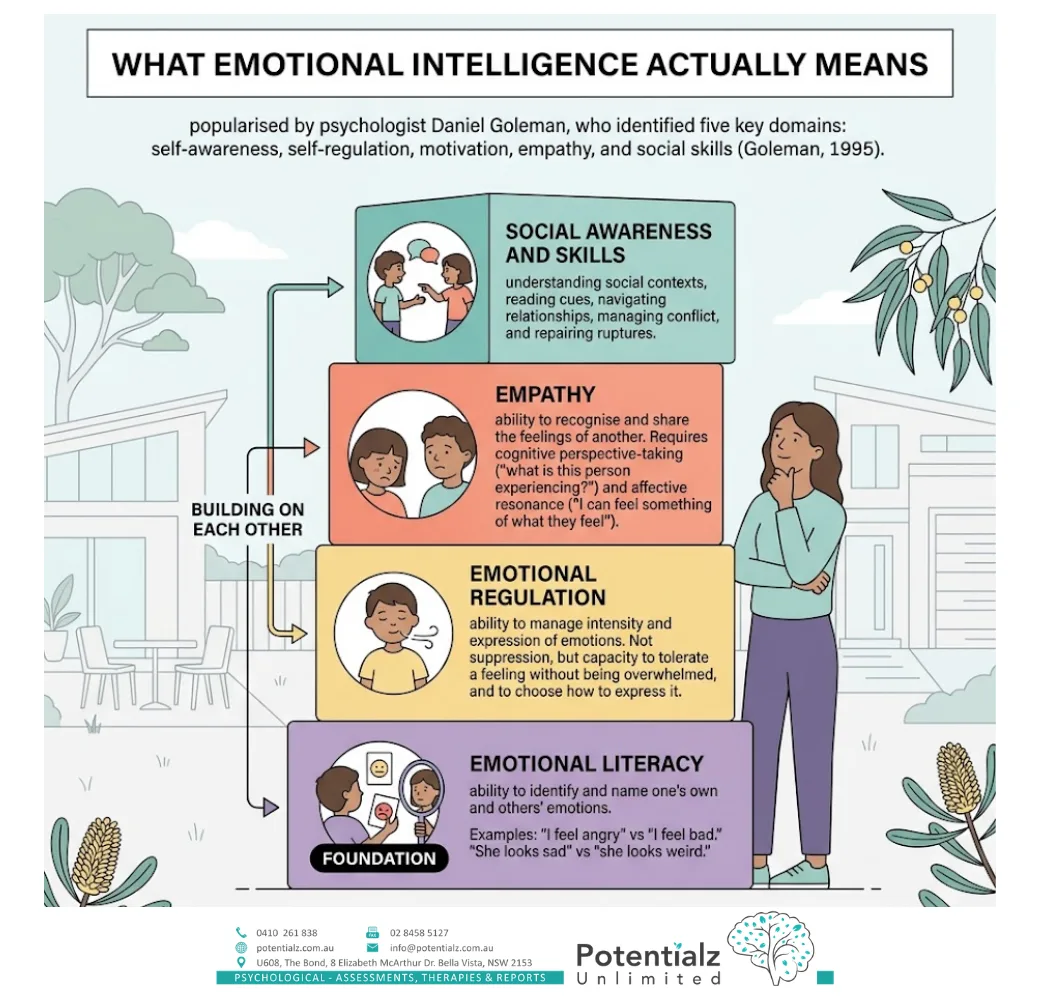
These capacities build on each other. A child cannot regulate what they cannot name. A child cannot empathise with others if they have no access to their own emotional experience. Emotional literacy is the foundation on which all other emotional intelligence capacities are built.
Why Many Children Lack Emotional Vocabulary
If emotional intelligence is so important, why do so many children (and adults) have so little access to it?
The answer is cultural as much as developmental. Many families and school environments have not historically prioritised the explicit development of emotional vocabulary. Emotions that are inconvenient, messy, or uncomfortable — anger, fear, sadness, jealousy — are often managed through suppression, redirection, or minimisation rather than naming and exploration.
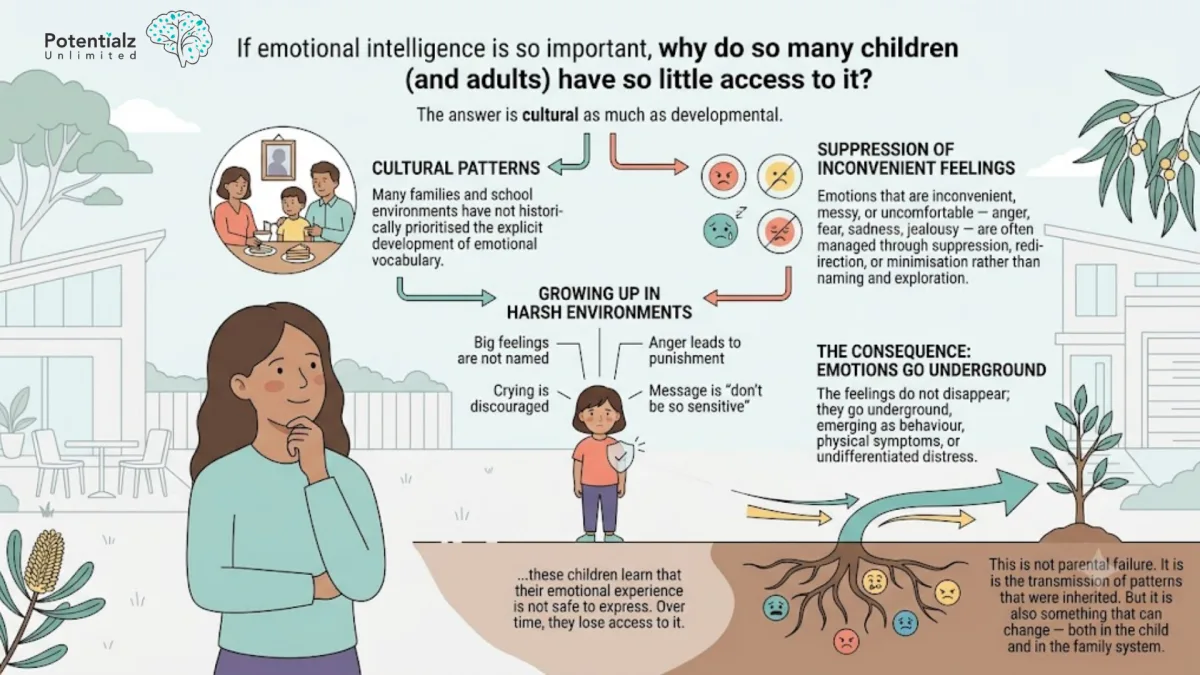
Children who grow up in environments where big feelings are not named, where crying is discouraged, where anger leads to punishment, or where the message is “don’t be so sensitive” — these children learn that their emotional experience is not safe to express. Over time, they lose access to it. The feelings do not disappear; they go underground, emerging as behaviour, physical symptoms, or undifferentiated distress.
This is not parental failure. It is the transmission of patterns that were inherited. But it is also something that can change — both in the child and in the family system.
How Play Naturally Builds Emotional Intelligence
Play is the primary medium through which children develop emotional intelligence — and this is not accidental. Play provides a safe, low-stakes environment in which children can:
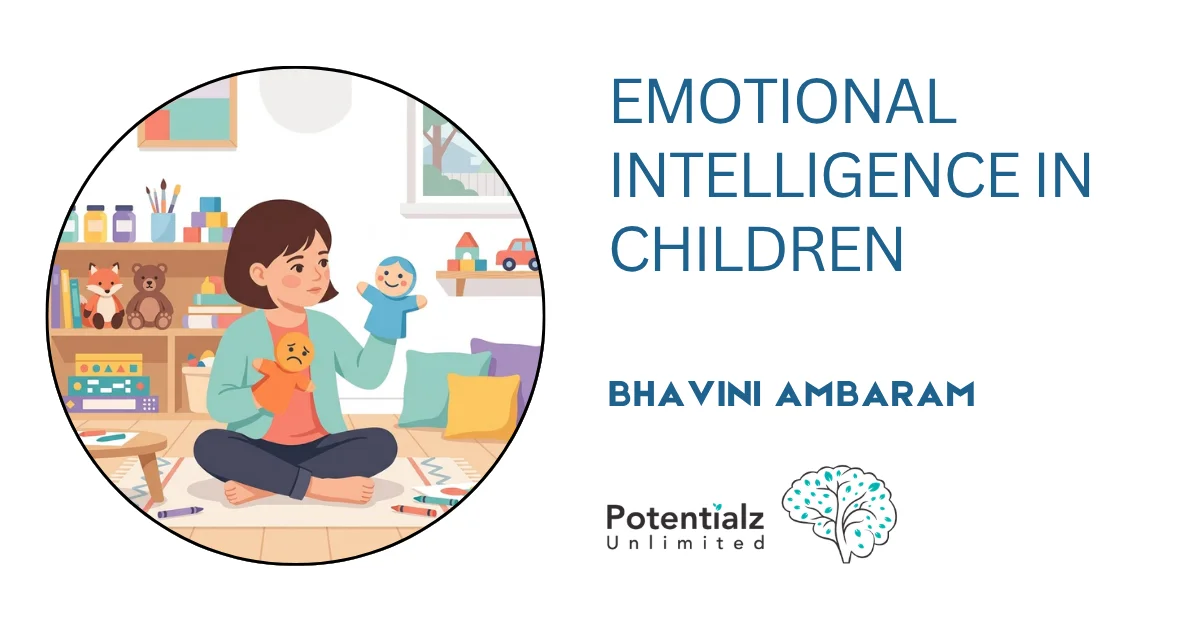
Practise naming feelings. When a child plays with puppets or figurines, they give those characters emotional lives. “This one is angry because the other one took his food.” “This character is sad and doesn’t know how to tell her mum.” In naming the feelings of characters, children develop the capacity to name their own.
Explore emotional complexity. In play, children can explore the full range of human emotion — including the complicated, contradictory, or socially “unacceptable” emotions that they could not express directly. A child who feels angry and ashamed about a parent’s illness can play out those feelings through characters, in a context where it is safe.
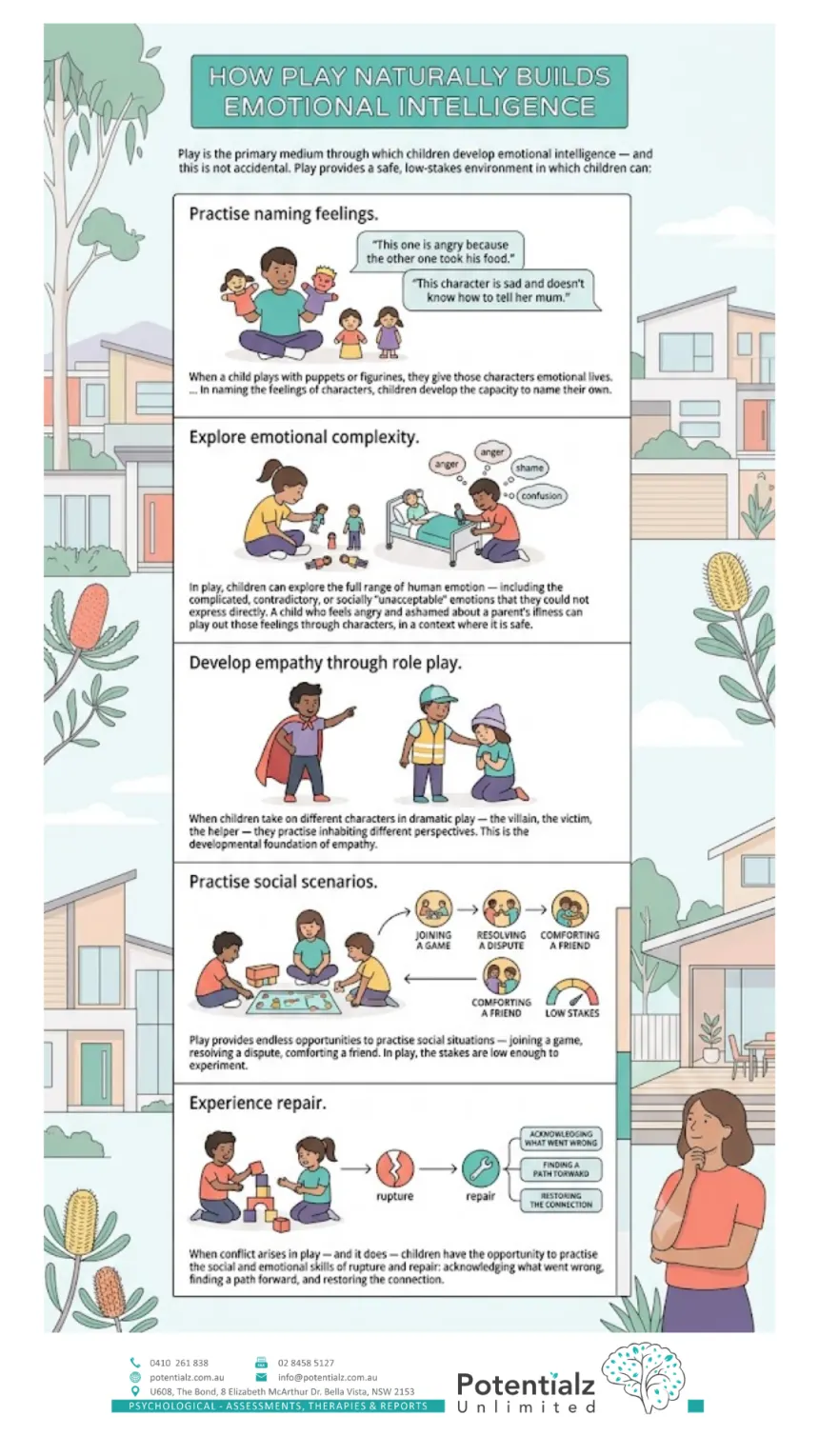
Develop empathy through role play. When children take on different characters in dramatic play — the villain, the victim, the helper — they practise inhabiting different perspectives. This is the developmental foundation of empathy.
Practise social scenarios. Play provides endless opportunities to practise social situations — joining a game, resolving a dispute, comforting a friend. In play, the stakes are low enough to experiment.
Experience repair. When conflict arises in play — and it does — children have the opportunity to practise the social and emotional skills of rupture and repair: acknowledging what went wrong, finding a path forward, and restoring the connection.
What Therapeutic Play Does Specifically
In therapeutic play sessions at Potentialz Unlimited, the development of emotional intelligence is not a separate curriculum or a specific agenda. It emerges from the quality of the therapeutic relationship and the richness of the play experience.
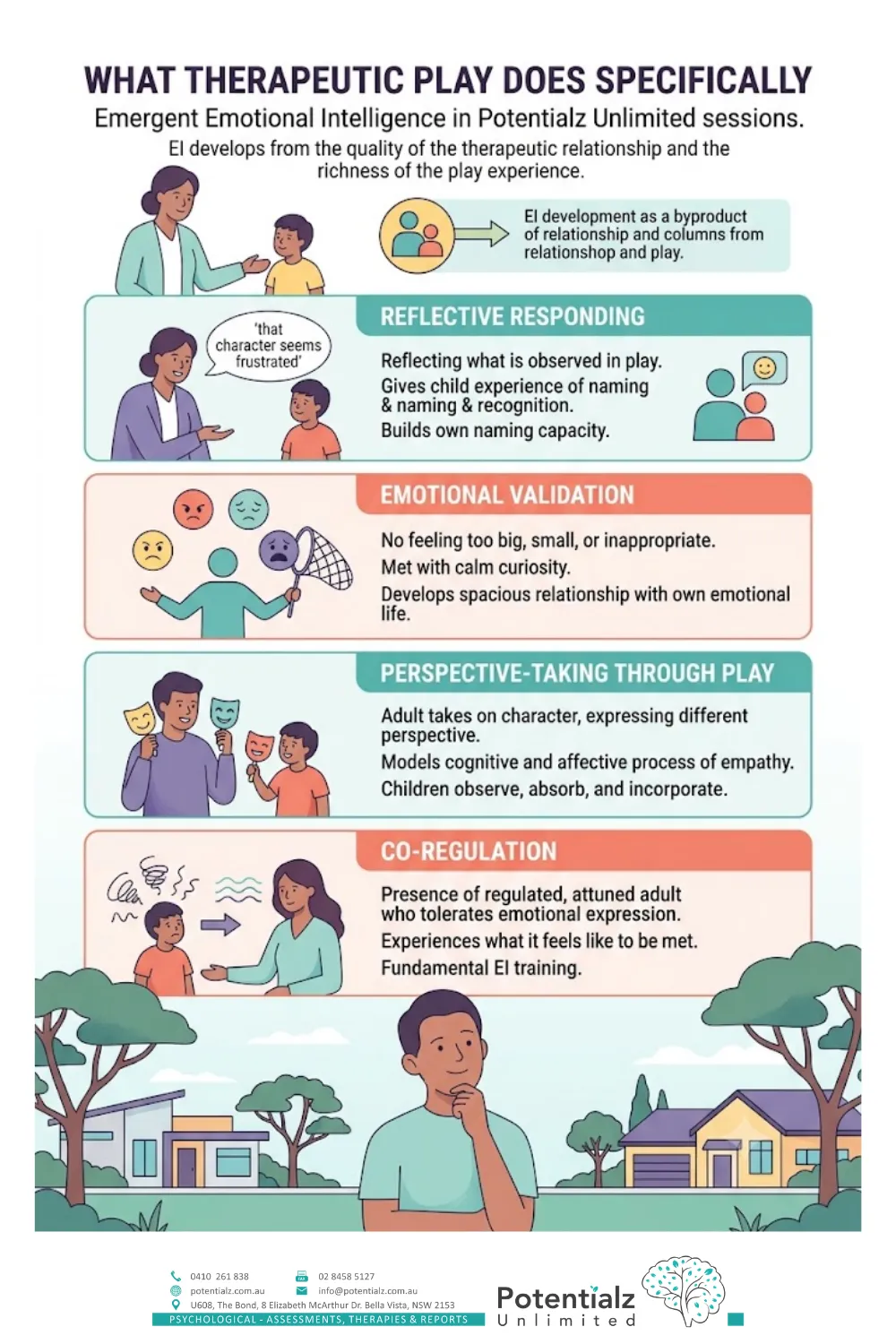
As a Practitioner in Therapeutic Play, I create the conditions in which emotional intelligence can develop:
Reflective responding. When I reflect back what I observe in a child’s play — “that character seems really frustrated right now” — I am giving the child the experience of having their emotional experience named and recognised. Over many repetitions, this builds the child’s own capacity to name what they feel.
Emotional validation. In the therapy room, there is no feeling that is too big, too small, or inappropriate. Anger, jealousy, sadness, fear — all are met with calm curiosity rather than correction. Children who experience their feelings being received rather than rejected begin to develop a more spacious relationship with their own emotional life.
Perspective-taking through play. When I take on a character in play and express a different emotional perspective, I am modelling the cognitive and affective process of empathy. Children observe, absorb, and gradually incorporate this capacity.
Co-regulation. Perhaps most fundamentally, the consistent experience of being in the presence of a regulated, attuned adult who can tolerate and respond to the child’s emotional expression — rather than shutting it down — is itself an emotional intelligence training. The child experiences what it feels like to be met.
How LEGO® Based Therapy Builds Empathy and Perspective-Taking
LEGO® Based Therapy is particularly well-suited to developing empathy and perspective-taking — two of the most central components of emotional intelligence.
The three-role structure (Engineer, Supplier, Builder) requires each child to track not just their own task but the experience of the others in the group. When the Builder is confused, the Engineer needs to adjust their communication. When the Supplier cannot find the right piece, the group problem-solves together. When something goes wrong and a child feels frustrated, the group navigates the repair.
These moments — when they are facilitated thoughtfully — are some of the richest emotional intelligence learning experiences available. They are real, they matter, and they happen in real time with real peers.
I have observed many children make significant gains in their capacity to read social cues, adjust their communication style, and manage frustration in group LEGO® sessions. The learning is embodied and experiential — not taught, but lived.
What Parents Can Do at Home
The most powerful thing parents can do to build emotional intelligence in their children is to name emotions — their own and their child’s — consistently and without judgment.
Name your own feelings out loud. “I feel a bit stressed about this traffic. I’m going to take a breath.” This models emotional vocabulary and shows the child that feelings are nameable, manageable, and survivable.
Name your child’s feelings without pressure to change them. “It looks like you’re feeling really disappointed about that.” Full stop. Not “but it’s okay, we can do it another time.” The validation first, the solution (if needed) later.
Read books that explore emotional complexity. Children’s literature is one of the most powerful tools for emotional literacy development. Books with characters who experience and navigate complex feelings — anger, jealousy, loneliness, grief — expand a child’s emotional vocabulary and normalise a wide range of experience. If your child is navigating especially big feelings, naming them together is a powerful first step.
Be curious about emotional life rather than corrective. “What were you feeling when that happened?” rather than “You shouldn’t feel that way.” The goal is not to fix the feeling but to make it visible.
Repair after your own emotional moments. When you have a moment of dysregulation — as all parents do — repair it with your child. “I raised my voice and I shouldn’t have. I was feeling overwhelmed. I’m sorry.” This models both emotional honesty and repair.
Key Takeaways
- Emotional intelligence — including emotional literacy, self-regulation, empathy, and social skills — is learnable, not fixed
- Many children have limited emotional vocabulary not because they don’t feel things, but because explicit emotional development has not been prioritised
- Play is the primary medium through which children develop emotional intelligence — providing safe, low-stakes opportunities to name, explore, and practise
- In therapeutic play sessions, emotional intelligence develops through reflective responding, validation, perspective-taking in play, and the experience of co-regulation
- LEGO® Based Therapy specifically builds empathy and perspective-taking through its structured social role framework
- The single most powerful thing parents can do at home is name emotions — their own and their child’s — consistently and without judgment
How Potentialz Can Help
At Potentialz Unlimited in Bella Vista, I work with children aged 3–12 to build emotional literacy, self-regulation, empathy, and social skills through therapeutic play. Whether your child is struggling with a specific emotional difficulty or simply needs support to develop the emotional capacities that will serve them throughout life, therapeutic play provides the ideal medium. When a family also needs psychological assessment or Medicare-rebated treatment, our child psychologists in Bella Vista step in for that part of care, so your child gets the right clinician for each piece of the work. If you are unsure which is the better starting point, our guide on choosing between a play therapist and a child psychologist can help.
You can contact the clinic or book directly at live.potentialz.com.au. We are at Unit 608/8 Elizabeth Macarthur Drive, Bella Vista NSW 2153, open Monday to Friday, 10am–7pm, with Saturday, after-hours, and telehealth appointments available. Call 0410 261 838.
References
Brackett, M. A., Rivers, S. E., & Salovey, P. (2011). Emotional intelligence: Implications for personal, social, academic, and workplace success. Social and Personality Psychology Compass, 5(1), 88–103. https://doi.org/10.1111/j.1751-9004.2010.00334.x
Goleman, D. (1995). Emotional intelligence: Why it can matter more than IQ. Bantam Books.
Landreth, G. L. (2012). Play therapy: The art of the relationship (3rd ed.). Routledge.
Ray, D. C. (2011). Advanced play therapy: Essential conditions, knowledge, and skills for child practice. Routledge.
Siegel, D. J., & Bryson, T. P. (2012). The whole-brain child: 12 revolutionary strategies to nurture your child’s developing mind. Delacorte Press.
AHPRA Disclaimer: This information is general in nature. Please consult a qualified health professional for individual advice. Bhavini Ambaram is a Practitioner in Therapeutic Play (PTUK/PTSA accredited), not an AHPRA-registered psychologist; her therapeutic play work sits alongside, not in place of, psychological diagnosis or treatment.
Crisis Resources: If you or someone you know needs support, please contact Lifeline on 13 11 14, Beyond Blue on 1300 22 4636, or Kids Helpline on 1800 55 1800.
Knowledge Check Quiz
Test what you have just read. Choose your answer for each question, then submit to reveal the answers and your score.
Need Professional Support?
If you're experiencing mental health concerns, our team is here to help.