Key Takeaways
- The WISC-V — Wechsler Intelligence Scale for Children, Fifth Edition — is the current standard for individually administered cognitive assessment in children aged roughly 6 to 16 years. It is the child counterpart to the WAIS (which is for ages 16+) and the WPPSI (which is for younger children, roughly 2 years 6 months to 7 years 7 months).
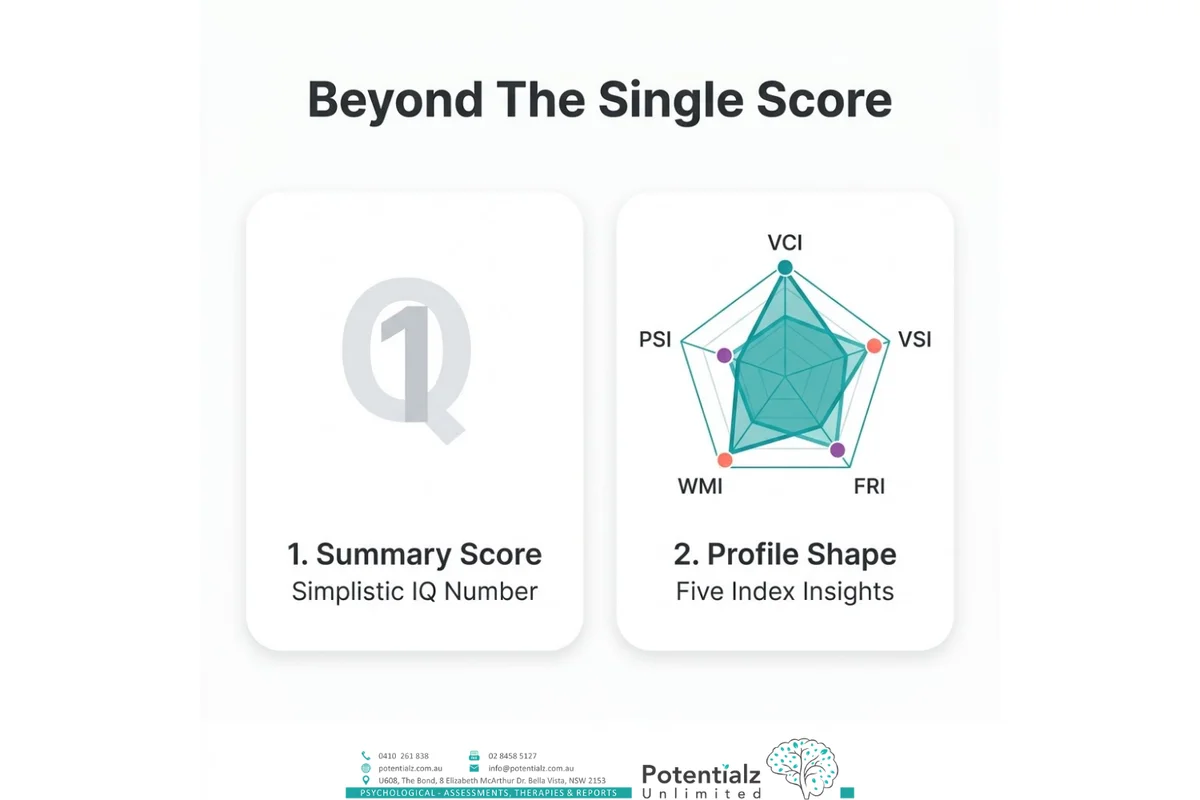
- The WISC-V does not tell you whether your child is “smart”. It gives you a detailed profile of how your child currently reasons, remembers, processes visual information, and works under time pressure — a profile with clinical and educational uses that a single IQ number can never capture.
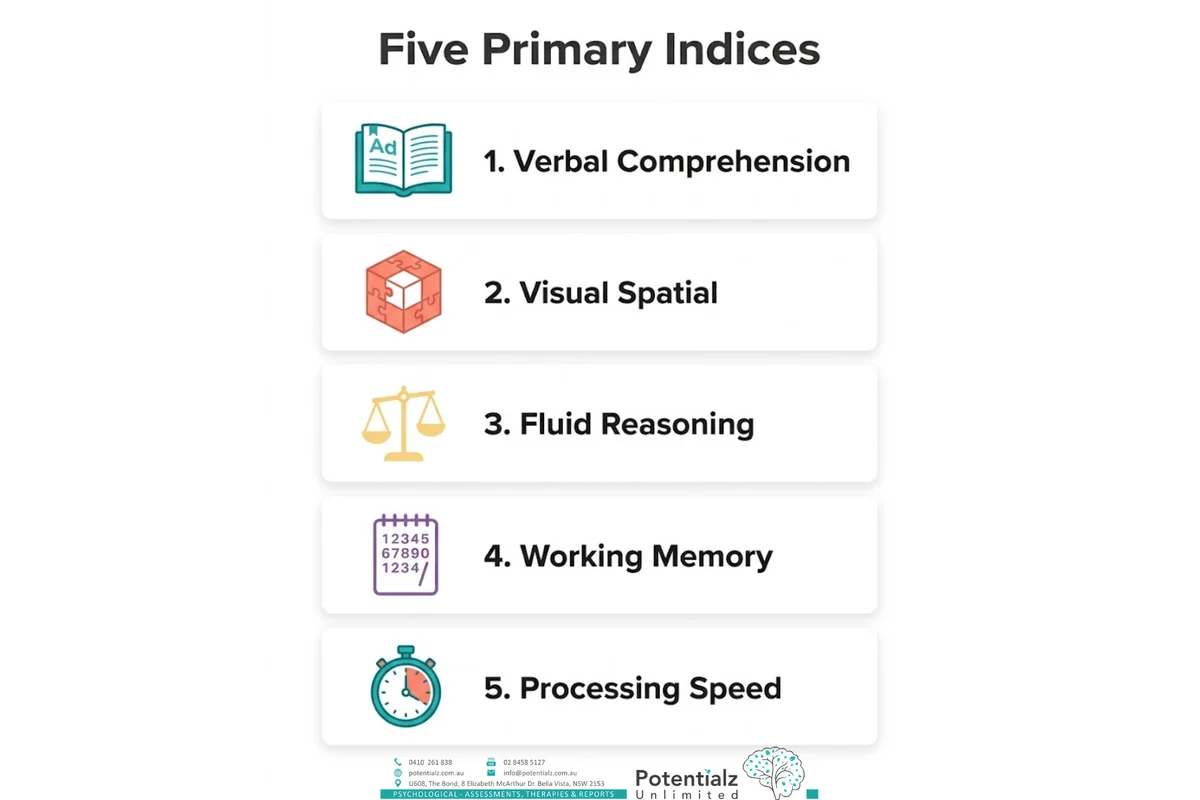
- The five primary index scores in the WISC-V are Verbal Comprehension, Visual Spatial, Fluid Reasoning, Working Memory, and Processing Speed. These five indices are where the clinically useful information about your child’s cognitive shape actually lives.
- Parents commonly consider a WISC-V when a child is struggling at school in a way that does not add up, when a diagnostic question (ADHD, autism, specific learning disorder, intellectual disability, giftedness) needs cognitive profiling to make sense of it, when NDIS evidence is being gathered, or when accommodations or educational placement decisions are on the table.
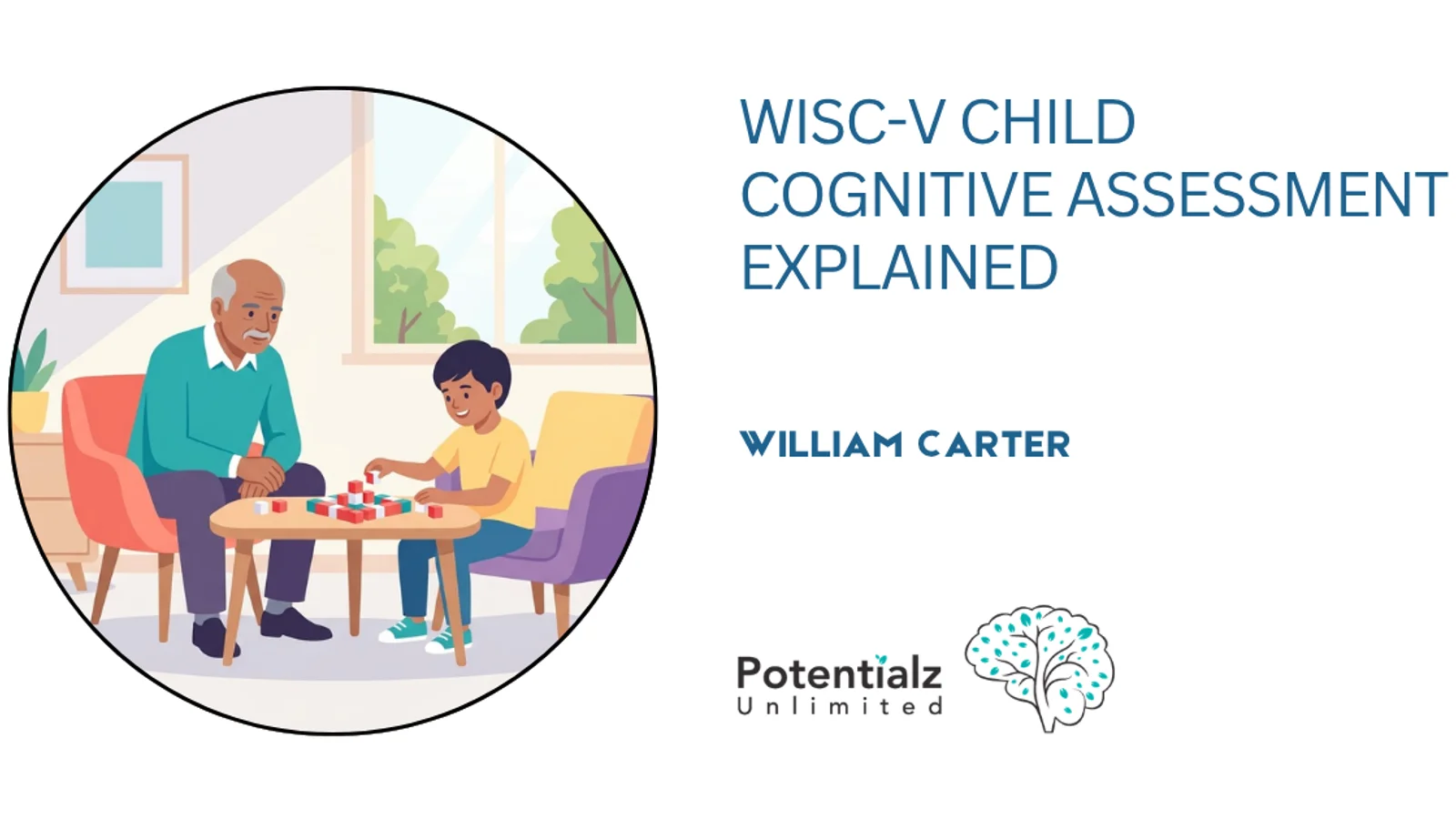
- A WISC-V is administered one-to-one by a qualified psychologist, usually over about three hours, sometimes split across two sessions. The child sits in a quiet room with the psychologist and works through a series of tasks — some verbal, some visual, some memory-based, some speed-based.
- A WISC-V is a snapshot, not a verdict. Cognitive scores in children are affected by tiredness, mood, anxiety, medication, hearing, vision, cultural and linguistic factors, and the child’s rapport with the assessing clinician. A good report holds those factors in view. Scores describe how your child worked on the day — they do not define who your child is.
- At Potentialz Unlimited in Bella Vista, formal cognitive assessment for children is delivered by our senior Clinical Psychologist. The Registered Psychologist team’s role is on the therapy side — supporting families before, during, and after assessment, and delivering the therapy that a diagnosis or profile often opens the door to.
- For under-8s, or where play-based work is a better first step, the practice’s play therapist may be a better starting point than formal cognitive assessment. Reception can help triage.
Why Parents End Up Asking About the WISC
When parents ring reception to ask about a “child IQ test”, or a “cognitive assessment”, or specifically a “WISC”, they are almost never asking out of casual curiosity. Something has usually been quietly nagging for a while.
The conversations tend to sound something like this.
“He is bright at home — articulate, curious, funny — but school reports don’t reflect that at all. Something isn’t fitting together.”
“She is exhausted every night, and it’s like she is working three times as hard as the other kids just to keep up. I don’t know if that is anxiety, or attention, or something with the way her brain processes things.”
“His paediatrician has asked for a cognitive assessment as part of the ADHD workup. We don’t really know what to expect.”
“She has been recommended for gifted assessment by her teacher and we don’t know whether to pursue it.”
“He was diagnosed with a language delay at 3, has had years of speech therapy, and now at 8 we don’t really have a clear picture of where he is cognitively — the school wants one to help with planning.”
“We are trying to work out whether an NDIS application makes sense and someone has told us we’ll need a cognitive assessment as part of the evidence.”
None of those are silly questions. All of them are legitimate reasons to consider a WISC-V, and all of them come up regularly in the assessment pathway at Potentialz Unlimited.
This is a Potentialz Unlimited editorial piece drawing on the clinical experience of our team. Formal cognitive assessment for children at Potentialz is coordinated through our senior Clinical Psychologist, with the Registered Psychologist team supporting families on the therapy and family-support side of the pathway. What this post gives you is an honest explanation of what the WISC-V is, what it measures, when it helps, when it does not, and what to expect if you decide to pursue one.
What the WISC-V Actually Is
The Wechsler Intelligence Scale for Children was originally developed by David Wechsler in 1949 as a child counterpart to his earlier adult scale. It has been revised several times. The WISC-V, published in 2014 (with an Australian and New Zealand standardisation released shortly after), is the current edition, and it is the most widely used individually administered cognitive assessment for children in Australia.
The WISC-V is designed for children aged 6 years 0 months through 16 years 11 months. For younger children, the WPPSI (Wechsler Preschool and Primary Scale of Intelligence) is used. For adolescents at the older end of the WISC range, clinicians will sometimes choose the WISC-V for continuity with previous assessment or the WAIS depending on the specific referral question.
Structurally, the WISC-V has ten primary subtests and a set of additional secondary subtests, which combine to produce five primary index scores and a single Full Scale IQ. Those five indices are the substantive cognitive picture, and they are worth understanding one by one.
Verbal Comprehension. This is about your child’s ability to understand and reason with language. Subtests include Similarities (in what way are two things alike?), Vocabulary (what does this word mean?), Information (general knowledge questions), and Comprehension (understanding of social and practical situations). Verbal Comprehension gives you a sense of your child’s language-based reasoning and stored knowledge — often relatively stable and often reflecting both innate language ability and exposure to language-rich environments over the child’s life.
Visual Spatial. This is about your child’s ability to process visual information, to reason with spatial relationships, and to construct visual patterns. Subtests include Block Design (using coloured blocks to recreate a two-dimensional pattern) and Visual Puzzles (mentally assembling shapes to match a target). Visual Spatial ability underpins a range of practical and academic tasks — from geometry, to reading maps, to assembling furniture, to some aspects of mathematics.
Fluid Reasoning. This is about your child’s ability to reason with novel visual information and solve problems that don’t rely on stored knowledge. Subtests include Matrix Reasoning (completing an abstract visual pattern) and Figure Weights (balancing visual “weights” using logical inference). Fluid Reasoning is thought to reflect a core aspect of cognitive ability that is relatively independent of specific cultural or educational exposure.
Working Memory. This is about your child’s ability to hold information in mind and manipulate it — the mental scratchpad. Subtests include Digit Span (repeating strings of numbers forwards, backwards, and in ascending order) and Picture Span (recalling a sequence of pictures). Working memory difficulties are one of the most common findings in children with ADHD, and they also affect a wide range of everyday tasks — following multi-step instructions, remembering what a paragraph was about while reading the next, keeping track of a mental math calculation, remembering what the teacher just said long enough to start the task.
Processing Speed. This is about how quickly and accurately your child can take in and respond to simple visual information under time pressure. Subtests include Coding (matching symbols to numbers as quickly as possible) and Symbol Search (scanning a row for a target symbol). Low processing speed in a child with otherwise strong reasoning is one of the more common patterns in ADHD, in some specific learning disorders, and in children dealing with significant anxiety or fatigue.
Together, the five indices combine into a Full Scale IQ. And, as with the adult WAIS, the Full Scale IQ is often the least clinically useful number in the report. What matters is the shape of the profile.
Why the Profile Matters More Than the Number
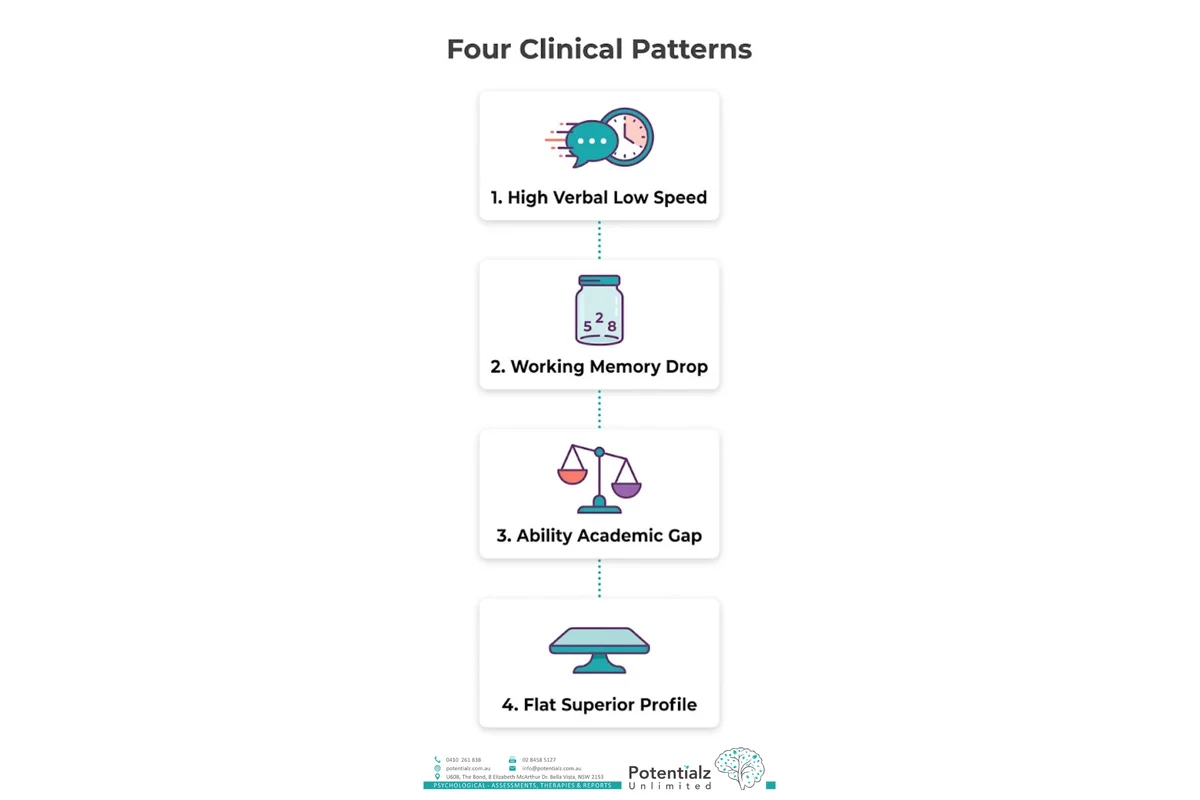
A few illustrative profile patterns and what they can point towards. These are patterns you might see discussed in cognitive assessment reports; none of them are diagnostic on their own, but they show why the profile is more useful than the summary number.
Strong verbal comprehension, low processing speed. A common pattern in bright kids who are struggling at school with speed-based tasks — timed tests, quick worksheet completion, note-taking from the whiteboard. The child appears to know the material but cannot demonstrate it fast enough on the tasks they are being marked on. This kind of profile is one of the flags clinicians pay attention to in an ADHD workup, but it can also appear in children without ADHD who have specific processing-speed differences.
Strong verbal and visual reasoning, low working memory. A child who is clearly a strong reasoner but whose working memory drags down the overall profile. Practical consequences: difficulty following multi-step verbal instructions, difficulty holding numbers in mind for mental math, difficulty tracking longer written sentences while reading. This is one of the most common patterns in ADHD in children, and it also appears in children dealing with high anxiety, poor sleep, or specific learning differences.
Significant discrepancy between verbal comprehension and academic achievement in a specific area. A big gap between a child’s cognitive ability (as measured on the WISC-V) and their academic achievement in a specific domain (as measured by an academic achievement test like the WIAT) — for example, average-to-strong cognitive ability but well-below-average reading achievement — is one of the classic findings that supports a specific learning disorder diagnosis (dyslexia in that example).
Strong non-verbal reasoning, weaker verbal comprehension in a bilingual or multilingual child. A pattern that requires careful interpretation. It may reflect an actual cognitive profile, but it may also reflect the fact that the child’s verbal comprehension is being measured in a language they are still developing. Good clinicians will hold this factor in view, may use additional assessments (such as non-verbal cognitive measures), and will interpret verbal scores with explicit acknowledgement of the linguistic context.
Flat profile, all indices in the high or superior range. Often relevant when the referral question is about giftedness, educational acceleration, or the emotional and social needs of intellectually advanced children. Giftedness assessment is a legitimate clinical use of the WISC-V, though it is important to understand that a high cognitive profile does not automatically mean a child is coping — many highly able children present clinically with anxiety, perfectionism, and social-emotional difficulties that need addressing regardless of the cognitive numbers.
Flat profile, all indices low. A profile that requires very careful interpretation and additional assessment. Depending on age, developmental history, and adaptive functioning measures (like the Vineland or ABAS), this pattern may support an intellectual disability diagnosis, or it may reflect other factors — significant developmental adversity, hearing or vision issues that have not been fully accounted for, or unusual patterns of engagement with the assessment itself. This is precisely the kind of profile that should not be interpreted in isolation.
The point is that the shape of the profile — where the strengths and weaknesses sit relative to each other — is where the useful information lives. A summary number cannot capture that shape.
When a WISC-V Genuinely Helps
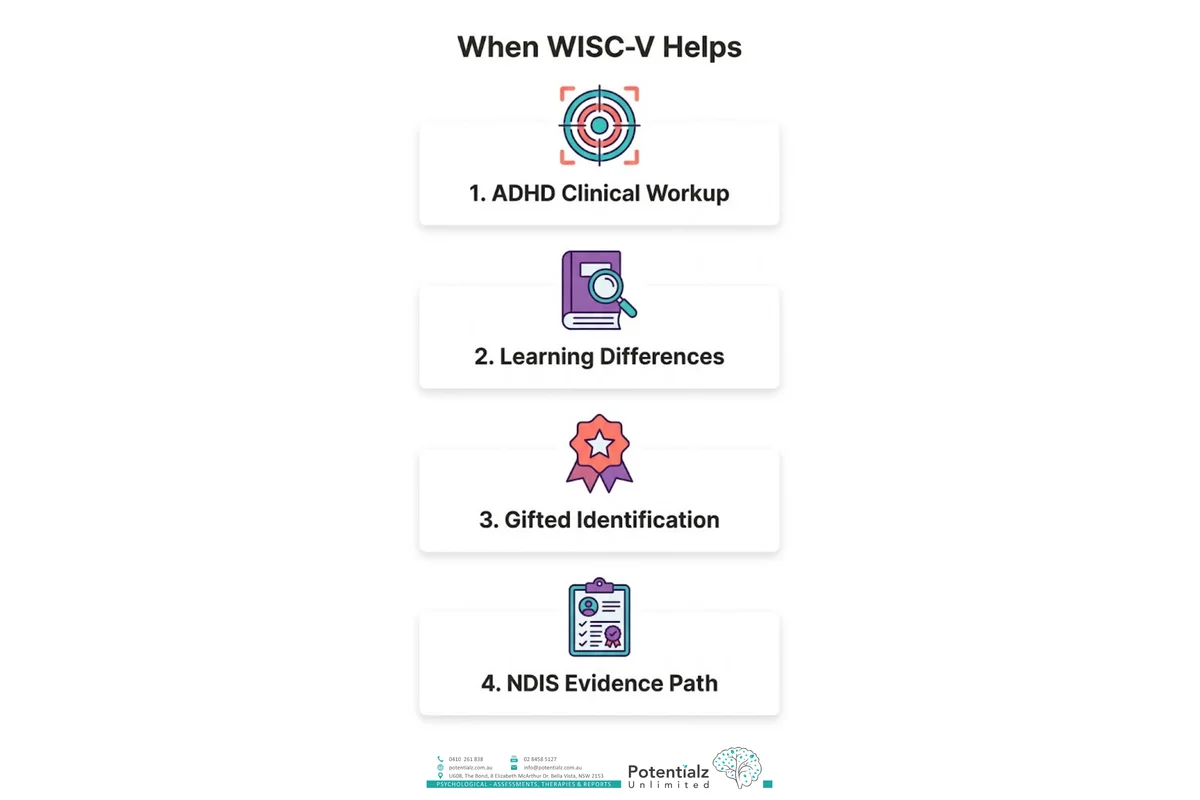
Not every struggling child needs a cognitive assessment. The practice steers families towards a WISC-V when there is a specific question it can help answer, and away from it when other work is more likely to help.
Here are the situations where a WISC-V, properly interpreted, tends to be worth the time and cost.
As part of an ADHD assessment
Adult and child ADHD assessment in Australia rests on clinical interview, developmental history, functional impact evidence, and — often — cognitive assessment. A WISC-V does not diagnose ADHD on its own. But it can help characterise cognitive strengths and weaknesses in a way that guides both diagnosis (by ruling out or flagging alternative explanations) and recommendations (by clarifying what accommodations will actually help).
At Potentialz, child ADHD assessment is coordinated through the practice. Where a WISC-V is clinically indicated, our senior Clinical Psychologist delivers it in-house. The therapy that often follows — psychoeducation for the child and family, evidence-based emotion coaching for parents, age-adapted CBT for anxiety that so often co-travels with ADHD, and ACT-based work on values, effort, and self-compassion — is delivered by the Registered Psychologist team.
As part of a specific learning disorder assessment
A specific learning disorder assessment — for suspected dyslexia, dyscalculia, or dysgraphia — typically requires both a cognitive assessment (like the WISC-V) and an academic achievement assessment (like the WIAT). The key finding is a significant discrepancy between cognitive ability and academic achievement in a specific domain, in a child whose difficulties are not better explained by intellectual disability, visual or auditory impairment, or lack of educational opportunity.
At Potentialz, assessment work of this kind is coordinated through the senior Clinical Psychologist. The wider team frequently talks with parents about whether such an assessment is the right next step, and about what will happen with the report once it exists (specific learning disorder findings often lead to school-based supports, accommodations, and specific literacy or numeracy interventions).
As part of an intellectual disability assessment
Intellectual disability assessment requires both a cognitive assessment and an adaptive functioning assessment (Vineland or ABAS), interpreted in the context of developmental history. A WISC-V is one part of that picture. This is not the kind of assessment to pursue on a whim — it has significant implications for eligibility for various supports and for the child’s own developing self-understanding — and it is worth having a careful conversation about whether this assessment is the right next step before booking.
As part of a giftedness assessment
Some children are assessed for cognitive giftedness for educational placement decisions, for entry to specific programmes, or because parents and teachers are trying to understand a highly able child whose social-emotional life has become difficult. The WISC-V is often the tool used. A high cognitive profile is real and worth naming; it also does not, on its own, tell you what a highly able child actually needs. Many gifted children have significant emotional intensity, perfectionism, social difficulties, or existential concerns that need therapy support regardless of the cognitive numbers.
For NDIS evidence
Where a family is applying for NDIS support and cognitive functioning is relevant to eligibility or plan development, a formal cognitive assessment is often part of the evidence pathway. The NDIS has specific requirements for the assessments it will accept. A WISC-V delivered by a qualified psychologist and interpreted alongside adaptive functioning measures can be part of that evidence.
The specifics of NDIS evidence requirements shift, and a phone conversation with reception before booking is usually the best way to make sure the assessment plan will give you what you need.
For educational placement or accommodation decisions
Some schools request formal cognitive assessment to inform placement decisions, differentiated teaching plans, or accommodations (extra time on exams, note-taking support, workload modification). A WISC-V is often part of that evidence base. It is worth checking with the specific school what they will accept and how they will use it before booking.
When something does not add up and you need a clinical clarifier
Sometimes a child’s presentation is genuinely puzzling and a careful cognitive profile is what allows the treating team to make sense of what is going on. This can be particularly relevant when the child has been under many services, has multiple partial diagnoses, or has been difficult to formulate. A well-done assessment can pull threads together.
When to consider a professional assessment. If any of the pathways above match your situation — an ADHD or learning-disorder question, NDIS evidence gathering, giftedness clarification, school-based accommodations, or a puzzling picture that needs pulling together — that is the point at which a phone call to reception, or a preliminary conversation with a clinician, is worth the time.
When a WISC-V Is Not the Right Next Step
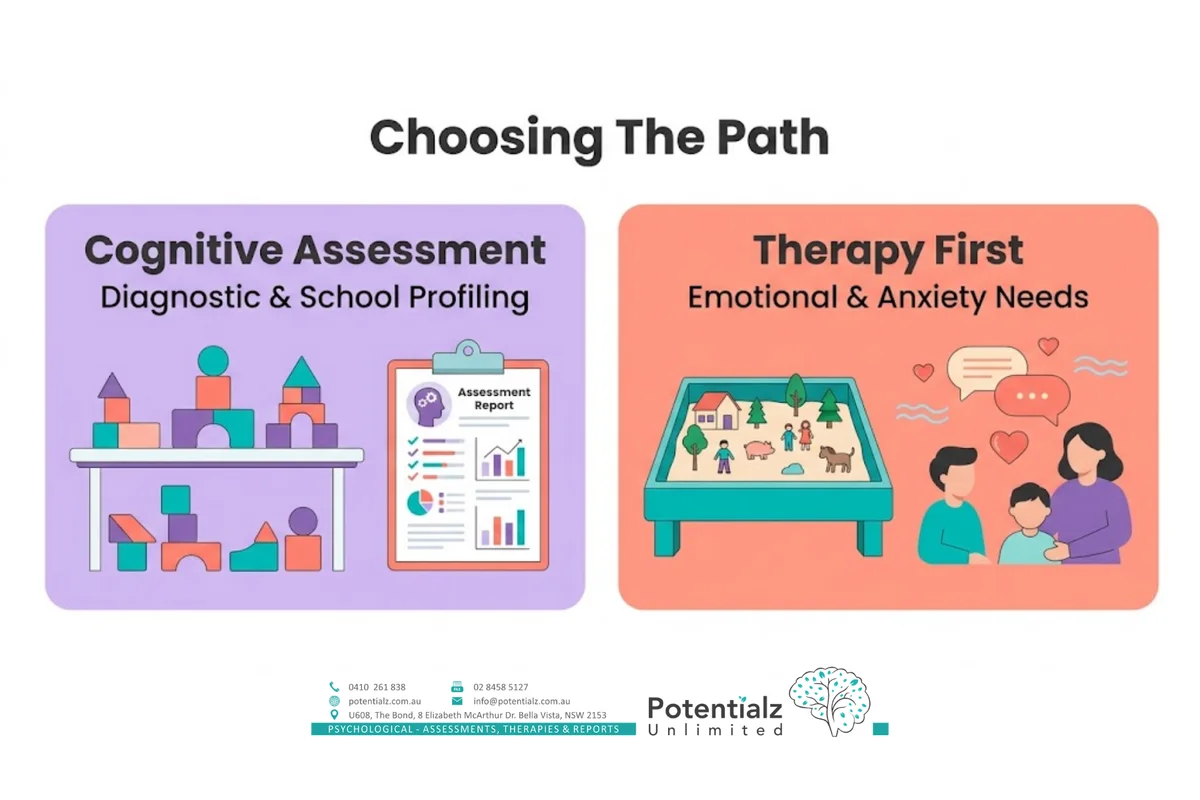
Equally honest about when we would gently steer a family away from a WISC-V, at least as the first step.
When the primary need is emotional regulation, anxiety, or family-relational work. A WISC-V will not treat these difficulties. Therapy will. If your child’s presenting concern is primarily emotional or behavioural in a way that does not seem to involve a cognitive question, therapy is a better first investment. Depending on age and presentation, that might be play therapy with the practice’s play therapist (usually for under-8s and for children who work better in a play-based frame), or age-adapted psychology work with the Registered Psychologist team (usually for 8+ children who can hold a therapeutic conversation). See our related post Play Therapist Bella Vista vs Child Psychologist: Which Does Your 8-Year-Old Need?.
When the child is in the middle of a major upheaval. A WISC-V administered during a family crisis, a school transition crisis, or a significant mental health episode will reflect the child’s current state and may under-represent their usual cognitive functioning. Sometimes it makes sense to stabilise first and assess later.
When cost or timing means the assessment will strain the family. A cognitive assessment is a significant investment. If the timing means it will disrupt other important priorities without a clear payoff, that is worth a conversation. Sometimes the answer is “yes, but not this month”.
When the referral question is vague. If you find yourself thinking “I want to get her tested so I know what’s going on” without a clearer picture of what specific question the testing is meant to answer, a preliminary conversation with a clinician is often more useful than jumping straight to assessment. Sometimes the conversation itself is the intervention.
For very young children, in most cases. For children under 6, the WISC-V is not the appropriate tool — the WPPSI is. And for very young children, formal cognitive assessment often adds less clinical value than a good developmental picture built through history, observation, and specific developmental screening. Play therapy is often a much richer starting point for young children whose presentation is emotional or developmental rather than clearly cognitive.
What a WISC-V Session Actually Looks Like for a Child
Because parents often worry about how their child will experience the assessment, here is an honest walk-through.
Before the day. You will typically have a preliminary intake conversation with the assessing clinician — reason for referral, developmental history, current functioning at home and school, any prior assessments, medications, sensory or health issues, family context. This is not administrative; it is what makes the eventual interpretation clinically useful.
The clinician will usually give you specific advice about preparing your child. This often includes: giving a simple, age-appropriate explanation (“you’re going to do some puzzles and games with a psychologist who helps us understand how you learn best”), avoiding over-preparation or coaching, ensuring a good night’s sleep, a proper breakfast, and appropriate medication (including any ADHD medication that the child normally takes on school days).
On the day. The assessment usually runs for about three hours, sometimes split into two shorter sessions if fatigue is likely to affect performance. The child sits in a quiet room with the assessing psychologist. Parents typically wait in the reception area — occasionally a parent is briefly in the room for a very young or anxious child, but this is exceptional and can affect the standardisation.
Bring your child’s glasses if they wear them, hearing aids if they use them, and any medication they would normally take on a school day. Bring a snack. Some clinicians will build in a break; some prefer to push through with the child’s agreement.
What the child experiences. The subtests are varied. Some are conversational — the psychologist asks the child questions (“in what way are an apple and a banana alike?”) and records the answers. Some are visual — the child uses coloured blocks to recreate patterns, or works with picture puzzles. Some involve memory — the child hears a sequence of numbers and repeats them back, forwards, then backwards, then in ascending order. Some are speed-based — the child matches symbols to numbers as quickly and accurately as possible for a couple of minutes.
Most children find some subtests easier and some harder. That is by design. Every subtest is calibrated to reach the child’s ceiling — so at some point every child will be working on tasks that feel genuinely difficult. This is not a failure. It is how the assessment locates the ceiling.
The clinician gives standardised instructions and cannot give substantive feedback during the assessment (that would compromise standardisation), but they are warm and encouraging within the constraints, and they use small breaks, praise for effort, and rapport-building throughout.
After the day. Scoring, interpretation, and report writing take real time. A good WISC-V report is a synthesis of the numbers, the child’s developmental history, the parent report, teacher input where relevant, the clinician’s observations during the assessment, and the specific clinical question that prompted the referral. Expect a written report and a feedback session where the assessing clinician walks the parents (and sometimes the child, depending on age and appropriateness) through the findings and answers questions.
The feedback session is often the most valuable part of the process. Come with questions written down.
Talking to Your Child About a Cognitive Assessment
This is a question that comes up in almost every intake, and it matters. Here is what we usually suggest to parents.
Keep the explanation simple, honest, and age-appropriate. For a younger primary-school child, something like: “You’re going to spend some time with a psychologist who helps us understand how your brain works best. You’ll do some puzzles, some talking, some games. There’s no way to fail — every kid finds some parts easy and some parts trickier, and that’s how we learn about them.”
Do not oversell it, and do not undersell it. Do not pitch it as “a fun day out” (it’s not — it’s a three-hour cognitive task) but also do not pitch it as scary or evaluative in a way that raises anxiety. Frame it as a helpful piece of work that will make it easier for the adults around the child to support them well.
Avoid over-preparation. Do not coach your child on the specific tasks. The WISC-V is a standardised assessment and its interpretation depends on the child having not been specifically prepared for the tasks. Reading widely, playing puzzle games, and having a rested and well-fed child are all fine; drilling on the actual subtests is not.
Explain what will happen with the results. Depending on age, this might be: “Afterwards, the psychologist will write us a report, and we’ll all sit down together to talk about what she noticed. Then we’ll figure out together whether anything needs to change to make school (or home) work better for you.”
Handle any anxious child with care. For an anxious child, additional preparation might include a preliminary visit to the practice to see the room and meet the receptionist, honest acknowledgement of the difficulty (“some bits will feel hard — that’s okay, the psychologist knows”), and clear reassurance that the results will be shared with the child in a way that helps rather than judges.
How to Read a WISC-V Report
If you have a WISC-V report in front of you, here is what to pay attention to.
Read the referral question first. A good report will restate why the child was referred. Findings are only meaningful in relation to the question.
Look at the five primary index scores, not just the Full Scale IQ. The Full Scale IQ is a summary that can obscure clinically important variation. Where the indices vary substantially, the Full Scale IQ is arguably not a useful summary at all.
Look at percentile ranks, not just standard scores. A percentile rank tells you what proportion of same-aged Australian children scored at or below that level. A percentile rank of 50 is exactly average for age. A percentile rank of 84 corresponds to a standard score of 115 (one standard deviation above the age-based mean).
Look at the qualitative observations. A good report includes observations about the child’s approach to the tasks, effort, attention, mood, anxiety, and social presentation. These observations are often as important as the numbers.
Look at the recommendations. The report should end with concrete, specific recommendations tied to the child’s profile and the referral question. Generic recommendations are a red flag.
Look at the caveats. A good report will explicitly acknowledge any factors that may have affected the assessment — fatigue, anxiety, cultural or linguistic factors, medication, the child’s engagement. These caveats matter because they shape how much weight to place on specific findings.
If the report you have received is short, generic, or purely numerical, you are entitled to ask for a fuller feedback conversation. Numbers without interpretation are of limited use.
The WISC-V and School — Working With the Report
One of the practical uses of a WISC-V is to inform how a child is supported at school. That handover between assessment and school can be handled well or badly. Here is what tends to work.
Share the report with the school with the parents’ active involvement. This is not a hand-off. Parents should read the report carefully, understand its findings, discuss any confusion with the assessing clinician, and go into the school meeting knowing what they want from the school.
Focus on what the profile means for teaching and support, not on the numbers themselves. Most classroom teachers are not psychometricians, and a conversation about “how does she learn best” is often more useful than a conversation about “what is her Full Scale IQ”.
Ask the school what specific supports are available and appropriate. Depending on the school and the finding, this might include: differentiated teaching in specific areas, small-group intervention (for literacy or numeracy in a specific learning disorder finding), extra time or reduced task volume, note-taking support, use of assistive technology (text-to-speech, speech-to-text), sensory or movement breaks, specific accommodations for exams and standardised testing.
Set up a review point. A good school-family plan is not set-and-forget. Agree on a point at which the plan will be reviewed — often at the end of a term, or at the transition between year levels — and what the criteria for success will be.
Involve the child appropriately. Depending on age, the child should be involved in some of this conversation. It is their brain and their school life. Being a passive object of adult discussion is rarely helpful.
The Common Myths — Cleared Up
Some of the same myths that surround adult IQ testing show up in child cognitive assessment too. Worth addressing them honestly.
“IQ is fixed.” Not exactly. A well-done WISC-V is a reasonably stable measure of current cognitive functioning in a child without significant health, developmental, or life factors affecting them. Test-retest reliability is high. But children’s cognitive scores can shift meaningfully over time in response to interventions, in response to changes in health or medication, in response to significant improvements or deteriorations in their environment, and simply as a function of ongoing development.
“An IQ score predicts how well a child will do in life.” No. Cognitive scores correlate with certain educational and occupational outcomes at a population level. They do not predict the life of an individual child. Motivation, mental health, relationships, opportunity, family circumstance, resilience, and specific interests contribute vastly more to how a child’s life actually unfolds.
“A high IQ means my child will be fine.” No. Many highly able children present clinically with anxiety, perfectionism, social difficulties, existential concerns, and — sometimes — a real sense of loneliness that comes from being cognitively out-of-step with peers. High cognitive ability is a resource, not a solution.
“A low IQ score means my child cannot learn.” No. Cognitive scores describe current functioning against a population norm; they do not determine capacity for learning, meaningful relationships, contribution, or a full life. Every child can learn; the assessment helps us work out how best to support them.
“IQ tests are biased and meaningless.” Historically, some IQ measures had significant validity issues, particularly around cultural bias. Contemporary Wechsler scales have been developed with attention to cultural fairness and are normed against representative populations. But cultural and linguistic factors still matter, and a WISC-V administered to a child for whom English is a second or third language, or who grew up in a very different cultural context, needs to be interpreted with those factors explicitly held in view. Good clinicians do this. Poor reports do not. Ask.
“The Full Scale IQ is the number that matters.” As above — the Full Scale IQ is a summary. The profile is where the clinically useful information lives.
A Word on Language — “Intelligence” and What the WISC-V Is Really Measuring
The word “intelligence” is doing a lot of work, and it is worth pausing on when we are talking about children.
What the WISC-V actually measures is a set of specific cognitive functions — verbal comprehension, visual-spatial reasoning, fluid reasoning, working memory, processing speed — that are useful predictors of certain kinds of academic functioning. It does not measure creativity, emotional intelligence, kindness, curiosity, courage, or artistic ability. It does not measure who your child is or who they will become.
A WISC-V is a useful tool for a specific clinical purpose. It is not a report card on your child as a person. Hold the report at the right altitude. Use it for what it is genuinely good for. Do not let it become a lens through which your child sees themselves as any smaller than they are.
This is something we try to say explicitly to families in feedback sessions when we are doing this kind of work, because it matters. Children are more than their cognitive profile. Always.
Cost, Wait Time, and Rebates — Honestly
As with adult cognitive assessment, we do not want to quote specific numbers here that will become out of date. What we can do is give you the shape of the picture.
Cost. A full child cognitive assessment is a significant piece of clinical work — several hours of direct assessment, scoring, interpretation, report writing, and a feedback session. It costs meaningfully more than a standard therapy hour reflects. A ballpark for a full WISC-V assessment with report and feedback in Australian private practice is typically in the low-to-mid four figures, though this varies with the specific assessment plan (whether academic achievement testing is added, whether adaptive functioning measures are used, whether autism-specific tools are included).
Wait time. Because the assessment is substantial, wait times vary. Reception can give you a current honest figure.
Medicare. Medicare rebates for cognitive assessment specifically are limited. The standard Mental Health Care Plan does not fund a full cognitive assessment. Reception can walk you through what, if anything, applies.
NDIS. For eligible NDIS participants, cognitive assessment may be funded under capacity-building supports, particularly where the assessment is relevant to disability evidence or to plan development. Self-managed and plan-managed participants generally have more flexibility here.
Private health insurance. Some private health insurance psychology extras cover a portion of psychological assessment; check with your insurer.
School or educational funding. In some cases, a school will contribute to the cost of an assessment they have requested; this is worth asking about explicitly.
The honest answer to “how much will this cost” is: check with reception at the point of enquiry, because the details shift.
What Happens After the Assessment
A WISC-V report is not the end of the work. It is often the beginning.
Common next steps after a child cognitive assessment include:
- School-based support planning. Sharing the report with the child’s school and working together on differentiated teaching, accommodations, and specific interventions.
- Therapy for anxiety, mood, or ADHD-related difficulties. Where the assessment has clarified a diagnostic question, therapy is often the appropriate next step. Depending on age and presentation, that might be age-adapted psychology work with the Registered Psychologist team (using CBT, ACT, and Solution-Focused Therapy) or play therapy with the practice’s play therapist.
- Emotion coaching for parents. A significant part of what helps a child is what the adults around the child learn to do differently. Evidence-based parent-facing programmes sit alongside CBT and ACT in this kind of work.
- Specialist literacy or numeracy intervention. Where a specific learning disorder has been identified, targeted intervention with a specialist teacher, tutor, or literacy programme can make a meaningful difference.
- Referral to a paediatrician or psychiatrist for consideration of medication. For ADHD in particular, medication is a decision that involves a paediatrician or child and adolescent psychiatrist. The psychology work sits alongside that medical decision, not in place of it.
- Support for the emotional adjustment to a diagnosis. For some children and their families, receiving a formal diagnosis is a significant event that takes time to integrate. This is legitimate therapy work.
- Occasionally, no further psychological input. Sometimes a report simply answers the question, and the family goes on with their life clearer than they arrived. That is also a good outcome.
The Difference Between the WISC-V and Some Instruments You May Have Heard Of
Parents sometimes come in having read about, or been offered, a range of different cognitive-related instruments. A quick clarifier on the more common ones.
WISC-V vs Stanford-Binet. Both are well-validated individually administered cognitive assessments used with children. The Wechsler scales are more commonly used in Australian practice; the Stanford-Binet is more commonly used in some US contexts. For most Australian referral questions the WISC-V is the appropriate default.
WISC-V vs cognitive tests administered at school. School psychologists and educational specialists sometimes administer group cognitive tests as part of broader screening. These are useful for screening purposes but do not replace an individually administered WISC-V for clinical or diagnostic questions. If your school has told you a screening test suggests further assessment might be worthwhile, that is what an individually administered WISC-V is for.
WISC-V vs neuropsychological assessment. A neuropsychological assessment is a broader, deeper cognitive assessment that typically includes cognitive testing (often a WISC-V or WAIS) alongside specific measures of attention, executive functioning, memory, language, and visuospatial processing. It is delivered by a clinical neuropsychologist and is typically used where there is a specific neurological question — brain injury, epilepsy, suspected neurological condition, complex cognitive change. A WISC-V is not a full neuropsychological assessment; where neuropsychological questions are prominent, a referral to a clinical neuropsychologist may be the more appropriate first step.
WISC-V vs WIAT (academic achievement testing). A WISC-V measures cognitive ability. A WIAT (Wechsler Individual Achievement Test) measures academic achievement — reading, writing, spelling, mathematics. The two are often used together for specific learning disorder assessment, because the diagnostic finding rests on a gap between cognitive ability and academic achievement in a specific domain.
WISC-V vs the WNV (Wechsler Nonverbal Scale of Ability). The WNV is a non-verbal cognitive assessment used where verbal assessment would be unfair — for example, for a child whose English is a second language, or for a child with a significant hearing or language disorder. In some clinical situations the WNV is a better fit than the WISC-V; a good clinician will discuss instrument choice openly at intake.
If you have been offered a specific instrument and you are not sure why that one has been chosen, ask. A clinician who cannot explain the choice of instrument in terms you can understand is probably not the clinician you want interpreting the report.
How Potentialz Can Help
If you have read this far and you have a genuine question about whether a cognitive assessment might be right for your child, you are welcome to reach out.
Because the formal assessment itself at Potentialz is coordinated through our senior Clinical Psychologist, the practical first step for a WISC-V enquiry is usually a phone conversation with reception to scope out the referral question, walk through current cost, wait time, and rebate arrangements, and book in.
If your question is more general — “I am not sure whether my child needs assessment, therapy, play therapy, or something else” — that is a conversation you can have with the practice first, and we will help you work out where to start. Reception can triage across the clinical team based on your child’s age, presentation, and what you actually want to move.
Potentialz Unlimited’s Registered Psychologist team works with children (aged 8 and up), adolescents, young adults, and older adults, using Cognitive Behavioural Therapy (CBT), Acceptance and Commitment Therapy (ACT), and Solution-Focused Therapy, always grounded in a strong, non-judgemental therapeutic relationship.
Medicare rebates are available with a Mental Health Care Plan (MHCP) from your GP for therapy sessions. NDIS (self-managed and plan-managed) referrals are accepted. Formal cognitive assessment cost and rebate arrangements are separate and best confirmed at the point of enquiry.
- Address: Unit 608, 8 Elizabeth Macarthur Drive, Bella Vista NSW 2153
- Phone: 0410 261 838
- Book: live.potentialz.com.au
- Hours: Monday–Friday 10am–7pm | Saturday & after-hours available | Telehealth via phone or Zoom (for therapy; formal cognitive assessment is delivered in person)
You may also find these related posts useful: WAIS Adult IQ and Cognitive Assessment in Bella Vista, IQ Testing Near Me: What to Expect at Bella Vista, Cognitive Assessment for Learning Difficulties: What WISC and WPPSI Actually Measure, and Play Therapist Bella Vista vs Child Psychologist: Which Does Your 8-Year-Old Need?.
Related Reading
More from our blog:
- Cognitive Assessment for Learning Difficulties: What WISC and WPPSI Actually Measure
- WIAT-III Academic Achievement Test: A Plain-English Guide for Parents and Adults
- Child Cognitive Assessment: Identifying the Hidden Blocks to Learning
- Dyslexia and Learning Difficulty Assessment for Children: A Parent’s Guide
Therapy services that may help:
- IQ testing Bella Vista
- child psychologist Bella Vista
- Teen Cognitive Assessment for School Difficulties: A Parent’s Guide — when a school struggle warrants formal assessment, and the WISC-V / WAIS-IV pathway for 13–17 year olds
References
Beal, A. L. (2019). Interpretation of the WISC-V for gifted assessment. In S. B. Kaufman (Ed.), Twice exceptional: Supporting and educating bright and creative students with learning difficulties (pp. 87–104). Oxford University Press.
Flanagan, D. P., & Alfonso, V. C. (Eds.). (2017). Essentials of WISC-V assessment. John Wiley & Sons.
Kaufman, A. S., Raiford, S. E., & Coalson, D. L. (2016). Intelligent testing with the WISC-V. John Wiley & Sons.
Prifitera, A., Saklofske, D. H., & Weiss, L. G. (Eds.). (2008). WISC-IV clinical assessment and intervention (2nd ed.). Academic Press.
Raiford, S. E., & Coalson, D. L. (2014). Essentials of WPPSI-IV assessment. John Wiley & Sons.
Sattler, J. M. (2018). Assessment of children: Cognitive foundations and applications (6th ed.). Jerome M. Sattler, Publisher.
Wechsler, D. (2014). Wechsler Intelligence Scale for Children — Fifth Edition (WISC-V): Technical and interpretive manual. Pearson.
Weiss, L. G., Saklofske, D. H., Holdnack, J. A., & Prifitera, A. (Eds.). (2019). WISC-V: Clinical use and interpretation (2nd ed.). Academic Press.
American Psychiatric Association. (2022). Diagnostic and statistical manual of mental disorders (5th ed., text rev.). https://doi.org/10.1176/appi.books.9780890425787
Barkley, R. A. (2015). Attention-deficit hyperactivity disorder: A handbook for diagnosis and treatment (4th ed.). Guilford Press.
Fletcher, J. M., Lyon, G. R., Fuchs, L. S., & Barnes, M. A. (2019). Learning disabilities: From identification to intervention (2nd ed.). Guilford Press.
Silverman, L. K. (2013). Giftedness 101. Springer Publishing Company.
Snowling, M. J. (2019). Dyslexia: A very short introduction. Oxford University Press.
Disclaimer
This article is a Potentialz Unlimited editorial piece drawing on our clinical team’s experience. It is for general education and information only, not clinical advice for your particular child. Potentialz Unlimited is a psychology practice based in Bella Vista NSW; our clinical team includes Registered Psychologists and a Clinical Psychologist (registered with AHPRA). Please consult a qualified health professional for your individual circumstances. If your child is experiencing a mental health crisis, contact your GP, call Kids Helpline on 1800 55 1800, or go to your nearest emergency department.
Crisis Resources
- Kids Helpline: 1800 55 1800 (24/7, ages 5–25)
- Lifeline: 13 11 14 (24/7)
- Beyond Blue: 1300 22 4636
- MensLine Australia: 1300 78 99 78
- 13YARN (Aboriginal & Torres Strait Islander crisis line): 13 92 76
- Emergency: 000
Knowledge Check Quiz
Test what you have just read. Choose your answer for each question, then submit to reveal the answers and your score.
Need Professional Support?
If you're experiencing mental health concerns, our team is here to help.