A Section 14 order under the Mental Health and Cognitive Impairment Forensic Provisions Act 2020 (NSW) results in the charge being dismissed, with no finding of guilt and no criminal conviction recorded. Because a standard National Police Check discloses convictions and findings of guilt — not dismissed charges — a Section 14 generally does not appear on a police check. There are important nuances, however, and this article explains them carefully.
This article is general information only and is not legal advice. Your individual circumstances may differ. Please consult a qualified lawyer about your specific situation.
What is a Section 14 Order?
Section 14 of the Mental Health and Cognitive Impairment Forensic Provisions Act 2020 (NSW) — commonly called “Section 14” — is a diversion provision in the NSW Local Court. It allows a magistrate to divert a defendant away from the ordinary criminal justice process when that person has (or had, at the time of the alleged offence) a mental health impairment or cognitive impairment, or both.
When a magistrate makes a Section 14 order, the charge is dismissed. The defendant is typically directed into a mental health treatment or support program rather than facing a criminal penalty. The magistrate can impose conditions and, for up to 12 months, can call the person back to court if they fail to follow through with their treatment plan.
It is important to understand what Section 14 is — and what it is not:
| What Section 14 IS | What Section 14 is NOT |
|---|---|
| A mental health diversion for the Local Court | A criminal conviction |
| A dismissal of the charge | A finding of guilt |
| Tied to a mental health or cognitive impairment | Available to any defendant for any reason |
| The successor to the old “Section 32” provisions | A guilty plea or criminal sentence |
What impairments qualify?
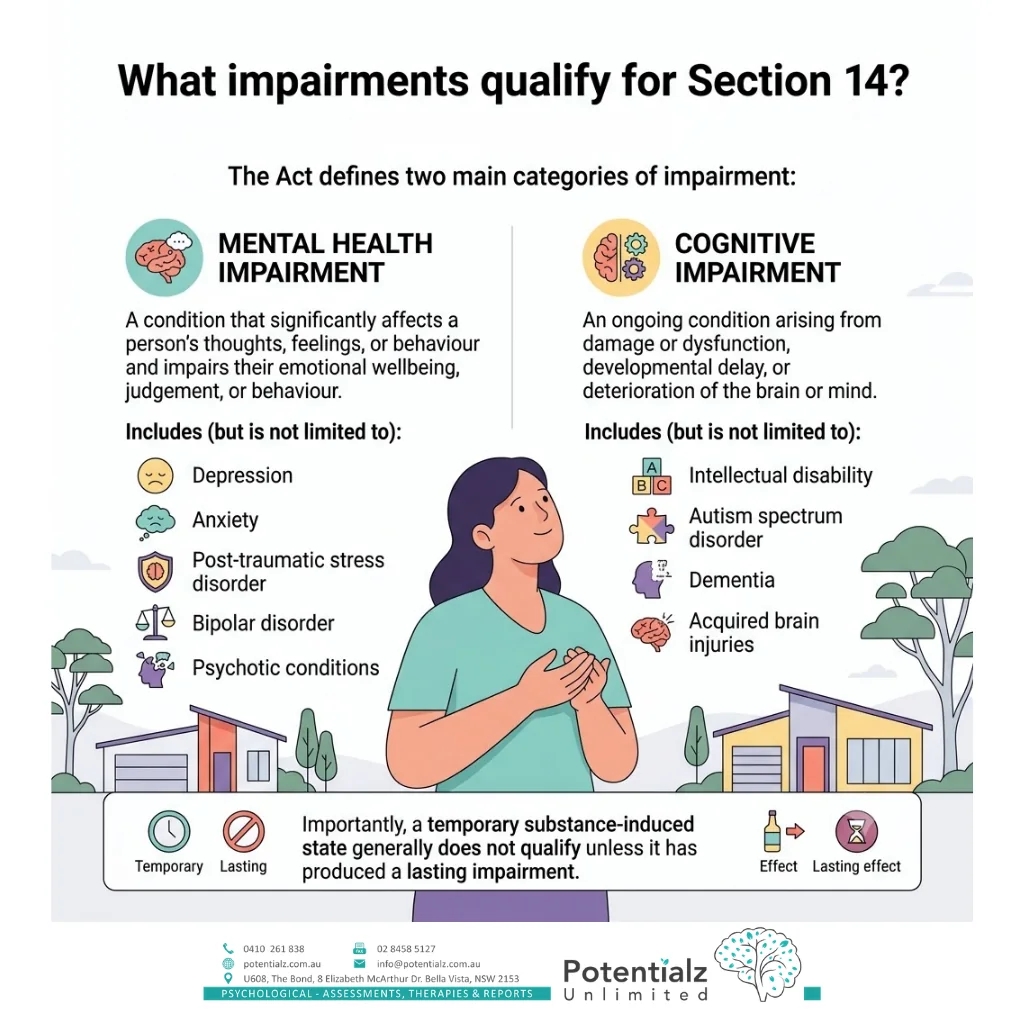
The Act defines two categories:
Mental health impairment — a condition that significantly affects a person’s thoughts, feelings, or behaviour and impairs their emotional wellbeing, judgement, or behaviour. This includes (but is not limited to) depression, anxiety, post-traumatic stress disorder, bipolar disorder, and psychotic conditions.
Cognitive impairment — an ongoing condition arising from damage or dysfunction, developmental delay, or deterioration of the brain or mind. This includes intellectual disability, autism spectrum disorder, dementia, and acquired brain injuries.
Importantly, a temporary substance-induced state generally does not qualify unless it has produced a lasting impairment.
For a deeper explanation of the Section 14 process, see our post: The What, Why and How of Section 14 Reports in the NSW Judicial System.
How Do Police Checks Work in Australia?
To understand whether a Section 14 appears on a police check, it helps to understand what police checks actually disclose.
National Police Check (NPC)
The most common check is the National Police Check (NPC), coordinated by the Australian Criminal Intelligence Commission (ACIC) through its National Police Checking Service. An NPC searches criminal history records held by police agencies across all Australian states and territories and returns what is called a “disclosable court outcome.”
A disclosable court outcome generally includes:
- Convictions (including spent convictions in some circumstances, depending on the purpose of the check)
- In some states and for some purposes: findings of guilt without conviction
- Pending court matters (charges not yet finalised)
What an NPC generally does not disclose:
- Charges that were dismissed (with no finding of guilt)
- Matters that were withdrawn before any court determination
- Medical or health information, including mental health records
The exact rules about what is disclosed depend on the purpose of the check (employment, volunteering, licensing), the state or territory in which the events occurred, and whether a spent convictions scheme applies.
Other types of checks
- Working With Children Check (WWCC): This check operates under separate state legislation and uses a different assessment framework. It may consider a broader range of information beyond criminal convictions — including, in some circumstances, charges that did not result in a conviction. Rules differ by state and territory.
- Vulnerable People Check / NDIS Worker Screening Check: These checks are also purpose-specific and may involve different disclosure rules.
- AFP National Police Check: Used for some federal roles and immigration purposes; follows similar principles to the NPC but is administered by the Australian Federal Police.
Does a Section 14 Appear on a Police Check?
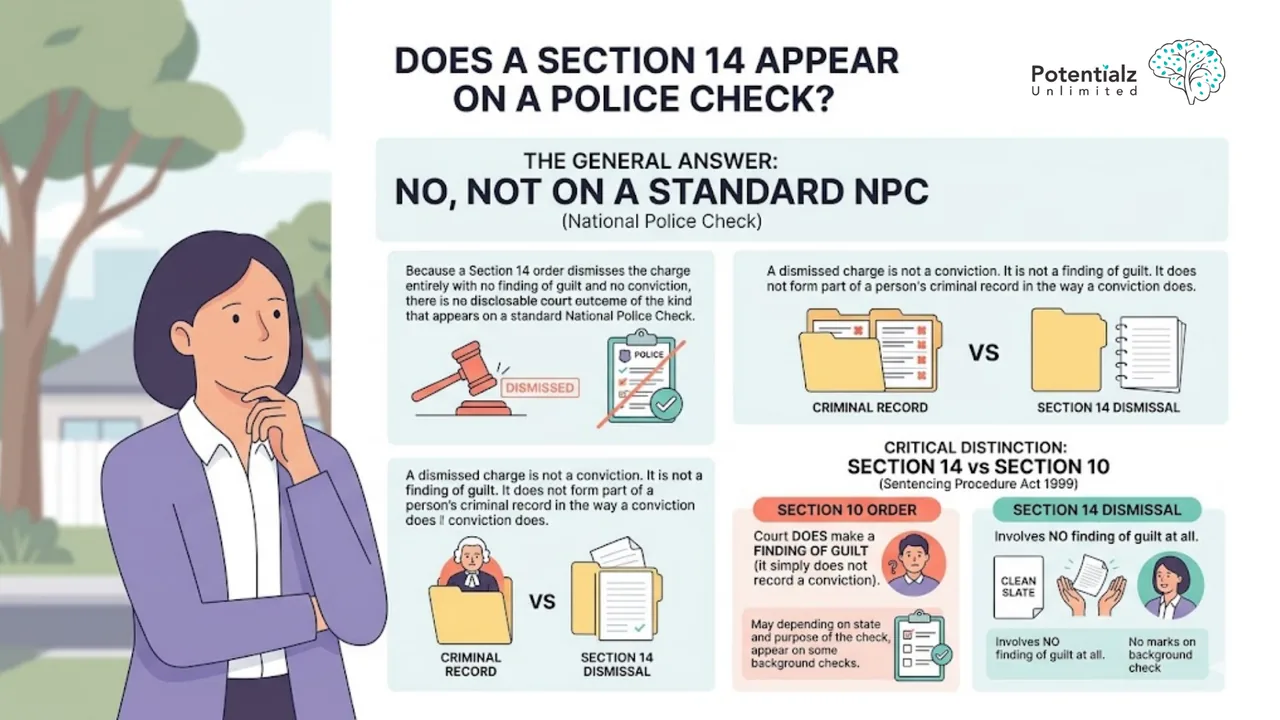
The general answer: no, not on a standard NPC
Because a Section 14 order dismisses the charge entirely with no finding of guilt and no conviction, there is no disclosable court outcome of the kind that appears on a standard National Police Check.
A dismissed charge is not a conviction. It is not a finding of guilt. It does not form part of a person’s criminal record in the way a conviction does.
This is meaningfully different from a Section 10 order under the Crimes (Sentencing Procedure) Act 1999, where the court does make a finding of guilt (it simply does not record a conviction). A Section 10 finding of guilt without conviction may, depending on the state and purpose of the check, appear on some background checks. A Section 14 dismissal, by contrast, involves no finding of guilt at all.
For a careful comparison of these two provisions, see: Section 10 vs Section 14 Reports: Understanding the Key Differences.
Important nuances — what police records may still hold
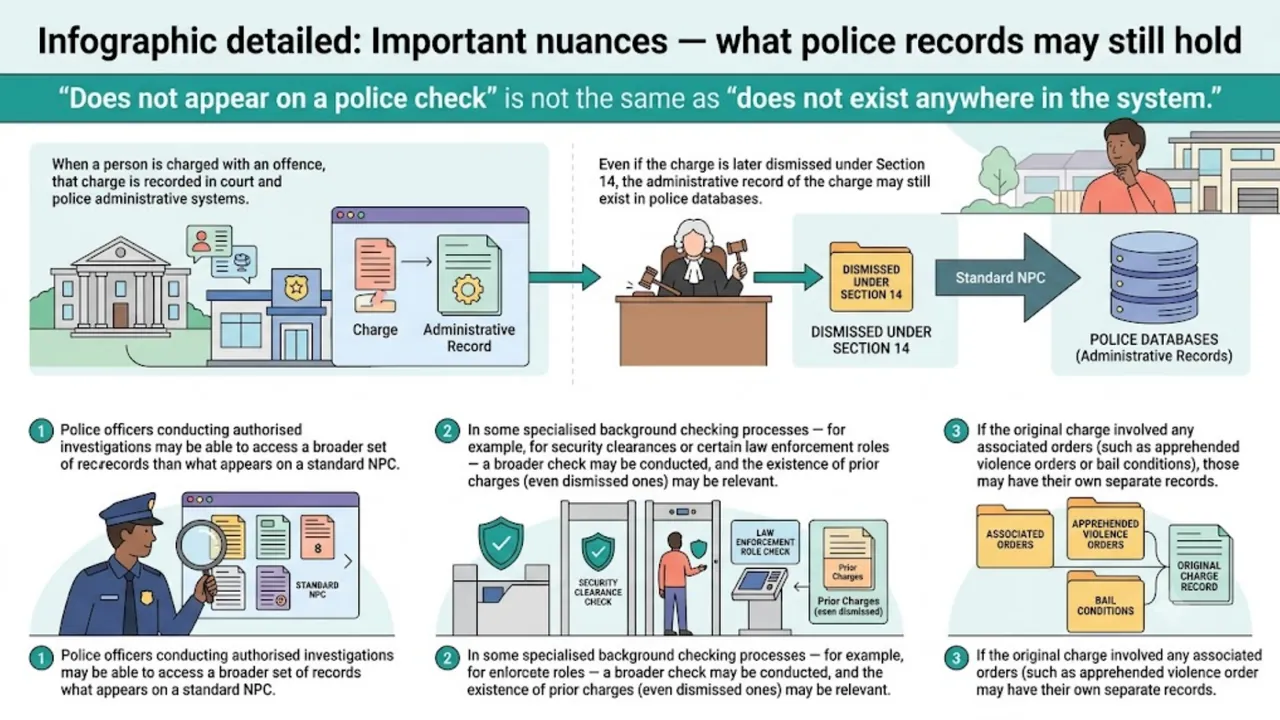
“Does not appear on a police check” is not the same as “does not exist anywhere in the system.”
When a person is charged with an offence, that charge is recorded in court and police administrative systems. Even if the charge is later dismissed under Section 14, the administrative record of the charge may still exist in police databases. This is different from what is disclosed on a standard NPC, but it is worth being aware of:
- Police officers conducting authorised investigations may be able to access a broader set of records than what appears on a standard NPC.
- In some specialised background checking processes — for example, for security clearances or certain law enforcement roles — a broader check may be conducted, and the existence of prior charges (even dismissed ones) may be relevant.
- If the original charge involved any associated orders (such as apprehended violence orders or bail conditions), those may have their own separate records.
Working With Children Checks — a specific caution
The WWCC is a particularly important check for many people. In NSW, the WWCC is administered by the Office of the Children’s Guardian. It assesses whether a person poses an unacceptable risk to the safety of children and can consider a broader range of information than a standard NPC, including (in some circumstances) charges that did not result in a conviction.
If you have a Section 14 matter and you work — or intend to work — in any role that involves children, you should seek specific legal advice about how this may be assessed under the WWCC framework. Do not rely on this article as a substitute for that advice.
The Spent Convictions Scheme
NSW and most other Australian states and territories have a spent convictions scheme — legislation that allows certain older, less serious convictions to be “spent” (no longer disclosed) after a qualifying period. Under the NSW Criminal Records Act 1991, a conviction may become spent after 10 years (or 3 years for juvenile offences) if there has been no reoffending.
A Section 14 dismissal is not a conviction, so the spent convictions scheme does not directly apply to it. This is actually a more favourable position — there is no conviction to be “spent” in the first place.
Why Does This Matter? The Practical Stakes
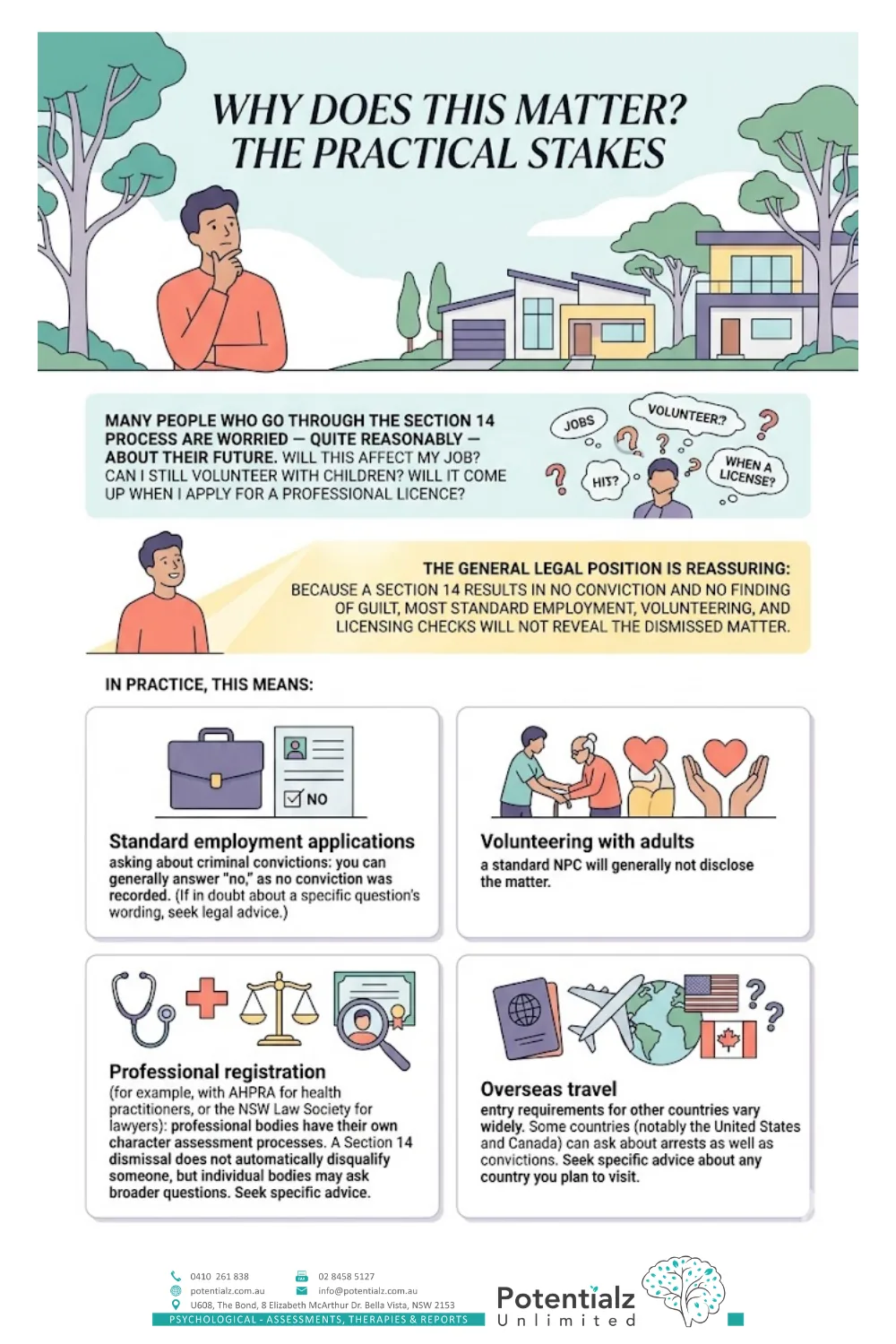
Many people who go through the Section 14 process are worried — quite reasonably — about their future. Will this affect my job? Can I still volunteer with children? Will it come up when I apply for a professional licence?
The general legal position is reassuring: because a Section 14 results in no conviction and no finding of guilt, most standard employment, volunteering, and licensing checks will not reveal the dismissed matter.
In practice, this means:
- Standard employment applications asking about criminal convictions: you can generally answer “no,” as no conviction was recorded. (If in doubt about a specific question’s wording, seek legal advice.)
- Volunteering with adults: a standard NPC will generally not disclose the matter.
- Professional registration (for example, with AHPRA for health practitioners, or the NSW Law Society for lawyers): professional bodies have their own character assessment processes. A Section 14 dismissal does not automatically disqualify someone, but individual bodies may ask broader questions. Seek specific advice.
- Overseas travel: entry requirements for other countries vary widely. Some countries (notably the United States and Canada) can ask about arrests as well as convictions. Seek specific advice about any country you plan to visit.
The Role of a Psychological Report in a Section 14 Application
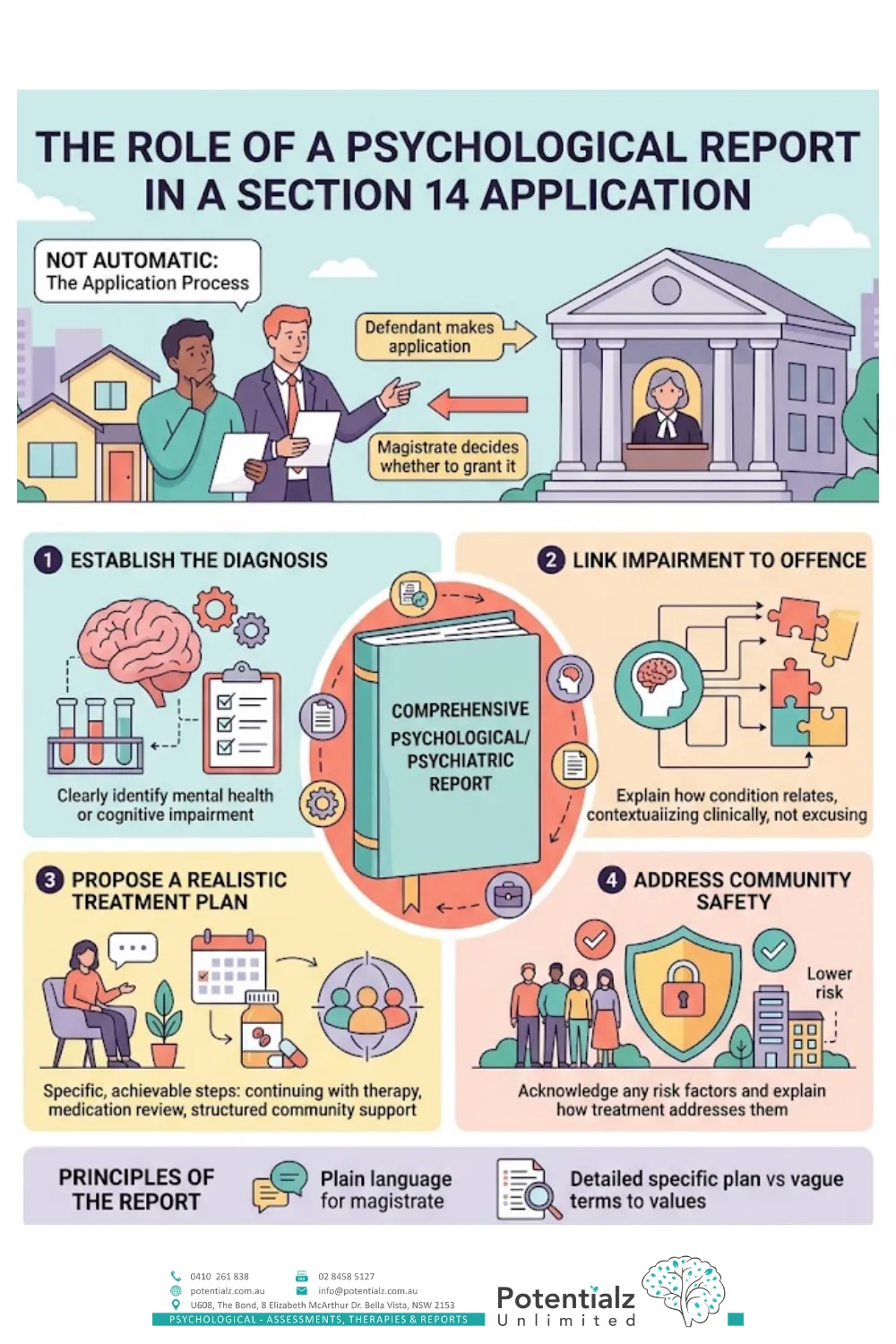
A Section 14 order does not happen automatically. The defendant — typically with the help of a lawyer — makes an application to the court, and a magistrate decides whether to grant it.
In practice, a comprehensive psychological or psychiatric report is central to almost every successful Section 14 application. The report needs to:
- Establish the diagnosis — clearly identify the mental health impairment or cognitive impairment the defendant has, using standardised clinical assessment.
- Link the impairment to the offence — explain how the condition relates to the alleged behaviour (this does not mean excusing it; it means contextualising it clinically).
- Propose a realistic treatment plan — recommend specific, achievable steps the defendant will take, such as continuing with therapy, medication review, or structured community support.
- Address community safety — acknowledge any risk factors and explain how the treatment plan addresses them.
The report must be written in clear, plain language that a magistrate who is not a mental health professional can understand and act upon. Vague recommendations or an absence of detail about the treatment plan are common reasons applications do not succeed.
At Potentialz Unlimited, Dr. Gurprit Ganda prepares Section 14 medico-legal reports for the NSW Local Court, drawing on more than 25 years of clinical experience. If you or your client are considering a Section 14 application, contact us to discuss whether an assessment is appropriate.
You may also find it helpful to read: How to Prepare for a Medico-Legal Psychological Report Interview.
A Note on Terminology: Section 32 vs Section 14
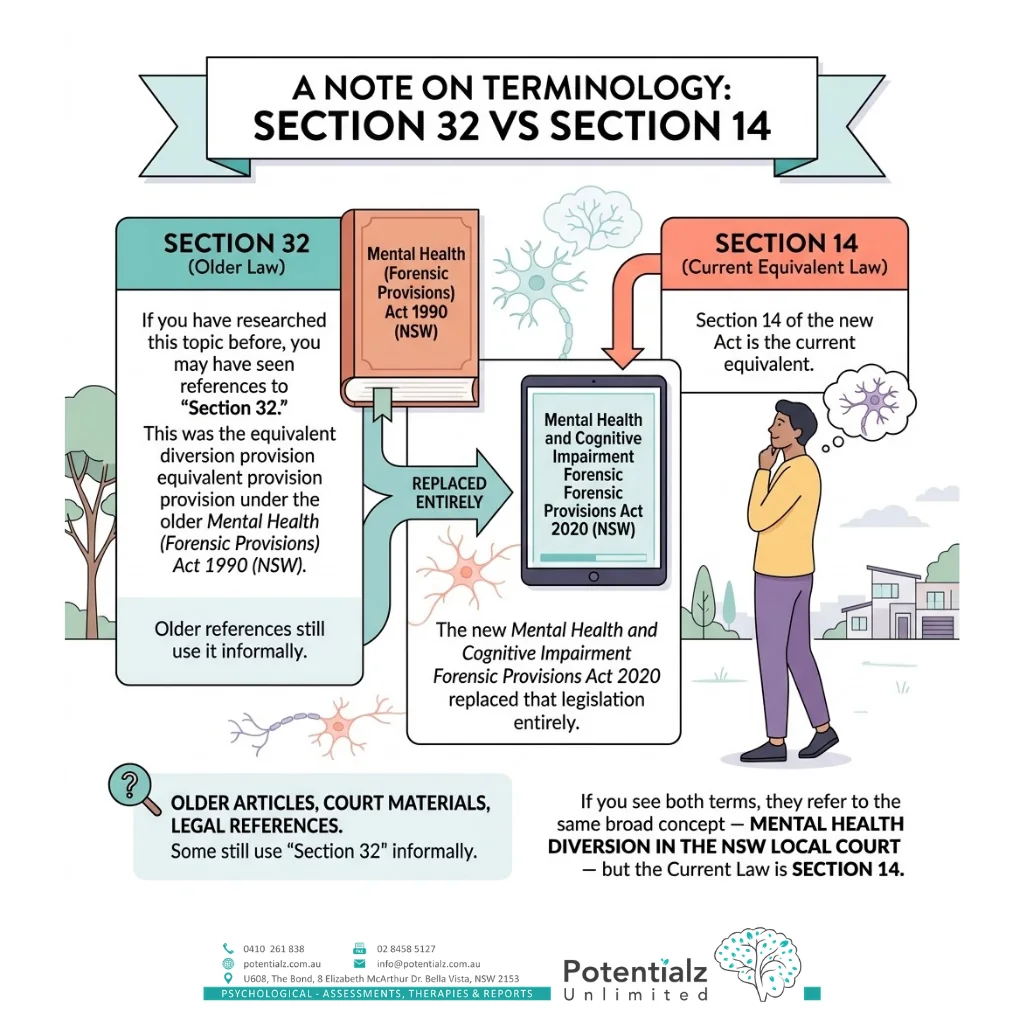
If you have researched this topic before, you may have seen references to “Section 32.” This was the equivalent diversion provision under the older Mental Health (Forensic Provisions) Act 1990 (NSW). The new Mental Health and Cognitive Impairment Forensic Provisions Act 2020 replaced that legislation entirely. Section 14 of the new Act is the current equivalent.
Some older articles, court materials, and legal references still use “Section 32” informally. If you see both terms, they refer to the same broad concept — mental health diversion in the NSW Local Court — but the current law is Section 14.
Key Takeaways
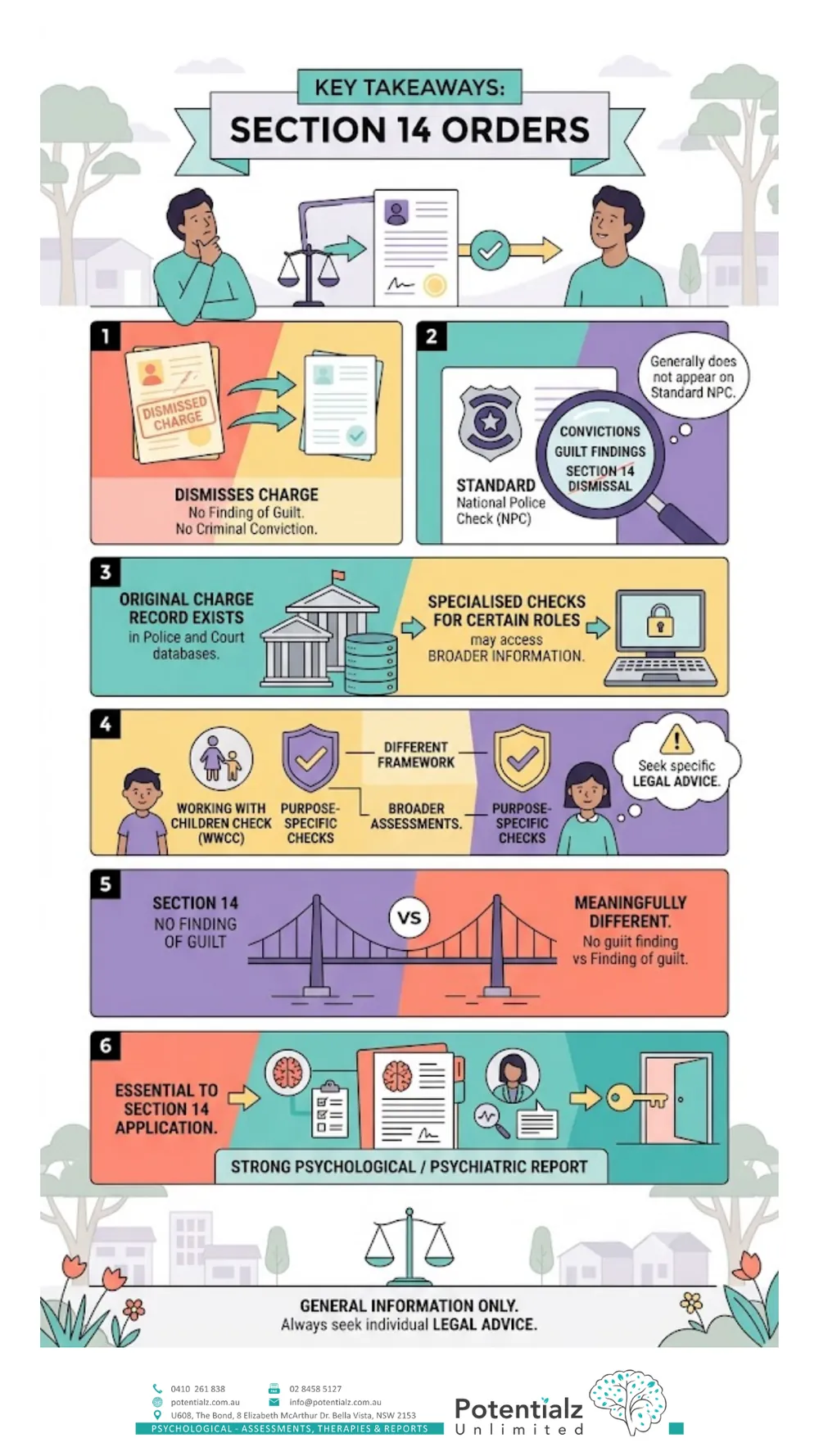
- A Section 14 order dismisses the charge. There is no finding of guilt and no criminal conviction.
- Because a standard National Police Check discloses convictions and findings of guilt — not dismissed charges — a Section 14 generally does not appear on a standard NPC.
- Police and court administrative systems may still hold a record of the original charge; specialised checks for certain roles may access broader information.
- The Working With Children Check and similar purpose-specific checks use different frameworks and may involve broader assessments — seek specific legal advice.
- Section 14 is meaningfully different from Section 10: Section 10 involves a finding of guilt (without a conviction); Section 14 involves no finding of guilt at all.
- A strong psychological or psychiatric report is essential to a Section 14 application.
- This article is general information only. Always seek legal advice about your individual situation.
About the Author
Dr. Gurprit Ganda is a Clinical Psychologist (AHPRA Clinical Endorsement) and Practice Director at Potentialz Unlimited in Bella Vista, NSW. With over 25 years of experience, her work includes forensic and medico-legal assessment — including the preparation of Section 14 psychological reports for the NSW Local Court. She is experienced in working collaboratively with legal teams to produce court-appropriate reports that are clinically rigorous, clearly written, and practically useful.
Potentialz Unlimited Unit 608, 8 Elizabeth Macarthur Drive, Bella Vista NSW 2153 Phone: 0410 261 838 | Book online | potentialz.com.au Monday–Friday 10am–7pm | Telehealth across NSW Funding: Medicare (GP Mental Health Care Plan), WorkCover, CTP, NDIS
Enquire about a Section 14 Report
If you are a solicitor or defendant seeking a Section 14 psychological assessment report for the NSW Local Court, contact us or visit our team page to learn more about our medico-legal services.
References
- Mental Health and Cognitive Impairment Forensic Provisions Act 2020 (NSW), s 14. NSW Legislation. Retrieved from https://legislation.nsw.gov.au/view/html/inforce/current/act-2020-005
- Australian Criminal Intelligence Commission (ACIC). National Police Checking Service. Retrieved from https://www.acic.gov.au/our-services/national-police-checking-service
- Legal Aid NSW. What is a section 14? Retrieved from https://www.legalaid.nsw.gov.au/ways-to-get-help/publications-and-resources/what-is-a-section-14
- NSW Government. Criminal Records Act 1991 (NSW). Retrieved from https://legislation.nsw.gov.au/view/html/inforce/current/act-1991-080
- Office of the Children’s Guardian (NSW). Working With Children Check. Retrieved from https://www.kidsguardian.nsw.gov.au/child-safe-organisations/working-with-children-check
- Crimes (Sentencing Procedure) Act 1999 (NSW), s 10. NSW Legislation. Retrieved from https://legislation.nsw.gov.au/view/whole/html/inforce/current/act-1999-092
Related Reading
More from our blog:
- The What, Why and How of Section 14 Reports in the NSW Judicial System
- Section 10 vs Section 14 Reports: Understanding the Key Differences
- How to Prepare for a Medico-Legal Psychological Report Interview
Medico-legal services:
Knowledge Check Quiz
Test what you have just read. Choose your answer for each question, then submit to reveal the answers and your score.
Need Professional Support?
If you're experiencing mental health concerns, our team is here to help.