If you have ever watched a child become completely absorbed in building with LEGO® bricks, you already have a glimpse into why LEGO® Based Therapy works. For many children, play is the language through which they feel safest. LEGO® Based Therapy takes that natural love of building and turns it into a powerful framework for developing the social skills — and the broader emotional intelligence — that children need in everyday life.
At Potentialz Unlimited in Bella Vista, our Practitioner in Therapeutic Play works with children aged 3–12 who find social interaction challenging. Whether a child has autism spectrum disorder (ASD), attention-deficit/hyperactivity disorder (ADHD), social anxiety, or simply struggles to connect with peers, this approach offers a structured, enjoyable path toward meaningful social growth.
The Origins of LEGO® Based Therapy
LEGO® Based Therapy was developed in the late 1990s by clinical psychologist Dr Daniel LeGoff, who noticed that children with social difficulties were highly engaged when playing with LEGO® bricks together. Working alongside Dr Gina Gómez de la Cuesta and Dr Barry LeVine, Dr LeGoff formalised a model where collaborative LEGO® building becomes the medium for practising social skills (LeGoff et al., 2014).
The therapy is not about building the best model. It is about what happens between the children during the building process — the negotiating, the waiting, the asking for help, and the celebrating together.
Since its development, the approach has been studied across multiple countries and is now used by speech pathologists, psychologists, occupational therapists, and play therapists around the world.
The Three Roles: Engineer, Supplier, Builder
The heart of LEGO® Based Therapy is a three-role structure that makes collaboration essential. Each child in a session is assigned one of three roles, and the roles rotate regularly. This means every child practises every skill throughout the session.
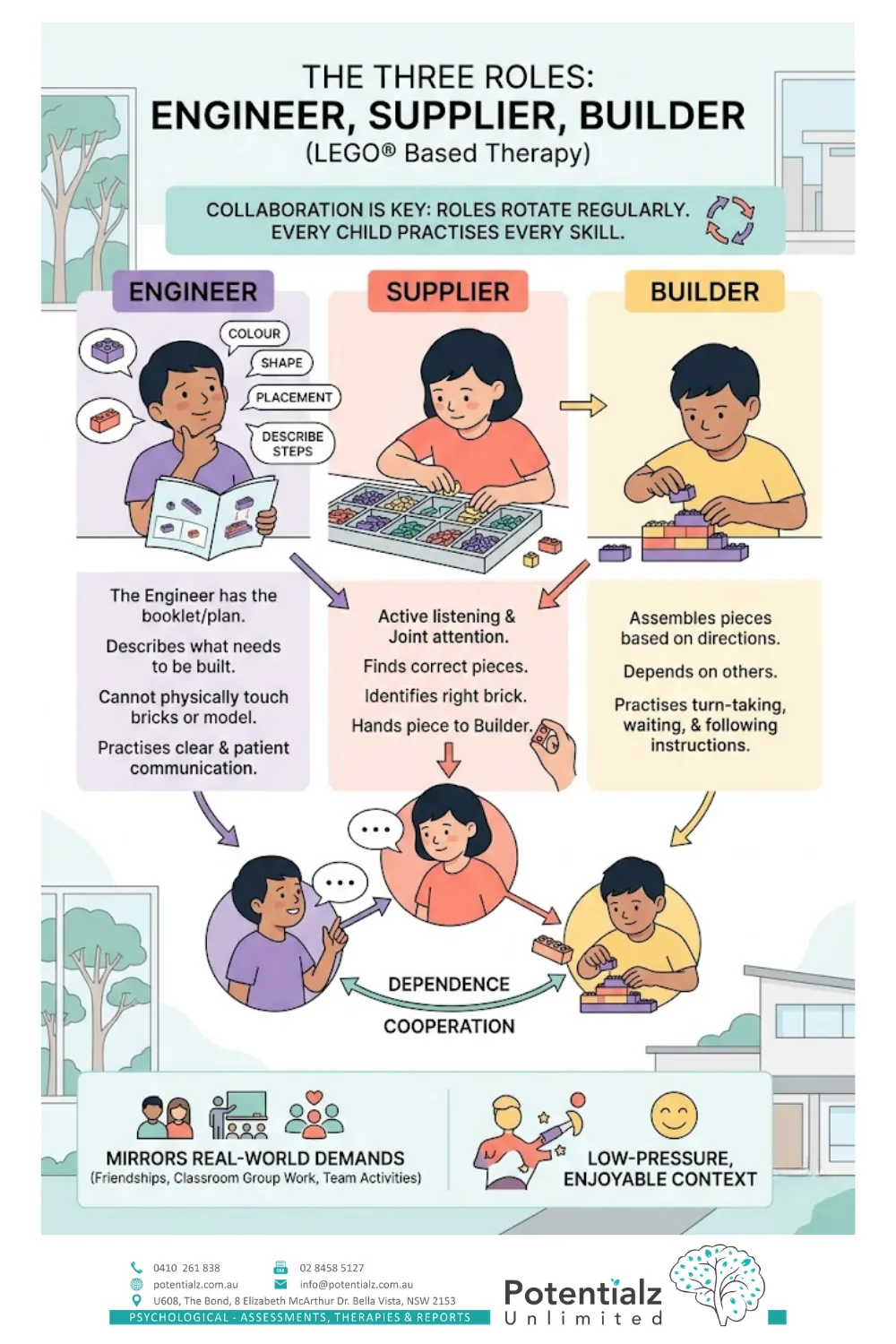
The Engineer holds the instruction booklet or the plan. This child describes what needs to be built — the colour, the shape, the placement — without physically touching the bricks or the model. The Engineer must communicate clearly and patiently.
The Supplier finds the correct pieces from the collection based on what the Engineer describes. This child must listen carefully, identify the right brick, and hand it to the Builder at the right time. The Supplier practises active listening and joint attention.
The Builder assembles the pieces according to what the Engineer directs and what the Supplier provides. The Builder cannot proceed alone — they depend entirely on the other two. The Builder practises turn-taking, waiting, and following instructions.
All three roles require cooperation. No single child can complete the task independently. This mirrors the real-world demands of friendships, classroom group work, and team activities — but within a low-pressure, enjoyable context.
What Social Skills Does LEGO® Based Therapy Build?
Research suggests that LEGO® Based Therapy can support a range of social communication skills (Owens et al., 2008). The structured format creates natural opportunities to practise skills that children with ASD and ADHD often find difficult.
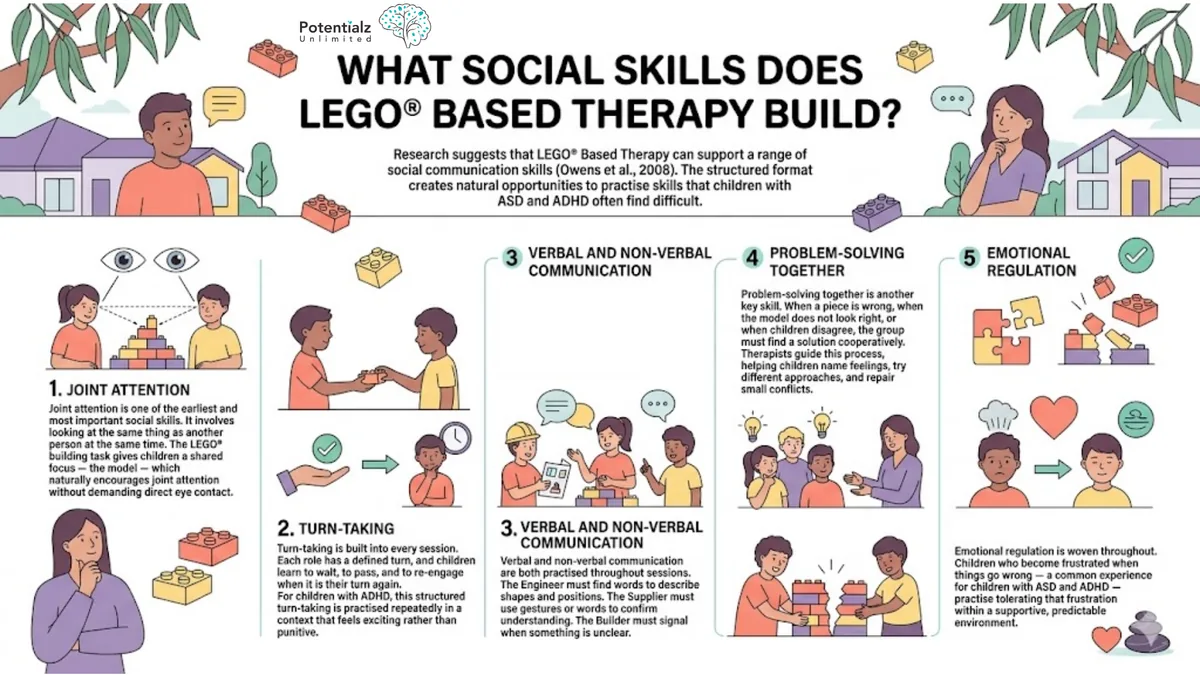
Joint attention is one of the earliest and most important social skills. It involves looking at the same thing as another person at the same time. The LEGO® building task gives children a shared focus — the model — which naturally encourages joint attention without demanding direct eye contact.
Turn-taking is built into every session. Each role has a defined turn, and children learn to wait, to pass, and to re-engage when it is their turn again. For children with ADHD, this structured turn-taking is practised repeatedly in a context that feels exciting rather than punitive.
Verbal and non-verbal communication are both practised throughout sessions. The Engineer must find words to describe shapes and positions. The Supplier must use gestures or words to confirm understanding. The Builder must signal when something is unclear.
Problem-solving together is another key skill. When a piece is wrong, when the model does not look right, or when children disagree, the group must find a solution cooperatively. Therapists guide this process, helping children name feelings, try different approaches, and repair small conflicts.
Emotional regulation is woven throughout. Children who become frustrated when things go wrong — a common experience for children with ASD and ADHD — practise tolerating that frustration within a supportive, predictable environment. (For more on this, see building emotional resilience in children.)
Who Benefits From LEGO® Based Therapy?
Studies indicate that LEGO® Based Therapy is particularly effective for children who have the cognitive ability to follow multi-step instructions but find social interaction confusing, overwhelming, or unrewarding (LeGoff, 2004).
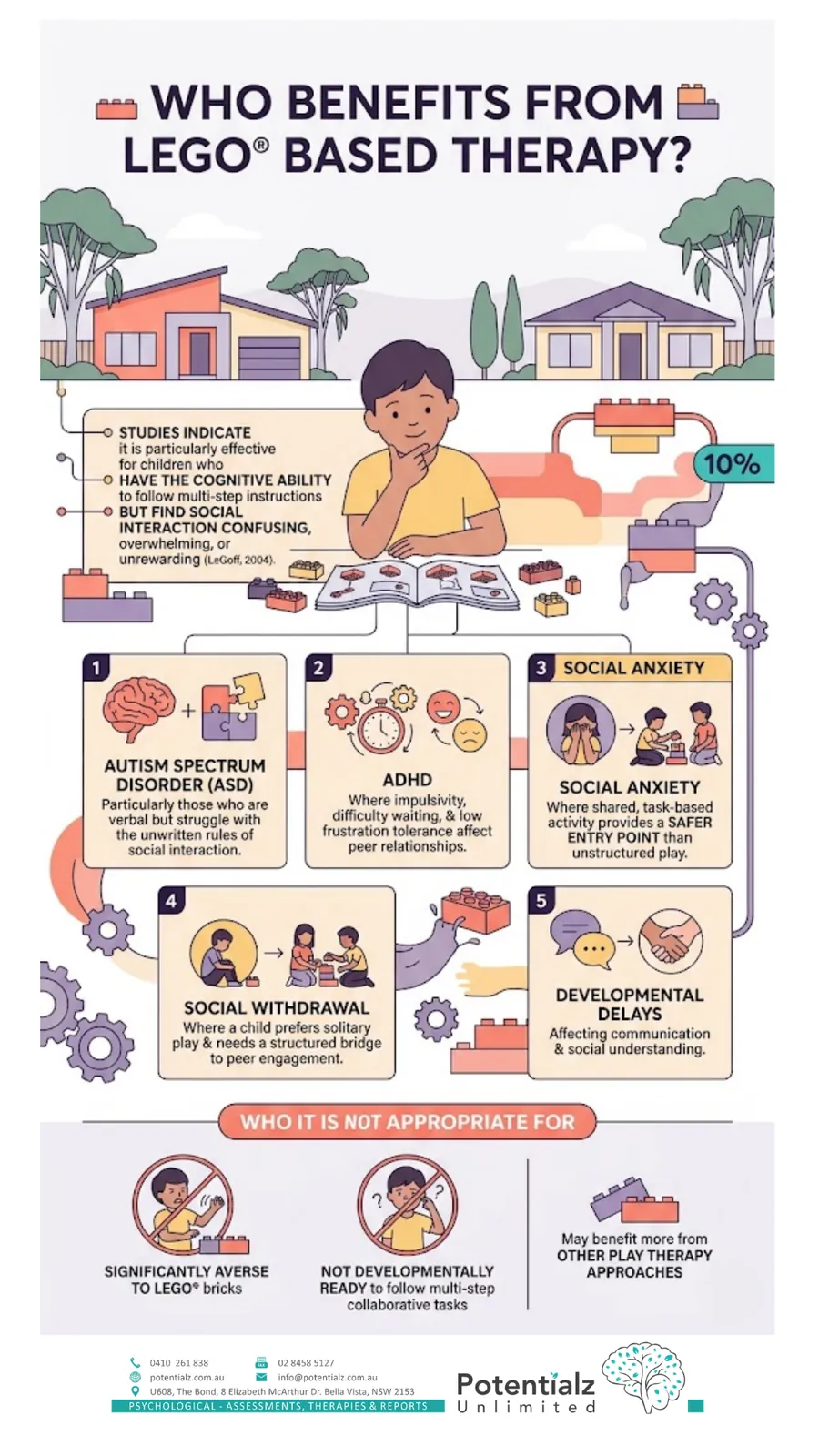
Children who may benefit include those with:
- Autism Spectrum Disorder (ASD) — particularly those who are verbal but struggle with the unwritten rules of social interaction
- ADHD — where impulsivity, difficulty waiting, and low frustration tolerance affect peer relationships
- Social anxiety — where shared task-based activity provides a safer entry point to interaction than unstructured free play
- Social withdrawal — where a child prefers solitary play and needs a structured bridge to peer engagement
- Developmental delays affecting communication and social understanding
LEGO® Based Therapy is not appropriate for every child. Children who are significantly averse to LEGO® bricks, or who are not yet developmentally ready to follow a multi-step collaborative task, may benefit more from other play therapy approaches available at Potentialz, such as Synergetic Play Therapy.
Individual vs Group Format
LEGO® Based Therapy can be delivered in individual or group settings, and both have specific advantages.
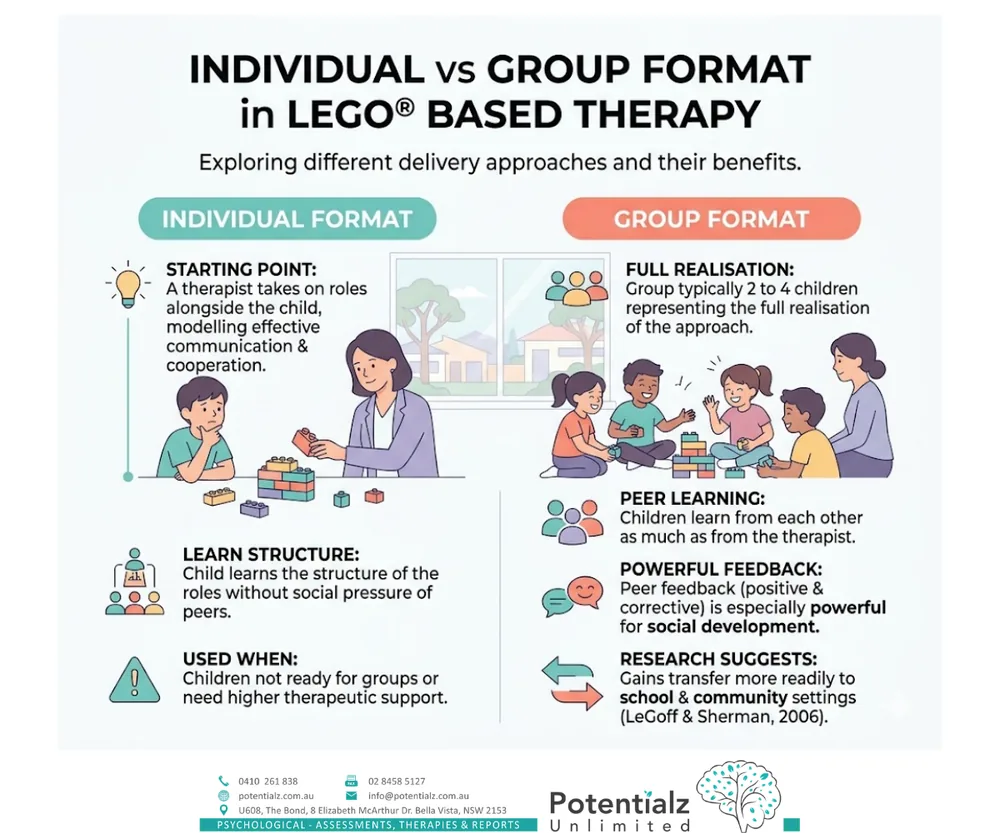
Individual sessions are often used as a starting point. A therapist takes on the roles alongside the child, modelling effective communication and cooperation. This allows the child to learn the structure of the roles without the social pressure of peers. Individual sessions are also used for children who are not yet ready for group settings or who need a higher level of therapeutic support.
Group sessions (typically two to four children) represent the full realisation of the approach. Children learn from each other as much as from the therapist. Peer feedback — both positive and corrective — is especially powerful for social development. Research suggests that gains made in group LEGO® Based Therapy transfer more readily to school and community settings than gains made in one-to-one social skills training (LeGoff & Sherman, 2006).
At Potentialz Unlimited, our Practitioner in Therapeutic Play assesses each child individually before recommending a format. Some children begin with individual sessions and transition to group work when they are ready. Others thrive immediately in a small group setting.
The Evidence Base
LEGO® Based Therapy has been studied in a range of contexts. A study by Owens et al. (2008) found significant improvements in social competence among children with ASD following a LEGO® Based Therapy programme compared to a social skills group comparison condition. LeGoff and Sherman (2006) reported that children who participated in LEGO® therapy maintained social gains at three-year follow-up, suggesting that the approach supports durable skill development.
More recently, a systematic review by LeGoff, Gómez de la Cuesta, Krauss, and Baron-Cohen (2014) synthesised findings across multiple studies, concluding that LEGO® Based Therapy shows promise as an evidence-informed approach to improving social competence in children with ASD and related conditions.
As with all therapeutic approaches, individual outcomes vary. The research base continues to grow, and LEGO® Based Therapy is increasingly recognised as a credible, complementary intervention within broader therapeutic programmes.
What Does a Session Look Like?
A typical LEGO® Based Therapy session at Potentialz Unlimited runs for approximately 50 minutes. Sessions follow a consistent structure, which helps children with ASD and ADHD feel safe and know what to expect.
The session begins with a brief check-in — a simple, predictable greeting that helps children transition from whatever they were doing before. The roles for the day are assigned, and the building task is introduced.
During the building phase, our Practitioner in Therapeutic Play facilitates interactions rather than directing them. If a child becomes frustrated, the therapist reflects their feeling and helps them find words or strategies. If children disagree, the therapist slows the process down and supports them to resolve the conflict together.
Sessions end with a review — celebrating what was built, noticing moments of good teamwork, and acknowledging challenges that were managed well. This reflection phase is important for helping children generalise what they experienced to other settings.
Parents receive a brief summary after each session, including observations about social skills and suggestions for how similar situations can be encouraged at home — much like the parent consultations built into every child’s program.
LEGO® Based Therapy and NDIS
LEGO® Based Therapy delivered by a qualified play therapist may be funded through an NDIS plan under Capacity Building supports, specifically under Improved Daily Living or Improved Relationships. If your child has an NDIS plan, you may wish to explore whether LEGO® Based Therapy could be included as part of their support.
You can find more information about how play therapy fits into NDIS plans on our NDIS page, or contact us directly to discuss your child’s plan with our team.
Key Takeaways
- LEGO® Based Therapy was developed by Dr Daniel LeGoff and colleagues and is now used worldwide to support social skill development in children.
- The three-role structure (Engineer, Supplier, Builder) makes cooperation essential and creates natural opportunities to practise joint attention, turn-taking, and communication.
- Research suggests the approach is particularly effective for children with ASD, ADHD, social anxiety, and social withdrawal.
- Sessions can be delivered individually or in small groups, with group formats supporting better generalisation to real-world social settings.
- LEGO® Based Therapy may be fundable through an NDIS plan under Capacity Building supports.
- Potentialz Unlimited in Bella Vista offers LEGO® Based Therapy delivered by our Practitioner in Therapeutic Play, working with children aged 3–12.
How Potentialz Can Help
At Potentialz Unlimited in Bella Vista, our practice offers LEGO® Based Therapy as part of a comprehensive, child-centred approach to supporting social development. Every child who comes through our door is assessed individually, and therapy programmes are tailored to their specific needs, strengths, and goals.
Our Practitioner in Therapeutic Play works with children aged 3–12 and supports families from diverse cultural backgrounds. We understand that seeking support for your child can feel overwhelming, and we aim to make the process as clear and welcoming as possible. You can read more about the practice on our meet the team page.
If you think LEGO® Based Therapy might benefit your child — or if you are not sure and would like to talk it through — we warmly invite you to get in touch.
Book a session online: live.potentialz.com.au Call us: 0410 261 838 Visit us: Unit 608/8 Elizabeth Macarthur Drive, Bella Vista NSW 2153 Hours: Monday to Friday, 10am–7pm
You can also learn more about our broader play therapy services in Bella Vista, or explore how we support children through our child psychology services.
References
LeGoff, D. B. (2004). Use of LEGO as a therapeutic medium for improving social competence. Journal of Autism and Developmental Disorders, 34(5), 557–571. https://doi.org/10.1007/s10803-004-2550-0
LeGoff, D. B., & Sherman, M. (2006). Long-term outcome of social skills intervention based on interactive LEGO play. Autism, 10(4), 317–329. https://doi.org/10.1177/1362361306064403
LeGoff, D. B., Gómez de la Cuesta, G., Krauss, G. W., & Baron-Cohen, S. (2014). LEGO®-based therapy: How to build social competence through LEGO®-based clubs for children with autism and related conditions. Jessica Kingsley Publishers.
Owens, G., Granader, Y., Humphrey, A., & Baron-Cohen, S. (2008). LEGO therapy and the social use of language programme: An evaluation of two social skills interventions for children with high functioning autism and Asperger syndrome. Journal of Autism and Developmental Disorders, 38(10), 1944–1957. https://doi.org/10.1007/s10803-008-0590-6
Disclaimer: This article is a Potentialz Unlimited editorial piece drawing on our clinical team’s experience. It is for general education and information only, not clinical advice for your particular child. Potentialz Unlimited is a psychology practice based in Bella Vista NSW; our clinical team includes Registered Psychologists and a Clinical Psychologist (registered with AHPRA) and an accredited Play Therapist. Please consult a qualified health professional for your individual circumstances. If your child is experiencing a mental health crisis, contact your GP, call Kids Helpline on 1800 55 1800, or go to your nearest emergency department.
Crisis support: If you or someone you know needs support, please contact Lifeline on 13 11 14, Beyond Blue on 1300 22 4636, or Kids Helpline on 1800 55 1800 — or call 000 in an emergency.
Related Reading
Knowledge Check Quiz
Test what you have just read. Choose your answer for each question, then submit to reveal the answers and your score.
Need Professional Support?
If you're experiencing mental health concerns, our team is here to help.