The 2:17am Your Partner Cannot Explain
It is 2:17am. Your partner has just sat bolt upright in bed with a sound you have never quite heard a human being make before — somewhere between a scream and a gasp — and is now staring at the wall with an expression that is not asleep and is not awake. You say their name. They do not respond. You touch their arm. They flinch as if you were the threat. Ninety seconds later, they lie back down and their breathing slows and they are, apparently, deeply asleep again. In the morning, they will remember none of it. You will remember all of it, and you will spend the day trying to work out what on earth just happened, and whether it means something is seriously wrong.
Or perhaps the person waking up terrified is you. You do not remember the episode itself — only the metallic taste at the back of your throat when you finally wake properly at 6am, and the vague sense that something happened in the night that you cannot quite reach. Your bed partner is watching you differently. You wonder how many nights this has been going on for.
Night terrors in adults are less common than in children, but they are real, they are frightening for everyone in the room, and — when they need it — they are treatable. This article is a practical map of what they are, what causes them, when to worry, and what actually helps.
What Night Terrors Actually Are
Night terrors — also called sleep terrors or pavor nocturnus — are a specific parasomnia classified in the International Classification of Sleep Disorders (ICSD-3-TR) as a disorder of arousal from non-REM sleep. They are not nightmares, and the distinction matters clinically.
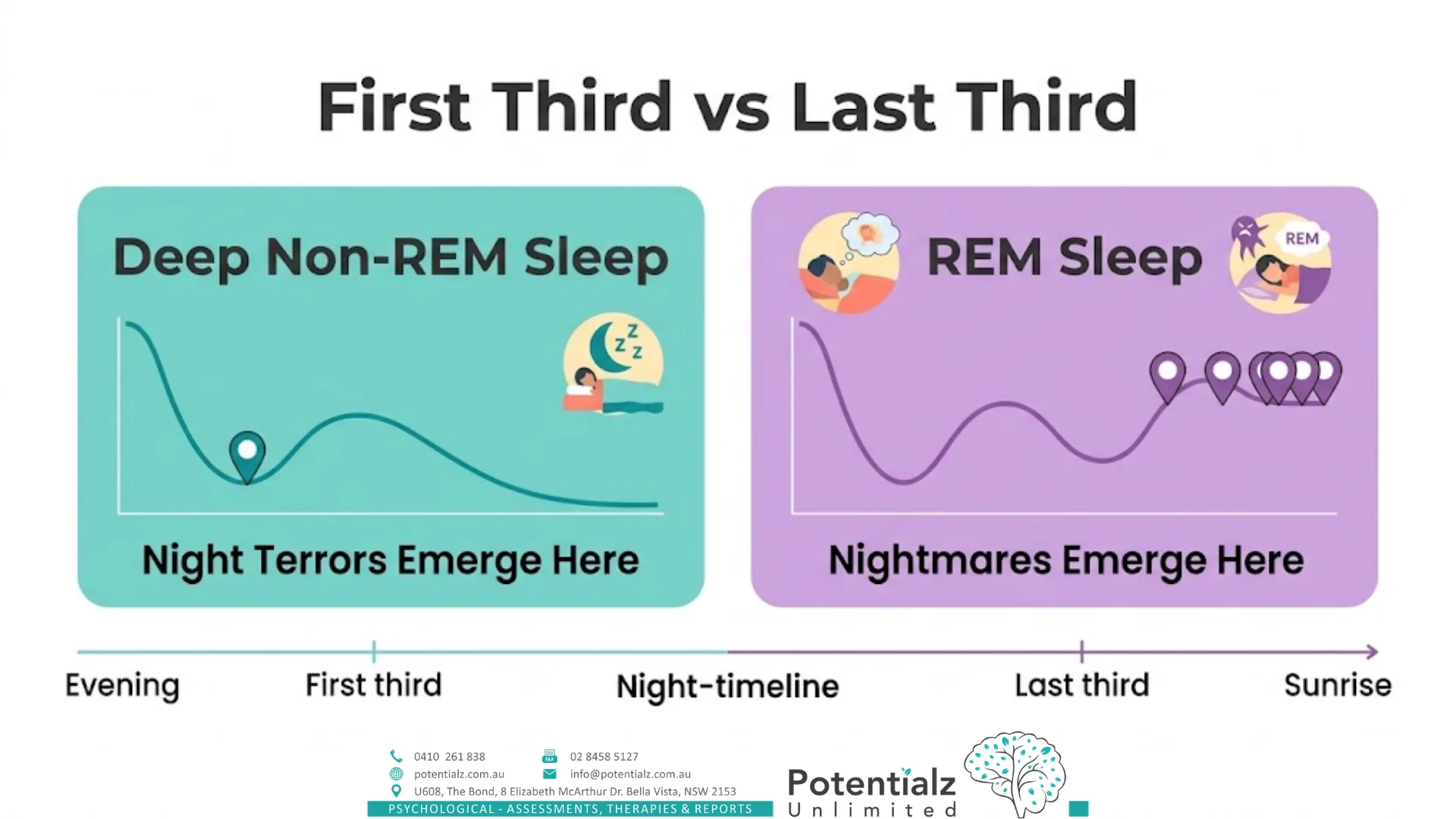
Night terrors arise out of N3 slow-wave sleep — the deepest stage of non-REM sleep, concentrated in the first third of the night. The person is in a partial-arousal state: physiologically activated (elevated heart rate, sweating, dilated pupils, sometimes sitting up or moving around), apparently terrified, but not actually conscious in the way waking or dreaming implies. They are difficult to fully wake. Attempts to comfort or restrain them may increase distress or provoke movement. Episodes usually last a few minutes and end with the person returning to deep sleep. There is typically no recall of the episode in the morning, though occasionally a fragment of imagery is remembered.
Nightmares, by contrast, are REM-sleep phenomena. They occur later in the night, involve narrative dream content, and the person wakes fully and remembers the dream. Both are distressing, both can co-occur (particularly in PTSD), but they emerge from different sleep architecture and are treated differently.
The distinction matters because well-intentioned advice for one is unhelpful for the other. “Talk about the dream” is appropriate for nightmares — the person can access the content. It is impossible for night terrors — the person has no content to access.
How Common Are Adult Night Terrors?
Night terrors are common in children — up to around 40% of children experience at least one episode, most commonly between ages 4 and 12 — and typically resolve by adolescence. In adults, prevalence is much lower. Epidemiological studies suggest around 2–3% of adults report ongoing sleep terror episodes (Ohayon et al., 1999). Adult-onset cases (never had them as a child) are less common still, and warrant particular clinical attention because they are more likely to have an identifiable trigger.
In my clinical practice, adult presentations for night terrors fall into two broad groups. The first is people whose childhood night terrors never fully resolved and have returned or intensified in adulthood, usually against a backdrop of adult stress, sleep debt, or life transition. The second — and clinically more important — is people whose night terrors are truly new-onset in adulthood, often in the context of PTSD, trauma, or a specific triggering event.
What Causes Adult Night Terrors
There is rarely a single cause. The clinical picture is usually a combination.
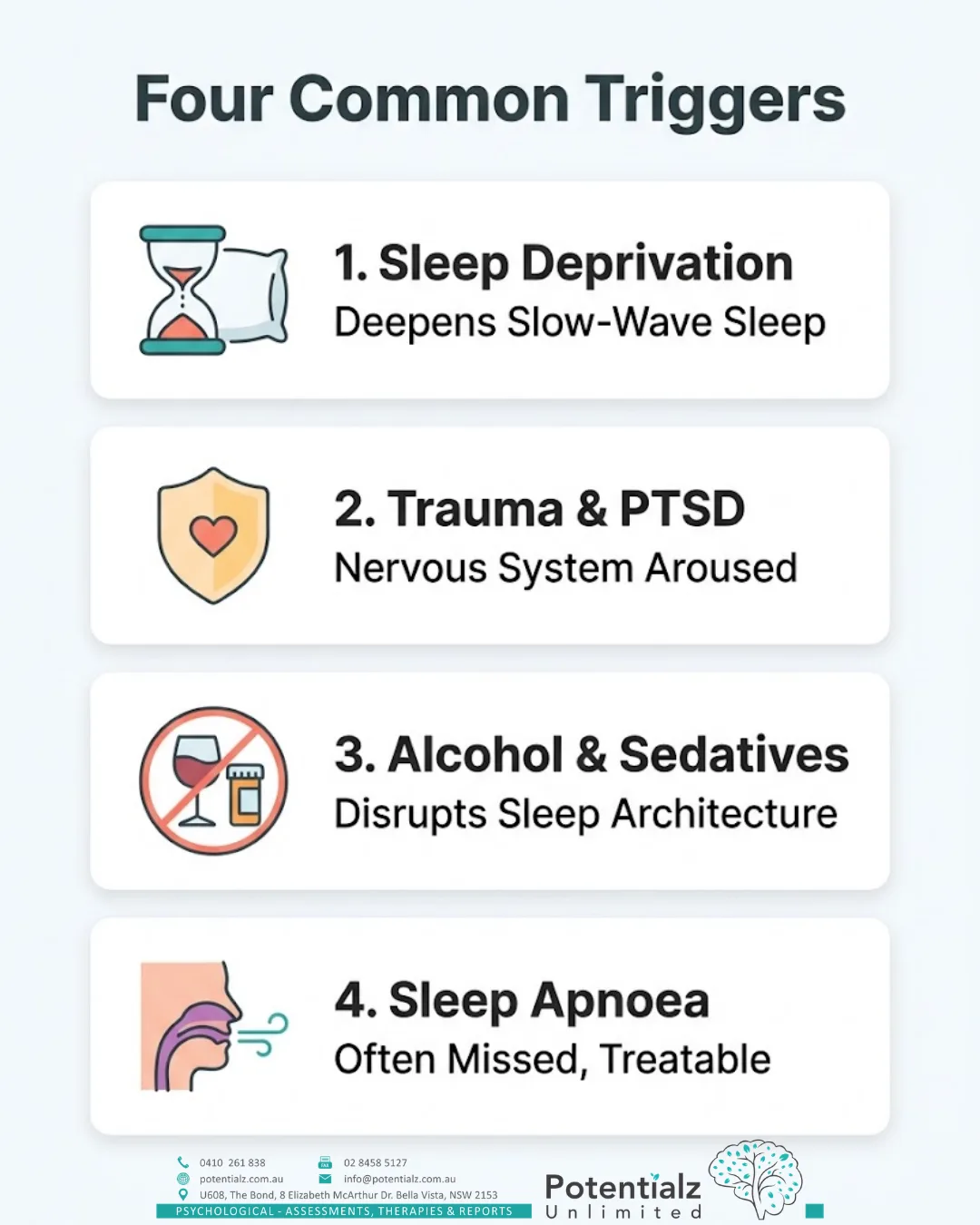
Sleep deprivation. Insufficient sleep deepens subsequent slow-wave sleep, which is precisely the sleep stage from which night terrors emerge. Adults running chronic sleep debt — shift workers, new parents, high-stress professionals — are at elevated risk. This is one of the most modifiable factors.
Trauma and PTSD. A traumatised nervous system remains hyper-aroused into deep sleep. Night terrors are a recognised feature of PTSD in adults, and adult-onset night terrors following a specific traumatic event are one of the more well-established clinical patterns (Nielsen et al., 2000). Combat veterans, survivors of assault, first responders, and adults with childhood trauma histories are over-represented in adult night terror clinics.
Alcohol and sedatives. Alcohol, benzodiazepines, some antidepressants, and other sedatives disrupt sleep architecture in ways that can precipitate parasomnias. Withdrawal from these substances can also trigger episodes. An honest medication and substance review is a standard part of assessment.
Febrile illness and physical stress. Fever, illness, and post-surgical states can trigger transient episodes.
Psychiatric comorbidity. Depression, anxiety disorders, and substance use disorders are over-represented in adults with parasomnias, though the direction of causality is not always clear.
Sleep-disordered breathing. Obstructive sleep apnoea can precipitate arousal-based parasomnias and is often missed. This is a specific reason a formal sleep assessment can be valuable — treat the apnoea and the parasomnia often resolves.
Neurological conditions. Rarely, adult-onset “night terrors” turn out to be nocturnal seizures, particularly frontal lobe seizures, which can look strikingly similar to a bed partner. This is one of the important differential diagnoses that a sleep study can help clarify.
When to Get a Sleep Study
The American Academy of Sleep Medicine practice parameters (Aurora et al., 2010) recommend polysomnography — an overnight in-lab sleep study — for adult parasomnias that are:
- Frequent — occurring often enough to be clinically significant
- Injurious or dangerous — involving falls, running, aggressive movement, or risk to self or bed partner
- Complex — involving unusual behaviours that are difficult to categorise
- Of new adult onset — new-onset in adulthood without a clear precipitant
- Diagnostically unclear — where the differential includes nocturnal seizures, REM sleep behaviour disorder, or another sleep disorder
A sleep study is not needed for every adult who has an occasional episode. But for the patterns above, the study protects against missing a treatable cause (like sleep apnoea) or a serious mimicker (like nocturnal epilepsy). Your GP is the right person to make the referral to a sleep physician.
When to See a Psychologist versus a Sleep Physician versus a GP
This is a common practical question. A rough guide:
- GP first. For most people, the first stop is a GP for a medical review — medications, substances, general health, mental health screening, and to organise referrals as needed.
- Sleep physician where the pattern is frequent, injurious, complex, of new adult onset, or where sleep-disordered breathing or a neurological cause needs to be ruled out. The sleep physician runs the polysomnography and manages the medical dimension.
- Clinical psychologist where trauma, PTSD, chronic stress, or entrenched sleep-related anxiety appears to be driving or maintaining the pattern — or in parallel with sleep medicine, addressing the psychological dimension.
None of these excludes the others. Complex parasomnias are best managed collaboratively.
What Psychological Treatment Looks Like
Psychological treatment does not directly change the underlying sleep architecture in the way sleep medicine does. What it does — often decisively — is address the psychological drivers that keep the arousal system hyperactive into deep sleep.
Trauma-focused psychological therapy is the single most useful thing where PTSD or unresolved trauma is underneath. In my practice, that most often means EMDR (Eye Movement Desensitisation and Reprocessing), which has strong evidence for PTSD generally and produces improvement in sleep disturbance including parasomnias in a substantial subset of clients. Trauma-focused CBT and prolonged exposure are the other main evidence-based options; the choice depends on the presentation and the person.
Cognitive-behavioural therapy for insomnia (CBT-I) is the evidence-based treatment for insomnia and is often relevant here, because sleep restriction and sleep-onset anxiety commonly co-exist with parasomnias and reinforce them. CBT-I addresses the sleep-hygiene, sleep-restriction, and stimulus-control fundamentals.
Imagery Rehearsal Therapy (IRT) — developed by Krakow and colleagues (Krakow et al., 2001) — is a brief cognitive-behavioural protocol for trauma-related nightmares. Strictly, IRT targets REM-based nightmares, not N3-based night terrors — but in PTSD the two commonly co-occur, and IRT can meaningfully reduce the overall nocturnal distress. It involves selecting a recurring nightmare, rewriting it in a non-threatening way while awake, and rehearsing the rewritten version deliberately in the days that follow.
Sleep-hygiene work — protecting sleep duration, consistent wake time, evening wind-down, moderating alcohol, addressing evening screen use — is not optional add-on advice; it is core treatment. Sleep debt directly deepens N3 and directly increases night terror risk.
Scheduled awakenings — briefly rousing the person about 15–30 minutes before the usual episode time, over one or two weeks — has some evidence in children and can be used adjunctively in adults where episodes are predictable, though it is generally a secondary rather than primary intervention.
If you or your partner have thoughts of not wanting to be here, please reach out for urgent support now: call Lifeline on 13 11 14, contact Beyond Blue on 1300 22 4636, or in an emergency call 000.
What Trauma-Focused Treatment Actually Looks Like in the Room
Where PTSD or unresolved trauma is the driver, treatment usually unfolds in phases. Early sessions focus on assessment, formulation, and stabilisation — a careful history of the trauma and the sleep pattern, screening for co-occurring conditions (depression, anxiety, substance use, ADHD), and building the regulation capacity that makes deeper trauma work tolerable. For many clients this stabilisation phase includes CBT-I fundamentals, DBT distress-tolerance skills, and psychoeducation about how trauma reshapes the nervous system and sleep architecture. Rushing to trauma processing before this ground is in place tends to produce worse outcomes, including transient worsening of nocturnal symptoms.
Middle sessions do the trauma-focused work. In my practice this is most often EMDR, working through specific target memories with the standard eight-phase protocol. Where nightmares are prominent alongside the night terrors — as they often are in PTSD — Imagery Rehearsal Therapy is added as a targeted intervention for the recurring dream content. Sleep-hygiene work runs in parallel throughout, because the nervous system does not process trauma effectively while it is chronically sleep-deprived, and because sleep debt directly deepens the N3 sleep from which night terrors emerge.
Later sessions consolidate the gains, address the parts of the trauma story that were harder to reach earlier, and support the person’s return to a fuller life — including relationships, work, and the ordinary daytime concerns that trauma had been crowding out. Progress is rarely linear. Night terror frequency and intensity often reduce substantially before they fully resolve, and it is normal for episodes to briefly increase during active trauma processing before they settle further. Naming this at the start prevents it being read as failure when it happens.
Safety in the Room — Practical Steps for the Bed Partner
Living with someone who has night terrors is its own form of stress, and there are practical steps that matter.
- Do not try to fully wake the person during an episode. Full wakening is difficult and often increases distress and confusion. Speak calmly and quietly, keep them safe, and let the episode pass.
- Make the sleeping environment safe — remove sharp objects and tripping hazards from beside the bed, consider a floor mattress if there is any risk of falling from bed, lock external doors and windows in the rare cases where sleepwalking co-occurs.
- Do not confront in the morning with the details. The person genuinely does not remember, and detailed morning reconstructions often produce guilt or shame without changing the pattern.
- Look after your own sleep. A partner who is progressively sleep-deprived from disrupted nights ends up with their own cascade of problems. Where episodes are frequent, temporary separate sleeping arrangements are a legitimate short-term step, not a failure.
- Get your own support if you need it. Watching a loved one in apparent terror repeatedly is not a small thing. Two or three sessions with a psychologist for the bed partner can be genuinely useful.
Multicultural Context — Sleep, Stigma, and Naming
In many cultural contexts I work with, disrupted sleep and parasomnias have folk explanations — spiritual, ancestral, or moral — that carry weight for the person even when they no longer fully believe them intellectually. In South Asian communities in particular, adult sleep disturbance is often minimised, framed as weakness, or attributed to lifestyle failure rather than treated as a clinical concern. This delays help-seeking. Where trauma sits underneath — including intergenerational trauma, migration trauma, or domestic-violence trauma that was never named — the delay can be years. Naming the clinical framing without dismissing the cultural framing is often part of the early work. People do not need to abandon their meaning-making system to accept evidence-based treatment.
Practical First Steps While You Book
Whether or not you end up in therapy, these are useful:
- Protect sleep duration — aim for a consistent seven to nine hours; sleep debt directly worsens night terrors
- Consistent wake time — even on weekends; irregular wake times destabilise deep-sleep architecture
- Moderate alcohol and evening sedatives — both fragment sleep and can precipitate episodes
- Keep a sleep diary for two weeks — bedtime, wake time, episodes, alcohol, medication, unusual stressors. This is the raw material for any clinical assessment
- Ask your bed partner for a factual description — position, duration, any complex behaviour, any injury. Written down is more useful than remembered
- Make the bedroom safe — clear the floor beside the bed, secure external doors, remove sharp objects from the bedside
- Book your GP — for a medical review, medication check, and consideration of a sleep physician referral
How Potentialz Unlimited Can Help
Potentialz Unlimited is a clinical psychology practice based in Bella Vista, NSW, serving adults and families across the Hills District — Norwest, Castle Hill, Kellyville, Baulkham Hills, Rouse Hill, and Glenhaven.
I am Dr Gurprit Ganda, a Clinical Psychologist with over 25 years of experience. I offer assessment and evidence-based psychological treatment for adult night terrors where a psychological driver — trauma, PTSD, chronic stress, or entrenched sleep disruption — is present or suspected. Treatment integrates EMDR, trauma-focused CBT, CBT for insomnia (CBT-I), and Imagery Rehearsal Therapy where trauma-related nightmares co-occur. Where the presentation warrants medical assessment — a sleep study, medication review, or a sleep physician’s input — I work alongside your GP on the referral pathway. Sessions available in English, Hindi, Punjabi, and Urdu. Medicare rebates are available with a GP Mental Health Care Plan. You can contact the clinic or book directly at live.potentialz.com.au.
Related Reading
More from our blog:
- PTSD: Understanding Trauma’s Lasting Impact and the Treatments That Work
- What Causes Sudden Night Terrors in Adults
- From Sleepless to Serene: An Asian Australian Journey Through EMDR Therapy
Therapy services that may help:
References
American Academy of Sleep Medicine. (2023). International classification of sleep disorders (3rd ed., text revision). American Academy of Sleep Medicine.
Aurora, R. N., Zak, R. S., Maganti, R. K., Auerbach, S. H., Casey, K. R., Chowdhuri, S., Karippot, A., Ramar, K., Kristo, D. A., & Morgenthaler, T. I. (2010). Best practice guide for the treatment of REM sleep behavior disorder (RBD). Journal of Clinical Sleep Medicine, 6(1), 85–95. https://doi.org/10.5664/jcsm.27717
Krakow, B., Hollifield, M., Johnston, L., Koss, M., Schrader, R., Warner, T. D., Tandberg, D., Lauriello, J., McBride, L., Cutchen, L., Cheng, D., Emmons, S., Germain, A., Melendrez, D., Sandoval, D., & Prince, H. (2001). Imagery rehearsal therapy for chronic nightmares in sexual assault survivors with posttraumatic stress disorder: A randomized controlled trial. JAMA, 286(5), 537–545. https://doi.org/10.1001/jama.286.5.537
Nielsen, T. A., Laberge, L., Paquet, J., Tremblay, R. E., Vitaro, F., & Montplaisir, J. (2000). Development of disturbing dreams during adolescence and their relation to anxiety symptoms. Sleep, 23(6), 727–736. https://doi.org/10.1093/sleep/23.6.1
Ohayon, M. M., Guilleminault, C., & Priest, R. G. (1999). Night terrors, sleepwalking, and confusional arousals in the general population: Their frequency and relationship to other sleep and mental disorders. Journal of Clinical Psychiatry, 60(4), 268–276. https://doi.org/10.4088/JCP.v60n0413
Schenck, C. H., & Mahowald, M. W. (2000). Parasomnias: Managing bizarre sleep-related behavior disorders. Postgraduate Medicine, 107(3), 145–156. https://doi.org/10.3810/pgm.2000.03.932
Schenck, C. H., & Mahowald, M. W. (2002). REM sleep behavior disorder: Clinical, developmental, and neuroscience perspectives 16 years after its formal identification in SLEEP. Sleep, 25(2), 120–138. https://doi.org/10.1093/sleep/25.2.120
Stallman, H. M., & Kohler, M. (2016). Prevalence of sleepwalking: A systematic review and meta-analysis. PLOS ONE, 11(11), e0164769. https://doi.org/10.1371/journal.pone.0164769
Knowledge Check Quiz
Test what you have just read. Choose your answer for each question, then submit to reveal the answers and your score.
Need Professional Support?
If you're experiencing mental health concerns, our team is here to help.