Key Takeaways
- Most conflict in relationships doesn’t come from bad intentions — it comes from unmet needs that get expressed as blame, criticism, or silence.
- Marshall Rosenberg’s Non-Violent Communication (NVC) model gives you four clear steps: observations, feelings, needs, requests.
- NVC is different from passive aggression, suppression, or attack — it’s a direct, honest, and compassionate way of communicating.
- Self-empathy — being able to identify and validate your own feelings and needs — is the essential first step before you can genuinely offer empathy to others.
- NVC works in families, workplaces, couples, and even conflict mediation settings.
- Counselling can help you learn and practise NVC in the context of your own relationships, where the stakes are highest.
Most arguments are not really about what they appear to be about.
Think about the last time you had a fight about something small — the dishes, a forgotten errand, a comment that landed wrong. The surface topic is rarely the real topic.
The fight about who forgot to call the plumber is usually about feeling unheard or undervalued. The standoff at the dinner table is usually about a need for respect that has gone unacknowledged for too long. The cold silence between partners after a difficult week is usually about longing for connection — expressed through withdrawal because speaking directly feels too vulnerable or too risky.
Marshall Rosenberg, the psychologist and mediator who developed Non-Violent Communication, built his entire framework on this insight: conflict is almost never really about the surface content. It is about unmet needs — and what happens when those needs come out as blame, criticism, demands, or silence instead of honest, direct communication.
This post explains what NVC is, how it works in practice, how it differs from the communication patterns most of us learned growing up, and how counselling can support you to genuinely integrate it into your relationships.
What Is Non-Violent Communication?
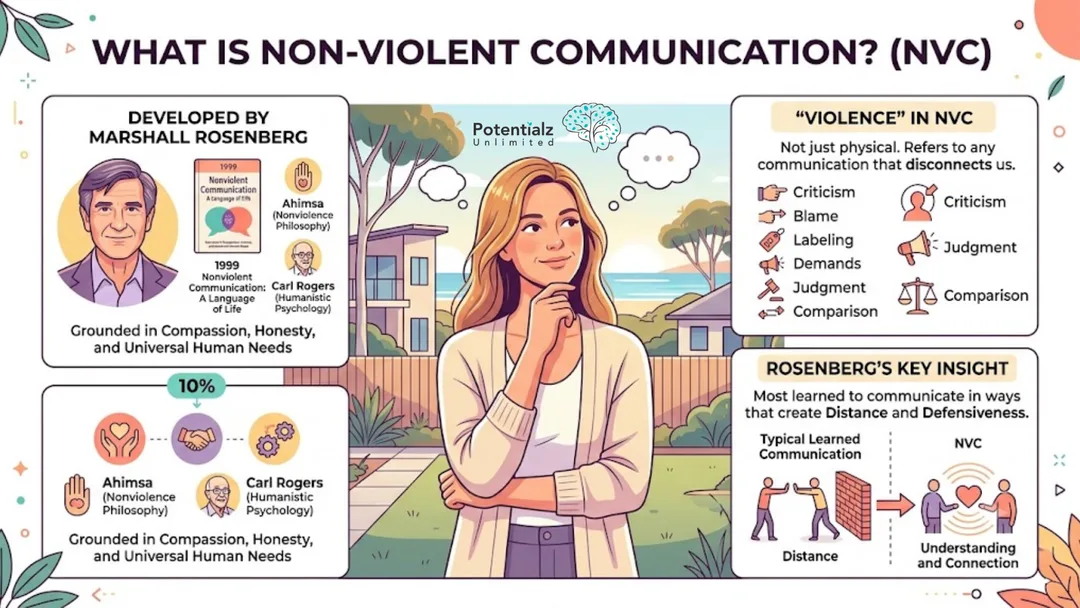
Non-Violent Communication is a framework developed by Marshall Rosenberg, first described in his 1999 book Nonviolent Communication: A Language of Life. Rosenberg drew on the philosophy of nonviolence (ahimsa) and the work of humanistic psychologist Carl Rogers to create a model grounded in compassion, honesty, and the universal nature of human needs.
The word “violence” in the name doesn’t refer only to physical violence. It refers to any communication that disconnects us from one another — criticism, blame, labelling, demands, judgment, and comparison.
Rosenberg noticed something important: most of us learned to communicate in ways that, despite our best intentions, create distance and defensiveness rather than understanding. NVC offers a genuine alternative.
The Four Components of NVC
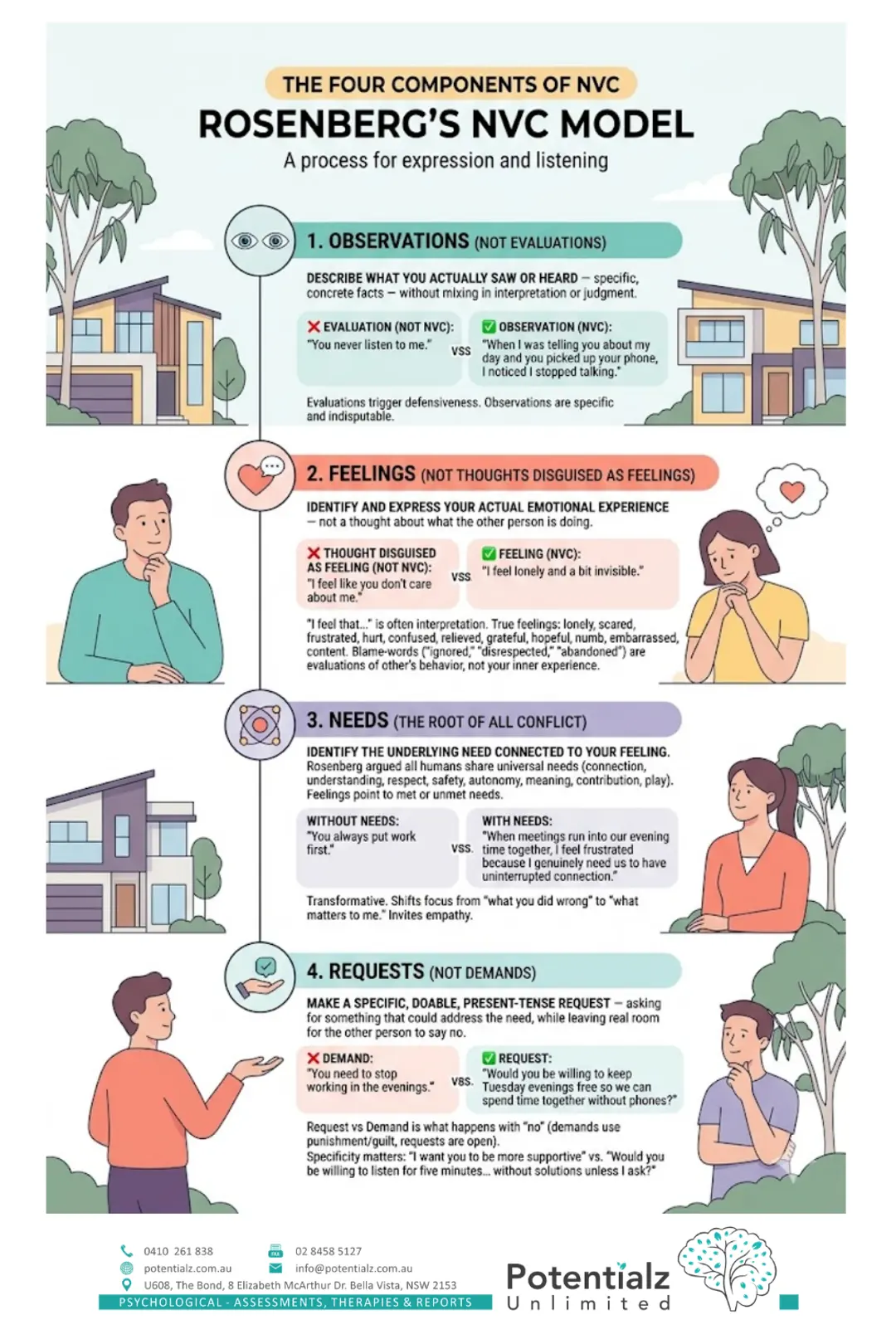
Rosenberg’s model has four components that work both for expressing yourself and for listening to others.
1. Observations (Not Evaluations)
The first step is to describe what you actually saw or heard — the specific, concrete facts — without mixing in interpretation or judgment.
Evaluation (not NVC): “You never listen to me.” Observation (NVC): “When I was telling you about my day and you picked up your phone, I noticed I stopped talking.”
The distinction matters because evaluations immediately trigger defensiveness. When someone hears “you never listen,” they are likely to argue about whether that is true — rather than engaging with whatever the real concern is. An observation, by contrast, is much harder to dispute. It refers to something specific that actually happened.
2. Feelings (Not Thoughts Disguised as Feelings)
The second step is to identify and express your actual emotional experience — not a thought about what the other person is doing.
Thought disguised as a feeling (not NVC): “I feel like you don’t care about me.” Feeling (NVC): “I feel lonely and a bit invisible.”
This is one of the most common stumbling blocks in NVC practice. Many people use the phrase “I feel that…” followed by an interpretation — which is not a feeling statement at all. Genuine feeling words include: lonely, scared, frustrated, hurt, confused, relieved, grateful, hopeful, numb, embarrassed, content.
Feeling words that include blame — “I feel ignored,” “I feel disrespected,” “I feel abandoned” — are actually evaluations of the other person’s behaviour, not descriptions of your inner experience. That’s a subtle but important difference.
3. Needs (The Root of All Conflict)
The third and most powerful component is identifying the underlying need that is connected to your feeling. Rosenberg argued that all human beings share a universal set of needs — for connection, understanding, respect, safety, autonomy, meaning, contribution, and play, among others — and that feelings are always pointing back to whether those needs are met or not.
This step is transformative. It shifts the conversation from “what you did wrong” to “what matters to me.” It invites empathy rather than defensiveness.
Without needs: “You always put work first.” With needs: “When meetings run into our evening time together, I feel frustrated because I genuinely need us to have uninterrupted connection.”
4. Requests (Not Demands)
The fourth component is making a specific, doable, present-tense request — asking for something that could genuinely address the need, while leaving real room for the other person to say no.
The difference between a request and a demand is what happens if the answer is no. A demand is enforced through punishment, guilt, or withdrawal. A request is held with genuine openness to a different answer.
Demand: “You need to stop working in the evenings.” Request: “Would you be willing to keep Tuesday evenings free so we can spend time together without phones?”
Requests should be specific rather than vague. “I want you to be more supportive” tells the other person nothing they can actually act on. “Would you be willing to listen for five minutes when I talk about my day, without offering solutions unless I ask?” — that’s a request.
How NVC Differs From Other Communication Patterns
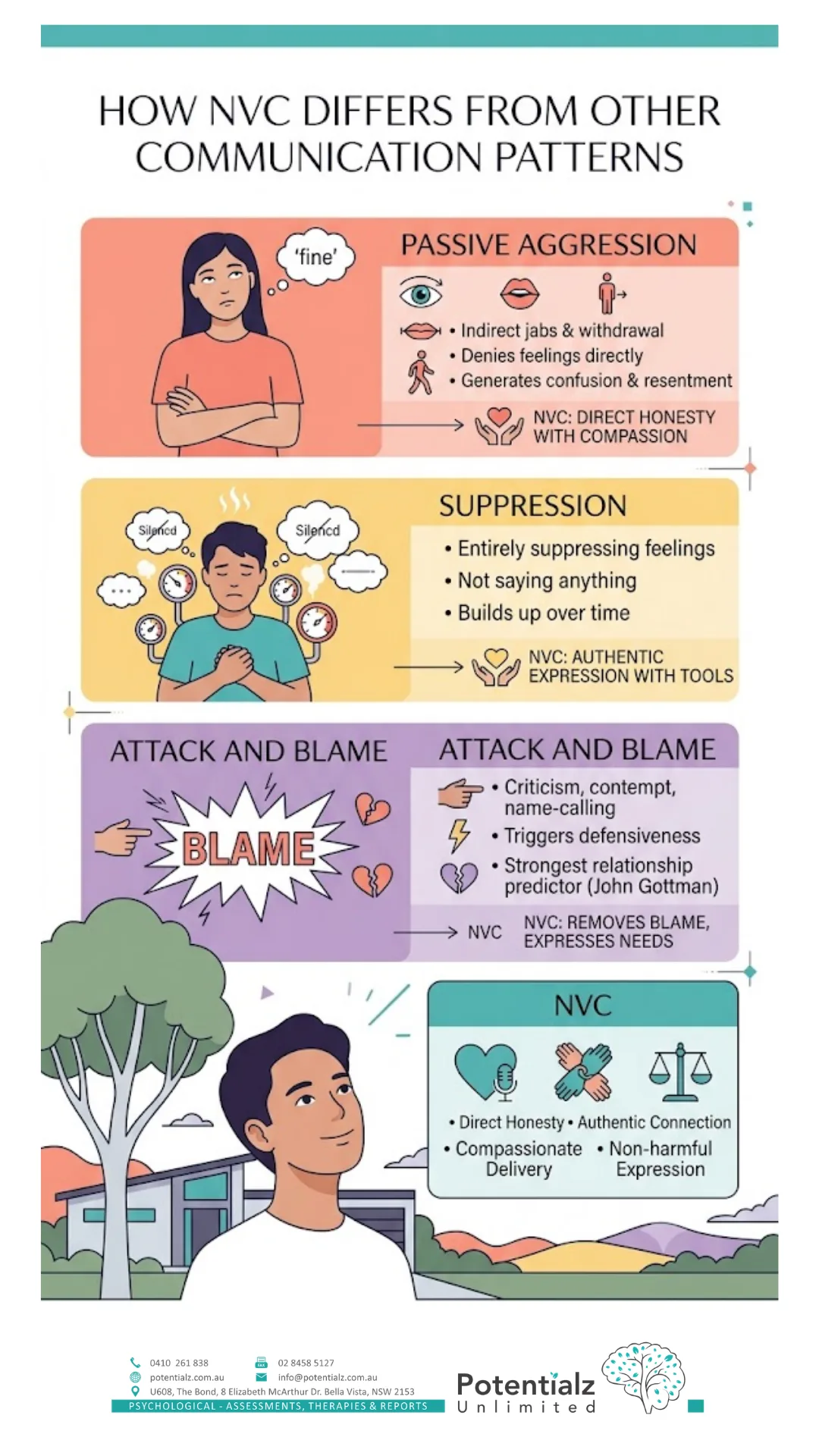
Passive Aggression
Passive aggression — the eye roll, the “fine,” the withdrawal, the indirect jab — is the opposite of NVC. It expresses negative feelings through indirect, often deniable channels rather than directly and honestly. It tends to generate confusion and resentment rather than resolution.
NVC asks for direct honesty, delivered with compassion. That combination is rarer than you might think.
Suppression
Many people cope with difficult relational moments by suppressing their feelings entirely — not saying anything, telling themselves it doesn’t matter, or disconnecting from the emotional experience. While suppression can look like keeping the peace, it tends to build up over time.
NVC encourages authentic expression — while giving you the tools to do so without causing harm.
Attack and Blame
Direct attack — criticism, contempt, name-calling — is perhaps the most damaging pattern of all. Relationship researcher John Gottman identified it as one of the strongest predictors of relationship breakdown. Attack triggers defensiveness, counterattack, and emotional flooding. NVC removes the blame from the equation entirely, making it possible to express strong feelings and important needs without shutting the other person down.
The Role of Self-Empathy
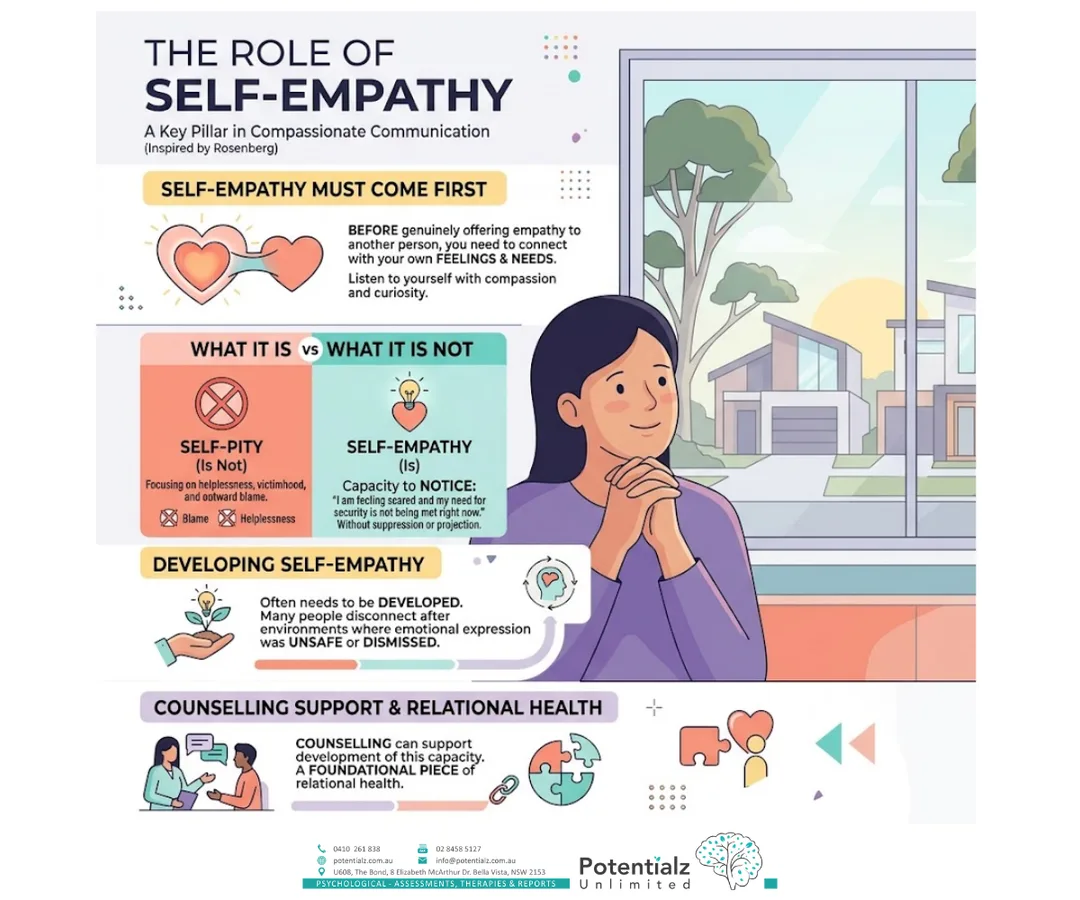
One of Rosenberg’s most important contributions is his insistence that self-empathy must come first. Before you can genuinely offer empathy to another person, you need to be able to connect with your own feelings and needs — to listen to yourself with the same compassion and curiosity you are trying to bring to the other person.
Self-empathy is not self-pity. It is the capacity to notice “I am feeling scared and my need for security is not being met right now” — rather than either suppressing that experience or projecting it outward as blame.
In my experience, self-empathy often needs to be developed. Many people — especially those who grew up in environments where emotional expression was unsafe or dismissed — have learned to disconnect from their own emotional experience. Counselling can support the development of this capacity as a foundational piece of relational health.
NVC in Practice: Real Scenarios
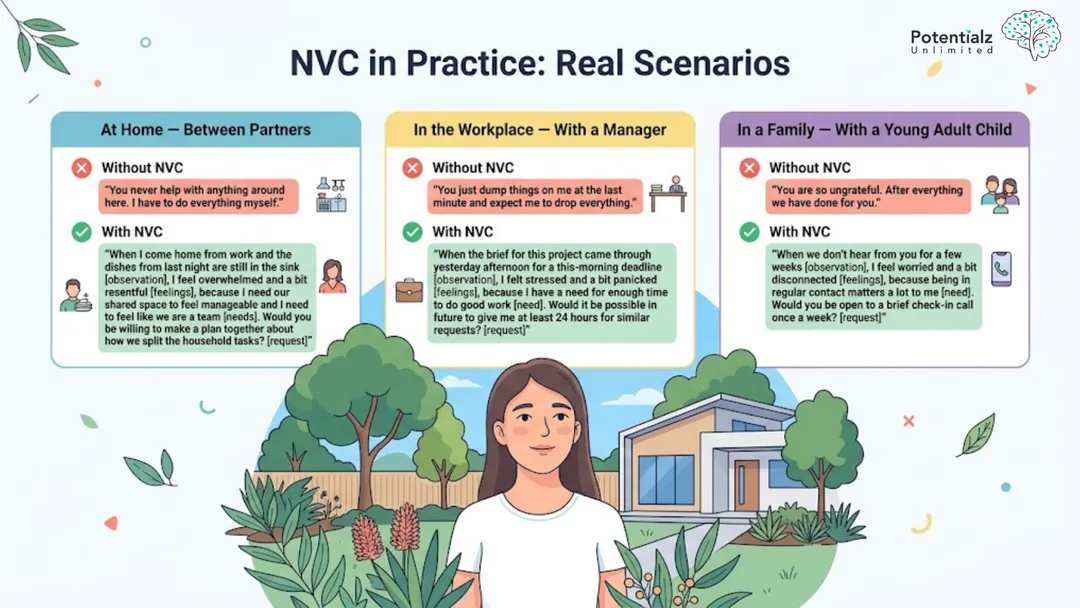
At Home — Between Partners
Without NVC: “You never help with anything around here. I have to do everything myself.”
With NVC: “When I come home from work and the dishes from last night are still in the sink [observation], I feel overwhelmed and a bit resentful [feelings], because I need our shared space to feel manageable and I need to feel like we are a team [needs]. Would you be willing to make a plan together about how we split the household tasks? [request]“
In the Workplace — With a Manager
Without NVC: “You just dump things on me at the last minute and expect me to drop everything.”
With NVC: “When the brief for this project came through yesterday afternoon for a this-morning deadline [observation], I felt stressed and a bit panicked [feelings], because I have a need for enough time to do good work [need]. Would it be possible in future to give me at least 24 hours for similar requests? [request]“
In a Family — With a Young Adult Child
Without NVC: “You are so ungrateful. After everything we have done for you.”
With NVC: “When we don’t hear from you for a few weeks [observation], I feel worried and a bit disconnected [feelings], because being in regular contact matters a lot to me [need]. Would you be open to a brief check-in call once a week? [request]“
Research on NVC Outcomes
The research base for NVC has grown steadily since the 1990s, and studies have found NVC training to be helpful across a range of contexts. Work by Lasley (2010) reported reductions in interpersonal conflict and gains in empathy among people trained in NVC. In healthcare settings, a field study found that NVC training reduced empathic distress and social stressors among health professionals (Wacker & Dziobek, 2018), and a systematic review found NVC valuable in interprofessional education and communication (Materne et al., 2016).
The results point in a consistent direction: learning to communicate needs directly — rather than through blame or withdrawal — supports better relationships across the settings where it has been studied. As with any body of research, these findings are best read as encouraging rather than the final word, and a single study rarely settles a question on its own.
How Samita Integrates NVC into Counselling
I integrate NVC throughout my couples and family counselling work at Potentialz Unlimited. What I love about NVC is that it’s not just a technique — it’s a way of relating that reflects genuine respect for everyone in the room.
In individual sessions, I use NVC to help clients develop self-empathy, identify their underlying needs, and practise expressing those needs in ways that don’t immediately trigger defensiveness in the people they care about.
In couples work, NVC provides a shared language — a set of agreed tools that both partners can use to slow down their communication, reduce reactivity, and get underneath the surface conflict to what is actually going on. You can read more in our guides to couples counselling in Bella Vista and how family therapy can strengthen relationships.
In family counselling, NVC can help bridge significant generational and cultural differences in how feelings and needs are expressed. This is particularly relevant in multicultural families and South Asian communities, where direct emotional expression may carry very different cultural meanings. My fluency in English, Hindi, Tamil, Kannada, and Urdu means I can meet clients in the language where these conversations feel most natural.
Rosenberg’s work aligns naturally with my own philosophy of non-violence and awareness-based living. NVC is not applied from the outside — it is a way of being that reflects genuine respect for the humanity of every person in the room.
Exercises You Can Try at Home
Exercise 1: The Feeling Inventory
Over the next week, when you notice a strong emotional reaction in a relationship, pause and ask yourself:
- What did I actually observe? (Stick to concrete facts — what was said or done, not your interpretation.)
- What am I feeling? (Use genuine feeling words — not “I feel that…”)
- What need is connected to this feeling? (Connection, safety, respect, autonomy, understanding?)
- What would I like to ask for? (Make it specific, doable, and genuinely a request rather than a demand.)
You don’t have to say any of this out loud immediately. The practice of connecting the feeling to the need is the most important first step.
Exercise 2: Translating Blame Into Needs
Take a complaint or criticism you’ve been holding about someone in your life. Write it down as a blame statement. Then ask: “What need of mine is not being met here?” Translate the complaint into a need statement.
For example: “She never takes my concerns seriously” might translate to: “My need to be genuinely heard, and to feel that my perspective matters.”
Notice how the second framing feels different in your body. Notice whether it changes how you might approach the conversation.
How Potentialz Can Help
If you find yourself in cycles of conflict that never quite resolve, or if you want to communicate more honestly without it always turning into a fight, I can help.
At Potentialz Unlimited in Bella Vista, I offer individual counselling, couples therapy, and family counselling with NVC principles woven throughout. Whether you’re struggling with conflict at home, communication difficulties at work, or the deeper relational patterns that keep you stuck, there is a way through.
To book an appointment, visit live.potentialz.com.au or call 0410 261 838. Sessions are available Monday to Friday, 10am to 7pm, in person at Bella Vista and via Telehealth. You can also meet our team or get in touch here.
This article is general information and is not a substitute for personalised advice from a qualified health professional. If you are in crisis or need urgent help, contact Lifeline on 13 11 14 (24/7) or call 000 in an emergency.
References
Gottman, J. M., & Silver, N. (1999). The seven principles for making marriage work. Crown Publishers.
Lasley, M. (2010). Facilitating communication in the workplace: Non-violent communication case study. OD Practitioner, 42(3), 13–18.
Materne, M., Bhanbhro, S., & Bhanbhro, A. (2016). Non-violent communication in interprofessional education: A systematic literature review. Nurse Education Today, 39, 150–163. https://doi.org/10.1016/j.nedt.2016.01.028
Rosenberg, M. B. (2015). Nonviolent communication: A language of life (3rd ed.). PuddleDancer Press.
Wacker, R., & Dziobek, I. (2018). Preventing empathic distress and social stressors at work through nonviolent communication training: A field study with health professionals. Journal of Occupational Health Psychology, 23(1), 141–150. https://doi.org/10.1037/ocp0000058
Related Reading
Knowledge Check Quiz
Test what you have just read. Choose your answer for each question, then submit to reveal the answers and your score.
Need Professional Support?
If you're experiencing mental health concerns, our team is here to help.