Key Takeaways
- Postnatal depression (PND) is a treatable condition — evidence-based therapies exist and are accessible in the Hills District.
- Two therapies have the strongest research base for PND specifically: cognitive behavioural therapy (CBT) and interpersonal therapy (IPT).
- The pathway in practice is almost always GP screening → talking therapy → a widened support network, with medication reviewed by the GP in parallel if clinically indicated.
- The baby blues (first two weeks) and postnatal depression (persistent beyond two weeks) are distinct — therapy is designed for the latter.
- Partners, family and the clinician work best as a triad, not three disconnected roles.
- Local Hills District access points include GP referral under a Mental Health Treatment Plan, PANDA, Karitane/Tresillian, and private psychology (including this practice).
If you are a new mother in the Hills District reading this, you already know the question. It is not “what is postnatal depression?” — the symptoms-and-signs reading sits in our earlier guide to postnatal depression symptoms and treatment and the broader new mother’s primer. The question is a quieter and more practical one: “what therapy actually helps, and how do I get to it from here?”
This post is the answer.
When is therapy the right call?
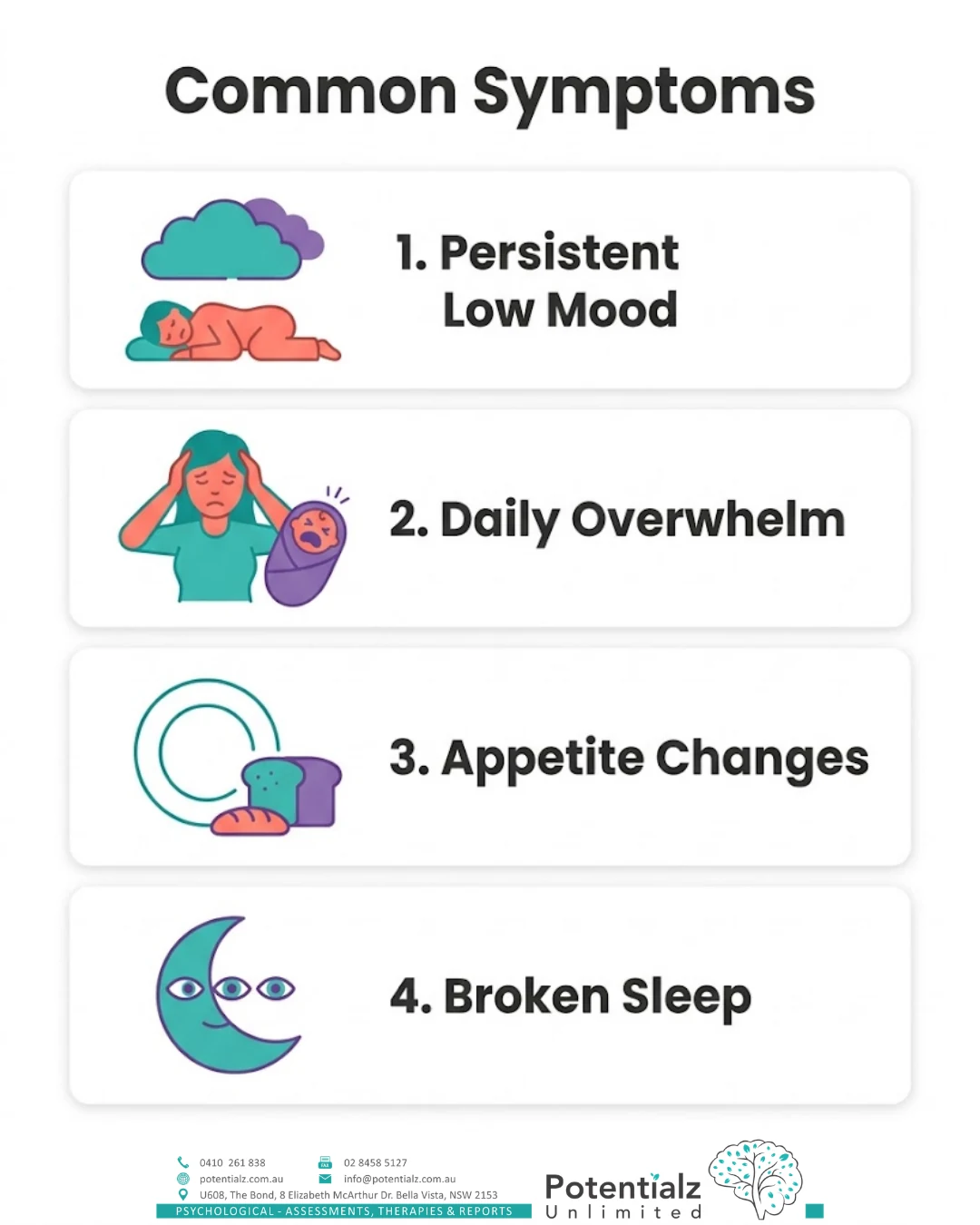
Therapy is designed for the picture that persists past the first two weeks after birth and that includes some combination of:
- Persistent low mood that does not shift across most days.
- Daily overwhelm that outsizes what the day actually contains.
- Appetite changes — eating much less or much more than feels right.
- Broken sleep that is not only about the baby — the kind where you cannot fall back asleep after a feed, or where you wake before the baby does.
Alongside these, many new mothers describe intrusive worries about the baby, loss of interest in things that previously mattered, a flat distance from the baby that feels wrong, or thoughts of being a burden. All of these are treatable, and none of them mean you are a bad mother. They mean a condition is in the room with you.
Baby blues or postnatal depression — a quick distinction
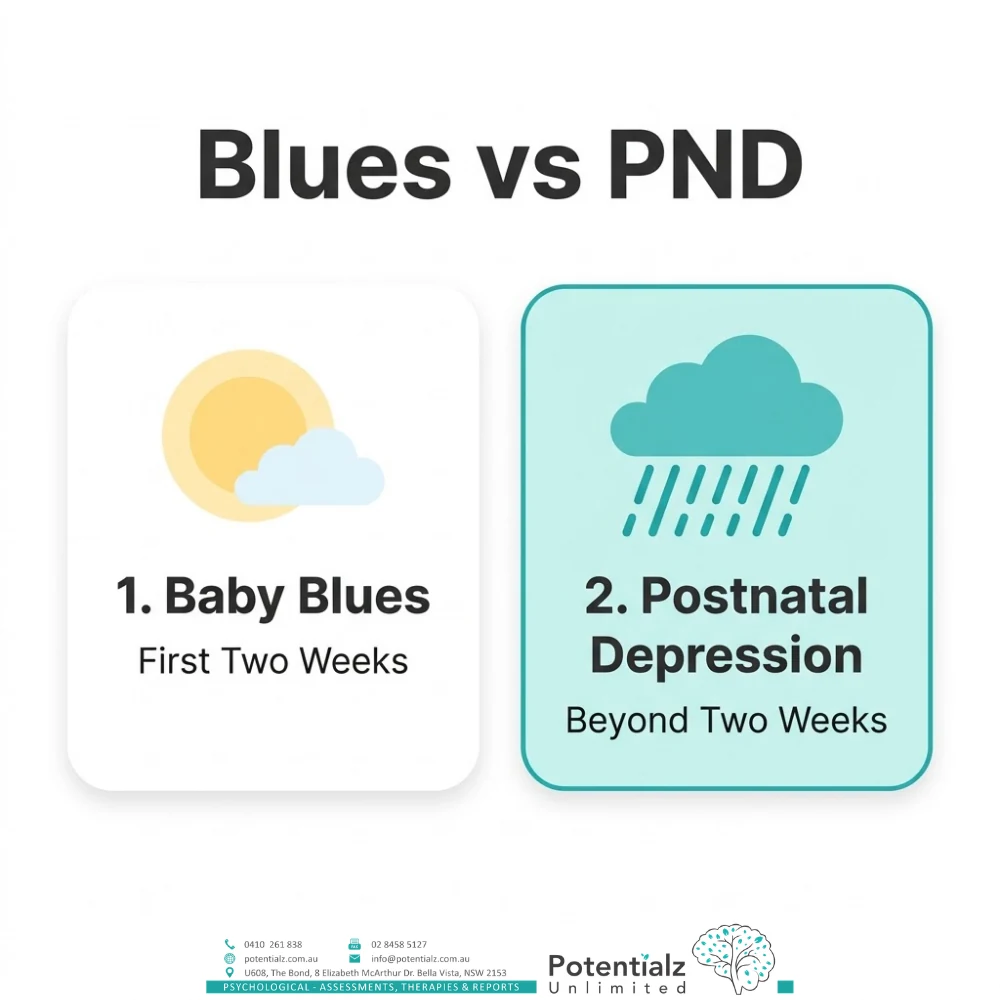
The baby blues are common, usually peak around day three to five after birth, and typically resolve on their own inside the first two weeks. They involve tearfulness, mood swings, and overwhelm, and they do not usually need treatment beyond rest and support.
Postnatal depression is distinguished by duration and depth. If the same cluster of symptoms is still present at two to three weeks post-birth, or if it starts later in the first year, that is the picture therapy is designed for. The two conditions are on a continuum, but their management is different, and the shift from one to the other is often where new mothers start to feel invisible — the people around them have assumed the early feelings will pass.
The evidence-based therapies
The research base for postnatal depression is substantial, and two therapy approaches sit at the top of it: cognitive behavioural therapy and interpersonal therapy. Several others play an important supporting role.
Cognitive behavioural therapy (CBT)
CBT works on the loop between thoughts, feelings and behaviour. For a new mother, that loop often looks like: a hard thought arrives (“I’m failing at this”), a wave of low mood follows, behaviour contracts (less going out, less talking, less self-care), the thought becomes more believable the next day. CBT interrupts the loop at both ends — testing the thought honestly, and widening the behaviour that follows it.
The evidence for CBT in postnatal depression is strong, including for mother-focused CBT groups and for individual CBT delivered face-to-face or by telehealth. Our broader CBT for anxiety and depression explainer covers how the modality works in general; in perinatal care it is adapted for the specific pressures of new parenthood — sleep deprivation, hormonal change, identity shift, and the practical reality that your “homework” has to fit around a newborn.
Interpersonal therapy (IPT)
IPT focuses on the territory most CBT does not emphasise: your current relationships, role transitions, and interpersonal patterns. For new mothers, this is often where the real work sits. The transition into motherhood, shifts in the relationship with a partner, strained communication with one’s own mother, isolation from previously-close friends — these are not symptoms to be reasoned away. They are the terrain of the condition.
IPT has a strong perinatal evidence base and is often chosen when a new mother says, “the thoughts aren’t the main thing — the relationships are.”
Mindfulness-based cognitive therapy (MBCT)
MBCT combines cognitive therapy tools with mindfulness practice. It has particularly strong evidence for preventing relapse in people with a history of depression, and is a sensible add-on for mothers who had depression before pregnancy and want to reduce the chance of recurrence postnatally. Our MBCT primer covers the approach in more depth.
Group-based and peer-supported programmes
Group therapy is not a lesser option; for some new mothers it is the better one. Being in a room (or on a call) with other mothers moving through the same thing is itself therapeutic. Group CBT and group IPT exist, and local organisations like PANDA offer peer-informed support alongside clinical care.
Medication, co-ordinated by your GP
For moderate-to-severe PND, your GP may discuss antidepressant medication as part of care. This is a medical conversation and is not something a psychologist prescribes. Where medication is appropriate, it works best in parallel with therapy — not instead of it. If you are breastfeeding, your GP will consider medication choice specifically through that lens; many antidepressants are compatible with breastfeeding, and this is a conversation to have openly.
The pathway in practice
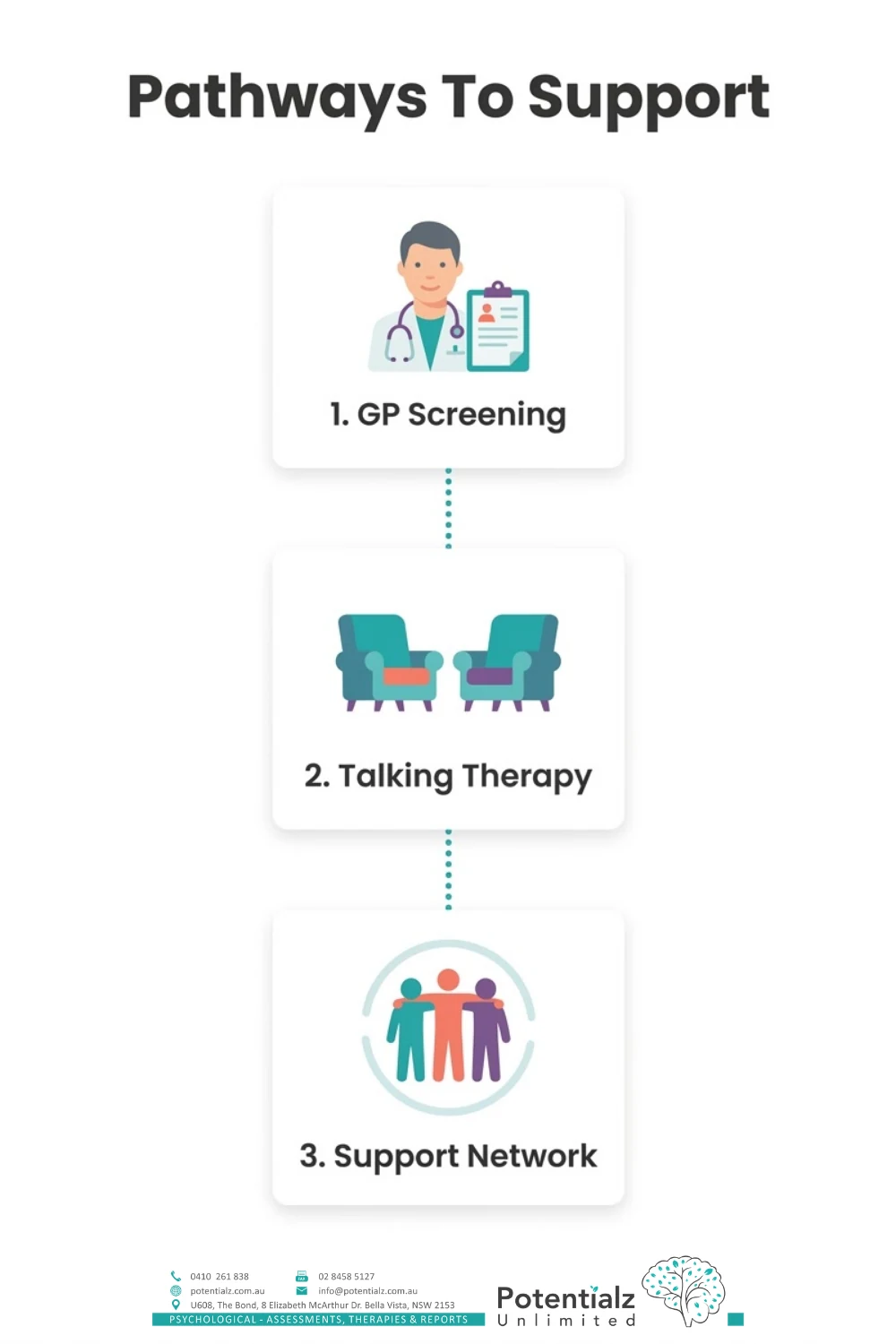
The pathway from “something is not right” to “I am getting help that works” has three usual steps in the Hills District:
1. GP screening. Your GP is the first stop. They can run a brief validated screening tool (usually the Edinburgh Postnatal Depression Scale) and, if indicated, prepare a Mental Health Treatment Plan under Medicare that funds a block of psychology sessions. Many Hills District GPs are experienced with perinatal mental health and this conversation is more common than you might think.
2. Talking therapy. With a plan in hand, you access CBT, IPT or an integrative perinatal-focused therapy with a psychologist. Private psychology practices (including ours) see new mothers both in person at Bella Vista and by telehealth. Telehealth can make an enormous difference when the baby is young and leaving the house for a one-hour appointment is itself a project.
3. Widening the support network. Therapy is primary; the network around it is what makes it stick. Partner involvement where possible, maternal and child health nurse visits, mothers’ groups, PANDA’s helpline for the harder nights, and Karitane or Tresillian for sleep-and-settling support where the compounding effect of exhaustion is doing damage.
The triad of care
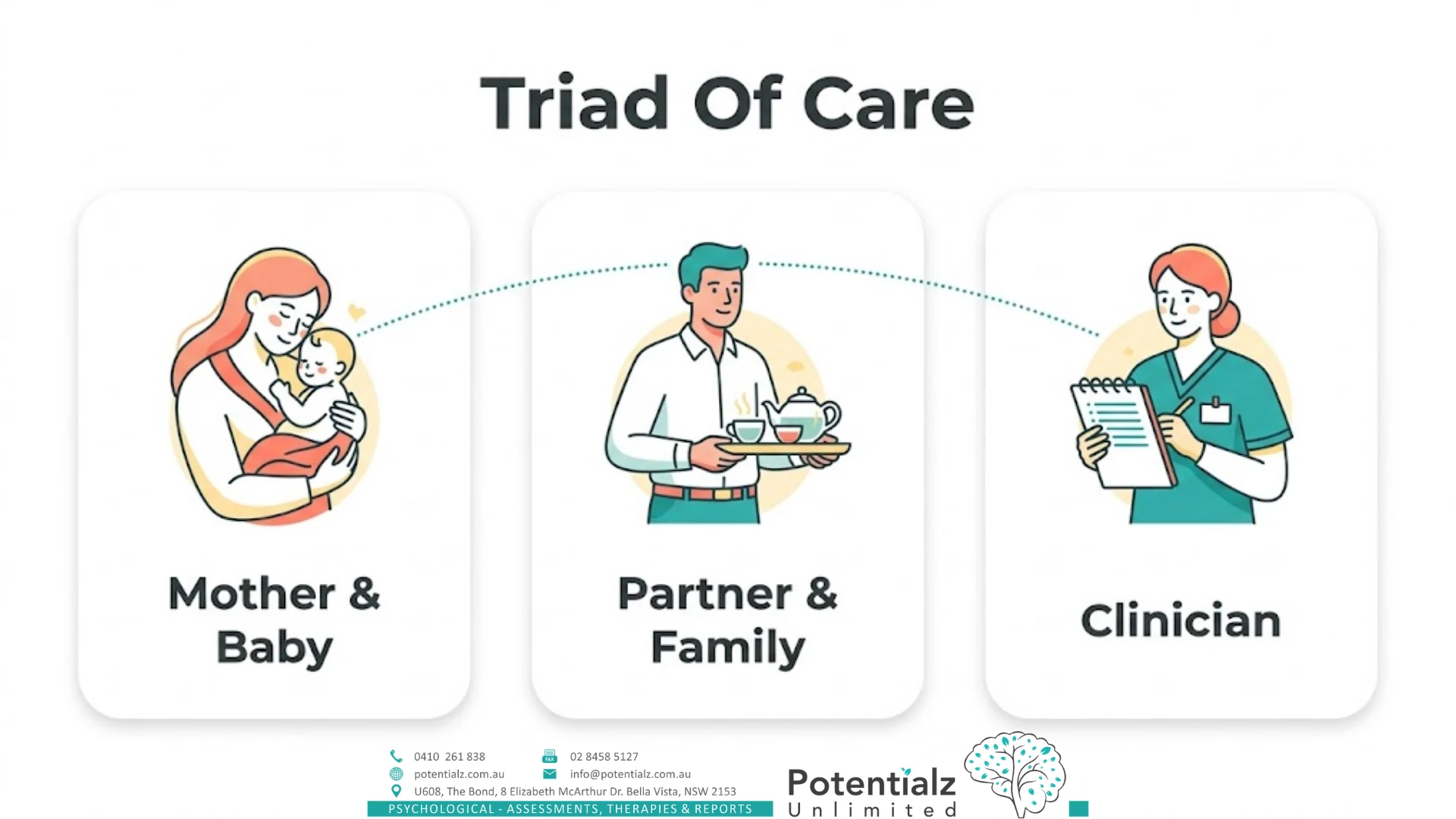
Postnatal depression responds best when care works as a triad, not three disconnected roles:
- Mother and baby. The therapy is for her, and part of its purpose is to support the attachment relationship as it develops.
- Partner and family. The people living with her are not bystanders. Their understanding of what she is navigating, their practical sharing of the load, and sometimes their own support (partners can experience postnatal depression too — see our paternal postnatal depression post) all shape recovery.
- Clinician. The psychologist holds the therapeutic frame; the GP holds the medical frame; the maternal and child health nurse holds the practical infant-care frame. These three communicate best when the mother is willing to have them loop in with each other.
Reaching out early is the right move
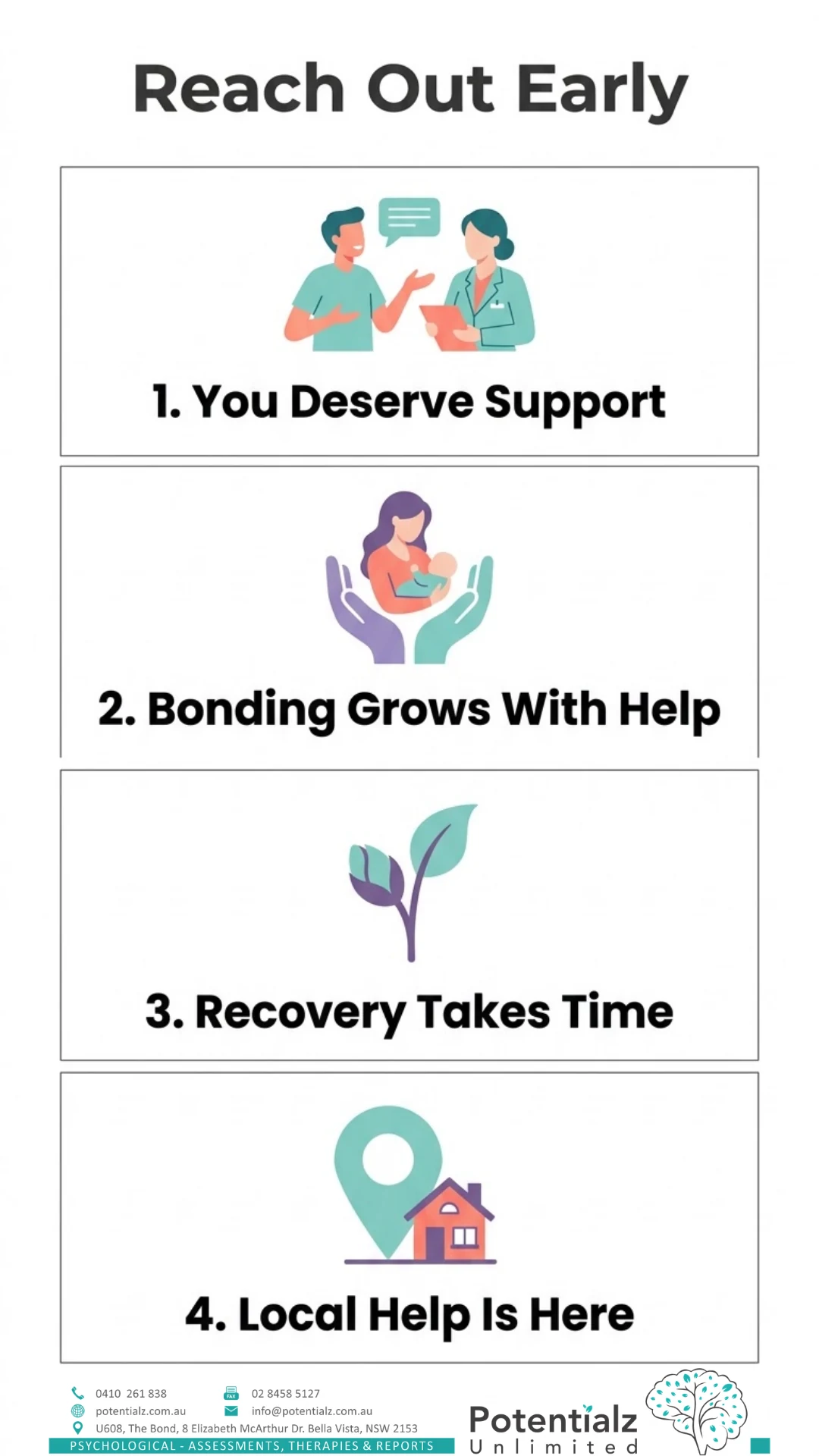
Many new mothers describe waiting much longer than they wish they had. The common reasons are familiar — “it will pass”, “I should be able to manage”, “I don’t want anyone to think I can’t cope”, “the baby comes first”. All of those are understandable, and all of them are the condition speaking.
Three things worth holding onto:
- You deserve support independent of how severe things feel. The threshold for reaching out is “something is not right”, not “I cannot cope at all”.
- Bonding grows with help, not without it. Treating PND actively protects the attachment relationship — therapy is not a distraction from the baby.
- Recovery takes time but is the norm. With evidence-based therapy, the majority of women with PND recover. The timeline is weeks to a few months in most cases; harder-end presentations take longer and still improve.
Local Hills District access points
- Your GP. First stop for screening, Mental Health Treatment Plan, and any medication conversation.
- PANDA (Perinatal Anxiety & Depression Australia). 1300 726 306. Peer and clinical support, including a national helpline staffed by people who understand the terrain.
- Karitane and Tresillian. Residential and day-stay support for sleep, settling and feeding — if exhaustion is compounding depression, these services are a critical intervention in their own right.
- Private psychology. Potentialz Unlimited offers CBT, IPT and integrative perinatal-focused therapy at our Bella Vista rooms and by telehealth across the Hills District. Our guide to finding the right psychologist covers what to look for.
- If things are urgent. Lifeline 13 11 14. If you or anyone in your care is in immediate danger, call 000.
Three next steps
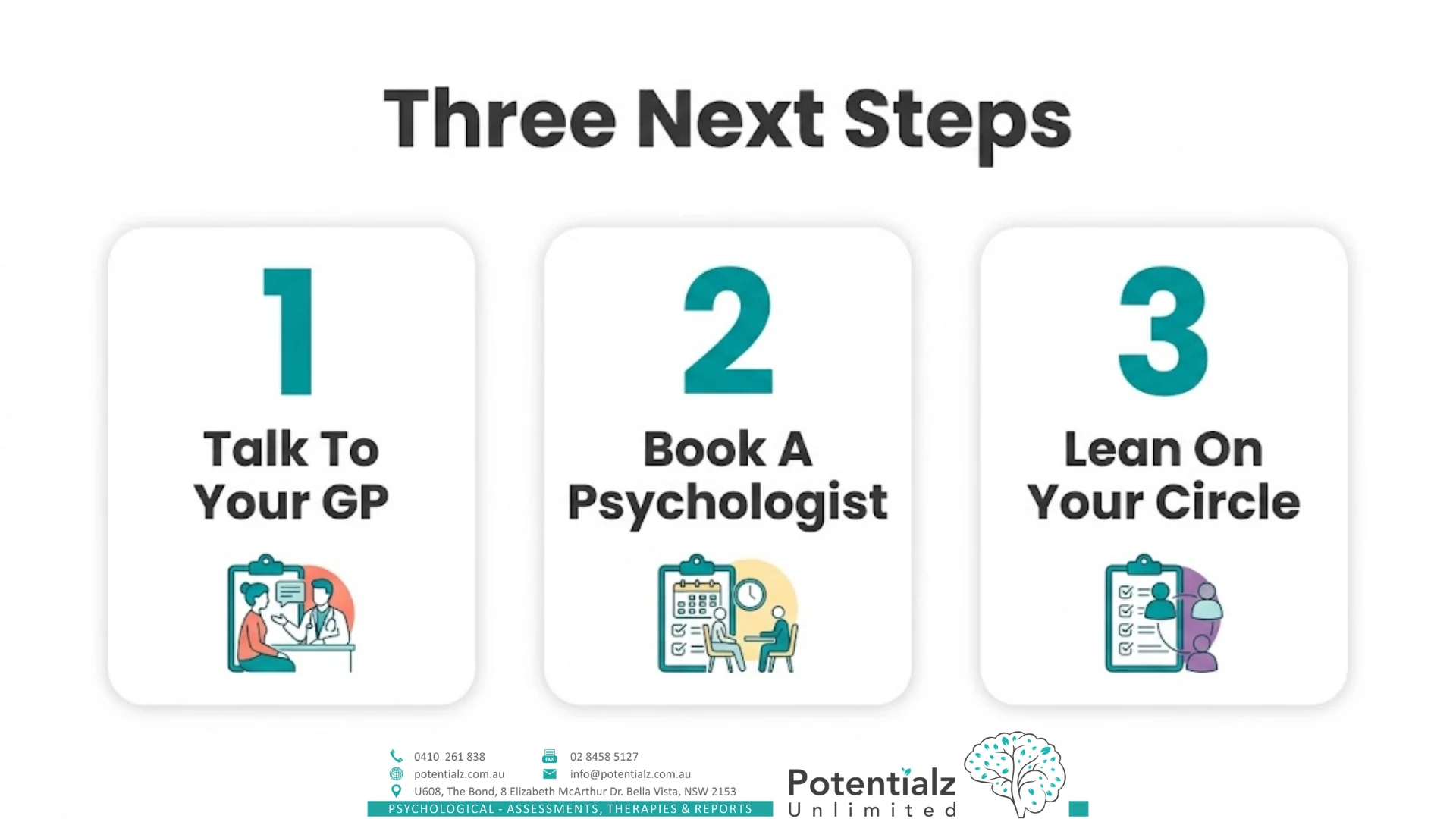
- Talk to your GP. Book a longer appointment, say “I think I might have postnatal depression”, and let them run through screening with you. This single step unlocks the rest.
- Book a psychologist. With your Mental Health Treatment Plan, book in with a psychology practice experienced in perinatal care. Telehealth is a legitimate option.
- Lean on your circle. Pick one person to be honest with this week — partner, parent, friend. Carrying this alone is harder, not more admirable.
Frequently asked questions
How is postnatal depression therapy different from regular depression therapy?
The core modalities (CBT, IPT) are the same, but perinatal-focused therapists adapt the pace, examples and homework to the specific pressures of early motherhood — sleep deprivation, hormonal change, identity shift, the practical reality of a newborn in the room. The therapy frame is also often more flexible on scheduling and format (including telehealth) because the logistics are different.
Can I do therapy for PND while breastfeeding?
Yes. Talking therapy has no interaction with breastfeeding. If medication becomes part of care, your GP will choose options that are compatible with breastfeeding — this is a routine conversation.
How long does PND therapy usually take?
Evidence-based protocols for CBT and IPT in PND are typically eight to sixteen sessions, though this varies by presentation. Many new mothers notice shift within the first four to six sessions, with the longer tail of work consolidating that shift.
Does my partner need to be involved?
Not required, but partner involvement — even one or two sessions — meaningfully improves outcomes for many families. The partner is often carrying their own version of the postnatal picture; our paternal postnatal depression post is a useful starting point for the partner specifically.
What if I had depression before pregnancy — is PND the same thing?
A prior history of depression increases risk for PND and makes early screening especially worthwhile. The therapy approach is similar, but relapse-prevention tools (such as MBCT) may play a larger role.
Can I access care if I am not in Bella Vista?
Yes. We see Hills District families across Baulkham Hills, Castle Hill, Norwest, Rouse Hill, Kellyville and surrounds, and offer telehealth for those for whom travelling with a newborn is impractical.
If you are a new mother or a worried partner and want to speak with a psychologist about postnatal depression therapy in the Hills District, Potentialz Unlimited is here. Reaching out is the first move, and it is the right one.
Knowledge Check Quiz
Test what you have just read. Choose your answer for each question, then submit to reveal the answers and your score.
Need Professional Support?
If you're experiencing mental health concerns, our team is here to help.