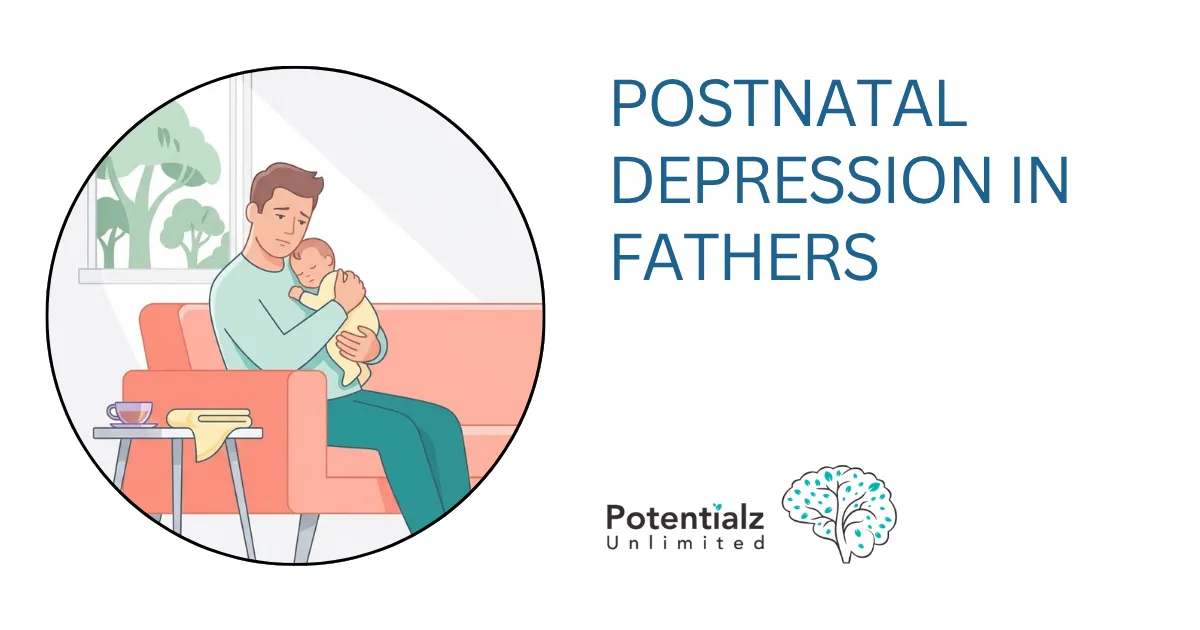
When a new baby arrives, the focus naturally flows toward the mother — her recovery, her wellbeing, her emotional landscape. This is as it should be. But it is worth turning clinical attention equally toward fathers, who are navigating one of the most profound transitions of their lives. Many are struggling far more deeply than those around them realise, yet their experience remains largely invisible in both public conversation and healthcare settings.
Paternal postnatal depression (PPND) is a real, clinically recognised condition. Across the work our psychologists at Potentialz Unlimited do with perinatal families, many fathers experience exactly this — and it affects a substantial proportion of new dads. Yet it remains one of the least addressed mental health presentations in Australian perinatal care. This post is for fathers, partners, and all who care about them.
How Common Is Paternal Postnatal Depression?
The prevalence is far greater than most people realise. Research indicates that 10 to 25 per cent of new fathers experience depressive symptoms in the postnatal period — with rates rising significantly in the three to six months after birth (Paulson & Bazemore, 2010; Wynter et al., 2013).
In Australia specifically, studies suggest that approximately 1 in 10 Australian fathers will experience postnatal depression at some point in the first year of their child’s life. And this figure likely underestimates the true picture, because many fathers do not recognise what they are experiencing as depression — and even fewer reach out for support.
When a mother experiences postnatal depression, the risk that her partner will also develop PPND rises substantially. Fathers of mothers with postnatal depression are up to 50% more likely to develop depression themselves (Goodman, 2004). This interconnection through the family system is something our psychologists look for carefully when working with perinatal families.
Why Does PPND Go Unrecognised?
Several factors make paternal postnatal depression easy to miss — for fathers themselves, for their partners, and for healthcare professionals. These patterns become clear over years of clinical practice.
Symptoms Look Different in Men
The classical image of depression — sadness, tearfulness, withdrawal, a sense of hopelessness — is how depression often manifests in women. In men, particularly in fathers, depression frequently presents quite differently. What PPND looks like in the therapy room often looks nothing like what most people expect:
- Irritability and anger — snapping at a partner or older children over small things
- Withdrawal — emotionally stepping back from family, spending more time alone
- Overwork — immersing in work as an escape from difficult feelings at home
- Increased substance use — relying on alcohol or other substances to manage or numb
- Risk-taking behaviour — actions that feel out of character
- Physical symptoms — headaches, fatigue, back pain without clear medical cause
- Disengagement from the baby — difficulty feeling connected, struggling with interaction
Because these presentations do not align with the public understanding of depression, many men — and those who care about them — do not make the connection. Clinically, the irritability is often attributed to stress, the withdrawal dismissed as introversion, the overwork framed as admirable provider instinct. But these can all be expressions of depression that needs professional attention.
The Stigma Around Men and Mental Health
Australian culture has long carried an expectation that men should be stoic, self-reliant, and capable of weathering hardship without complaint. For new fathers who feel the weight of expectation to be strong for their partner and family, this cultural message is often amplified.
Research consistently shows that men are less likely than women to recognise their own psychological distress, less likely to seek professional support, and more likely to turn to unhelpful coping strategies (Addis & Mahalik, 2003). A common clinical observation is that many fathers find it easier to talk to a psychologist than to admit their struggles to family or close friends. The therapy room offers a space where they do not have to manage anyone else’s reaction to their distress. That neutrality matters enormously for this group.
In many communities — including the South Asian communities Potentialz Unlimited works with across Western Sydney — these barriers are even more substantial. The expectation to remain the strong provider, to manage silently, to not show vulnerability, runs very deep. Our psychologists approach this with respect and without judgment.
Perinatal Healthcare Often Focuses on Mothers
The vast majority of perinatal mental health screening in Australian healthcare centres on mothers. General practitioners, midwives, and maternal and child health nurses routinely assess mothers’ emotional wellbeing. This is entirely necessary — and yet fathers are much less often screened or asked directly about their own experience. When fathers accompany their partners to appointments, the conversation naturally centres on the mother and baby, which means paternal mental health frequently goes entirely unaddressed.
Risk Factors for Paternal Postnatal Depression
Certain factors increase a father’s vulnerability to PPND. Understanding these factors allows for early recognition and intervention.
Key risk factors include:
- A partner with postnatal depression or anxiety — this is one of the strongest predictors
- A personal history of depression or anxiety — prior mental health difficulties are a significant risk factor
- Relationship difficulties — strain, conflict, or disconnection in the couple relationship
- Financial stress — pressure related to income, job security, or the cost of supporting a family
- Unemployment or underemployment — shifts in role identity can be particularly significant for men
- Poor social support — isolation from friends, family, or community
- Sleep deprivation — severe and chronic sleep disruption profoundly affects mood regulation
- An unplanned pregnancy or ambivalence about parenthood
- A history of trauma or adverse childhood experiences
- Migration stress — adjusting to parenting in a new country, away from extended family networks
How PPND Affects the Whole Family
Paternal postnatal depression does not affect fathers in isolation. It reverberates through the entire family system in ways that are clinically significant.
Impact on the Couple Relationship
Depression in one partner places substantial strain on any relationship. New parenthood already stresses couple dynamics — sleep deprivation, role changes, reduced intimacy, and competing demands. When one or both partners are also experiencing depression, the relationship can deteriorate rapidly. Communication fragments. Conflict intensifies. Partners feel as though they are moving in opposite directions at the very moment they need each other most.
Research shows that couples where one or both partners have PPND are at elevated risk of relationship breakdown in the early years of parenting (Whisman et al., 2011).
Impact on Child Development
Fathers play a distinct and essential role in child development. Studies indicate that paternal depression in the first year of a child’s life is associated with:
- Poorer emotional and cognitive development in the child
- Increased behavioural difficulties at school age
- Lower levels of engagement in play and stimulation
Importantly, these effects are not inevitable. When PPND is identified and treated effectively, the impact can be significantly reduced (Ramchandani et al., 2008). Early support makes a real difference — for the father, for the couple, and for the child.
Impact on the Mother
A father who is depressed, irritable, or withdrawn adds to the load already carried by the mother. If she is also managing her own postnatal mental health challenges, the combination can become overwhelming. Partners’ wellbeing is deeply interconnected — and this is precisely why identifying and treating PPND matters for the entire family’s health.
Evidence-Based Psychological Approaches for PPND
PPND responds well to evidence-based psychological treatment. At Potentialz Unlimited, our psychologists draw primarily on Cognitive Behavioural Therapy (CBT) and Acceptance and Commitment Therapy (ACT) when working with fathers.
Cognitive Behavioural Therapy (CBT)
CBT helps men identify the thinking patterns and behaviours that maintain their depression. Fathers frequently hold beliefs like “I should be able to handle this” or “being a good father means never showing struggle.” These thoughts can keep men locked in a cycle of self-criticism and disengagement. CBT provides structured skills for examining these patterns and building behavioural strategies that reduce depression and increase engagement with family life.
Many men are drawn to CBT’s practical, skills-focused structure. It is time-limited, goal-oriented, and focused on tangible change — qualities that resonate with men who may be more comfortable with a structured approach than an open-ended, exploratory one.
To learn more about cognitive behavioural approaches, see our CBT psychologist in Bella Vista service page, or read our plain-language guide to how CBT therapy works.
Acceptance and Commitment Therapy (ACT)
ACT is used extensively with fathers experiencing PPND, and it is particularly well matched to this population. It helps fathers clarify what kind of father and partner they genuinely want to be — their deepest values — and take committed action in line with those values even when depression is making the path feel heavy.
Rather than waiting to feel better before engaging with family life, ACT encourages men to act according to their values now, even amidst difficulty. This can produce genuine mood improvement in a way that can seem paradoxical but is very real in practice. Acting as the father you want to be — even imperfectly, even when you feel low — changes how you feel about yourself.
ACT also teaches psychological flexibility: the ability to hold difficult emotions with awareness, without being controlled by them. For men who have learned to suppress or avoid their feelings, this can be clinically transformative.
Psychoeducation and Partner Involvement
Understanding what is happening is itself therapeutically significant. When a father learns that what he is experiencing has a name, that it is common, and that it is treatable, the shame and self-blame often begin to dissolve. Involving the partner — where appropriate — in psychoeducation and the treatment process can strengthen the couple relationship and support recovery.
Clinical Experience with Fathers and Families at Potentialz Unlimited
Our psychologists work with fathers and couples across a range of clinical settings — including private practice, community health, and Employee Assistance Programs. That experience brings an understanding of the particular cultural pressures men navigate, including those from South Asian communities where expectations around masculinity, silence, and providing for the family are deeply embedded in identity.
A message to any father reading this: asking for help is not weakness. The fathers who reach out are often the ones who care most about their families. They are looking for a way to be more present, more engaged, more like the father they want to be. That is the best reason in the world to make an appointment.
Potentialz Unlimited sees perinatal clients — including fathers — in Bella Vista, accepts referrals via Medicare Mental Health Care Plans, and offers telehealth for those who prefer remote access.
When to Seek Support: Questions for Fathers
If you are a new father, consider these questions honestly:
- Am I more irritable or angry than usual, and struggling to manage it?
- Am I pulling back from my partner and baby, even though I know I should be present?
- Have I started drinking more, or relying on other substances to cope?
- Am I immersing myself in work to avoid being at home?
- Do I feel disconnected from my baby — as though the bond hasn’t formed?
- Have I been feeling low, numb, or flat for more than a few weeks?
- Has my partner, family member, or friend expressed concern about how I am going?
If you answered yes to two or more of these, speaking with your GP or a Registered Psychologist is worth your time. You are not broken. You are experiencing a recognised clinical condition that responds well to professional support — and that support will benefit not just you, but your entire family.
You may also find it helpful to read about perinatal anxiety in pregnancy and new parenthood and, for partners, postnatal depression in mothers.
Key Takeaways
- Paternal postnatal depression affects 10–25% of new fathers — it is far more common than widely believed
- Symptoms in men often look different from classic depression: irritability, withdrawal, overwork, and substance use are common presentations
- Stigma, male help-seeking barriers, and healthcare system gaps all contribute to PPND being underdiagnosed
- Risk is elevated when the partner has postnatal depression or anxiety
- PPND affects not just the father, but the couple relationship and child development
- CBT and ACT are effective evidence-based psychological therapies for paternal postnatal depression
- Early support leads to better outcomes for the father, the relationship, and the child
How Potentialz Can Help
If you are a new father who is struggling more than you expected — and feeling the pressure to hide it — reaching out is a strong first step. The sooner a father gets appropriate psychological support, the better the outcome for him and for his whole family.
At Potentialz Unlimited, our psychologists provide evidence-based psychological treatment — including CBT and ACT — for fathers experiencing postnatal depression and anxiety. Whether you come alone or with your partner, you will be met professionally and without judgment. Our team works with fathers from diverse cultural backgrounds and understands the particular pressures many men navigate.
Sessions are available by telehealth, phone, and in-person at Bella Vista, with referrals accepted via Medicare Mental Health Care Plans.
Sushama Sathe is a Registered Psychologist (AHPRA) with 20 years of clinical experience. She works at Potentialz Unlimited in Bella Vista, accepting referrals via Medicare, WorkCover, NDIS, and EAP. She provides services in English, Hindi, Marathi, and Punjabi. Book at live.potentialz.com.au or call 0410 261 838. Unit 608, 8 Elizabeth Macarthur Drive, Bella Vista NSW 2153. Monday–Friday 10am–7pm | Saturday & after-hours | Telehealth available.
Book online: live.potentialz.com.au Call: 0410 261 838 Website: potentialz.com.au
Or visit our contact page for more ways to reach out.
Crisis Resources
If you or someone you know is in distress, please reach out:
- PANDA (Perinatal Anxiety and Depression Australia): 1300 726 306 — for fathers and mothers in the perinatal period
- Lifeline: 13 11 14 — 24/7 crisis support
- Beyond Blue: 1300 22 4636 — mental health information and support
Related Reading
More from our blog:
- Postnatal Depression: What Every New Mother Needs to Know
- Women’s Mental Health: Understanding and Addressing the Unique Challenges Women Face
- This Week in Mental Health: Sleep, Work, and Emotional Skills (10 July 2026)
Therapy services that may help:
References
Addis, M. E., & Mahalik, J. R. (2003). Men, masculinity, and the contexts of help seeking. American Psychologist, 58(1), 5–14. https://doi.org/10.1037/0003-066X.58.1.5
Goodman, J. H. (2004). Paternal postpartum depression, its relationship to maternal postpartum depression, and implications for family health. Journal of Advanced Nursing, 45(1), 26–35. https://doi.org/10.1046/j.1365-2648.2003.02857.x
Paulson, J. F., & Bazemore, S. D. (2010). Prenatal and postpartum depression in fathers and its association with maternal depression: A meta-analysis. JAMA, 303(19), 1961–1969. https://doi.org/10.1001/jama.2010.605
Ramchandani, P. G., Stein, A., O’Connor, T. G., Heron, J., Murray, L., & Evans, J. (2008). Depression in men in the postnatal period and later child psychopathology: A population cohort study. Journal of the American Academy of Child & Adolescent Psychiatry, 47(4), 390–398. https://doi.org/10.1097/CHI.0b013e31816429c2
Whisman, M. A., Davila, J., & Goodman, S. H. (2011). Relationship adjustment, depression, and anxiety during pregnancy and the postpartum period. Journal of Family Psychology, 25(3), 375–383. https://doi.org/10.1037/a0023197
Wynter, K., Rowe, H., & Fisher, J. (2013). Common mental disorders in women and men in the first twelve months after a first birth: Community based cohort study. Journal of Affective Disorders, 151(3), 980–985. https://doi.org/10.1016/j.jad.2013.08.007
Disclaimer: This information is general in nature. Please consult a qualified health professional for advice tailored to your individual circumstances. Sushama Sathe is an AHPRA Registered Psychologist (PSY0001370871).
Knowledge Check Quiz
Test what you have just read. Choose your answer for each question, then submit to reveal the answers and your score.
Need Professional Support?
If you're experiencing mental health concerns, our team is here to help.