Key Takeaways
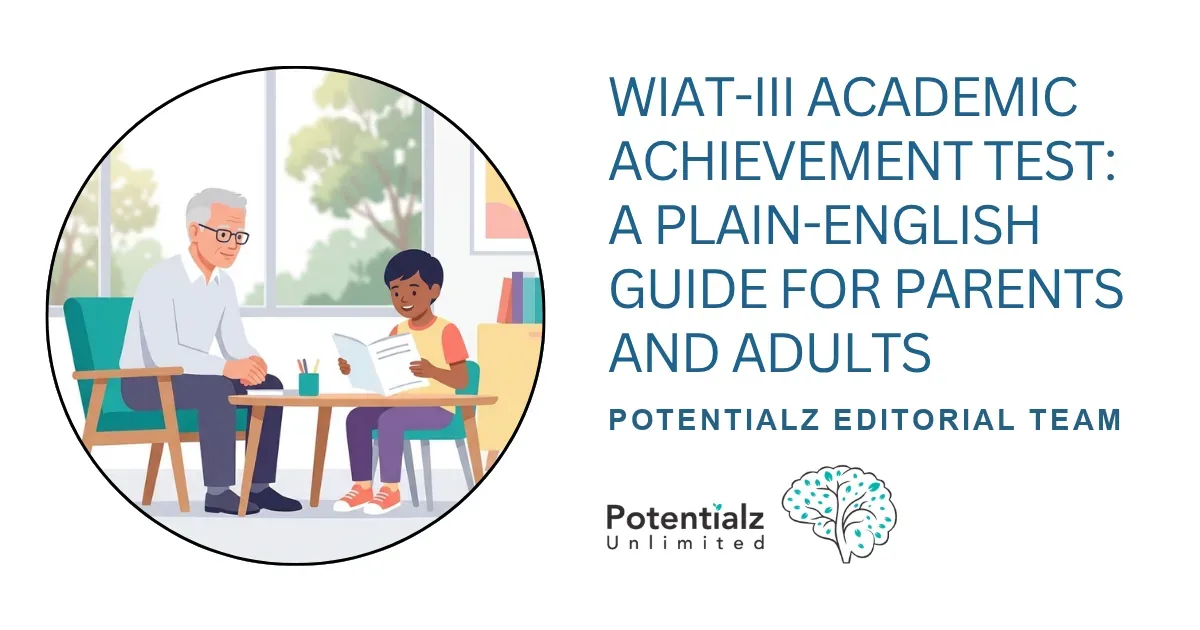
- The WIAT-III is short for the Wechsler Individual Achievement Test, Third Edition. It is a set academic test, given the same way to everyone so scores can be fairly compared. This is called “standardised” testing. A trained clinician gives it to one person at a time. It checks how well someone can read, write, do maths, and use spoken language. It sits next to the cognitive tests in the Wechsler family (WISC-V for children, WAIS for adults). In a learning difficulty test, both tests are almost always used together.
- A WIAT-III is not an IQ test. A cognitive test (WISC-V, WAIS-IV) measures cognitive ability. That means the underlying way a person’s mind reasons and holds on to information. An achievement test like the WIAT-III measures what a person has actually learned to do in reading, writing, and maths. This difference matters. A proper learning difficulty assessment compares the two.
- The clinical logic is simple. Say a child’s cognitive ability sits in the average or above average range. But their reading or maths score is well below what you would expect from that. That gap is called an “ability–achievement gap”. It is one of the key clues for a specific learning disorder, such as dyslexia, dyscalculia, or dysgraphia.
- The WIAT-III covers four areas. Reading (word reading, understanding what is read, reading speed, and sounding out made up words). Written expression (spelling, writing sentences, writing an essay). Maths (written sums, word problems, quick number facts). Oral language (understanding spoken words, speaking clearly). Not every part is given every time. The clinician picks the parts that fit the reason for the test.
- People usually book a WIAT-III for a few reasons. A child is struggling at school and the usual first steps have not helped. A NSW school asks for outside test evidence to support extra help in class. A young adult heading to university wants to understand a pattern that has followed them for years. Or an adult wants to finally answer a question left over from their own school years.
- At Potentialz Unlimited in Bella Vista, formal WIAT-III testing is done by Dr Gurprit Ganda, our senior Clinical Psychologist. Our Registered Psychologists help families work out whether a test is the right next step. They also prepare children and young people for the day, and pick up the therapy work that often follows a learning difficulty finding.
- Cost is a real factor. A combined cognitive and achievement assessment is a big piece of clinical work. In Australian private practice it usually sits in the low to mid four figures. Medicare rebates for this kind of test are limited. The standard Mental Health Care Plan, a GP referral that funds a set number of therapy sessions, does not cover a full assessment. NDIS funding is available for eligible participants where the test supports their plan. Reception will walk you through current fees and rebates when you enquire.
- If you are trying to work out whether a WIAT-III is worth it, a short phone call beats filling in a form. The most useful question to answer first is not “which test do we book”, but “what question are we actually trying to answer”.
Why Families and Adults Book an Academic Achievement Test
Very few families we speak with at Potentialz start out wanting to “arrange a WIAT-III”. They reach that point after a longer journey. Often it is a child who has been struggling at school, and the usual first steps have not worked. Or it is an adult still carrying a question from their own childhood.
The reasons tend to sound something like this.
“Our son is in Year 3 and his teacher says his reading is not tracking with his class. We have been doing extra reading at home for a year and it is not shifting. The school is starting to talk about learning support and we want to know what is actually going on.”
“My daughter is bright, articulate, and creative — but writing is torture for her. She can tell you a story out loud in beautiful detail and then produce two shaky sentences on paper. Something does not add up.”
“We have a Year 5 child who was assessed for ADHD last year. The paediatrician mentioned that a learning assessment could be a useful next step. We have been putting it off and now high school is on the horizon.”
“I am in my second year of university, doing well on the ideas side, but I am losing marks on written assignments in ways that feel disproportionate to the effort I am putting in. I have wondered about dyslexia for years.”
“I am 42, I have a demanding job, and I have finally admitted that I have been quietly compensating for something to do with reading and spelling my whole life. I want a proper answer.”
“The school is asking for an assessment report before they will formalise adjustments for our child. We are trying to understand what kind of assessment they are actually looking for.”
Each of those is a good reason to think about a WIAT-III. But the WIAT-III is almost never the whole answer on its own. It is one part of a bigger test. That usually also includes a cognitive test (WISC-V or WAIS-IV), a close look at the person’s development and schooling so far, a clinical interview, and often input from teachers and parents.
At Potentialz Unlimited in Bella Vista, our team includes Registered Psychologists who work with young people on academic and learning difficulties. They draw on years of running cognitive tests and reading support programs. Formal WIAT-III and WISC-V testing at Potentialz is Dr Ganda’s own territory, as our senior Clinical Psychologist. This post is our honest, plain-English walk through the WIAT-III. What it is. What it measures. How it fits with cognitive testing. And how to think clearly about whether it is the right next step for you or your child.
What the WIAT-III Actually Is
The Wechsler Individual Achievement Test, Third Edition, or WIAT-III for short, is a set achievement test made by Pearson. It is used around the world to measure academic skill. One trained clinician gives it to one person at a time. It belongs to the wider Wechsler family of tests. That family also includes the WISC-V for children (roughly ages 6 to 16), the WPPSI-IV for younger children, and the WAIS-IV for teens and adults aged 16 and up. A newer version, the WAIS-5, is slowly being brought in too.
The WIAT-III can be used from age 4 right through to adulthood. That makes it one of the more flexible achievement tests in clinical use. In Australia, it is most often given to children and teens as part of a learning difficulty test. But it is also used with young adults heading into university or TAFE, and with adults seeking a formal diagnosis for the first time.
It is made up of a set of “subtests”. Each subtest is a single task that measures one specific skill. A clinician sits in the room with the client and works through the tasks together, one at a time. It is not a group test. It is not a form you fill in about yourself. It is not a computer screening. This one-to-one delivery matters. The clinician also watches closely through the session. How does the person approach each task? What strategies do they use? Where do they get stuck? How do they respond when something is hard? These notes shape how the results are read afterwards.
The WIAT-III groups its subtests into four broad areas.
Reading. This area checks both how well someone reads and how well they understand what they read. Word Reading checks how well someone can read single words. Pseudoword Decoding uses made up “nonwords” (like “gluft” or “sprane”) to test sounding out skills on their own. This means working out an unfamiliar string of letters without simply recognising a real word from memory. Reading Comprehension checks understanding of a passage. Oral Reading Fluency checks reading speed, accuracy, and expression. Together, these subtests build a clear picture of where reading is strong and where it is breaking down.
Written Expression. This area covers the skills used to write. Spelling checks the ability to write single words that are read aloud. Sentence Composition checks the ability to build and join sentences from prompts. Essay Composition checks longer written work on a set topic — how well it is organised, the range of words used, sentence structure, and mechanics like punctuation and grammar. Alphabet Writing Fluency, for younger children, checks how fast and accurately a child can write letters.
Mathematics. This area measures number and maths skills. Numerical Operations checks the ability to solve written sums. This can mean addition, subtraction, multiplication, division, fractions, or algebra, depending on age. Math Problem Solving checks the ability to solve word problems and use maths in real situations. Math Fluency checks the speed and accuracy of basic arithmetic — how fast and reliably a person can answer simple number facts.
Oral Language. This area measures listening and speaking skills. Listening Comprehension checks understanding of spoken language, at both the word level and the paragraph level. Oral Expression checks how well someone speaks — describing pictures, naming items in a group, or telling a story from a set of pictures.
Not every subtest is given every time. The clinician picks the subtests based on the reason for referral, the person’s age, and the specific question being asked. A young child being checked for suspected dyslexia will sit a different set of subtests than a Year 10 student being assessed for extra time in exams.
How the WIAT-III Pairs With Cognitive Testing
This is where the clinical logic gets interesting. It is also where a proper learning difficulty test shows its worth.
A cognitive test like the WISC-V or WAIS-IV measures cognitive ability. That is the underlying way a person’s mind works. It gives a profile. How well someone reasons using words. How well they reason using pictures and shapes. How well they can hold and juggle information in their head (called working memory). And how fast they process simple visual information (called processing speed). It answers one question: what is this person’s cognitive shape?
An achievement test like the WIAT-III measures what a person has actually learned to do in reading, writing, maths, and spoken language. It compares their skills to other people their age and school year. It answers a different question: what has this person actually achieved at school?
Neither test on its own can tell you if someone has a specific learning disorder. That question is answered by comparing the two tests together.
Say cognitive ability sits in the average or above average range. But achievement in one area sits well below what that cognitive profile would predict. That gap between ability and achievement is one of the strongest clues for a specific learning disorder. Take a Year 4 child with an overall cognitive score around 105 — an average result. This overall score is called a Full Scale IQ. If that child reads at a Year 1 level, that is a pattern that needs a closer look. A Year 8 student with strong verbal reasoning whose writing score is well below average for their age shows a pattern that fits a written-expression difficulty.
Australian and world research has moved past simply comparing ability and achievement scores. Modern learning difficulty assessment also looks at how well a child responds to extra teaching. It looks at the pattern of strengths and weaknesses inside the cognitive profile. And it looks at specific processing problems. Trouble hearing the separate sounds in words is one, called phonological processing. Trouble recognising letter patterns is another, called orthographic processing. Weak working memory is a third. These are known to sit behind specific academic difficulties. Even so, the WISC-V-plus-WIAT-III combination remains the backbone of learning difficulty assessment in Australia. It gives the clinician both the cognitive shape and the academic reality, side by side.
Want to see this comparison in action? We have written about the cognitive side in WAIS Adult IQ and Cognitive Assessment in Bella Vista. We have written about child cognitive testing in WISC-V Child Cognitive Assessment Explained. And we cover the wider picture in IQ Testing Near Me: What to Expect at Bella Vista. This post, on the WIAT-III, is the achievement-side match to those.
Who Actually Benefits From a WIAT-III
The WIAT-III is most useful when it answers a specific question. In our clinical conversations at Potentialz, we try to steer families and adults toward a test when it will actually give them useful information. And we steer them away from it when there is a better first step.
Here are the situations where a WIAT-III, usually paired with a WISC-V or WAIS-IV, is most worth the time and cost.
A child whose academic progress is not tracking with what the family and teachers expect
This is the most common referral. A Year 2 child who is struggling to read, despite being clearly bright in conversation. A Year 4 child whose writing is much weaker than their thinking. A Year 5 child whose maths keeps stalling on the basics, no matter how much practice happens at home. In each case, the family has already tried the usual first steps: reading at home, tutoring, extra time on homework. The pattern has not shifted. A combined cognitive and achievement assessment gives a real answer. It shows whether a specific learning difficulty is behind it, what shape it takes, and what the right next steps look like.
Investigating suspected dyslexia, dyscalculia, or dysgraphia
A formal diagnosis of a specific learning disorder (SLD) needs solid evidence. SLD is the umbrella term used in the DSM-5-TR, the clinical handbook doctors and psychologists use for diagnosis. It covers what schools often call dyslexia, dyscalculia, and dysgraphia. The evidence must show three things. The academic difficulty is well below what you would expect for the person’s age and cognitive ability. It has lasted despite proper teaching. And it is not better explained by something else. That could be intellectual disability, an uncorrected vision or hearing problem, poor teaching, or difficulty with the language of instruction. A WIAT-III paired with a WISC-V or WAIS-IV supplies much of the evidence for that picture, alongside a developmental history and information from school.
School-requested assessments to underpin adjustments
NSW public and independent schools increasingly ask for outside test evidence. This supports formal learning adjustments, individual learning plans, or applications for extra help in end of school exams (HSC access provisions, for example). Exactly what evidence is needed varies by school and by the type of support requested. But a combined cognitive and achievement assessment is often part of the paperwork required. Before booking, check with the school exactly what evidence they will accept, and which specific tests (WISC-V, WIAT-III, or others) they need to see.
Young adults preparing for tertiary study
Some young adults with a long-standing academic difficulty, never formally tested, pursue a WIAT-III before starting university or TAFE. Formal evidence of a specific learning disorder can open some doors. Disability support services. Extra exam time. Note taking support. Different ways of being assessed. Assistive technology. Australian universities usually want test evidence that is fairly recent, often within the last three to five years, depending on the institution.
Adults revisiting an unresolved question from their own schooling
Many of the adults we speak with about learning difficulty assessment are, in effect, going back to answer a question from their school days. They struggled with reading, spelling, writing, or maths in ways that were never properly checked. They found ways to work around it, through education and into working life. A WIAT-III on its own does not diagnose an adult SLD. The DSM-5-TR criteria need evidence that the difficulties go back to the school years, and that is a question for the clinical interview and developmental history. But the WIAT-III is still a core piece of hard evidence in an adult SLD assessment.
A bright child whose school work does not match what you see at home
Some children read well beyond their years, or work things out fast in conversation, yet hand in school work that looks ordinary. Parents often sense a gap long before a teacher raises it.
Pairing a WIAT-III with a WISC-V helps here. The cognitive test shows how the child thinks. The achievement test shows what has landed on paper. When thinking scores sit high and one academic area sits well below them, that gap is the useful finding — it can point to a specific learning difficulty sitting underneath strong ability, which is easy to miss precisely because the child is coping.
Schools also ask for this pairing when a family applies for a gifted or selective programme, since most want evidence of both ability and current achievement rather than one or the other.
Cognitive change after illness or injury where academic skills are affected
Sometimes adults have post-concussion syndrome, a stroke, long COVID, or another brain change. They want to know how their skills now compare to before. A WIAT-III can be part of that picture. But this question is usually better answered a different way. A neuropsychology pathway looks closely at brain-based change over time. That is often a better fit than a standard cognitive and achievement assessment.
Who a WIAT-III Will Not Help
We want to be just as honest about who we would gently steer away from a WIAT-III as a first step.
Families where the child’s main difficulty is emotional or behavioural, not academic. Some children are unhappy, anxious, cut off from friends, or refusing to go to school. That child is often struggling with something other than a learning difficulty, even if their marks have dropped. In those cases, the priority is usually to work on the emotional or behavioural side first, through therapy, family work, or support at school. A learning assessment can wait until later, if academic difficulties are still there once that side has been supported.
Families where a recent change has not yet had a chance to work. Say a child has just started targeted reading support, or has just moved schools, or has just been through a big life change (a parent’s illness, a house move). The test results will be clouded by these factors. Sometimes the right answer is: wait six months, let the change settle, then test if the difficulty is still there.
Children in acute crisis. A three-to-four-hour test session is not the right thing to do during a crisis or a period of major upheaval. Stabilise first. Assess later.
Adults or families looking for a specific label, not a clinical picture. If the goal is to get a particular diagnosis, rather than to understand what is actually going on, the assessment will disappoint. A good clinician names what the profile actually shows. That may or may not match the label the person came in hoping for.
Situations where practical support does not need a formal report. Say the school or workplace is already giving a person what they need. And no outside body is asking for formal test evidence. In that case, a WIAT-III may just be information with no clear use. Ask what the report will actually change before booking.
What Actually Happens in a WIAT-III Session
Most parents and adults feel more comfortable once they know roughly what to expect. Here is an honest walk-through of a WIAT-III session. At Potentialz, Dr Ganda runs the assessment himself. The steps below reflect the shared clinical approach used across the practice.
Before the session. There is usually a first conversation, by phone or in a short intro appointment. The assessing clinician gathers the reason for referral. They ask about the person’s development and schooling so far, including school reports, past tests, and teacher input. They ask how the person is going day to day: medications, sleep, mood, and current emotional difficulties. And they ask what the family or adult actually hopes the test will help with. This history is not just paperwork. It is what turns the final results into something clinically useful, rather than a set of numbers with no context.
On the day. A WIAT-III session on its own usually runs for two to three hours, depending on which subtests are given and the person’s age. Often it is paired with a WISC-V or WAIS-IV, which is the more common case. Then the whole assessment can take four to six hours. It is often split over two sessions to manage tiredness. For younger children, splitting the day is almost always better than one long sitting. Bring water, glasses if the child uses them, and any medication they normally take. This includes ADHD medication, if that is what they take on a school day — the assessment tells you more when it reflects how the child actually functions day to day.
The subtests themselves. The tasks are varied. Some involve reading aloud: single words, then made up nonwords, then longer passages. Some involve reading quietly and answering questions. Some involve writing: single words read aloud for spelling, sentences from prompts, longer written passages on a set topic. Some involve maths: written sums, word problems, quick-fire number facts. Some involve listening and speaking: hearing a passage and answering questions about it, describing pictures, or talking about a topic. The clinician gives the same set instructions to every person and records responses carefully. With children, the clinician stays warm and encouraging while keeping the test fair and consistent.
What it feels like for the child. Most children find some tasks easy and some genuinely hard. The test is built to reach each child’s ceiling: the point where the tasks become too hard for them. That is how the test works out where their skills actually sit. So every child will hit some questions they cannot answer. That is by design, not a sign of failure. Good clinicians know how to handle the moment a child starts to feel discouraged. They pause, encourage, and reassure, when needed.
After the session. Scoring and reading the results takes time. A good WIAT-III report is not just a table of numbers with a stock paragraph attached. It pulls the whole picture together. The achievement results. The cognitive results, if a cognitive test was given too. The person’s development and school history. What the clinician noticed during the session. And the specific reason for referral. Expect a written report and a feedback appointment, where the assessing clinician walks the family, and the child too where it suits their age, through the findings. That feedback session is often the most useful part of the whole process.
How to Read a WIAT-III Report
If you have already had a WIAT-III done and you are looking at a report, here is what is worth paying attention to.
Read the reason for referral first. A good report will restate why the assessment was arranged. If it does not, ask. The findings only make sense against the question you were asking in the first place.
Look at both the composite scores and the individual subtest scores. A “composite” score is a combined summary score built from several related subtests. For example, Total Reading combines Word Reading, Pseudoword Decoding, and the other reading subtests into one overall number. The individual subtest scores show you where the specific skill gaps actually are. A child with a Reading composite in the low-average range, but a very low Pseudoword Decoding score, is showing a specific sounding out difficulty. That is the kind of pattern that points toward dyslexia, even though the combined score might look less alarming on its own.
Look at the percentile ranks, not just the standard scores. A “standard score” is a number that places a person’s result on a fixed scale, so it can be compared with everyone else’s. For the WIAT-III, 100 is exactly average. A “percentile rank” tells you what share of the same-age comparison group scored at or below that level. A percentile rank of 50 is exactly average. A percentile rank of 10 means the child scored at or above only 10 per cent of the comparison group. That is a meaningfully low result, one that would call for extra support. Percentiles are often easier for families to picture than standard scores.
Look at the age-equivalent and grade-equivalent scores with caution. These are widely reported because families and schools find them easy to picture (“your Year 4 child is reading at a Year 2 level”). But they are actually the least precise of all the score types. A grade-equivalent score does not mean the child is “the same as an average child in that grade”. It means the child’s raw score on this specific test matches what an average child in that grade would score. Treat them as a rough, plain-English summary, not a precise clinical fact.
Look at the ability–achievement comparison. If a cognitive test was given alongside the WIAT-III, the report should discuss how cognitive ability and academic achievement relate to each other. A large gap in one area matters clinically. The report should also note where achievement broadly matches the cognitive profile. That is meaningful information too.
Look at the notes on how the person approached the tasks. A good report includes notes on the child’s or adult’s approach, effort, attention, anxiety, and behaviour during the assessment. Say a child scored poorly because they were exhausted and switched off in the last hour of a five-hour assessment. That is a different picture from a child who scored poorly on the same task while fully engaged.
Look at the recommendations. The report should end with practical recommendations that answer the original referral question: for teaching, for support at school, for further testing where needed, for follow-up. If the recommendations feel generic, they probably are. A good report ties its recommendations to the specific profile in front of it.
The Common Myths — Cleared Up
There are several myths about achievement testing and the WIAT-III that we hear from families most weeks.
“An achievement test will diagnose dyslexia on its own.” No. A specific learning disorder like dyslexia is a clinical diagnosis. It needs a WIAT-III, or a similar test, plus a cognitive test, a developmental history, an education history, and a careful look at other possible explanations. The WIAT-III is a key piece of the evidence, but it is not the whole assessment on its own.
“If my child is bright, they can’t have a learning difficulty.” Actually, this is one of the most common patterns in a specific learning disorder. A child’s overall cognitive ability is average or above. But their achievement in one area, usually reading or writing, is well below what you would expect from that. Being bright and having a specific learning difficulty are not opposites. In fact, the gap between the two is often exactly what makes the difficulty stand out.
“Everyone in the family is like this — it’s just how we are.” Specific learning disorders run strongly in families. It is very common for one parent to have quietly worked around a reading or spelling difficulty all through school, one that was never picked up. Then the same pattern shows up in their child. That family pattern is not a reason to skip assessment. If anything, it makes the assessment more useful.
“The assessment will label my child and follow them forever.” A clinical report belongs to the family. It is not shared with the school unless the family chooses to share it. Even when it is shared, a specific learning disorder describes a learning profile, not a life sentence. With the right teaching and support, children with a specific learning disorder can, and do, achieve strong results at school.
“If we wait until high school, the school will just deal with it.” In practice, unassessed learning difficulties tend to build up over time. Reading is the base for most other school learning. So an unaddressed reading difficulty in early primary school goes on to affect maths word problems, science, essay writing, and a child’s confidence right across their schooling. Earlier testing usually opens up more options.
“The test will just give us a bunch of numbers.” A well written WIAT-III report pulls the whole picture together. It is not just a printout of numbers. If your report is short, generic, or is purely numbers with no explanation, you are entitled to ask for a fuller feedback conversation. Numbers without an explanation are of limited use.
Dyslexia, Dysgraphia, Dyscalculia — A Closer Look at the Achievement Side
The WIAT-III is often used specifically to check for these three conditions. It is worth spending a little time on how each one shows up in the test.
Dyslexia (specific learning disorder with impairment in reading). On the WIAT-III, dyslexia usually shows up as much lower Word Reading and Pseudoword Decoding scores than the child’s cognitive ability would predict. Reading Comprehension may be less affected, if the child has strong verbal reasoning skills to draw on when working out meaning. Though comprehension is usually still affected too, because so much effort goes into sounding words out. Oral Reading Fluency is often affected as well. On the cognitive side, weak phonological processing is a common underlying feature. That means trouble hearing and working with the separate sounds inside words. This is why a full dyslexia assessment often includes extra tests of phonological processing, such as the CTOPP-2. We have written about the broader dyslexia assessment pathway in Dyslexia and Learning Difficulty Assessment for Children: A Parent’s Guide.
Dysgraphia (specific learning disorder with impairment in written expression). On the WIAT-III, dysgraphia usually shows up as much lower Spelling, Sentence Composition, and Essay Composition scores than the child’s cognitive ability would predict. Often it is lower than the child’s spoken-language ability too. This is the classic pattern of a child who can tell a rich story out loud but writes very little on paper. Handwriting difficulties are common but not universal. The cognitive side often involves weak working memory, or trouble coordinating the physical act of writing.
Dyscalculia (specific learning disorder with impairment in mathematics). On the WIAT-III, dyscalculia shows up as much lower Numerical Operations, Math Problem Solving, and Math Fluency scores than the child’s cognitive ability would predict. Underlying cognitive factors often include weak working memory, slower processing speed, and specific trouble with number sense. Number sense is the natural, gut feel for quantity that most children develop early.
None of these diagnoses is made on the WIAT-III alone. All of them need the full clinical picture. But the WIAT-III is where the hard academic evidence sits.
The Assessment Team at Potentialz — Who Does What
This question comes up a lot, so here is a quick, clear note on how the team at Potentialz works.
Dr Gurprit Ganda — Clinical Psychologist (senior). His background spans more than two decades of clinical work. Formal cognitive and academic achievement testing across all ages. EMDR, a structured therapy used for trauma. And forensic and medico-legal assessment. Formal WIAT-III, WISC-V, and WAIS work at Potentialz is his territory.
Sushama Sathe — Registered Psychologist. She has two decades of experience, including EMDR, perinatal and grief work, and multicultural family work.
William Carter — Registered Psychologist (AHPRA PSY0002696305). He works with children (aged 8 and up), teens, young adults, and older adults, using Cognitive Behavioural Therapy (CBT), Acceptance and Commitment Therapy (ACT), and Solution-Focused Therapy. His background includes cognitive and functional assessment work (WISC, WPPSI, WNV, BASC, Vineland, ABAS) and reading support programs at Learning Links in Sydney. So learning difficulty ground is familiar to him. At Potentialz specifically, though, formal WIAT-III and WISC-V testing sits with Dr Ganda. William’s role in the assessment pathway is often on the preparation and therapy side. He helps families work out if an assessment is the right step. He gets children ready for what to expect. And he picks up the therapy or coaching work that often follows a learning finding.
Samita Rathor — Clinical Counsellor and Psychotherapist (PACFA Clinical Registrant), who also brings yoga therapy into her work. Where a body-based, breath-based, or somatic-integrated approach fits, Samita is the right person.
Bhavini Ambaram — Practitioner in Therapeutic Play (PTUK/PTSA accredited). She has extra training in Synergetic Play, LEGO-Based Therapy, and Parent-Child Attachment Play. For children under 8, or for children who need play-based rather than talking-based work, Bhavini is the main clinician.
If you are not sure who to see, reception can help sort that out. A short phone call is usually more useful than trying to work it out from a website.
Cost, Wait Time, and Rebates — Honestly
We do not want to quote figures that will be out of date within months. What we can do is give you the shape of the picture, and point you to reception for the current details when you enquire.
Cost. A combined cognitive and achievement assessment is a big piece of clinical work: several hours of direct testing, plus scoring, reading the results, writing the report, and a feedback session. A rough figure for a full WISC-V-plus-WIAT-III assessment with report and feedback in Australian private practice is typically in the low to mid four figures. This varies with the specific test plan and any extra testing (phonological processing measures, behaviour scales, or measures of everyday life skills). A WIAT-III on its own, without a cognitive test, costs less, but it is also of limited use for most clinical questions.
Wait time. Because the assessment is a large piece of work, wait times vary with clinician availability. At Potentialz, reception will give you an honest current figure when you enquire.
Medicare. Medicare rebates for cognitive and academic achievement testing are limited. The standard Mental Health Care Plan (MHCP), a GP referral that funds a set number of sessions, does not fund a full learning difficulty assessment. Some specific item numbers may apply in certain cases — reception can walk you through what, if anything, applies. For therapy sessions with our Registered Psychologists, Medicare rebates are available with an MHCP from your GP. But that is a separate arrangement from assessment.
NDIS. For eligible NDIS participants, assessment may be funded under capacity building supports. This mainly applies where the testing is directly relevant to disability evidence or plan development. Self-managed and plan-managed participants usually have more flexibility here than NDIA-managed participants.
Private health insurance. Some private health insurance psychology extras cover part of a psychological assessment. Check with your insurer, and note this varies a lot between funds and levels of cover.
School-funded assessments. Occasionally a NSW school will contribute to or fund an assessment they have specifically requested. This is not the norm, but it is worth asking your school before you book.
None of this gives you a specific number. That is the honest answer. Reception will.
What Happens After the Report
Once you have the WIAT-III report, usually alongside a WISC-V or WAIS-IV report, the work is really only beginning. A profile is only useful if you actually do something with it.
Common next steps after a learning difficulty assessment include:
- Sharing the report with the school and asking for formal learning adjustments. Most NSW schools have a process for reviewing outside test evidence. This can lead to a learning plan, such as an Individual Education Plan, classroom adjustments, or support under the national framework for students with disability. The report gives the school specific evidence to work from.
- Targeted support for the specific difficulty. For reading difficulties, this often means evidence based structured literacy tuition (approaches such as Orton-Gillingham or MSL). For maths difficulties, targeted number-skills support. For writing difficulties, direct teaching of writing skills, alongside tools such as speech-to-text or word prediction.
- Therapy for the emotional side of a learning difficulty. Many children and adults with a specific learning disorder carry real anxiety, low self-esteem, and shame about their school performance by the time they are tested. Therapy, whether CBT, ACT, or emotion coaching for parents of younger children, often has a real part to play after the assessment. It helps the person take the diagnosis on board and rebuild confidence in their own learning. This is work our Registered Psychologists do at Potentialz.
- Applications for formal support in end of school exams or tertiary study. For older students, the report is often used as evidence for provisions in HSC exams or in university disability support processes.
- Occasionally, no further psychological input. Sometimes a report simply answers the question you brought, and the family moves forward with the school based support it makes possible. That is also a good outcome.
Whatever the next step, the report should not sit in a drawer.
A Note on Language — “Learning Difficulty”, “Learning Disability”, “Specific Learning Disorder”
The words used around learning difficulties in Australia are genuinely confusing, and it is worth pausing on them.
“Specific learning disorder” (SLD) is the current diagnostic term in the DSM-5-TR, the international clinical handbook that psychologists and psychiatrists use to classify conditions. It has three types: with impairment in reading, with impairment in written expression, and with impairment in mathematics. This is the formal diagnostic language.
“Learning disability” is the term more commonly used in North American schools. In Australia it can be confusing, because “disability” is often kept for more global or intellectual disability.
“Learning difficulty” is the term more commonly used in Australian schools. It is broader: it can cover both a specific learning disorder and general academic struggle from other causes.
“Dyslexia”, “dysgraphia”, and “dyscalculia” are the traditional names for specific reading, writing, and maths difficulties. They are still widely used, especially in advocacy and school settings, even though the DSM-5-TR uses “specific learning disorder” as the umbrella term.
When you read a clinical report or a school document, pay attention to which words are used and what they actually mean. A report that says “specific learning disorder with impairment in reading” is describing what most people would call dyslexia. A school document that says “learning difficulty” may be describing a specific learning disorder, or may be describing a broader academic struggle. The words alone will not tell you which.
How We Can Help
Have you read this far? Do you have a real question about whether a WIAT-III, or a full learning difficulty assessment, is right for you or your child? You are welcome to reach out.
Formal WIAT-III and cognitive testing at Potentialz is Dr Ganda’s territory. So the practical first step for a formal assessment enquiry is usually a phone call with reception. They will work out the referral question with you. They will walk you through current cost, wait time, and rebate arrangements. And they will book you in with Dr Ganda where that is the right fit.
If your question is more general, that is fine too. Something like “I’m not sure whether we need an assessment, or a different approach, or something else.” That is a conversation you can have with one of our Registered Psychologists first. We can work out together whether an assessment is the right next step. Where it is, we will happily connect you with Dr Ganda in-house. Where therapy or emotion coaching for parents is the better first step, our team can do that with you.
Our Registered Psychologists at Potentialz Unlimited in Bella Vista work with children (aged 8 and up), teens, young adults, and older adults. We use Cognitive Behavioural Therapy (CBT), Acceptance and Commitment Therapy (ACT), and Solution-Focused Therapy. All of this rests on a strong, non-judgemental relationship.
Medicare rebates are available with a Mental Health Care Plan (MHCP) from your GP for therapy sessions. NDIS (self-managed and plan-managed) referrals are accepted. Cost and rebate arrangements for formal cognitive and achievement assessment are separate, and best confirmed when you enquire.
- Address: Unit 608, 8 Elizabeth Macarthur Drive, Bella Vista NSW 2153
- Phone: 0410 261 838
- Book: live.potentialz.com.au
- Hours: Monday–Friday 10am–7pm | Saturday & after-hours available | Telehealth via phone or Zoom (for therapy; formal assessment is delivered in person)
You may also find these related posts useful: WAIS Adult IQ and Cognitive Assessment in Bella Vista, WISC-V Child Cognitive Assessment Explained, IQ Testing Near Me: What to Expect at Bella Vista, Dyslexia and Learning Difficulty Assessment for Children, and Processing Speed and Working Memory Explained: What the WISC and WAIS Indices Actually Measure.
References
American Psychiatric Association. (2022). Diagnostic and statistical manual of mental disorders (5th ed., text rev.). https://doi.org/10.1176/appi.books.9780890425787
Berninger, V. W., & Wolf, B. J. (2016). Dyslexia, dysgraphia, OWL LD, and dyscalculia: Lessons from science and teaching (2nd ed.). Brookes Publishing.
Fletcher, J. M., Lyon, G. R., Fuchs, L. S., & Barnes, M. A. (2019). Learning disabilities: From identification to intervention (2nd ed.). Guilford Press.
Flanagan, D. P., & Alfonso, V. C. (2017). Essentials of WISC-V assessment. John Wiley & Sons.
Kaufman, A. S., Raiford, S. E., & Coalson, D. L. (2016). Intelligent testing with the WISC-V. John Wiley & Sons.
Mather, N., & Wendling, B. J. (2011). Essentials of dyslexia assessment and intervention. John Wiley & Sons.
Pearson. (2009). Wechsler Individual Achievement Test — Third Edition (WIAT-III): Technical manual. Pearson.
Sattler, J. M. (2018). Assessment of children: Cognitive foundations and applications (6th ed.). Jerome M. Sattler, Publisher.
Snowling, M. J., & Hulme, C. (2012). Interventions for children’s language and literacy difficulties. International Journal of Language & Communication Disorders, 47(1), 27–34. https://doi.org/10.1111/j.1460-6984.2011.00081.x
Vellutino, F. R., Fletcher, J. M., Snowling, M. J., & Scanlon, D. M. (2004). Specific reading disability (dyslexia): What have we learned in the past four decades? Journal of Child Psychology and Psychiatry, 45(1), 2–40. https://doi.org/10.1046/j.0021-9630.2003.00305.x
Wechsler, D. (2014). Wechsler Intelligence Scale for Children — Fifth Edition (WISC-V): Technical and interpretive manual. Pearson.
Weiss, L. G., Saklofske, D. H., Holdnack, J. A., & Prifitera, A. (Eds.). (2019). WISC-V: Clinical use and interpretation (2nd ed.). Academic Press.
Disclaimer
This post is written and reviewed by the clinical team at Potentialz Unlimited, a Bella Vista psychology practice registered with AHPRA (Psychology Board of Australia). The information in this post is general in nature and does not constitute clinical advice for your particular situation. Please consult a qualified health professional for your individual circumstances. If you are experiencing a mental health crisis, contact your GP, call Lifeline on 13 11 14, or go to your nearest emergency department.
Crisis Resources
- Lifeline: 13 11 14 (24/7)
- Beyond Blue: 1300 22 4636
- Kids Helpline: 1800 55 1800
- MensLine Australia: 1300 78 99 78
- 13YARN (Aboriginal & Torres Strait Islander crisis line): 13 92 76
- Emergency: 000
Knowledge Check Quiz
Test what you have just read. Choose your answer for each question, then submit to reveal the answers and your score.
Need Professional Support?
If you're experiencing mental health concerns, our team is here to help.