Key Takeaways
- In clinical practice, “IQ testing” means a proper cognitive test given one-on-one by a trained psychologist. Children aged about 6 to 16 usually sit the WISC-V. Younger children sit the WPPSI. Adults aged 16 and over sit the WAIS. Online quizzes and free web tests are not real IQ tests, no matter what they call themselves.
- A real IQ test does not just give you one number. It gives you a full picture. This picture shows how well you reason with words, and how well you reason with shapes and pictures. It shows how well you hold information in mind (called working memory), and how fast you handle simple information (called processing speed). This full picture, not the single number, is where the useful information sits.
- People seek IQ testing for many good reasons. These include checking for adult ADHD, suspected learning difficulties (in themselves or their child), NDIS access, and workplace or study support. Other reasons include questions about giftedness, telling one diagnosis apart from another, or understanding cognitive change after illness or injury.
- A proper cognitive test usually takes three to four hours face to face. On top of that, the psychologist spends extra time scoring the test, working out what it means, writing the report, and giving feedback. Because of all this extra time, it costs more than a normal therapy session.
- At Potentialz Unlimited in Bella Vista, Dr Ganda, our senior Clinical Psychologist, carries out formal cognitive tests for people of all ages. Our other psychologists support families and clients on the therapy side — before, during, and after the test.
- A cognitive test is a snapshot, taken on one day. Sleep, mood, anxiety, medication, health, language background, and how comfortable someone feels with the psychologist can all affect the result. A good psychologist keeps all of this in mind. A single number on its own, with no context, tells you almost nothing useful.
- If you are searching “IQ testing near me”, the single most useful first step is usually a short phone call with reception. This helps you work out exactly what question you want answered, and whether a formal cognitive test is the right tool for it.
- Not everyone who thinks they need IQ testing needs it. Sometimes the better first step is therapy, with testing later. Sometimes testing only makes sense for one specific question, not as a general scan.
What People Actually Mean When They Google “IQ Testing Near Me”
If you have typed “IQ testing near me” into a search bar, you are almost certainly looking for something more specific than the phrase suggests. Across the practice, we hear this phrase at the start of around fifteen intake conversations a month, and behind it is usually one of the following questions.
“I think I might have ADHD and I’ve read that a cognitive test is part of the workup.”
“My child is struggling at school and I don’t know why. Someone has mentioned an IQ test.”
“I’m applying for NDIS support and I’ve been told I need a cognitive test as part of the evidence.”
“I’ve always felt like something is different about the way my brain works and I want a real answer, not another opinion.”
“My child has been recommended for gifted assessment.”
“I’ve been diagnosed with a health condition — long COVID, MS, post-concussion — and I want to understand what my baseline cognitive functioning looks like.”
“My daughter is planning to go to university and we want a proper picture of her cognitive profile to help with course choice and any accommodations she might need.”
Each of those is a good reason to look into cognitive testing. None of them is “I just want to know my IQ number as a party trick” — although sometimes that is part of it too, and there is nothing wrong with plain curiosity.
In every one of these cases, what people mean by “IQ testing” is a formal cognitive test: a test given one-on-one by a qualified psychologist, using set questions and standard scoring. The tests used belong to one family, called the Wechsler scales, which have been the standard for cognitive testing in Australia and around the world for decades. The WAIS is for adults aged 16 and older. The WISC-V is for children aged roughly 6 through 16. The WPPSI is for younger children.
At Potentialz Unlimited in Bella Vista, formal cognitive assessment is Dr Ganda’s area — he is our senior Clinical Psychologist. This post walks through what “IQ testing” in Bella Vista looks like, and what it can and cannot tell you. It should help you think clearly about whether it is the right next step for you or someone in your family.
What an IQ Test Actually Is (And What It Is Not)
Let’s be clear about the difference.
A proper IQ test is a set, standard cognitive test. It has been built and checked over many years. It has been tried out on a large group of real people first — this is called “norming” the test — so scores can be fairly compared. Giving and scoring it takes special training. In Australia, the current standard tests are the WAIS-IV (with the newer WAIS-5 being rolled out slowly), the WISC-V, and the WPPSI-IV. Sitting one takes hours. It uses set test materials. It is always done one-to-one with a trained psychologist. Scoring it and making sense of the results also takes real training. What you get at the end is a full report, not just one number.
What is not an IQ test. Online quizzes that claim to measure your IQ in fifteen minutes. Self-scored web tests. Mensa entry tests (these have their own purpose but are not full cognitive tests). School group tests that give one score to a whole classroom. Puzzle apps. Any test where nobody sits in the room with you.
Some of these can be fun. None of them give the kind of useful clinical information a formal cognitive test does. None should be used for big decisions about health, school, work, or support.
Here is why the gap matters. A one-to-one cognitive test has been fine-tuned over many years. It rules out things that can throw a score off. These include a person’s cultural or language background, how motivated they feel that day, and anxiety. They also include whether the person has seen similar questions before, their strategy for answering, or simply misunderstanding the instructions. The psychologist then reads the results in the context of the real person sitting in front of them. A self-scored web quiz cannot do any of that.
If you want a number for fun, take the online quiz. If you want an answer you can use, see a psychologist instead. This applies for ADHD, for NDIS, for school, for workplace support, or for a serious question about your own or your child’s thinking.
The Three Wechsler Scales — Which One You’ll Actually Sit
The Wechsler scales are the current world standard for one-to-one cognitive testing. There are three tests, sorted by age.
WPPSI-IV — Wechsler Preschool and Primary Scale of Intelligence, Fourth Edition. For children aged 2 years 6 months through 7 years 7 months. Built to suit very young children. It has shorter tasks (called subtests), more play-like activities, and close attention to what preschoolers can manage.
WISC-V — Wechsler Intelligence Scale for Children, Fifth Edition. For children aged 6 to nearly 17. This is the standard test for school-aged children. It gives five main scores, called index scores. Verbal Comprehension is reasoning with words. Visual Spatial is reasoning with shapes and pictures. Fluid Reasoning is solving new problems. Working Memory is holding information in mind. Processing Speed is how fast someone handles simple visual tasks. It also gives one overall score, called the Full Scale IQ. It takes roughly three hours face to face. We have written more about the WISC-V in WISC-V Child Cognitive Assessment Explained.
WAIS-IV / WAIS-5 — Wechsler Adult Intelligence Scale. For people aged 16 and older. Most Australian practices currently use the WAIS-IV. The newer WAIS-5 is being brought in slowly as psychologists retrain. The WAIS-IV gives four index scores: Verbal Comprehension, Perceptual Reasoning, Working Memory, and Processing Speed. The WAIS-5 changes this structure a little. It takes roughly three to four hours face to face. We have written more about adult cognitive assessment in WAIS Adult IQ and Cognitive Assessment in Bella Vista.
Which test you sit depends on your age. At Potentialz, Dr Ganda’s assessment work covers all three.
There are other cognitive tests too. Non-verbal tests like the WNV or Raven’s Progressive Matrices are used when a test built around spoken English would be unfair. This might suit a client whose first language is not English, or a child with a major hearing or language difficulty. Choosing the right test for the question at hand is a clinical decision that the assessing psychologist makes together with you.
Why People Actually Come In for a Cognitive Assessment
Here are the most common reasons people come in for cognitive assessment at Potentialz, with an honest note about what the test can and cannot do for each.
Adult ADHD
This is the single most common reason adults come in asking about cognitive testing. A cognitive test does not diagnose ADHD by itself. An ADHD diagnosis needs a clinical interview based on the official criteria (the DSM-5-TR). It also needs a look at the person’s development, a look at how much ADHD affects daily life now, and often extra checklists like the ASRS or DIVA-5. But a cognitive profile can still add real value inside an ADHD workup. It shows strengths and weaknesses. It flags other possible explanations, such as a missed learning difficulty. It helps shape practical advice.
At Potentialz, adult ADHD workups usually combine a clinical interview with cognitive assessment where that is useful. Dr Ganda does the assessment piece. The therapy piece is often done by our other psychologists. This includes CBT for ADHD-related patterns, ACT-based work on values and follow-through, and coaching for adults working out how to run their lives differently after diagnosis. We have written about the adult ADHD assessment pathway in Adult ADHD Assessment: What to Expect and What the Results Actually Mean.
Child ADHD, autism, and neurodivergence
For children, cognitive assessment is often one part of a bigger process. This can involve paediatricians or child psychiatrists, and sometimes speech pathologists, occupational therapists, or educational specialists too. A cognitive test alone does not diagnose ADHD or autism. It adds useful information about strengths and weaknesses, which helps the whole treating team build an accurate picture and give sensible advice on support.
Specific learning disorders (dyslexia, dyscalculia, dysgraphia)
Assessing a specific learning disorder usually combines a cognitive test (like the WISC-V or WAIS) with an academic achievement test (WIAT or WRAT). The achievement test measures actual skills such as reading and maths. The key thing to look for is a large gap between a person’s cognitive ability and their academic achievement in one specific area. This gap must not be better explained by intellectual disability, a hearing or vision problem, or a lack of proper schooling. These tests are Dr Ganda’s area at Potentialz.
Intellectual disability
Assessing intellectual disability needs two things: a cognitive test, and a measure of everyday skills such as self-care and communication (using tools called the Vineland or ABAS). Both are read alongside the person’s developmental history. This kind of test carries real weight, so it is worth a careful conversation before booking.
Giftedness
Cognitive assessment can be a useful piece of the picture for children where school placement, more challenging teaching, or the emotional and social needs of a highly able child are being considered. A high cognitive profile is not, on its own, a treatment plan. Many gifted children still need real support for anxiety, perfectionism, social difficulties, or big questions about life that a good score alone will not fix.
NDIS access and plan development
Where cognitive functioning matters for NDIS eligibility or plan development, a formal cognitive test is often part of the evidence needed. The NDIS has specific rules about what it will accept. A phone call with reception before booking is usually the best way to make sure the assessment plan gives you what you need.
Cognitive change after illness or injury
Adults dealing with post-concussion syndrome, long COVID, multiple sclerosis (MS), cognitive change linked to chemotherapy, or early changes in older age sometimes want a cognitive test. The goal is to work out “what has changed” from “what was always there”. This is a fair goal, but it helps to be realistic — one cognitive test gives you a single snapshot, not a comparison with an earlier baseline. Where tracking change over time is the real question, other options may suit better, such as repeat testing, or a specialised set of tests given by a neuropsychologist.
Work and study accommodations
Some workplaces and universities or TAFEs need formal cognitive evidence before granting extra support, known as accommodations. A cognitive test, read in context, can support that process. It is worth checking with the specific employer or institution what they will accept before you book.
Genuine self-knowledge
Some adults simply want to understand how their mind works. That is a fair reason, and a good cognitive profile can genuinely help someone understand themselves. We are always honest with these clients: the report will not be a magic answer. It will be a well-informed sketch of your cognitive shape. Its real value comes from how you use it afterwards.
What Actually Happens When You Book a Cognitive Assessment at Bella Vista
The process can feel confusing from the outside, so here is an honest walk-through of what to expect, from your first phone call to your final feedback session.
Step 1 — The initial phone conversation with reception
The first contact is usually a phone call. Reception will ask you (or, for a child, the parents) a few questions. Why are you enquiring? Has there been an assessment before? What is the purpose — an ADHD workup, NDIS evidence, a learning check, school placement, or just wanting to understand yourself better? They will also ask about any medical or developmental background.
This call is not a sales pitch. Its job is to work out if a formal cognitive test is the right next step. If it is, the call also helps plan what the test should look like. Sometimes the answer is “yes, let’s book you in with Dr Ganda for a full assessment”. Sometimes it is “let’s start with therapy first, and think about assessment later”. Sometimes it is “have you thought about seeing a paediatrician or GP first? Here is why”.
We would rather you have this conversation before booking. That is better than booking in and finding out later that the test did not answer your real question.
Step 2 — The intake appointment (or intake conversation)
Before a formal cognitive test, there is usually a first conversation with the assessing psychologist. This might be a short in-person visit or a phone call. In this conversation, Dr Ganda (or, sometimes, a colleague) builds a detailed history. This covers the person’s development, schooling, medical background, day-to-day life now, family situation, and any past tests. It also pins down exactly what question the assessment needs to answer. This history is not just paperwork. It is what turns the final results into something useful, rather than just a set of numbers.
Step 3 — The assessment day
The test itself usually runs for three to four hours. For children, it is sometimes split into two shorter sessions, since tiredness can affect results. You will sit in a quiet room with the assessing psychologist. Bring water, snacks, glasses if you use them, and hearing aids if you use them. Bring any medication you would normally take on a work or school day too, including ADHD medication. This way, the test reflects how you work day to day.
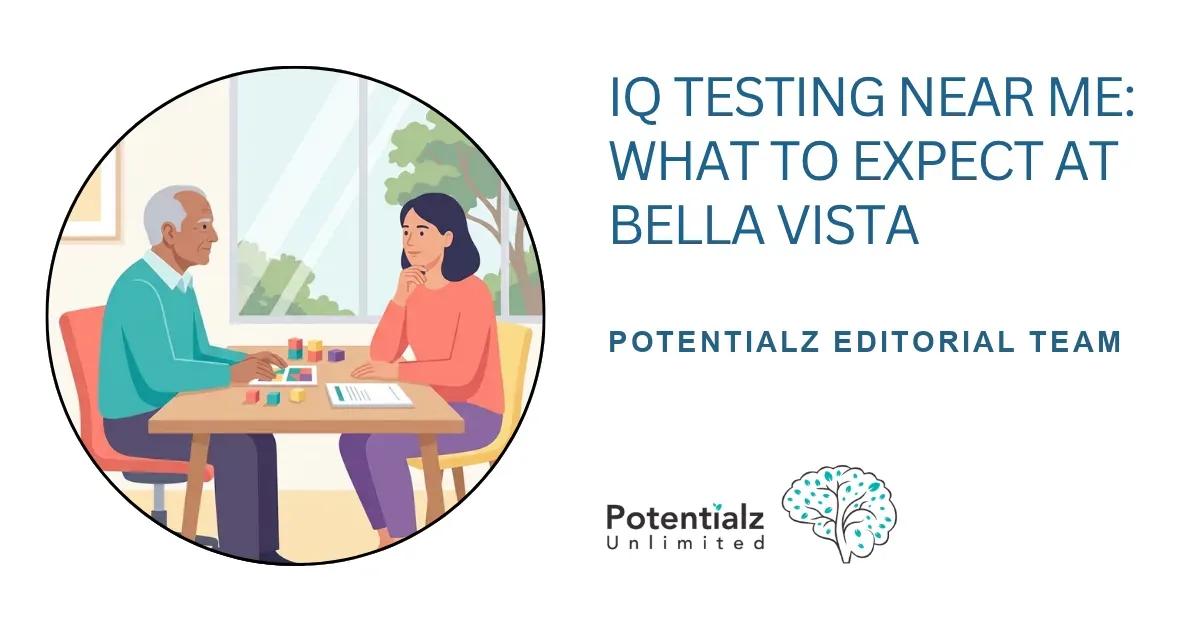
The tasks (called subtests) vary a lot. Some involve talking — defining words, explaining how two ideas are alike, or answering general knowledge questions. Some involve doing — arranging coloured blocks to match a picture, solving visual puzzles, or matching symbols to numbers under time pressure. Some involve holding information in mind, such as repeating strings of numbers, or doing simple maths in your head.
Most people find some tasks easy and some hard. That is by design. Every task is built to eventually reach your limit, called your ceiling. So at some point, you will hit tasks that feel genuinely hard. This is normal. It does not mean you have “failed”. Getting some items wrong is exactly how the test works out where your ceiling sits.
The psychologist reads out set instructions and cannot give you detailed feedback during the test itself. That would change the standard conditions the test relies on. But they stay warm and encouraging within those limits. Small breaks, water, and some friendly chat are all part of the day.
Step 4 — Scoring, interpretation, and report writing
After the test day comes a period of scoring the test, working out what it all means, and writing the report. This can take a few weeks. A good cognitive report is not something a psychologist writes in an hour on the same afternoon. This means scoring each task, reading the pattern of results alongside the person’s history, working out what it means clinically, and writing a report that says something useful. All of this takes real time. If it took less time, it probably would not be worth reading.
Step 5 — The feedback session
Once the report is written, there is usually a feedback appointment with the assessing psychologist. Here, the psychologist walks you through the findings, explains what they mean, answers your questions, and talks through next steps. For a child’s test, feedback is usually given to the parents. An age-appropriate version is also given to the child, either in that same meeting or in a separate short talk.
The feedback session is often the single most valuable part of the whole process. Come with your questions written down. Take notes. If something is confusing, ask. It is your report and your life. You are entitled to fully understand it.
Step 6 — What happens next
After the feedback session, the report belongs to you. What happens next depends on why you had the test. It might mean sharing the report with a school or workplace. It might mean starting therapy to work on specific findings. It might mean sharing it with your GP or paediatrician, or sending it to the NDIS as part of an application. Or it might simply mean keeping it as a piece of clinical information about yourself or your child.
What “Near Me” Actually Means in Bella Vista
If you are searching for IQ testing “near me” from Bella Vista, The Hills, Baulkham Hills, Kellyville, Rouse Hill, Norwest, Castle Hill, Winston Hills, or nearby suburbs, Potentialz Unlimited is a genuinely local option. The practice is at Unit 608, 8 Elizabeth Macarthur Drive, Bella Vista, in the Norwest business precinct, with easy access from the M2 and Windsor Road, and Bella Vista Metro station a short drive away.
Being close to the practice matters more for cognitive assessment than for most other kinds of psychology work, because the test itself has to happen in person. A three-to-four-hour block of face-to-face time cannot be done over video. Follow-up therapy is often available by phone or Zoom if that suits better, and the intake and feedback conversations can sometimes be done that way too. But the assessment day itself has to happen in person.
For families where a child is the one being assessed, being close to the practice cuts down the travel on a long test day. For adults, where tiredness from the test is part of the picture, being close also helps — a long drive home after a mentally tiring day is not ideal.
Most clients come from The Hills district nearby. Some travel from further away — the wider northwest, parts of Parramatta and the inner west, and occasionally the Central Coast. That is because a good combination of things can be hard to find: an experienced psychologist, a manageable wait, and reasonable cost. This combination can be harder to find than a regular therapy appointment.
How Much Will It Cost?
We do not want to quote exact figures here, because they go out of date within months. What we can do is give you the general shape of it.
Total cost for a full cognitive test. A formal cognitive test is a big piece of clinical work. It takes several hours of direct assessment time, plus scoring, working out what it means, writing the report, and a feedback session. In Australian private practice, a full cognitive test with report and feedback typically costs somewhere in the low-to-mid thousands of dollars. This depends on the specific test plan. For example, extra tests for academic skills, everyday functioning, or autism can be added. It also depends on how senior the assessing psychologist is, and on the practice itself.
Medicare rebates. Medicare rebates for cognitive assessment are limited. The standard Mental Health Care Plan from your GP does not fund a full cognitive test. A few specific item numbers may apply in particular circumstances, but do not assume Medicare will cover much of the cost of a private cognitive assessment. Reception can talk you through what, if anything, applies to you.
NDIS. For eligible NDIS participants, cognitive assessment may be funded under capacity-building supports, where the assessment relates directly to disability evidence or plan development. Self-managed and plan-managed participants generally have more flexibility here than NDIA-managed participants.
Private health insurance. Some private health insurance extras policies cover part of the cost of a psychological test. Check with your insurer — this varies a lot between funds and levels of cover.
Employer, school, or educational funding. Sometimes an employer, school, university, TAFE, or workplace insurer will fund an assessment directly linked to accommodations or a return-to-work plan. It is always worth asking.
The honest answer to “how much will this cost me” is: check with reception when you enquire. The figures shift over time, and we would rather you had accurate current information than a stale number from a blog post.
How Long Will I Wait?
Wait times for cognitive assessment vary, and they are often longer than for a standard therapy appointment. This is because the test takes a large block of the psychologist’s time. It is also because only a limited number of psychologists have the specific training and experience to do a good cognitive assessment.
Wait times at Potentialz change over time. Reception will give you an honest current figure when you enquire. If your test is time-critical — for example, an NDIS application with a set deadline, or a school placement decision — say so clearly when you enquire. Sometimes an urgent slot can be found where circumstances allow.
If the wait at Potentialz is longer than you can work with, reception can also point you honestly toward other options nearby. This includes practices that focus mainly on high-volume cognitive assessment work. We would rather point you to the right place than have you wait longer than you can afford to.
Common Concerns and Honest Answers
Here are the questions we hear most often in intake conversations about cognitive assessment, with honest answers.
“Will I get a number that makes me feel bad about myself?”
Maybe, maybe not. The honest answer is that the number is not really the point. A good cognitive profile has many parts. Most people who go through a proper cognitive test find that it makes sense of things they already half-knew about themselves, rather than a shock. That said, if you tend to judge yourself harshly, use the feedback session as a chance to look at the profile with clinical support. Do not read a cognitive report alone and let the numbers hit you with no support.
“What if my child gets a low score and then thinks they are stupid?”
This is a fair worry. Raise it directly with the assessing psychologist. Good practice with children means careful, age-appropriate feedback. It names the child’s strengths as well as their difficulties. It treats the profile as a map for support, not a final verdict. It never reduces a child to a number. Parents are usually the main gatekeepers of how a child understands the test — how you frame it matters more than the number itself.
“Is the number really accurate?”
Cognitive assessment is one of the most carefully checked and tested tools in clinical psychology. It gives similar results if repeated, and it genuinely measures what it claims to measure. Still, every score comes with a confidence interval — a range the person’s “true” score is very likely to sit within. A Full Scale IQ of 108, with a 95 per cent confidence interval of 103 to 113, means the true score is very likely somewhere in that range. This is not sloppiness. It is honesty about the limits of any measurement. Good reports include confidence intervals; poor reports do not.
“Can I practise beforehand?”
You cannot practise the specific tasks. They are copyrighted materials you would not have access to anyway, and practising would ruin the accuracy of your score. What you can do is get a good night’s sleep, eat properly, take your regular medication as usual, and turn up rested. That is all the preparation the test needs from you.
“What if I’m anxious on the day?”
Feeling anxious on test day is normal, and expected to some extent. Good psychologists build in warm-up time, friendly chat, and reassurance. If anxiety is bad enough to genuinely affect the results, this can be flagged, and in some cases the test can be rescheduled. If you live with an ongoing anxiety disorder, talk to the assessing psychologist about it beforehand.
“What if English isn’t my first language?”
Raise this directly with the assessing psychologist at intake. Tasks that involve spoken language are marked using the language used in the test. So for a client whose English is a second or third language, verbal scores need to be read with that background clearly in mind. In some cases, a non-verbal or bilingual test may suit better. Good psychologists will discuss this openly and adjust the plan.
“Can I have someone with me?”
For adult tests, generally no — the test relies on the client working one-to-one with the psychologist. For very young children, or in unusual circumstances, a parent may briefly stay in the room for part of the test, but this is uncommon and is usually agreed in advance.
Preparing Yourself (or Your Child) for the Assessment Day
A little bit of practical preparation goes a long way. Here is what we usually suggest.
Sleep. A proper night’s sleep the night before is one of the most important things you can do. Cognitive scores — especially working memory and processing speed — are clearly affected by tiredness. If you or your child struggle to sleep before something important, flag it with the assessing psychologist. Sometimes the test can be rescheduled if a bad night’s sleep gets in the way.
Food. Eat a proper meal before the test. Three to four hours of concentrated thinking uses real energy. Bring water and a snack for the middle. Low blood sugar is not a great state to be in for standard cognitive tasks.
Medication. Take any regular medication as you normally would on a work or school day. This matters especially for ADHD medication — the general advice is to take it as usual, so the test reflects how you work, not an artificial unmedicated state. If you are unsure, check with your prescribing doctor beforehand.
Sensory aids. Bring glasses if you use them. Bring hearing aids if you use them. Bring anything else that helps you (or your child) take part in a task the way you normally would.
Emotional preparation. Give yourself (or your child) an honest, low-key idea of what to expect — a few hours of varied tasks with a psychologist, some easier, some harder, with no way to fail. Do not talk it up, and do not talk it down. Avoid coaching your child on specific tasks — the test is standard for everyone, and coaching would ruin that.
Logistics. Leave buffer time on both sides. Do not book anything urgent straight after the test — cognitive tiredness afterward is real. If you are travelling to Bella Vista from further away, allow for traffic and parking.
Questions. Bring your questions written down. Some can be answered before the test, some are for the feedback session, and some may come up during the day. Writing them down means they do not get lost in the moment.
Who Sees Whom at Potentialz — Quick Reference
Because the question of “which clinician do I need” comes up so often, here is a quick summary of how the practice is organised.
Dr Gurprit Ganda — Clinical Psychologist (senior). Formal cognitive and neuropsychological assessment across all ages (WAIS, WISC-V, WPPSI, WIAT, everyday-functioning measures, and autism-specific tools where appropriate). EMDR-trained. Forensic and medico-legal assessment. The right person for anything needing formal assessment, or complex trauma work with adult clients.
Sushama Sathe — Registered Psychologist with two decades of experience. EMDR-trained. Strong on perinatal and grief work, and on multicultural family therapy.
Samita Rathor — Clinical Counsellor and Psychotherapist (PACFA Clinical Registrant), who also brings yoga therapy into her work. Body-based, breath-based approaches, particularly for stress, anxiety, and life transitions where that style is a good fit.
Bhavini Ambaram — Practitioner in Therapeutic Play (PTUK/PTSA accredited), with extra training in Synergetic Play Therapy, LEGO-Based Therapy, and Parent-Child Attachment Play. The right person for children under 8, or for children of any age whose main need is play-based rather than talking-based therapy.
William Carter — Registered Psychologist (AHPRA PSY0002696305). Works with children (aged 8 and up), adolescents, young adults, and older adults, using Cognitive Behavioural Therapy (CBT), Acceptance and Commitment Therapy (ACT), and Solution-Focused Therapy. At Potentialz, formal cognitive assessment sits with Dr Ganda; William’s role in the assessment pathway is on the therapy and family-support side.
If you are not sure who to see, reception can help work it out. A brief phone conversation is usually more useful than trying to guess from a website.
When “IQ Testing” Is Not Actually the Right Answer
Let’s be honest about this, because it matters.
Not everyone who thinks they want cognitive assessment needs it. Sometimes the right answer is something else.
If your main struggle is emotional or relational. Cognitive assessment does not treat anxiety, depression, relationship trouble, grief, or life transitions. Therapy does. If that is your main concern, a therapy appointment is a far better first step than an assessment. You can always assess later if a cognitive question comes up through the therapy work.
If your child is under 8 and the worry is emotional or developmental, not cognitive. For very young children, cognitive assessment adds less clinical value than a good developmental picture built from history, observation, and, where useful, play-based therapy. Bhavini’s play therapy work is often the right first step here.
If you are in an acute crisis or a major life upheaval. A three-to-four-hour cognitive assessment during a crisis is not clinically useful. Stabilise first, assess later.
If you have already had a cognitive assessment recently. Testing again on the same test soon after a previous assessment is generally not useful. Cognitive scores stay fairly stable in the short term, and testing again brings “practice effects” that can push scores up in a misleading way. If you have had an assessment in the last two to three years and the question is basically the same, the existing report is usually a better starting point than doing it again.
If your main motivation is to prove something to yourself or someone else. That feeling is real, but cognitive assessment is not the right tool for it. That work is usually better done in therapy, unpacking where the need to prove yourself comes from and what would help.
If cost or timing means the test will strain other priorities without a clear payoff. Sometimes the honest answer is “yes, but not this month”, or “let’s find a way to spread the cost”, or “therapy is the better use of these resources right now”.
The Cognitive Profile — Why Five Numbers (or Four) Are More Useful Than One
Here is a plain example of why “IQ” as one number is far less useful than the full profile behind it.
Picture two made-up adults. Both have a Full Scale IQ of 108, which sits in the average-to-high-average range.
Person A has a fairly flat profile: Verbal Comprehension 108, Perceptual Reasoning 110, Working Memory 105, Processing Speed 110. Each of these four scores sits close to the overall number. For Person A, the Full Scale IQ of 108 is a fair summary of how they think.
Person B has a very uneven profile. Verbal Comprehension is 132 (in the top 2 per cent — well into the superior range). Perceptual Reasoning is 118 (above average). Working Memory is 92 (average). Processing Speed is 80 (well below average, around the bottom 9 per cent). The four scores average out to roughly the same Full Scale IQ. But Person B moves through the world very differently to Person A.
In daily life, Person B is likely to feel “smart but slow”. They are brilliant with ideas, but worn out by admin. They shine in conversation, but struggle to do several things at once. They can hold a complex argument in their head, yet cannot keep up in a fast-moving meeting. This exact pattern shows up often enough in adult ADHD workups that psychologists take it seriously as a flag worth following up.
The Full Scale IQ of 108 tells you almost nothing useful about Person B. The full profile tells you a great deal. It can inform conversations about medication. It can shape workplace support planning. It can guide therapy. And it can help Person B stop blaming themselves for a pattern that has finally been given a name.
This is why any cognitive assessment report worth reading spends most of its time on the profile, not the single overall number. It is also why “cognitive profile assessment” is a better description of this work than “IQ testing”.
What a Good Cognitive Report Actually Contains
You may end up reading one of these reports yourself. Here is what a good cognitive assessment report looks like from the inside.
Referral question and background. This restates why the test happened, who referred the person, and what real-world question it is meant to answer. If this part is missing or vague, the rest of the report is unlikely to be much use.
History. A summary of the person’s development, schooling, medical background, and family situation. All of this shapes how the results should be read. For a child’s test, this covers birth history, developmental milestones, medical history, school history, and family context. For an adult’s test, it covers school history, work history, medical history, current mental health, and how things affect daily life now.
Behavioural observations. The psychologist’s notes on how the person behaved during the test. This covers how engaged they were, how much effort they put in, and their mood, anxiety, and attention. It also covers how they handled hard items, and how they responded within the set test conditions. These notes are often just as important as the numbers.
Test results with confidence intervals. Every task score, every index score, and the Full Scale IQ, each with a proper confidence interval. A confidence interval is a range showing how much the exact number could shift if the person sat the test again. The report should also show percentile ranks alongside the standard scores. A percentile rank shows what share of the comparison group scored the same or lower. There should also be a section describing the overall profile — the pattern of strengths and weaknesses — with the psychologist’s own reading of it.
Discussion, or formulation. A summary of what the results mean, read alongside the person’s history and the original question. Not a dry list of numbers — a clinical picture that ties everything together.
Recommendations. Specific, practical advice tied to the profile and the original question. Generic advice is a warning sign. The report should say something specific about this person, in this context, with this profile.
Caveats. This is a clear note on anything that may have affected the test, such as tiredness, anxiety, cultural or language background, medication, or engagement. It should say how much weight the results should carry, given those factors.
If a report you receive is missing several of these parts, or is shorter than around ten pages of real content, you are entitled to ask the assessing psychologist for a fuller explanation.
What a Good Assessment Actually Looks Like — Signs to Look For
Not all cognitive tests are done equally well. If you are choosing between practices, here are signs of a good assessment service.
A proper intake conversation before booking. A good service spends time clarifying the referral question before booking an assessment. If a practice will book you in for a full cognitive assessment from a two-line online enquiry, that is a warning sign.
Clarity about who will do the test. You are entitled to know which psychologist will carry out the test, what their training and experience is, and whether they are a Registered Psychologist or a Clinical Psychologist.
Realistic timeframes. A full cognitive assessment with report and feedback should usually take three to six weeks, from the assessment day to final feedback. A service promising a full report within 48 hours is either using a shortened assessment or cutting corners on the analysis.
A written report of proper depth. A good cognitive report is typically 10 to 20 pages. It includes the history, the specific findings with confidence intervals, notes on behaviour during the test, and specific practical advice tied to the profile. A one-page list of numbers is not a report.
A feedback session as a standard part of the service. If feedback is charged as an extra, optional appointment rather than included in the test, that is a warning sign.
Willingness to say “you don’t need this test”. A trustworthy service will sometimes tell you that a cognitive assessment is not the right next step, and suggest what might work better instead. A service that always says yes to assessment is not always giving you honest clinical advice.
How We Can Help
If you have read this far and have a genuine question about whether cognitive assessment is right for you or a family member, you are welcome to reach out.
For a formal cognitive assessment, the practical first step is usually a phone conversation with reception. Reception will clarify the referral question, walk you through current cost, wait time, and rebate arrangements, and book you in with Dr Ganda where that is the right fit.
If your question is more general — “I am not sure whether I need an assessment, therapy, or something else” — start with a conversation with one of our Registered Psychologists. Together, you can work out whether an assessment is the right next step. Where it is, we will happily connect you with Dr Ganda in-house. Where therapy is the better first step, we can do that work together.
Our psychology team at Potentialz Unlimited in Bella Vista works with children (aged 8 and up), adolescents, young adults, and older adults. We use Cognitive Behavioural Therapy (CBT), Acceptance and Commitment Therapy (ACT), and Solution-Focused Therapy. All of this is grounded in a strong, non-judgemental relationship with the client.
Medicare rebates are available with a Mental Health Care Plan (MHCP) from your GP for therapy sessions. NDIS (self-managed and plan-managed) referrals are accepted. Formal cognitive assessment cost and rebate arrangements are separate, and are best confirmed when you enquire.
- Address: Unit 608, 8 Elizabeth Macarthur Drive, Bella Vista NSW 2153
- Phone: 0410 261 838
- Book: live.potentialz.com.au
- Hours: Monday–Friday 10am–7pm | Saturday & after-hours available | Telehealth via phone or Zoom (for therapy; formal cognitive assessment is delivered in person)
You may also find these related posts useful: WAIS Adult IQ and Cognitive Assessment in Bella Vista, WISC-V Child Cognitive Assessment Explained, Cognitive Assessment for Learning Difficulties: What WISC and WPPSI Actually Measure, Adult ADHD Assessment: What to Expect and What the Results Actually Mean, and Play Therapist Bella Vista vs Child Psychologist: Which Does Your 8-Year-Old Need?.
References
American Psychiatric Association. (2022). Diagnostic and statistical manual of mental disorders (5th ed., text rev.). https://doi.org/10.1176/appi.books.9780890425787
Barkley, R. A. (2015). Attention-deficit hyperactivity disorder: A handbook for diagnosis and treatment (4th ed.). Guilford Press.
Deary, I. J., Penke, L., & Johnson, W. (2010). The neuroscience of human intelligence differences. Nature Reviews Neuroscience, 11(3), 201–211. https://doi.org/10.1038/nrn2793
Flanagan, D. P., & Alfonso, V. C. (Eds.). (2017). Essentials of WISC-V assessment. John Wiley & Sons.
Fletcher, J. M., Lyon, G. R., Fuchs, L. S., & Barnes, M. A. (2019). Learning disabilities: From identification to intervention (2nd ed.). Guilford Press.
Groth-Marnat, G., & Wright, A. J. (2016). Handbook of psychological assessment (6th ed.). Wiley.
Kaufman, A. S., Raiford, S. E., & Coalson, D. L. (2016). Intelligent testing with the WISC-V. John Wiley & Sons.
Lichtenberger, E. O., & Kaufman, A. S. (2013). Essentials of WAIS-IV assessment (2nd ed.). John Wiley & Sons.
Sattler, J. M. (2018). Assessment of children: Cognitive foundations and applications (6th ed.). Jerome M. Sattler, Publisher.
Silverman, L. K. (2013). Giftedness 101. Springer Publishing Company.
Wechsler, D. (2008). Wechsler Adult Intelligence Scale — Fourth Edition (WAIS-IV): Technical and interpretive manual. Pearson.
Wechsler, D. (2014). Wechsler Intelligence Scale for Children — Fifth Edition (WISC-V): Technical and interpretive manual. Pearson.
Weiss, L. G., Saklofske, D. H., Coalson, D. L., & Raiford, S. E. (Eds.). (2010). WAIS-IV clinical use and interpretation: Scientist-practitioner perspectives. Academic Press.
Weiss, L. G., Saklofske, D. H., Holdnack, J. A., & Prifitera, A. (Eds.). (2019). WISC-V: Clinical use and interpretation (2nd ed.). Academic Press.
Disclaimer
The clinical team at Potentialz Unlimited includes psychologists registered with AHPRA (Psychology Board of Australia), including William Carter, Registered Psychologist (Registration No. PSY0002696305). The information in this post is general in nature and does not constitute clinical advice for your particular situation. Please consult a qualified health professional for your individual circumstances. If you are experiencing a mental health crisis, contact your GP, call Lifeline on 13 11 14, or go to your nearest emergency department.
Crisis Resources
- Lifeline: 13 11 14 (24/7)
- Beyond Blue: 1300 22 4636
- Kids Helpline: 1800 55 1800
- MensLine Australia: 1300 78 99 78
- 13YARN (Aboriginal & Torres Strait Islander crisis line): 13 92 76
- Emergency: 000
Knowledge Check Quiz
Test what you have just read. Choose your answer for each question, then submit to reveal the answers and your score.
Need Professional Support?
If you're experiencing mental health concerns, our team is here to help.