Key Takeaways
- The WAIS — Wechsler Adult Intelligence Scale — is one of the most widely used standardised measures of adult cognitive functioning in Australia and internationally. The most commonly administered edition in Australian practice is currently the WAIS-IV; the WAIS-5 has been released more recently and is being phased in gradually.
- A WAIS is not an “IQ test” in the pop-culture sense. It is a structured, roughly four-hour, individually-administered set of subtests that produces a detailed cognitive profile — verbal comprehension, perceptual reasoning, working memory, and processing speed — not just a single number.
- People come to WAIS assessment for many reasons: suspected learning differences that were missed in childhood, adult ADHD workups that call for cognitive profiling, differential diagnostic questions where cognitive functioning matters, NDIS access requirements, workplace or study accommodations, cognitive change after illness or injury, and — sometimes — genuine curiosity about how their mind works.
- The single-number “IQ score” is real but oversold. The profile is where the useful clinical information lives, especially the discrepancies between scales (for example, a strong Verbal Comprehension Index alongside a much lower Processing Speed Index tells you something important).
- At Potentialz Unlimited in Bella Vista, formal cognitive assessment is delivered by our senior Clinical Psychologist, who has over two decades of assessment experience. This post is an editorial piece from our practice; the Registered Psychologist team sits alongside the assessment work with the therapy that often follows.
- A good WAIS report is not a verdict. It is a starting point for conversations about strengths to lean on, difficulties to accommodate, and where — if anywhere — further assessment or intervention is indicated.
- Cost, wait time, and rebate arrangements vary. Medicare rebates for cognitive assessment specifically are limited; NDIS funding is often available for eligible participants under capacity-building categories. Please check the current arrangements with reception when you enquire — those numbers move.
- If you are wondering whether a WAIS is right for you, a brief phone conversation is usually more useful than a form. Reception will listen to what is actually going on and help you decide whether cognitive assessment, therapy, or a combination is the appropriate next step.
Why Adults Book a Cognitive Assessment in the First Place
Most of the adults who end up sitting a WAIS did not grow up planning to sit one. They are usually here because a question has been bothering them for a while — sometimes for decades — and they have arrived at a point where they want a real answer rather than another opinion.
The questions tend to sound like this.
“I have always felt like I was working twice as hard as everyone around me for the same result. Something is going on and I want to know what it is.”
“I have started an ADHD assessment and the clinician has mentioned a cognitive assessment as part of the picture. I don’t really understand why.”
“I have been diagnosed with a chronic health condition — post-concussion, long COVID, MS, early cognitive change — and I want to know what is baseline and what has actually shifted.”
“I want to apply for NDIS support and I have been told I need a cognitive assessment to help make the case.”
“I am considering going back to study, or changing careers into something more cognitively demanding, and I want an honest sense of what my mind is good at.”
“I have a young adult son or daughter who is struggling at university and we are trying to work out whether there is a learning issue that has been missed.”
None of those are frivolous reasons. All of them come up regularly in intake conversations at Potentialz Unlimited in Bella Vista.
The WAIS does not answer every one of those questions on its own. But in the hands of a skilled clinician, and interpreted alongside a proper clinical interview, developmental history, current functioning, and — where relevant — other assessments, it is a genuinely useful piece of information. It is one of the best-validated psychological instruments in the world, and its use is standard clinical practice for a reason.
This post is a Potentialz Unlimited editorial piece drawing on our clinical team’s experience — an honest, plain-English walk through what the WAIS actually is, what it measures, what a session looks like, who it helps, who it does not help, and how it fits into the assessment work at Potentialz Unlimited. Formal cognitive assessment at the practice is delivered in-house by our senior Clinical Psychologist, whose background in assessment is deep. The Registered Psychologist team’s role is on the therapy side of the pathway — before, during and after assessment.
What the WAIS Actually Is
The Wechsler Adult Intelligence Scale — WAIS for short — was originally developed by the American psychologist David Wechsler in 1955, as an adult counterpart to his earlier scales for children. It has been through several revisions since then. The WAIS-III appeared in 1997, the WAIS-IV in 2008, and the WAIS-5 has been released in the last few years and is being progressively adopted by clinicians internationally. Most Australian practices are currently using the WAIS-IV, sometimes alongside the WAIS-5 depending on the clinician’s training and the client’s specific question. For a fuller history and structure of the test itself, see our dedicated explainer in an overview of the Wechsler Adult Intelligence Scale.
The WAIS is designed for people aged 16 and older, and in Australia it is normed against a representative sample so that a score can be interpreted in the context of what is typical for the general adult population.
Structurally, it is a set of individually-administered subtests — meaning one clinician sits in the room with one client and works through the tasks together. It is not a computerised test, a self-report questionnaire, or a group test. That one-to-one delivery matters, and we will come back to it.
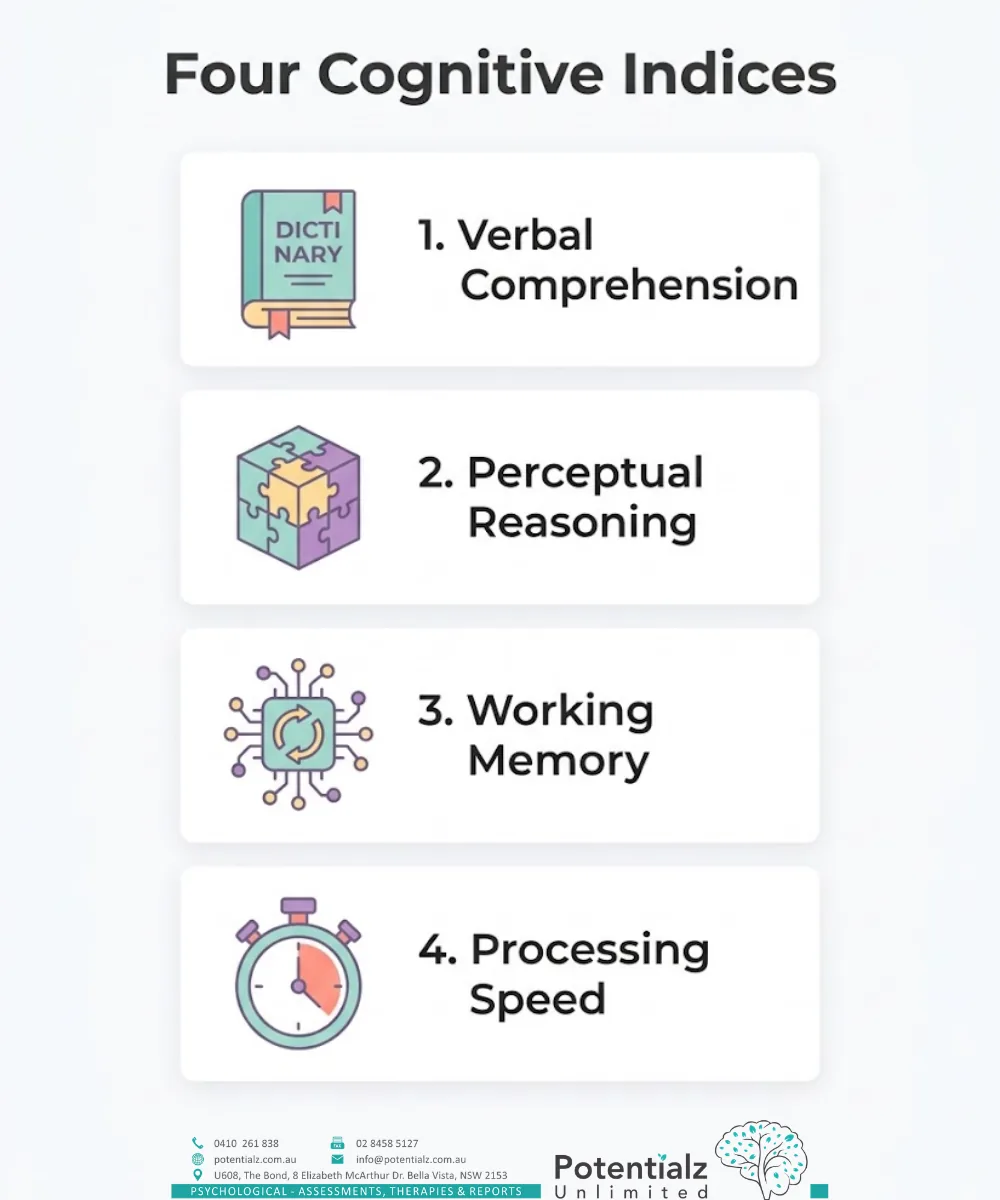
The WAIS-IV, which is what most Australian clinicians will currently administer, consists of ten core subtests and a small number of supplementary subtests. Those ten core subtests roll up into four “index scores” — Verbal Comprehension, Perceptual Reasoning, Working Memory, and Processing Speed — and a single Full Scale IQ that summarises overall performance.
The four indices are worth understanding, because they are where most of the clinically useful information lives.
Verbal Comprehension. This is about your ability to understand and reason with words and language. Subtests include Similarities (how are two concepts alike?), Vocabulary (what does this word mean?), and Information (general knowledge questions from the culture you grew up in). Verbal Comprehension is often stable over time and tends to be a reasonable indicator of what people historically called “crystallised intelligence” — the store of knowledge and language you have accumulated over a lifetime.
Perceptual Reasoning. This is about your ability to reason with visual and spatial material, to see patterns, and to solve novel visual problems. Subtests include Block Design (recreating a two-dimensional pattern using coloured blocks), Matrix Reasoning (completing an abstract visual pattern), and Visual Puzzles (mentally assembling shapes to match a target). This is closer to what used to be called “fluid intelligence” — the ability to reason with novel information rather than draw on existing knowledge.
Working Memory. This is about your ability to hold information in mind, work with it, and manipulate it. Subtests include Digit Span (repeating strings of numbers forwards, backwards, and in ascending order) and Arithmetic (mental math problems delivered verbally). Working memory is heavily implicated in day-to-day functioning — following multi-step instructions, keeping track of a conversation, remembering what you came into the room for — and is one of the areas most commonly affected in ADHD, in some anxiety presentations, and in cognitive change after illness or injury.
Processing Speed. This is about how quickly you can take in, process, and respond to simple visual information. Subtests include Coding (matching symbols to numbers under time pressure) and Symbol Search (scanning a row of symbols to see whether a target is present). Processing Speed is particularly sensitive to fatigue, mood, ADHD, and neurological factors. A low Processing Speed score in someone with otherwise strong reasoning ability is one of the more common patterns seen in adult ADHD assessments.
The Full Scale IQ pulls all four indices together into a single number, standardised so that the average is 100 and about two-thirds of the population score between 85 and 115. But — and this is the piece most people miss — the Full Scale IQ is often the least clinically interesting number in the report. What matters is the shape of the profile: which indices are strong, which are relatively weaker, and where the gaps between them tell a story about how a person actually functions in daily life.
Why the Profile Matters More Than the Number
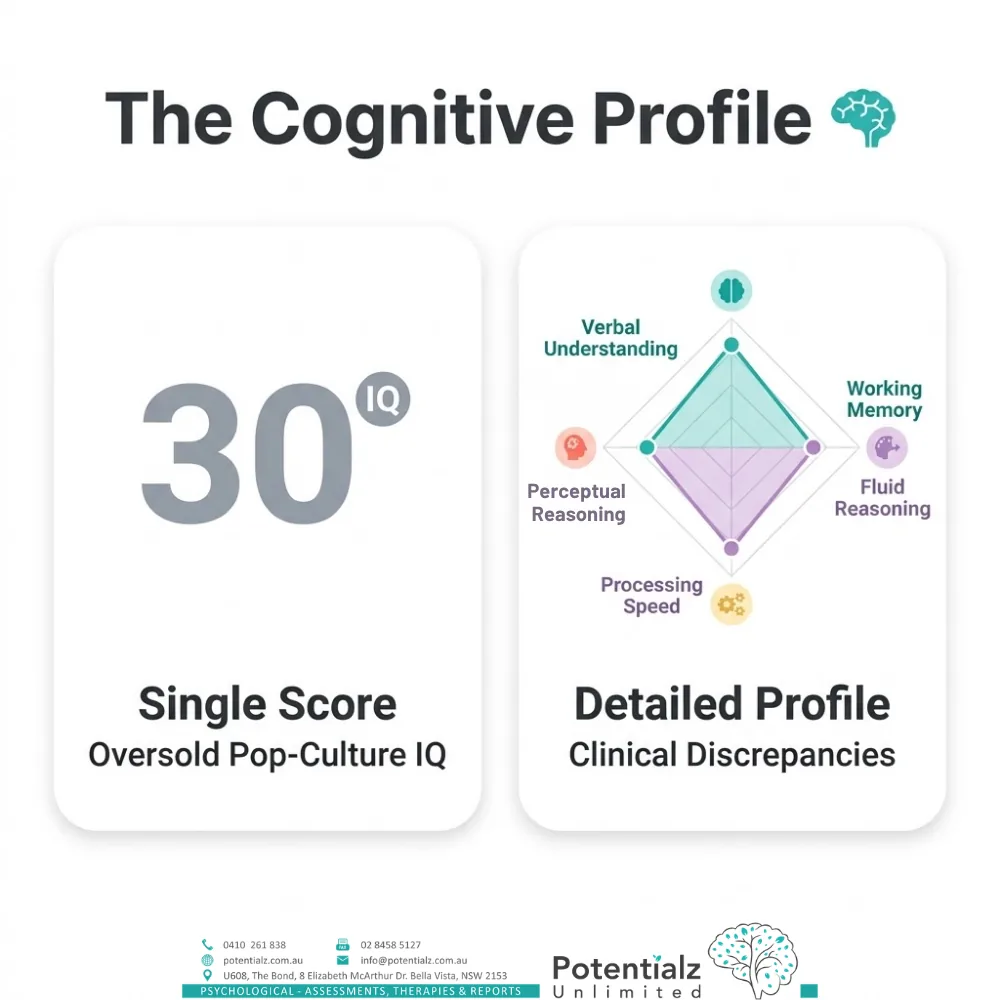
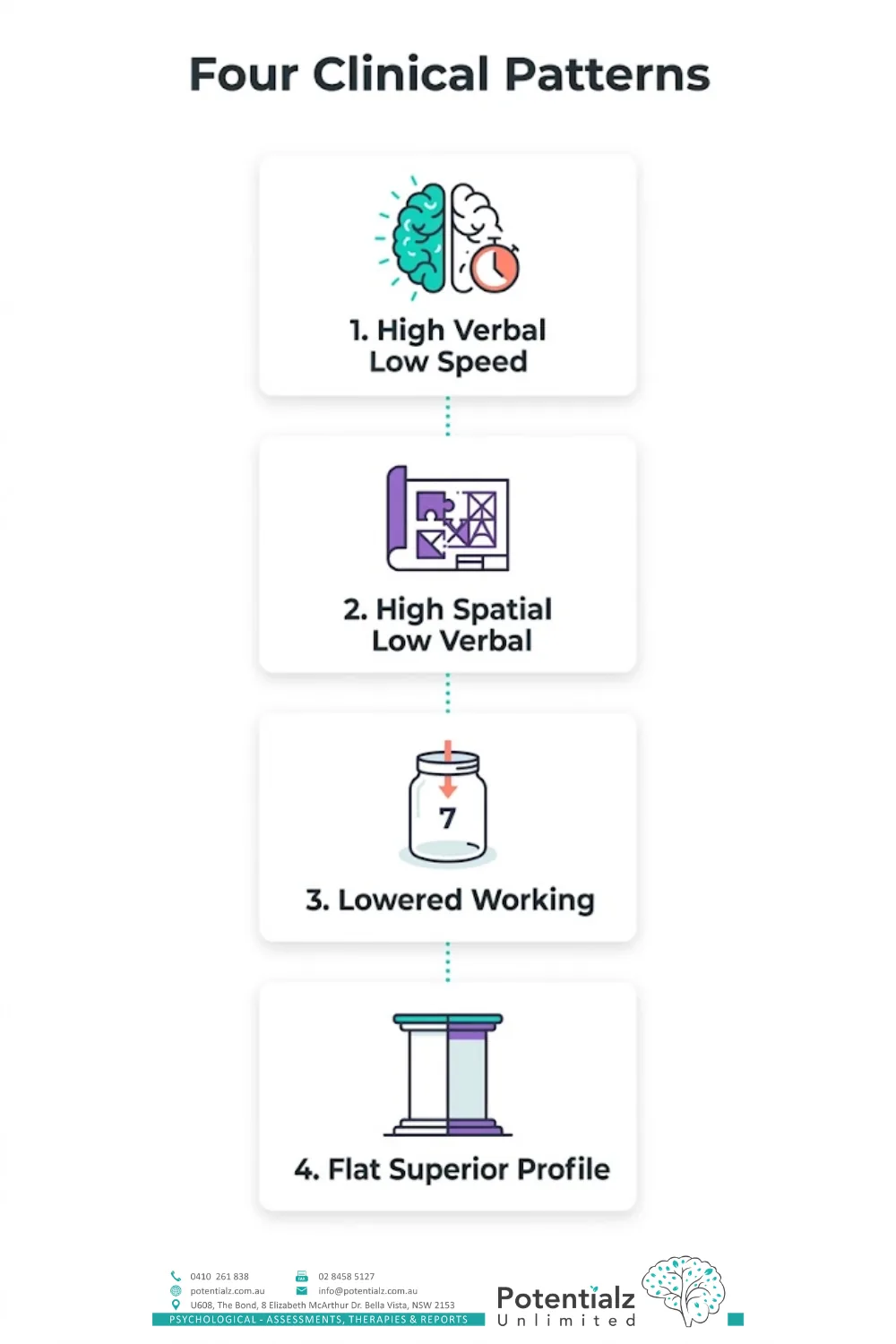
To make this concrete, here are a few of the patterns that come up in clinical discussions of cognitive profiles.
Pattern 1: strong verbal reasoning, low processing speed. Imagine a client with a Verbal Comprehension Index at the 92nd percentile and a Processing Speed Index at the 15th percentile. Their Full Scale IQ might land somewhere in the average range — a “normal” number that hides the underlying story. But the person living inside that profile often describes themselves as “smart but slow”, “constantly overwhelmed by admin”, “good at ideas, hopeless at paperwork”. They may have struggled with exams that were speed-based rather than knowledge-based, may have found university reading manageable but assignment deadlines punishing, and may have burnt out repeatedly trying to keep up with roles that expected fast task-switching. That profile is common enough in adult ADHD workups that it is one of the flags clinicians pay attention to.
Pattern 2: strong perceptual reasoning, weaker verbal comprehension. Some clients present with strong non-verbal reasoning — they can see patterns, solve visual problems, build things — but comparatively weaker verbal comprehension. This can be relevant in the context of undiagnosed language-based learning differences, in some presentations related to hearing history or bilingual development, and occasionally in specific neurodevelopmental profiles. It can also help explain why someone who is clearly clever in practical or technical domains has struggled with academic writing or verbal presentations across their whole education.
Pattern 3: low working memory, average everything else. A low Working Memory Index in an otherwise average or above-average profile is one of the more common findings in adults dealing with anxiety, sleep disruption, chronic health conditions, and ADHD. The clinical work then is to figure out which of those factors is driving the working memory load — because the intervention differs. Better sleep, treatment of anxiety, ADHD medication, or environmental accommodations at work will each help a different underlying cause.
Pattern 4: flat profile, all indices low. A profile where all four indices sit toward the low end raises different clinical questions — questions about developmental history, educational history, health factors, and whether an intellectual disability might be part of the picture. This is the kind of finding that requires careful interpretation alongside a full history and, often, adaptive functioning measures like the Vineland or ABAS.
Pattern 5: flat profile, all indices high. A profile where everything sits in the superior range is not uncommon and does not require intervention on its own. What it sometimes explains — for adults presenting with anxiety or perfectionism — is a long history of being able to “muscle through” until the demands got large enough that raw ability was not sufficient. It can also be useful in identifying gifted adults whose intensity, sensitivity, or existential concerns have never had a frame.
None of these patterns are diagnostic on their own. All of them are examples of why a careful cognitive profile can add real value that a self-report questionnaire cannot.
Who Actually Benefits From a WAIS
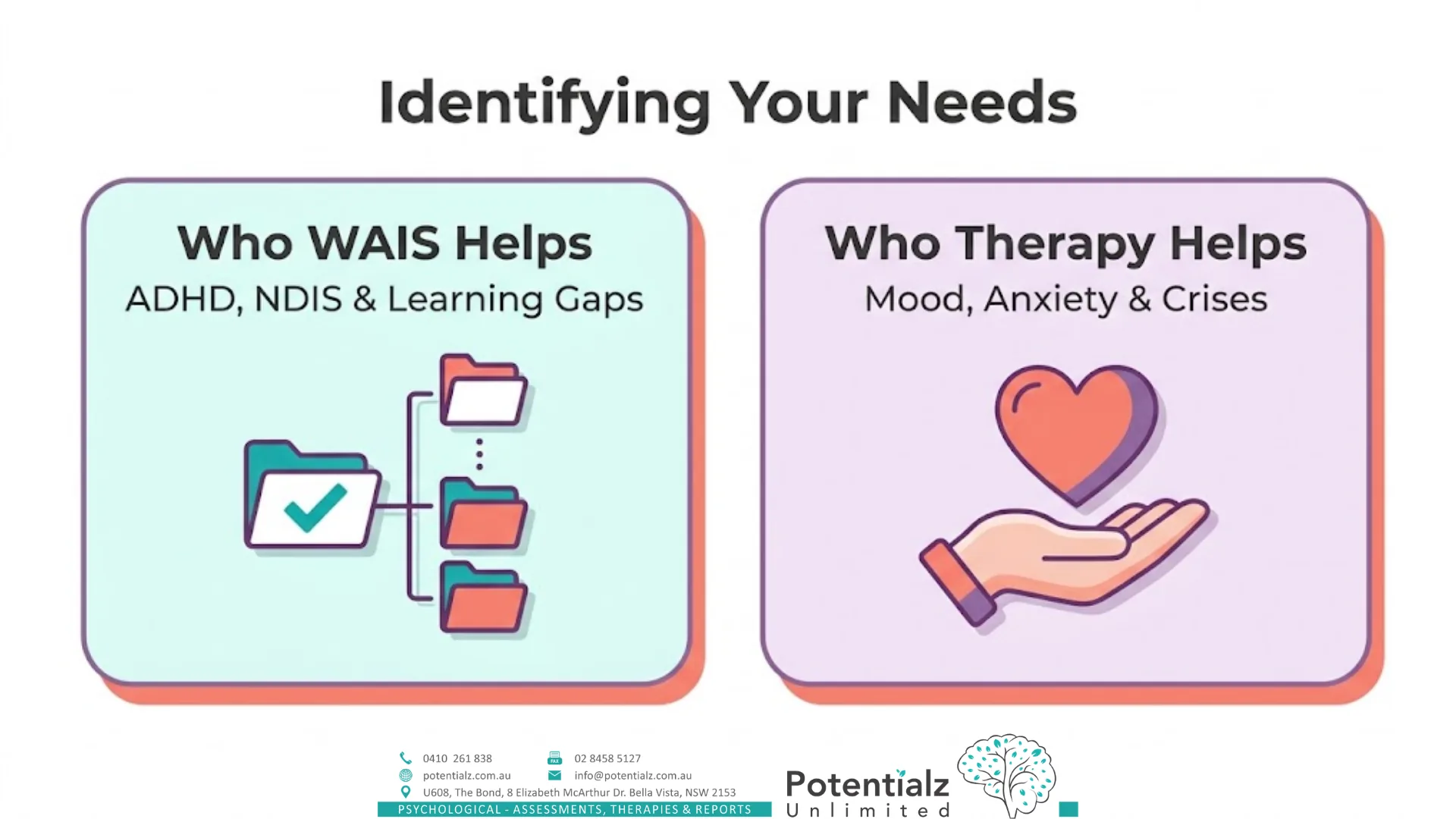
In clinical conversations at Potentialz, the practice steers people towards a WAIS only when it will actually help them make a decision or answer a question that matters. Here are the situations in which it tends to be worth the time and cost.
Adult ADHD assessment (as part of the picture, not the whole)
The gold-standard adult ADHD assessment is a clinical interview covering current symptoms, developmental history, functional impact across multiple domains, and rule-out of alternative explanations. Cognitive assessment does not diagnose ADHD on its own. It cannot — there are people with clear ADHD whose cognitive profiles look unremarkable, and there are people with unusual cognitive profiles who do not have ADHD.
What a WAIS can do inside an ADHD assessment is add a layer of information about cognitive strengths and weaknesses that helps with two things. First, it helps rule out or flag alternative explanations for the presenting difficulties — for example, an underlying learning difference that was never picked up in childhood. Second, it helps guide practical recommendations: someone with a strong verbal profile and a slower processing speed will benefit from very different workplace accommodations than someone with strong processing speed but limited working memory.
At Potentialz, adult ADHD assessment work is coordinated through the practice’s assessment stream. Where a cognitive component is clinically indicated, that piece is delivered by our senior Clinical Psychologist; the follow-up therapy or coaching for ADHD-related difficulties is typically picked up by the Registered Psychologist team using CBT and ACT frameworks. See what to expect from an adult ADHD assessment for more on the assessment pathway, and our ADHD psychologist in Bella Vista page for ongoing support.
Suspected learning differences missed in childhood
A significant proportion of the adults who come in about cognitive assessment are, essentially, revisiting an unresolved question from school. They struggled with reading, or with maths, or with written expression, or with sustained attention, in ways that never quite added up — and either it was never assessed, or it was assessed inadequately, and they have carried the confusion into adult life.
A WAIS on its own does not diagnose specific learning disorders like dyslexia, dyscalculia, or dysgraphia — those require additional academic achievement testing (WIAT, WRAT, or similar) alongside the cognitive profile. But the cognitive profile is a core part of that picture. A big gap between overall cognitive ability and academic achievement, in a specific domain, is one of the key findings that supports a specific learning disorder diagnosis. See cognitive assessment for learning difficulties, and what the WISC and WPPSI actually measure for more on how these tools work together.
Cognitive assessment work of this kind at Potentialz is coordinated through our senior Clinical Psychologist, who can also arrange academic achievement testing where it is clinically indicated.
NDIS access and support planning
For clients seeking or reviewing NDIS support where cognitive functioning is relevant to eligibility or plan development, a formal cognitive assessment is often part of the evidence pathway. The NDIS has specific requirements for the assessments it will accept as evidence of disability, and a WAIS delivered by a qualified psychologist and interpreted in context can be part of that evidence when accompanied by appropriate adaptive functioning measures.
Please note — the specifics of NDIS evidence requirements do shift, and different plans have different needs. If you are considering a WAIS for NDIS reasons, a phone conversation with reception first is usually the best way to make sure the assessment you book will actually give you what you need.
Suspected cognitive change after illness or injury
Adults dealing with post-concussion syndrome, long COVID, multiple sclerosis, chemotherapy-related cognitive effects, or early cognitive changes in older age sometimes want a formal cognitive measure to help distinguish “what has changed” from “what was always there”. This is legitimate, but it is important to be realistic about the limits — a single WAIS in isolation gives you a snapshot, not a baseline comparison. Where longitudinal cognitive change is the clinical question, other assessment approaches (repeat testing over time, specialised neuropsychological batteries) may be more appropriate. In those cases the right first step is often a conversation about whether a WAIS is actually the tool you need, or whether a referral to a neuropsychologist for a fuller battery is more fitting.
Work and study accommodations
Some workplaces and tertiary institutions require formal evidence of cognitive strengths and weaknesses to grant accommodations — extra time on exams, note-taking support, workload adjustments, or role modifications. A WAIS, interpreted in context, can support that process. It is worth checking with the specific institution or employer what they will accept before booking.
Genuine curiosity, held with appropriate expectations
Occasionally an adult books a WAIS because they simply want to understand how their mind works. That is a valid reason, and a good cognitive profile can be a genuinely illuminating self-knowledge tool. What we try to be honest about with those clients is that the report will not be a magic answer — it will be a well-informed sketch of your cognitive shape, useful mostly in how you interpret and use it going forward.
Who a WAIS Will Not Help
The practice is equally honest about who it would gently steer away from booking a WAIS as a first step.
People primarily struggling with mood, anxiety, or relationship difficulties. Cognitive assessment does not treat depression, anxiety, or interpersonal difficulty. If your primary concern is one of those, therapy is a much better first investment. A WAIS in the middle of a depressive episode is also likely to under-represent your actual cognitive ability — depression suppresses processing speed and working memory in particular, and the profile will reflect the current state, not the underlying capacity.
People looking for reassurance that they are “smart enough”. We understand where this impulse comes from, and take it seriously. But the WAIS is not the right tool for it, and the number you get back is unlikely to give you the reassurance you are actually looking for. That work is usually better done in therapy, unpacking where the self-doubt is coming from and what it needs, rather than trying to answer it with a psychometric.
People in acute crisis. A four-hour cognitive assessment is not the right piece of work during acute crisis or significant instability. Stabilise first, assess later.
People who cannot access an assessment they can actually use. If cost, timing, or practical constraints mean the assessment will strain other important priorities without a clear payoff, that is worth a conversation. Sometimes the right answer is “yes but not yet”, or “yes, and here is how to spread the cost”, or “actually, therapy first and assessment later”.
Children. The WAIS is for ages 16 and up. Younger clients need the WISC (roughly 6–16) or the WPPSI (roughly 2.5–7). You can read more about child cognitive testing in cognitive assessment for learning difficulties, and what the WISC and WPPSI actually measure, and about the broader IQ-testing landscape on our IQ testing in Bella Vista page.
What Actually Happens in a WAIS Session
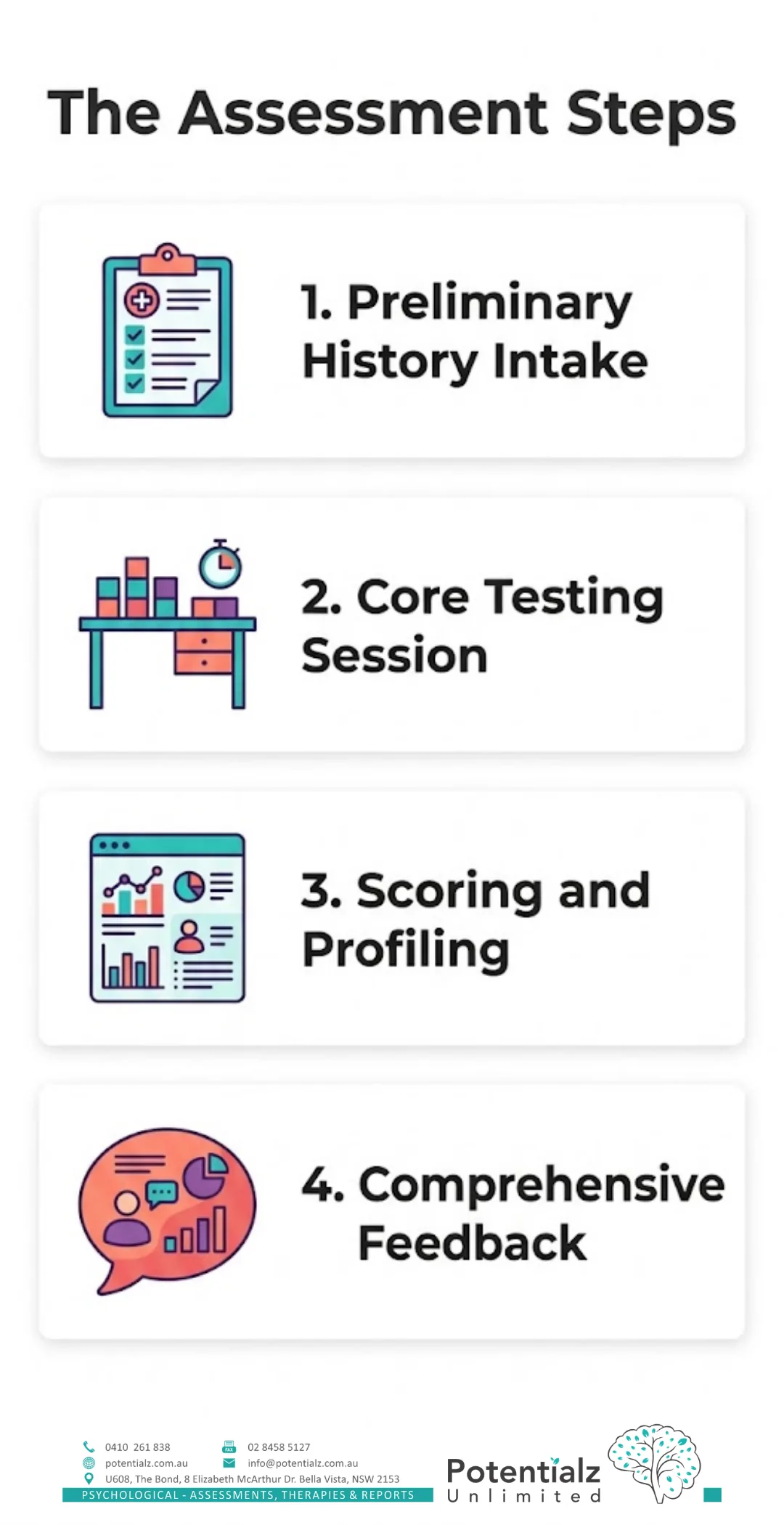
Most people are more comfortable if they know roughly what to expect. Here is an honest walk-through of what a typical WAIS assessment session at Potentialz looks like — bearing in mind that our senior Clinical Psychologist administers the assessment itself, and this description is drawn from the shared clinical culture of the practice and the general assessment literature.
Before the session. You will usually have had a preliminary intake conversation with the practice, either by phone or in a short introductory appointment. This is where the assessing clinician gathers the reason for referral, developmental and educational history, current functioning, medications, sleep, any current mood or anxiety difficulties, and what you are actually hoping the assessment will help with. This history is not a formality — it is what makes the eventual interpretation clinically useful rather than just a set of numbers.
On the day. A WAIS assessment typically runs for three to four hours, sometimes split across two sessions if fatigue is a factor or if additional assessments are being run alongside. You will be in a quiet room with the assessing clinician. Bring water, glasses if you use them, and any medications you would normally take during a workday (including any ADHD medication if that is what you normally take — the assessment reflects how your brain works in real life, and being medicated as usual is generally more informative than trying to test unmedicated unless there is a specific clinical reason).
The subtests themselves. The subtests are varied. Some involve talking — defining words, explaining how two concepts are similar, answering general knowledge questions. Some involve doing — arranging coloured blocks to match a pattern, completing abstract visual puzzles, matching symbols to numbers as quickly and accurately as you can. Some involve holding information in mind — repeating strings of numbers, doing mental arithmetic. The clinician gives standardised instructions and records your responses carefully; they are trained not to give feedback during the assessment that would compromise the standardisation, but they are warm and encouraging within those constraints.
What it feels like. Most people find some subtests easier and some harder. That is by design — the tests are calibrated to reach every person’s ceiling, so at some point you will be doing tasks that feel genuinely difficult. This is normal and does not mean you have “failed”. Failing items is how the test works out where your ceiling is.
After the session. Scoring and interpretation take time. A good WAIS report is not just a set of numbers and a boilerplate description — it is a synthesis of the numbers, your history, your presentation on the day, and the clinical question that brought you in. Expect a written report and a feedback session where the assessing clinician walks you through the findings and answers your questions. That feedback session is often the most valuable part of the process.
How to Read a WAIS Report
If you have already had a WAIS done and you are looking at a report, here are the things worth paying attention to.
Read the referral question first. A good report will restate why you were referred. If it does not, ask. The findings are only meaningful in relation to the question you were asking.
Look at the four index scores, not just the Full Scale IQ. The four indices tell the real story. The Full Scale IQ is a summary that can hide clinically important variation. Where the indices are similar, the Full Scale IQ is a reasonable summary. Where the indices vary substantially (differences of 15+ points between them), the Full Scale IQ is arguably not a very useful summary at all.
Look at the percentile ranks, not just the standard scores. A percentile rank tells you what proportion of the general adult population scored at or below that level. A percentile rank of 50 is exactly average. A percentile rank of 84 corresponds to a standard score of 115 (one standard deviation above the mean). Percentiles are often more intuitive than standard scores for non-clinicians.
Look at the confidence intervals. Every score in a psychological assessment comes with a confidence interval — a range within which the “true” score is likely to fall. A Full Scale IQ of 108 with a 95 per cent confidence interval of 103–113 means the “true” score is very likely to be somewhere in that band. That variability is not noise; it is honesty about the limits of measurement.
Look at the qualitative observations. A good report includes observations about your approach, effort, attention, anxiety, and behaviour during the assessment. These observations are often as important as the numbers, particularly where they reveal how the person actually engages with cognitive demands.
Look at the recommendations. The report should end with practical recommendations that respond to the referral question. If the recommendations feel generic, they probably are — a good report grounds recommendations in your specific profile and situation.
If a report you have received is short, generic, or purely numerical, you are entitled to ask for a fuller feedback conversation. Numbers without interpretation are of limited use.
The Common Myths — Cleared Up
There are several persistent myths about IQ testing and the WAIS that come up most weeks. Worth addressing them honestly.
“IQ is fixed.” Not exactly. A well-administered WAIS is a reasonably stable measure of current cognitive functioning in a person without significant health or life factors affecting them. Test-retest reliability is high. But “current cognitive functioning” is not the same as “innate immutable ability”. Cognitive performance is affected by sleep, mood, anxiety, medication, chronic illness, education, cultural familiarity with test-like tasks, and life circumstance. The score reflects the person taking the test on the day; it does not fix them.
“IQ predicts life success.” IQ correlates with some educational and occupational outcomes at a population level. It does not predict the life of an individual person. Motivation, mental health, relationships, opportunity, family circumstances, resilience, and specific interests contribute vastly more to how a given life unfolds than a single cognitive number.
“High IQ means everything is easy.” No. Many of the adults the practice works with who score in the high or superior range have struggled significantly with anxiety, perfectionism, burnout, imposter feelings, and difficulty in unstructured settings. High cognitive ability is a resource, not a solution.
“A low IQ score means someone cannot learn or grow.” No. Cognitive scores describe current functioning against a population norm; they do not determine capacity for learning, meaningful work, relationships, or a full life.
“IQ tests are culturally biased.” Historically, this critique had significant validity, and it has driven important improvements in test development, standardisation, and interpretation. Contemporary WAIS editions are developed with attention to cultural fairness and are normed against representative populations. That said, cultural and linguistic factors still matter, and a WAIS administered to a person for whom English is a second or third language, or who grew up in a very different cultural context, needs to be interpreted with those factors explicitly held in view. Good clinicians do this; poor reports do not. Ask.
“The Full Scale IQ is the score that matters.” As above — the Full Scale IQ is a summary. The profile is where the clinically useful information lives. A report that centres the Full Scale IQ and glosses over the profile is not doing you a full service.
The WAIS and Other Assessments — What Goes Together
Cognitive assessment is often more useful in combination with other assessments than in isolation. Depending on the referral question, a WAIS might be paired with:
- Academic achievement testing (WIAT, WRAT) — for questions about specific learning disorders like dyslexia, dyscalculia, or dysgraphia. A gap between cognitive ability and academic achievement in a specific domain is a key finding.
- Adaptive functioning measures (Vineland, ABAS) — for questions about intellectual disability, or for NDIS evidence purposes.
- Attention and executive functioning measures — for adult ADHD assessment, where cognitive testing is one piece of a broader multi-domain assessment.
- Mood and anxiety self-report measures (DASS-21, PAI) — to understand the current mental health context in which the cognitive assessment is being interpreted.
- Autism-relevant assessments — where autism is part of the differential, appropriate autism-specific tools might be used.
- Personality assessment — occasionally relevant, particularly for return-to-work or specific vocational questions.
The exact combination depends on the question. A good assessment plan is not “one size fits all” — it is built for the individual referral.
At Potentialz, this combination work is coordinated within the practice. Our senior Clinical Psychologist holds the formal assessment work; where the follow-up requires therapy — for ADHD, for anxiety, for learning-related distress, for adjustment to a diagnosis — that piece often comes back to the Registered Psychologist team, depending on modality and fit. The practice also includes play-based therapeutic work for younger children, EMDR-based trauma work, and holistic, somatic work delivered by other members of the clinical team.
Adult ADHD and the WAIS — A Closer Look
Because adult ADHD is one of the most common reasons adults consider cognitive assessment, it is worth spending a little more time on how the WAIS fits into that specific picture.
Adult ADHD assessment in Australia currently rests on a clinical interview using DSM-5-TR (or ICD-11) criteria, alongside developmental history, functional impact evidence, screening measures like the ASRS or the DIVA-5 structured interview, and — where clinically indicated — cognitive assessment. Australian ADHD prescribing practice varies by state and by clinician; the National Health and Medical Research Council has published clinical guidelines that shape best practice.
The WAIS does not diagnose ADHD. It is not a diagnostic instrument for the condition. What it can do inside an ADHD assessment is:
- Help characterise cognitive strengths and weaknesses that inform treatment recommendations. Someone with strong verbal reasoning but low processing speed benefits from different accommodations than someone with the reverse profile.
- Help identify or rule out alternative explanations for the presenting difficulties. An unidentified learning difference, an intellectual disability, or a specific cognitive deficit can all present with attention and organisation problems that look like ADHD but need a different response.
- Provide a baseline for later re-assessment if there are questions about cognitive change over time.
At Potentialz, the assessment work is led by our senior Clinical Psychologist. The therapy that often follows an ADHD diagnosis — psychoeducation, CBT for ADHD-related patterns, ACT-based work on values and follow-through, evidence-based emotion coaching for parents of children and adolescents with ADHD — is delivered by the Registered Psychologist team, drawing on both CBT and ACT frameworks. If you are interested in the therapy side of ADHD support after an assessment, the adult ADHD assessment post linked above covers the pathway in more detail.
Cost, Wait Time, and Rebates — Honestly
We do not want to quote specific numbers here that will become out of date within months. What we can do is give you the shape of the picture, and encourage you to check current specifics with reception when you enquire.
Cost. Formal cognitive assessment is a significant piece of clinical work — several hours of direct assessment time, scoring, interpretation, report writing, and a feedback session. It costs meaningfully more than a standard therapy hour reflects. This is not a mark-up; it reflects the actual time investment. A ballpark for a full WAIS assessment with report and feedback in Australian private practice is typically in the low-to-mid four figures, though this varies with the specific assessment plan and any additional testing.
Wait time. Because the assessment is a substantial piece of work, wait times vary depending on clinician availability. At Potentialz, reception will give you an honest current figure when you enquire.
Medicare. Medicare rebates for cognitive assessment specifically are limited. Some cognitive assessment work may be claimable under specific item numbers in specific circumstances, but the standard Mental Health Care Plan (MHCP) does not fund a full cognitive assessment. Reception can walk you through what, if anything, applies to your situation.
NDIS. For eligible NDIS participants, cognitive assessment may be funded under capacity-building supports, particularly where the assessment is relevant to disability evidence or to plan development. Self-managed and plan-managed participants generally have more flexibility here than NDIA-managed participants.
Private health insurance. Some private health insurance psychology extras cover a portion of psychological assessment; check with your insurer, and be aware that this varies substantially between funds and levels of cover.
Employer or educational institution funding. In some cases, an employer, tertiary institution, or workplace insurer will fund an assessment that has direct relevance to accommodations or return-to-work planning. It is always worth asking.
None of this gives you a specific number. That is the honest answer. Reception will.
What Happens After the Report
Once you have your WAIS report, the work is really only beginning. A profile is only useful if you actually do something with it.
Common next steps after a WAIS include:
- Therapy for anxiety, mood, or ADHD-related difficulties. Where the assessment has clarified a diagnostic question, therapy is often the appropriate next step. The Registered Psychologist team does this kind of work using CBT, ACT, and Solution-Focused Therapy.
- Practical accommodation planning. Working out what the profile means for study, work, or daily life — and what specific accommodations or strategies will help.
- Feedback to referrers. If the assessment was arranged as part of a GP-led workup, a specialist consultation, or an NDIS plan, the report will need to be shared appropriately with those referrers.
- A course of ADHD medication, if that is clinically appropriate. Prescribing is a psychiatrist or GP function, not a psychologist function. Where medication is being considered, the practice works alongside your medical team.
- Support for the emotional adjustment to a diagnosis. For some clients, receiving a formal diagnosis — of ADHD, of a specific learning disorder, of an intellectual disability, of any cognitive finding — is a significant life event that takes time to integrate. This is legitimate therapy work in its own right.
- Occasionally, no further psychological input. Sometimes a report simply answers the question you brought, and you go on with your life clearer than you arrived. That is also a good outcome.
Whatever the next step, the report should not sit in a drawer. If it does, the clinical work has not been finished.
A Note on Language — “IQ”, “Intelligence”, and What We Are Actually Measuring
The word “intelligence” is doing a lot of work in these conversations, and it is worth pausing on.
What the WAIS actually measures is a set of specific cognitive functions — verbal reasoning, perceptual reasoning, working memory, processing speed — that are useful predictors of certain kinds of academic and occupational functioning. It does not measure creativity, emotional intelligence, practical wisdom, social intelligence, artistic ability, moral capacity, kindness, or any number of other qualities that most of us would include in what “being smart” means in a full human sense.
The construct that psychologists call “IQ” is a useful, well-validated psychometric construct. It is not the same thing as a person’s intelligence in the everyday human sense of the word.
We try to be honest with clients about this because getting it right matters. A WAIS report that comes back with a Full Scale IQ of, say, 92 tells you something specific about a set of cognitive functions on the day of the assessment. It does not tell you that you are or are not “smart”. It certainly does not tell you what you are capable of building, or being, or contributing.
Hold the report at the right altitude. It is a useful piece of information. It is not a verdict on you.
When Cognitive Assessment Meets Therapy
One of the things that is genuinely useful about working in a multi-clinician practice like Potentialz is that assessment and therapy sit under the same roof, and the handover from one to the other can be warm.
A typical shape looks like this. A client comes in wondering whether they might have ADHD, or a learning difference, or something else going on cognitively. A first conversation works out whether a formal assessment is likely to help, and if so what the plan should look like. Our senior Clinical Psychologist handles the assessment work. Once the report is done and the feedback session has happened, if the findings open up a therapy question — anxiety around a new diagnosis, ADHD-related patterns that need behavioural work, adjustment to a specific learning disorder finding — that piece often comes back to the Registered Psychologist team. Sometimes it goes to a colleague trained in EMDR-relevant trauma work. Sometimes to a somatic-integrated therapist where that angle fits.
The point is that you do not have to work out which clinician you need on your own. Reception can triage, and the team communicates internally where clients are being seen by more than one clinician.
A Word on Preparation — Before You Book
If you are seriously considering a WAIS, a few things are worth doing before you book.
Get clear on what you actually want to know. “I want an IQ test” is not a clinical question. “I want to know whether the difficulty I have had all my working life with speed-based tasks might reflect a specific cognitive profile that would help me plan around it” is a clinical question. The clearer you can be about what you want to know, the more useful the assessment will be.
Rule out obvious factors that could distort a snapshot. If you are in the middle of a major depressive episode, an acute anxiety crisis, or significant sleep deprivation, the assessment will reflect that state and may under-represent your usual functioning. Sometimes it makes sense to stabilise first and assess later.
Consider whether medication should be part of the picture. If you are on medication that affects cognition — including ADHD medication, mood stabilisers, or others — the general recommendation is to take it as usual on the day of the assessment, so that the profile reflects how you actually function in daily life. Discuss this with your prescribing clinician if you are unsure.
Bring your questions. Write down the specific questions you are hoping the assessment will help answer. Bring them to the intake. Refer back to them at feedback.
Give yourself space for the feedback. The feedback session is often the most important part of the process. Do not schedule it in a rushed lunchtime. Come with time to sit with the findings and ask the questions you need to.
How Potentialz Can Help
If you have read this far and you have a genuine question about whether a cognitive assessment might be right for you or a family member, you are welcome to reach out.
Because the formal assessment itself at Potentialz is coordinated through our senior Clinical Psychologist, the practical first step for a WAIS enquiry is usually a phone conversation with reception, who will scope out the referral question, walk you through the current cost, wait time, and rebate arrangements, and book you in where that is the right fit.
If your question is more general — “I’m not sure whether I need an assessment, or therapy, or something else” — that is a conversation you can have with the practice first, and we will help you work out where to start. Reception can triage across the clinical team based on your presentation and what you actually want to move.
Potentialz Unlimited’s Registered Psychologist team works with children (aged 8 and up), adolescents, young adults, and older adults, using Cognitive Behavioural Therapy (CBT), Acceptance and Commitment Therapy (ACT), and Solution-Focused Therapy, always grounded in a strong, non-judgemental therapeutic relationship.
Medicare rebates are available with a Mental Health Care Plan (MHCP) from your GP for therapy sessions. NDIS (self-managed and plan-managed) referrals are accepted. Formal cognitive assessment cost and rebate arrangements are separate and best confirmed at the point of enquiry.
- Address: Unit 608, 8 Elizabeth Macarthur Drive, Bella Vista NSW 2153
- Phone: 0410 261 838
- Book: live.potentialz.com.au
- Hours: Monday–Friday 10am–7pm | Saturday & after-hours available | Telehealth via phone or Zoom (for therapy; formal cognitive assessment is delivered in person)
You may also find these related pages useful: cognitive assessment for learning difficulties, and what the WISC and WPPSI actually measure, an overview of the Wechsler Adult Intelligence Scale, what to expect from an adult ADHD assessment, the child counterpart to the WAIS — WISC-V child cognitive assessment explained — for parents wondering about the equivalent for children aged 6 to 16, and our IQ testing in Bella Vista service page.
Related Reading
- Teen Cognitive Assessment for School Difficulties: A Parent’s Guide — when a school struggle warrants formal assessment, and the WISC-V / WAIS-IV pathway for 13–17 year olds
References
Deary, I. J., Penke, L., & Johnson, W. (2010). The neuroscience of human intelligence differences. Nature Reviews Neuroscience, 11(3), 201–211. https://doi.org/10.1038/nrn2793
Flanagan, D. P., & Kaufman, A. S. (2009). Essentials of WISC-IV assessment (2nd ed.). John Wiley & Sons.
Groth-Marnat, G., & Wright, A. J. (2016). Handbook of psychological assessment (6th ed.). Wiley.
Kaufman, A. S., Raiford, S. E., & Coalson, D. L. (2016). Intelligent testing with the WISC-V. John Wiley & Sons.
Lichtenberger, E. O., & Kaufman, A. S. (2013). Essentials of WAIS-IV assessment (2nd ed.). John Wiley & Sons.
Nyborg, H. (Ed.). (2003). The scientific study of general intelligence: Tribute to Arthur R. Jensen. Pergamon.
Sattler, J. M. (2018). Assessment of children: Cognitive foundations and applications (6th ed.). Jerome M. Sattler, Publisher.
Wechsler, D. (2008). Wechsler Adult Intelligence Scale — Fourth Edition (WAIS-IV): Technical and interpretive manual. Pearson.
Weiss, L. G., Saklofske, D. H., Coalson, D. L., & Raiford, S. E. (Eds.). (2010). WAIS-IV clinical use and interpretation: Scientist-practitioner perspectives. Academic Press.
Weiss, L. G., Saklofske, D. H., Holdnack, J. A., & Prifitera, A. (Eds.). (2019). WISC-V: Clinical use and interpretation (2nd ed.). Academic Press.
Whitaker, S. (2010). Error in the estimation of intellectual ability in the low range using the WISC-IV and WAIS-III. Personality and Individual Differences, 48(5), 517–521. https://doi.org/10.1016/j.paid.2009.11.017
Barkley, R. A. (2015). Attention-deficit hyperactivity disorder: A handbook for diagnosis and treatment (4th ed.). Guilford Press.
Nigg, J. T. (2013). Attention-deficit/hyperactivity disorder and adverse health outcomes. Clinical Psychology Review, 33(2), 215–228. https://doi.org/10.1016/j.cpr.2012.11.005
Disclaimer
This article is a Potentialz Unlimited editorial piece drawing on our clinical team’s experience. It is for general education and information only, not clinical advice for your particular circumstances. Potentialz Unlimited is a psychology practice based in Bella Vista NSW; our clinical team includes Registered Psychologists and a Clinical Psychologist (registered with AHPRA). Please consult a qualified health professional for your individual circumstances. If you are experiencing a mental health crisis, contact your GP, call Lifeline on 13 11 14, or go to your nearest emergency department.
Crisis Resources
- Lifeline: 13 11 14 (24/7)
- Beyond Blue: 1300 22 4636
- Kids Helpline: 1800 55 1800
- MensLine Australia: 1300 78 99 78
- 13YARN (Aboriginal & Torres Strait Islander crisis line): 13 92 76
- Emergency: 000
Knowledge Check Quiz
Test what you have just read. Choose your answer for each question, then submit to reveal the answers and your score.
Need Professional Support?
If you're experiencing mental health concerns, our team is here to help.