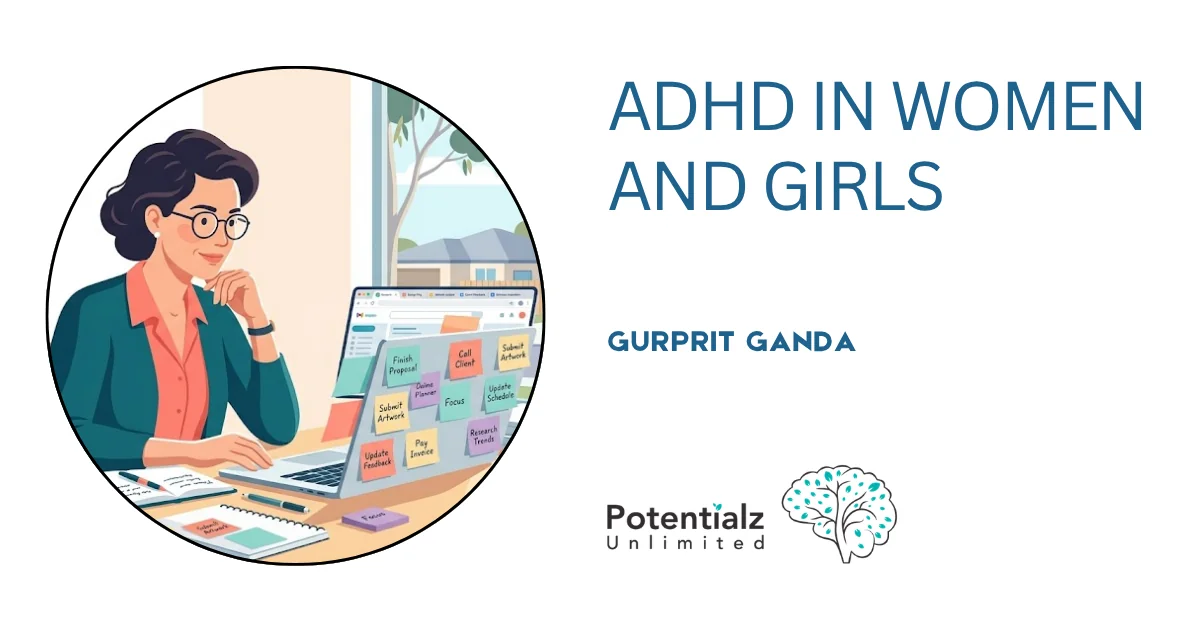
She was the quiet girl who daydreamed in class. The teenager who studied twice as hard as everyone else just to keep up. The university student who pulled all-nighters not because she procrastinated, but because she could not organise her thoughts. The professional woman who felt like she was constantly one step behind, held together by caffeine, lists, and sheer willpower.
She was never disruptive. Never hyperactive. Never the “problem child.” And that is exactly why her ADHD was missed.
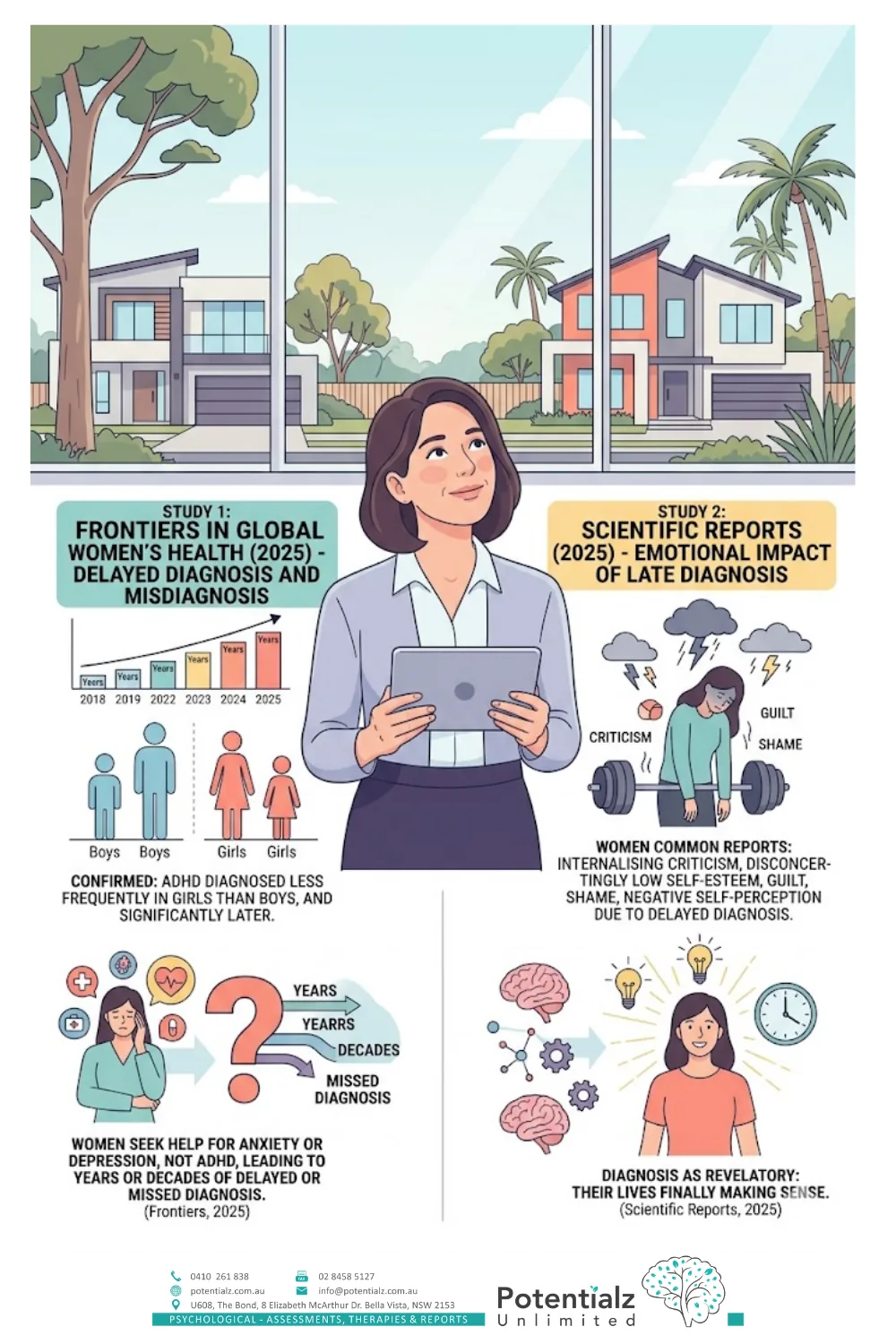
A 2025 study published in Frontiers in Global Women’s Health confirmed what clinicians have long suspected: ADHD is not only diagnosed less frequently in girls than boys, but also at a significantly later age. Women with ADHD seek help for anxiety or depression far more often than for ADHD itself, leading to years — sometimes decades — of delayed or missed diagnosis (Frontiers, 2025).
A 2025 study in Scientific Reports found that women with late-diagnosed ADHD commonly reported internalising criticism, disconcertingly low self-esteem, guilt, shame, and negative self-perception. When they finally received a diagnosis, participants described it as revelatory — their lives finally making sense (Scientific Reports, 2025).
Why ADHD Looks Different in Women and Girls
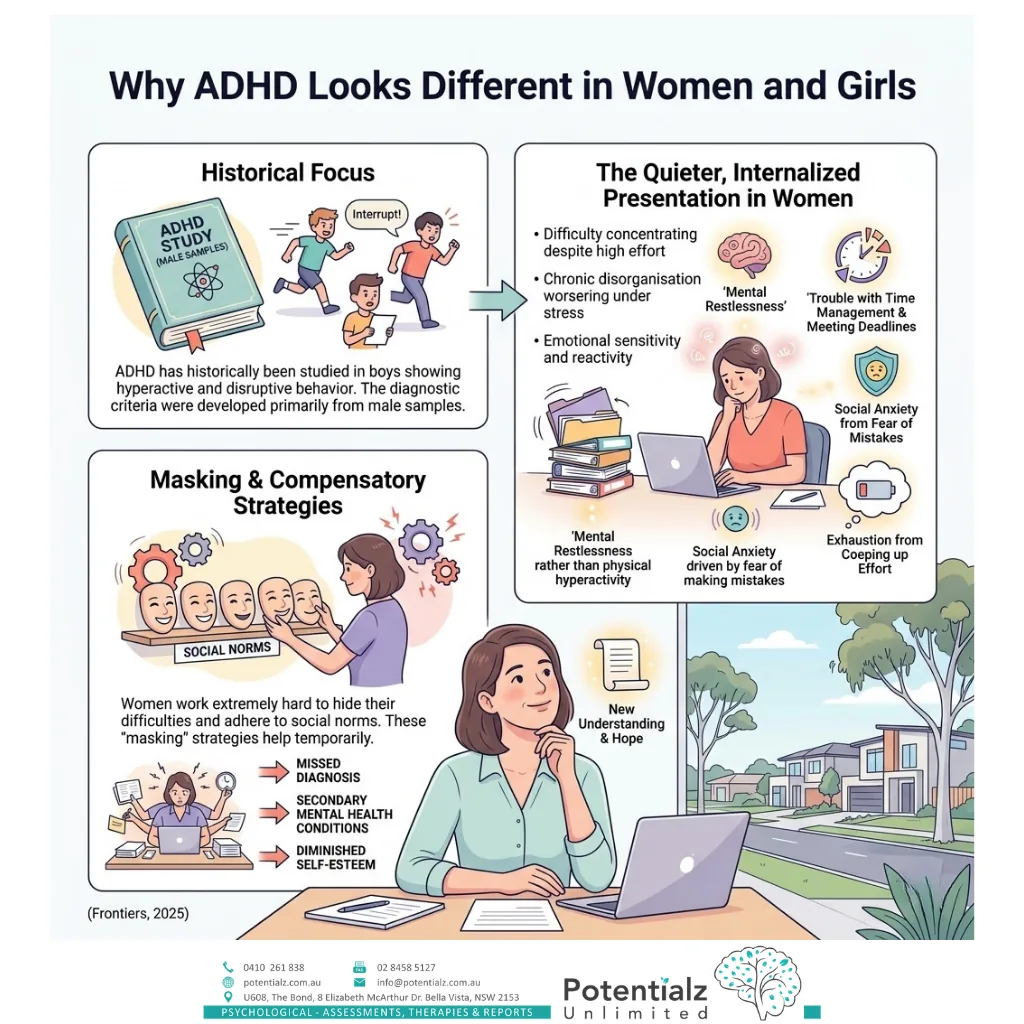
ADHD has historically been studied in boys who show hyperactive and disruptive behaviour. The diagnostic criteria were developed primarily from male samples. This means the quieter, inattentive presentation — more common in girls and women — has been systematically overlooked.
In women, ADHD often presents as difficulty concentrating despite high effort, chronic disorganisation that worsens under stress, emotional sensitivity and reactivity, trouble with time management and meeting deadlines, mental restlessness rather than physical hyperactivity, social anxiety driven by fear of making mistakes, and exhaustion from the constant effort of “keeping up.”
Women with ADHD often develop what researchers call “masking” or “compensatory strategies.” They adhere strongly to social norms and work extremely hard to hide their difficulties. While these strategies help temporarily, they lead to missed diagnoses, accumulation of secondary mental health conditions, and diminished self-esteem (Frontiers, 2025). If you would like a clinical overview of the diagnostic process, see our guide on understanding ADHD and tools for accurate diagnosis.
The Hormonal Factor: Why ADHD Symptoms Change Across a Woman’s Life
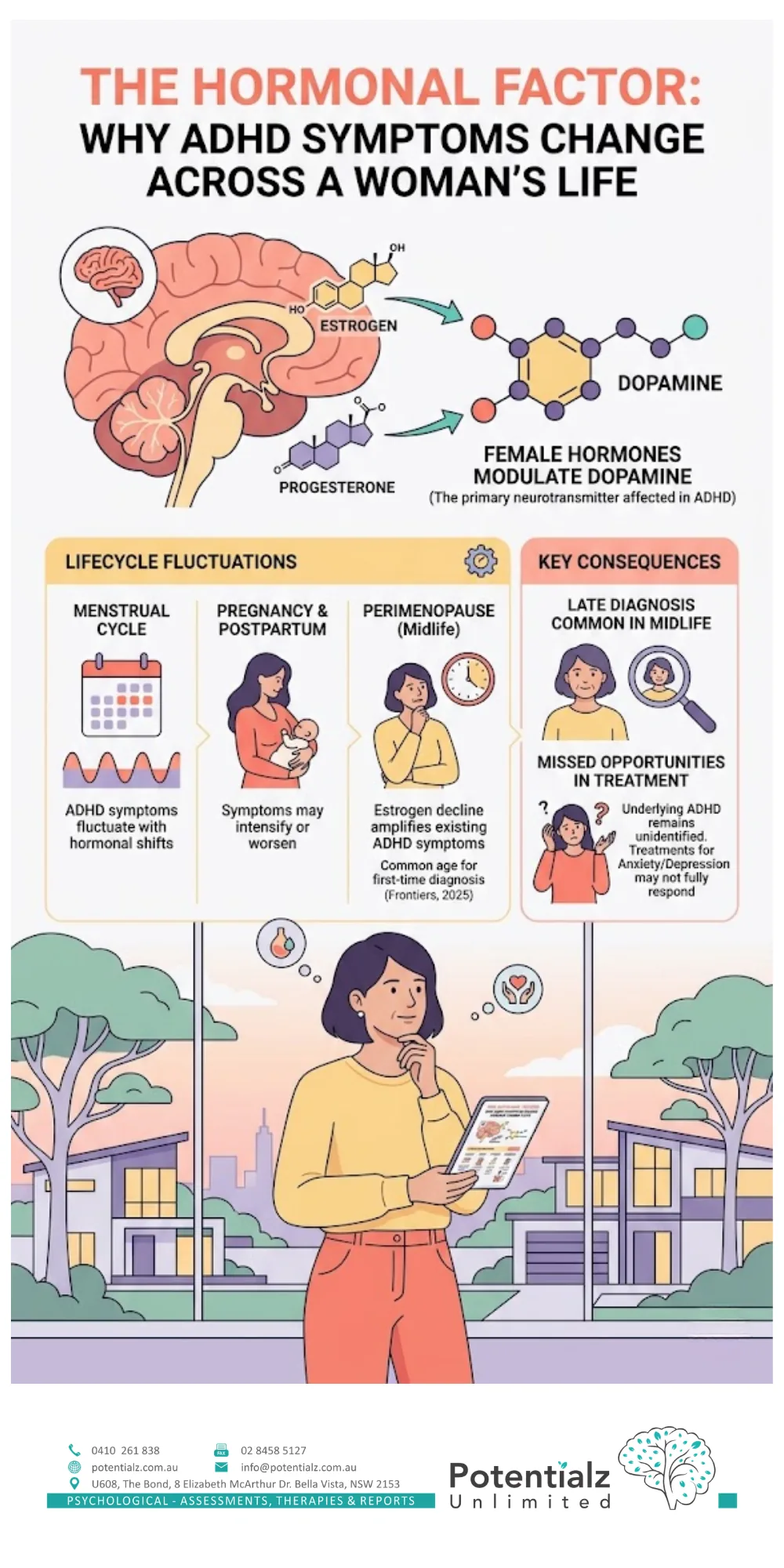
One of the most significant research advances of the last decade is the understanding that female hormones directly affect ADHD symptoms. Estrogen and progesterone modulate dopamine — the neurotransmitter most affected in ADHD. This means ADHD symptoms in women fluctuate with the menstrual cycle, worsen during pregnancy or postpartum, intensify during perimenopause, and may appear to emerge for the first time in midlife.
This hormonal connection explains why many women are first diagnosed with ADHD during perimenopause — the very period when estrogen decline amplifies existing but previously compensated ADHD symptoms (Frontiers, 2025). It also explains why some women’s anxiety and depression do not fully respond to standard treatment: the underlying ADHD has never been identified.
The Cost of Missed Diagnosis
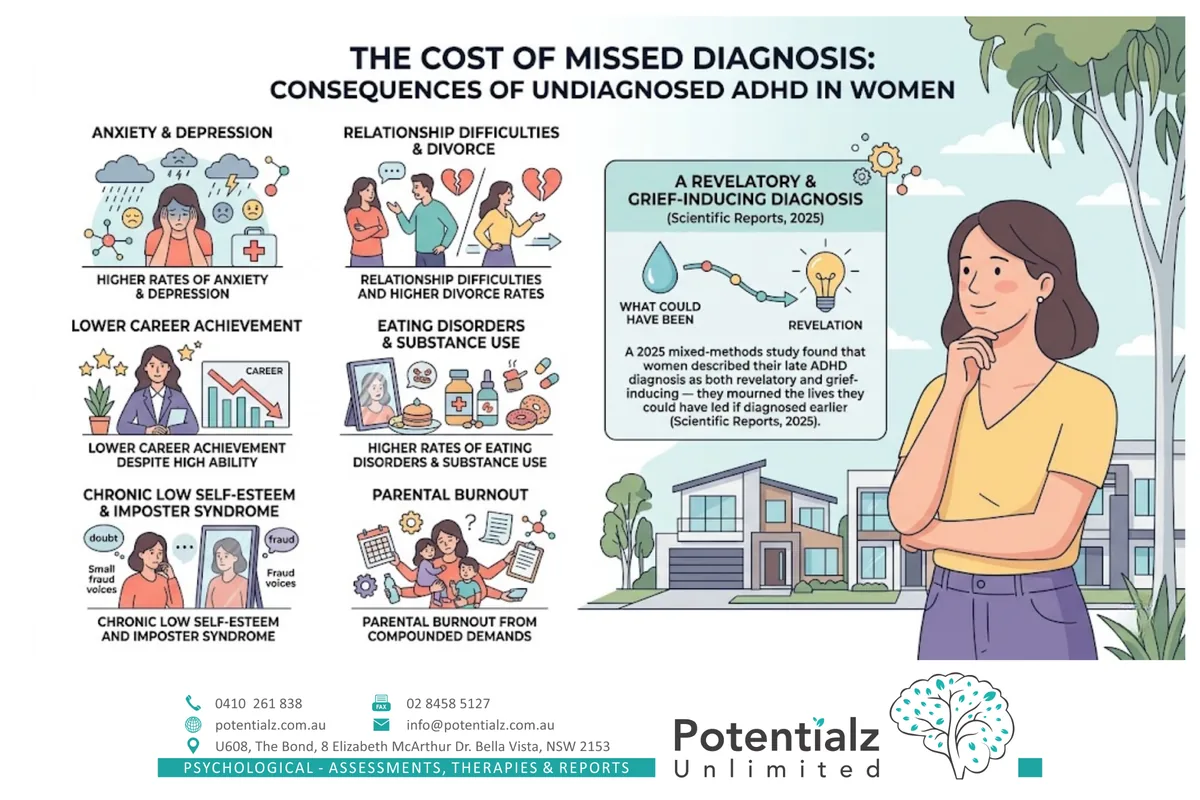
The consequences of undiagnosed ADHD in women are significant. Research consistently shows higher rates of anxiety and depression, relationship difficulties and higher divorce rates, lower career achievement despite high ability, higher rates of eating disorders and substance use, chronic low self-esteem and imposter syndrome, and parental burnout from the compounded demands of managing a household with undiagnosed ADHD.
A 2025 mixed-methods study found that women described their late ADHD diagnosis as both revelatory and grief-inducing — they mourned the lives they could have led if diagnosed earlier (Scientific Reports, 2025). The grief is real, and it is part of the process. But so is the relief, and the recalibration that follows.
How ADHD Is Assessed in Women at Potentialz Unlimited
At Potentialz Unlimited in Bella Vista, Dr Gurprit Ganda provides comprehensive ADHD assessment for women and girls. Our assessment process includes:
- A clinical interview exploring your history from childhood through to present
- Standardised ADHD screening tools including the CAARS (Conners Adult ADHD Rating Scale) and ASRS (Adult ADHD Self-Report Scale)
- Cognitive assessment using the WAIS to identify processing speed and working memory patterns
- Differential diagnosis to distinguish ADHD from anxiety, depression, or other conditions
- Consideration of hormonal factors and life-stage influences
Assessment is particularly important because ADHD symptoms in women overlap significantly with anxiety, depression, bipolar disorder, and borderline personality disorder. Without a thorough assessment, treatment may target the wrong condition. For a closer look at the structured assessment process, see the role of assessments in ADHD treatment.
Evidence-Based Treatment for ADHD in Women
Once diagnosed, treatment for ADHD in women typically includes:
- CBT adapted for ADHD to build organisational skills, manage time, and challenge perfectionistic thinking
- Skills training for emotional regulation, as women with ADHD often experience rejection sensitivity and emotional flooding
- Self-compassion work to address the accumulated shame and self-criticism from years of undiagnosed struggle
- Psychoeducation about how ADHD affects the female brain across the lifespan
- If appropriate, referral for medication review in collaboration with your GP or psychiatrist
If you are interested in non-medication approaches, our team has written on how psychotherapy can help people with adult ADHD. You can also read about our assessment-first adult ADHD treatment in Bella Vista.
When to Seek an ADHD Assessment
Consider an ADHD assessment if you have always felt like you are working harder than everyone else to achieve the same results. If you were told you were “not living up to your potential” at school. If you struggle with organisation, time management, or finishing tasks despite being intelligent. If you have been treated for anxiety or depression but the treatment has not fully worked. If your symptoms worsen around your period, after pregnancy, or during perimenopause. Or if you recognise yourself in the descriptions above.
For a quick orientation to the common questions women ask, our frequently asked questions about ADHD covers the basics in plain language, and how to check for ADHD in adults walks through the assessment pathway in more detail. For a step-by-step view of the appointment itself, see what to expect from an adult ADHD assessment.
Related reading: harnessing ADHD hyperfocus for productivity
Key Takeaways
- ADHD in women is systematically under-diagnosed because diagnostic criteria were developed from male samples and the inattentive presentation more common in women is quieter and less disruptive.
- Female hormones (estrogen and progesterone) directly modulate dopamine, so ADHD symptoms in women fluctuate with the menstrual cycle and intensify during pregnancy, postpartum, and perimenopause.
- “Masking” — high-effort compensatory strategies — helps short-term but contributes to missed diagnosis, exhaustion, and secondary anxiety or depression.
- Late diagnosis is often described as both revelatory and grief-inducing; both responses are normal parts of the process.
- A comprehensive ADHD assessment uses standardised tools (CAARS, ASRS), clinical interview, cognitive testing, and differential diagnosis to rule out conditions with overlapping symptoms.
- Treatment combines CBT adapted for ADHD, emotional regulation skills, self-compassion work, and, where appropriate, collaboration with your GP on medication options.
How Potentialz Can Help
At Potentialz Unlimited in Bella Vista, Dr Gurprit Ganda provides comprehensive ADHD assessment and treatment for women and girls across the Hills District — including Norwest, Castle Hill, Kellyville, Baulkham Hills, and Rouse Hill. If you have spent years wondering what is wrong with you, the right assessment can change the conversation.
Book a session online: live.potentialz.com.au Call us: 0410 261 838 Visit us: Unit 608/8 Elizabeth Macarthur Drive, Bella Vista NSW 2153 Hours: Monday to Friday, 10am–7pm | Saturday and after-hours available | Telehealth via phone or Zoom
Get in touch or learn more about our ADHD psychology services.
References
Babinski, D. E., & Libsack, E. J. (2025). Adult diagnosis of ADHD in women: A mixed methods investigation. Journal of Attention Disorders, 29(3), 245–258. https://doi.org/10.1177/10870547241297897
Frontiers in Global Women’s Health. (2025). Research advances and future directions in female ADHD: The lifelong interplay of hormonal fluctuations with mood, cognition, and disease. Frontiers in Global Women’s Health, 6, 1613628. https://doi.org/10.3389/fgwh.2025.1613628
Scientific Reports. (2025). Adverse experiences of women with undiagnosed ADHD and the invaluable role of diagnosis. Scientific Reports, 15, 20945. https://doi.org/10.1038/s41598-025-04782-y
JCPP Advances. (2025). Investigating the reasons behind a later or missed diagnosis of ADHD in young people. JCPP Advances, 5(4), e12275. https://doi.org/10.1002/jcv2.12275
Disclaimer: This information is general in nature and is not a substitute for individual clinical assessment. Dr Gurprit Ganda is an AHPRA-registered Clinical Psychologist at Potentialz Unlimited. If you are concerned about ADHD, please book a comprehensive assessment rather than self-diagnosing.
Crisis Resources: If you or someone you know needs support, please contact Lifeline on 13 11 14, Beyond Blue on 1300 22 4636, or Kids Helpline on 1800 55 1800.
Related Reading
Knowledge Check Quiz
Test what you have just read. Choose your answer for each question, then submit to reveal the answers and your score.
Need Professional Support?
If you're experiencing mental health concerns, our team is here to help.