The 6pm Feeling in Norwest
You know the moment. You’ve left the office in the Norwest business park, you’re inching along Old Windsor Road, and instead of winding down, your mind is speeding up — tomorrow’s meeting, the unanswered email, the school pick-up you nearly forgot. Life in Bella Vista and the surrounding Hills District is comfortable and fast, and for a lot of people that pace comes with a quiet, constant hum of stress and anxiety.
If that’s you, here’s the first thing worth knowing: you are in very good company, and this is genuinely workable. In this guide I’ll explain the difference between stress and anxiety, what the evidence says actually helps, and how to know when it’s time to get support.
You’re Not the Only One
Anxiety is the most common mental health condition in Australia. The Australian Bureau of Statistics’ National Study of Mental Health and Wellbeing (2020–2022) found that 17.2% of Australians — around 3.4 million people, more than one in six — had a 12-month anxiety disorder (Australian Bureau of Statistics, 2023). It’s even more common in women (21.1%) and strikingly high in young people aged 16–24 (almost one in three).
So if stress and anxiety have become unwelcome companions, this isn’t a personal failing or a sign you’re not coping “as well as everyone else.” Everyone else is quietly wrestling with it too.
Stress and Anxiety Aren’t the Same Thing

People use the words interchangeably, but there’s a useful difference.
Stress is usually a response to a specific, identifiable pressure — a deadline, a big bill, a house move, a hard conversation. It’s your body gearing up to meet a demand, and it typically eases once the demand passes. In small doses, it’s normal and even helpful.
Anxiety is more about anticipated or imagined threats. It’s the mind running ahead to what might go wrong, and it can linger even when nothing is actually wrong right now. That’s why you can be safe on your own couch and still feel your heart racing.
Both are part of being human. The problem isn’t feeling them — it’s when they become chronic: always switched on, out of proportion, and getting in the way of sleep, work, relationships and enjoyment.
When It Tips From Normal to “Time to Get Help”
There’s no need to wait until you’re at breaking point. It’s worth reaching out when stress or anxiety is:
- Persistent — there most days, for weeks, rather than passing with the situation.
- Distressing — genuinely uncomfortable, not just background noise.
- Interfering — affecting your sleep, concentration, mood, relationships or work.
- Driving avoidance — you’re shrinking your life to dodge the things that make you anxious.
That last one matters more than people realise, which brings us to why therapy works.
Why Avoidance Backfires — and Therapy Doesn’t
When something makes us anxious, the natural move is to avoid it. Skip the event, dodge the phone call, stay home. And it works — for about an hour. The relief is real but short, and it comes at a price: every time you avoid, your brain quietly learns “that thing really was dangerous,” and the fear grows a little stronger. Avoidance is the fuel anxiety runs on.
Good therapy does the opposite. Instead of feeding the fear, it helps you turn towards it — safely, gradually, and with skills — so your brain can learn a new, truer lesson: I can handle this. When anxiety takes the shape of obsessive thoughts and compulsions, this same principle drives ERP for OCD — gradually facing the fear without performing the ritual.
The Therapies That Actually Help
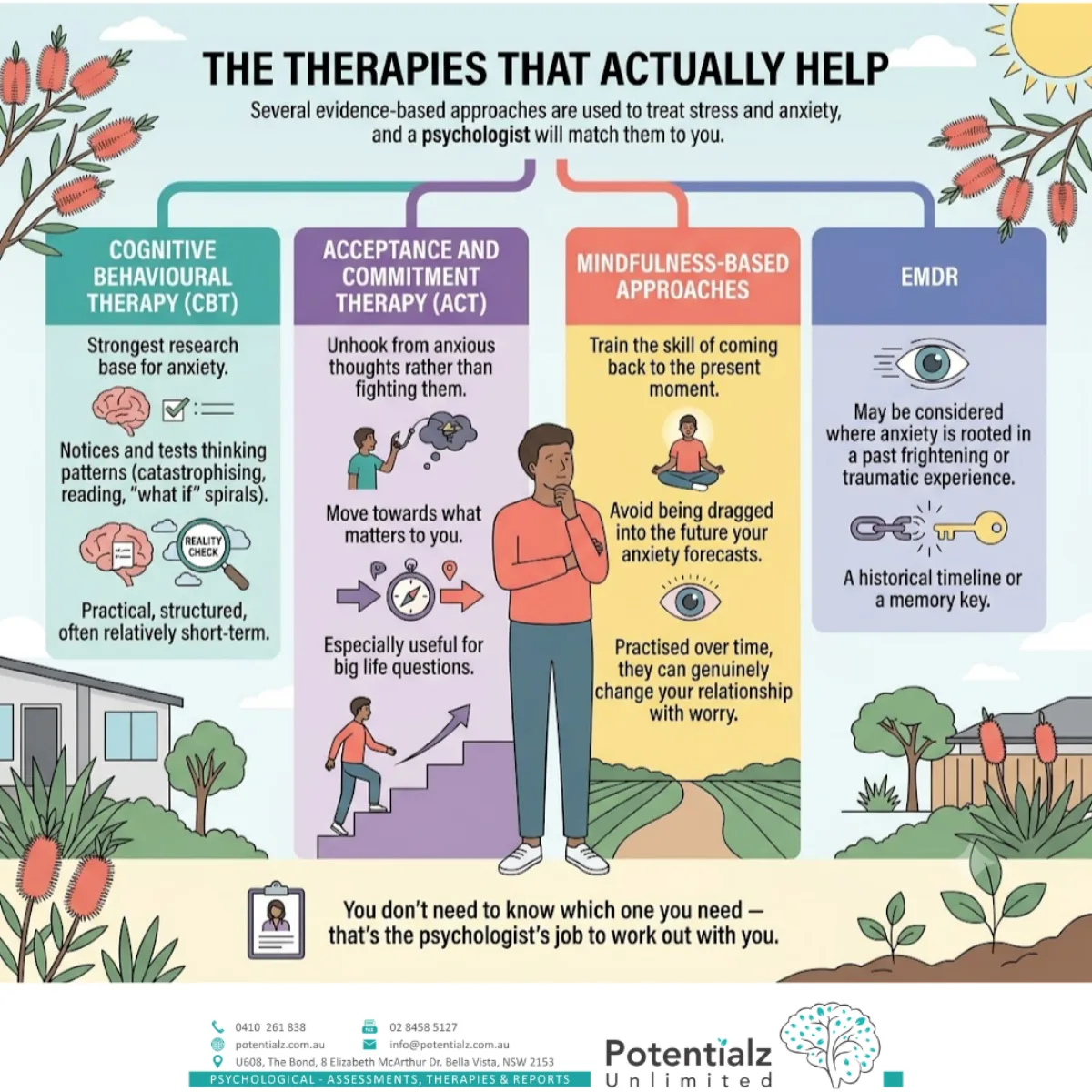
Several evidence-based approaches are used to treat stress and anxiety, and a psychologist will match them to you.
Cognitive Behavioural Therapy (CBT) has the strongest research base for anxiety. It helps you notice the thinking patterns that crank anxiety up — catastrophising, mind-reading, “what if” spirals — and test them against reality, while gradually facing avoided situations so they lose their grip. It’s practical, structured and often relatively short-term.
Acceptance and Commitment Therapy (ACT) takes a different angle: rather than fighting anxious thoughts, it teaches you to unhook from them and keep moving towards what matters to you. It’s especially useful when anxiety is tangled up with big life questions.
Mindfulness-based approaches train the skill of coming back to the present moment instead of being dragged into the future your anxiety is forecasting. Practised over time, they can genuinely change your relationship with worry.
EMDR may be considered where anxiety is rooted in a past frightening or traumatic experience.
You don’t need to know which one you need — that’s the psychologist’s job to work out with you.
What You Can Start Doing Today
Therapy does the deeper work, but these habits genuinely support a calmer nervous system, and you can begin now:
- Move your body. Regular exercise is one of the best-evidenced things you can do for anxiety — a walk around Lake Norwest counts.
- Protect your sleep. Anxiety and poor sleep feed each other; a consistent wind-down routine helps break the cycle.
- Breathe slowly, longer out-breath. A few minutes of slow breathing tells your body the threat has passed.
- Get outside. Time in green space measurably lowers stress — the Hills has plenty of it.
- Set boundaries. Not everything is urgent. Deciding what you won’t do is a form of self-care.
Think of these as first aid, not a cure. If the anxiety is persistent, they work best alongside proper support.
What Your First Appointment Actually Looks Like
A lot of people put off seeing a psychologist because they don’t know what they’re walking into. It’s worth demystifying, because the reality is far less daunting than the worry.
Your first session is mostly a conversation. You won’t be asked to lie on a couch or relive your worst moments on day one. The psychologist will ask about what’s been happening, how it’s affecting your life, your sleep, your relationships and your body, and what you’d like to be different. You set the pace — you share as much or as little as you’re ready to.
From there, you build a shared picture of what’s going on and a realistic plan: what approach fits, roughly how many sessions, and small things you can start between appointments. Good therapy is collaborative — you’re not a passive patient having something done to you, you’re an active partner working out what helps. Many people leave that first session already feeling lighter, simply from having named the thing out loud to someone who understands it.
Practically: in New South Wales you can see a psychologist directly, but asking your GP for a Mental Health Care Plan first can make you eligible for Medicare rebates on a set number of sessions each year — worth doing before you book if cost is a consideration.
Finding a Psychologist in Bella Vista
If stress and anxiety have outstayed their welcome, talking to a professional can change things. Potentialz Unlimited is a psychology practice right here in Bella Vista, serving Norwest, Castle Hill, Baulkham Hills, Kellyville and Rouse Hill. Dr Gurprit Ganda is a Clinical Psychologist with more than 25 years of experience.
A sensible first step is a conversation — no pressure, no commitment. You can get in touch here, book at live.potentialz.com.au, or call 0410 261 838. Ask your GP about a Mental Health Care Plan, which can make you eligible for Medicare rebates on sessions. Serenity in the city is possible — it usually starts with reaching out.
Related Reading
More from our blog:
- CBT for Anxiety Explained — Techniques, Evidence, and What to Expect
- Understanding Anxiety, Stress, and Trauma: A Comprehensive Guide
- How a Psychologist Can Help With Anxiety Management
- Effective Strategies for Managing Anxiety and Depression
Services that may help:
References
A-Tjak, J. G. L., Davis, M. L., Morina, N., Powers, M. B., Smits, J. A. J., & Emmelkamp, P. M. G. (2015). A meta-analysis of the efficacy of acceptance and commitment therapy for clinically relevant mental and physical health problems. Psychotherapy and Psychosomatics, 84(1), 30–36. https://doi.org/10.1159/000365764
Australian Bureau of Statistics. (2023). National Study of Mental Health and Wellbeing, 2020–2022. ABS. https://www.abs.gov.au/statistics/health/mental-health/national-study-mental-health-and-wellbeing/latest-release
Carpenter, J. K., Andrews, L. A., Witcraft, S. M., Powers, M. B., Smits, J. A. J., & Hofmann, S. G. (2018). Cognitive behavioral therapy for anxiety and related disorders: A meta-analysis of randomized placebo-controlled trials. Depression and Anxiety, 35(6), 502–514. https://doi.org/10.1002/da.22728
Knowledge Check Quiz
Test what you have just read. Choose your answer for each question, then submit to reveal the answers and your score.
Need Professional Support?
If you're experiencing mental health concerns, our team is here to help.