Anxiety in children doesn’t always look like worrying. Sometimes it looks like a child who won’t leave your side. A child who melts down before school. A child who refuses to try new things, or who needs every detail of every plan before they can agree to go.
And sometimes it doesn’t look like anxiety at all. It looks like a stomachache every Sunday evening. A child who has gone quiet and flat. Tantrums that seem to come from nowhere over things that feel small. A child who is always watching, always braced, always waiting for something to go wrong.
If any of this sounds familiar, you are not imagining it. Approximately one in seven Australian children aged 4–17 live with an anxiety disorder (Lawrence et al., 2015; Australian Bureau of Statistics, 2022). And the earlier it is understood and supported, the better the outcomes.
This post is for you: the parent who has noticed something is off and wants to understand what is happening — and what actually helps.
What Anxiety Actually Is
Anxiety is a normal part of being human. It is the nervous system’s early warning signal — designed to prepare the body for threat. In the right doses, it keeps children safe, motivates preparation, and sharpens attention.
The problem happens when the alarm system becomes overactive. When it fires in situations that are not actually dangerous. When it fires so often that everyday life starts to feel too hard.
In children, this matters especially because the nervous system is still developing. When anxiety is chronic — when a child’s nervous system stays in a near-constant state of alert — it shapes the growing brain in ways that can make anxiety worse over time. The brain becomes more sensitive to perceived threat, more reactive, and less able to find its way back to calm.
This is why early support matters. Not to prevent children from ever feeling anxious — that would neither be possible nor helpful. But to help the nervous system develop the capacity to manage anxiety when it arises.
What Anxiety in Children Looks Like at Different Ages
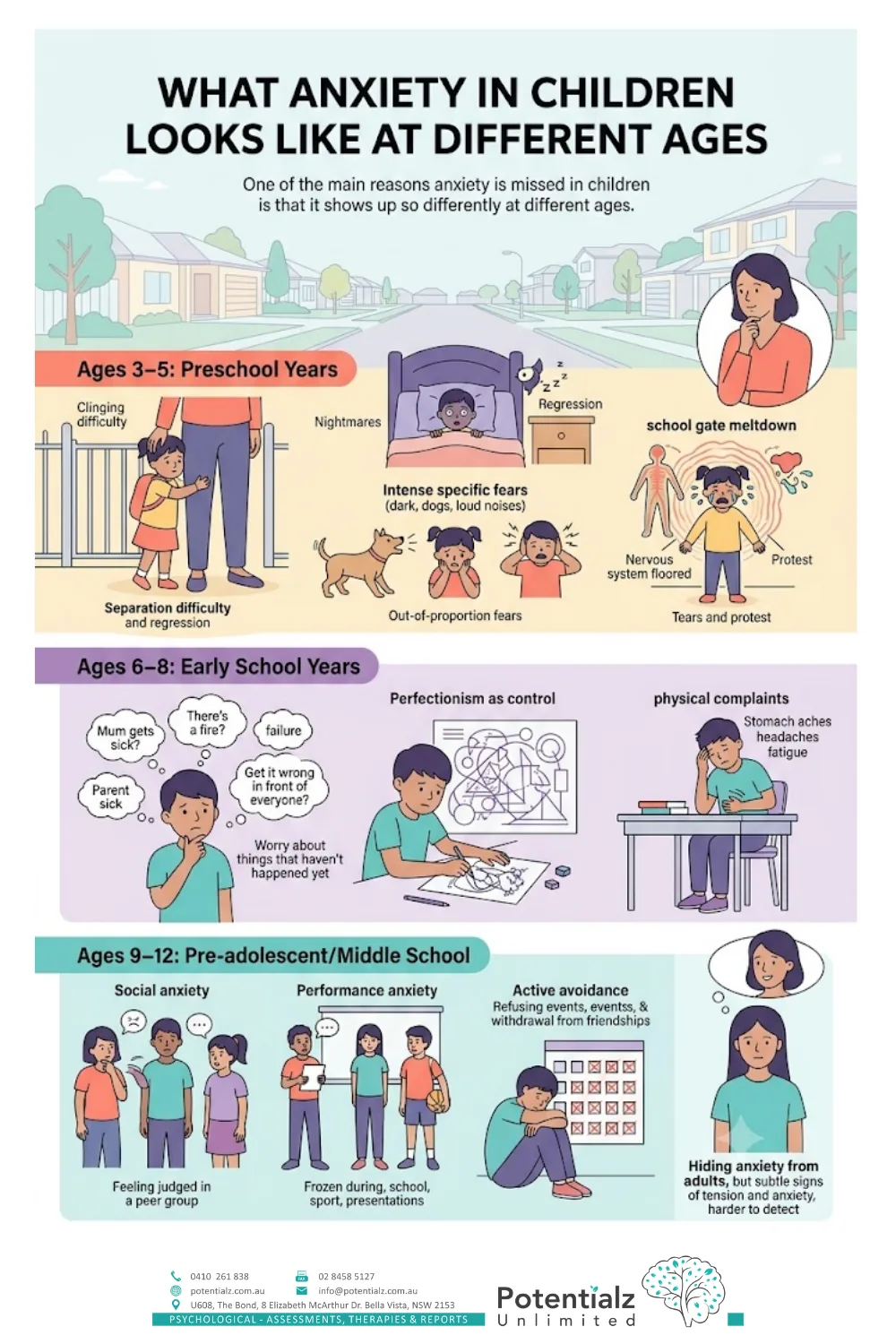
One of the main reasons anxiety is missed in children is that it shows up so differently at different ages.
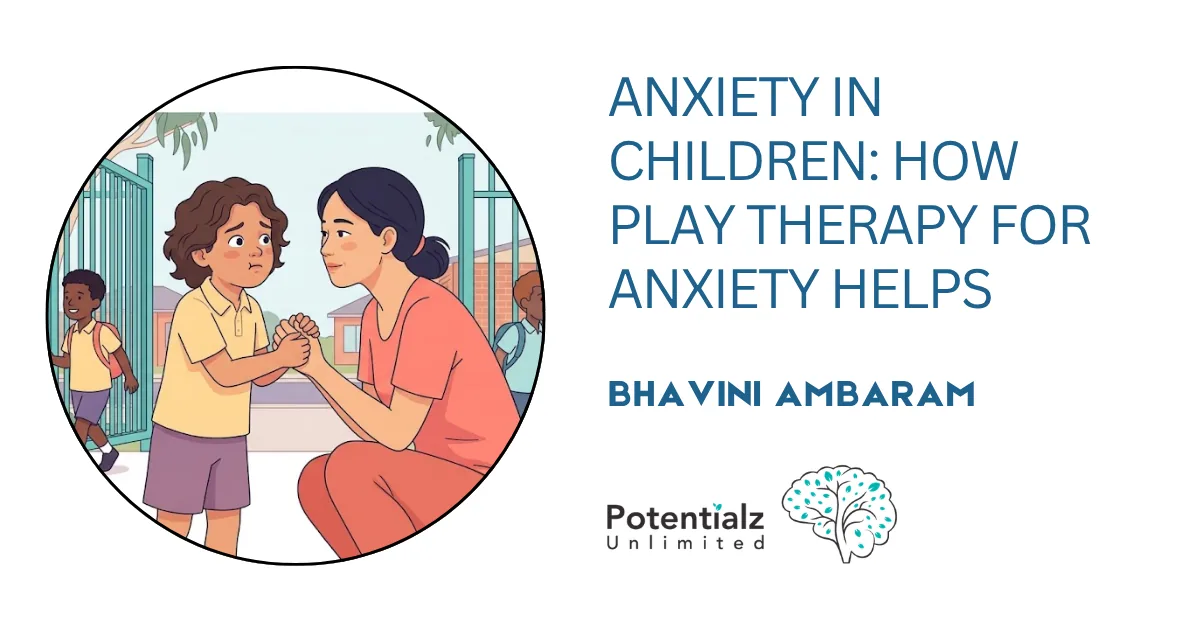
Ages 3–5: Anxiety at this age most often appears as clinging, separation difficulties, nightmares, and regression. Children may become intensely fearful of specific things — the dark, dogs, loud noises — and these fears can look out of proportion to the actual risk. A meltdown at the school gate is often an anxiety response. The child’s nervous system is flooded, and tears and protest are the only outlet available.
Ages 6–8: Children at this stage can now worry about things that have not happened yet. What if Mum gets sick? What if there’s a fire? What if I get it wrong in front of everyone? Perfectionism can be strong at this age — the anxious child’s way of trying to control an unpredictable world. Physical complaints like stomach aches, headaches, and fatigue are common.
Ages 9–12: Social anxiety becomes more prominent as children grow more aware of how others see them. Performance anxiety around school work, sport, or presentations increases. Children may begin actively avoiding situations that trigger anxiety — refusing events, withdrawing from friendships, or becoming rigid in routines. When that avoidance settles onto school specifically, our companion post on school refusal in children explains what is often driving it and how play therapy helps. Some children this age become very skilled at hiding their anxiety from adults, which makes it harder to detect.
Reading the Body Language of Anxiety
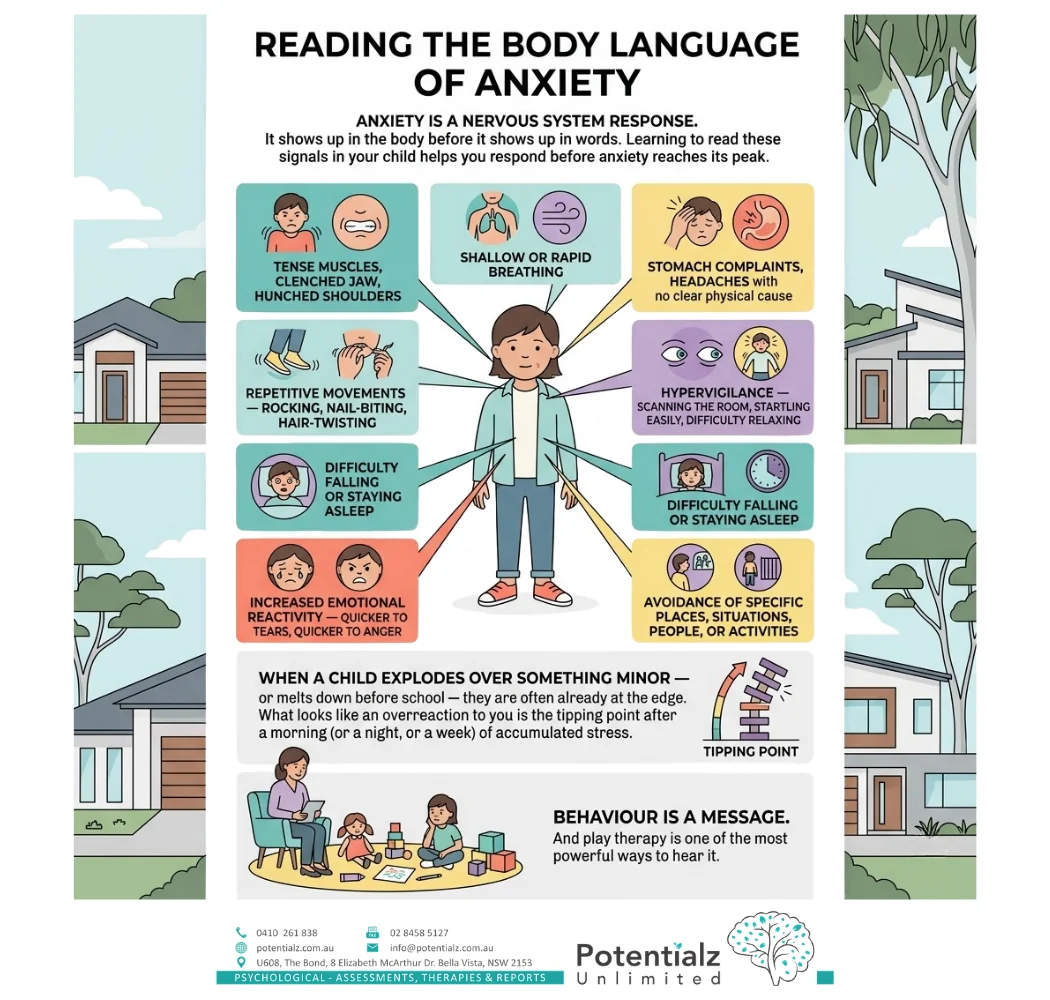
Because anxiety is a nervous system response, it shows up in the body before it shows up in words. Learning to read these signals in your child helps you respond before anxiety reaches its peak.
Signs of anxiety in a child’s body and behaviour include:
- Tense muscles, clenched jaw, hunched shoulders
- Shallow or rapid breathing
- Stomach complaints, headaches with no clear physical cause
- Repetitive movements — rocking, nail-biting, hair-twisting
- Hypervigilance — scanning the room, startling easily, difficulty relaxing
- Difficulty falling or staying asleep
- Increased emotional reactivity — quicker to tears, quicker to anger
- Avoidance of specific places, situations, people, or activities
When a child explodes over something that seems minor — or melts down before school — they are often already at the edge of their capacity. What looks like an overreaction to you is the tipping point after a morning (or a night, or a week) of accumulated stress. If meltdowns, rages or shutdowns are the dominant signal for your child, our companion post on big emotions in children walks through how the developing brain produces those storms and what helps.
The behaviour is a message. And play therapy is one of the most powerful ways to hear it.
Why Reassurance Often Is Not Enough
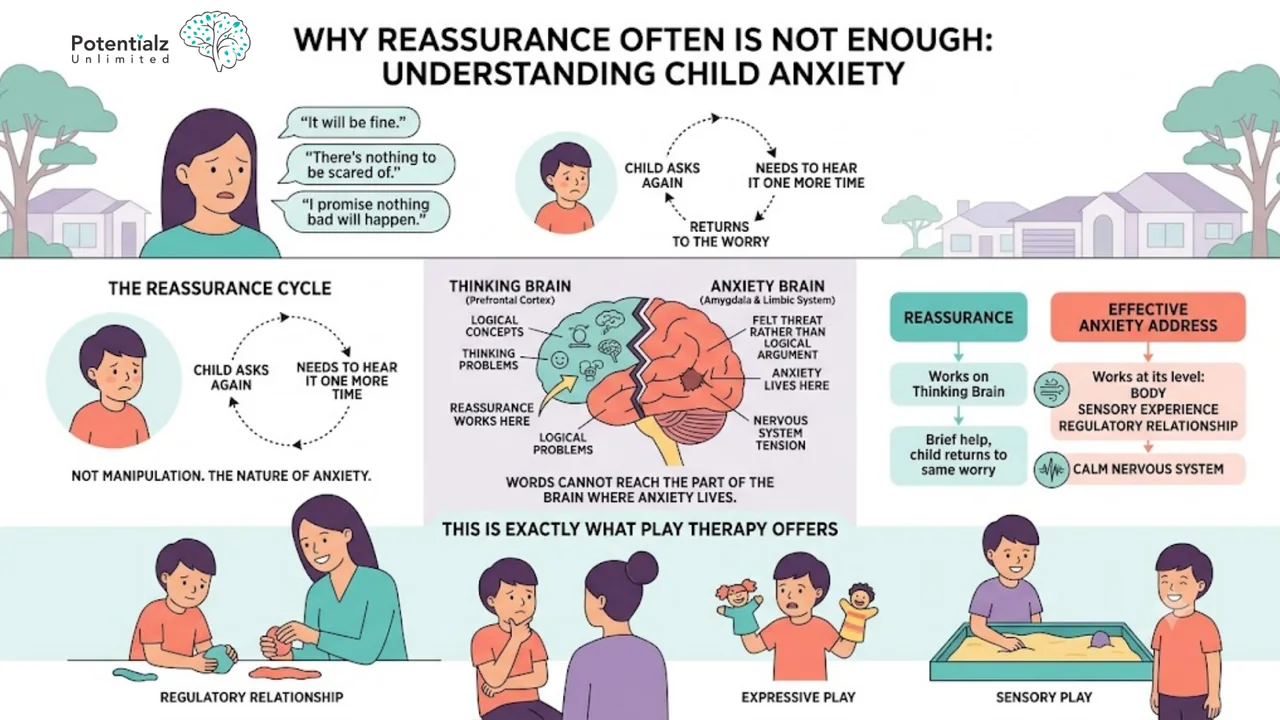
When a child is anxious, the first instinct is to reassure them. “It will be fine.” “There’s nothing to be scared of.” “I promise nothing bad will happen.” And for a brief moment, this may help. But parents of anxious children often notice that the reassurance does not last — the child asks again, returns to the same worry, needs to hear it one more time.
This is not manipulation. It is the nature of anxiety.
Anxiety is primarily a nervous system response, not a thinking problem. Words that make sense to the thinking brain — the prefrontal cortex — often cannot reach the part of the brain where anxiety actually lives: the amygdala and the limbic system, which are concerned with felt threat rather than logical argument.
Reassurance works on the thinking brain. But anxiety lives in the nervous system. To address anxiety effectively, we need to work at the level where it actually lives — which means working with the body, with sensory experience, and with the regulatory relationship.
This is exactly what play therapy for anxiety offers.
How Play Therapy for Anxiety Helps Children
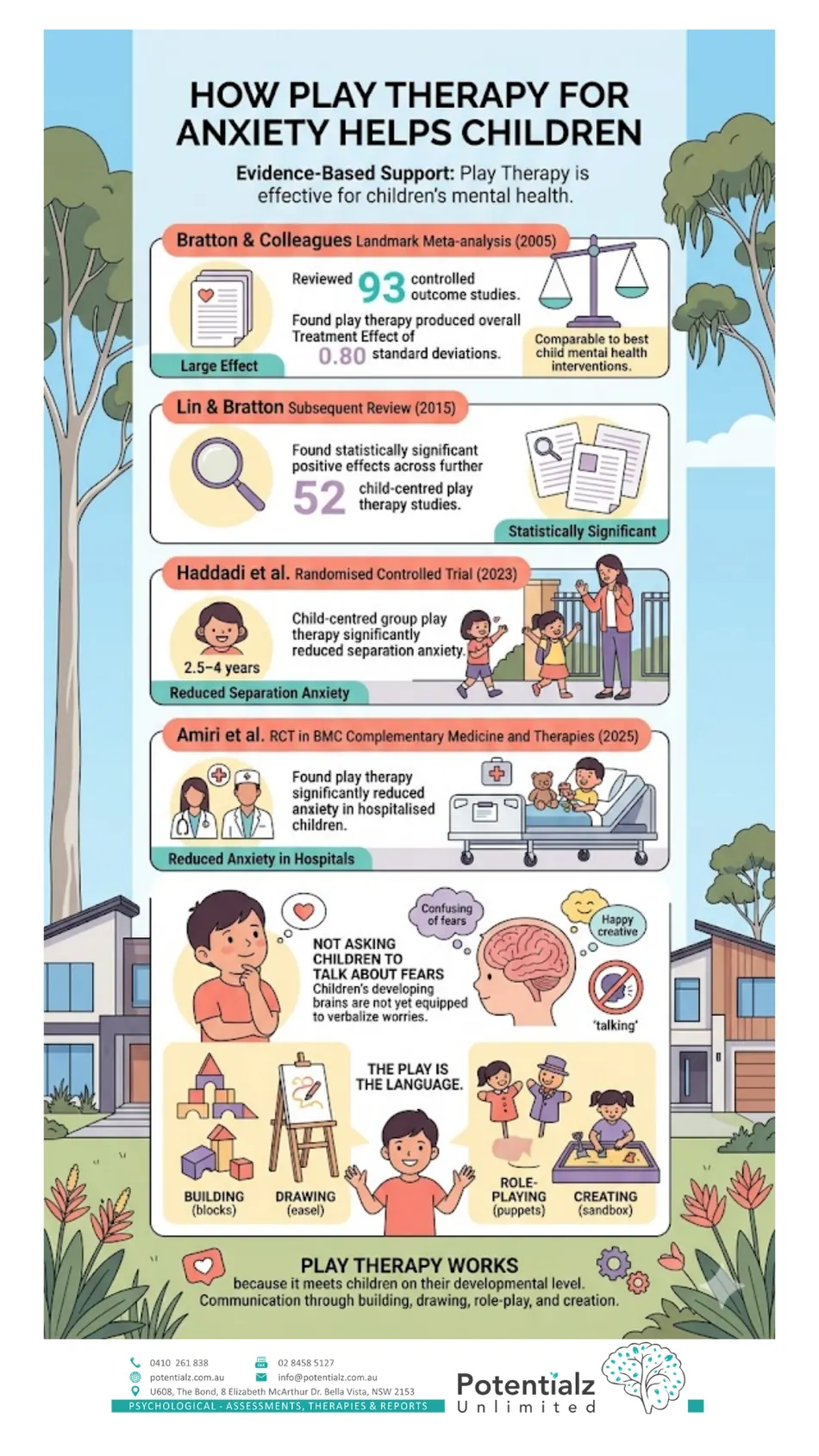
A landmark meta-analysis by Bratton and colleagues (2005) reviewed 93 controlled outcome studies and found that play therapy produced an overall treatment effect of 0.80 standard deviations — a large effect, comparable to the best available children’s mental health interventions. A subsequent systematic review by Lin and Bratton (2015) found statistically significant positive effects across a further 52 child-centred play therapy studies.
More recently, a 2023 randomised controlled trial found that child-centred group play therapy significantly reduced separation anxiety in children aged 2.5–4 years compared to control conditions (Haddadi et al., 2023). A 2025 RCT published in BMC Complementary Medicine and Therapies found play therapy significantly reduced anxiety in hospitalised children (Amiri et al., 2025).
The evidence is consistent: play therapy works. And it works because it does not ask children to talk about their fears in a way their developing brains are not yet equipped to do.
In therapeutic play sessions, your child does not need to name what is worrying them. They communicate through play — through what they build, draw, role-play, and create. The play is the language. Our Practitioner in Therapeutic Play reads what that play is telling us, and uses it as the vehicle for the child’s healing.
Synergetic Play Therapy and the Nervous System
The approach the practice draws on most often with anxious children is Synergetic Play Therapy — a nervous-system-focused model developed by Lisa Dion that works directly with the regulatory capacity underlying anxiety, rather than the cognitive content of the fears.
In Synergetic Play Therapy (SPT), the therapist maintains their own regulated state and uses it as an anchor for the child. When the child’s anxiety activates during a session — through the play, through contact with a feared theme, through a moment of relational uncertainty — the therapist stays calm, present, and attuned. The child’s nervous system registers this and begins to learn, experientially, that activation does not have to mean catastrophe (Dion, 2018). When a child’s anxiety is entangled with a disrupted caregiver relationship, Parent–Child Attachment Play can address the attachment dimension alongside this work.
Over time, these repeated experiences build the child’s own regulatory capacity. The window of tolerance — the range within which a child can experience anxiety without being overwhelmed — expands. The anxiety does not disappear. But the child has more capacity to move through it. The avoidance begins to reduce. The world feels a little less dangerous.
This is fundamentally different from teaching a child to think differently about their fears. It works at a deeper level — the felt level, the body level, the nervous system level — which is where anxiety actually lives.
LEGO® Based Therapy for Anxious Children
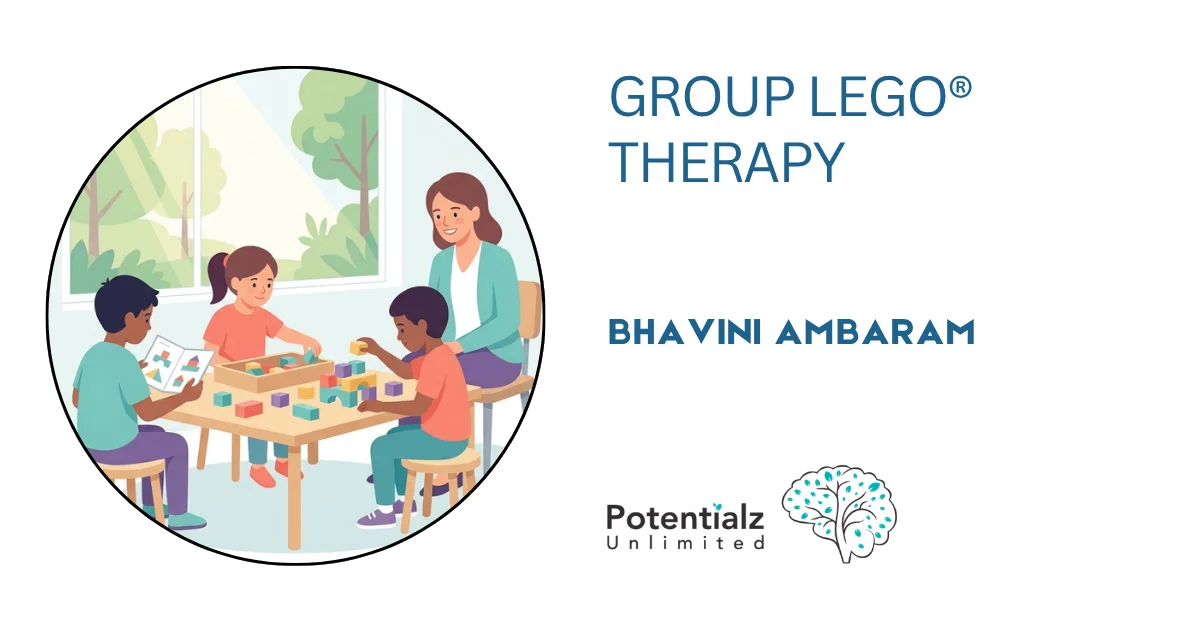
For children aged 6 and above, the practice also draws on LEGO® Based Therapy — particularly for children whose anxiety is linked to social situations or perfectionism. LEGO® Based Therapy was originally developed by Daniel LeGoff to support social skill development, and its structured, rule-governed, collaborative format is ideal for anxious children who feel safer in predictable environments.
Working towards a shared goal with clearly defined roles reduces social threat and allows the child to experience mastery and connection — two things that directly counter anxiety’s core messages (I am not capable, I am not safe with others). For perfectionist children, the building process also offers a gentle challenge to the need for things to be done exactly right.
What Parent Consultations Look Like
The practice always begins with an initial parent consultation — a session for you alone, without your child. This gives us the foundation we need: your child’s history, the family context, your specific concerns and goals, and an explanation of how the therapeutic process works.
After that, parent review consultations happen approximately every six weeks. In these sessions our play therapist shares what she is noticing in the therapeutic work — not the specific content of your child’s play, which stays confidential, but the general themes and the developmental shifts she is observing. You bring what you are seeing at home. Together, we adjust the plan.
Parent consultations are not optional additions to the therapeutic process. They are a core part of it. You are your child’s most important co-regulatory resource — and your understanding of the process directly affects how much your child benefits from it. For a full explanation of what to expect, see our post on parent consultations in play therapy.
What You Can Do Right Now
The single most powerful thing you can do for your anxious child is to build your own capacity to stay regulated in the face of their anxiety. This is harder than it sounds. Watching a child suffer activates your own distress. And when your nervous system escalates, your child’s registers that signal and escalates further.
Here are four things that genuinely help:
Validate before problem-solving. “I can see that feels really scary” before “let’s think about why it’s actually fine.” Your child needs to feel heard before they can hear anything else.
Limit reassurance. Too much reassurance inadvertently sends the message that there is something to be afraid of — otherwise why would you need to keep reassuring? Brief, warm acknowledgement is more useful than extended explanation.
Gently reduce avoidance. Avoiding anxiety triggers brings short-term relief but long-term amplification. Where safe and appropriate, gradual and supported exposure to mild triggers builds tolerance. This should never be forced.
Model regulated responses. When you encounter something mildly stressful, name it and your response: “I feel a bit nervous about that, but I’ve done it before and I’ll be okay.” This teaches your child — through your nervous system, not your words — that anxiety is survivable.
What to Expect: The Therapeutic Journey
Therapeutic play is not a quick fix. Anxiety, particularly when it has been present for some time, is a pattern that took time to form and takes time to shift.
The practice recommends a minimum of 12 sessions before drawing conclusions about progress. Many children — particularly those with longer-standing anxiety, a history of trauma, or strong avoidance patterns — benefit most from 35–40 sessions. Progress is tracked at every parent review and the plan is adjusted as we go.
Sessions run for approximately 50 minutes. Parent reviews are held every six weeks and are billed separately at $190. The therapeutic relationship itself — the felt experience of being with a calm, attuned practitioner who stays present through the hard moments — is the core mechanism of change.
If you are wondering whether your child needs more specialist psychological assessment, our team at Potentialz includes AHPRA-registered psychologists who provide formal assessment and diagnosis. The play therapy work sits alongside that specialist assessment pathway, not instead of it.
How Potentialz Can Help
At Potentialz Unlimited in Bella Vista, our accredited Practitioner in Therapeutic Play works with children aged 3–12 and their families, drawing on Synergetic Play Therapy, LEGO® Based Therapy, and Parent–Child Attachment Play.
This work supports children experiencing anxiety in all its forms — separation anxiety, generalised anxiety, social anxiety, perfectionism, school anxiety, and anxiety linked to trauma or family change. The practice creates a safe, attuned therapeutic space where children feel seen, understood, and empowered.
If your child is in the Hills District, Bella Vista, Norwest, Castle Hill, Baulkham Hills, Kellyville, or surrounding suburbs, we are conveniently located at Potentialz Unlimited and offer telehealth for families who cannot attend in person.
Fees:
- Initial parent consultation: $250
- Play therapy sessions: $190 per session
- Parent review sessions: $190 (approximately every six weeks)
- Package discounts available for upfront payment
- NDIS self-managed plans accepted
Book a session online: live.potentialz.com.au
Call us: 0410 261 838
Visit us: Unit 608/8 Elizabeth Macarthur Drive, Bella Vista NSW 2153
Hours: Monday to Friday, 10am–7pm | Saturday and after-hours available | Telehealth via phone or Zoom
You can also explore our NDIS-funded support options, meet our team, or get in touch with any questions.
Key Takeaways
- Anxiety in children affects approximately one in seven Australian children aged 4–17 — and it rarely looks like worrying
- Anxiety presents differently at different ages: clinginess and nightmares in 3–5 year olds; perfectionism and physical symptoms in 6–8 year olds; social avoidance in 9–12 year olds
- Anxiety is primarily a nervous system response — which is why reassurance alone is often not enough
- Play therapy for anxiety has strong research support, including large-effect meta-analyses and recent randomised controlled trials
- Synergetic Play Therapy works directly at the nervous system level through co-regulation — expanding the child’s window of tolerance for anxiety
- Parent involvement through consultations and reviews is an essential part of the therapeutic process, not an optional add-on
- The most powerful thing parents can do is build their own capacity to stay regulated — because a calm parent is the child’s most powerful co-regulatory resource
References
Amiri, M., Rezaei, M., & Karimi, M. (2025). Effect of play therapy and storytelling on the anxiety level of hospitalised children: A randomised controlled trial. BMC Complementary Medicine and Therapies, 25, Article 47. https://doi.org/10.1186/s12906-025-04767-4
Australian Bureau of Statistics. (2022). National study of mental health and wellbeing, 2020–2022. ABS. https://www.abs.gov.au/statistics/health/mental-health/national-study-mental-health-and-wellbeing/latest-release
Bratton, S. C., Ray, D., Rhine, T., & Jones, L. (2005). The efficacy of play therapy with children: A meta-analytic review of treatment outcomes. Professional Psychology: Research and Practice, 36(4), 376–390. https://doi.org/10.1037/0735-7028.36.4.376
Dion, L. (2018). Aggression in play therapy: A neurobiological approach for integrating intensity. W. W. Norton & Company.
Haddadi, M., Bahrami, F., & Etemadi, O. (2023). The effectiveness of child-centred group play therapy and narrative therapy on preschoolers’ separation anxiety disorder and social-emotional behaviours. Early Child Development and Care, 193(3), 401–415. https://doi.org/10.1080/03004430.2023.2167987
Landreth, G. L. (2012). Play therapy: The art of the relationship (3rd ed.). Routledge.
Lawrence, D., Johnson, S., Hafekost, J., Boterhoven de Haan, K., Sawyer, M., Ainley, J., & Zubrick, S. R. (2015). The mental health of children and adolescents: Report on the second Australian Child and Adolescent Survey of Mental Health and Wellbeing. Department of Health.
Lin, Y.-W., & Bratton, S. C. (2015). A meta-analytic review of child-centred play therapy approaches. Journal of Counseling & Development, 93(1), 45–58. https://doi.org/10.1002/j.1556-6676.2015.00180.x
Disclaimer: This article is a Potentialz Unlimited editorial piece drawing on our clinical team’s experience. It is for general education and information only, not clinical advice for your particular child. Potentialz Unlimited is a psychology practice based in Bella Vista NSW; our clinical team includes Registered and Clinical Psychologists (registered with AHPRA) and an accredited Play Therapist. Please consult a qualified health professional for your individual circumstances. If your child is experiencing a mental health crisis, contact your GP, call Kids Helpline on 1800 55 1800, or go to your nearest emergency department.
Crisis Resources: If you or someone you know needs support right now, please contact Lifeline on 13 11 14, Beyond Blue on 1300 22 4636, or Kids Helpline on 1800 55 1800. For emergencies, call 000.
Related Reading
Knowledge Check Quiz
Test what you have just read. Choose your answer for each question, then submit to reveal the answers and your score.
Need Professional Support?
If you're experiencing mental health concerns, our team is here to help.