Key Takeaways
- Between 40% and 80% of autistic adults have at least one co-occurring mental health condition; anxiety is the most common.
- Anxiety in autistic adults often presents differently — through shutdown, meltdown, rigidity, or extreme avoidance — rather than visible panic.
- Masking (suppressing autistic traits to appear neurotypical) has a significant mental health cost and contributes to autistic burnout.
- Autistic burnout is distinct from ordinary fatigue — it involves a profound loss of skills, tolerance, and function following prolonged masking and sensory overload.
- Depression in autistic adults may not look like “typical” depression and is frequently missed or misattributed.
- CBT can be effective for autistic adults when it is adapted to be concrete, structured, explicit, and predictable, with reduced reliance on inferring social context.
- NDIS funding covers psychological therapy, functional capacity assessments, and behaviour support for eligible autistic participants — Sushama is NDIS registered with 11 years of direct autism clinical experience.
What I Have Seen in 11 Years of Clinical Autism Work
From 2012 to 2023, I worked at the Royal Institute for Deaf and Blind Children (RIDBC), providing psychological services to children and adults with autism spectrum disorder and associated conditions. That work included cognitive assessment, functional capacity assessment, behaviour management, anxiety and stress management, NDIS liaison, and collaboration with disability service providers, medical professionals, transport authorities, and families.
That experience — over a decade of direct clinical work in a specialist disability setting — shapes everything I do when I see autistic clients in my private practice at Potentialz Unlimited.
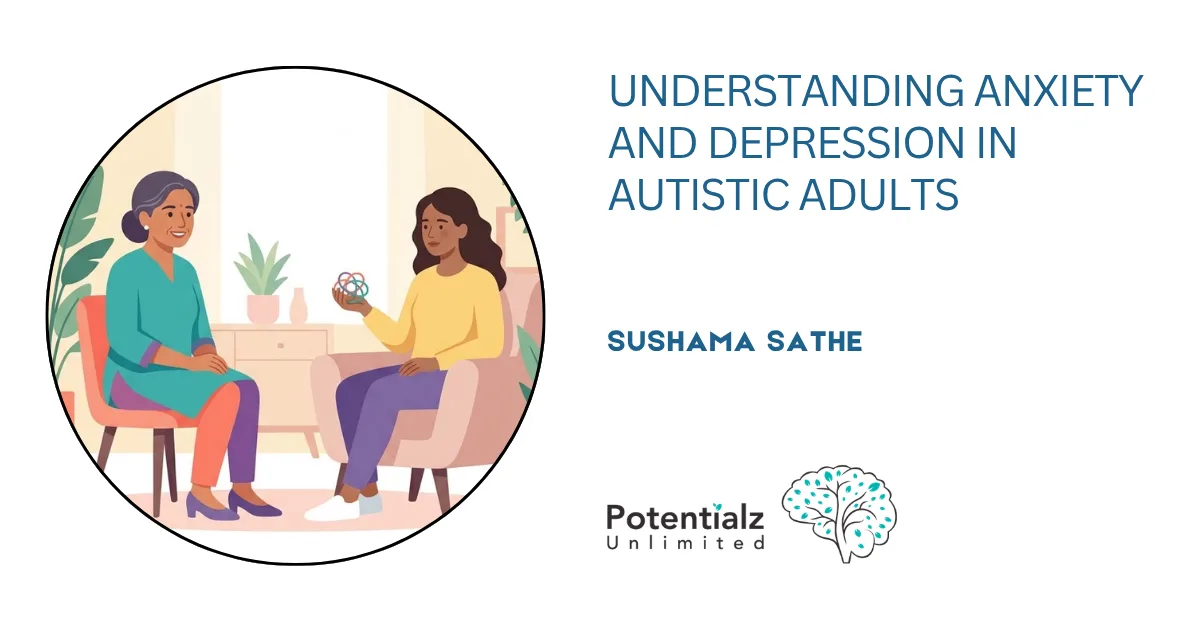
What I want to address in this post is the intersection of autism and mental health: specifically, the very high rates of anxiety and depression in autistic adults, why they so often go unrecognised or misunderstood, and what psychological support that genuinely helps looks like in practice.
This is not a post about autism as a deficit. Autism is a neurological difference, not a disease. But the mental health challenges that autistic people face — many of which arise not from autism itself but from navigating a world not designed for autistic neurology — are real, serious, and treatable.
Why Anxiety and Depression Are So Common in Autistic Adults
The research is consistent and striking: between 40% and 80% of autistic adults meet criteria for at least one co-occurring mental health condition (Lever & Geurts, 2016). Anxiety disorders are the most prevalent, affecting an estimated 40–50% of autistic adults. Depression is the second most common, with rates significantly higher than in the general population.
Why are these rates so high? There are several contributing factors that I see clinically.
Chronic stress from navigating a neurotypical world. Sensory environments that are overwhelming, social interactions that require constant effortful interpretation, workplaces and educational settings that were not designed with autistic neurology in mind — the cumulative stress of navigating these daily is enormous. Chronic stress is a well-established risk factor for both anxiety and depression.
Social isolation and loneliness. Despite the persistent stereotype that autistic people do not want social connection, many autistic adults want deep, meaningful relationships and find that social barriers leave them isolated. Loneliness is one of the strongest risk factors for depression.
Repeated experiences of failure, rejection, and misunderstanding. Autistic adults frequently describe histories of being told they are “too much,” “too sensitive,” “rude,” or “weird” — sometimes by people trying to help. This accumulation of negative feedback leaves real marks on self-concept.
Difficulty getting appropriate support. Autistic adults are frequently diagnosed late, misdiagnosed, or undiagnosed. Without an accurate understanding of their own neurology, many have spent years believing they are simply broken or inadequate.
How Anxiety Presents Differently in Autistic Adults
This is one of the most clinically important things I can share: anxiety in autistic adults frequently does not look like the anxiety presentations described in standard clinical texts.
In non-autistic clients, anxiety tends to present as visible distress, worry, avoidance, or physiological arousal. In autistic clients, the same internal experience of anxiety may manifest as:
- Shutdown: becoming very still, quiet, and apparently unresponsive — which may look like indifference or rudeness, but is actually an internal overwhelm response
- Meltdown: an involuntary, intense response to being overwhelmed — involving emotional flooding, distress, and sometimes behavioural dysregulation — that the person is not choosing and cannot simply stop
- Increased rigidity: a stronger-than-usual insistence on routine, sameness, or predictability as an attempt to reduce the unpredictability that drives anxiety
- Increased or altered stimming: repetitive behaviours (rocking, hand movements, vocalisation) that serve a self-regulatory function and often increase when the person is anxious
- Extreme avoidance: refusing to engage with situations that previously were manageable
I want to be explicit about meltdowns in particular, because they are frequently misunderstood by families, employers, and even clinicians. A meltdown is an involuntary overwhelm response — not a behavioural choice, not manipulation, not a lack of effort. Treating it as a behavioural problem to be managed through consequences is both ineffective and harmful. Understanding it as the output of an overwhelmed nervous system leads to entirely different — and much more helpful — approaches.
Alexithymia: When It Is Hard to Know What You Feel
A significant proportion of autistic adults — estimates range from 40% to 65% — experience alexithymia: difficulty identifying and describing their own emotional states (Kinnaird et al., 2019).
Alexithymia creates a particular clinical challenge because many standard mental health interventions rely heavily on the client’s ability to notice, name, and track their emotions. “How are you feeling?” turns out to be a much harder question for many autistic clients than clinicians typically assume.
In my clinical practice, this means I am explicit and concrete in helping clients build an emotional vocabulary. We may use tools like body-based cues (what is happening in your body right now?), numerical rating scales, or structured check-ins. I do not assume that because a client is articulate and appears calm, they are calm. And I do not assume that an absence of expressed emotion means an absence of emotional experience.
Understanding alexithymia also changes how I interpret clinical presentations. A client who cannot clearly report sadness or anxiety may nonetheless be significantly depressed or anxious — it is the pattern of their sleep, energy, motivation, activities, and behaviour that tells the clinical story.
Masking: The Hidden Mental Health Cost
Masking — also called “camouflaging” in the research literature — refers to the practice of suppressing or modifying autistic traits to appear neurotypical in social contexts. It may involve suppressing stims, forcing eye contact, rehearsing scripted social responses, or monitoring oneself constantly for social missteps.
Many autistic adults — particularly women, who are diagnosed significantly later than men partly because of more developed masking — describe masking as a survival strategy they have used since childhood, often without realising they were doing it. The social costs of appearing autistic in a world that is frequently intolerant of autistic difference can be severe: social exclusion, professional disadvantage, misunderstanding.
But the mental health cost of chronic masking is profound. It is exhausting — cognitively and emotionally — to monitor oneself continuously and suppress natural responses. Over time, it erodes the person’s sense of their own identity. Many autistic adults who have masked for decades describe feeling that they do not know who they actually are when no one is watching.
In my clinical work, one of the most important things I do is create conditions where masking is unnecessary. My consulting room should be a place where autistic traits are not a problem to be managed. That starts with my understanding them clinically rather than just socially.
Autistic Burnout: What It Is and Why It Matters
Autistic burnout is distinct from the occupational burnout that non-autistic people experience, and it is frequently misunderstood or missed by clinicians who are not familiar with it.
Autistic burnout typically follows a period of sustained effort at functioning in neurotypical environments — often involving prolonged masking, sensory overload, and insufficient recovery. It involves a significant and sometimes sudden loss of previously mastered skills and capacities: executive function deteriorates, communication becomes harder, sensory sensitivities intensify, and the ability to mask collapses. The person may appear to have regressed significantly.
Depression, social withdrawal, increased rigidity, meltdowns, and an inability to engage with activities that were previously manageable are common features.
What is critical clinically is that autistic burnout responds to rest and a reduction in neurotypical demands — not to being pushed harder to “keep going.” Recovery often requires significant changes to environment, workload, or social obligations, and may take months. Treating burnout as depression and increasing demands on the person (through activation-based behavioural interventions, for example) can make it worse.
In my practice, I assess carefully for the possibility of burnout when autistic clients present with fatigue and loss of function, and I adapt my approach accordingly.
Adapting Therapy for Autistic Adults
Therapy needs to be adapted to work well for autistic clients. I want to be concrete about what that means in practice.
CBT adaptations. Standard CBT relies on identifying automatic thoughts, inferring social cues, and noticing emotional states — all of which may be more challenging for autistic clients. In my practice, I make CBT more explicit and concrete: providing written summaries of sessions, using visual supports and structured worksheets, being very direct about the rationale for each technique, and allowing more processing time. I reduce reliance on intuiting social meaning and instead make social rules and expectations explicit where they are clinically relevant.
Predictability and structure. Many autistic clients find uncertainty inherently anxiety-provoking. I am explicit about what each session will involve, consistent in how I structure appointments, and I flag in advance when there will be a change. This is not rigid — it is clinically appropriate.
ACT for autistic adults. Acceptance and Commitment Therapy is particularly well-suited to autistic adults because it does not require neurotypical social conformity as a treatment goal. ACT focuses on living in accordance with one’s own values, developing psychological flexibility, and accepting experiences that cannot be changed — rather than trying to eliminate or suppress them. This framework allows me to work with autistic clients on wellbeing and meaningful living without pathologising their neurology.
NDIS liaison and functional assessment. A significant part of my autism clinical work involves functional capacity assessment — documenting the impact of disability on daily living, work, and social participation for NDIS planning purposes — and working collaboratively with NDIS support coordinators, allied health teams, and families. I bring 11 years of this work to my private practice.
How I Can Help
I am an NDIS-registered psychologist with 11 years of direct clinical experience working with autistic children and adults at the Royal Institute for Deaf and Blind Children. My training includes cognitive assessment, functional capacity assessment, behaviour management, and anxiety and stress management for autistic clients.
In my practice at Potentialz Unlimited, I offer:
- Psychological therapy (CBT and ACT, adapted for autistic adults) for anxiety, depression, burnout, and adjustment difficulties
- Functional capacity assessments for NDIS planning — comprehensive reports documenting how disability affects daily living, work, and social participation
- Cognitive assessments — I have specific training in cognitive and functional disability assessment, including tools used for NDIS planning
- NDIS-funded appointments — I follow NDIS pricing schedules and can work directly with plan managers and support coordinators
If you are an autistic adult, or if you support one, and you are looking for a psychologist who understands autism clinically and practically — not just as a diagnostic category on a referral form — I would welcome the opportunity to help.
I practise at Potentialz Unlimited, Unit 608, 8 Elizabeth Macarthur Drive, Bella Vista NSW 2153. Telehealth is available for clients across NSW. I speak English, Hindi, Marathi, and Punjabi.
To book, visit live.potentialz.com.au or call 0410 261 838.
References
Lever, A. G., & Geurts, H. M. (2016). Psychiatric co-occurring symptoms and disorders in young, middle-aged, and older adults with autism spectrum disorder. Journal of Autism and Developmental Disorders, 46(6), 1916–1930. https://doi.org/10.1007/s10803-016-2722-8
Kinnaird, E., Stewart, C., & Tchanturia, K. (2019). Investigating alexithymia in autism: A systematic review and meta-analysis. European Psychiatry, 55, 80–89. https://doi.org/10.1016/j.eurpsy.2018.10.008
Raymaker, D. M., Teo, A. R., Steckler, N. A., Lentz, B., Scharer, M., Delos Santos, A., Kapp, S. K., Hunter, M., Joyce, A., & Nicolaidis, C. (2020). “Having all of your internal resources exhausted beyond measure and being left with no clean-up crew”: Defining autistic burnout. Autism in Adulthood, 2(2), 132–143. https://doi.org/10.1089/aut.2019.0079
Hull, L., Mandy, W., & Lai, M. C. (2017). Behavioural and cognitive sex/gender differences in autism spectrum condition and typically developing males and females. Autism, 21(6), 706–727. https://doi.org/10.1177/1362361316669087
Mazefsky, C. A., & White, S. W. (2014). Emotion regulation: Concepts and practice in autism spectrum disorder. Child and Adolescent Psychiatric Clinics of North America, 23(1), 15–24. https://doi.org/10.1016/j.chc.2013.07.002
Disclaimer
Sushama Sathe is an AHPRA Registered Psychologist (PSY0001370871) at Potentialz Unlimited. The information in this post is for general educational purposes only and does not constitute clinical advice or diagnosis. Please consult a qualified health professional for assessment and treatment tailored to your circumstances.
Crisis Resources
- Lifeline: 13 11 14 (24/7)
- Beyond Blue: 1300 22 4636
- Kids Helpline: 1800 55 1800
- Emergency: 000
Knowledge Check Quiz
Test what you have just read. Choose your answer for each question, then submit to reveal the answers and your score.
Need Professional Support?
If you're experiencing mental health concerns, our team is here to help.