The Fifth Therapist
You are sitting in a new consulting room. You have done this before. You have done this four times before, in fact. Each time you sat down and gave a short version of the story — the childhood, the household, the years of not being safe — and each time the therapist nodded, and you did some CBT, and you got a bit better at some things, and you kept coming apart in the same places.
The relationship blowups still happen. The self-loathing still shows up on Sunday nights. The body still braces at the sound of certain footsteps or a raised voice. You still cannot always tell whether you are 41 or seven. The word “trauma” has been mentioned. So has “PTSD.” Neither has ever quite fit, because you were not in a war and there was no single event, and the diagnostic checklists never quite matched what actually goes on inside you.
If this describes you, there is a good chance you are living with complex post-traumatic stress disorder (cPTSD). It is a distinct clinical presentation, formally recognised by the World Health Organization in the ICD-11 in 2018. It responds to treatment. And the treatment looks different — and takes longer — than treatment for single-event PTSD.
What Complex PTSD Actually Is
The concept of complex PTSD was proposed by Judith Herman in her 1992 book Trauma and Recovery, based on decades of clinical work with survivors of childhood abuse, domestic violence, prolonged captivity, and other chronic interpersonal harm. She argued that the standard PTSD framework — developed largely from combat and single-event trauma — captured only part of what she saw in the room.
The ICD-11, published by the WHO in 2018 and formally in use since 2022, now includes cPTSD as a distinct diagnosis. Alongside the three core PTSD clusters (re-experiencing, avoidance, and hyperarousal), it adds three “disturbances in self-organisation”:
- Affect dysregulation — heightened emotional reactivity, difficulty calming down, or in the opposite direction, emotional numbing and dissociation
- Negative self-concept — persistent beliefs of worthlessness, shame, or being fundamentally damaged
- Interpersonal disturbances — difficulty sustaining close relationships, avoiding intimacy, or oscillating between over-attachment and withdrawal
To meet criteria for cPTSD you need both the PTSD cluster and the self-organisation cluster, and the pattern is generally linked to prolonged or repeated trauma from which escape was difficult or impossible — most classically childhood abuse or neglect, prolonged domestic violence, coercive control, trafficking, or extended captivity.
Why the Distinction Matters
For a long time, people with complex trauma received one of two labels: PTSD (which did not quite fit) or borderline personality disorder (which fit worse, and carried heavy stigma). Neither pointed to the right treatment. Treating cPTSD as if it were single-event PTSD often failed — trauma-focused work started too early left people flooded and destabilised. Treating it as a personality disorder often failed differently — locating the problem in the person’s “personality” rather than in what happened to them, and missing the trauma at the core.
The recognition of cPTSD as a distinct condition matters because it points to a different treatment sequence. It says: the disruption is deeper than symptoms; the therapeutic relationship itself is part of the treatment; healing takes time; and you cannot start with trauma processing before the person can safely tolerate it.
In my clinical practice in Bella Vista, most of the people I see for trauma work have some form of complex trauma. Very few present with a clean single-event picture. What they typically bring is the pattern above — the reactivity, the shame, the relationship difficulties, the sense that previous therapy helped a bit but never reached the thing underneath.
Herman’s Three Phases — Still the Map
Herman’s tri-phasic model remains the internationally accepted framework for complex trauma treatment, endorsed by the ISTSS complex PTSD guidelines (2019):
Phase 1: Safety and stabilisation. Before any trauma processing, the person needs a foundation. External safety (are you currently in a harmful situation?), physiological stability (sleep, eating, substances), emotional-regulation skills (the capacity to notice, name, tolerate, and calm strong feelings), and a working therapeutic alliance. This phase is often the longest and — done properly — is where much of the healing actually happens.
Phase 2: Trauma processing. Once stabilisation is well established, structured trauma-focused work reprocesses the traumatic memories so they no longer hijack the present. EMDR, Cognitive Processing Therapy (CPT), and Prolonged Exposure all have strong evidence. Trauma processing is done gradually, with careful pacing, and the person always retains the agency to slow down.
Phase 3: Reconnection and integration. As the trauma loses its grip, work turns to the life the person is now free to build — relationships, work, meaning, community, and often reconnecting with parts of themselves that were shut down. This phase is under-discussed in the trauma literature and, in my view, is where some of the most profound growth happens.
Progress is not neatly linear. People move between phases as new material surfaces or life stressors arise. The map is a compass, not a timetable.
What Actually Works: The Evidence-Based Toolkit
The ISTSS complex PTSD guidelines (2019) and subsequent reviews (Coventry et al., 2020; Karatzias et al., 2019) support a multimodal, phase-oriented approach. The specific tools that appear most often in evidence-based cPTSD treatment:
Skills-training approaches — for Phase 1. STAIR (Skills Training in Affective and Interpersonal Regulation), developed by Marylene Cloitre and colleagues, is a structured protocol that builds affect-regulation and interpersonal skills before or alongside trauma processing. Randomised trials show STAIR followed by narrative therapy outperforms narrative therapy alone for complex trauma populations (Cloitre et al., 2010). DBT (Dialectical Behaviour Therapy), developed by Marsha Linehan, provides the deepest evidence base for emotion-regulation skills, distress tolerance, and interpersonal effectiveness — the exact areas where cPTSD most disrupts function. DBT-derived skills modules are now widely integrated into complex trauma treatment.
Trauma-focused therapies — for Phase 2. EMDR (Eye Movement Desensitisation and Reprocessing), developed by Francine Shapiro, has strong evidence for both PTSD and complex PTSD (Shapiro, 2018; Hase, 2021). EMDR reprocesses trauma memories without requiring detailed verbal recounting, which many complex trauma survivors find more tolerable. Cognitive Processing Therapy (CPT) works on the “stuck points” — trauma-generated beliefs about safety, trust, power, esteem, and intimacy. Prolonged Exposure (PE) systematically exposes the person to trauma memories and avoided reminders.
Third-wave and integrative approaches. CBT grounded in trauma-specific formulation and ACT (Acceptance and Commitment Therapy) both contribute. ACT is particularly valuable for the values-based reconnection of Phase 3 — moving toward a chosen life rather than away from painful feelings.
Medication. SSRIs and other medication (prescribed by a GP or psychiatrist) may be helpful adjuncts, particularly where depression, anxiety, or sleep disruption is prominent.
The therapeutic relationship itself. For complex trauma, the relationship with the therapist is not just the container for treatment — it is part of the treatment. A steady, boundaried, warm, transparent therapeutic relationship gradually rewrites the implicit template of what close relationships can be.
How I Work with Complex PTSD
In my Bella Vista practice, I follow Herman’s tri-phasic map, adapted to the person in front of me. Early sessions focus on formulation — what happened, what is happening now, what capacities are already there, and what needs building. We do not rush to trauma processing. Stabilisation might involve psychoeducation about the nervous system, DBT-derived distress tolerance and emotion regulation skills, sleep and body-based work, boundary work in current relationships, and CBT/ACT on the shame narratives that often dominate the internal landscape.
When we move to processing, EMDR is my most frequent choice — it is well-tolerated, does not require exhaustive verbal recounting, and integrates well with the stabilisation work. For some people, cognitive-processing approaches are a better fit. We choose together.
Reconnection work — Phase 3 — is often the most satisfying. This is where the person begins to notice, sometimes with surprise, that a Sunday night now feels quiet. That a partner’s raised voice no longer sends them into a five-day shutdown. That they can enjoy something without waiting for it to be taken away.
Multicultural context runs through all of this. In many South Asian and other cultural contexts, prolonged interpersonal trauma — particularly familial or domestic — carries heavy silence, shame, and family-honour weight. Being able to work with a clinician who understands both the neurobiology and the cultural context — and can hold both without minimising either — often removes barriers that have kept treatment inaccessible for years.
If your low mood or the trauma memories ever bring thoughts of not wanting to be here, please reach out for urgent support now: call Lifeline on 13 11 14, contact Beyond Blue on 1300 22 4636, or in an emergency call 000. For sexual, domestic, or family violence support, 1800RESPECT is available on 1800 737 732.
Why Previous Therapy May Not Have Worked
One of the most common things I hear in a first session is a rueful account of past therapy — often two or three episodes, sometimes more — that helped a little and then plateaued. This is not necessarily a failure of the previous therapist, and it is very often not a failure of the person. It usually reflects one of a small number of predictable patterns.
The trauma was never identified as trauma. Standard CBT for depression or anxiety does not target trauma memories. If the underlying driver is complex trauma, CBT can help with surface symptoms without touching the engine. Progress plateaus.
Trauma processing was attempted before stabilisation. For complex trauma, jumping into detailed recounting or exposure before the person has the affect-regulation resources to tolerate it can be destabilising rather than healing. Some people leave that experience believing trauma work is not for them, when in fact only the sequencing was off.
The therapeutic relationship never became stable. Complex trauma survivors often carry an implicit expectation that close relationships will eventually hurt them. If therapy repeats that pattern — short-term, unpredictable, or under-boundaried — the deeper work cannot happen. A steady, boundaried, longer-term relationship is often part of the treatment itself.
Comorbid patterns dominated the session hour. Chronic emotion dysregulation, self-harm risk, substance use, or acute life crises can consume every session, leaving no space for trauma work. When this pattern is recognised, a phase of skills-focused work (often DBT-derived) creates the stability that lets the trauma processing eventually happen.
Naming these patterns early in a new therapeutic relationship — as I try to do in a first appointment — helps the person understand that “therapy has not worked for me” is often really “the right kind of therapy has not been done in the right sequence.” That reframe is quietly hopeful.
The Body in Complex Trauma
A generation of trauma research, popularised by Bessel van der Kolk’s The Body Keeps the Score (2014), has made clear that complex trauma is stored not only in narrative memory but in the nervous system and the body. Chronic sympathetic activation, altered vagal tone, disturbed sleep architecture, and heightened interoceptive sensitivity are all common. Chronic pain, functional gut symptoms, autoimmune presentations, and unexplained fatigue frequently accompany cPTSD.
Good complex trauma treatment respects this. Bottom-up regulation strategies — breathwork, grounding, controlled movement, yoga, appropriate exercise, sleep hygiene — sit alongside top-down cognitive and processing work. Referrals to trauma-informed bodywork practitioners, physiotherapists, or GPs with an interest in the mind-body interface are often part of the picture. Healing is a whole-nervous-system project, not just a cognitive one.
The Role of Post-Traumatic Growth
Post-traumatic growth is not a mandatory outcome and is never something a therapist should push. But it is a real, well-documented phenomenon. Many people who complete good complex trauma treatment describe not only recovery from symptoms but a deepened sense of what matters to them, a clearer set of values, a discerning approach to relationships, and a felt capacity to be with pain — their own and other people’s — without collapsing. This is not a silver lining on suffering. It is what the human nervous system can do when the conditions for healing are met.
For some people, growth also takes on a communal dimension — engagement with advocacy, peer support, writing, or creative work that gives shape to what was survived. This is the person’s own choice, not a therapeutic prescription, and it happens when it happens.
A Note on Timing and Life Season
Complex trauma work is intensive. It benefits from a period in life with reasonable external stability — housing, finances, a workable work situation, adequate sleep, and at least one supportive relationship or community. If those conditions are missing, the sensible first move is often not trauma processing at all but shorter-term work on stabilising the current life. Trauma processing then becomes possible when the ground under the person’s feet is steady enough to hold the work. Being told “this is not the right season for that piece of work yet, and here is what we can usefully do instead” is often clarifying rather than disappointing.
Common Companion Diagnoses
Complex PTSD rarely arrives on its own. In my practice, I most often see it alongside:
- Depression — chronic, often treatment-resistant to standard antidepressant-plus-CBT approaches until the trauma is addressed
- Anxiety disorders — generalised anxiety, panic, social anxiety
- Substance use — often as self-medication for hyperarousal or emotional pain
- Chronic pain and functional physical symptoms — the body-based sequelae of chronic sympathetic activation
- Dissociative symptoms — from mild detachment to more organised dissociative patterns
- Eating disorders — often an emotion-regulation strategy in disguise
Good cPTSD treatment holds all of this together, rather than sending the person from specialist to specialist.
What to Expect in the First Appointment
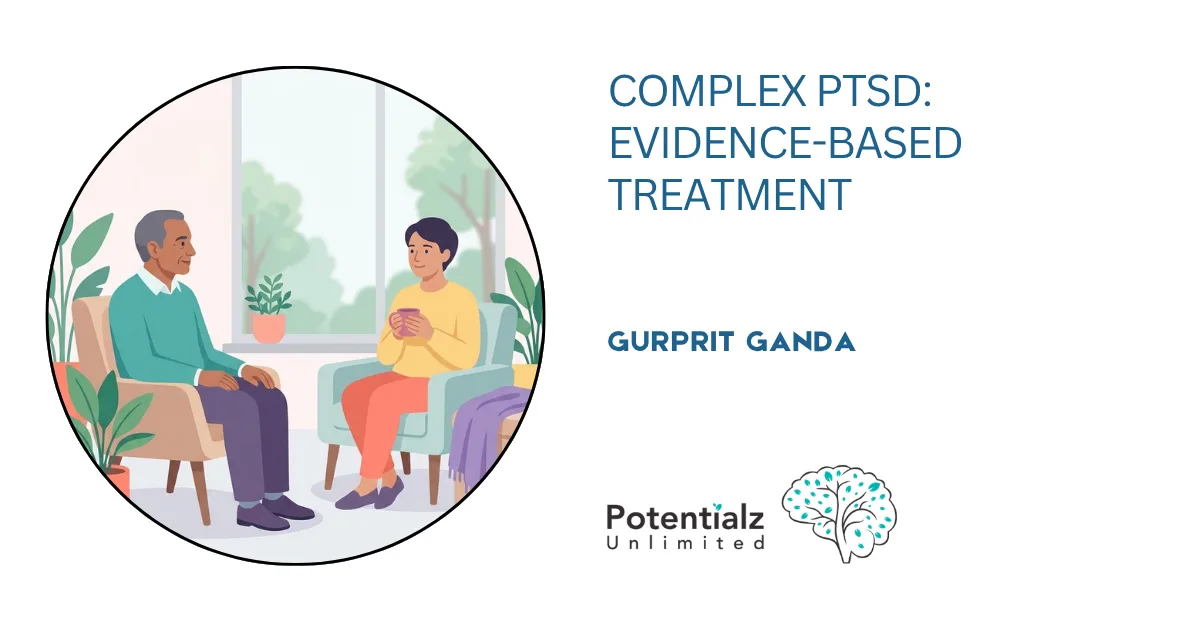
If you come to me for a first appointment for complex trauma, the first session will not require you to tell the whole story. It will focus on getting a clear picture of what is happening now, what you have already tried, what supports you have around you, and what you are hoping for. Together we will decide whether the fit feels right, and if so, what a plausible plan looks like.
You do not need to arrive with the story polished or the diagnosis pre-formed. You just need to arrive.
How Potentialz Unlimited Can Help
Potentialz Unlimited is a clinical psychology practice based in Bella Vista, NSW, supporting adults across the Hills District — Norwest, Castle Hill, Kellyville, Baulkham Hills, Rouse Hill, and Glenhaven.
I am Dr Gurprit Ganda, a Clinical Psychologist with over 25 years of experience in complex trauma. I offer phased, evidence-based treatment for complex PTSD — stabilisation with DBT-derived skills and CBT/ACT, trauma processing with EMDR, and reconnection work as recovery consolidates. Sessions available in English, Hindi, Punjabi, and Urdu. Medicare rebates are available with a GP Mental Health Care Plan; WorkCover, CTP, and NDIS also accepted where applicable. You can contact the clinic or book directly at live.potentialz.com.au.
References
Cloitre, M., Stovall-McClough, K. C., Nooner, K., Zorbas, P., Cherry, S., Jackson, C. L., Gan, W., & Petkova, E. (2010). Treatment for PTSD related to childhood abuse: A randomized controlled trial. American Journal of Psychiatry, 167(8), 915–924. https://doi.org/10.1176/appi.ajp.2010.09081247
Coventry, P. A., Meader, N., Melton, H., Temple, M., Dale, H., Wright, K., Cloitre, M., Karatzias, T., Bisson, J., Roberts, N. P., Brown, J. V. E., Barbui, C., Churchill, R., Lovell, K., McMillan, D., & Gilbody, S. (2020). Psychological and pharmacological interventions for posttraumatic stress disorder and comorbid mental health problems following complex traumatic events: Systematic review and component network meta-analysis. PLOS Medicine, 17(8), e1003262. https://doi.org/10.1371/journal.pmed.1003262
Ford, J. D., & Courtois, C. A. (Eds.). (2021). Treating complex traumatic stress disorders in adults: Scientific foundations and therapeutic models (2nd ed.). Guilford Press.
Hase, M. (2021). The structure of EMDR therapy: A guide for the therapist. Frontiers in Psychology, 12, 660753. https://doi.org/10.3389/fpsyg.2021.660753
Herman, J. L. (1992). Trauma and recovery: The aftermath of violence — from domestic abuse to political terror. Basic Books.
International Society for Traumatic Stress Studies. (2019). ISTSS guidelines position paper on complex PTSD in adults. ISTSS. https://istss.org/getattachment/Treating-Trauma/New-ISTSS-Prevention-and-Treatment-Guidelines/ISTSS_CPTSD-Position-Paper-(Adults)_FNL.pdf.aspx
Karatzias, T., Murphy, P., Cloitre, M., Bisson, J., Roberts, N., Shevlin, M., Hyland, P., Maercker, A., Ben-Ezra, M., Coventry, P., Mason-Roberts, S., Bradley, A., & Hutton, P. (2019). Psychological interventions for ICD-11 complex PTSD symptoms: Systematic review and meta-analysis. Psychological Medicine, 49(11), 1761–1775. https://doi.org/10.1017/S0033291719000436
Linehan, M. M. (2015). DBT skills training manual (2nd ed.). Guilford Press.
Maercker, A., Cloitre, M., Bachem, R., Schlumpf, Y. R., Khoury, B., Hitchcock, C., & Bohus, M. (2022). Complex post-traumatic stress disorder. The Lancet, 400(10345), 60–72. https://doi.org/10.1016/S0140-6736(22)00821-2
Shapiro, F. (2018). Eye movement desensitization and reprocessing (EMDR) therapy: Basic principles, protocols, and procedures (3rd ed.). Guilford Press.
van der Kolk, B. A. (2014). The body keeps the score: Brain, mind, and body in the healing of trauma. Viking.
World Health Organization. (2018). International classification of diseases for mortality and morbidity statistics (11th Revision). WHO. https://icd.who.int/
Knowledge Check Quiz
Test what you have just read. Choose your answer for each question, then submit to reveal the answers and your score.
Need Professional Support?
If you're experiencing mental health concerns, our team is here to help.