The Wednesday Night That Kept Repeating
It is 10:47pm on a Wednesday. You have said something you did not mean to say. Again. The message came out of your fingers before your mind caught up, and now your partner has gone quiet, and now the quiet is louder than the argument, and now you are alone with the familiar internal soundtrack — why do I keep doing this, what is wrong with me, this is going to end the way the last one ended.
You have been in this exact loop before. In previous relationships. In old workplaces. On phone calls with your mother. The pattern is not that you are a bad person; the pattern is that some emotions arrive with a force your nervous system was never taught how to hold, and by the time you notice what is happening, the words have already left the room.
If any of this feels familiar, please read on. Dialectical Behaviour Therapy — DBT — is one of the most researched, practical, and effective frameworks for exactly this pattern. It is not the answer to every mental health question. But for people whose emotions repeatedly hijack their behaviour, relationships, and self-image, the DBT skill set is well supported by research — and, importantly, it is learnable.
What DBT Actually Is
DBT was developed by American psychologist Marsha Linehan in the 1980s and 90s. Linehan had been trying to apply standard cognitive-behavioural therapy to chronically suicidal women who met criteria for borderline personality disorder, and finding that it was not working. Pure change-focused therapy was invalidating for people whose emotional experience was already dismissed at every turn; pure acceptance-focused therapy left the self-harm and suicidality untouched. The synthesis — dialectical — was the recognition that people in extreme emotional pain need both acceptance of where they are and skills for change, held simultaneously. That is where the name comes from.
Modern DBT is one of the most extensively studied psychotherapies in the world. The original trials showed marked reductions in self-harm, suicide attempts, hospitalisations, and treatment drop-out for women with borderline personality disorder (Linehan et al., 1991; Linehan et al., 2006). Meta-analyses have since confirmed moderate-to-large effects for BPD (Kliem et al., 2010), and growing evidence supports DBT and DBT-informed treatment for eating disorders, PTSD (DeCou et al., 2019), substance use disorders, adolescent emotion dysregulation, and treatment-resistant depression.
In my clinical practice in Bella Vista, DBT — usually as DBT-informed individual therapy — sits alongside EMDR, CBT, and ACT as one of the core frameworks I work with. People rarely arrive asking for DBT by name. They arrive describing a pattern: emotions that arrive too fast and stay too long, relationships that keep breaking down the same way, self-harm they cannot fully explain, a sense that they are “too much” or “too intense” or “too sensitive” and have been told so for as long as they can remember. When that pattern is present, DBT skills belong in the treatment.
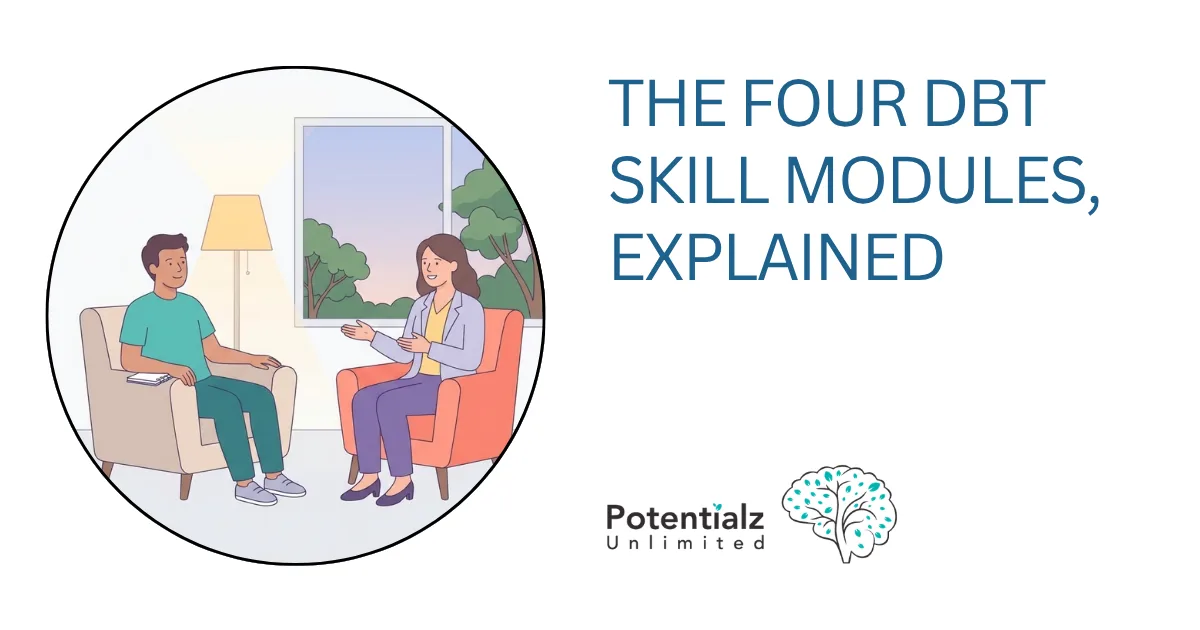
The Four Modules of DBT Skills Training
The core of DBT — the part that most people encounter first — is a structured set of skills organised into four modules (Linehan, 2015). Each module addresses a different domain of the emotional life, and each skill is taught concretely, practised deliberately, and reviewed for real-world use. This is not vague self-help language; it is a specific curriculum.
Mindfulness
Mindfulness is the foundation of DBT and every other module rests on it. In DBT, mindfulness is not primarily meditation; it is a set of skills for paying attention to what is actually happening in your own mind and body, on purpose, without immediately reacting. Linehan teaches this through the “what” skills — observe, describe, participate — and the “how” skills — non-judgementally, one-mindfully, effectively. The clinical value is enormous. People who cannot notice an emotion until it has already taken over the situation cannot regulate that emotion. Mindfulness builds the narrow window between stimulus and response inside which every other skill becomes possible.
Distress Tolerance
Distress tolerance skills are for the moments when the emotion is already at 8, 9, or 10 out of 10 — when problem-solving is impossible and the only workable goal is to get through the moment without making things worse. This is where DBT is at its most concretely useful. TIPP — cold water on the face (Temperature), Intense exercise, Paced (slow) breathing, and Paired muscle relaxation — uses physiology to rapidly bring extreme arousal down. STOP — Stop, Take a step back, Observe, Proceed mindfully — creates a pause in an escalating moment. Radical acceptance — the deliberate practice of accepting reality as it is, not because you approve of it but because fighting it costs more than accepting it — is one of the harder skills to learn and often one of the most transformative.
Emotion Regulation
Where distress tolerance is about surviving the crisis, emotion regulation is about changing the baseline. This module teaches skills for identifying and naming emotions accurately (many people arrive unable to distinguish anger from anxiety from shame), for reducing vulnerability to emotional overwhelm through PLEASE skills (Physical illness treatment, balanced Eating, avoiding mood-Altering substances, balanced Sleep, and Exercise), for checking the facts against the story your emotion is telling you, and for opposite action — deliberately acting the opposite of what an unjustified emotion urges you to do, in order to weaken the underlying pattern.
Interpersonal Effectiveness
The fourth module is the relational one. Many people with chronic emotion dysregulation have learned, understandably, that expressing needs directly leads to bad outcomes — being dismissed, being punished, being abandoned. Interpersonal effectiveness skills teach concrete templates for asking, refusing, and negotiating in ways that preserve both the relationship and self-respect. DEAR MAN (Describe, Express, Assert, Reinforce, stay Mindful, Appear confident, Negotiate) is the request-and-refusal template; GIVE (Gentle, Interested, Validate, Easy manner) helps preserve the relationship; FAST (Fair, no Apologies, Stick to values, be Truthful) helps preserve self-respect. Together, they replace decades of ineffective habits with something workable.
When DBT Is Indicated — and When It Is Not
DBT was designed for chronic emotion dysregulation, and that remains the core indication. In my clinical experience, DBT or DBT-informed work is often the right fit when the presenting picture includes several of the following: chronic emotional intensity that seems disproportionate to the trigger; long-standing self-harm, whether current or in remission; recurring relationship rupture with the same pattern; borderline personality features (with or without a formal BPD diagnosis); complex trauma requiring stabilisation before deeper trauma work; eating-disorder-adjacent dysregulation; ADHD with prominent emotional dysregulation; or a sense that “I know what to do, I just cannot do it in the moment.”
DBT is not the first-line treatment for a discrete anxiety disorder without significant dysregulation (CBT is), for uncomplicated depression (CBT or interpersonal therapy is), for a single-incident trauma (EMDR or trauma-focused CBT is), or for a couples issue where individual dysregulation is not the primary problem (EFT-informed couples work is). Good clinical formulation matters. A DBT skill set is a powerful thing to have — but it is not the only tool, and forcing every presentation into a DBT frame is as unhelpful as forcing every presentation into a CBT frame.
Comprehensive DBT versus DBT-Informed Individual Therapy
This is the honest conversation many blog articles skip. Comprehensive DBT — the model studied in the landmark trials — has four components delivered together over about a year: (1) weekly individual DBT therapy, (2) a weekly DBT skills group running through the four modules, (3) between-session phone coaching with the individual therapist for in-the-moment skills use, and (4) a weekly DBT therapist consultation team meeting for the clinicians delivering the program.
Most private-practice psychologists in Australia — including me — do not run a full four-component comprehensive DBT program. What we deliver is best described as DBT-informed individual therapy: individual psychological therapy that integrates DBT strategies and teaches DBT skills, without the group, without between-session phone coaching in the DBT sense, and without a formal DBT consultation team. This is a legitimate, evidence-informed way to work — and it is what many people actually need — but it is not the same thing as a comprehensive DBT program and should never be advertised as one.
Why does this distinction matter? Because for someone at the more severe end of the spectrum — chronic active self-harm, frequent hospitalisation, repeated treatment drop-out — the full four-component package has evidence that individual DBT-informed work alone does not. If comprehensive DBT is what you need, you deserve a clinician who will name that and support you into a program that offers it, not one who will sell you a diluted version under the same label. In Sydney, comprehensive DBT programs are available through several specialist services; a GP or psychiatrist referral is usually the practical route in.
For everyone else — the substantial group whose emotion dysregulation is real and impairing but not at the acute-crisis end — DBT-informed individual therapy is often exactly right.
What DBT-Informed Therapy Actually Looks Like in the Room
A typical course of DBT-informed individual work I offer runs across roughly 12–20 sessions, longer where trauma or complex comorbidity is present. Early sessions focus on formulation, psychoeducation about the dialectical model, and behavioural analysis of specific recurring incidents — the argument that keeps happening, the self-harm episode, the workplace explosion — to understand the chain of triggers, thoughts, emotions, urges, and behaviours. This chain analysis is a distinctive DBT tool and often generates real insight the first time it is done properly.
Middle sessions work systematically through the four skill modules, adapted to the person’s presenting concerns. Mindfulness is threaded through everywhere. Distress tolerance skills are typically taught early so there is something concrete to reach for on the worst days. Emotion regulation and interpersonal effectiveness skills are layered in as capacity grows. Between-session practice is built in — DBT is a behavioural therapy and skills only become real through repetition.
Later sessions consolidate the skills into daily life, address the patterns that keep re-emerging under stress, and — where trauma has been sitting underneath the dysregulation — integrate trauma-focused work (often EMDR) once regulation is stable enough to do so safely. This staged approach, sometimes called stabilisation-then-processing, is the standard for complex trauma work.
If your low mood ever brings thoughts of not wanting to be here, please reach out for urgent support now: call Lifeline on 13 11 14, contact Beyond Blue on 1300 22 4636, or in an emergency call 000.
DBT and Trauma — a Note on Sequencing
Many people who benefit from DBT also carry significant trauma histories. This is not a coincidence — the emotional environments that produce chronic dysregulation are often the same environments that produce trauma. The clinical question is not usually whether to address the trauma but when. Standard practice for complex trauma is a phased approach: stabilisation and regulation first, trauma processing second, integration and consolidation third. DBT skills sit squarely in the first phase, providing the emotion-regulation and distress-tolerance capacity that makes later trauma processing tolerable rather than destabilising. EMDR or trauma-focused CBT can then be introduced when the ground is stable. Rushing to trauma processing before regulation is in place tends to produce worse outcomes than a slower, staged approach.
DBT and ADHD — the Overlap Worth Naming
Emotional dysregulation is now recognised as a core feature of adult ADHD, not an incidental extra (Faraone et al., 2021). Many adults with ADHD describe exactly the pattern DBT was designed for — intense emotions that arrive too fast, dominate too long, and drive behaviour they later regret. DBT skills — particularly distress tolerance, opposite action, and interpersonal effectiveness — are now widely integrated into adult ADHD treatment alongside ADHD-adapted CBT and, where indicated, medication. In my practice, adults presenting for ADHD assessment often benefit from DBT skills work as part of the post-diagnostic treatment package.
Multicultural Context — Emotion and Culture
Emotion is universal but the rules for expressing it are cultural. In many South Asian, East Asian, and other collectivist contexts, direct expression of anger, sadness, or need — especially by women, especially toward elders — has been discouraged for generations. That does not mean the emotion was absent; it means the skills for holding, naming, and expressing it may never have been taught. Many of my clients arrive with the specific pattern of decades of over-controlled expression followed by episodic loss of control, and a strong internal narrative that the loss of control is “who I really am.” DBT’s dialectical stance — that both the tight control and the loss of control are understandable responses to an emotional life that was never met with the skills it needed — is often profoundly relieving to hear named clinically for the first time. Interpersonal effectiveness work in this context has to be done carefully, respecting the cultural weight of the relationships being renegotiated.
Practical First Steps While You Book
Whether or not you end up in DBT-informed therapy, these are useful:
- Notice one emotion, once a day — pause and name what you are feeling using more than one word. “Anxious and also disappointed.” Naming widens the window
- Try TIPP once, in a low-stakes moment — cold water on your face for 30 seconds when you are calm, so the skill is familiar when you need it in a crisis. One caution: the temperature and intense-exercise steps are not appropriate for everyone. If you have a cardiac condition or an eating disorder, check with your GP before using them
- Sleep, food, movement, no substances — the PLEASE skills are not optional extras; a sleep-deprived, under-fed, dysregulated body cannot practise regulation skills reliably
- Track one recurring pattern for two weeks — the argument, the outburst, the shutdown — noting trigger, thought, emotion, action. This is the raw material for chain analysis in session
- Buy the DBT skills workbook — Marsha Linehan’s DBT Skills Training Handouts and Worksheets (2015) is written to be usable. It is not a substitute for therapy where dysregulation is severe, but it is a real resource
- Book your GP — for a Mental Health Care Plan referral, and to rule out sleep, thyroid, iron, and B12 issues that magnify emotional reactivity
How Potentialz Unlimited Can Help
Potentialz Unlimited is a clinical psychology practice based in Bella Vista, NSW, serving adults and families across the Hills District — Norwest, Castle Hill, Kellyville, Baulkham Hills, Rouse Hill, and Glenhaven.
I am Dr Gurprit Ganda, a Clinical Psychologist with over 25 years of experience. I offer DBT-informed individual psychological therapy — integrating mindfulness, distress tolerance, emotion regulation, and interpersonal effectiveness skills into evidence-based individual work, alongside CBT, ACT, and EMDR where trauma is present. Where a full comprehensive DBT program (individual + skills group + phone coaching + consultation team) is what you need, I will name that honestly and support the referral. Sessions available in English, Hindi, Punjabi, and Urdu. Medicare rebates are available with a GP Mental Health Care Plan. You can contact the clinic or book directly at live.potentialz.com.au.
References
DeCou, C. R., Comtois, K. A., & Landes, S. J. (2019). Dialectical behavior therapy is effective for the treatment of suicidal behavior: A meta-analysis. Behavior Therapy, 50(1), 60–72. https://doi.org/10.1016/j.beth.2018.03.009
Faraone, S. V., Banaschewski, T., Coghill, D., Zheng, Y., Biederman, J., Bellgrove, M. A., Newcorn, J. H., Gignac, M., Al Saud, N. M., Manor, I., Rohde, L. A., Yang, L., Cortese, S., Almagor, D., Stein, M. A., Albatti, T. H., Aljoudi, H. F., Alqahtani, M. M. J., Asherson, P., … Wang, Y. (2021). The World Federation of ADHD International Consensus Statement: 208 evidence-based conclusions about the disorder. Neuroscience & Biobehavioral Reviews, 128, 789–818. https://doi.org/10.1016/j.neubiorev.2021.01.022
Kliem, S., Kröger, C., & Kosfelder, J. (2010). Dialectical behavior therapy for borderline personality disorder: A meta-analysis using mixed-effects modeling. Journal of Consulting and Clinical Psychology, 78(6), 936–951. https://doi.org/10.1037/a0021015
Linehan, M. M. (2015). DBT skills training manual (2nd ed.). Guilford Press.
Linehan, M. M., Armstrong, H. E., Suarez, A., Allmon, D., & Heard, H. L. (1991). Cognitive-behavioral treatment of chronically parasuicidal borderline patients. Archives of General Psychiatry, 48(12), 1060–1064. https://doi.org/10.1001/archpsyc.1991.01810360024003
Linehan, M. M., Comtois, K. A., Murray, A. M., Brown, M. Z., Gallop, R. J., Heard, H. L., Korslund, K. E., Tutek, D. A., Reynolds, S. K., & Lindenboim, N. (2006). Two-year randomized controlled trial and follow-up of dialectical behavior therapy vs therapy by experts for suicidal behaviors and borderline personality disorder. Archives of General Psychiatry, 63(7), 757–766. https://doi.org/10.1001/archpsyc.63.7.757
Neacsiu, A. D., Rizvi, S. L., & Linehan, M. M. (2010). Dialectical behavior therapy skills use as a mediator and outcome of treatment for borderline personality disorder. Behaviour Research and Therapy, 48(9), 832–839. https://doi.org/10.1016/j.brat.2010.05.017
Panos, P. T., Jackson, J. W., Hasan, O., & Panos, A. (2014). Meta-analysis and systematic review assessing the efficacy of dialectical behavior therapy (DBT). Research on Social Work Practice, 24(2), 213–223. https://doi.org/10.1177/1049731513503047
Knowledge Check Quiz
Test what you have just read. Choose your answer for each question, then submit to reveal the answers and your score.
Need Professional Support?
If you're experiencing mental health concerns, our team is here to help.