Key Takeaways
- Children grieve differently to adults — in fragments, through behaviour and play, and according to their developmental understanding of death.
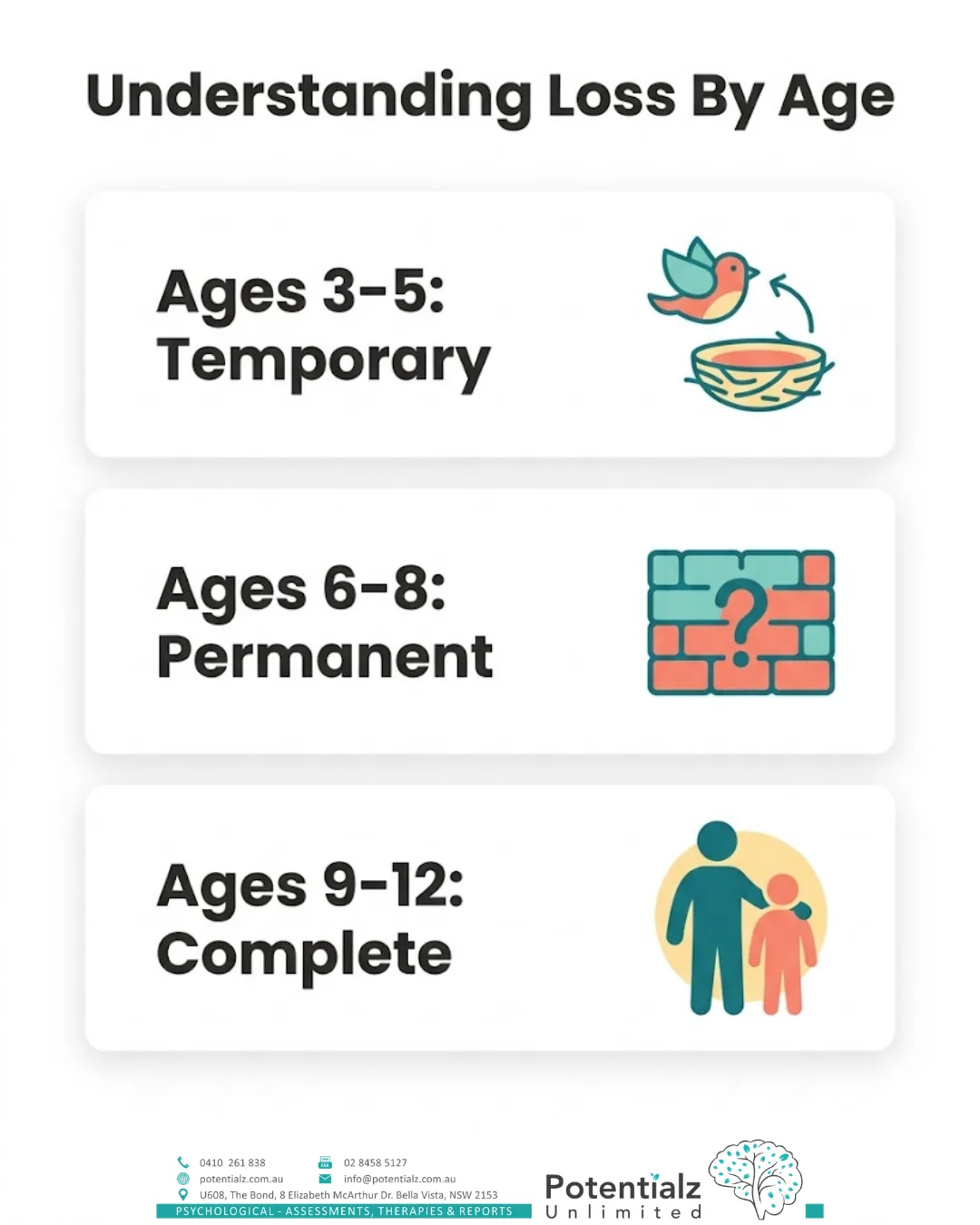
- Children aged 3–5 typically see death as temporary and reversible; children aged 6–8 begin to grasp permanence; children aged 9–12 understand death essentially as adults do.
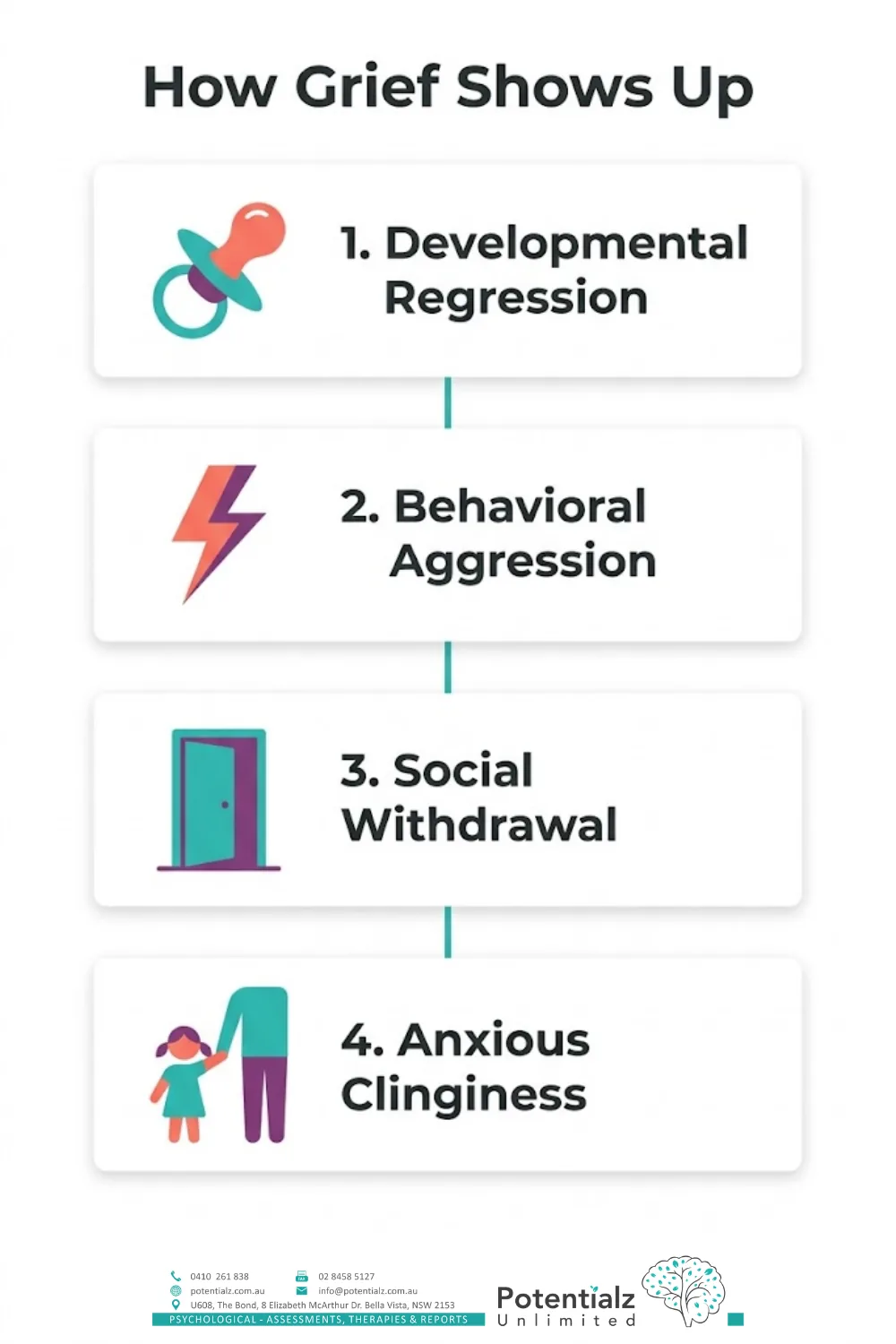
- Grief in children shows up as regression, aggression, withdrawal, school difficulties, anxiety, and changes in play themes.
- Excluding children from grief or using euphemisms often creates more confusion and difficulty, not less.
- Play therapy gives children a language for loss that does not require words — a safe, non-directive space where grief can be processed at the child’s own pace.
- Parent–Child Attachment Play supports the parent-child relationship through loss — strengthening one of the most important healing resources a grieving child has.
You watched your child at the funeral and you could not figure out what you were seeing. They were quiet for a while — and then they asked if they could have a biscuit. They seemed fine the next morning. And then three weeks later, at bedtime, they completely fell apart. They are asking questions you don’t know how to answer. Or they are asking nothing, which worries you even more. And you are trying to hold your own grief while also figuring out how to help them hold theirs.
Grief in children is one of the most bewildering things a parent can witness. Because children do not grieve the way we expect. They grieve in fragments — in and out, intense and then apparently fine, present and then seemingly somewhere far away. They may use play to process what they cannot say. They may use behaviour to express what they cannot feel. And the adults around them often do not know how to respond — partly because they are grieving too, and partly because children’s grief simply does not follow the patterns we have been taught to recognise.
This post is for every parent navigating loss alongside their child, wondering whether what they are seeing is normal, and looking for ways to genuinely help.
How Children Understand Death at Different Ages
One of the most important things for parents to understand about children’s grief is that children’s understanding of death is developmentally determined. What a three-year-old understands about death is entirely different from what a nine-year-old understands — and responding helpfully requires meeting the child at their developmental level.
Ages 3–5: Death as reversible and temporary
Very young children typically do not yet have the cognitive capacity to understand the permanence of death. They may understand that someone has “gone away,” but expect them to return. They may ask repeatedly where the person is, or when they are coming back. They may seem unbothered — playing normally — and then suddenly ask about the deceased in a matter-of-fact way that can feel jarring to adults.
This is not a sign that the child does not care. It is a sign that their brain is not yet able to fully grasp the concept of permanent absence. Children at this age are also highly attuned to the emotions of the adults around them — they may not understand death, but they can feel that something is deeply wrong, and this can manifest as increased clinginess, separation anxiety, or changes in sleep and appetite (Landreth, 2012).
Ages 6–8: Beginning to grasp permanence
By around age 6, most children are beginning to understand that death is permanent. They may also start to understand that death is universal — that it happens to everyone, including people they love, and including themselves. This realisation can be frightening, and children at this age may become anxious about the safety of their remaining caregivers, or about their own death.
Children in this age range often want factual information — they may ask detailed questions about what happens to a body, where the person is now, or what caused the death. This is healthy and normal. Honest, age-appropriate answers are almost always more helpful than avoidance or euphemism.
Ages 9–12: Understanding death as adults do
By the upper primary years, most children understand death in essentially the same way adults do — permanent, universal, and irreversible. They may experience grief that looks very similar to adult grief: sadness, anger, guilt, confusion, difficulty concentrating, social withdrawal, or physical symptoms.
Children in this age group often become very aware of how they are supposed to grieve, which can mean they perform “appropriate” grief in front of adults while actually struggling significantly in private. They may also feel enormous pressure to “be strong” for grieving parents — a role that is far too heavy for a child to carry.
How Grief Shows Up in Children’s Behaviour and Play
Because children — especially younger children — do not yet have the emotional vocabulary or the cognitive capacity to process grief in words, they process it primarily through behaviour and play. Recognising the signs of grief in a child’s behaviour is one of the most important tools a parent can have.
Grief in children can look like:
- Regression: returning to behaviours from an earlier developmental stage — bedwetting, baby talk, thumb-sucking, increased need for physical closeness
- Aggression: increased anger, irritability, fighting with siblings or peers, explosive reactions to small frustrations
- Withdrawal: becoming quieter, less engaged in activities they previously enjoyed, pulling back from friendships
- School difficulties: difficulty concentrating, forgetting things, declining grades, increased absences
- Physical symptoms: headaches, stomach aches, fatigue, changes in sleep or appetite
- Anxiety: increased worry about the safety of remaining family members, reluctance to separate from parents, fear of the dark or of dying
- Clingy or testing behaviour: alternating between needing closeness and pushing adults away — testing whether the attachment relationship is secure
In play, children’s grief often shows up as themes of loss, death, absence, and reunion. A child may repeatedly play scenarios where a character dies and comes back, or where something precious is lost and then found. They may create elaborate burial ceremonies for toys, or they may avoid any play theme that touches on loss. These are all forms of processing — the child’s inner world finding expression through the only language available to them. If you’d like to understand this more broadly, our post on big emotions in children and how play therapy helps explores how children express what they cannot yet say.
Why Adults Try to Protect Children from Grief
When a child they love is in pain, every adult instinct is to remove that pain. And when the source of that pain is something as devastating as death, the temptation to minimise, distract, or protect is enormous.
This shows up in many ways. Using euphemisms like “gone to sleep,” “passed on,” or “gone to a better place” to soften the reality of death. Telling children they are “fine” before they have had a chance to not be fine. Keeping children away from funerals, from adult tears, from the visible expressions of grief — in an effort to protect them from the weight of it.
These impulses come from love. But the research on children’s grief is consistent on one point: children who are excluded from grief, given inaccurate information about what has happened, or discouraged from expressing their own sadness, tend to have more difficulty integrating their loss in the long run (Worden, 2018).
Children are extraordinarily perceptive. They know when something important is being kept from them. And when the adults around them are performing “fine” while clearly not being fine, children learn that the truth of their experience — the confusion, the fear, the sadness — is not something they can bring to the adults they depend on.
The most protective thing adults can do for grieving children is to be honestly, age-appropriately present with them in the reality of what has happened.
How Play Therapy Gives Children a Language for Loss
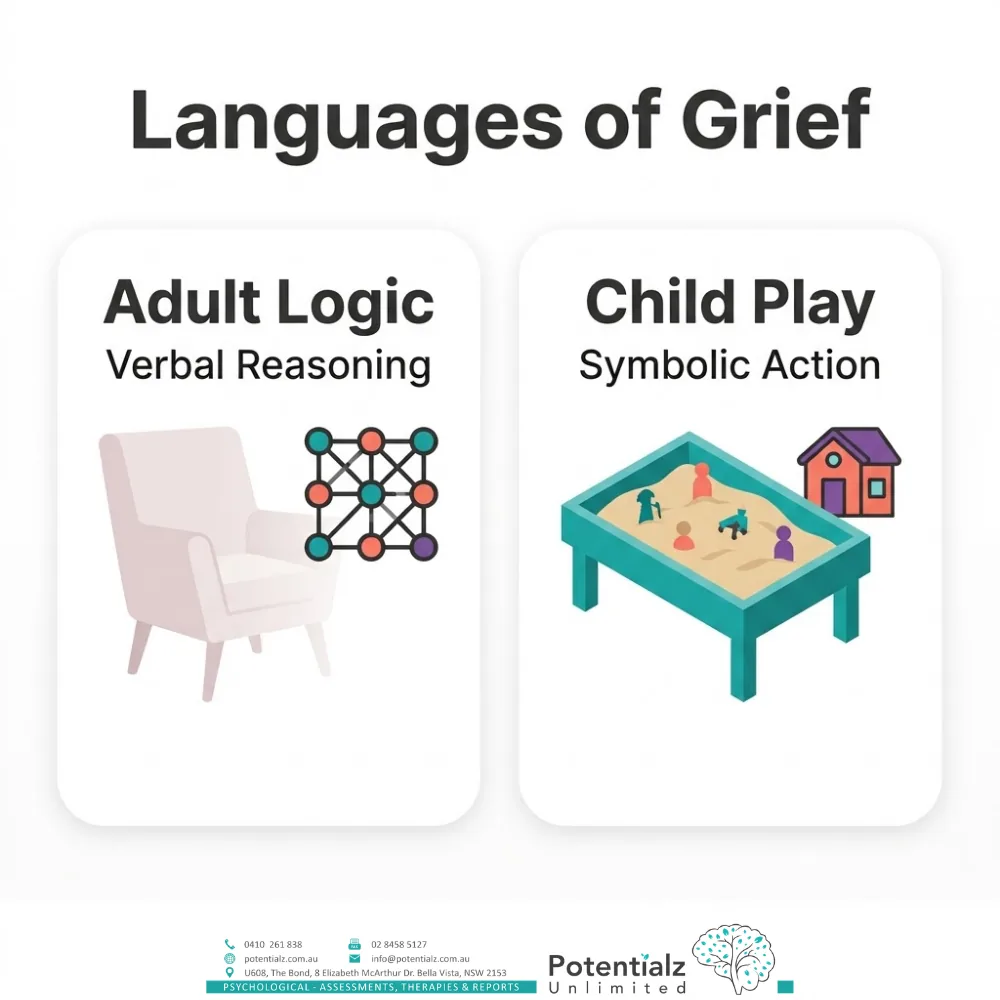
Because children process experience through play, play therapy is one of the most natural and supportive environments for helping children through grief. In play therapy, a child does not need to have words for what they are experiencing. They do not need to sit still and talk. They communicate through what they build, what they draw, the scenarios they create, and the figures they move through the sand.
The play therapy room contains materials specifically chosen to invite the expression of a full range of emotions and experiences. Sand trays allow children to create worlds and destroy them. Puppets and figurines allow them to voice feelings through characters. Art materials allow them to externalise inner states. Building materials allow them to create and demolish and rebuild — which is, in itself, a profound metaphor for the grief process (Ray, 2011). If you’re new to the approach, our overview of how play therapy works and why it helps children is a good place to start.
In sessions, I follow the child’s lead entirely. I do not introduce themes of death or loss. I do not interpret the child’s play to them or ask them to explain what they are doing. I simply remain with them — calm, present, and attuned — as the play unfolds. Over time, many children find ways to approach their loss in the play that they could not approach directly. They process it at their own pace, in their own way, in the medium that feels safest. This non-directive, attuned way of working is at the heart of Synergetic Play Therapy, one of the approaches I draw on.
This is not permissive or unstructured. It is deeply intentional. Every session builds on the one before it. And the relationship — the consistent, safe, predictable presence of a trusted adult who is genuinely attuned to this particular child — is itself a part of the healing.
Parent–Child Attachment Play: Supporting the Relationship Through Grief
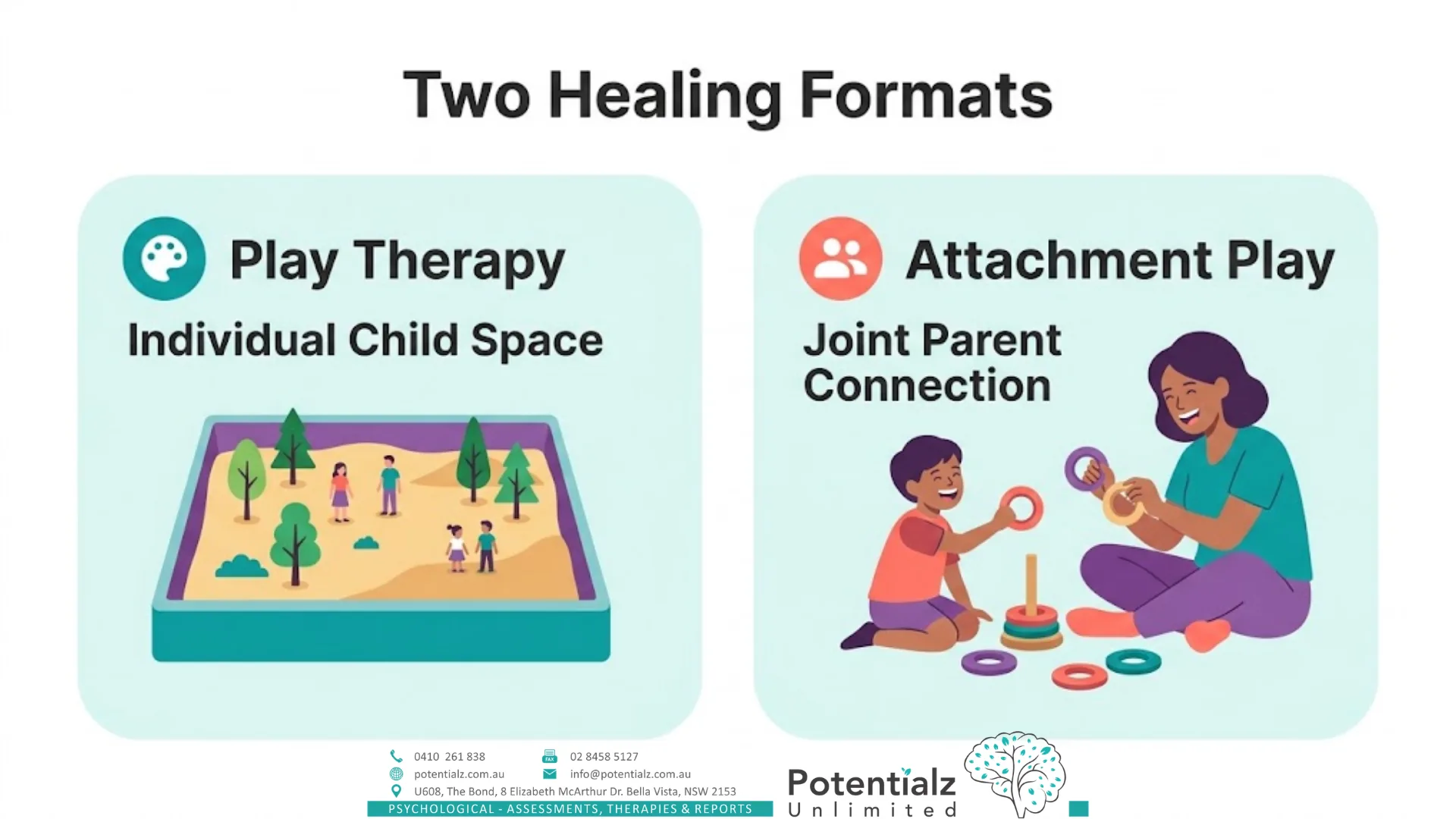
Grief does not only affect the child. It affects the family system. And one of the most significant things that can happen in a bereaved family is a disruption to the parent-child relationship — not because of any failure of love, but because grief places enormous demands on parents that can temporarily reduce their capacity for the kind of attentive, attuned presence their child needs.
Parent–Child Attachment Play is a therapeutic modality that I use specifically to support and strengthen the parent-child relationship during and after periods of stress, loss, or family disruption. In these sessions, the parent and child play together — under my guidance — in ways that are specifically designed to build safety, attunement, and connection between them. Our post on Parent–Child Attachment Play and rebuilding connection explains this modality in more depth.
These sessions are not about teaching parents how to play with their children. They are about creating the conditions for the kind of genuine, co-regulated, attentive play that tells a child: you matter, you are seen, you are safe, and I am here. For children who are grieving, this message — repeated consistently through embodied, playful connection — is one of the most healing things they can receive.
Parent–Child Attachment Play is particularly useful when:
- A parent’s own grief is making it difficult to be as present as they would like to be
- The bereaved parent is the primary caregiver and the relationship has become strained under the pressure of loss
- The child has become either very clingy or has begun to push the parent away
- The family is navigating a changed structure — a single-parent family following a death, a blended family after a loss, or a family where one parent is significantly more affected than the other
Loss is not the only change that shakes a family system. If your family is navigating other transitions alongside grief, our post on family change, divorce, separation, and new siblings covers how play therapy supports children through those shifts too.
What Parents Can Say and Do
Parents do not need to have all the answers to help their grieving child. They do need to be willing to stay in the conversation — even the uncomfortable, unanswerable parts of it.
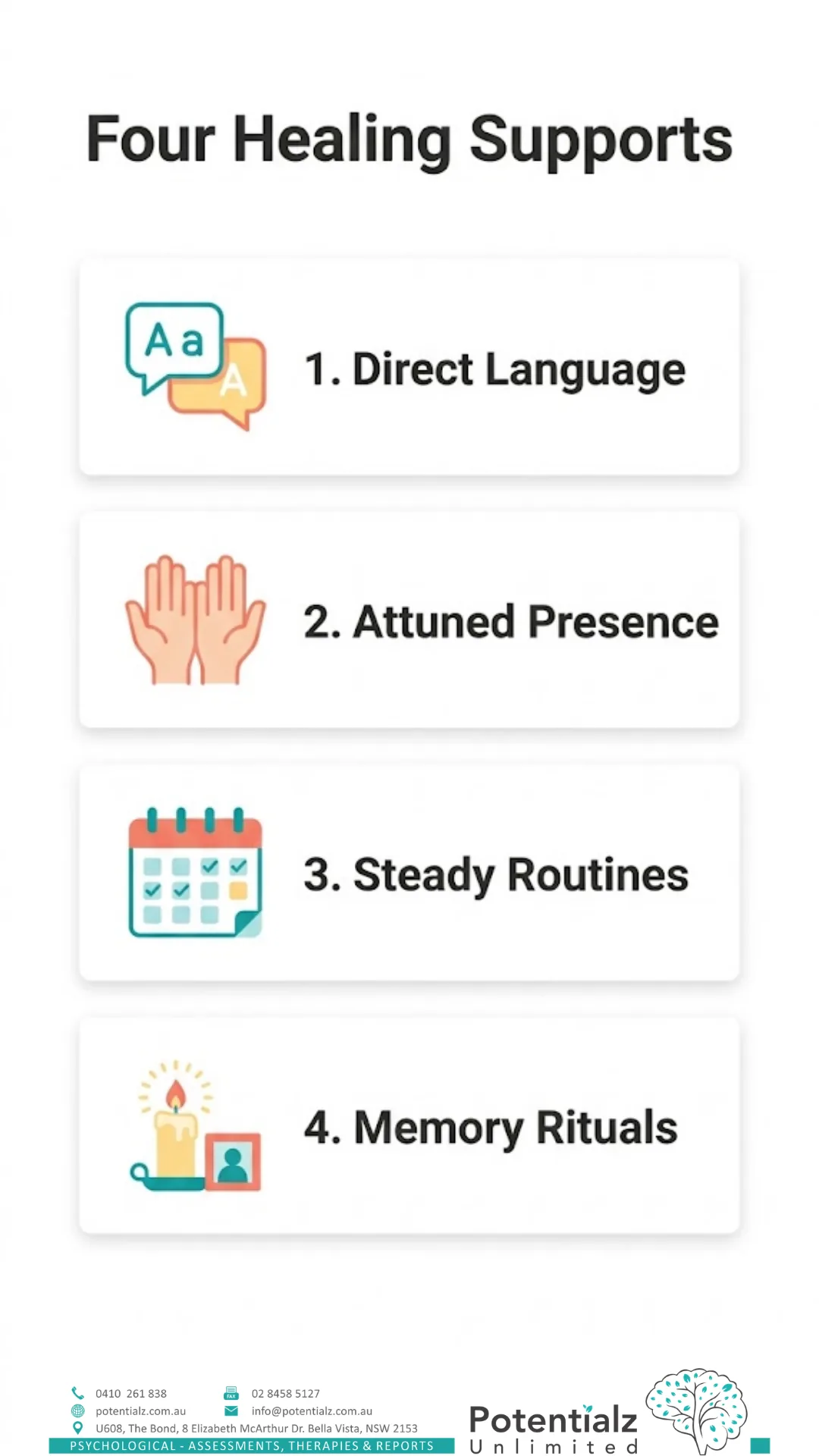
Use honest, direct language. Rather than “passed away” or “gone to sleep,” use the words “died” and “death.” Children need accurate information to make sense of what has happened. Euphemisms can confuse and frighten them more than the truth.
Answer questions honestly and at the child’s level. “We don’t know exactly what happens after we die, but we know that [person’s name] is not in pain anymore, and that we will always love them and remember them.” You do not need to have theological certainty to give a child something true and comforting.
Let children see your grief. You do not need to fall apart in front of your child. But allowing them to see that you are sad — and that you are managing it — teaches them that it is safe to be sad, and that grief is survivable. “Yes, I miss Grandpa too. I feel sad sometimes. And I’m okay.”
Keep routines as stable as possible. Routine provides predictability, which provides safety. In the weeks and months after a loss, maintaining consistent mealtimes, bedtimes, and school attendance helps a child’s nervous system feel anchored.
Create rituals of remembrance. Looking at photos together, talking about the person who died, lighting a candle on significant dates, visiting a grave or a meaningful place — these rituals give grief a container. They tell the child that it is okay to remember, and that remembering is a form of love.
Watch for signs that more support is needed. Most children move through grief with time and the support of caring adults. But some children develop more persistent difficulties — prolonged sleep disruption, significant withdrawal, or grief that does not seem to ease after several months. In these situations, professional support is worth seeking.
How Potentialz Can Help
At Potentialz Unlimited in Bella Vista, I work with children aged 3–12 who are navigating grief, loss, and bereavement. As a PTUK/PTSA accredited Practitioner in Therapeutic Play, I use child-centred therapeutic play, Synergetic Play Therapy, and Parent–Child Attachment Play to support children in processing loss at their own pace, in their own way.
I also work with parents — both in parent consultations and in Parent–Child Attachment Play sessions — to support the parent-child relationship during what is often one of the most demanding periods a family experiences.
You can learn more about our play therapy service in Bella Vista and about the wider clinical team on our our team page. If a psychologist-led assessment or therapy may be a better fit for your child’s needs, our child psychologist in Bella Vista page explains those options. NDIS self-managed and plan-managed families are welcome — please check current arrangements with reception when you book.
If your family has experienced a loss and you are not sure how best to support your child, please get in touch with our team. You do not have to navigate this alone.
Book a session online: live.potentialz.com.au Call us: 0410 261 838 Visit us: Unit 608, 8 Elizabeth Macarthur Drive, Bella Vista NSW 2153 Hours: Monday to Friday, 10am–7pm | Saturday and after-hours available | Telehealth via phone or Zoom
I’m Bhavini Ambaram, a Practitioner in Therapeutic Play at Potentialz Unlimited in Bella Vista. Grief is not something to fix. It is something to be with — and your child does not have to be with it alone.
Crisis Resources
If you or your child needs support right now, help is available 24/7:
- Lifeline: 13 11 14
- Kids Helpline (ages 5–25): 1800 55 1800
- Beyond Blue: 1300 22 4636
- Emergency: 000
If your child is in immediate danger or at risk of harm, call 000 or go to your nearest emergency department.
References
Landreth, G. L. (2012). Play therapy: The art of the relationship (3rd ed.). Routledge.
Luecken, L. J. (2008). Long-term consequences of parental death for children: Psychological and physiological manifestations. In M. S. Stroebe, R. O. Hansson, H. Schut, & W. Stroebe (Eds.), Handbook of bereavement research and practice: Advances in theory and intervention (pp. 397–416). American Psychological Association.
Ray, D. C. (2011). Advanced play therapy: Essential conditions, knowledge, and skills for child practice. Routledge.
Siegel, D. J., & Bryson, T. P. (2012). The whole-brain child: 12 revolutionary strategies to nurture your child’s developing mind. Delacorte Press.
Webb, N. B. (Ed.). (2010). Helping bereaved children: A handbook for practitioners (3rd ed.). Guilford Press.
Worden, J. W. (2018). Grief counseling and grief therapy: A handbook for the mental health practitioner (5th ed.). Springer.
Disclaimer
This information is general in nature and does not constitute clinical advice. Please consult a qualified health professional for advice about your individual circumstances. If you or your child is experiencing distress or a mental health crisis, contact your GP, call Lifeline on 13 11 14 or Kids Helpline on 1800 55 1800, or call 000 in an emergency.
Knowledge Check Quiz
Test what you have just read. Choose your answer for each question, then submit to reveal the answers and your score.
Need Professional Support?
If you're experiencing mental health concerns, our team is here to help.