You are navigating one of the biggest changes your family has ever faced. A separation. A new partner. A new baby arriving. A household that is reorganising itself, with new routines, new people, new rules, and perhaps two homes instead of one. You are doing your best to hold it together and to shield your child from the adult weight of what is happening. And yet something has shifted in your child. They are clingier than before, or more defiant. Sleep has become difficult. They are asking the same questions over and over. Or they have gone very quiet in a way that worries you.
Family change is one of the most common reasons children come to see our play therapist at Potentialz Unlimited. Not because parents have done something wrong — but because children feel the earthquake of family change through their nervous systems, and they need support to find their footing again. This post is for the parent who is going through change and wants to understand what their child is experiencing — and what will actually help.
Key Takeaways
- Family change — including separation, divorce, new partners, and new siblings — disrupts the predictability and security that children’s developing nervous systems depend on
- Children process change through behaviour and play, not conversation — and this processing is healthy, not concerning
- The most protective factor during family change is the quality and availability of the parent-child relationship
- Children need honest, age-appropriate information, consistent routines, and permission to have big feelings without protecting the adult from those feelings
- Play therapy provides a safe, non-directive space for children to process change at their own pace
- Parent–Child Attachment Play specifically supports and strengthens the parent-child relationship through periods of family transition
Why Family Change Is So Hard for Children
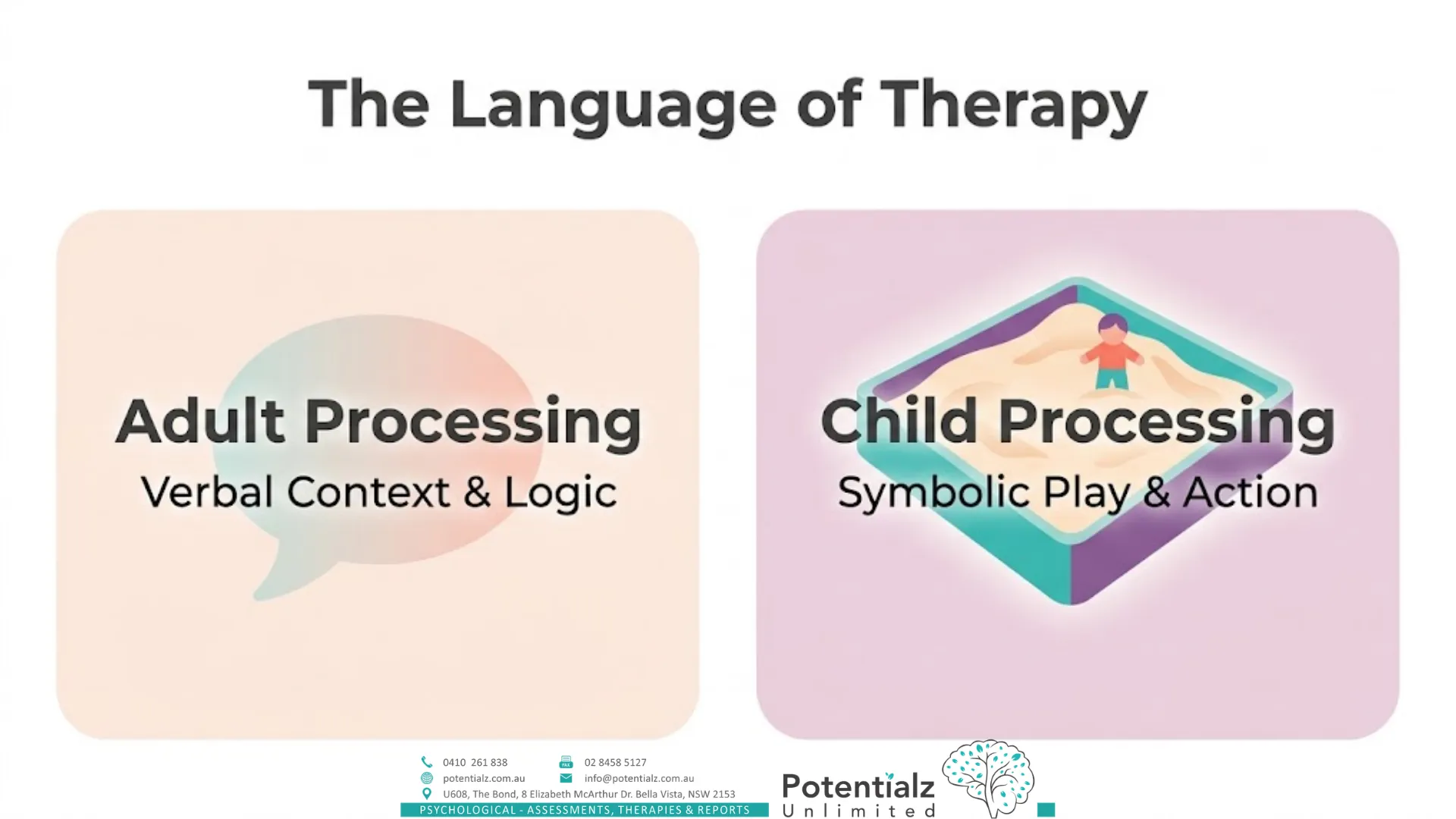
Adults navigating family change experience enormous complexity — legal, financial, emotional, relational. But adults have something children do not: a developed brain capable of understanding context, holding multiple perspectives, and reasoning about the future.
Children, particularly those under 10, are not able to do this. Their brain is still developing the very capacities needed to make sense of complex relational change. What they experience, instead, is a profound disruption to the predictability and security that their developing nervous system depends on (Siegel & Bryson, 2012).
A child’s sense of safety is built on constancy — consistent caregivers, familiar routines, predictable responses. When the family structure changes, that constancy is disrupted at its very foundation. The child may not have the language to say “I am frightened that my world is no longer reliable.” But their nervous system registers the disruption acutely, and the impact shows up in behaviour.
This is true whether the change is:
- Parental separation or divorce — two households, different routines, parents who may be distressed, a changed family identity
- A parent’s new relationship — a new adult in the home, potentially new children, shifting attention and family dynamics
- A new sibling — a new baby or a step-sibling, a dramatic shift in the child’s place in the family and in their claim on parental attention
Each of these changes requires a child to reorganise their internal model of their world — a genuinely demanding task for a developing brain.
What Children Need Most During Family Change
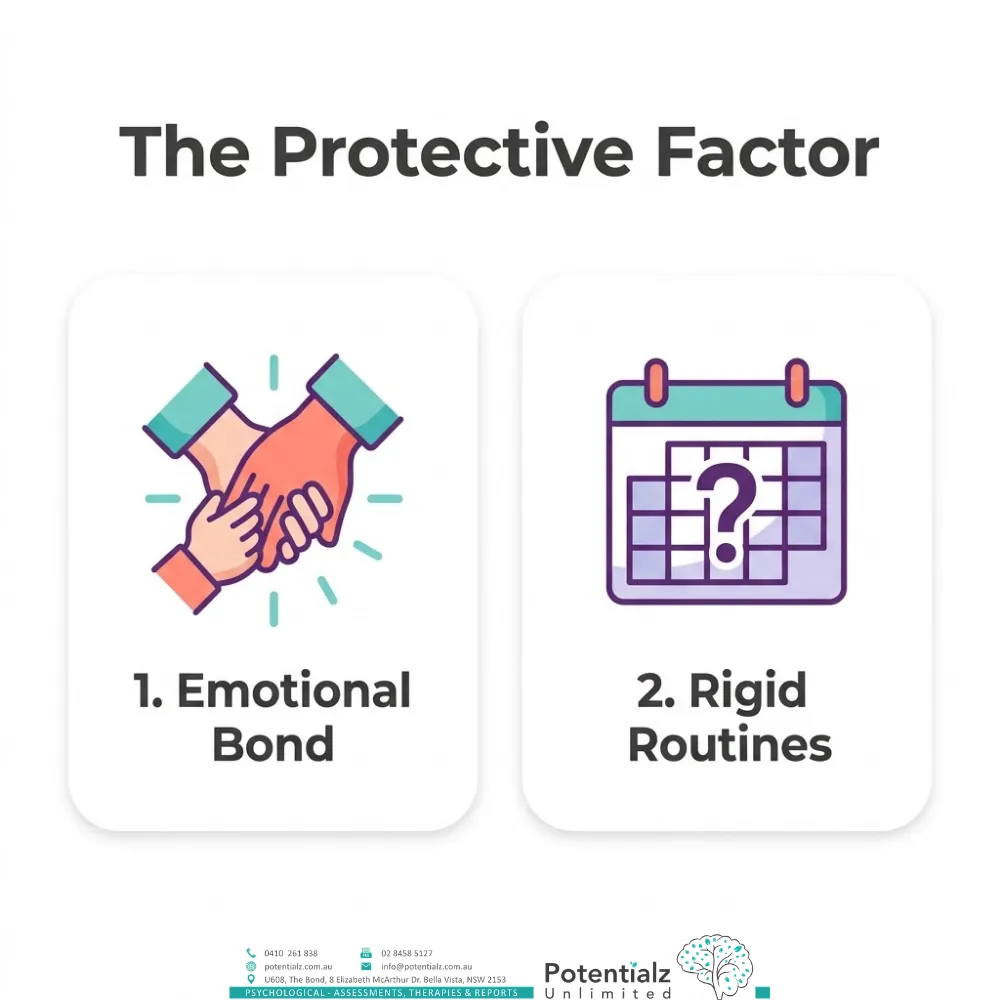
Research on children’s adjustment to family change is clear on one point: the single most protective factor is the quality of the parent-child relationship (Kelly & Emery, 2003). Children whose parents are able to remain emotionally available, warm, and consistent — even in the middle of enormous personal stress — fare significantly better than children whose parents become emotionally unavailable due to their own distress.
This is not about being perfect. It is not about hiding your own emotions. It is about maintaining enough connection that your child can still bring their feelings to you, and still feel that you are a safe base.
What children need during family change includes:
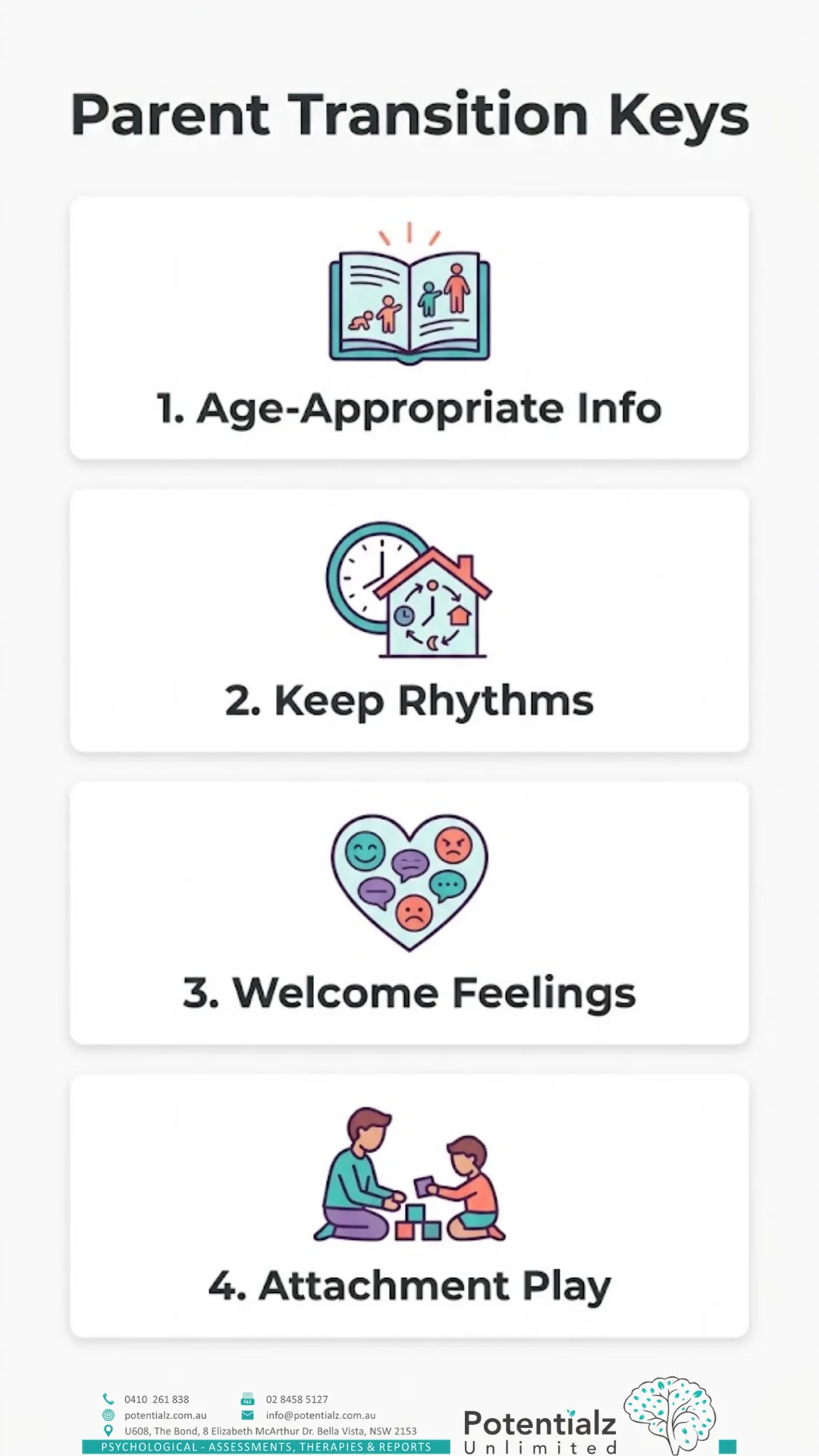
Honest, age-appropriate information. Children fill in gaps with imagination, and imagination is often worse than reality. Age-appropriate, honest explanations — “Dad and I have decided to live in different homes, but we both love you and nothing changes that” — are better than vague reassurances or silence.
Consistent routines. When the family structure is changing, keeping as much routine as possible — mealtimes, bedtimes, school mornings, weekend rhythms — gives the child’s nervous system something predictable to anchor to.
Permission to have big feelings. Children need to know it is okay to be sad, angry, confused, or scared. They need adults who can tolerate those feelings without shutting them down, or asking the child to protect the adult from them. When those feelings start to look like ongoing worry or fear, therapy for anxiety in children can help before the distress becomes entrenched.
Both parents spoken of with respect. Where possible — and it is not always possible — children benefit from knowing that both their parents are okay, and that they do not have to choose sides or hide how they feel about either parent.
How Children of Different Ages Experience Family Change
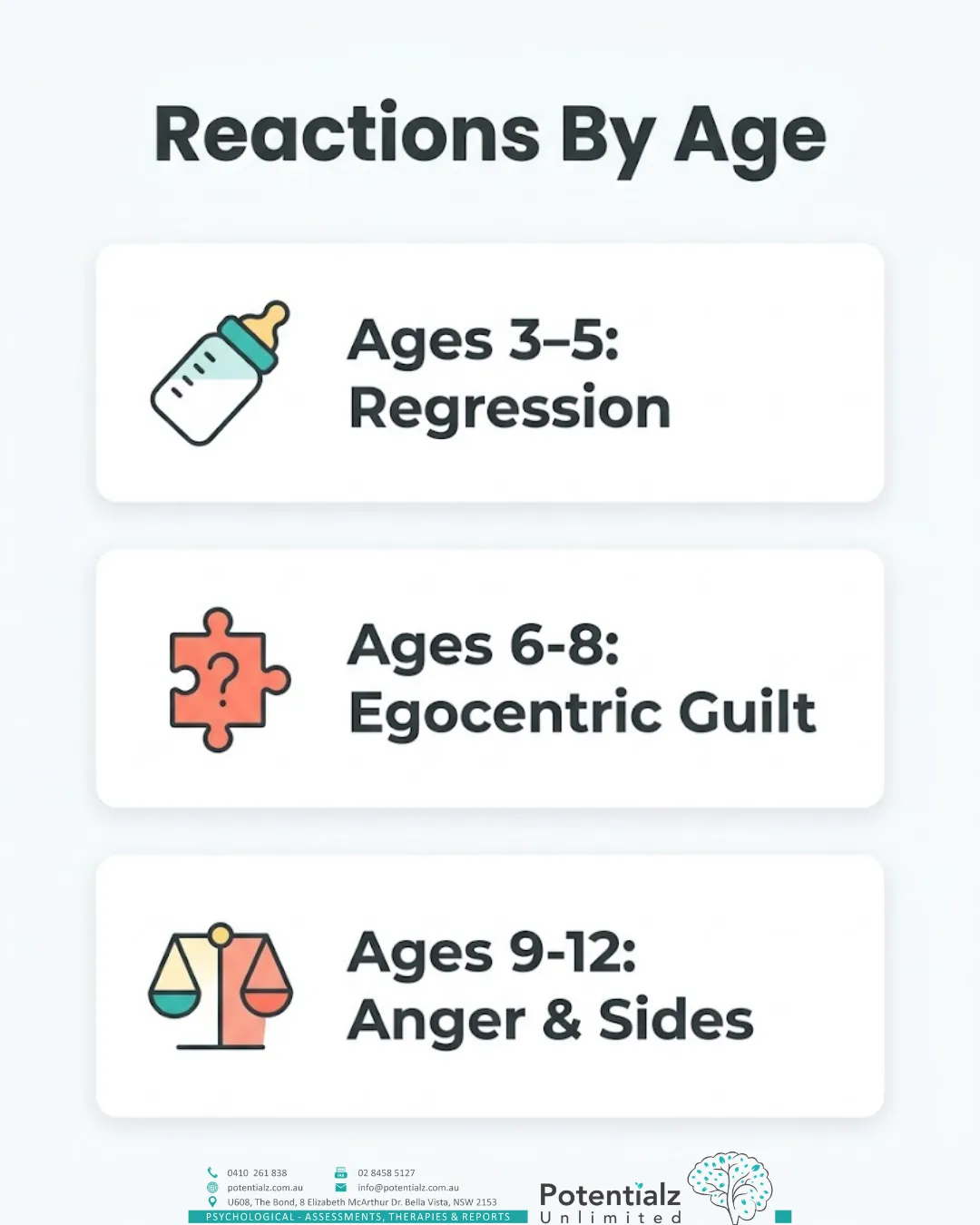
Ages 3–5: Very young children may not understand the concept of divorce, separation, or even a new sibling arriving. What they understand is change — and change in routine, in who is present, and in the emotional atmosphere of the home. They may become clingy, regress to earlier behaviours (bedwetting, thumb-sucking, baby talk), have tantrums more frequently, or develop separation anxiety. They are not manipulating — their nervous system is responding to perceived threat.
Ages 6–8: Children in this age group are beginning to understand the permanence of change. They may feel responsible for the family change — a belief that something they did caused the separation, or that they are somehow responsible for fixing it. They may become very focused on fairness (“Why does she get more time at Mum’s?”), or they may become the family “helper” — trying to care for the distressed adult. This is too much for a child to carry.
Ages 9–12: Older children often become more aware of the adult dynamics and may form strong opinions, take sides, or become angry with one or both parents. They may withdraw, become secretive, or seek more time with peers. Pre-teens navigating family change alongside the ordinary challenges of early adolescence are carrying a significant load.
How Children Process Change Through Play
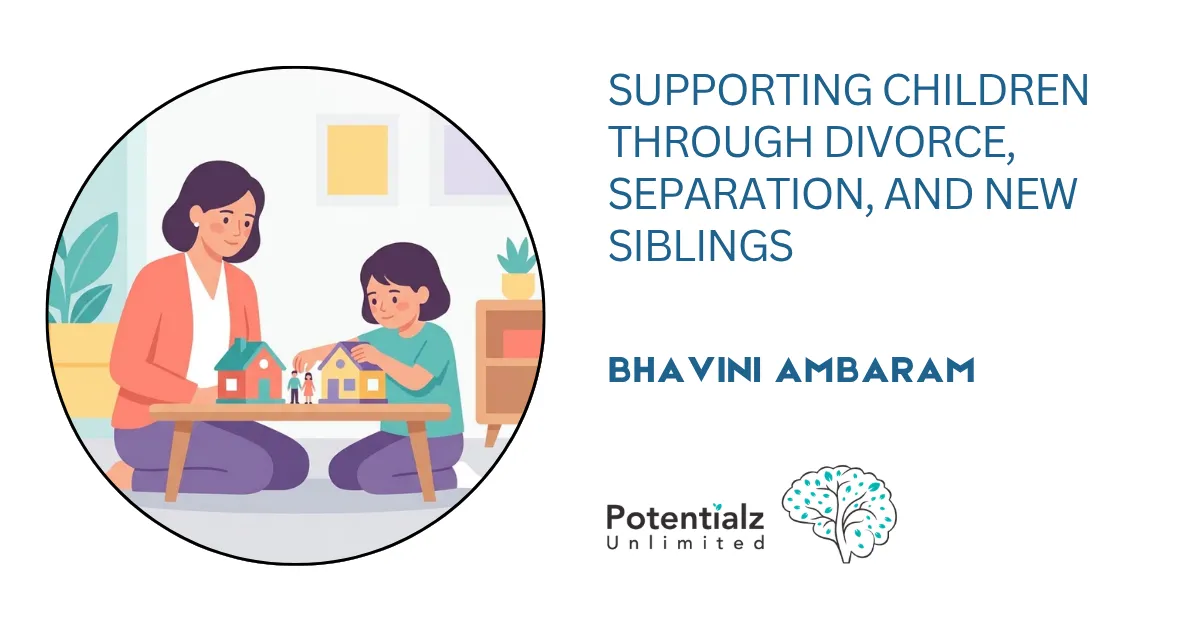
Children do not process change through conversation. They process it through play — through the scenarios they create, the figures they move, the worlds they build and destroy and rebuild. When a child’s family structure is changing, you will often see that change reflected in their play: family figures being rearranged, two houses being built, a baby figure being ignored or treated roughly, scenarios of loss and reunion playing out repeatedly.
This is not disturbing — it is healthy. It is the child’s psyche doing exactly what it is supposed to do: externalising the internal, finding a manageable language for what is too big to say.
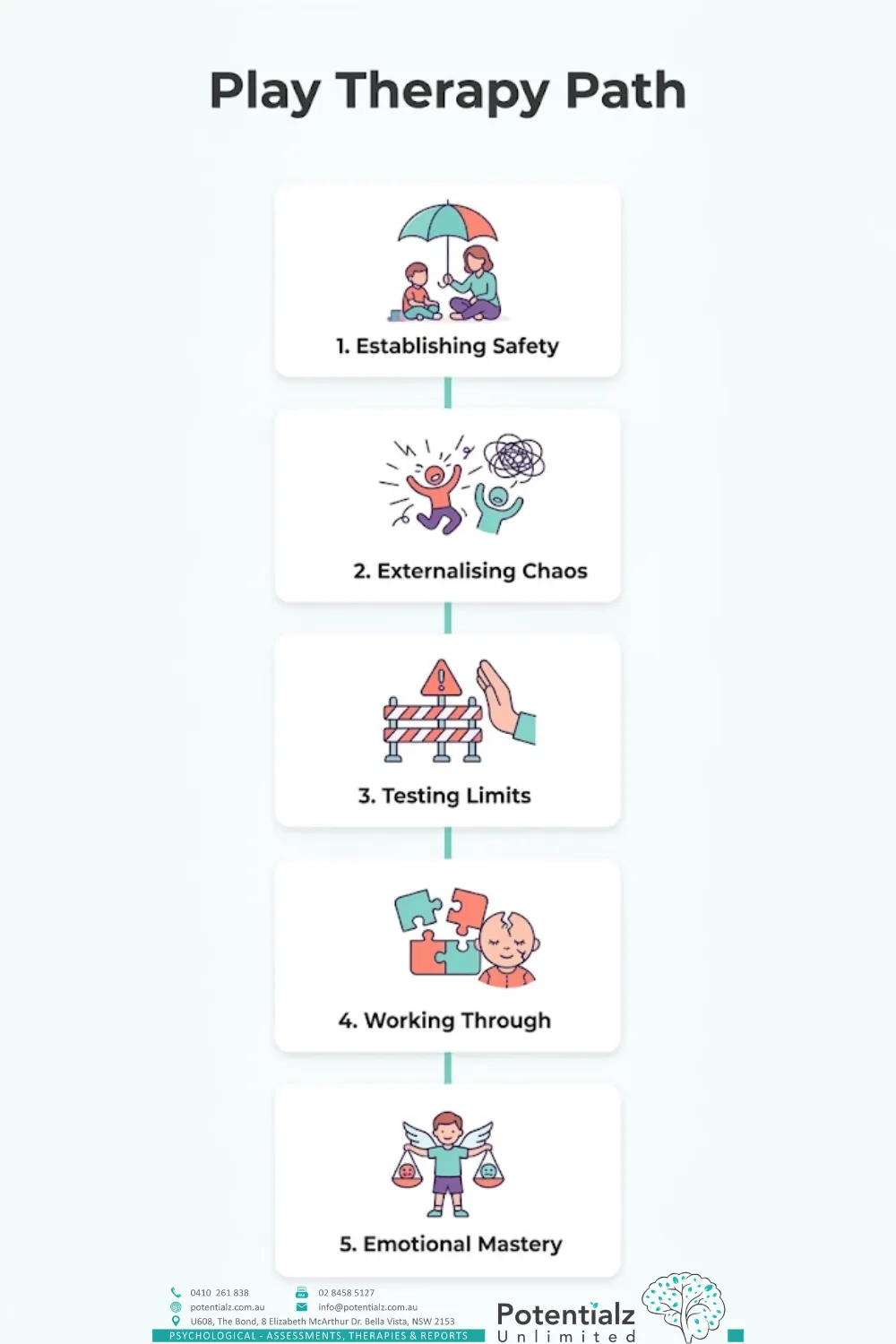
In play therapy, our play therapist creates a space where this processing can happen safely and with attuned presence. The child leads the play. The therapist does not direct, interrupt, or interpret — they stay present, reflect, and offer the relational containment that makes it safe for the child to approach even the most difficult themes.
Over the course of therapy, children’s play often shows a characteristic shift: early themes of chaos, loss, or conflict gradually give way to themes of resolution, stability, and mastery. The child is working something through — and the play is the vehicle.
Parent–Child Attachment Play: Rebuilding Connection Through Change
One of the most significant casualties of family change is often the parent-child relationship itself. Not because parents stop loving their children — but because the emotional demands of navigating separation, new relationships, and family reorganisation can temporarily reduce a parent’s capacity for the kind of warm, attuned, playful presence their child needs.
Parent–Child Attachment Play is a specific therapeutic modality our practice uses to support and strengthen the parent-child relationship through change. In these sessions, our play therapist guides parents and children through play experiences specifically designed to reinforce attunement, safety, and connection — the building blocks of secure attachment. Helping children name and move through big feelings is often part of this same work.
These sessions are valuable for both parents, not just the parent the child lives with primarily. Children need to feel securely attached to both parents where possible — and Parent–Child Attachment Play can help a parent who has been feeling disconnected, guilty, or uncertain about how to reconnect with their child.
A Note on New Siblings
The arrival of a new sibling — whether a biological baby or a step-sibling through a parent’s new relationship — is its own particular kind of family change. For the child who has been the only, or the eldest, or who has had a particular place in the family structure, a new sibling represents a shift in identity and a real or perceived reduction in parental attention.
Regression is extremely common: older children may suddenly want a bottle, ask to be carried, or start speaking in baby talk. This is not manipulation. It is the child’s nervous system seeking the kind of care and attention the baby is receiving, as a way of testing that their place in the family is still secure.
The most helpful response to regression is warmth and patience, not correction. The child needs to know that their place is not threatened. Where possible, maintaining one-on-one time with each parent is one of the most protective things parents can do during the adjustment period.
How Potentialz Can Help
At Potentialz Unlimited in Bella Vista, our play therapist works with children aged 3–12 navigating family change — including parental separation, divorce, step-family formation, and the arrival of new siblings. The practice uses child-centred therapeutic play, Synergetic Play Therapy, and Parent–Child Attachment Play to support children through transition. If you are weighing up the right kind of support, our guide to play therapy versus child psychology explains the difference.
We offer individual sessions with your child and parent consultations, and Parent–Child Attachment Play for one or both parents where this is appropriate.
- Initial consultation: $250
- Play therapy sessions: $190 per session
- Package discounts available for upfront payment
- NDIS self-managed plans accepted
Book a session online: live.potentialz.com.au Call us: 0410 261 838 Visit us: Unit 608, 8 Elizabeth Macarthur Drive, Bella Vista NSW 2153 Hours: Monday to Friday, 10am–7pm | Saturday and after-hours available | Telehealth via phone or Zoom
References
Kelly, J. B., & Emery, R. E. (2003). Children’s adjustment following divorce: Risk and resilience perspectives. Family Relations, 52(4), 352–362. https://doi.org/10.1111/j.1741-3729.2003.00352.x
Landreth, G. L. (2012). Play therapy: The art of the relationship (3rd ed.). Routledge.
Siegel, D. J., & Bryson, T. P. (2012). The whole-brain child: 12 revolutionary strategies to nurture your child’s developing mind. Delacorte Press.
Wallerstein, J. S., Lewis, J. M., & Blakeslee, S. (2000). The unexpected legacy of divorce: A 25-year landmark study. Hyperion.
Disclaimer: This article is a Potentialz Unlimited editorial piece drawing on our clinical team’s experience. It is for general education and information only, not clinical advice for your particular child. Potentialz Unlimited is a psychology practice based in Bella Vista NSW; our clinical team includes Registered Psychologists and a Clinical Psychologist (registered with AHPRA) and an accredited Play Therapist. Please consult a qualified health professional for your individual circumstances. If your child is experiencing a mental health crisis, contact your GP, call Kids Helpline on 1800 55 1800, or go to your nearest emergency department.
Crisis Resources: If you or someone you know needs support, please contact Lifeline on 13 11 14, Beyond Blue on 1300 22 4636, or Kids Helpline on 1800 55 1800.
Related Reading
Knowledge Check Quiz
Test what you have just read. Choose your answer for each question, then submit to reveal the answers and your score.
Need Professional Support?
If you're experiencing mental health concerns, our team is here to help.