Key Takeaways
- Grief is not purely a psychological process — it lives in the body through physical symptoms including chest heaviness, fatigue, and somatic pain.
- Loss takes many forms beyond death: relationship endings, migration, identity loss, health decline, and the loss of the life you expected.
- The stages model of grief, while widely known, has significant limitations — grief rarely follows a sequential or predictable path.
- Holistic counselling addresses grief at every level: body practices, meditation, spiritual meaning-making, and narrative processing in counselling.
- South Indian and Indian cultural traditions hold specific rituals and expressions of grief that deserve acknowledgement and respect in any counselling approach.
- When grief becomes complicated, professional support is essential — grief counselling creates space for what cannot be rushed.
- If you are in grief-related crisis, Lifeline is available on 13 11 14 and Grief Australia’s resources are at grief.org.au.
Grief doesn’t follow a timeline. And it certainly doesn’t follow the rules.
You can think you’re coping — and then a song comes on in the car, or you reach for the phone to call someone who’s no longer there, and suddenly you’re undone. Or you’re in the supermarket of all places, and it hits you. Out of nowhere. With no warning.
That’s not weakness. That’s what grief actually is.
It’s not tidy. It doesn’t move in one direction. And it doesn’t live only in your thoughts and feelings — it lives in your body too. In the weight in your chest. In the exhaustion that sleep doesn’t touch. In the way your throat closes when you try to speak about what you’ve lost.
This post takes grief seriously — as the full-body, full-person experience it really is. And it explores a holistic approach to healing that goes beyond talking alone.
Grief Is More Than a Psychological Process
We often think of grief as something happening in the mind — the memories, the thoughts, the slow and difficult work of adjusting to a world that’s been altered. That’s real and important.
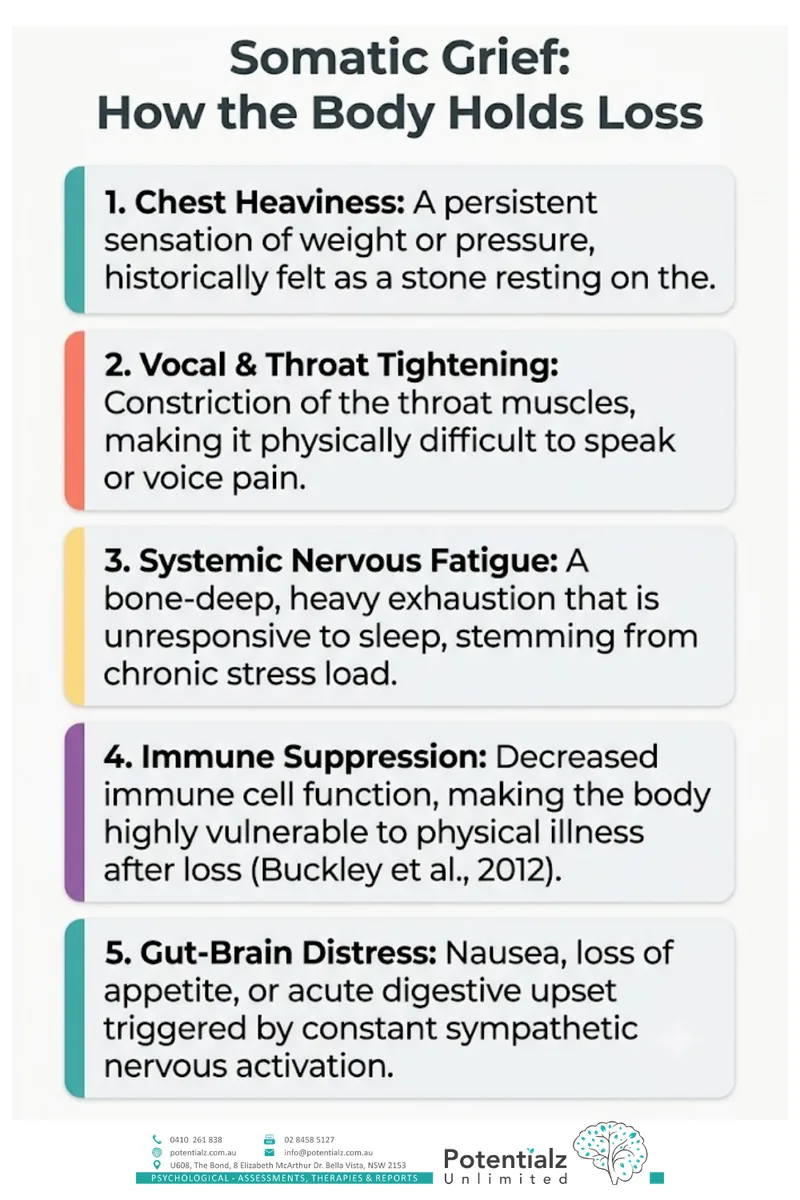
But grief also lives in the body. Research on bereavement has increasingly confirmed what ancient healing traditions always understood: the body grieves alongside the mind. And the physical dimension of grief can persist long after the emotional processing appears complete.
Common physical expressions of grief include:
- Weight in the chest — a sense of heaviness or pressure that many people describe as “a stone on my chest” or “something pressing on my heart”
- Throat tightening — the urge to cry that gets caught in the throat; difficulty speaking about the loss
- Fatigue — a heavy, bone-deep exhaustion that is disproportionate to what you’ve been doing and doesn’t resolve with rest
- Somatic pain — headaches, back pain, and generalised physical aching without a clear cause
- Immune suppression — increased vulnerability to illness in the months following a significant loss, consistent with research on the relationship between grief and immune function (Buckley et al., 2012)
- Gastrointestinal disturbance — nausea, loss of appetite, or digestive upset as the gut responds to the nervous system’s distress
- Hyperarousal and disrupted sleep — difficulty settling, night waking, or disrupted dream states as the nervous system processes what it cannot fully integrate while awake
This is not “all in your head.” It is the body’s genuine, biologically grounded response to loss. And it deserves to be addressed directly — not only through words, but through practices that work at the level of the body itself.
The Many Faces of Loss
When people hear the word grief, they think of bereavement — the death of someone loved. And death loss is one of the most profound things a human being can go through.
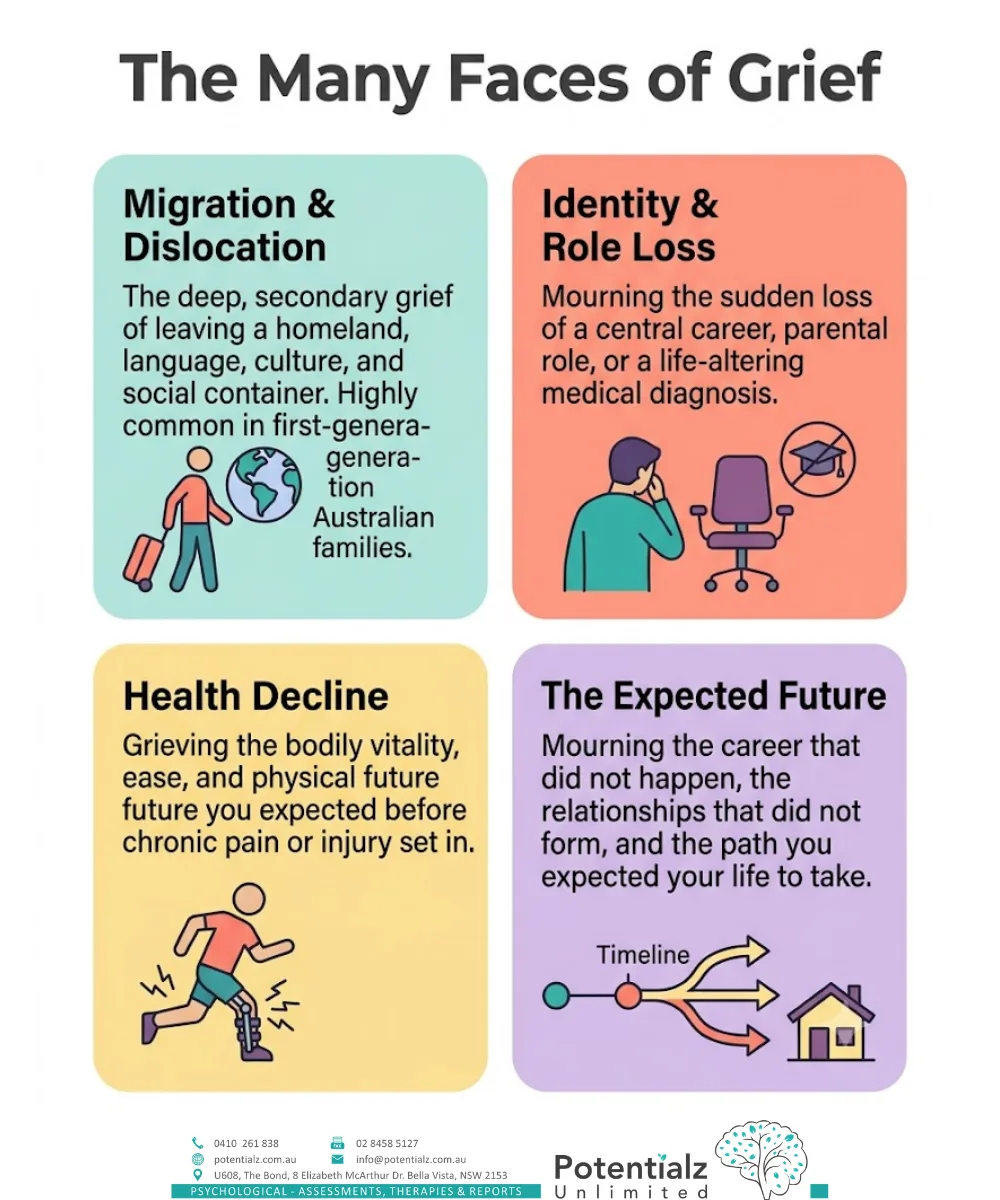
But grief is not limited to death. We grieve many kinds of loss. And one of the reasons people find themselves struggling without understanding why is that they haven’t recognised their experience as grief.
Types of loss that carry grief:
- Death of a loved one — including sudden, traumatic, or anticipated death, each of which carries its own texture
- Relationship ending — the end of a marriage or long partnership, the estrangement of a child, the loss of a close friendship
- Migration and cultural dislocation — the grief of leaving a homeland, a language, a community, a way of life. This is particularly significant for first-generation migrants and refugee communities
- Identity loss — the grief of a diagnosis that changes how you understand yourself; the loss of a role — professional, parental, athletic — that has been central to who you are
- Health decline — grief for the body you had before illness, injury, or chronic condition; grief for the future you expected
- Pregnancy loss — miscarriage, stillbirth, and the grief that is often carried in silence because those around the bereaved don’t quite know how to acknowledge it
- Loss of the expected future — the career that didn’t happen, the relationship that didn’t come, the life that took a different shape than you had planned
Each of these carries its own weight. Each deserves to be taken seriously.
The Limits of the Stages Model
Most people have heard of the stages of grief — denial, anger, bargaining, depression, acceptance — originally described by psychiatrist Elisabeth Kübler-Ross in her 1969 book On Death and Dying. They were based on her work with terminally ill patients and were never meant to be a prescriptive map for how grief should progress.
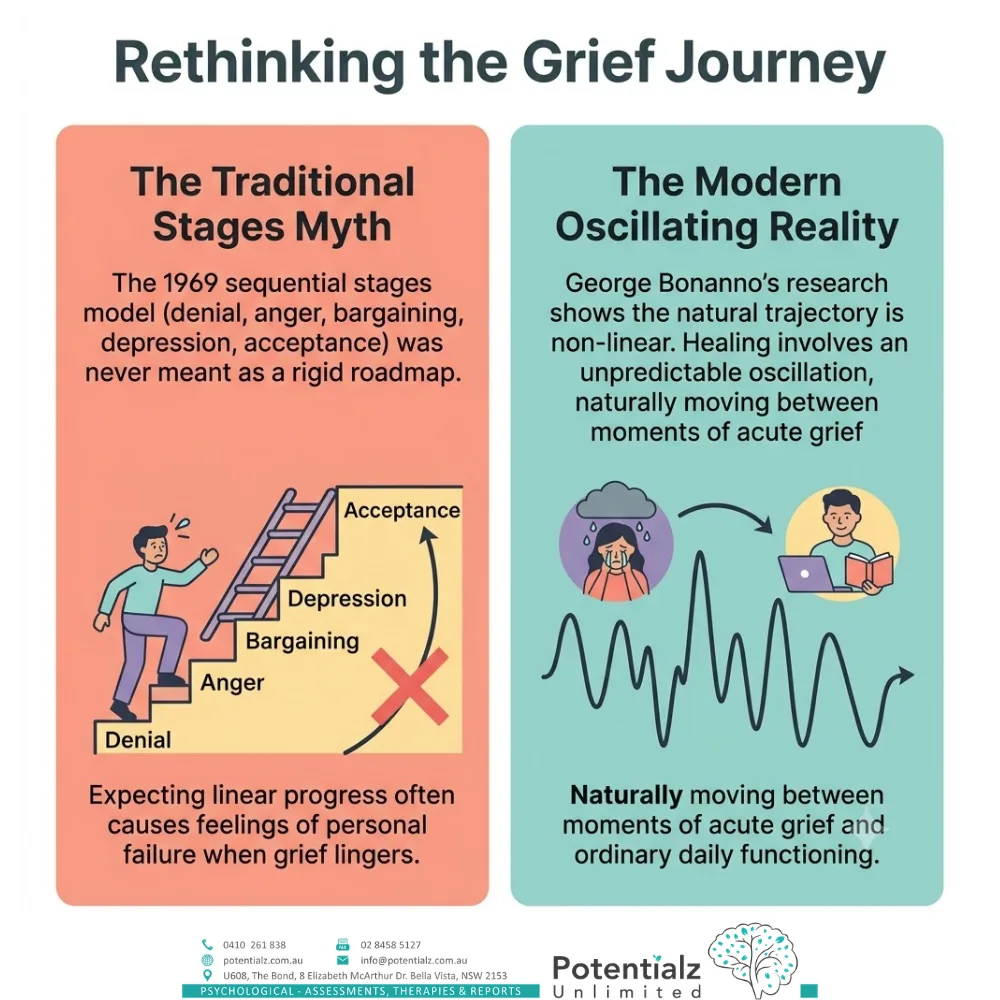
But that’s often how they get applied. Creating the idea that grief should follow a sequence. That acceptance is the destination. That lingering in any stage represents failure to move on.
Contemporary grief researchers have largely moved away from this model. George Bonanno’s research found that the most common trajectory after significant loss is not extended, sequential stage-based grieving — it’s more oscillating. Moving between acute grief and ordinary functioning in a way that can be unpredictable and nonlinear (Bonanno, 2004).
William Worden offered a more useful alternative — a tasks model. Grief involves the active tasks of accepting the reality of the loss, processing the pain, adjusting to a changed world, and finding a way to stay connected to what has been lost while still engaging in life (Worden, 2009).
The most important thing to understand is this: there is no correct way to grieve. No correct timeline. No correct outcome. Grief is as individual as the person experiencing it and as unique as the relationship that was lost.
How Holistic Counselling Addresses Grief Differently
Holistic grief counselling doesn’t replace the essential work of narrative processing — the telling of the story, the naming of what has been lost, the making of meaning in the aftermath. But it adds dimensions that are often missing from purely talk-based approaches.
Body Practices: Gentle Yoga for Grief
Yoga for grief — distinct from fitness or performance-oriented yoga — works with what the body is holding directly. Because grief is often stored in the chest and throat (the areas most associated with the heart chakra and emotional expression in yogic and Ayurvedic frameworks), specific postures that gently open these areas can support a release that words cannot reach.
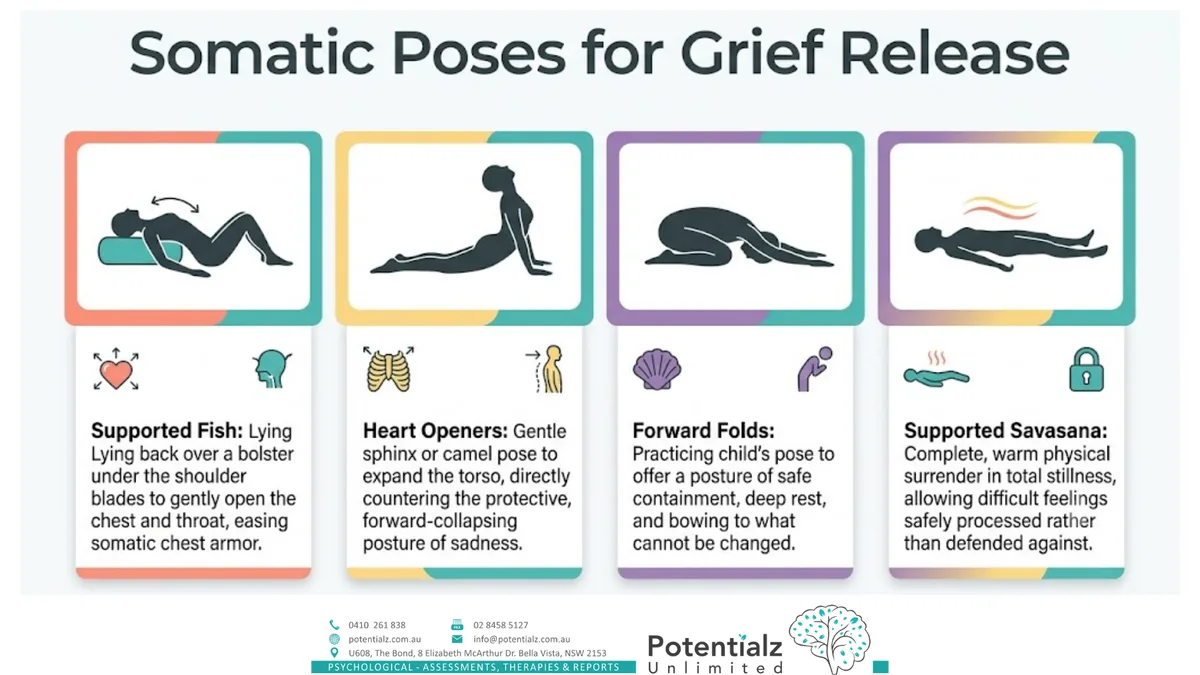
Useful practices include:
- Supported fish pose (Matsyasana with bolster): Lying back over a bolster placed across the shoulder blades, arms open, chest lifted. This posture gently opens the chest and throat and can evoke powerful emotional release in people carrying grief in these areas.
- Heart openers (gentle backbends): Supported sphinx, camel with hands on hips, or chair backbend — gentle backward opening that counters the forward-collapsing posture of grief and creates space for the breath.
- Forward folds (Uttanasana, child’s pose): The forward fold can also be deeply supportive in grief — it offers a posture of humility, of rest, of bowing to what cannot be changed.
- Supported savasana with eye pillow: Lying in total stillness, completely supported, with warmth — this posture of complete surrender can create conditions for grief to be felt rather than defended against.
These practices are done slowly, with breath awareness, without performance goals, and with the explicit permission to feel whatever arises.
Breathwork for the Grief in the Chest and Throat
Many people grieving find that full, deep breaths are difficult — as if the grief is occupying the space that breath needs. The chest feels constricted. The throat closes.
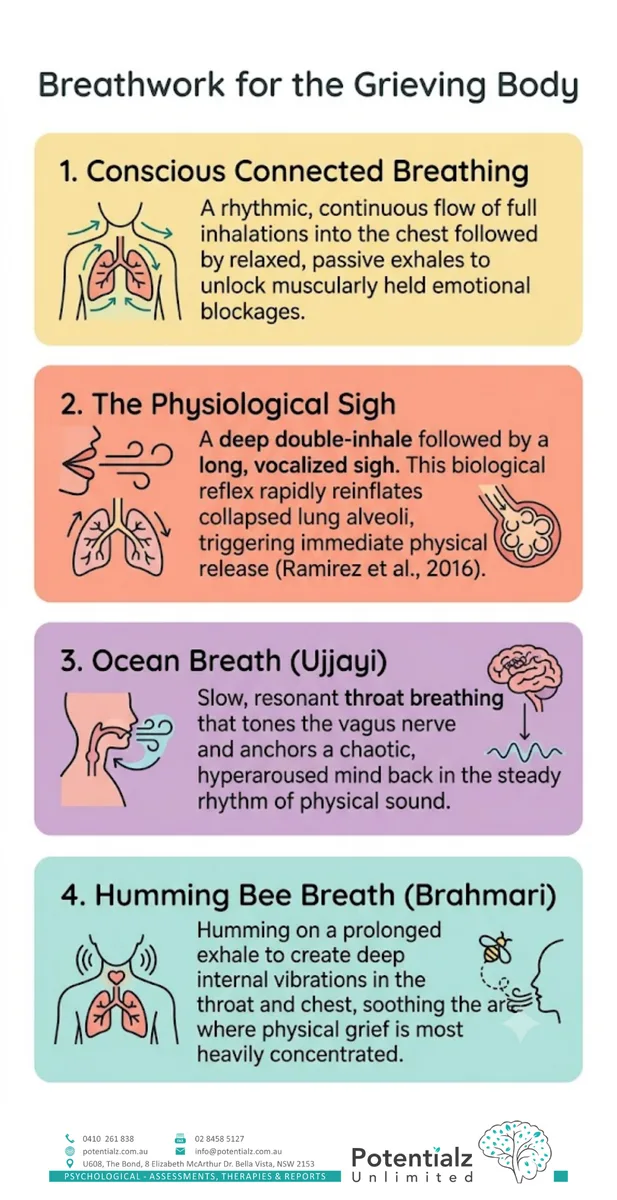
Breathwork practices that support grief include:
- Conscious connected breathing — a practice of full inhalation into the chest followed by a passive, relaxed exhale, repeated in a rhythmic cycle that can produce the release of emotional material held in the body
- Sighing exhale — the simplest and perhaps most natural breath for grief: a full inhale followed by a long, audible sigh. Research by Ramirez et al. (2016) found that physiological sighs are the body’s way of reinflating collapsed alveoli in the lungs — a real physical function connected to the sensation of emotional release
- Ocean breath (ujjayi) during movement — combining this breath with gentle yoga movement produces an internal sound that many people find deeply calming and supportive when words feel inadequate
- Brahmari (humming bee breath) — humming on the exhale activates the vagus nerve and creates internal vibration in the chest and throat, directly addressing the areas where grief is most physically held
Meditation for Sitting With Pain Without Escaping
One of the hardest things grief asks of us is to sit with pain without immediately moving to escape it — through distraction, numbing, busyness, or a rush toward positivity.
Mindfulness meditation cultivates exactly this capacity. It trains us to observe experience — including painful experience — without immediately reacting. In the context of grief, this means being able to sit with the weight of loss, to notice it in the body and the mind, to allow it to exist without collapsing into it or fighting it.
Loving-kindness meditation (metta) has particular relevance in grief — both as a way of directing compassion toward yourself during a painful time, and as a way of maintaining connection with the person or thing that has been lost. Sending loving-kindness to someone who has died — imagining them at peace, wishing them well — can support healthy grief processing and reduce complicated grief symptoms.
Spiritual Meaning-Making
For those who hold spiritual beliefs — whether from a religious tradition, a personal spiritual framework, or a broader sense of connection to something larger than the self — the spiritual dimension of grief is often deeply significant. And it’s too rarely addressed in secular counselling approaches.
The existential questions that grief surfaces — Why? What happens after death? Did their life have meaning? Does mine? — are genuinely spiritual questions, and they deserve space rather than deflection.
My philosophy of non-violence and awareness-based living, and my deep familiarity with Indian philosophical traditions — including the Vedantic concept of the immortality of consciousness — inform a counselling approach that can engage with these questions honestly and with genuine respect for whatever framework the client holds. I will never impose any particular belief. But I won’t avoid these questions either.
Narrative Processing in Counselling
The talking dimension of grief counselling — the telling of the story, the naming of what was loved and what was lost — remains essential. It is in the telling that grief is witnessed. And being genuinely witnessed in grief — having your loss taken seriously and your pain seen — is one of the most powerful therapeutic experiences there is.
Counselling also supports the work of meaning-making: finding a way to integrate the loss into a revised understanding of yourself and your world, and discovering what continues to matter in the aftermath.
Cultural Expressions of Grief in Indian and South Indian Communities
Grief is expressed differently across cultures. These differences aren’t superficial — they reflect fundamentally different understandings of what loss means, how it should be marked, and what healing looks like.
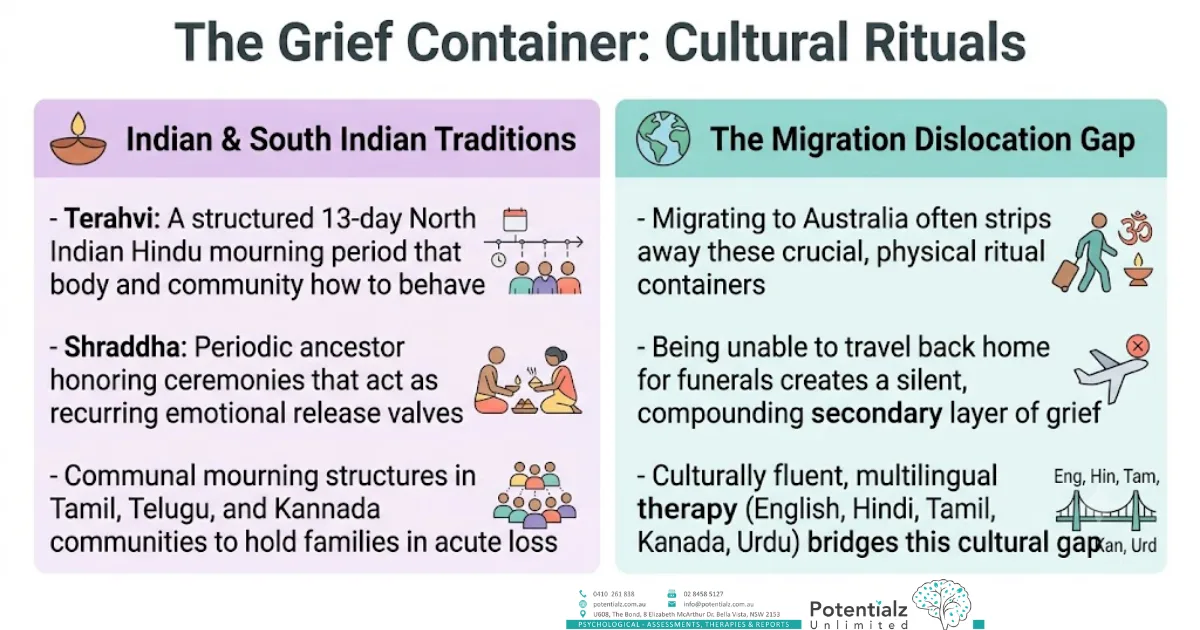
In Indian and South Indian communities, grief is often expressed within specific ritual frameworks that serve important psychological and communal functions. Rituals such as the 13-day mourning period (terahvi) in some North Indian Hindu traditions, the rituals of shraddha (honouring deceased ancestors), and the particular communal mourning practices of South Indian Tamil, Telugu, and Kannada communities provide a structured container for grief — a shared practice that tells the bereaved what to do with their body, their time, and their community during the acute phase of loss.
When these rituals are unavailable — as they often are for migrants who lose family members in India and cannot travel, or who grieve in an Australian context without access to the community structures that would normally surround them — the loss of the ritual container itself becomes an additional layer of grief.
I bring both personal and professional cultural fluency to this work. I offer sessions in English, Hindi, Tamil, Kannada, and Urdu — meeting clients in their first language, where grief is often most naturally expressed.
When Grief Becomes Complicated
Most people will move through acute grief over weeks and months, with the sharpness gradually easing even as the loss remains real. But for some people, grief doesn’t follow this path. It stays acute. It becomes “complicated” — characterised by persistent, intense grief that doesn’t diminish over time, significant functional impairment, and an inability to engage in ordinary life.
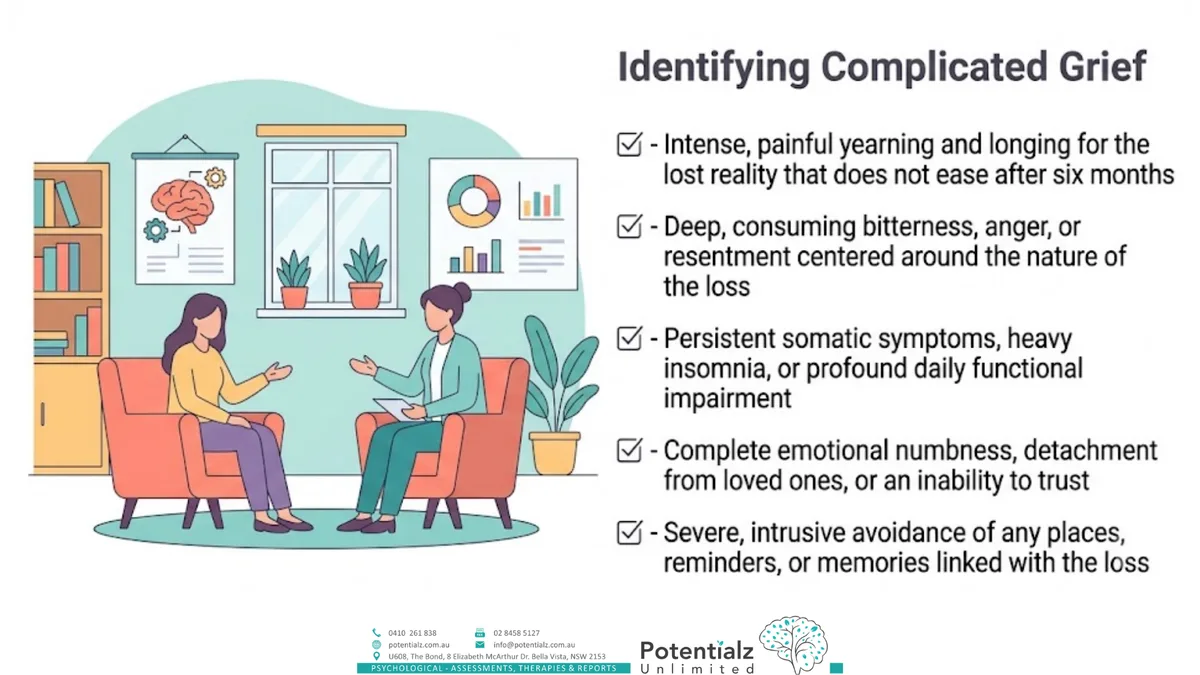
Signs that grief may have become complicated include:
- Intense longing and yearning that doesn’t diminish after six months or more
- Difficulty accepting that the loss is real and permanent
- Bitterness or anger about the loss that remains central and consuming
- A sense that life is meaningless without the person or thing lost
- Avoidance of any reminders of the person or loss
- Inability to trust others since the loss
- Feeling numb or emotionally detached from others
- Physical symptoms that persist beyond what would be expected
- Thoughts of self-harm or of wanting to join a deceased person
If you recognise these signs in yourself or someone you care about, please reach out for professional support. Complicated grief responds well to the right therapeutic approach. It does not resolve without help.
How Potentialz Can Help
Grief doesn’t have a deadline. And it doesn’t have to be carried alone.
At Potentialz in Bella Vista, I offer holistic grief counselling for individuals navigating all forms of loss. My integrative approach combines evidence-based counselling — including narrative therapy, meaning-making frameworks, and trauma-informed care — with gentle yoga for grief, breathwork, meditation, and culturally informed support.
For clients (particularly older adults) whose acute grief has passed and whose question is now how to rebuild the shape of daily life, our team’s Solution-Focused Therapy work for older adults offers a brief, forward-looking complement to holistic grief support.
I work with clients from diverse backgrounds including Indian, South Indian, and other CALD communities, and I offer sessions in English, Hindi, Tamil, Kannada, and Urdu. Telehealth sessions are available for clients across New South Wales who cannot attend in person.
Whatever you are grieving — your loss deserves space and support. I’d be honoured to hold that space with you.
To book an appointment, visit live.potentialz.com.au or call 0410 261 838.
Potentialz Unlimited | Unit 608, 8 Elizabeth Macarthur Drive, Bella Vista NSW 2153 Hours: Mon–Fri 10am–7pm | Saturday & after-hours available | Telehealth via phone or Zoom Languages: English, Hindi, Tamil, Kannada, Urdu
For the full range of counselling and psychotherapy services, visit potentialz.com.au/services-we-offer. Samita’s clinical work with depression and significant mood difficulties is also described at potentialz.com.au/clinical-psychologist-bella-vista.
Crisis Resources
If you or someone you care about is in distress related to grief or loss, please reach out for support:
- Lifeline: 13 11 14 (24 hours, 7 days a week)
- Beyond Blue: 1300 22 4636
- Grief Australia: grief.org.au — resources, support groups, and counselling referrals for bereaved Australians
- In an emergency: Call 000
References
Bonanno, G. A. (2004). Loss, trauma, and human resilience: Have we underestimated the human capacity to thrive after extremely aversive events? American Psychologist, 59(1), 20–28. https://doi.org/10.1037/0003-066X.59.1.20
Buckley, T., Sunari, D., Marshall, A., Bartrop, R., McKinley, S., & Tofler, G. (2012). Physiological correlates of bereavement and the impact of bereavement interventions. Dialogues in Clinical Neuroscience, 14(2), 129–139. https://doi.org/10.31887/DCNS.2012.14.2/tbuckley
Kübler-Ross, E. (1969). On death and dying. Macmillan.
Ramirez, J. M., Helfrich, M. P., & Koch, H. (2016). The importance of being sighing. Neuron, 92(4), 685–688. https://doi.org/10.1016/j.neuron.2016.11.005
Worden, J. W. (2009). Grief counselling and grief therapy: A handbook for the mental health practitioner (4th ed.). Springer Publishing.
AHPRA Disclaimer
The information in this article is intended for general educational purposes only. It does not constitute medical advice, psychological assessment, or a therapeutic relationship. Grief responses vary significantly between individuals, and this content should not be used as a substitute for personalised professional support from a qualified health practitioner. Complicated grief and grief accompanied by significant functional impairment or thoughts of self-harm requires professional assessment and treatment. Samita Rathor is a Registered Counsellor and Psychotherapist practising at Potentialz Unlimited, Bella Vista NSW.
If you are in distress or crisis, please contact:
- Lifeline: 13 11 14 (24/7)
- Beyond Blue: 1300 22 4636
- Grief Australia: grief.org.au
- Emergency services: 000
Related Reading
Knowledge Check Quiz
Test what you have just read. Choose your answer for each question, then submit to reveal the answers and your score.
Need Professional Support?
If you're experiencing mental health concerns, our team is here to help.