Welcome to This Week in Mental Health
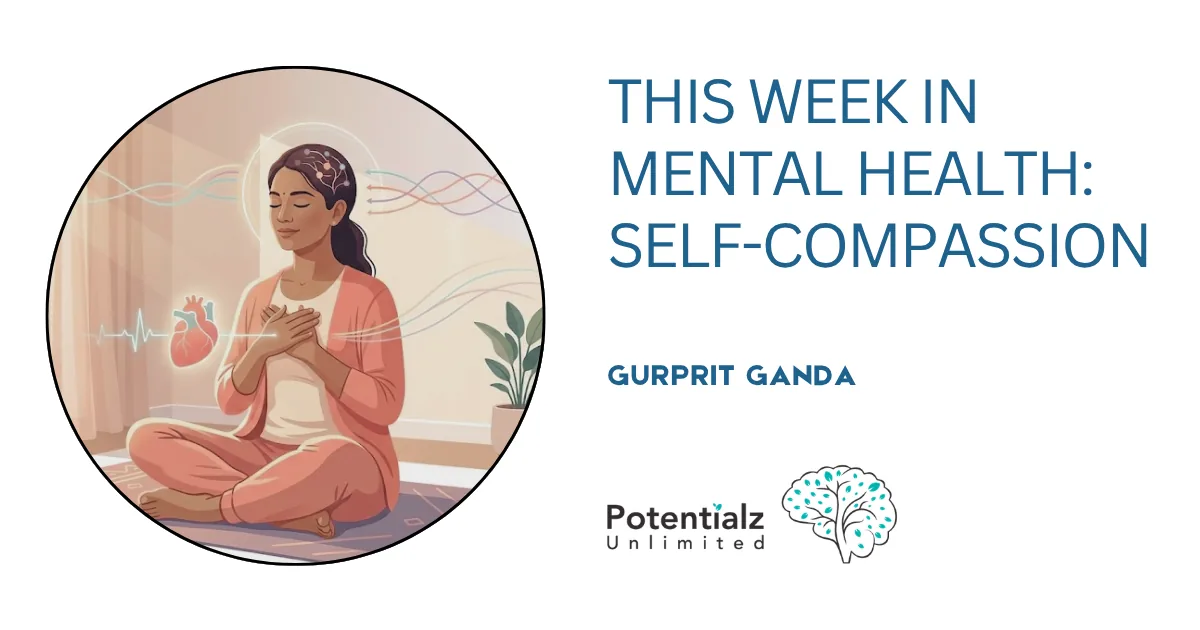
Each week we round up the developments worth knowing about across psychotherapy, counselling, and mental health — translated into plain language, with a careful clinical eye and links to the original research. This week’s focus: self-compassion.
A quick word on how we do this. We only report from credible, primary sources — peer-reviewed journals, universities, and official health bodies — and we frame new research as emerging rather than settled. New findings are interesting and important, but a single study rarely changes clinical practice on its own.
Self-compassion has had a remarkable decade. Once dismissed as soft or self-indulgent, it is now one of the most actively researched ideas in clinical psychology. So when three new randomised controlled trials landed within months of each other, we read them closely — and what they show, together, is more honest and more useful than the headlines usually allow. Here are the three on our radar.
1. Self-compassion lowers stress — and the workbook did as well as the app
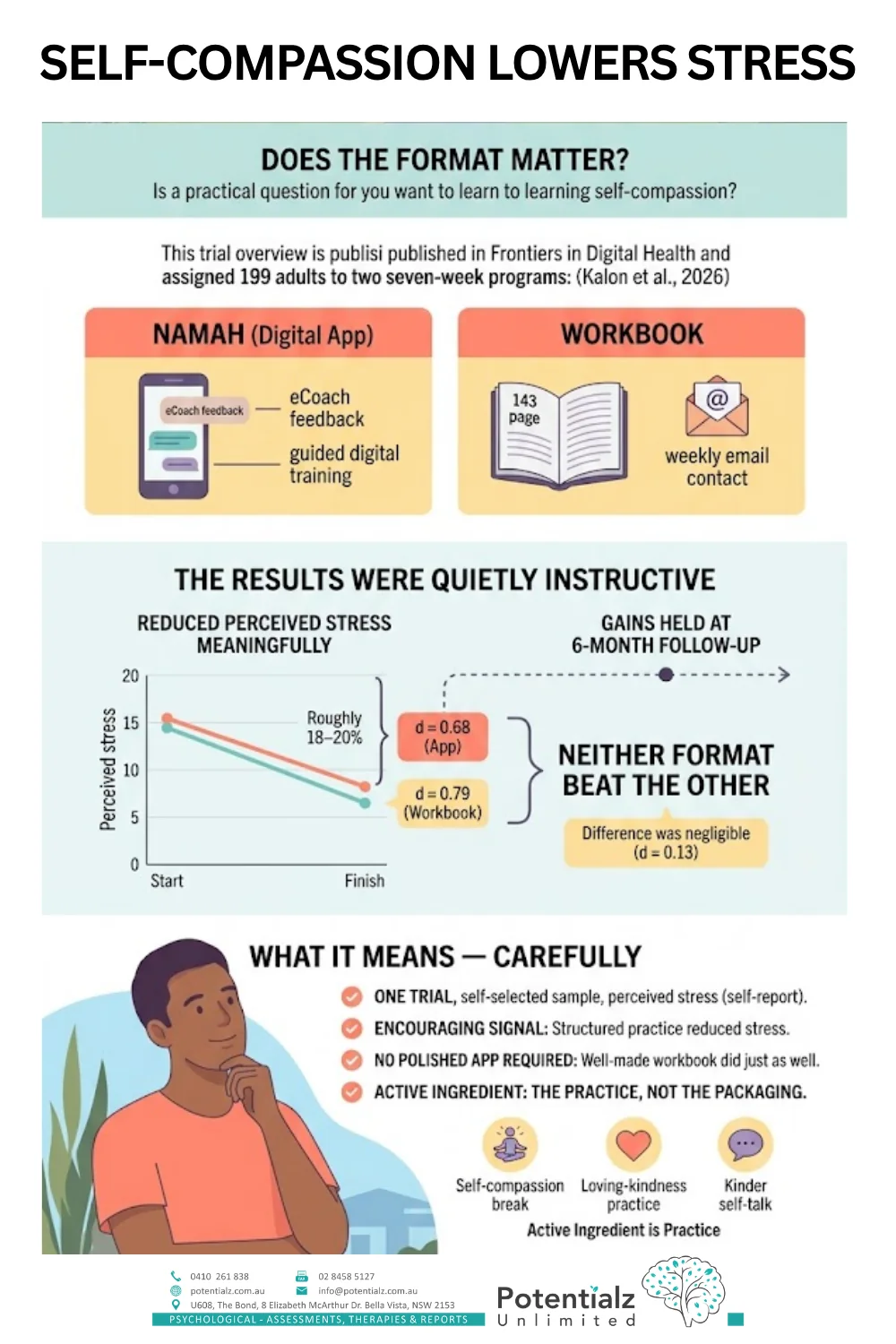 Self-compassion training cut stress ~18–20% — and the workbook did as well as the app.
The first trial asks a very practical question: if you want to learn self-compassion, does the format matter?
Published in Frontiers in Digital Health, the study randomly assigned 199 adults to one of two seven-week programs: Namah, a guided digital self-compassion training with personalised eCoach feedback, or a 143-page self-help workbook with weekly email contact (Kalon et al., 2026).
The results were quietly instructive:
- Both groups reduced their perceived stress meaningfully — by roughly 18–20% from start to finish (within-group effect sizes of d = 0.68 for the app and d = 0.79 for the workbook), and the gains held at six-month follow-up.
- Neither format beat the other. The difference between the app and the workbook was negligible (d = 0.13).
What it means — carefully. This is one trial, in a mostly self-selected sample, and “perceived stress” is a self-report measure rather than a clinical diagnosis. But the signal is encouraging and refreshingly down-to-earth: structured self-compassion practice reduced stress, and you did not need a polished app to get there — a well-made workbook did just as well. The lesson for anyone starting out is that the active ingredient is the practice, not the packaging. The exercises themselves — the self-compassion break, loving-kindness practice, kinder self-talk — are laid out in our guide to self-compassion as the foundation of good mental health.
2. A short self-compassion course softened the inner critic — but it was no silver bullet
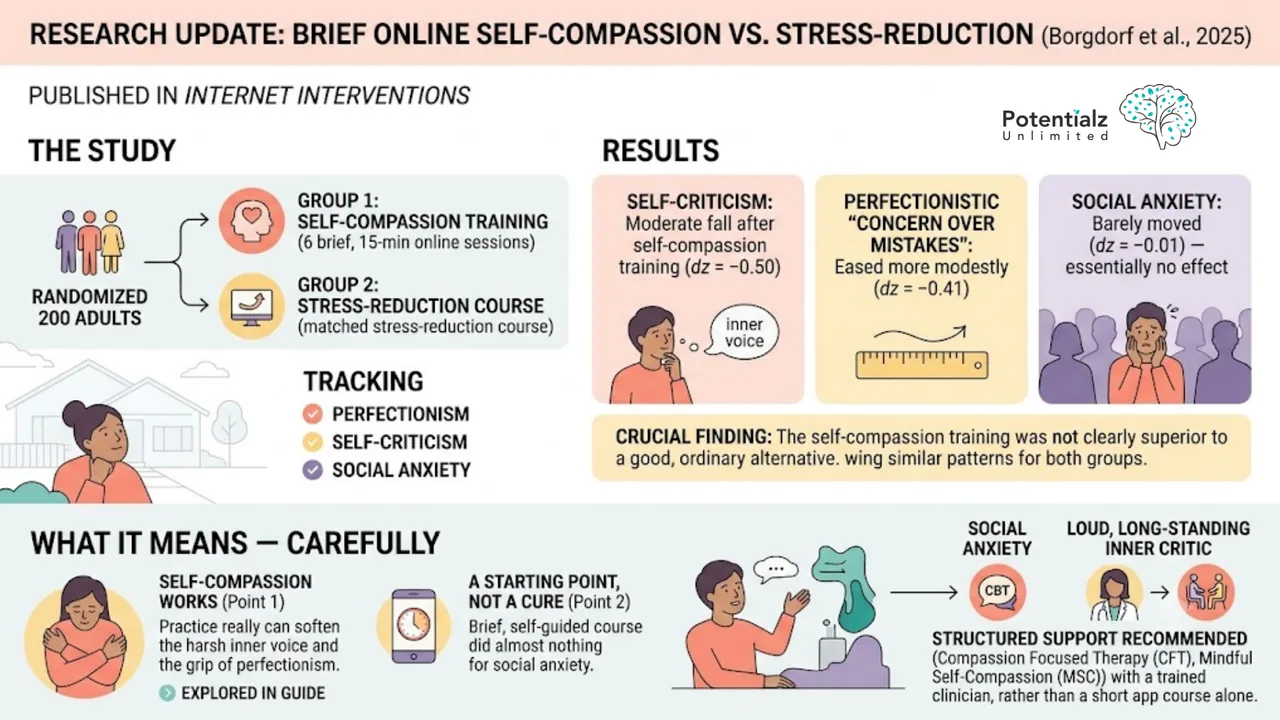 A brief self-compassion course eased self-criticism and perfectionism — but not social anxiety, and was no better than a generic control.
The second trial is the kind we think is most worth reporting, precisely because it is honest about limits.
Published in Internet Interventions, researchers randomly assigned 200 adults to either six brief (15-minute) online self-compassion sessions or a matched stress-reduction course, then tracked perfectionism, self-criticism, and social anxiety (Borgdorf et al., 2025).
The pattern was nuanced:
- Self-criticism fell by a moderate amount after the self-compassion training (dz = −0.50).
- Perfectionistic “concern over mistakes” eased more modestly (dz = −0.41).
- Social anxiety barely moved (dz = −0.01) — essentially no effect.
- And crucially, the generic stress-reduction course produced a similar pattern. The self-compassion training was not clearly superior to a good, ordinary alternative.
What it means — carefully. Two things are true at once here. First, self-compassion practice really can soften the harsh inner voice and the grip of perfectionism — the very patterns we explored in this week’s self-compassion guide and in our piece on perfectionism, anxiety and depression. Second, a brief, self-guided course is a starting point, not a cure — and it did almost nothing for social anxiety, which has its own evidence-based treatment in CBT for social anxiety disorder. For a loud, long-standing inner critic, the research consistently points toward more structured support — Compassion Focused Therapy (CFT) or Mindful Self-Compassion (MSC) with a trained clinician — rather than a short app course alone.
3. Self-compassion at work: modest gains for stressed employees
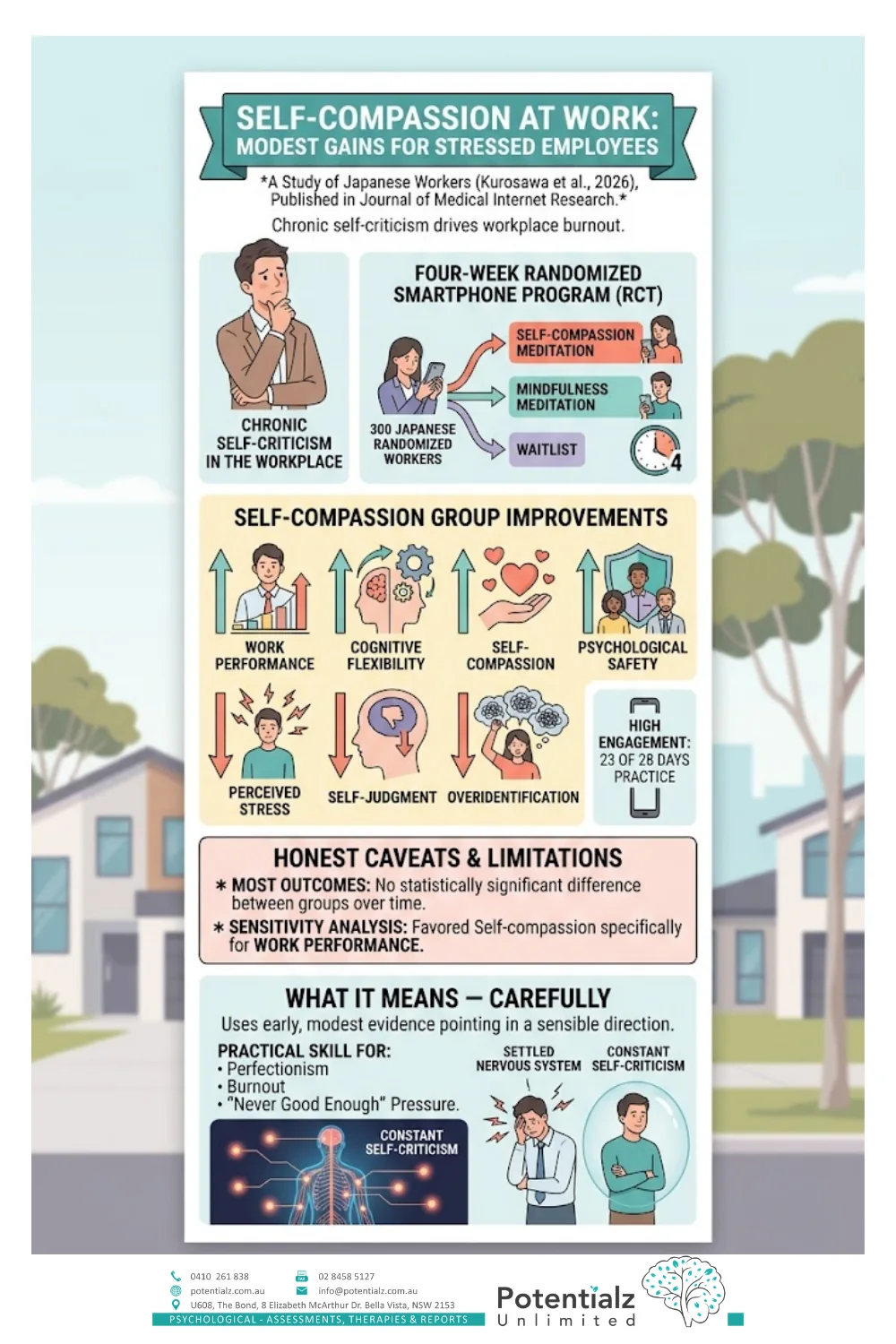 Self-compassion at work — modest gains for stressed employees, with honest caveats.
The third trial takes self-compassion into the workplace — where chronic self-criticism quietly drives a great deal of burnout.
Published in the Journal of Medical Internet Research, the study randomised 300 Japanese workers to a four-week smartphone program of self-compassion meditation, mindfulness meditation, or a waitlist (Kurosawa et al., 2026).
The self-compassion group showed improvements in work performance, cognitive flexibility, self-compassion, and psychological safety, alongside reductions in perceived stress, self-judgment, and overidentification (getting swept up in difficult thoughts). Engagement was high — participants completed around 23 of 28 days of practice.
The honest caveat: for most outcomes there was no statistically significant difference between the groups over time, though a closer (sensitivity) analysis did favour self-compassion specifically for work performance.
What it means — carefully. This is early, modest evidence — but it points in a sensible direction. For the perfectionism, burnout, and “never quite good enough” pressure so many working people carry, learning to meet setbacks with steadiness rather than self-attack is a genuinely practical skill. As we wrote this week, a nervous system under constant self-criticism cannot do its best work; one that has learned to settle can.
The bottom line
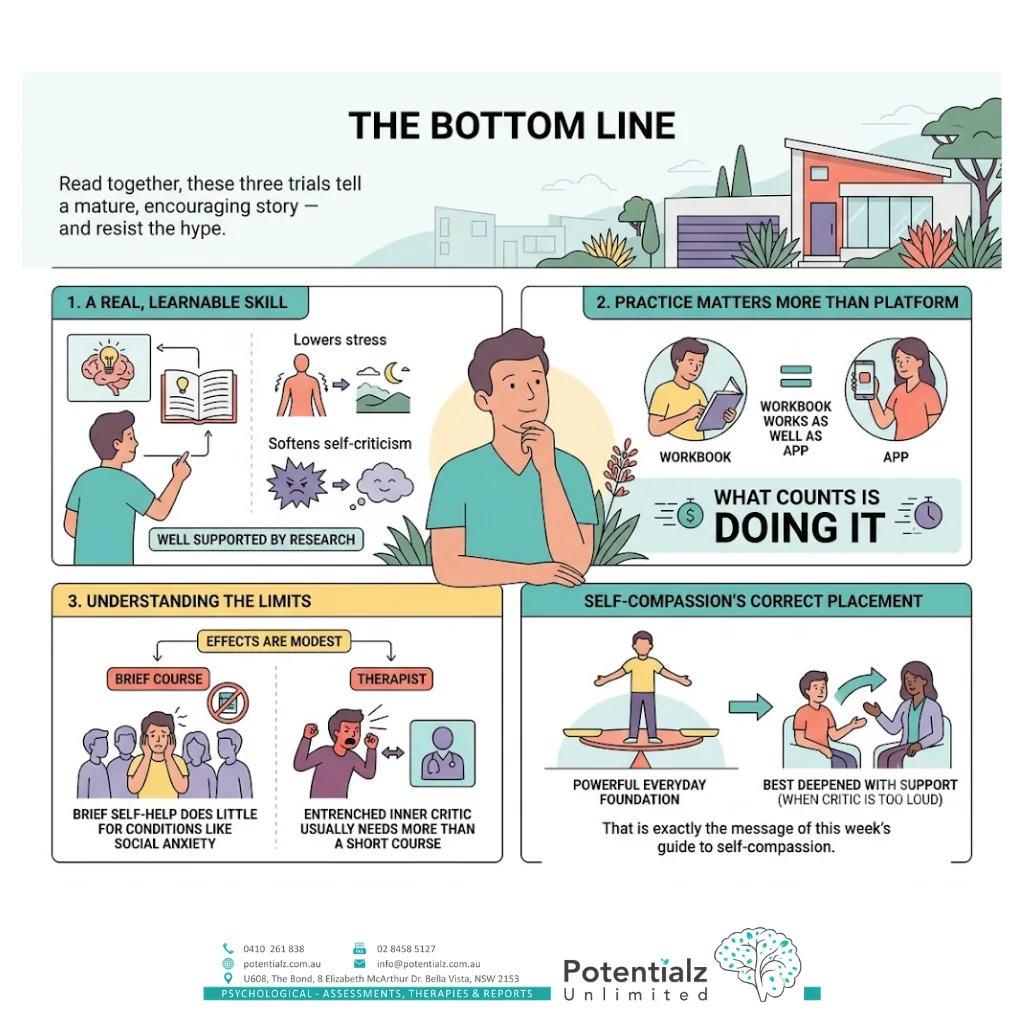 The bottom line: a real, learnable skill — practice over platform — with clear limits.
Read together, these three trials tell a mature, encouraging story — and resist the hype.
- Self-compassion is a real, learnable skill that lowers stress and softens self-criticism. That is now well supported.
- The practice matters more than the platform. A workbook worked as well as an app; what counts is doing it.
- It has limits. Effects are modest, brief self-help does little for conditions like social anxiety, and an entrenched inner critic usually needs more than a short course.
None of that diminishes self-compassion — it places it correctly: a powerful everyday foundation, and, when the inner critic is too loud for self-help alone, a practice best deepened with support. That is exactly the message of this week’s guide to self-compassion.
If your self-criticism has tipped into persistent anxiety, low mood, or burnout, you do not have to work it out alone. Our team at Potentialz Unlimited in Bella Vista offers evidence-based counselling and psychology — including approaches built specifically for self-criticism. You can get in touch here.
References
- Borgdorf, K. S. A., Aguilar-Raab, C., & Holt, D. V. (2025). Effects of a brief online self-compassion training on perfectionism, self-criticism, and social anxiety: A randomized controlled trial. Internet Interventions, 42, 100870. https://doi.org/10.1016/j.invent.2025.100870
- Kalon, L. S., Boß, L., Wiencke, C., Zarski, A.-C., & Lehr, D. (2026). A two-armed pragmatic randomized controlled trial comparing the effectiveness of two self-compassion interventions at reducing perceived stress. Frontiers in Digital Health, 8, 1680033. https://doi.org/10.3389/fdgth.2026.1680033
- Kurosawa, T., Adachi, K., & Takizawa, R. (2026). Effects of self-compassion and mindfulness interventions on mental health and work-related outcomes among Japanese workers: Randomized controlled trial. Journal of Medical Internet Research, 28(1), e79991. https://doi.org/10.2196/79991
Crisis and Support Resources
If you or someone you know needs immediate support, please reach out:
- Lifeline: 13 11 14 (24/7 crisis support)
- Beyond Blue: 1300 22 4636 (24/7)
- 1800RESPECT: 1800 737 732 (family and sexual violence)
- Emergency: 000
Disclaimer: This roundup is general information, not clinical advice, and summarises emerging research that has not necessarily changed clinical guidelines. Single studies should be read with caution. Dr. Gurprit Ganda is a Clinical Psychologist (AHPRA) and Practice Director at Potentialz Unlimited, Bella Vista. If you are experiencing significant distress, please contact your GP, a registered mental health professional, or one of the crisis services listed above.
Need Professional Support?
If you're experiencing mental health concerns, our team is here to help.