The Same Fight. Again.
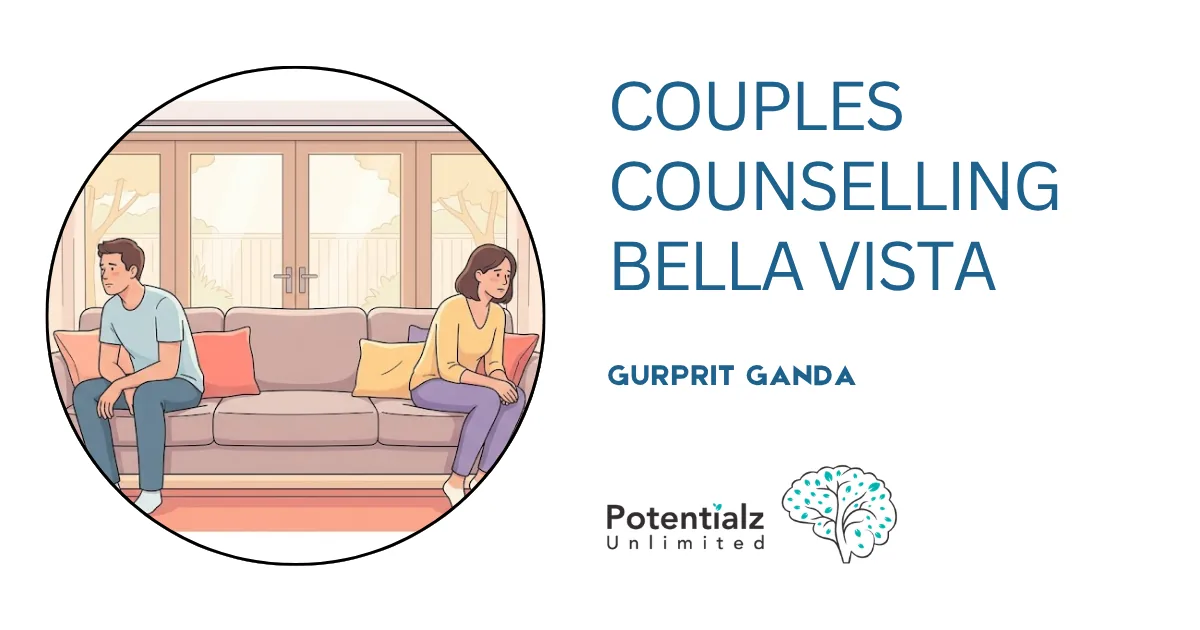
You know how it starts. A comment about the dishes. A tone of voice. A silence that lasts too long. Before you know it, you are in the exact same argument you had last month — and the month before that. You both say things you regret. Then you retreat to separate corners of the house, wondering how it got to this point.
You love each other. That is not in question. But love alone does not dissolve the patterns that have hardened between you. It does not repair the resentment that builds when the same wound keeps getting reopened. It does not restore the sense of being truly known by the person sitting across the dinner table.
If this sounds familiar, you are far from alone. Relationship distress is one of the most common reasons people seek mental health support in Australia. And the evidence for couples counselling is robust — a landmark meta-analysis found that couple therapy produces a large effect on relationship satisfaction (Hedges’ g = 1.12), while couples on waiting lists show no significant improvement (Roddy et al., 2020).
The patterns can change. Here is how.
What Is Couples Counselling?
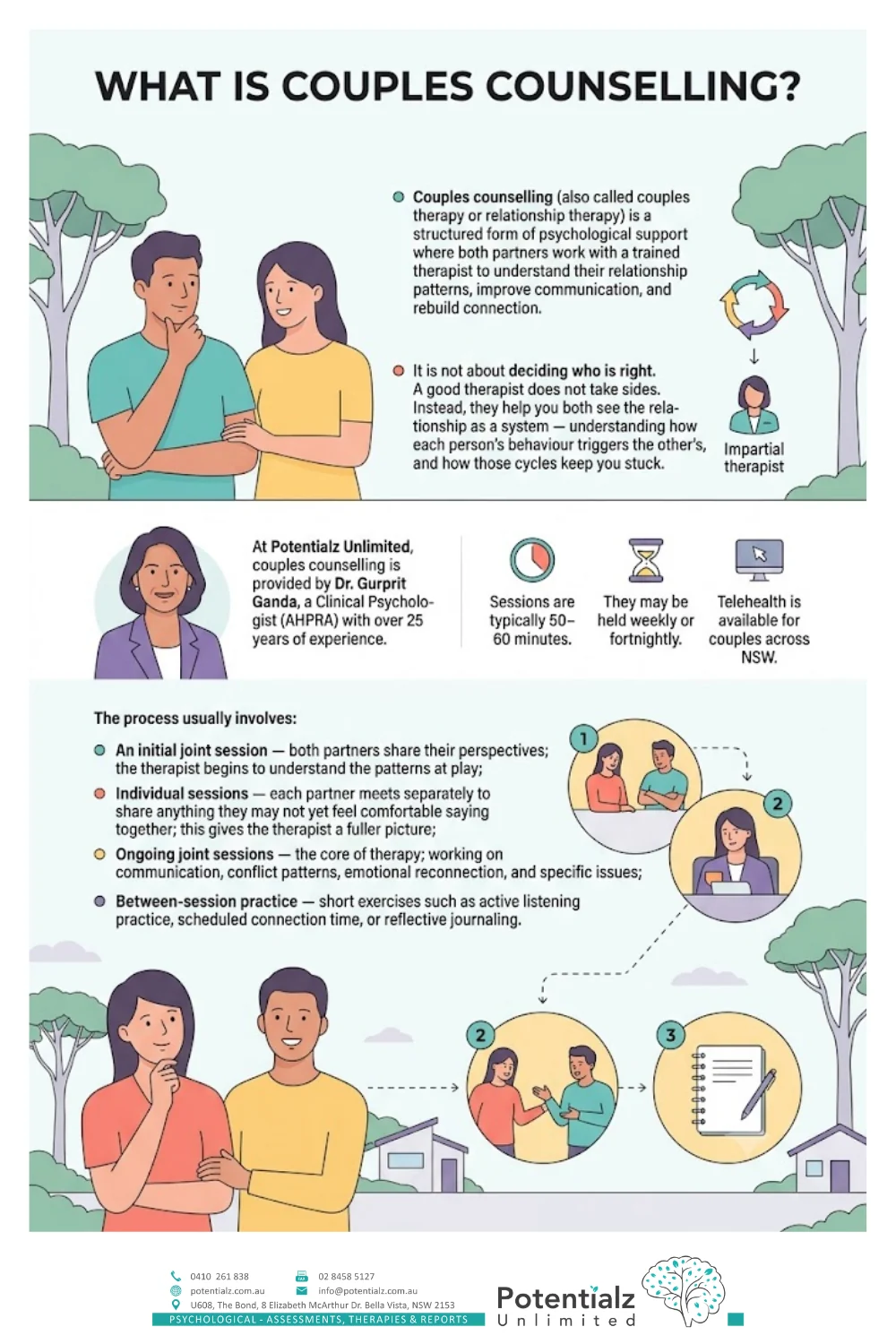
Couples counselling (also called couples therapy or relationship therapy) is a structured form of psychological support where both partners work with a trained therapist to understand their relationship patterns, improve communication, and rebuild connection.
It is not about deciding who is right. A good therapist does not take sides. Instead, they help you both see the relationship as a system — understanding how each person’s behaviour triggers the other’s, and how those cycles keep you stuck.
At Potentialz Unlimited, couples counselling is provided by Dr. Gurprit Ganda, a Clinical Psychologist (AHPRA) with over 25 years of experience. Sessions are typically 50–60 minutes. They may be held weekly or fortnightly. Telehealth is available for couples across NSW.
The process usually involves:
- An initial joint session — both partners share their perspectives; the therapist begins to understand the patterns at play
- Individual sessions — each partner meets separately to share anything they may not yet feel comfortable saying together; this gives the therapist a fuller picture
- Ongoing joint sessions — the core of therapy; working on communication, conflict patterns, emotional reconnection, and specific issues
- Between-session practice — short exercises such as active listening practice, scheduled connection time, or reflective journaling
Common Patterns Couples Bring to Therapy
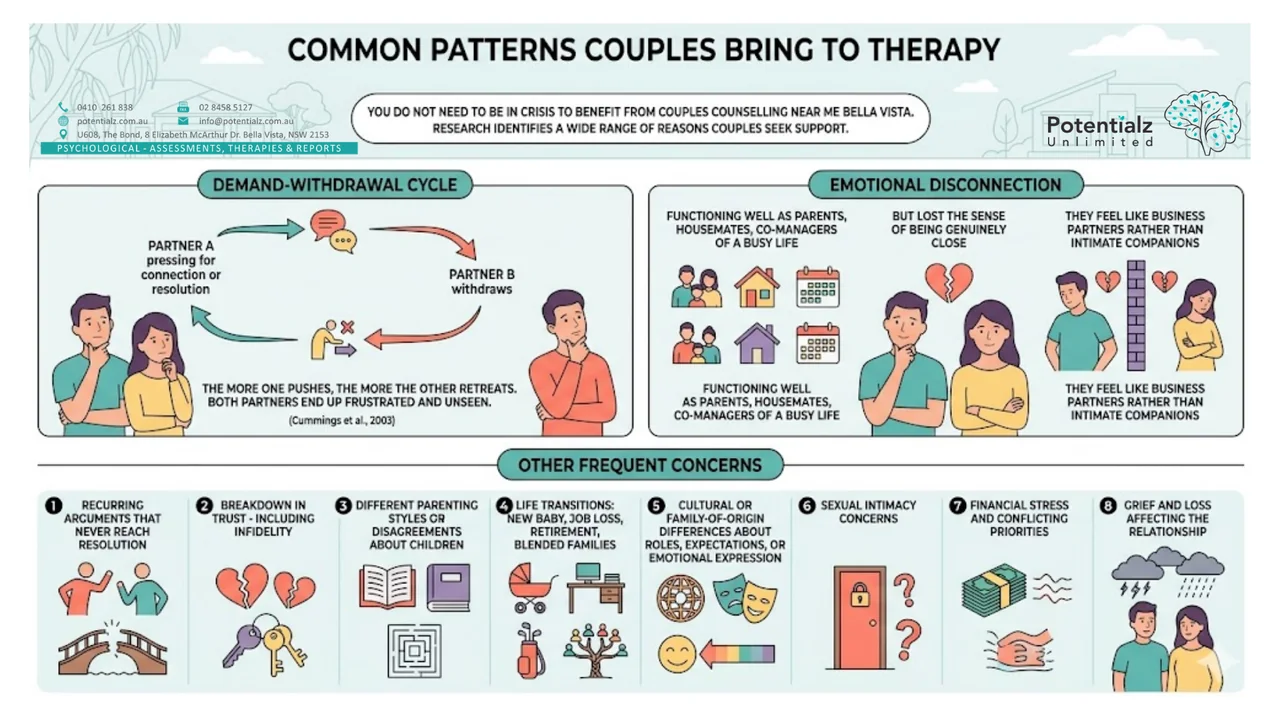
You do not need to be in crisis to benefit from couples counselling near me Bella Vista. Research identifies a wide range of reasons couples seek support.
The demand-withdrawal cycle is one of the most common and well-studied. One partner presses for connection or resolution; the other withdraws. The more one pushes, the more the other retreats. Both partners end up frustrated and unseen. Research shows this cycle predicts relationship deterioration over time (Cummings et al., 2003).
Emotional disconnection is another common presentation — couples who function well as parents, housemates, and co-managers of a busy life, but who have lost the sense of being genuinely close. They feel like business partners rather than intimate companions.
Other frequent concerns include:
- Recurring arguments that never reach resolution
- Breakdown in trust — including infidelity
- Different parenting styles or disagreements about children
- Life transitions: new baby, job loss, retirement, blended families
- Cultural or family-of-origin differences about roles, expectations, or emotional expression
- Sexual intimacy concerns
- Financial stress and conflicting priorities
- Grief and loss affecting the relationship
Many Hills District and Norwest couples face particular pressures: the cost of living, long commutes, high expectations around academic and professional achievement, and for multicultural families, the added complexity of navigating between cultural worlds. These contextual pressures do not cause relationship problems on their own — but they are the soil in which problems grow.
The Evidence: What Couples Counselling Actually Does
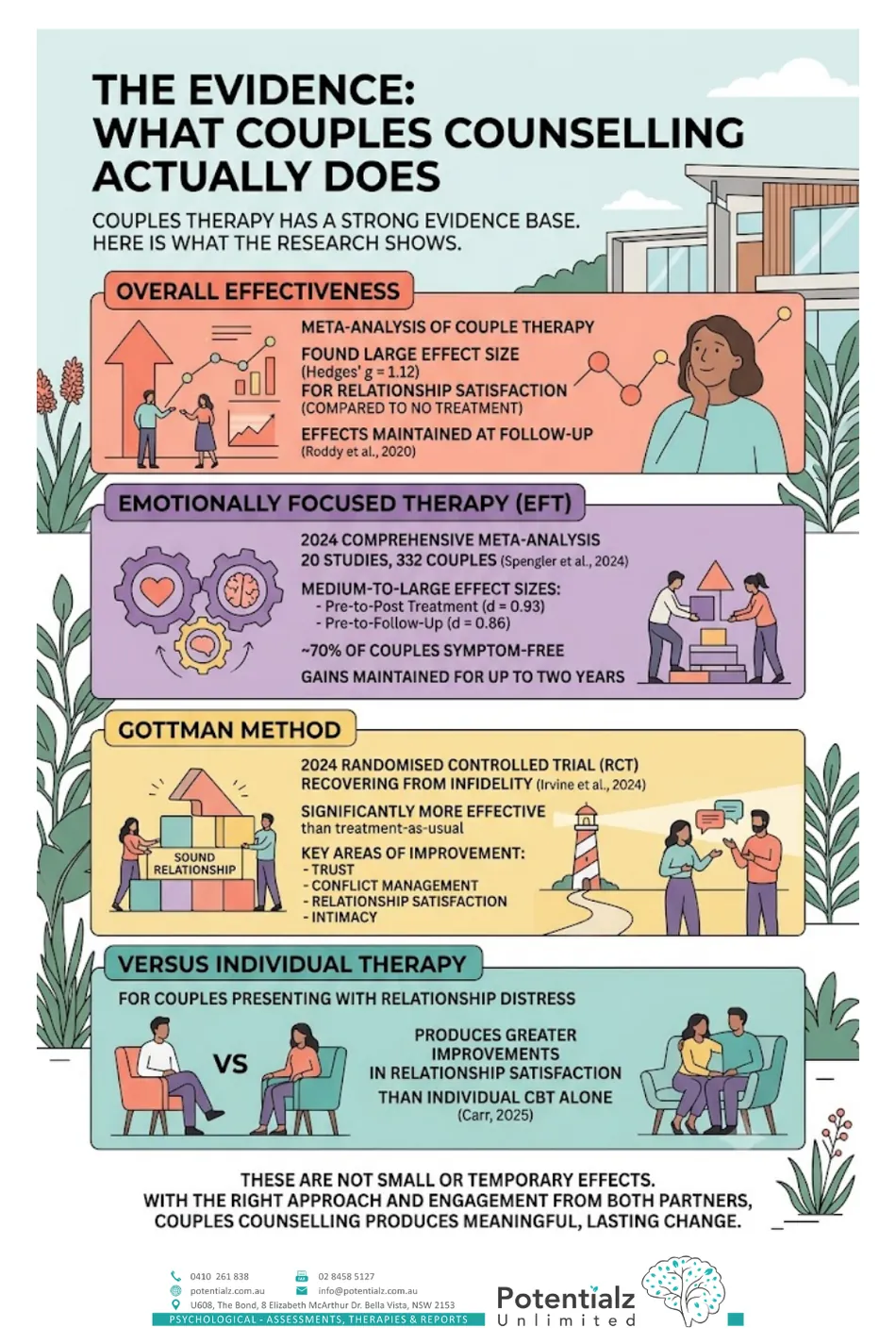
Couples therapy has a strong evidence base. Here is what the research shows.
Overall effectiveness: A meta-analysis of couple therapy across 49 studies found a large effect size (Hedges’ g = 1.12) for relationship satisfaction compared to no treatment, with effects maintained at follow-up (Roddy et al., 2020).
Emotionally Focused Therapy (EFT): A comprehensive 2024 meta-analysis by Spengler and colleagues reviewed 20 studies involving 332 couples. They found medium-to-large effect sizes for pre-to-post treatment (d = 0.93) and pre-treatment to follow-up (d = 0.86). Approximately 70% of couples were symptom-free at the end of treatment. Importantly, gains were maintained for up to two years after therapy ended (Spengler et al., 2024).
Gottman Method: A 2024 randomised controlled trial found that Gottman Method Couples Therapy was significantly more effective than treatment-as-usual for couples recovering from infidelity — particularly in the areas of trust, conflict management, relationship satisfaction, and intimacy (Irvine et al., 2024).
Versus individual therapy: For couples presenting with relationship distress, couples therapy produces greater improvements in relationship satisfaction than individual cognitive behaviour therapy alone (Carr, 2025).
These are not small or temporary effects. With the right approach and engagement from both partners, couples counselling produces meaningful, lasting change.
Emotionally Focused Therapy: Working With Attachment
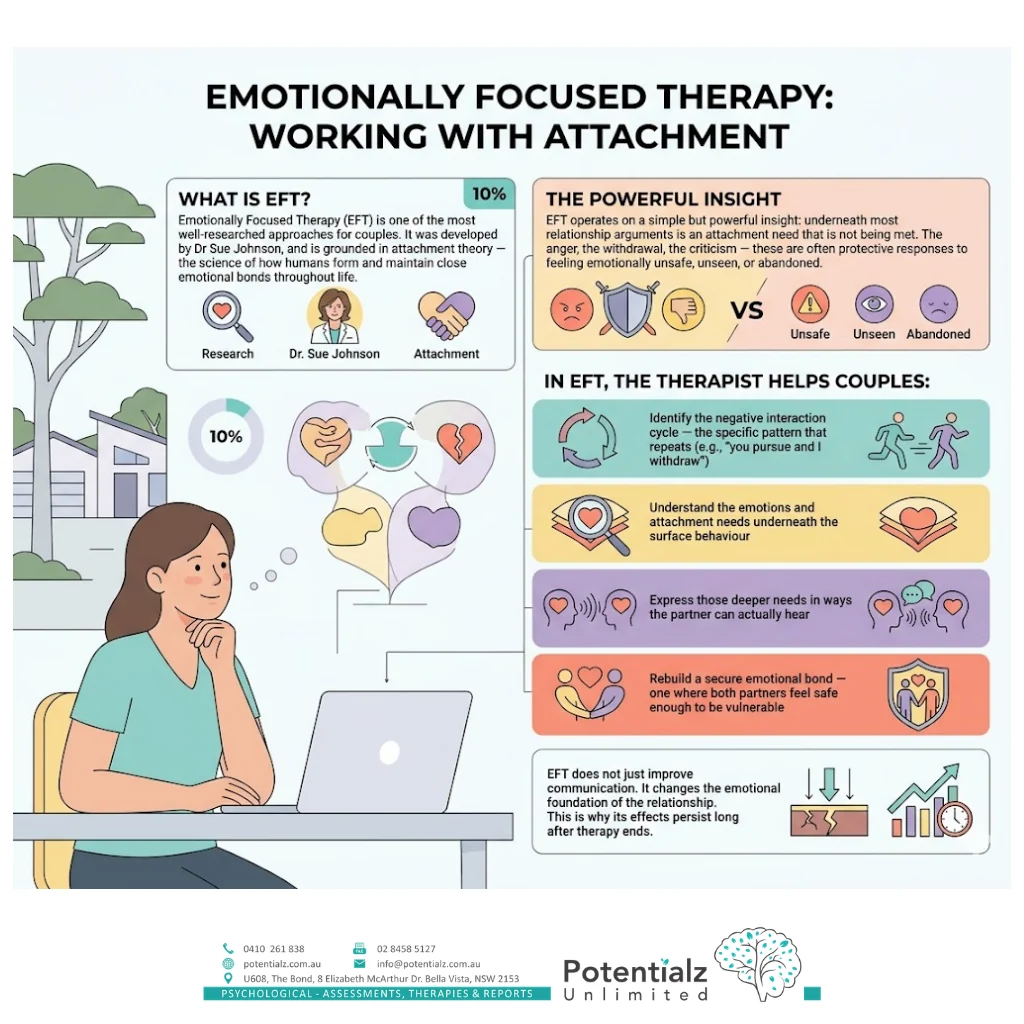
Emotionally Focused Therapy (EFT) is one of the most well-researched approaches for couples. It was developed by Dr Sue Johnson, and is grounded in attachment theory — the science of how humans form and maintain close emotional bonds throughout life.
EFT operates on a simple but powerful insight: underneath most relationship arguments is an attachment need that is not being met. The anger, the withdrawal, the criticism — these are often protective responses to feeling emotionally unsafe, unseen, or abandoned.
In EFT, the therapist helps couples:
- Identify the negative interaction cycle — the specific pattern that repeats (e.g., “you pursue and I withdraw”)
- Understand the emotions and attachment needs underneath the surface behaviour
- Express those deeper needs in ways the partner can actually hear
- Rebuild a secure emotional bond — one where both partners feel safe enough to be vulnerable
EFT does not just improve communication. It changes the emotional foundation of the relationship. This is why its effects persist long after therapy ends.
The Gottman Method: Building a Strong Relationship House
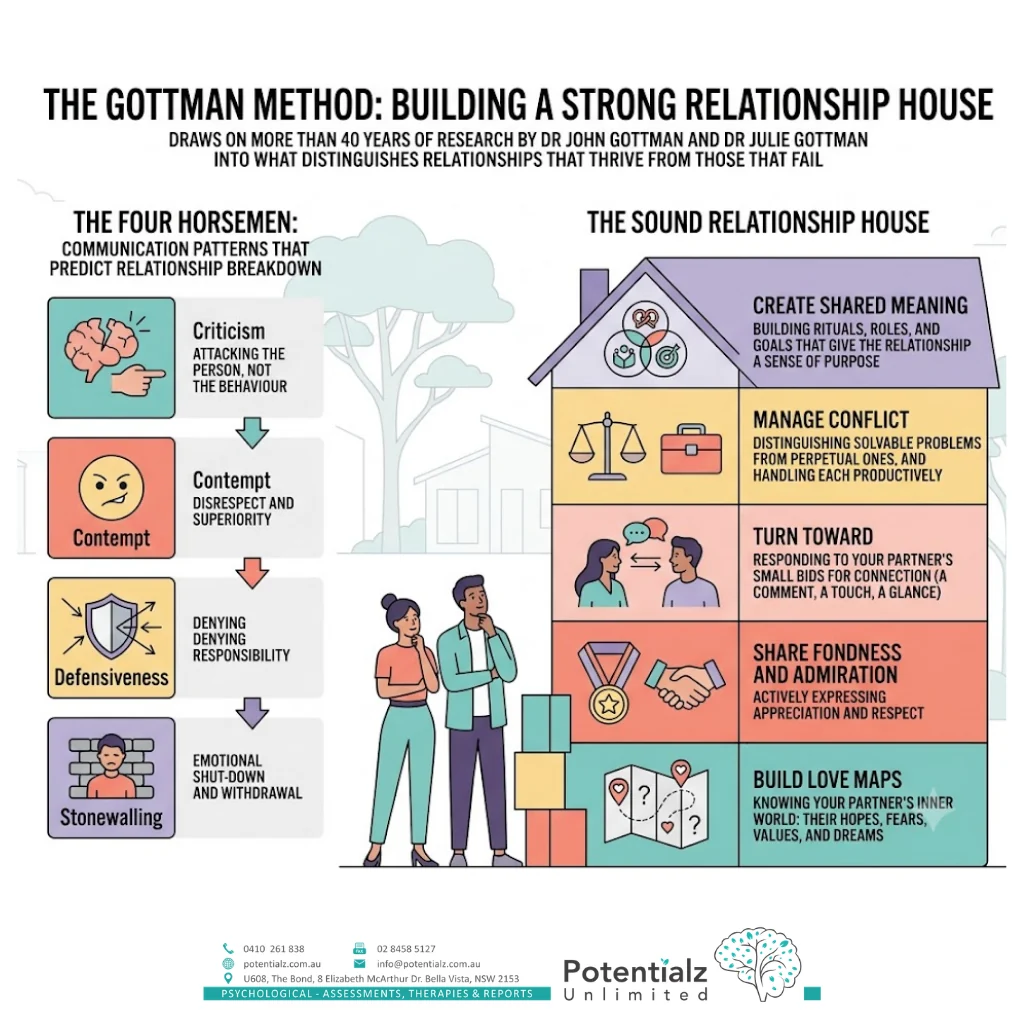
The Gottman Method draws on more than 40 years of research by Dr John Gottman and Dr Julie Gottman into what distinguishes relationships that thrive from those that fail.
Their research identified the “Four Horsemen” — communication patterns that reliably predict relationship breakdown: criticism (attacking the person, not the behaviour), contempt (disrespect and superiority), defensiveness (denying responsibility), and stonewalling (emotional shut-down and withdrawal).
The Gottman Method builds the “Sound Relationship House” — a structure of skills and practices that make relationships resilient:
- Build Love Maps — knowing your partner’s inner world: their hopes, fears, values, and dreams
- Share Fondness and Admiration — actively expressing appreciation and respect
- Turn Toward — responding to your partner’s small bids for connection (a comment, a touch, a glance)
- Manage Conflict — distinguishing solvable problems from perpetual ones, and handling each productively
- Create Shared Meaning — building rituals, roles, and goals that give the relationship a sense of purpose
What Happens in Your First Session?
Many couples feel nervous before their first session. That is completely normal. Here is what to expect at Potentialz Unlimited.
The first session is a joint session. Dr. Ganda will hear both of your perspectives — not to evaluate who is right, but to understand the patterns at play. You will be asked about your relationship history, the specific concerns that brought you in, and what you are hoping therapy can help you achieve.
There is no pressure to disclose more than you are ready to share. The pace is yours. The therapist’s role is to create a space where both partners feel safe enough to be honest.
After the first session, Dr. Ganda may recommend individual sessions for each partner. This is standard practice and is not a sign that the relationship is in deeper trouble than you thought. Individual sessions allow each person to share their full experience and ensure the therapist has a complete picture.
Subsequent joint sessions focus on the specific goals you have identified: breaking the recurring conflict cycle, rebuilding trust, re-establishing emotional and physical intimacy, or strengthening a relationship that is fundamentally sound but under pressure.
Progress is not always linear. Some sessions feel like breakthroughs. Others feel harder. This is normal — and it is part of the process.
When to Seek Couples Counselling Near Me Bella Vista
Research shows the average couple waits approximately six years after problems begin before seeking professional help (Gottman & Silver, 2015). By that time, negative patterns are deeply entrenched and repair takes longer.
Earlier is better. Consider seeking couples counselling near me Bella Vista if:
- You have the same argument repeatedly without resolution
- You feel emotionally disconnected or lonely in the relationship
- You avoid difficult conversations because they always end badly
- Trust has been broken and you want to repair it
- A major life change has destabilised the relationship
- You are concerned about how conflict affects your children
- You want to strengthen a good relationship and protect it from future strain
You do not need to be at the point of separation to benefit. Couples counselling is not a last resort — it is a proactive investment in one of the most important parts of your life.
If there is any family violence or safety concern in the relationship, please contact 1800RESPECT (1800 737 732) before booking couples sessions. Safety assessment is the first priority.
How Dr. Ganda and Potentialz Unlimited Can Help
Dr. Gurprit Ganda is a Clinical Psychologist (AHPRA) with over 25 years of clinical experience, a member of the Australian Psychological Society and the College of Clinical Psychologists. She has extensive experience working with couples and individuals navigating relationship distress, trust repair, and the pressures specific to multicultural families in the Hills District.
At Potentialz Unlimited, couples counselling is integrated with individual psychological support where needed. If one or both partners are also dealing with anxiety, depression, trauma, or other mental health concerns, these can be addressed alongside the relationship work — often the individual and relational issues are closely connected.
We use evidence-based approaches including EFT and Cognitive Behavioural Therapy for relationships — tailored to each couple’s specific needs and goals.
Medicare and fees: Couples sessions are not typically covered by Medicare’s Better Access program. Medicare rebates are available for individual psychology sessions with a GP Mental Health Care Plan. If you are experiencing individual mental health concerns alongside relationship difficulties, a Mental Health Care Plan can support individual sessions that complement couples work. Please speak with your GP about your options.
We are located at Unit 608/8 Elizabeth Macarthur Drive, Bella Vista NSW 2153 — close to Norwest Business Park, Castle Hill, and Baulkham Hills. Book a consultation by calling 0410 261 838 or visiting live.potentialz.com.au. Telehealth is available across NSW.
Related reading: raising emotionally intelligent children
References
Carr, A. (2025). Couple therapy and systemic interventions for adult-focused problems: The evidence base. Journal of Family Therapy, 47(1), 1–42. https://doi.org/10.1111/1467-6427.12481
Cummings, E. M., Goeke-Morey, M. C., & Papp, L. M. (2003). Children’s responses to everyday marital conflict tactics in the home. Child Development, 74(6), 1918–1929. https://doi.org/10.1046/j.1467-8624.2003.00646.x
Gottman, J. M., & Silver, N. (2015). The seven principles for making marriage work (Rev. ed.). Harmony Books.
Irvine, T. J., Peluso, P. R., Benson, K., Cole, C., Cole, D., Gottman, J. M., & Gottman, J. S. (2024). A pilot study examining the effectiveness of Gottman Method Couples Therapy over treatment-as-usual approaches for treating couples dealing with infidelity. The Family Journal, 32(1), 18–29. https://doi.org/10.1177/10664807231210123
Johnson, S. M. (2019). Attachment theory in practice: Emotionally focused therapy with individuals, couples, and families. Guilford Press.
Lebow, J. L., Chambers, A. L., Christensen, A., & Johnson, S. M. (2012). Research on the treatment of couple distress. Journal of Marital and Family Therapy, 38(1), 145–168. https://doi.org/10.1111/j.1752-0606.2011.00249.x
Roddy, M. K., Walsh, L. M., Rothman, K., Hatch, S. G., & Doss, B. D. (2020). Meta-analysis of couple therapy: Effects across outcomes, designs, timeframes, and other moderators. Journal of Consulting and Clinical Psychology, 88(7), 583–596. https://doi.org/10.1037/ccp0000514
Spengler, P. M., Lee, N. A., Wiebe, S. A., & Wittenborn, A. K. (2024). A comprehensive meta-analysis on the efficacy of emotionally focused couple therapy. Couple and Family Psychology: Research and Practice, 13(2), 81–99. https://doi.org/10.1037/cfp0000233
Crisis and Support Resources
If you or your partner are experiencing domestic or family violence, or if anyone is in immediate danger, please reach out now.
- 1800RESPECT (domestic and family violence support): 1800 737 732 (24/7)
- Lifeline (24/7 crisis support): 13 11 14
- Beyond Blue (mental health support): 1300 22 4636
- Emergency: 000
Dr. Gurprit Ganda is a Clinical Psychologist (AHPRA) and member of the Australian Psychological Society and the College of Clinical Psychologists. Potentialz Unlimited, Unit 608/8 Elizabeth Macarthur Drive, Bella Vista NSW 2153. Phone: 0410 261 838. This article is general educational information and is not a substitute for individual psychological assessment or treatment.
Related Reading
Knowledge Check Quiz
Test what you have just read. Choose your answer for each question, then submit to reveal the answers and your score.
Need Professional Support?
If you're experiencing mental health concerns, our team is here to help.