Key Takeaways
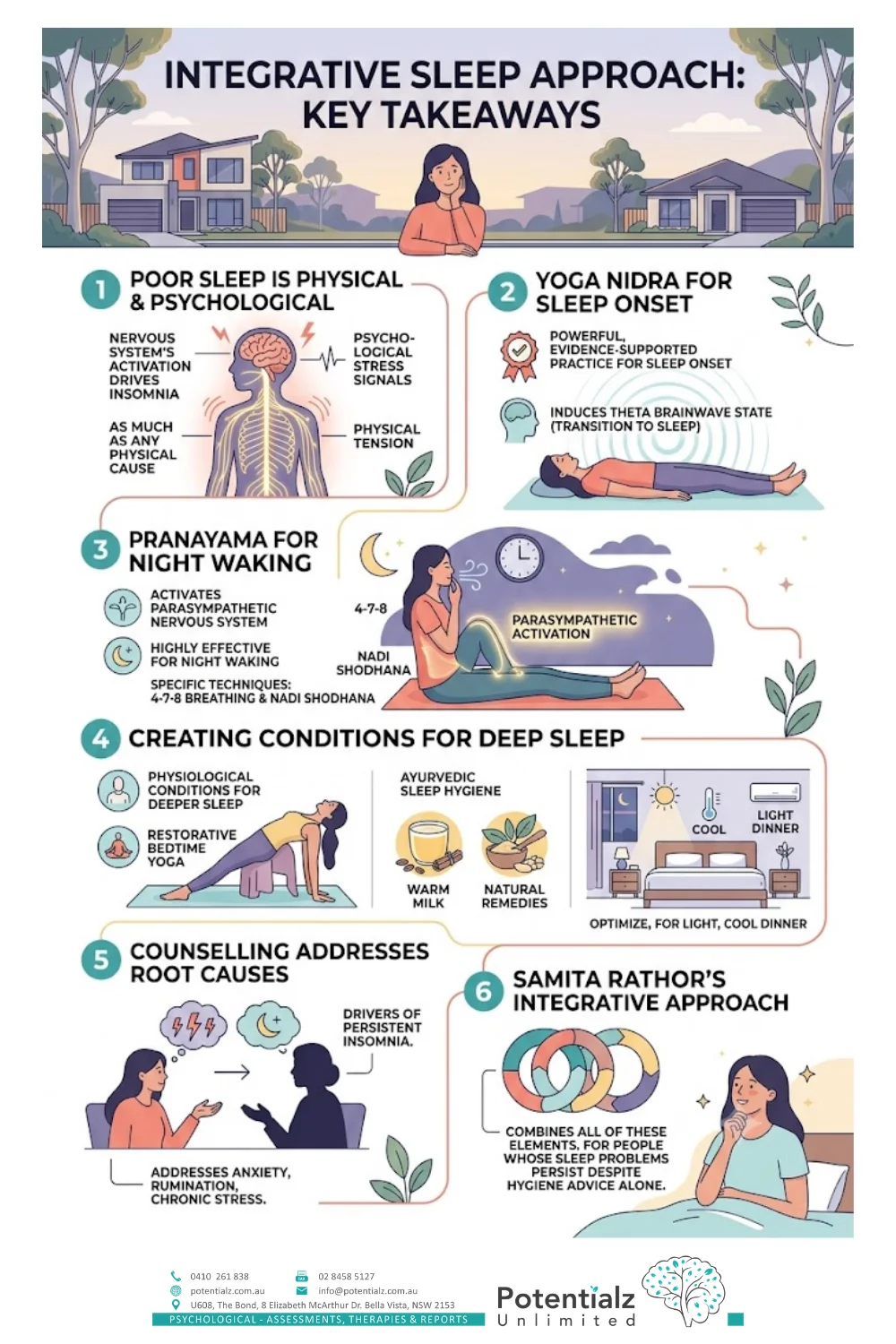
- Poor sleep is almost always both physical and psychological — the nervous system’s state of activation drives insomnia as much as any physical cause.
- Yoga nidra is a powerful, evidence-supported practice for sleep onset that works by inducing a theta brainwave state similar to the transition into sleep.
- Pranayama practices — particularly 4-7-8 breathing and nadi shodhana — activate the parasympathetic nervous system and are highly effective for night waking.
- Restorative bedtime yoga, Ayurvedic sleep hygiene, and a holistic approach to light, temperature, and food create the physiological conditions for deeper sleep.
- Counselling addresses the anxiety, rumination, and chronic stress that are almost always driving persistent insomnia.
- Samita Rathor’s integrative approach combines all of these elements for people whose sleep problems have not responded to sleep hygiene advice alone.
You’ve done everything they told you to do.
No screens after 9pm. Consistent bedtime. Bedroom cool and dark. No caffeine after noon. And you’re still lying awake at 3am, watching the minutes tick past, mind running at full speed, body exhausted but unable to switch off.
If that’s familiar, you’re not doing it wrong. Standard sleep advice is genuinely useful. But for many people, it simply doesn’t get to the root of what’s happening.
This post explores the holistic dimension of sleep — practices that go beyond standard hygiene tips and work directly at the level of the nervous system. Because that’s usually where persistent insomnia actually lives.
Why Sleep Problems Are Both Physical and Psychological
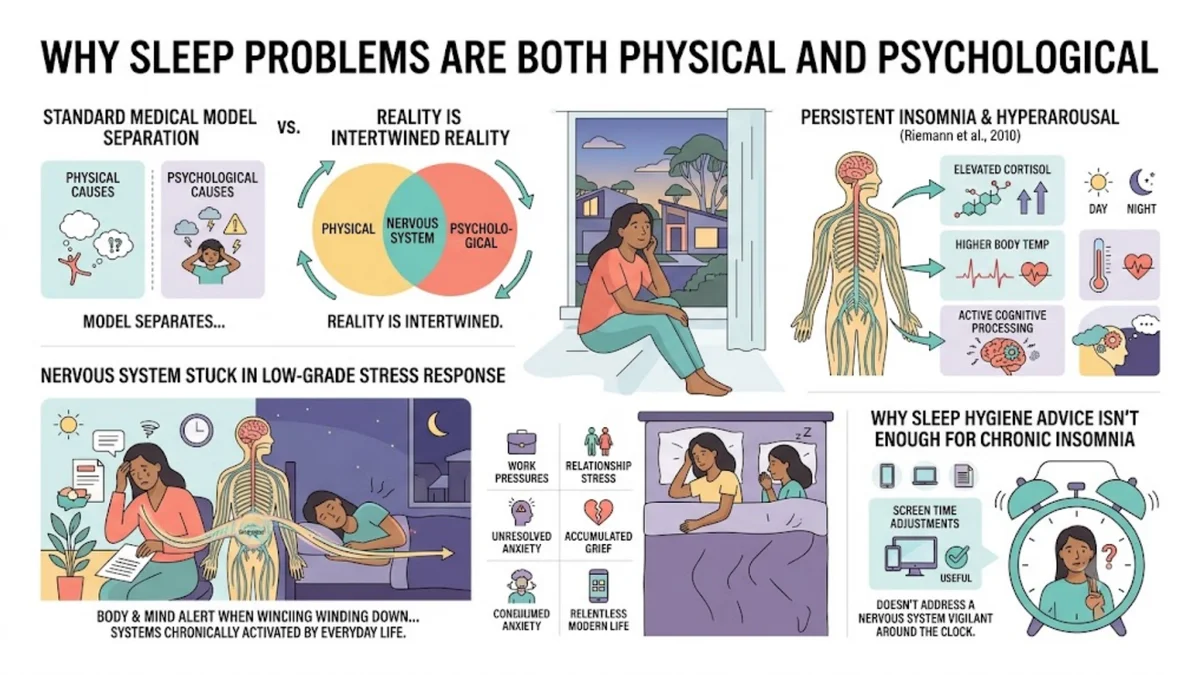
The standard medical model tends to separate physical and psychological causes of insomnia. In practice, they’re almost always intertwined.
Persistent insomnia is most commonly maintained by a state of hyperarousal in the nervous system (Riemann et al., 2010). The hyperarousal model suggests that people with chronic sleep difficulties show elevated physiological and cognitive arousal — higher cortisol levels, higher body temperature, faster heart rate, and more active cognitive processing — both at night and during the day.
In other words, the nervous system of someone with chronic insomnia is effectively stuck in a low-grade stress response. The body and mind are alert when they should be winding down. Not because something is wrong with you — but because the systems designed to keep you safe in threatening situations have been chronically activated by the pressures of everyday life. Work. Relationships. Unresolved anxiety. Accumulated grief. The relentlessness of modern life.
This is why sleep hygiene advice often falls short for chronic insomnia. Adjusting your screen time is useful. But it doesn’t address a nervous system that has learned to stay vigilant around the clock.
Holistic approaches work differently. They address the nervous system directly, creating the physiological conditions in which sleep becomes possible again.
Yoga Nidra for Sleep Onset
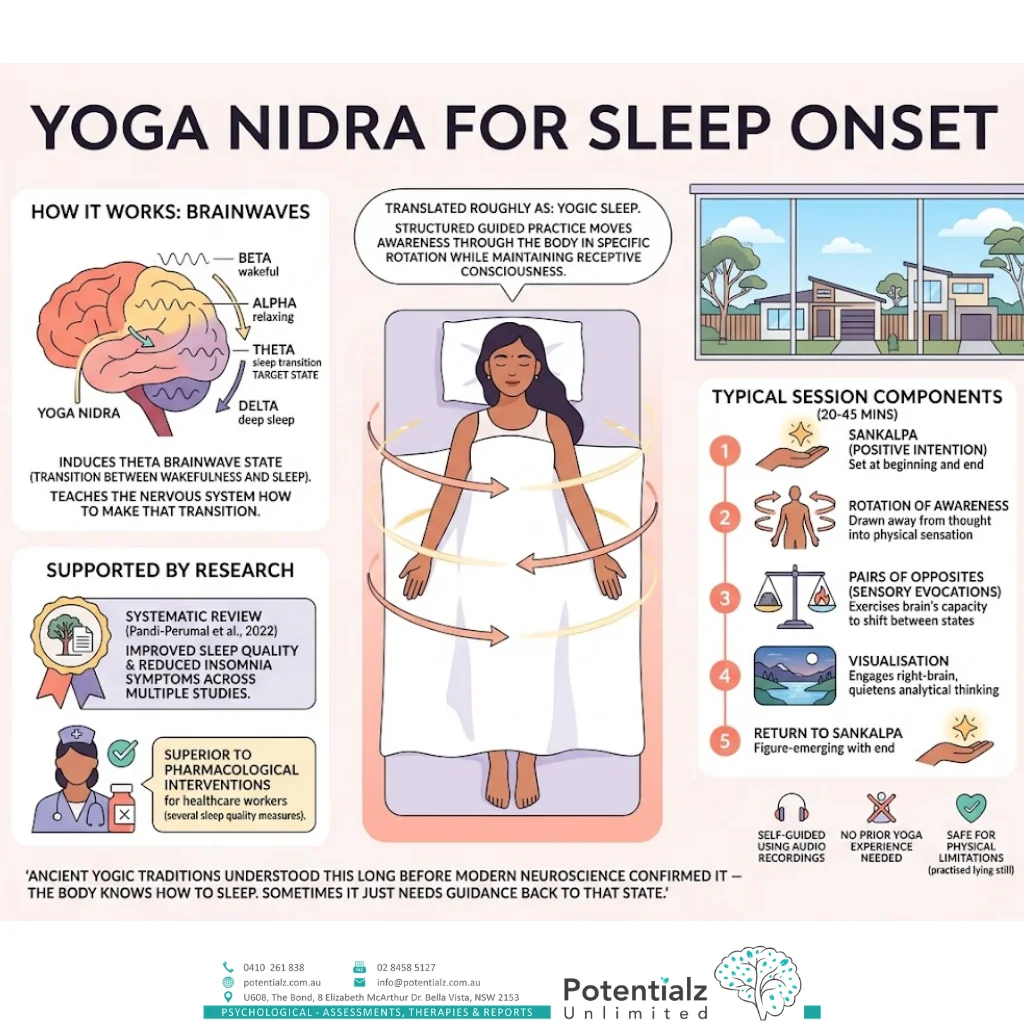
Yoga nidra — translated roughly as “yogic sleep” — is one of the most powerful tools I use with clients who struggle with sleep onset. It is not a relaxation technique in the ordinary sense. It is a structured guided practice that systematically moves awareness through the body in a specific rotation while maintaining the practitioner in a state of relaxed, receptive consciousness.
The practice induces a theta brainwave state — the same state that occurs naturally in the transition between wakefulness and sleep. For people who lie awake unable to cross that threshold, yoga nidra effectively teaches the nervous system how to make that transition.
Research has supported the effectiveness of yoga nidra for sleep. A systematic review by Pandi-Perumal et al. (2022) found that yoga nidra practices significantly improved sleep quality and reduced insomnia symptoms across multiple studies. In healthcare workers — a population with high rates of insomnia — yoga nidra was found to be superior to pharmacological interventions for several sleep quality measures.
A yoga nidra session typically runs between 20 and 45 minutes and is practised lying down. It involves:
- A sankalpa (a short, positive intention set at the beginning and end of the practice)
- A rotation of awareness through the body — a rapid, systematic scanning that draws attention away from thought and into physical sensation
- Pairs of opposites — brief sensory evocations (heaviness then lightness, warmth then cold) that exercise the brain’s capacity to shift between states
- Visualisation — brief, specific visualisations that engage right-brain activity and quieten analytical thinking
- Return to the sankalpa before re-emerging into ordinary waking consciousness
Yoga nidra can be self-guided using audio recordings and does not require prior yoga experience. It’s also safe for people who carry physical limitations, as it’s practised entirely lying still.
Ancient yogic traditions understood this long before modern neuroscience confirmed it — the body knows how to sleep. Sometimes it just needs guidance back to that state.
Pranayama Practices for Night Waking
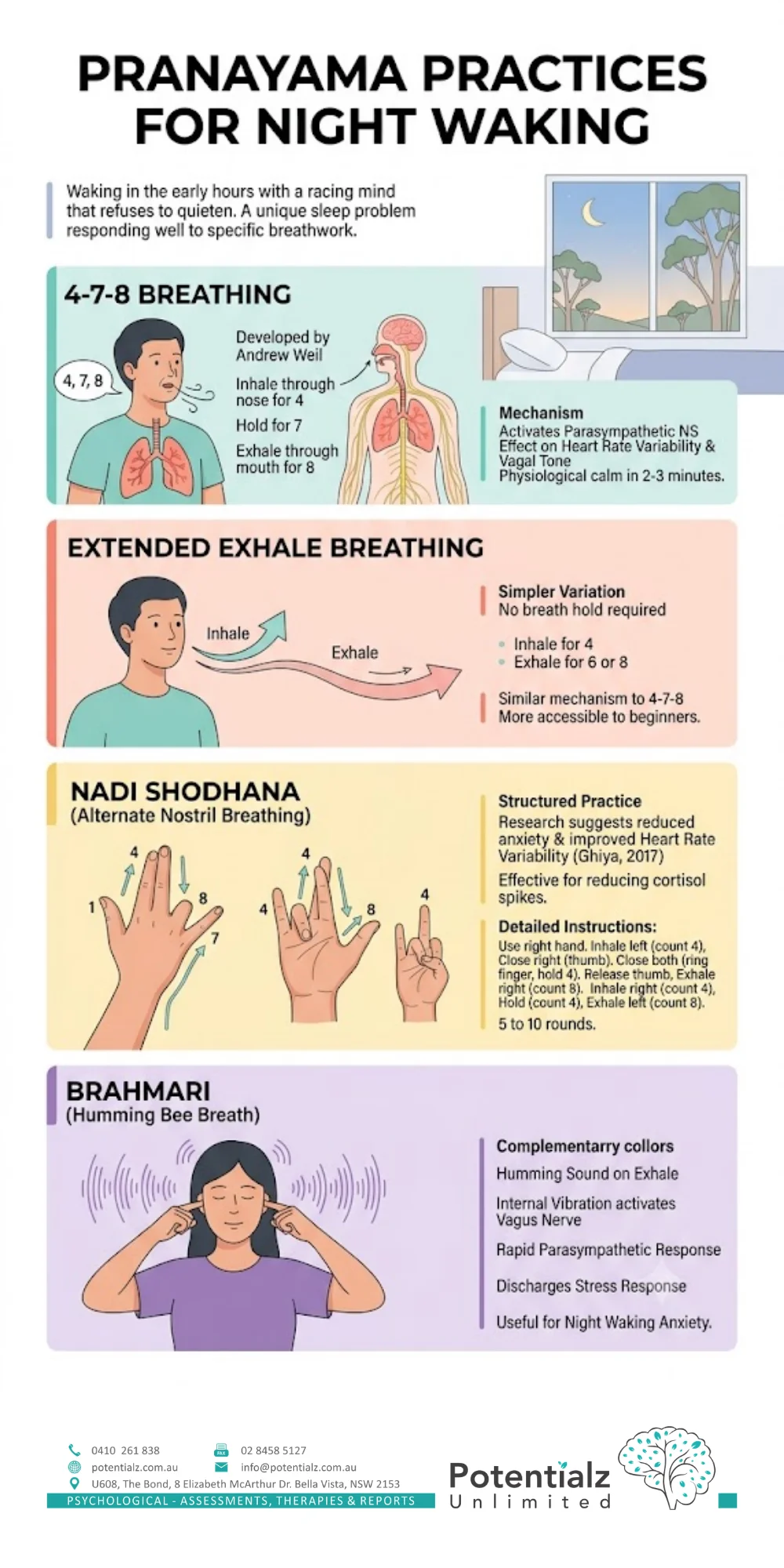
Night waking — waking in the early hours with a racing mind that refuses to quieten — is a distinct problem from sleep onset and responds well to specific breathwork practices. For a fuller look at how these techniques calm the mind more broadly, see pranayama and breathwork for mental health.
4-7-8 Breathing
Developed within the framework of pranayama by integrative medicine physician Andrew Weil, 4-7-8 breathing involves:
- Inhaling through the nose for a count of 4
- Holding the breath for a count of 7
- Exhaling through the mouth for a count of 8
The extended hold and long exhale activate the parasympathetic nervous system through the direct effect of breath rate on heart rate variability and vagal tone. Repeated cycles typically produce noticeable physiological calm within two to three minutes.
Extended Exhale Breathing
A simpler variation — simply making the exhale longer than the inhale — has a similar mechanism and can be more accessible for those new to breathwork. Inhaling for a count of 4 and exhaling for a count of 6 or 8, without a breath hold, is effective and requires no training to begin.
Nadi Shodhana (Alternate Nostril Breathing)
Nadi shodhana is a more structured pranayama practice that alternates the breath between left and right nostrils. Research suggests that nadi shodhana specifically activates the parasympathetic nervous system, reduces anxiety, and improves heart rate variability (Ghiya, 2017). When practised for 5 to 10 minutes after night waking, it’s particularly effective at reducing the cortisol spike that often accompanies early morning waking.
Practice: Use the right hand. Place the index and middle fingers between the brows. Close the right nostril with the thumb and inhale through the left for a count of 4. Close both nostrils (add the ring finger) and hold for a count of 4. Release the thumb and exhale through the right for a count of 8. Inhale through the right for 4. Hold for 4. Exhale through the left for 8. This is one round. Practise 5 to 10 rounds.
Brahmari (Humming Bee Breath)
Brahmari — closing the eyes, gently plugging the ears, and producing a humming sound on the exhale — creates internal vibration that activates the vagus nerve and produces rapid parasympathetic response. It’s particularly useful for people whose night waking is accompanied by anxiety, as the vibration helps discharge the stress response held in the body.
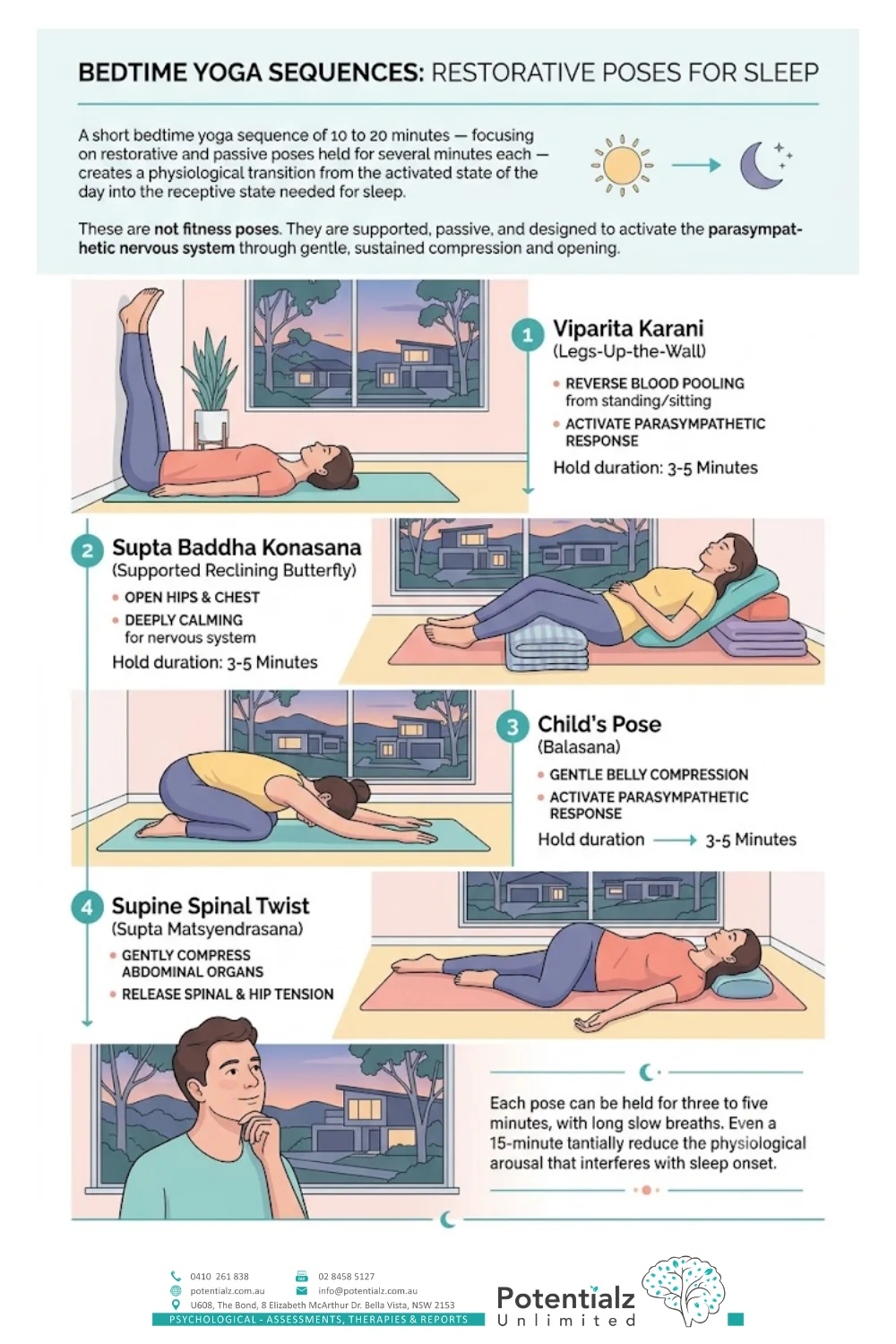
Bedtime Yoga Sequences: Restorative Poses for Sleep
A short bedtime yoga sequence of 10 to 20 minutes — focusing on restorative and passive poses held for several minutes each — creates a physiological transition from the activated state of the day into the receptive state needed for sleep.
These are not fitness poses. They are supported, passive, and designed to activate the parasympathetic nervous system through gentle, sustained compression and opening.
Useful poses for a bedtime sequence include:
- Viparita Karani (Legs-Up-the-Wall): Lie on your back with your legs resting vertically against a wall. Highly effective for reversing the pooling of blood in the lower body from a day of standing or sitting, and for activating parasympathetic response through the gentle inversion.
- Supta Baddha Konasana (Supported Reclining Butterfly): Lie on your back with the soles of the feet together and knees falling open. Support the knees with cushions or folded blankets. This pose opens the hips and chest and is deeply calming for the nervous system.
- Child’s Pose (Balasana): Kneeling and folding forward with arms extended or resting alongside the body. The gentle compression of the belly and the forward fold activate the parasympathetic response.
- Supine Spinal Twist (Supta Matsyendrasana): Lying on the back, knees drawn to one side with arms open. The twist gently compresses the abdominal organs and releases tension in the spine and hips.
Each pose can be held for three to five minutes, with long slow breaths. Even a 15-minute sequence before bed can substantially reduce the physiological arousal that interferes with sleep onset.
Sleep Hygiene Through a Holistic Lens
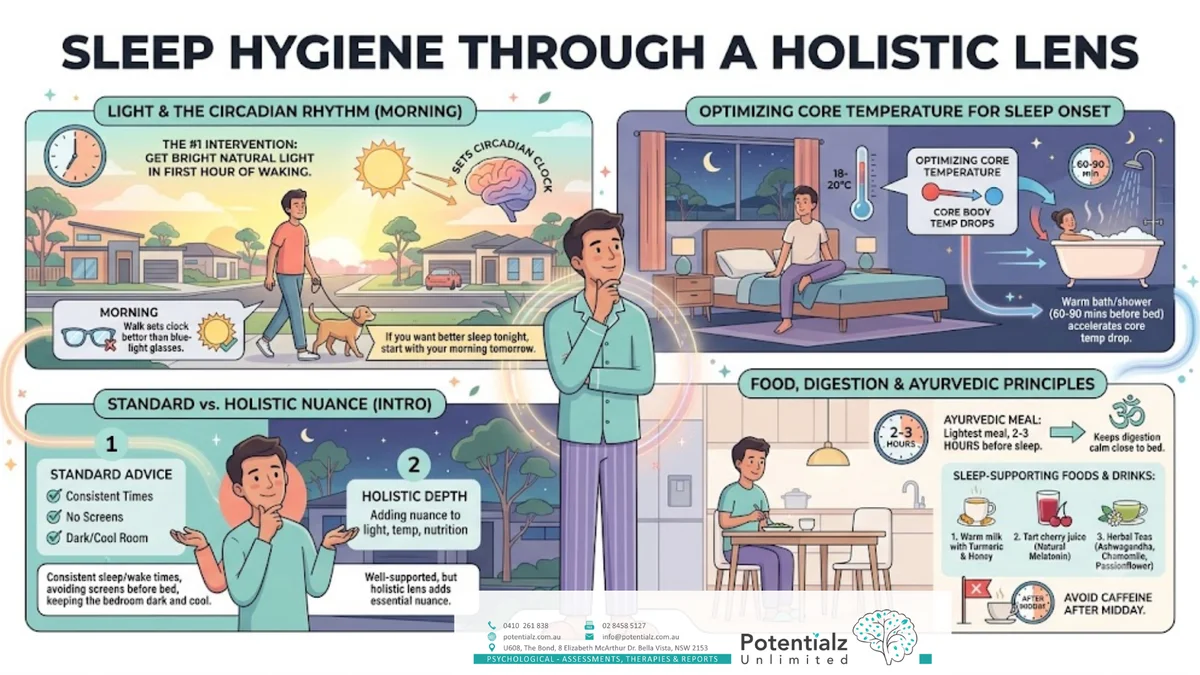
Standard sleep hygiene advice — consistent sleep and wake times, avoiding screens before bed, keeping the bedroom dark and cool — is well-supported by research. But a holistic lens adds some nuance that’s often missing from standard advice.
Light and the Circadian Rhythm
The body’s circadian rhythm is set primarily by light exposure. The most important intervention for circadian health is not avoiding screens at night (though that helps) — it’s getting bright natural light in the first hour of waking. Morning light exposure, even on an overcast day, sets the circadian clock more powerfully than any blue-light-blocking glasses. A 10-20 minute walk in natural morning light is one of the highest-impact sleep interventions available.
Think of it this way: if you want better sleep tonight, start with your morning tomorrow.
Temperature
Core body temperature naturally drops as the body prepares for sleep. A room temperature of approximately 18 to 20 degrees Celsius supports this process. A warm bath or shower 60 to 90 minutes before bed is also counterintuitively helpful — not because warmth induces sleep, but because the rapid cooling that follows a warm bath accelerates the core temperature drop that the body needs.
Food, Digestion, and Ayurvedic Principles
From an Ayurvedic perspective, the evening meal should be the lightest meal of the day, eaten at least two to three hours before sleep. Heavy, rich, or spicy food consumed close to bedtime keeps the digestive system active during the night, elevating core body temperature and metabolic activity.
Certain foods are traditionally considered sleep-supporting in Ayurveda and are also consistent with modern nutritional research: warm milk with turmeric and a small amount of honey, tart cherry juice (a natural source of melatonin), and calming herbal teas such as ashwagandha, chamomile, or passionflower. Heavy caffeine use, including coffee consumed after midday, is one of the most common and underestimated contributors to poor sleep.
The Nervous System’s Role in Insomnia
Understanding the nervous system’s role in sleep makes many other interventions make more sense.
The autonomic nervous system has two branches: the sympathetic (fight-or-flight) and the parasympathetic (rest-and-digest). Sleep is only possible when the parasympathetic branch is dominant. In people with chronic insomnia — particularly anxiety-driven insomnia — the sympathetic branch remains inappropriately activated into the evening and night hours.
This sympathetic activation is maintained by:
- Unresolved daily stress that has not been adequately discharged
- Anxiety and rumination — particularly catastrophising about the future or replaying the day’s events
- Anticipatory anxiety about sleep itself — the phenomenon in which lying down in bed triggers alertness because the bed has become associated with the experience of failed sleep
- Underlying mood difficulties — both anxiety and depression are strongly associated with sleep disruption
All of the holistic practices described in this post work, at their root, by reducing sympathetic nervous system activation and supporting the conditions in which parasympathetic dominance is possible. But they’re most effective when the underlying anxiety, stress, or mood difficulty is also being addressed directly.
How Counselling Addresses the Anxiety Driving Poor Sleep
For many people with chronic insomnia, the most important intervention is not a breathing technique or a bedtime routine. It’s addressing the anxiety, rumination, or unresolved stress that is maintaining the nervous system in an alert state.
In my experience working with clients on sleep, the breathwork and yoga often provide noticeable relief within a few weeks. But lasting change — the kind where you stop dreading bedtime — usually requires addressing what’s underneath.
Counselling helps with sleep in several ways:
- Psychoeducation about the sleep-arousal cycle: Understanding why your sleep is disrupted — the hyperarousal model — helps reduce the secondary anxiety about sleep that often compounds the problem.
- Addressing underlying anxiety: Anxiety is the most common driver of chronic insomnia. Treating the anxiety directly — through mindfulness-based approaches, ACT-informed work, and somatic techniques — reliably improves sleep.
- Processing unresolved stress: Unexpressed grief, unresolved anger, work-related stress, relationship difficulties, and accumulated tension held in the nervous system can all maintain sleep disruption. Counselling creates a space to process these.
- Developing a realistic relationship with sleep: Unhelpful beliefs about sleep — “I must get eight hours or tomorrow will be ruined,” “I never sleep well” — maintain the anticipatory anxiety that perpetuates insomnia. Counselling helps to challenge and update these beliefs. For older adults whose sleep has worsened alongside a bigger life transition (retirement, chronic health, bereavement), a brief, structured psychological approach can be a good complement — see William Carter’s post on Solution-Focused Therapy for older adults.
How Potentialz Can Help
If you’ve tried all the standard advice and you’re still not sleeping — please know that it’s not a personal failing. Chronic insomnia is almost always a nervous system problem. And nervous systems can change.
At Potentialz Unlimited in Bella Vista, I offer an integrative approach to sleep difficulties that goes well beyond standard advice. I combine holistic counselling with yoga nidra, pranayama, mindfulness, and holistic wellness guidance — working with both the nervous system dysregulation and the underlying psychological patterns that are maintaining poor sleep.
You can book a session in person in Bella Vista, or via Telehealth across New South Wales — making it accessible even when your schedule is demanding.
Book at live.potentialz.com.au or call 0410 261 838.
Potentialz Unlimited | Unit 608/8 Elizabeth Macarthur Drive, Bella Vista NSW 2153 Hours: Mon–Fri 10am–7pm | Saturday & after-hours available | Telehealth via phone or Zoom Languages: English, Hindi, Tamil, Kannada, Urdu
Please note: Samita Rathor is a holistic counsellor and yoga therapist, not an AHPRA-registered psychologist. Counselling sessions with Samita are not Medicare-rebatable. For sleep problems where CBT-I or medical review is indicated, our psychology colleagues at Potentialz can help — see The Complex Dance of Anxiety and Sleep Disturbances and Sleep and Mental Health.
If your low mood or worry ever brings thoughts of not wanting to be here, please reach out for urgent support now: call Lifeline on 13 11 14, or in an emergency call 000.
References
Ghiya, S. (2017). Alternate nostril breathing: A systematic review of clinical trials. International Journal of Research in Medical Sciences, 5(8), 3273–3282. https://doi.org/10.18203/2320-6012.ijrms20173516
Pandi-Perumal, S. R., Spence, D. W., Srinivasan, V., Kato, M., Cardinali, D. P., & Shapiro, C. M. (2022). Yoga nidra: An ancient technique meets modern science. Frontiers in Neuroscience, 16, 863714. https://doi.org/10.3389/fnins.2022.863714
Riemann, D., Spiegelhalder, K., Feige, B., Voderholzer, U., Berger, M., Perlis, M., & Nissen, C. (2010). The hyperarousal model of insomnia: A review of the concept and its evidence. Sleep Medicine Reviews, 14(1), 19–31. https://doi.org/10.1016/j.smrv.2009.04.002
Walker, M. (2017). Why we sleep: Unlocking the power of sleep and dreams. Scribner.
Zaccaro, A., Piarulli, A., Laurino, M., Garbella, E., Menicucci, D., Neri, B., & Gemignani, A. (2018). How breath-control can change your life: A systematic review on psycho-physiological correlates of slow breathing. Frontiers in Human Neuroscience, 12, 353. https://doi.org/10.3389/fnhum.2018.00353
Knowledge Check Quiz
Test what you have just read. Choose your answer for each question, then submit to reveal the answers and your score.
Need Professional Support?
If you're experiencing mental health concerns, our team is here to help.