3:14 in the Morning
The clock says 3:14. You have been in bed since 10:30, you have been awake since 1:12, and your mind has been through Thursday’s meeting twice, Tuesday’s conversation with your teenager once, and the mortgage renewal at least four times. The alarm goes at 6:30. You do the maths — again — and the maths makes it worse.
If you know this hour, you are not alone. Anxiety and sleep disturbances have a relationship that clinicians describe as bidirectional and self-feeding. Anxiety wrecks sleep. Poor sleep worsens anxiety. And each night the loop tightens.
The good news is that this loop is one of the most treatable patterns we see. The strategies that work are not glamorous, and they do not involve willpower. They involve a specific evidence-based approach — cognitive behavioural therapy for insomnia (CBT-I) — combined with CBT for anxiety where relevant. Together, they break the loop reliably.
Two Systems That Should Take Turns
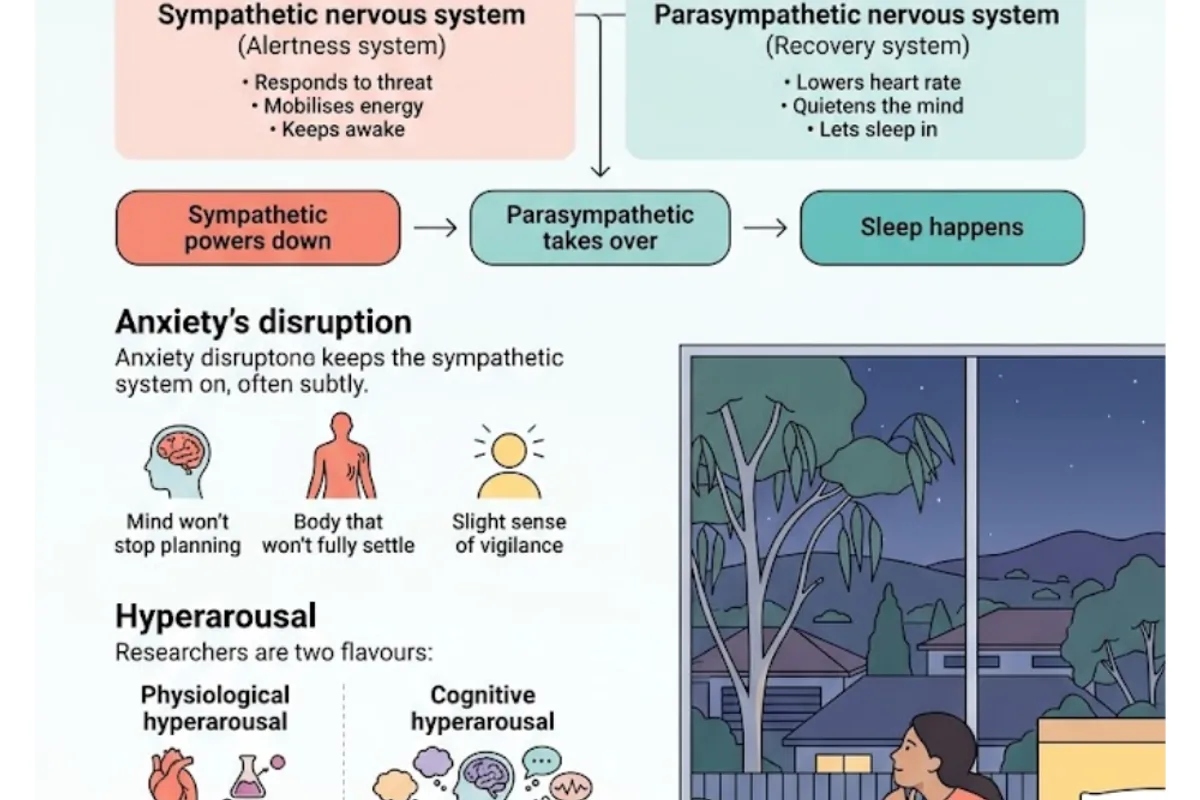
Sleep is not just the absence of wakefulness. It is an actively regulated state, and it depends on a handover between two systems in the brain.
The sympathetic nervous system is the alertness system — the one that responds to threat, mobilises energy, and keeps us awake. The parasympathetic nervous system is the recovery system — the one that lowers heart rate, quietens the mind, and lets sleep in.
For sleep to happen, the sympathetic system needs to power down and the parasympathetic system needs to take over. Anxiety does something specific: it keeps the sympathetic system on. Not always dramatically. Often quite subtly. A mind that will not stop planning, a body that will not fully settle, a slight sense of vigilance that never really goes away.
Researchers describe this as hyperarousal, and it comes in two flavours:
- Physiological hyperarousal — a raised heart rate, muscle tension, cortisol running higher than it should at bedtime
- Cognitive hyperarousal — a mind that keeps scanning, worrying, rehearsing, and problem-solving when it should be quietening
Cognitive hyperarousal is the more clinically important of the two for anxious sleepers. It is what people mean when they say “my body is exhausted but my brain will not stop.” And it is exactly what CBT-I is designed to address.
The Bidirectional Loop — Why It Feeds Itself
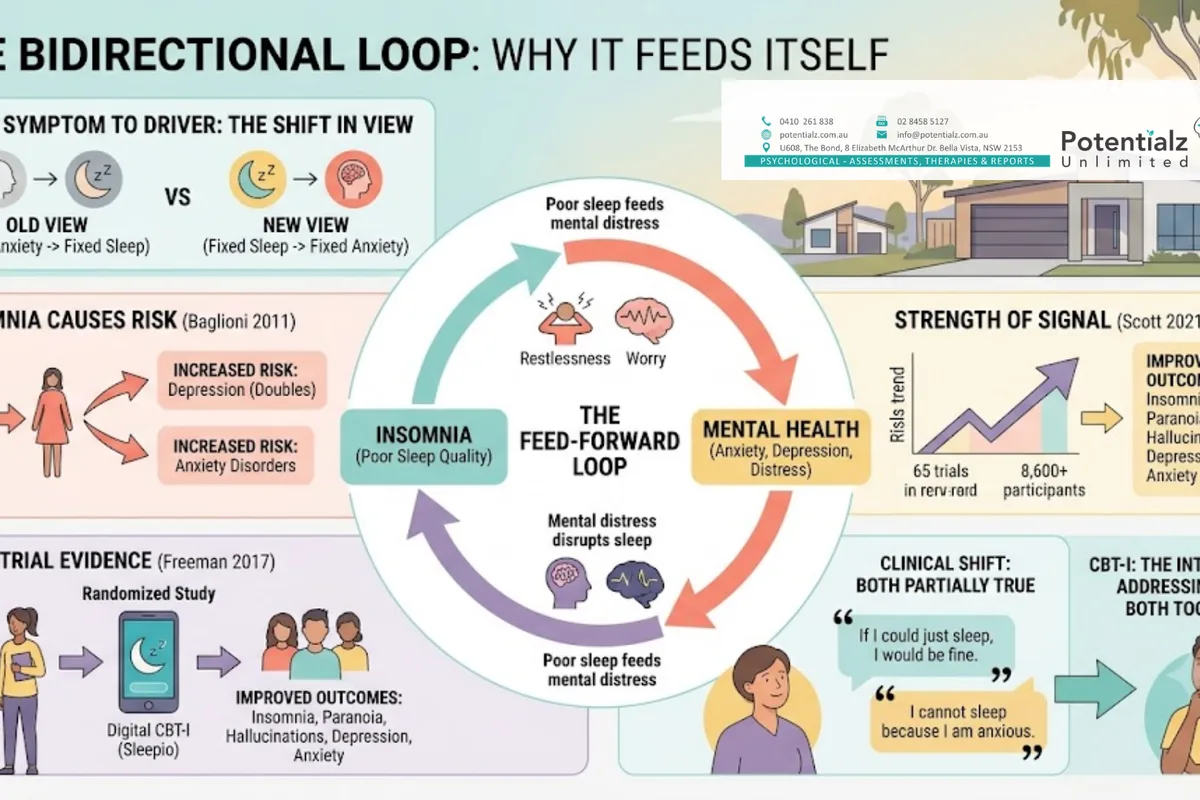
For a long time, insomnia was viewed mainly as a symptom of anxiety and depression. If you fixed the anxiety, the sleep would follow. In the last 20 years that view has flipped.
A meta-analysis by Baglioni and colleagues (2011) pooled 21 prospective studies and found that insomnia doubles the risk of developing depression later, and independently raises the risk of anxiety disorders. That is a causal direction the old view missed.
A landmark randomised controlled trial by Freeman and colleagues (2017) — the OASIS trial — took this further. Nearly 3,800 university students with sleep problems were randomised to a digital CBT-I program (Sleepio) or usual care. Improving sleep produced improvements not only in insomnia but in paranoia, hallucinations, depression, and anxiety. In other words: sleep is not just a symptom that follows mental health. It is a causal driver of mental health.
A 2021 meta-analysis in Sleep Medicine Reviews by Scott and colleagues pooled 65 randomised trials with more than 8,600 participants. Interventions that improved sleep produced medium-sized improvements in mental health, and the bigger the sleep improvement, the bigger the mental health gain. That is about as clean a causal signal as behavioural research produces.
Clinically, this changes the conversation. When an anxious client says “if I could just sleep, I would be fine,” they are not entirely wrong. And when they say “I cannot sleep because I am anxious,” they are not entirely wrong either. Both are partially true. The intervention that helps them both, together, is CBT-I.
What Sleep Problems Look Like When Anxiety Is the Driver
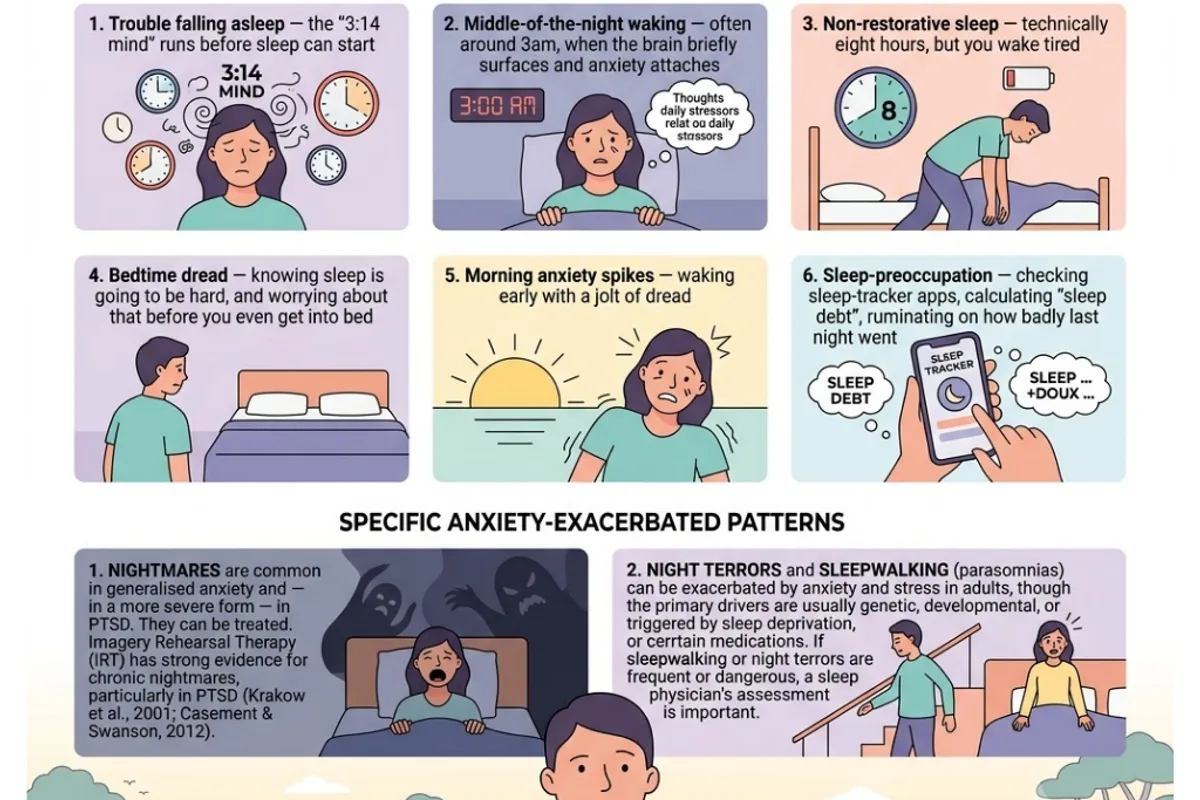
Not every sleep problem is anxiety-driven. But anxiety-driven sleep problems have some recognisable features:
- Trouble falling asleep — the “3:14 mind” runs before sleep can start
- Middle-of-the-night waking — often around 3am, when the brain briefly surfaces and anxiety attaches
- Non-restorative sleep — technically eight hours, but you wake tired
- Bedtime dread — knowing sleep is going to be hard, and worrying about that before you even get into bed
- Morning anxiety spikes — waking early with a jolt of dread
- Sleep-preoccupation — checking sleep-tracker apps, calculating “sleep debt”, ruminating on how badly last night went
Two specific patterns deserve mention.
Nightmares are common in generalised anxiety and — in a more severe form — in PTSD. They can be treated. Imagery Rehearsal Therapy (IRT) has strong evidence for chronic nightmares, particularly in PTSD (Krakow et al., 2001; Casement & Swanson, 2012).
Night terrors and sleepwalking (parasomnias) can be exacerbated by anxiety and stress in adults, though the primary drivers are usually genetic, developmental, or triggered by sleep deprivation, alcohol, or certain medications. If sleepwalking or night terrors are frequent or dangerous, a sleep physician’s assessment is important. Our post on what causes sudden night terrors in adults covers this in more depth.
What Does Not Work — and Why
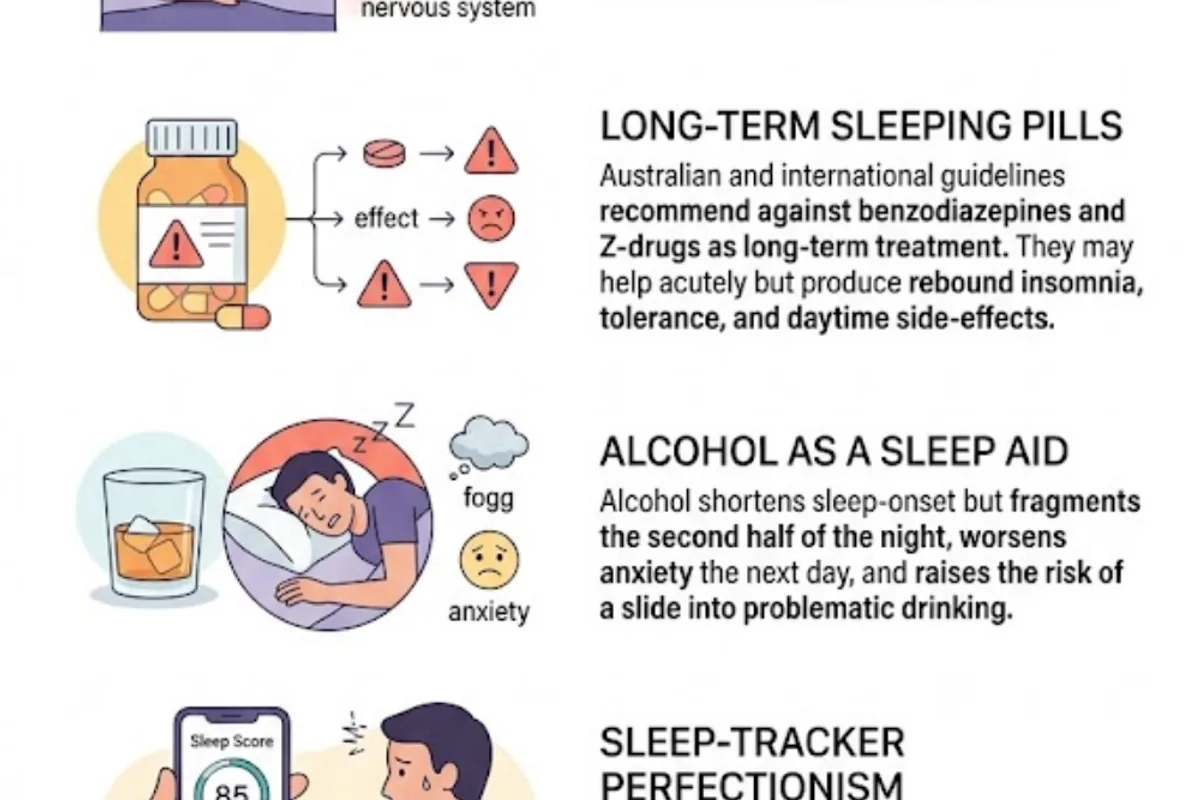
Before what works, a short list of what does not — because the anxious mind gravitates toward these:
- Trying harder to sleep. Effortful trying activates the sympathetic system. The more you push, the more awake you get. Willpower is the wrong tool.
- Long-term sleeping pills. Australian and international guidelines recommend against benzodiazepines and Z-drugs as long-term treatment. They may help acutely but produce rebound insomnia, tolerance, and daytime side-effects.
- Alcohol as a sleep aid. Alcohol shortens sleep-onset but fragments the second half of the night, worsens anxiety the next day, and raises the risk of a slide into problematic drinking.
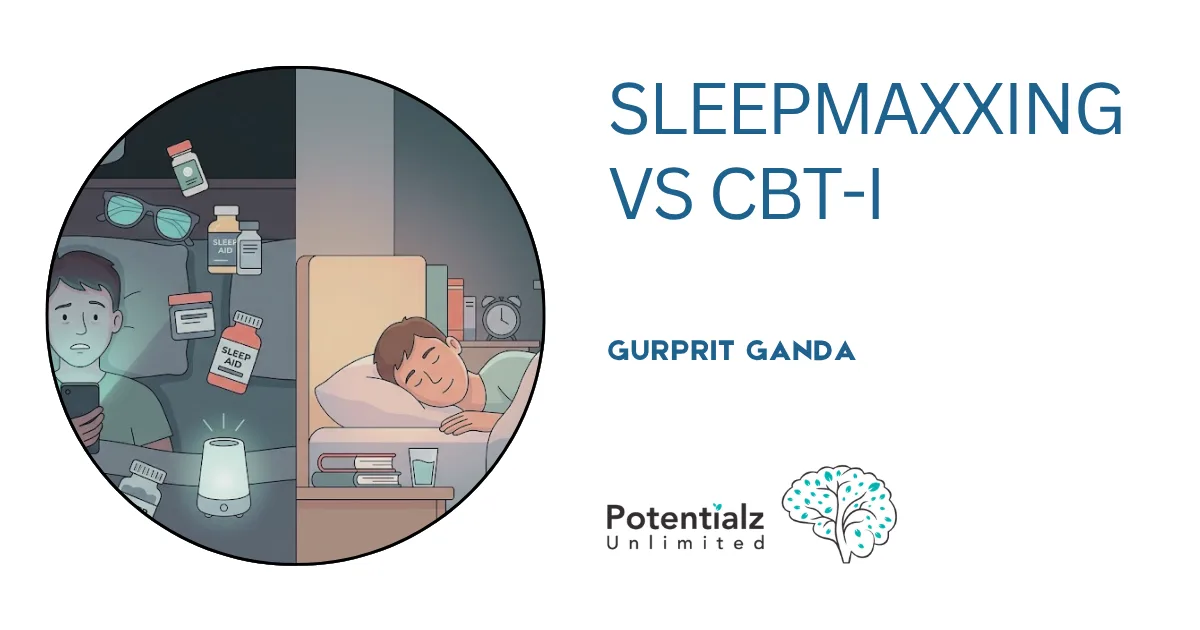
- Sleep-tracker perfectionism. The obsessive monitoring of a sleep score is a known trap — “orthosomnia” — that worsens anxiety about sleep and creates the very problem it tries to measure (Baron et al., 2017).
- Compensating naps. Long daytime naps steal sleep pressure from the coming night. Short strategic naps (under 20 minutes, before 3pm) are usually fine.
What Actually Works: CBT-I
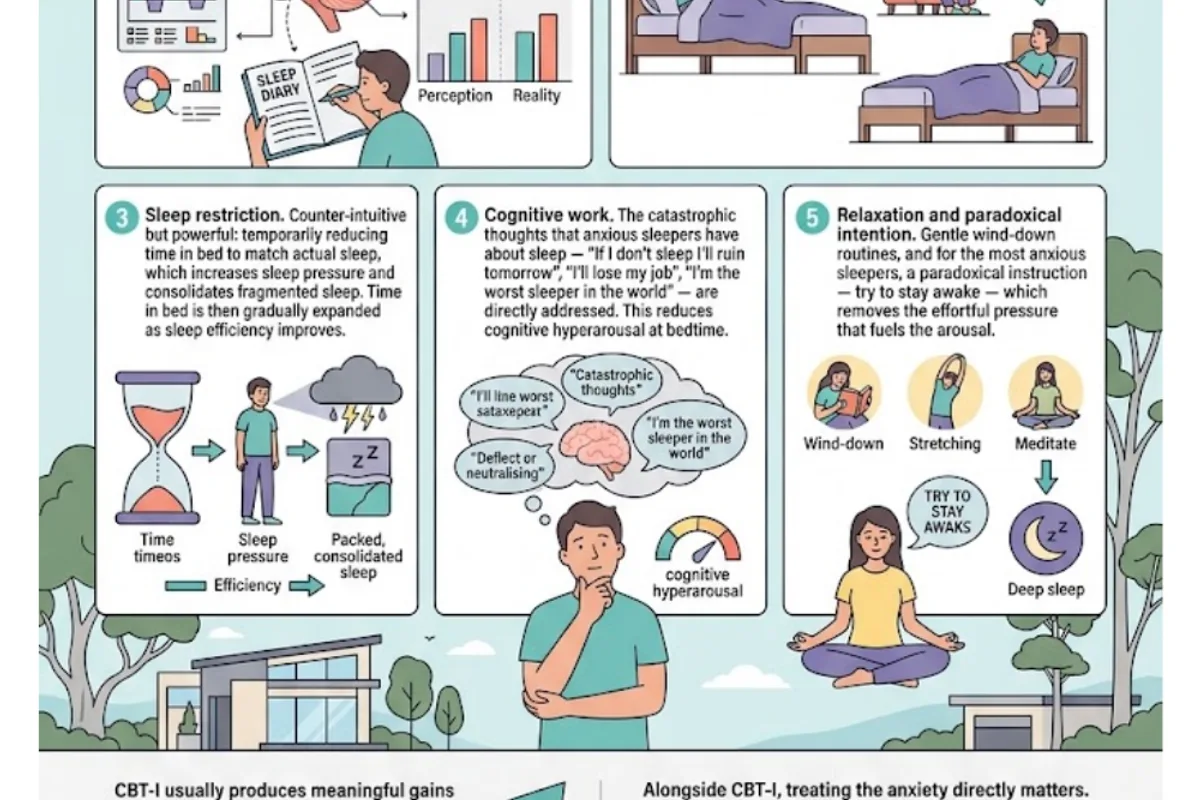
CBT-I is a structured 6–8 session psychological treatment that is now the recommended first-line therapy for chronic insomnia in almost every international guideline. It has five main components:
1. Sleep education and monitoring. Understanding sleep cycles, sleep pressure, and what is happening in your specific pattern. A sleep diary maps the reality — which is usually different from the perception.
2. Stimulus control. The bed is for sleep only. If you are awake for more than about 20 minutes, you get up and go somewhere else until sleepy — then return. Over time this rebuilds the brain’s association between “bed” and “sleep”.
3. Sleep restriction. Counter-intuitive but powerful: temporarily reducing time in bed to match actual sleep, which increases sleep pressure and consolidates fragmented sleep. Time in bed is then gradually expanded as sleep efficiency improves.
4. Cognitive work. The catastrophic thoughts that anxious sleepers have about sleep — “If I don’t sleep I’ll ruin tomorrow”, “I’ll lose my job”, “I’m the worst sleeper in the world” — are directly addressed. This reduces cognitive hyperarousal at bedtime.
5. Relaxation and paradoxical intention. Gentle wind-down routines, and for the most anxious sleepers, a paradoxical instruction — try to stay awake — which removes the effortful pressure that fuels the arousal.
CBT-I usually produces meaningful gains within 3–4 weeks. It is a highly structured, protocol-driven treatment — which is why it can also be delivered effectively as a digital program, as OASIS demonstrated.
Alongside CBT-I, treating the anxiety directly matters. For generalised anxiety, CBT and ACT have strong support. For anxiety with a trauma root, trauma-focused approaches (including EMDR) can substantially reduce the night-time reactivity that keeps sleep fragmented. Our related posts on when to seek help for managing anxiety and sleep and mental health explore both sides of the loop in more detail.
Practical First Steps While You Book an Appointment
None of these replace CBT-I, but most of them make the first appointment more productive:
- Consistent wake time every day, weekends included — this is the single strongest sleep-regulation lever
- No caffeine after midday
- Get outside within an hour of waking — bright light anchors the body clock
- Wind-down routine — same order, low lights, no work emails, phone out of the bedroom
- Bedroom = sleep and intimacy only — not the office, not the doomscroll station
- The 20-minute rule — if you are awake and frustrated for more than about 20 minutes, get up quietly, sit in low light with a boring book, return when sleepy
- Keep a brief sleep diary for two weeks before your appointment — it makes the assessment much more accurate
If your low mood or worry ever brings thoughts of not wanting to be here, please reach out for urgent support now: call Lifeline on 13 11 14, or in an emergency call 000.
How Potentialz Unlimited Can Help
Potentialz Unlimited is a clinical psychology practice based in Bella Vista, NSW, serving individuals and families across the Hills District — Norwest, Castle Hill, Kellyville, Baulkham Hills, Rouse Hill, and Glenhaven.
I am Dr Gurprit Ganda, a Clinical Psychologist with over 25 years of experience across anxiety, chronic insomnia, and the sleep–anxiety loop. I use CBT-I for insomnia and CBT and ACT for anxiety — with EMDR added where sleep problems have a trauma root. Sessions available in English, Hindi, Punjabi, and Urdu. Medicare rebates available with a GP Mental Health Care Plan. You can contact the clinic or book directly at live.potentialz.com.au.
References
Baglioni, C., Battagliese, G., Feige, B., Spiegelhalder, K., Nissen, C., Voderholzer, U., Lombardo, C., & Riemann, D. (2011). Insomnia as a predictor of depression: A meta-analytic evaluation of longitudinal epidemiological studies. Journal of Affective Disorders, 135(1–3), 10–19. https://doi.org/10.1016/j.jad.2011.01.011
Baron, K. G., Abbott, S., Jao, N., Manalo, N., & Mullen, R. (2017). Orthosomnia: Are some patients taking the quantified self too far? Journal of Clinical Sleep Medicine, 13(2), 351–354. https://doi.org/10.5664/jcsm.6472
Casement, M. D., & Swanson, L. M. (2012). A meta-analysis of imagery rehearsal for post-trauma nightmares: Effects on nightmare frequency, sleep quality, and posttraumatic stress. Clinical Psychology Review, 32(6), 566–574. https://doi.org/10.1016/j.cpr.2012.06.002
Freeman, D., Sheaves, B., Goodwin, G. M., Yu, L.-M., Nickless, A., Harrison, P. J., Emsley, R., Luik, A. I., Foster, R. G., Wadekar, V., Hinds, C., Gumley, A., Jones, R., Lightman, S., Jones, S., Bentall, R., Kinderman, P., Rowse, G., Brugha, T., … Espie, C. A. (2017). The effects of improving sleep on mental health (OASIS): A randomised controlled trial with mediation analysis. The Lancet Psychiatry, 4(10), 749–758. https://doi.org/10.1016/S2215-0366(17)30328-0
Krakow, B., Hollifield, M., Johnston, L., Koss, M., Schrader, R., Warner, T. D., Tandberg, D., Lauriello, J., McBride, L., Cutchen, L., Cheng, D., Emmons, S., Germain, A., Melendrez, D., Sandoval, D., & Prince, H. (2001). Imagery rehearsal therapy for chronic nightmares in sexual assault survivors with posttraumatic stress disorder: A randomized controlled trial. JAMA, 286(5), 537–545. https://doi.org/10.1001/jama.286.5.537
Scott, A. J., Webb, T. L., Martyn-St James, M., Rowse, G., & Weich, S. (2021). Improving sleep quality leads to better mental health: A meta-analysis of randomised controlled trials. Sleep Medicine Reviews, 60, 101556. https://doi.org/10.1016/j.smrv.2021.101556
Knowledge Check Quiz
Test what you have just read. Choose your answer for each question, then submit to reveal the answers and your score.
Need Professional Support?
If you're experiencing mental health concerns, our team is here to help.