Learning about the National Disability Insurance Scheme (NDIS) can feel like learning a new language. There are funding types, plan types, forms, and reviews. On top of that, you are trying to find the right help for your child. Maybe someone told you play therapy could help. You might wonder if it fits your NDIS plan. You might wonder how to start.
This guide answers those questions in plain words. At Potentialz Unlimited in Bella Vista, our play therapy team works with many NDIS families. We support kids aged 3 to 12. This guide shows how play therapy can help your child grow. It also shows how NDIS funding works.
What Is the NDIS?
The National Disability Insurance Scheme is run by the Australian government. It gives money to people with a lasting, serious disability. The scheme lets people choose their own support. It helps them work toward their goals.
For children, the NDIS can fund many kinds of help. This can include early therapy, gear, and programs that help kids join in with their community. To get funding, the support must be needed and must make sense. It must also link to the child’s disability and their NDIS goals.
Children can join the NDIS from birth. Many join through the Early Childhood Approach. This is for children under nine who have a delay in their growth, or a disability.
Which Children May Be Eligible for NDIS Funding?
Your child may get NDIS funding if they have a lasting, serious disability. They may also qualify if they are under nine and behind in their growth. Some things that often lead to NDIS funding for children are:
- Autism Spectrum Disorder (ASD) — ASD is one of the top reasons kids join the NDIS. Many children with ASD get NDIS funding from a young age.
- Attention-Deficit/Hyperactivity Disorder (ADHD) — ADHD may qualify if it has a big effect on daily life. Not every child with ADHD will qualify.
- Intellectual disability — Children with an intellectual disability often need a lot of help, and the NDIS can fund this.
- Developmental delay — Children under nine who are behind in talking, social skills, moving, or thinking may qualify.
- Childhood trauma — This counts when trauma has a lasting, or likely lasting, effect on how a child copes.
- Speech and language disorders that have a big effect on talking and joining in.
- Other conditions — other brain-related or body-related conditions that affect daily life.
The NDIS decides who qualifies. Having a diagnosis does not always mean your child will get funding. A key step is a functional assessment — a check on what your child can and can’t do day to day.
How Does Play Therapy Fit Into an NDIS Plan?
Play therapy can be funded under the Capacity Building part of an NDIS plan. Capacity Building helps people build skills and take part in daily life. Two parts of this matter most for play therapy:
Improved Daily Living (CB Daily Activity) — This funds support that helps a child do daily tasks, manage their behaviour, talk better, and cope with big feelings. Play therapy that works on these goals fits here.
Improved Relationships (CB Relationships) — This is about building social skills, family bonds, and calm behaviour. Play therapy that works on friendships and family ties fits well here too.
When your child’s plan is made, it helps to write play therapy goals in clear words. Do this both in the plan and in the service agreement with your provider. Goals might sound like “cope with big feelings at home and school,” “build social skills with peers,” or “manage change and new routines.”
Not sure how to word play therapy goals in your child’s NDIS plan? Our team is happy to talk with your planner or support coordinator. We can explain what play therapy involves and how it helps your child’s NDIS goals.
What Do NDIS Play Therapy Sessions Look Like?
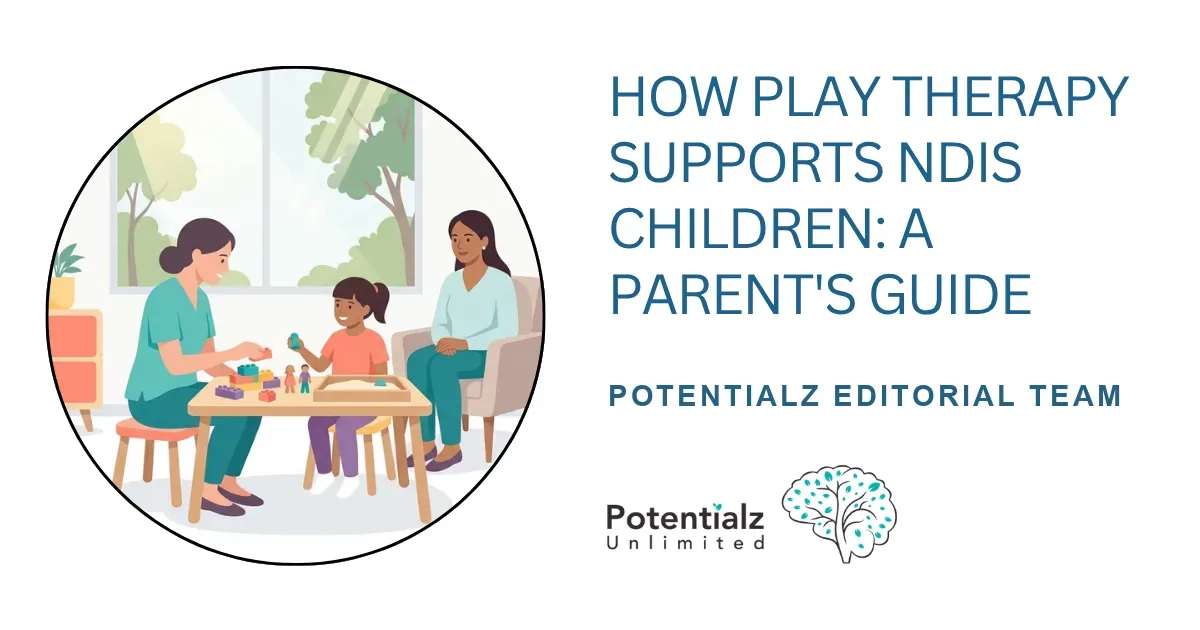
Play therapy for NDIS families at Potentialz Unlimited works the same way as all our sessions. It puts your child first and follows good research. But it also links clearly to your child’s NDIS goals.
Before therapy starts, our team does a first check-in. This looks at your child’s growth, their NDIS goals, and what matters most to your family. It guides the approach we use and the skills we work on.
Sessions for children with ASD might work on shared focus, flexible thinking, calm senses, and social play. The LEGO® Based Therapy approach suits many of these children well. You can read more in our guide to play therapy and social skills for autistic children. Sessions for children with a delay might work on talking, following steps, and playing on their own. Sessions for children who have been through trauma might use Synergetic Play Therapy. This helps calm the body’s stress response and build a sense of safety with caregivers.
Each session runs for about 50 minutes. Parents get a short note after each session. This covers what was worked on and tips to help at home. We keep progress notes in line with NDIS rules. Our team can also write reports for plan reviews when needed.
ASD and Play Therapy Under the NDIS
Children with ASD often need help in many areas. Play therapy is one of a few well-researched options that can be part of a wider NDIS support plan. Research suggests play therapy can help children with ASD talk and connect with others, cope with big feelings, and think in more flexible ways (Ray et al., 2015).
Play therapy does not try to change who a child with ASD is. Instead, it helps children build the skills and inner strength they need to take part in their world, in their own way. The child-centred approach at Potentialz respects each child’s unique mind and treats them as an individual.
Many families with autistic children use play therapy along with other NDIS-funded help, such as speech therapy, occupational therapy, and behaviour support. Play therapy adds to this by focusing on feelings and relationships.
ADHD and Play Therapy Under the NDIS
Children with ADHD who qualify for NDIS funding can use play therapy under Capacity Building. This can help with acting on impulse, big feelings, social skills, and self-worth. Research suggests play therapy can make a real difference here (Ray et al., 2007).
Play therapy sessions for children with ADHD have clear structure and are fun. This suits children who find it hard to sit still, or to sit through adult-led, talk-heavy therapy. We use LEGO® Based Therapy, art, sand tray, and movement play, so sessions stay active and varied.
Many children with ADHD also have anxiety. Play therapy can help with both at once. For more, visit our ADHD psychology page.
Developmental Delay and Play Therapy Under the NDIS
Children with a delay may find talking, social skills, self-care, moving, or thinking hard. Play therapy under the NDIS aims to build a child’s growth through play. Play is the way young children learn best and enjoy most.
For children under nine who get NDIS funding through the Early Childhood Approach, play-based therapy is often the top pick. This is because it suits their age and helps build basic skills well. Sessions may mix in speech and language activities, social skills practice, and sensory play, based on the child.
Trauma and Play Therapy Under the NDIS
Some children get NDIS funding because early trauma has had a serious effect on how they cope. This can include neglect, abuse, family violence, or other hard early events. These children may struggle with big feelings, trust, pulling away from others, anger, or anxiety.
Play therapy can help these children. This is true above all for trauma-aware approaches like Synergetic Play Therapy. A trusting bond with the practitioner, a steady, predictable routine, and safe play all support healing. For more on this kind of support, visit our anxiety psychology page.
Plan Management: Self-Managed, Plan-Managed, and NDIA-Managed
How your NDIS money is managed changes how you access and pay for play therapy.
Self-managed families can use any provider, listed or not. You pay the bill and claim it back from the NDIS. This gives you the most choice.
Plan-managed families have a plan manager who handles the money for them. You still pick your own providers, but the plan manager pays the bills. Most families find this a good mix of choice and ease.
NDIA-managed (agency-managed) families can only use NDIS-listed providers. Potentialz Unlimited is not a registered NDIS provider, so agency-managed funding cannot be used for sessions with us. If your child’s plan is agency-managed and you want to see us, you can ask to switch to plan-managed or self-managed at your next plan review.
Not sure which type suits your family? A Local Area Coordinator (LAC) or Support Coordinator can help you work it out.
Getting Started at Potentialz Unlimited
Starting play therapy at Potentialz Unlimited is simple. Here is how it works:
-
Make contact. Call us on 0410 261 838 or book online at live.potentialz.com.au. Tell us your child has an NDIS plan so we can guide you through the next steps.
-
First check-in. Your first visit is a check-in session. Your practitioner learns about your child’s growth, their NDIS goals, and what matters to your family. They explain the approach they suggest and what progress might look like.
-
Service agreement. We set up a service agreement. This lists the support, how often sessions happen, the cost, and the goals. NDIS families need this document.
-
Ongoing sessions. Sessions are usually weekly or every two weeks. This depends on your child’s needs and your plan funding.
-
Review. Your practitioner gives you regular updates on progress. They can also write a report for NDIS plan reviews if you need one.
Key Takeaways
- The NDIS funds support for children with a disability or a delay in growth, including therapy from play therapists.
- Play therapy can be funded under Capacity Building — Improved Daily Living or Improved Relationships.
- It can help children with ASD, ADHD, a delay in growth, and trauma.
- Plan-managed and self-managed families can see a play therapist at Potentialz Unlimited.
- Sessions match each child’s NDIS goals, with regular progress notes.
- Potentialz Unlimited is in Bella Vista. We see children aged 3–12, Monday to Friday, 10am–7pm.
How Potentialz Can Help
At Potentialz Unlimited, we know NDIS families are dealing with a tricky system. You are also raising a child with extra needs, day to day. Our goal is to make the therapy part of that journey as smooth as we can.
Our team works with children aged 3 to 12. We have experience with families from many backgrounds, including Australian, South African, and Indian families. We are happy to talk with your support coordinator, plan manager, or other therapists, so everyone works together.
Want to talk about whether play therapy is right for your NDIS child? We warmly invite you to reach out. You may also find our other guide, NDIS psychology and psychological support, useful.
Book a session online: live.potentialz.com.au Call us: 0410 261 838 Visit us: Unit 608, 8 Elizabeth Macarthur Drive, Bella Vista NSW 2153 Hours: Monday to Friday, 10am–7pm
You can also read more about our play therapy services and NDIS psychology support on our website.
References
Bratton, S. C., Ray, D., Rhine, T., & Jones, L. (2005). The efficacy of play therapy with children: A meta-analytic review of treatment outcomes. Professional Psychology: Research and Practice, 36(4), 376–390. https://doi.org/10.1037/0735-7028.36.4.376
Ray, D. C., Schottelkorb, A., & Tsai, M. H. (2007). Play therapy with children exhibiting symptoms of attention deficit hyperactivity disorder. International Journal of Play Therapy, 16(2), 95–111. https://doi.org/10.1037/1555-6824.16.2.95
Ray, D. C., Armstrong, S. A., Balkin, R. S., & Jayne, K. M. (2015). Child-centered play therapy in the schools: Review and meta-analysis. Psychology in the Schools, 52(2), 107–123. https://doi.org/10.1002/pits.21798
Stagnitti, K., & Cooper, R. (2009). Play as therapy: Assessment and therapeutic interventions. Jessica Kingsley Publishers.
AHPRA Disclaimer: This information is general in nature. Please consult a qualified health professional for individual advice.
Crisis Resources: If you or someone you know needs support, please contact Lifeline on 13 11 14, Beyond Blue on 1300 22 4636, or Kids Helpline on 1800 55 1800.
Knowledge Check Quiz
Test what you have just read. Choose your answer for each question, then submit to reveal the answers and your score.
Need Professional Support?
If you're experiencing mental health concerns, our team is here to help.