Key Takeaways
- NDIS psychology covers psychological therapy, functional capacity assessments, behaviour support, and capacity building for eligible participants.
- Eligible participants include people with autism, intellectual disability, psychosocial disability, acquired brain injury, and other disabilities with a permanent, significant functional impact.
- Psychology is typically funded through the “Improved Daily Living” or “Capacity Building” budget categories in an NDIS plan.
- Functional capacity assessments (FCAs) are comprehensive reports documenting how disability affects daily living, work, and social participation — used in NDIS planning and reviews.
- Sushama Sathe has 11 years of direct clinical autism and disability experience at the Royal Institute for Deaf and Blind Children, plus prior experience with functional disability assessments using DADHC tools and Centrelink job capacity assessments.
- Telehealth (phone or Zoom) is available for NDIS participants who cannot travel to Bella Vista.
- Sushama speaks English, Hindi, Marathi, and Punjabi — a significant advantage for NDIS participants from CALD backgrounds navigating a complex system.
Understanding What NDIS Psychology Actually Is
The National Disability Insurance Scheme is Australia’s framework for funding support and services for people with permanent and significant disability. Within that framework, psychology is a funded support — but it is one that many NDIS participants, families, and even support coordinators do not fully understand. What exactly does a psychologist do under NDIS? Who is eligible? How is it funded? And what does it actually look like in practice?
In my 20 years as a registered psychologist, the work I have done within disability settings has been among the most clinically rich and practically meaningful of my career. From 2012 to 2023, I worked at the Royal Institute for Deaf and Blind Children (RIDBC), providing psychological services to autistic children and adults — cognitive assessment, functional assessment, behaviour management, anxiety management, and extensive NDIS liaison. Before NDIS was introduced, I worked at Assessments Australia in 2006, assessing functional disabilities using DADHC (Department of Ageing, Disability and Home Care) tools. In 2011–2012, I undertook job capacity assessments and cognitive assessments at Centrelink.
All of that experience is what I bring to my NDIS work at Potentialz Unlimited in Bella Vista.
This post is my practical guide to NDIS psychology — written to give participants, families, and referrers a clear, honest picture of what psychology can provide and how to access it.
Who Can Access NDIS Psychology?
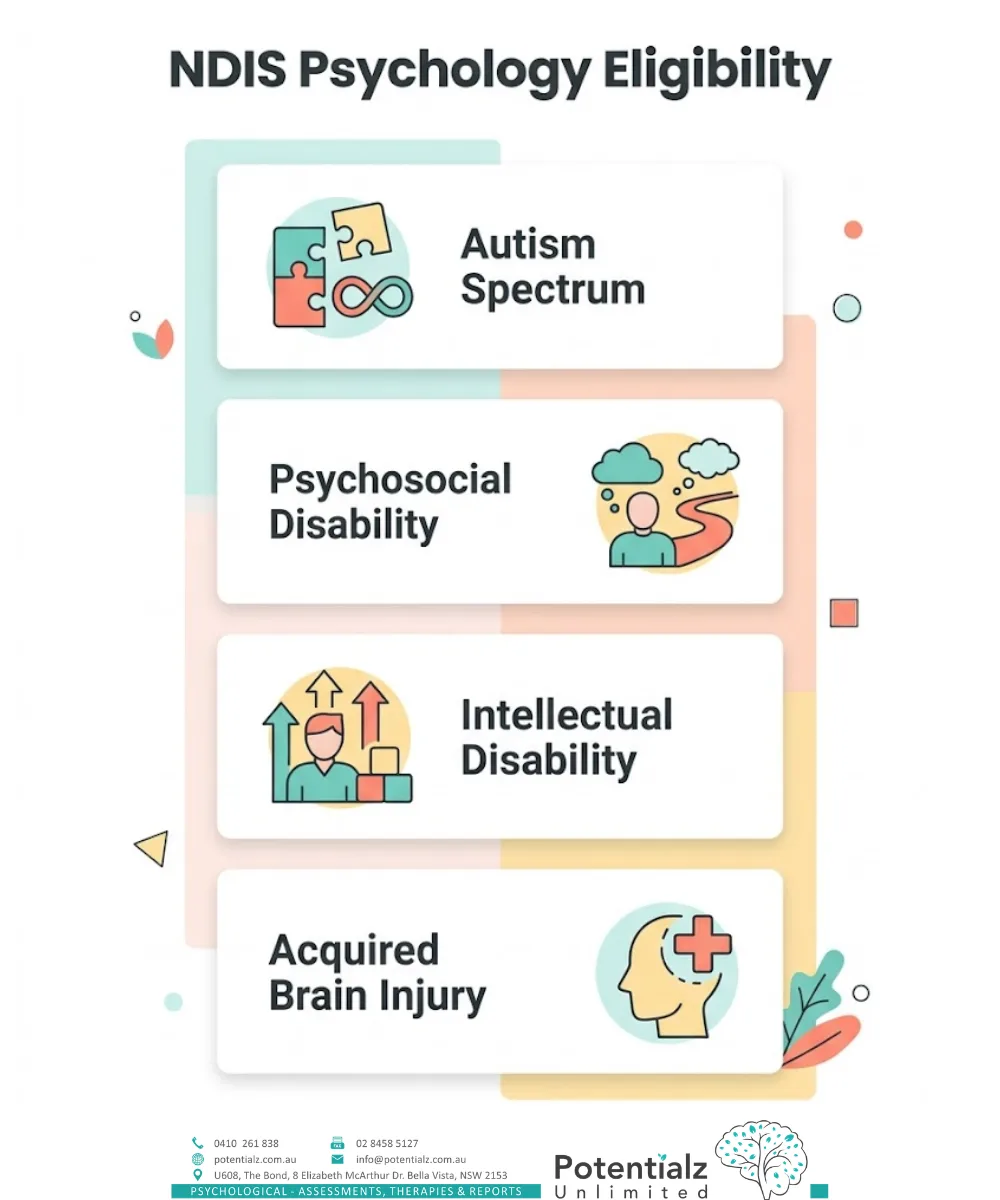
NDIS psychology is available to participants whose plan includes funding for psychological support. That funding is typically included when a participant has one of the following:
Autism Spectrum Disorder. Autism is one of the most common primary disability categories in the NDIS. Psychology can address the co-occurring mental health conditions that are extremely common in autistic participants (anxiety, depression, emotional regulation difficulties), as well as providing functional capacity assessments and contributing to behaviour support.
Intellectual disability. Psychology can provide assessments of cognitive functioning and adaptive behaviour, contribute to behaviour support planning, and provide adapted therapeutic support depending on the participant’s level of functioning.
Psychosocial disability. This refers to significant, long-term functional impairment arising from mental health conditions — such as severe, treatment-resistant depression, bipolar disorder, schizophrenia, PTSD, or severe anxiety disorders. Psychosocial disability participants can access psychology for ongoing therapeutic support, capacity building, and functional assessment.
Acquired brain injury (ABI). Psychology contributes to cognitive assessment, rehabilitation support, and psychosocial adjustment for participants with ABI.
Other disability categories where there is a significant psychological or behavioural component — including physical disability, sensory disability, neurological conditions — may also include psychology in the plan.
Access to NDIS begins with a referral to the NDIS and an access decision. For participants already in the scheme, psychology support needs to appear in the plan — either as a specific line item, or under a broader Capacity Building or Improved Daily Living budget.
What a Psychologist Can Provide Under NDIS
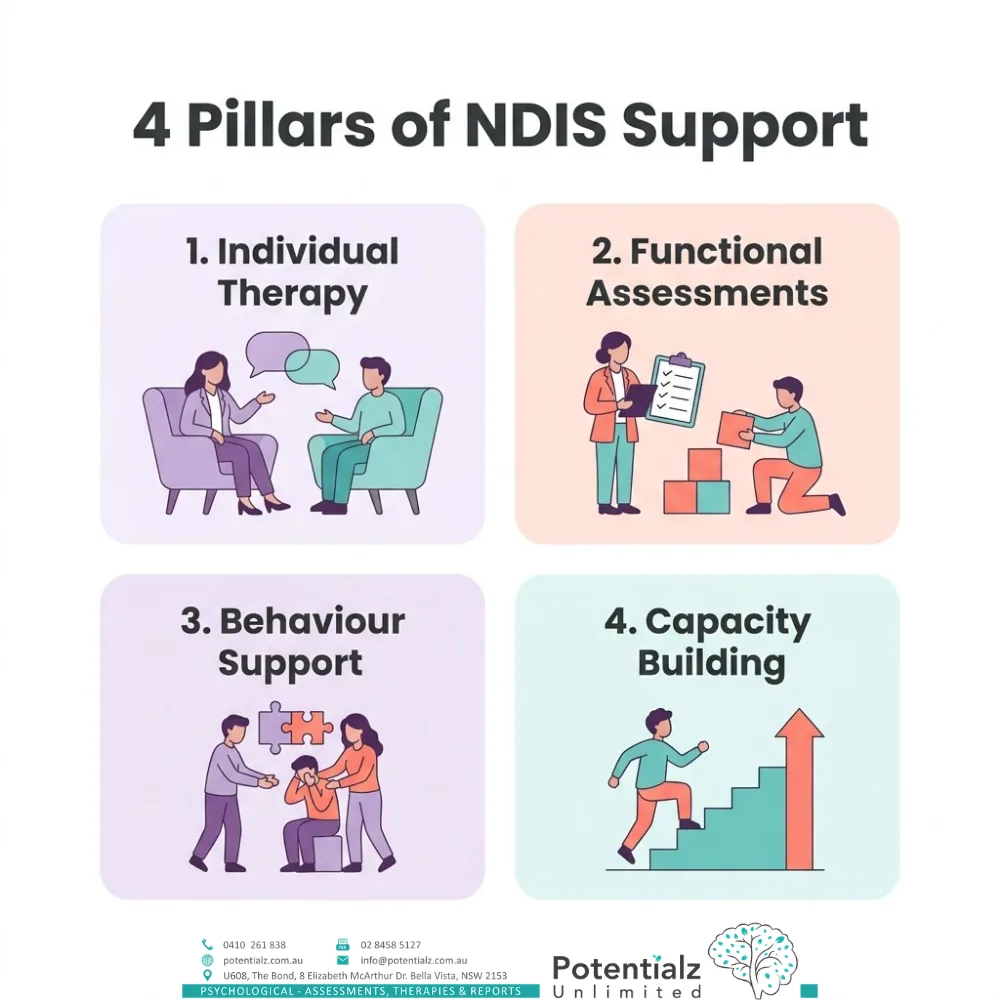
There are four main categories of psychological service that I provide under NDIS at Potentialz Unlimited.
1. Psychological Therapy
This includes individual therapy sessions using evidence-based approaches — CBT, ACT, and mindfulness-based strategies — for mental health conditions that affect daily living and social participation. Common presentations include:
- Anxiety (including social anxiety, generalised anxiety, phobias, and anxiety related to change and transition)
- Depression and low mood
- Emotional dysregulation — difficulty managing strong emotional responses
- Adjustment difficulties — coping with diagnosis, change, loss, or life transitions
- Self-esteem and identity, including for autistic adults navigating masking and burnout
- Stress and occupational burnout
For autistic participants in particular, I adapt how I deliver therapy — using concrete language, structured sessions, written summaries, and approaches that do not require neurotypical social conformity as a goal.
2. Functional Capacity Assessments
A functional capacity assessment (FCA) is a comprehensive written report documenting how a participant’s disability affects their ability to function in daily life — including self-care, domestic tasks, social participation, community access, and employment.
FCAs are used in NDIS planning to support funding requests, justify specific supports, and assist with plan reviews. A well-written FCA from a psychologist with genuine clinical knowledge of the participant can be the difference between a plan that actually meets a participant’s needs and one that does not.
My FCA work draws on 11 years at RIDBC and prior training in DADHC functional disability assessment tools. I understand what NDIS planners and LACs need to see, and I write FCAs that are thorough, evidence-based, and clinically defensible.
3. Behaviour Support
For participants whose disability is associated with behaviours of concern — behaviours that cause harm to themselves or others, or that significantly limit participation — psychology can contribute to behaviour support. This involves understanding the function of the behaviour (what need is it meeting?), identifying contributing factors in the environment, and developing support strategies that address those factors.
Behaviour support for NDIS participants is a regulated area. For plans that include restrictive practices, a Behaviour Support Practitioner registered with the NDIS Quality and Safeguards Commission is required for the formal Behaviour Support Plan. My contribution is typically at the assessment and strategy development level, working collaboratively with the participant’s support team.
4. Capacity Building
Capacity building refers to helping participants develop skills for daily living, self-management, and social connection. This might include social skills development, emotional regulation skills training, supported decision-making, and strategies for managing sensory sensitivities in community settings. The goal is increasing the participant’s independence and quality of life over time.
How NDIS Psychology Is Funded
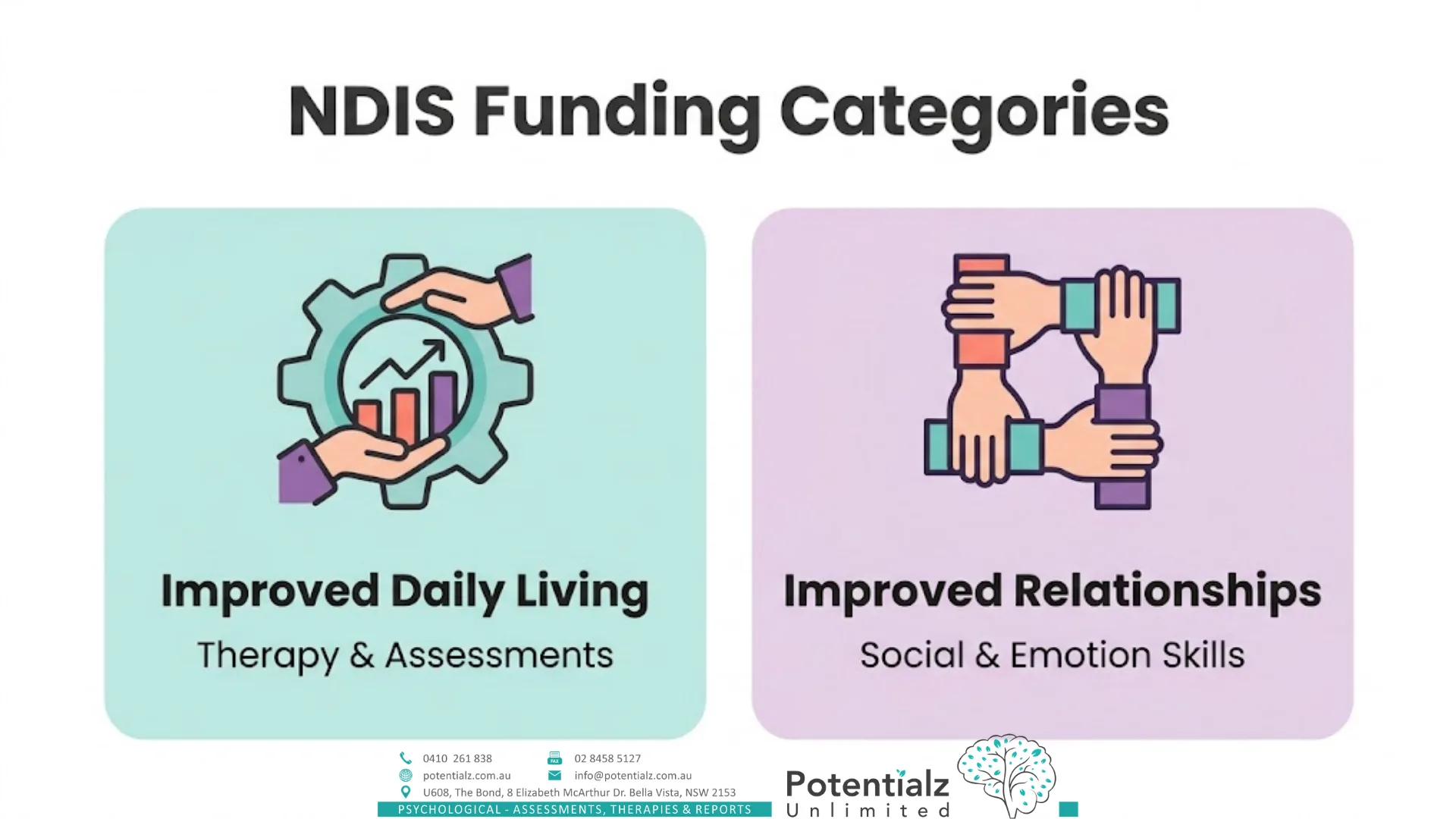
Psychology services are funded under NDIS through two main budget categories:
Improved Daily Living (IDL) — this is the most common pathway for psychological therapy. IDL funding is for supports that help participants improve their daily living skills and participation. Psychology is listed as an eligible IDL support.
Capacity Building: Improved Relationships — this category funds supports that help participants improve their social and community participation, including therapeutic work on emotional regulation, social skills, and relationship skills.
Support Coordination or Specialist Support Coordination budgets may also be used to fund coordination of psychological services, though not the therapy itself.
The NDIS uses a published price guide (the NDIS Support Catalogue) that sets maximum prices for each type of support. I follow the current NDIS pricing schedule for all NDIS-funded services at Potentialz Unlimited.
If you are a self-managed or plan-managed participant, you can book directly with me and use your NDIS funding for my services. Agency-managed (NDIA-managed) funding can only be used with registered NDIS providers, and Potentialz Unlimited is not a registered NDIS provider, so agency-managed funding cannot be used for my services.
Functional Capacity Assessments: What to Expect
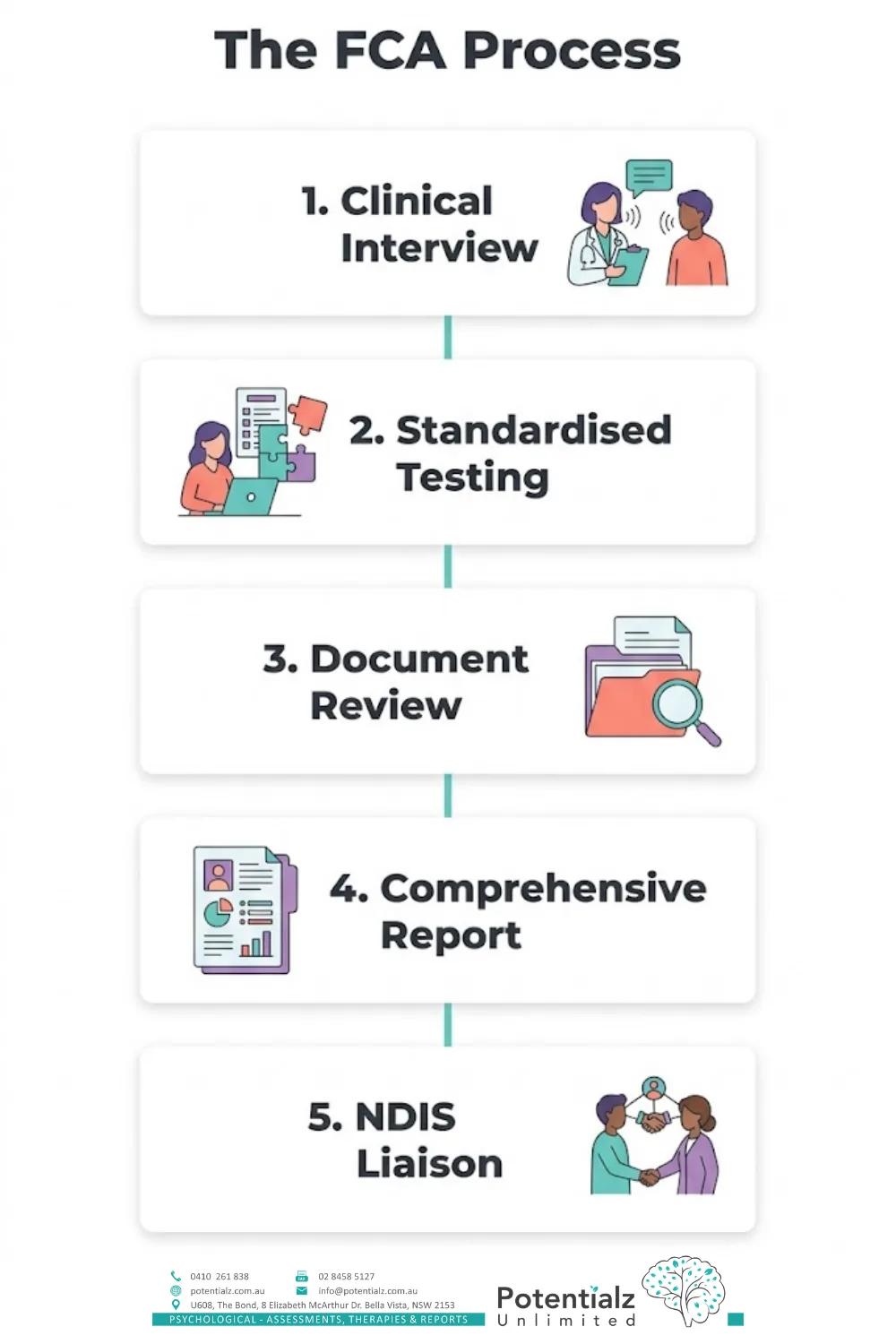
An FCA with me is a thorough, multi-session process. Here is what it typically involves:
Initial interview. We meet to gather a comprehensive history — your disability, your daily functioning, your current supports, and the areas where you are experiencing significant difficulty. I ask detailed, specific questions about how your disability affects you across different domains of life.
Standardised assessment tools. Depending on your disability type and referral question, I may use validated assessment instruments — cognitive assessments, adaptive behaviour scales, mental health measures — to provide an objective picture of your functioning.
Review of existing reports. I review previous diagnostic assessments, medical reports, and other documentation that is relevant to understanding your situation.
Written report. I produce a comprehensive written report documenting my findings, the evidence base for them, the impact on your functioning, and my recommendations for NDIS supports. I write in plain language that both planners and participants can understand.
Liaison. Where appropriate, I liaise with your support coordinator, LAC, or NDIS planner to clarify my findings or support the implementation of recommendations.
Multicultural NDIS Participants: Why Language Access Matters
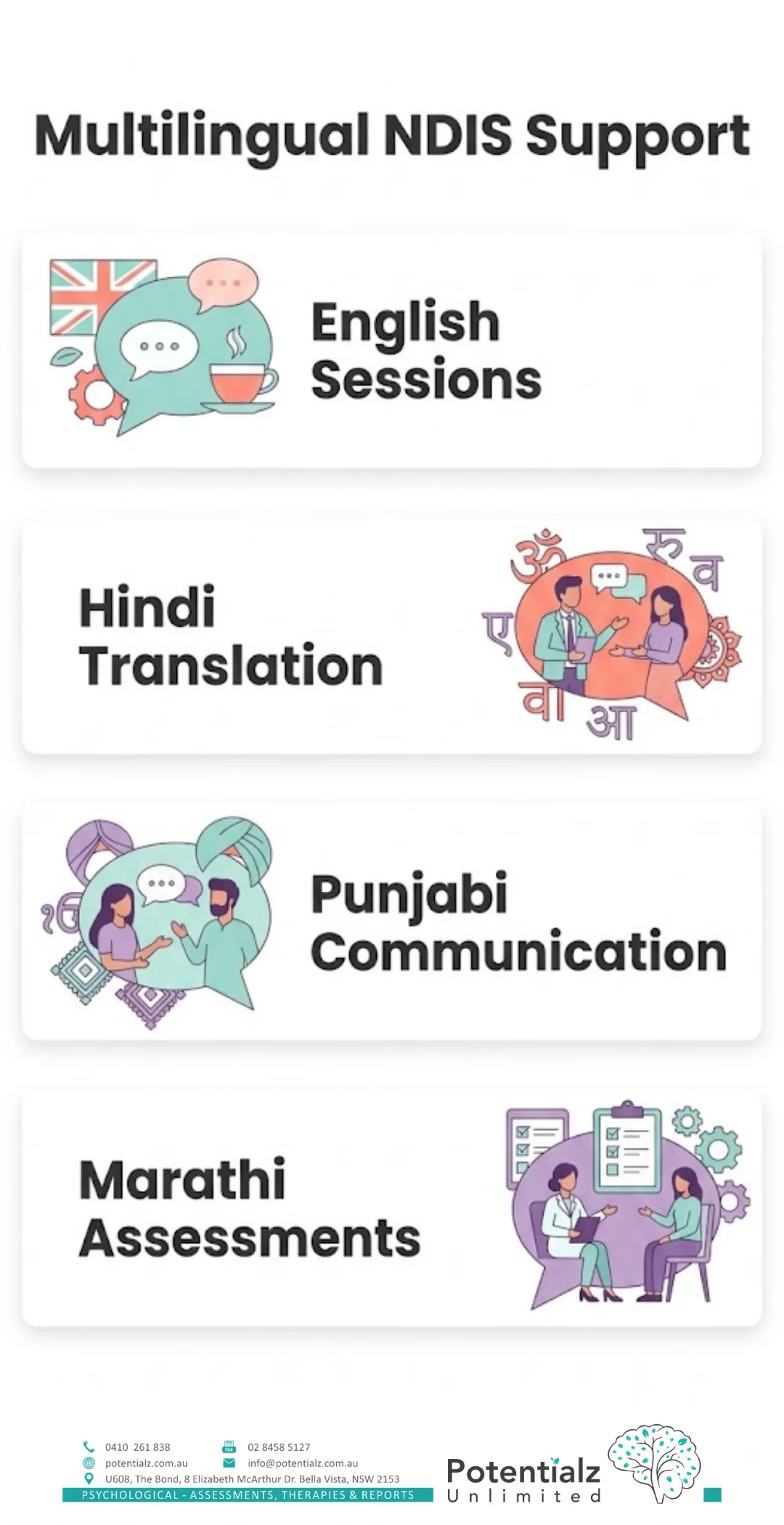
Navigating the NDIS is complex for anyone. For families from culturally and linguistically diverse backgrounds, the complexity is compounded by language barriers, unfamiliarity with Australian disability frameworks, and stigma around disability in many cultural communities.
I speak Hindi, Marathi, and Punjabi — in addition to English. For families from South Asian backgrounds, this is a genuine clinical and practical advantage. It means I can conduct assessments in the participant’s preferred language, explain findings and recommendations without relying on informal interpreters (which creates its own clinical and confidentiality problems), and understand the cultural context in which a family is navigating disability.
In 20 years of working with migrant and refugee communities, including at Medibank Health Solutions and through community seminars, I have seen how profoundly the accessibility of support changes when language is not a barrier.
Telehealth for NDIS Participants
Telehealth sessions — via phone or Zoom — are available for NDIS participants who cannot travel to Bella Vista or who live in regional or remote areas. Psychological therapy, consultation, and some aspects of assessment can be conducted via telehealth. Functional capacity assessments that require in-person standardised testing may require at least one face-to-face appointment.
If travel is a barrier, please contact me to discuss what is possible via telehealth.
How I Can Help
I am a registered psychologist at Potentialz Unlimited in Bella Vista with over a decade of direct clinical experience in disability settings. Potentialz is not a registered NDIS provider, but self-managed and plan-managed participants can use their NDIS funding for my services. I provide:
- Individual psychological therapy (NDIS-funded) for autistic adults, people with psychosocial disability, and others
- Functional capacity assessments for NDIS planning and review
- Cognitive assessments
- NDIS liaison and report writing
- Behaviour support consultation
- Telehealth for clients who cannot travel
I practise at Unit 608/8 Elizabeth Macarthur Drive, Bella Vista NSW 2153. Telehealth is available across NSW and other states.
To discuss your NDIS needs or book an appointment, visit live.potentialz.com.au or call 0410 261 838.
Quiz: Test Your Understanding
1. Which NDIS budget category is most commonly used to fund psychological therapy? a) Core Supports b) Improved Daily Living ✓ c) Capital Supports d) Support Coordination
2. Which of the following is NOT a primary purpose of a functional capacity assessment? a) Documenting how disability affects daily living and social participation b) Supporting NDIS funding requests and plan reviews c) Providing a formal diagnosis of a new disability ✓ d) Informing recommendations for appropriate supports
3. Which disability types can access NDIS psychology? a) Autism and intellectual disability only b) Psychosocial disability only c) Autism, intellectual disability, psychosocial disability, acquired brain injury, and others ✓ d) Only physical disabilities
4. What does “Improved Daily Living” (IDL) funding cover in an NDIS plan? a) Housing modifications only b) Supports that help participants improve daily living skills and participation, including psychology ✓ c) Short-term accommodation only d) Supported employment only
5. Why is language access particularly important for NDIS participants from CALD backgrounds? a) NDIS assessments must be conducted in English only b) The NDIS does not provide interpreters in any circumstance c) Navigating NDIS is complex, and assessment accuracy, comprehension, and rapport are all affected by language access ✓ d) CALD participants have different NDIS eligibility criteria
References
National Disability Insurance Agency. (2024). NDIS support catalogue 2024–25. NDIA. https://www.ndis.gov.au/providers/pricing-arrangements
Australian Psychological Society. (2020). Psychology and the NDIS: A guide for participants, families and carers. APS. https://www.psychology.org.au
Scherer, N., Verhey, I., & Kuper, H. (2019). Depression and anxiety in parents of children with intellectual and developmental disabilities: A systematic review and meta-analysis. PLOS ONE, 14(7), e0219888. https://doi.org/10.1371/journal.pone.0219888
Jacobson, J. W., & Mulick, J. A. (Eds.). (1996). Manual of diagnosis and professional practice in mental retardation. American Psychological Association.
Kenyon, E., Dixon, L., & Braithwaite, J. (2022). Understanding the experiences of autistic adults accessing disability support under the NDIS. Journal of Autism and Developmental Disorders, 52(4), 1612–1626. https://doi.org/10.1007/s10803-021-05052-4
Disclaimer
Sushama Sathe is an AHPRA Registered Psychologist (PSY0001370871) at Potentialz Unlimited. The information in this post is for general educational purposes only and does not constitute clinical advice or diagnosis. Please consult a qualified health professional for assessment and treatment tailored to your circumstances.
Crisis Resources
- Lifeline: 13 11 14 (24/7)
- Beyond Blue: 1300 22 4636
- Kids Helpline: 1800 55 1800
- Emergency: 000
Related Reading
Need Professional Support?
If you're experiencing mental health concerns, our team is here to help.