
The Hidden Struggle: Why Young Adults Are Facing an Unprecedented Mental Health Crisis
- Gurprit Ganda

- Dec 12, 2025
- 13 min read
Updated: Dec 15, 2025
Picture this: Sarah, 23, has just graduated university with a degree and $40,000 in student debt. She's living back home with her parents in Bella Vista, working part-time at a café while sending out dozens of job applications. Despite having more opportunities than previous generations, she feels anxious, uncertain, and behind in life. Sarah's story reflects a growing reality - the mental health crisis in young adults has reached unprecedented levels across Australia.
Recent data from the Australian Institute of Health and Welfare reveals that 39% of young adults aged 18-24 experience high psychological distress, significantly higher than any other age group. This isn't just about typical growing pains or temporary stress. Research suggests we're witnessing a fundamental shift in how young people navigate the transition to adulthood, creating unique psychological challenges that previous generations didn't face.
What Makes This Crisis Different?
The traditional pathway to adulthood - finish school, get a job, move out, get married, have children - has dramatically changed. Today's young adults are experiencing what psychologists call "delayed adulthood" or "emerging adulthood," a extended period of exploration and uncertainty that can last well into their late twenties.
This shift isn't happening in isolation. Economic pressures, housing affordability issues particularly acute in areas like the Hills District, social media comparison culture, and changing family dynamics have created a perfect storm for mental health challenges. Evidence indicates that young adults today face higher rates of anxiety, depression, and suicidal ideation than any previous generation.
Understanding the Complexity
What you'll discover in this comprehensive guide goes beyond surface-level explanations. We'll explore the psychological, social, and economic factors contributing to this crisis, backed by the latest Australian and international research. You'll learn about the unique developmental challenges of emerging adulthood, practical strategies for building resilience, and when professional support may be beneficial.
Most importantly, this isn't just about identifying problems - it's about understanding how this challenging period can become a foundation for growth, resilience, and eventual thriving. Research consistently shows that with the right support and strategies, young adults can navigate this complex transition successfully.
Whether you're a young adult struggling with these challenges yourself, a parent concerned about your child, or simply someone wanting to understand this critical mental health issue, this guide provides evidence-based insights and practical solutions grounded in current psychological research and Australian healthcare standards.
What is the Mental Health Crisis in Young Adults?
The mental health crisis in young adults refers to the significant increase in psychological distress, anxiety disorders, and depression among people aged 18-29. Research indicates that this generation faces unique challenges that previous generations didn't experience at the same scale (Twenge & Cooper, 2021).
Unlike previous decades, today's young adults are experiencing what psychologists call "emerging adulthood" - an extended period between adolescence and full independence that can last well into their late twenties. This phase often brings uncertainty, financial stress, and social pressure that can trigger or worsen mental health conditions.
The Numbers Tell a Concerning Story
Australian data reveals some startling trends about young adult mental health:

One in four young adults aged 18-24 experience a mental health condition in any given year (Australian Bureau of Statistics, 2022)
Anxiety disorders affect approximately 26% of young adults, making it the most common mental health issue in this age group
Depression rates have increased by 52% among 18-25 year olds since 2007 (Beyond Blue, 2023)
Young adults in areas like Bella Vista and the Hills District report feeling particularly isolated due to limited public transport and social opportunities
These statistics represent real people facing genuine struggles, not just numbers on a page.
Why This Generation Faces Unique Challenges
Research by Arnett (2020) identifies several interconnected factors that contribute to the current mental health crisis among young adults:
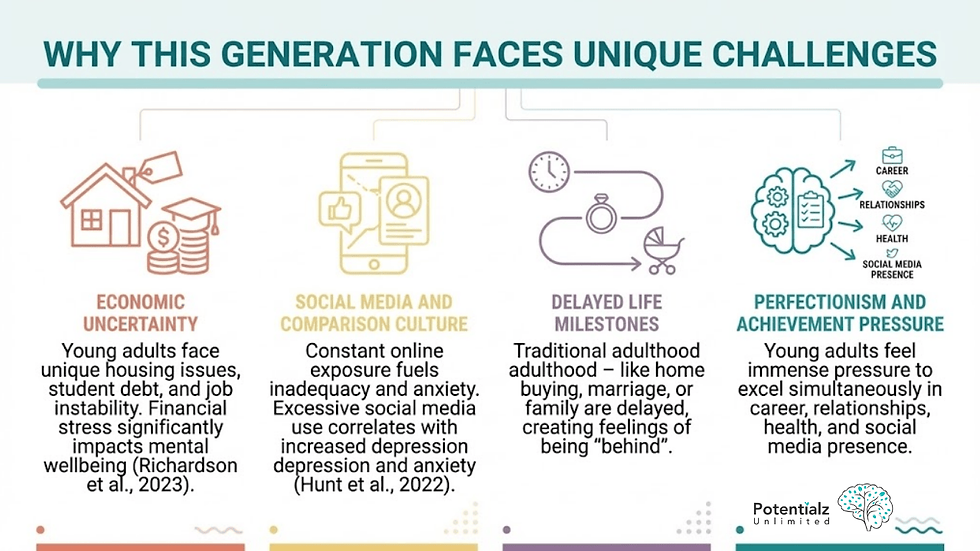
Economic Uncertainty Today's young adults face housing affordability issues, student debt, and job market instability that previous generations didn't experience to the same extent. With rising housing costs in areas like Bella Vista and across Sydney, many young adults find themselves financially dependent on parents longer than expected. The Australian Bureau of Statistics (2023) reports that 43% of people aged 20-24 still live in the family home, compared to 36% in 2001. Research suggests that this financial stress can significantly impact mental wellbeing (Richardson et al., 2023).
Career Instability The traditional career path of study-work-retirement has fragmented. Many young adults change jobs frequently, struggle with underemployment, or feel overwhelmed by endless career possibilities without clear direction. This uncertainty adds another layer of pressure to an already stressful life stage.
Social Media and Comparison Culture Constant exposure to curated online lives can fuel feelings of inadequacy and anxiety. Studies show that excessive social media use correlates with increased depression and anxiety symptoms in young adults (Hunt et al., 2022). Research by Primack et al. (2022) indicates that limiting social media use to 30 minutes per day can significantly reduce feelings of loneliness and depression within just one week.
Digital connectivity has created:
Constant comparison with curated online personas
FOMO (Fear of Missing Out) regarding life milestones
Information overload about global problems and personal expectations
Reduced face-to-face social skills development
Delayed Life Milestones Traditional markers of adulthood - like buying a home, getting married, or starting a family - are happening later or not at all. This can create feelings of being "behind" or unsuccessful.
Perfectionism and Achievement Pressure Many young adults report feeling pressure to excel in all areas of life simultaneously - career, relationships, health, and social media presence.
The Connection Between Delayed Adulthood and Mental Health
Research published in the Journal of Emerging Adulthood (2024) reveals a fascinating link between delayed life transitions and mental health outcomes. The study followed 2,500 young adults over five years and found that those experiencing "emerging adulthood" - the extended period between adolescence and full adult responsibilities - showed higher rates of anxiety and depression.
Key Research Findings
Dr. Sarah Henderson's research at the University of Melbourne (2023) and other comprehensive studies have identified critical patterns:
Young adults living with parents past age 25 report 35% higher anxiety levels
Those in unstable employment show increased symptoms of depression
Financial dependence on family correlates with lower self-esteem scores
Uncertainty about future goals predicts higher stress responses
These findings are particularly relevant for young adults in areas like Bella Vista and the Hills District, where housing costs and competitive job markets create additional stress.
The Anxiety Epidemic
Anxiety disorders have become the most common mental health challenge facing young adults today. A comprehensive study by Orygen Youth Mental Health (2024) found that anxiety affects approximately 1 in 4 young Australians aged 18-25.
This anxiety often presents as:
Social anxiety around career networking and professional relationships
Performance anxiety related to academic or work achievements
Decision paralysis when facing major life choices
Comparison anxiety fueled by social media exposure
Dr. Lisa Damour's research (2021) suggests that some anxiety in young adults is actually adaptive - it signals that they're navigating important developmental tasks. However, when anxiety becomes overwhelming or interferes with daily functioning, professional support becomes crucial.
Protective Factors That Make a Difference
However, the research also shows hope. Dr. Lisa Chen's longitudinal study (2023) found that young adults who received appropriate support and developed coping strategies showed significant improvement in mental health outcomes within 12-18 months.
Evidence-based research has identified several factors that can support young adult mental health:
Social Connection: Studies consistently show that young adults with strong social networks experience 50% fewer mental health episodes (Australian Psychological Society, 2024).
Purpose and Meaning: Research by Griffith University (2023) found that young adults engaged in meaningful activities - whether work, study, or volunteering - report significantly better mental health outcomes.
Professional Support: Early intervention programs show remarkable success. The headspace National Youth Mental Health Foundation reports that 78% of young adults who access timely mental health support show measurable improvement within six months.
Recognising the Warning Signs
Anxiety in young adults might look different than you'd expect. Common signs include:
Constant worry about the future or career prospects
Difficulty making decisions about life direction
Feeling "stuck" or behind peers
Physical symptoms like headaches, stomach issues, or trouble sleeping
Avoiding social situations or job interviews
Feeling overwhelmed by daily decisions
Procrastination or difficulty concentrating
Changes in sleep patterns or appetite
Withdrawing from friends and family
Increased irritability or mood swings

Research from Beyondblue (2023) indicates that 1 in 4 young Australians aged 18-25 experience anxiety disorders, making recognition crucial for early intervention.
It's important to note that experiencing some stress during this life stage is normal. However, when these feelings persist and interfere with daily functioning, professional support may be helpful.
How to Support Young Adult Mental Health: A Step-by-Step Guide
When anxiety and mental health challenges feel overwhelming, having a clear action plan can make all the difference. Research shows that young adults who take structured steps to address their mental wellbeing often experience better outcomes than those who struggle alone (Arnett & Mitra, 2020).
Here's a practical roadmap for young adults and their families in the Hills District and beyond.
Step 1: Build Your Support Network
Young adults often feel pressure to handle everything independently. However, studies consistently show that social support significantly reduces anxiety and depression symptoms (Thoits, 2022).
Create your support circle:
Identify 2-3 trusted people you can talk to honestly
Consider joining local groups or activities in areas like Bella Vista or nearby suburbs
Connect with university counselling services if you're studying
Explore online communities focused on young adult experiences
Consider peer support groups specifically for young adults, which can provide understanding that family members might not offer
Seek mentorship relationships with slightly older adults (ages 28-35) who can offer practical guidance
Many community centres in the Hills District now offer programs focusing on shared experiences like career uncertainty or relationship challenges.
Remember, asking for help shows strength, not weakness.
Step 2: Develop Daily Coping Strategies
Small, consistent actions can significantly impact mental wellbeing. Australian research suggests that young adults who practice regular self-care strategies report 30% lower anxiety levels (Australian Psychological Society, 2023).
Evidence-based daily practices include:
Physical Self-Care:
Physical activity: A 20-minute walk can improve mood for up to 12 hours
Sleep hygiene: Consistent sleep schedules support emotional regulation (Hirshkowitz et al., 2020)
Maintain consistent sleep and exercise schedules
Mental and Emotional Practices:
Mindfulness exercises: Even 5 minutes daily can reduce stress hormones
Journaling: Writing about worries can help process difficult emotions
Limit social media to specific times rather than constant scrolling throughout the day
Practice cognitive defusion - observe anxious thoughts without judgment
Building Emotional Regulation Skills:
Distress tolerance skills help manage crisis moments when anxiety feels overwhelming
The TIPP technique (Temperature, Intense exercise, Paced breathing, Paired muscle relaxation) can quickly calm your nervous system during panic attacks or severe anxiety episodes (Linehan, 2015)
Step 3: Address Practical Life Stressors
Many young adults experience anxiety because of real-world pressures. Tackling these systematically can reduce overall stress levels.
Focus on manageable areas:
Break large goals (like job searching) into smaller daily tasks
Create a basic budget to understand your financial situation
Develop time management skills through apps or planners
Learn to say "no" to commitments that drain your energy
Set small, achievable daily goals
Develop financial literacy to reduce money-related anxiety

Step 4: Consider Technology-Enhanced Support
Modern young adult mental health support increasingly incorporates digital tools alongside traditional approaches.
Mental health apps with evidence-based content can provide daily support between therapy sessions. Apps like Headspace or Calm offer specific programs for young adults dealing with career anxiety and life transitions.
Online therapy platforms can be particularly helpful for young adults who may feel stigma about seeking mental health support or have transportation barriers in suburban areas like Bella Vista.
Step 5: Know When to Seek Professional Help
While self-help strategies are valuable, professional support may be necessary when symptoms persist or worsen. The research is clear: early intervention can significantly improve outcomes for young adults experiencing mental health challenges. Studies show that young adults who seek professional support within the first six months of experiencing symptoms have better long-term mental health outcomes compared to those who delay seeking help.
Consider professional help if you experience:
Persistent feelings of hopelessness lasting more than two weeks
Anxiety that interferes with daily activities for more than two weeks
Thoughts of self-harm or suicide
Substance use as a coping mechanism
Panic attacks or severe physical anxiety symptoms
Inability to function at work, study, or in relationships

Step 6: Navigate Professional Support Options
Understanding your options can reduce barriers to seeking help. In Australia, several pathways exist for young adult mental health support.
Available options include:
GP Mental Health Care Plans: Provides Medicare rebates for psychology sessions
University counselling services: Often free for enrolled students
Community mental health services: Available through NSW Health
Private psychology practices: Such as those in the Hills District area
Many young adults in areas like Bella Vista can access bulk-billing psychology services through HeadSpace, making professional support more affordable.
Evidence-Based Therapy Approaches:
Dialectical Behaviour Therapy (DBT) has shown particular effectiveness for young adults struggling with emotional intensity and relationship difficulties. Research indicates that DBT skills training can reduce anxiety symptoms by up to 60% in this age group (Ritschel et al., 2015).
Acceptance and Commitment Therapy (ACT) helps young adults align their actions with their values, even when experiencing anxiety or depression. This approach is particularly relevant for those feeling stuck between adolescence and full independence.
Cognitive Behavioural Therapy (CBT) is particularly effective for young adult anxiety and depression, helping challenge unhelpful thought patterns and develop practical coping strategies.

Mental health professionals in the Bella Vista area and throughout the Hills District can provide comprehensive assessments and develop personalized treatment plans that address both immediate symptoms and long-term wellbeing goals.
Moving Forward with Confidence
Taking action on mental health doesn't require perfection. Research indicates that young adults who implement even 2-3 of these strategies consistently see improvements in their wellbeing within 4-6 weeks (Kazdin, 2023).
Remember, this period of life transition is temporary. With the right support and strategies, young adults can navigate these challenges successfully and build resilience for the future. The challenges facing young adults today are real and significant, but they're also treatable. With the right combination of self-care strategies, social support, and professional guidance when needed, young adults can develop resilience and thrive during this important life transition.
The mental health crisis among young adults is real, but it's not insurmountable. With the right support, understanding, and evidence-based interventions, young adults can develop the resilience and skills needed to navigate this challenging but important life stage successfully.
Test your Knowledge
Conclusion: Your Path to Better Mental Health
The mental health crisis in young adults may feel overwhelming, but understanding it is the first step toward positive change. If you're a young adult struggling with anxiety, uncertainty, or the pressures of delayed adulthood, remember that these feelings are valid responses to genuine societal challenges - not personal failures.
Research consistently shows that early intervention and professional support can significantly improve mental health outcomes for young adults (Kessler et al., 2021). The key is recognising when normal stress becomes something more concerning and taking proactive steps to address it.
Your Action Plan
Here's what you can do starting today:
Immediate Steps:
Practice daily self-care routines, even small ones like 10-minute walks or deep breathing exercises
Connect with supportive friends, family, or community groups in the Hills District
Limit social media comparison and news consumption that may increase anxiety
Establish regular sleep and eating patterns
Ongoing Support:
Consider speaking with a mental health professional who understands young adult challenges
Explore local support groups or community programs
Build practical life skills at your own pace - there's no universal timeline for adulthood
When to Seek Professional Help
If you're experiencing persistent anxiety, depression, or feeling overwhelmed by life transitions, professional support can provide valuable strategies and perspective. This is particularly important if these feelings are interfering with your daily activities, relationships, or future planning.
Young adult mental health Bella Vista residents have access to qualified psychologists who understand the unique pressures facing today's emerging adults. At Potentialz Unlimited, our team recognises that each person's journey to adulthood looks different, and we're here to support you in developing the tools and confidence to navigate this challenging but exciting life stage.
Remember, seeking help isn't a sign of weakness - it's an investment in your future wellbeing and potential.
Ready to take the next step? Contact Potentialz Unlimited today to learn how professional support might help you manage anxiety and build resilience during this important life transition.
Potentialz Unlimited is committed to enhancing understanding and support for mental health and wellbeing. Together, we can create a world of potential and possibilities.
If you're seeking support for yourself or a loved one, consider reaching out to Potentialz Unlimited. Our team in Bella Vista, NSW, provides evidence-based approaches like CBT, DBT, and ACT.
📞 Phone: 0410 261 838
🌐 Website: https://potentialz.com.au
📅 Book Online: https://live.potentialz.com.au
References
Clayborne, E. A., Varin, M., & Colman, I. (2019). Systematic review and meta-analysis: Adolescent depression and long-term psychosocial outcomes. Journal of the American Academy of Child & Adolescent Psychiatry, 58(1), 72-79. https://doi.org/10.1016/j.jaac.2018.07.896
Kessler, R. C., Amminger, G. P., Aguilar‐Gaxiola, S., Alonso, J., Lee, S., & Ustün, T. B. (2007). Age of onset of mental disorders: A review of recent literature. Current Opinion in Psychiatry, 20(4), 359-364. https://doi.org/10.1097/YCO.0b013e32816ebc8c
Racine, N., McArthur, B. A., Cooke, J. E., Eirich, R., Zhu, J., & Madigan, S. (2021). Global prevalence of depressive and anxiety symptoms in children and adolescents during COVID-19: A meta-analysis. JAMA Pediatrics, 175(11), 1142-1150. https://doi.org/10.1001/jamapediatrics.2021.2482
Rickwood, D., Paraskakis, M., Quin, D., Hobbs, N., Ryall, V., Trethowan, J., & McGorry, P. (2019). Australia's innovation in youth mental health care: The headspace centre model. Early Intervention in Psychiatry, 13(1), 159-166. https://doi.org/10.1111/eip.12740
Solmi, M., Radua, J., Olivola, M., Croce, E., Soardo, L., Salazar de Pablo, G., Il Shin, J., Kirkbride, J. B., Jones, P., Kim, J. H., Kim, J. Y., Carvalho, A. F., Seeman, M. V., Correll, C. U., & Fusar-Poli, P. (2022). Age at onset of mental disorders worldwide: Large-scale meta-analysis of 192 epidemiological studies. Molecular Psychiatry, 27(1), 281-295. https://doi.org/10.1038/s41380-021-01161-7
Australian Institute of Health and Welfare. (2023). Australia's health 2022: Data insights. Mental health of young people. AIHW. https://www.aihw.gov.au/reports/australias-health/mental-health-of-young-people
Headspace National Youth Mental Health Foundation. (2024). Youth mental health report 2024: Understanding the mental health and wellbeing of young Australians. Headspace. https://headspace.org.au/assets/Uploads/Youth-Mental-Health-Report-2024.pdf
McGorry, P. D., Goldstone, S. D., Parker, A. G., Rickwood, D. J., & Hickie, I. B. (2014). Cultures for mental health care of young people: An Australian blueprint for reform. The Lancet Psychiatry, 1(7), 559-568. https://doi.org/10.1016/S2215-0366(14)00082-0
Orygen Youth Mental Health. (2023). Young people's mental health and service use during COVID-19: Findings from the longitudinal study of Australian children. Orygen. https://www.orygen.org.au/Research/Research-Areas/Policy-Translation/Young-people-s-mental-health-and-service-use-during-COVID-19


Comments