Welcome to This Week in Mental Health
Each week we round up the developments worth knowing about across psychotherapy, counselling, and mental health — translated into plain language, with a careful clinical eye and links to the original sources. This week’s focus: trauma and recovery, and the growing evidence about how the mind is hurt by trauma — and how it heals.
A quick word on how we do this. We only report from credible, primary sources — peer-reviewed journals, universities, and official health bodies — and we frame new research as emerging rather than settled. New findings are interesting and important, but a single study rarely changes clinical practice on its own.
Trauma sits underneath far more mental health struggles than most people realise. It can begin in childhood and echo for decades, or it can arrive in a single overwhelming event. The good news from the research desk this week is hopeful: the therapies that help people recover are getting stronger evidence behind them. Three studies crossed our desk — one on EMDR for PTSD, one on childhood adversity, and one on Acceptance and Commitment Therapy. Read together, they tell one quiet story: trauma is serious, but recovery is real and well-supported.
1. EMDR for PTSD: effective, and good value too
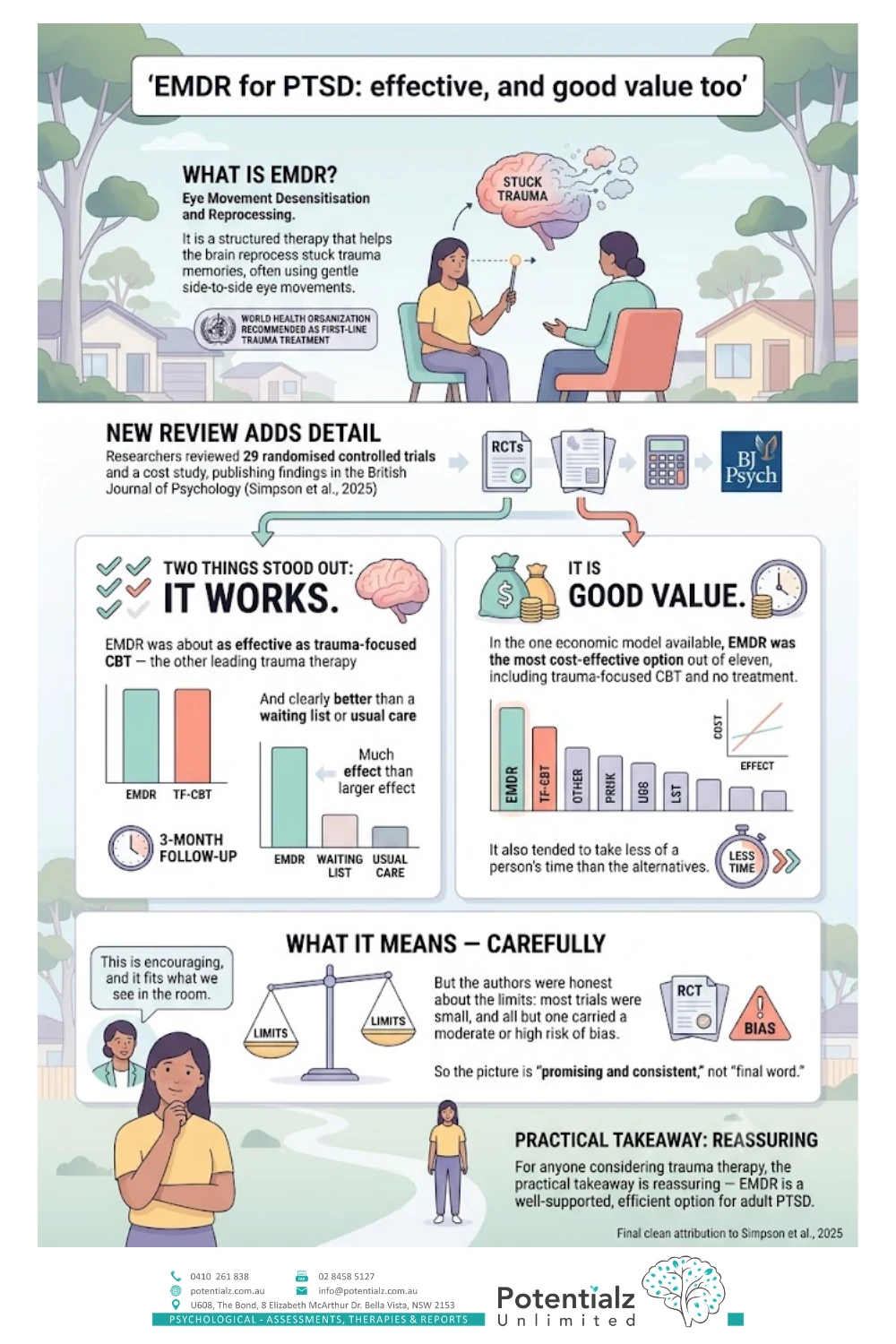
EMDR stands for Eye Movement Desensitisation and Reprocessing. It is a structured therapy that helps the brain reprocess stuck trauma memories, often using gentle side-to-side eye movements. It is already recommended as a first-line trauma treatment by the World Health Organization. This week, a new review added useful detail.
Researchers reviewed 29 randomised controlled trials and a cost study, publishing their findings in the British Journal of Psychology (Simpson et al., 2025). Two things stood out:
- It works. EMDR was about as effective as trauma-focused CBT — the other leading trauma therapy — and clearly better than a waiting list or usual care, with large effects after treatment and at three-month follow-up.
- It is good value. In the one economic model available, EMDR was the most cost-effective option out of eleven, including trauma-focused CBT and no treatment. It also tended to take less of a person’s time than the alternatives.
What it means — carefully. This is encouraging, and it fits what we see in the room. But the authors were honest about the limits: most trials were small, and all but one carried a moderate or high risk of bias. So the picture is “promising and consistent,” not “final word.” For anyone considering trauma therapy, the practical takeaway is reassuring — EMDR is a well-supported, efficient option for adult PTSD. We explain exactly how the eight-phase process works in our new guide, EMDR therapy for trauma and PTSD, and you can read more about trauma and PTSD treatment on our service pages.
2. Childhood adversity and adult mental health — the strongest signal yet
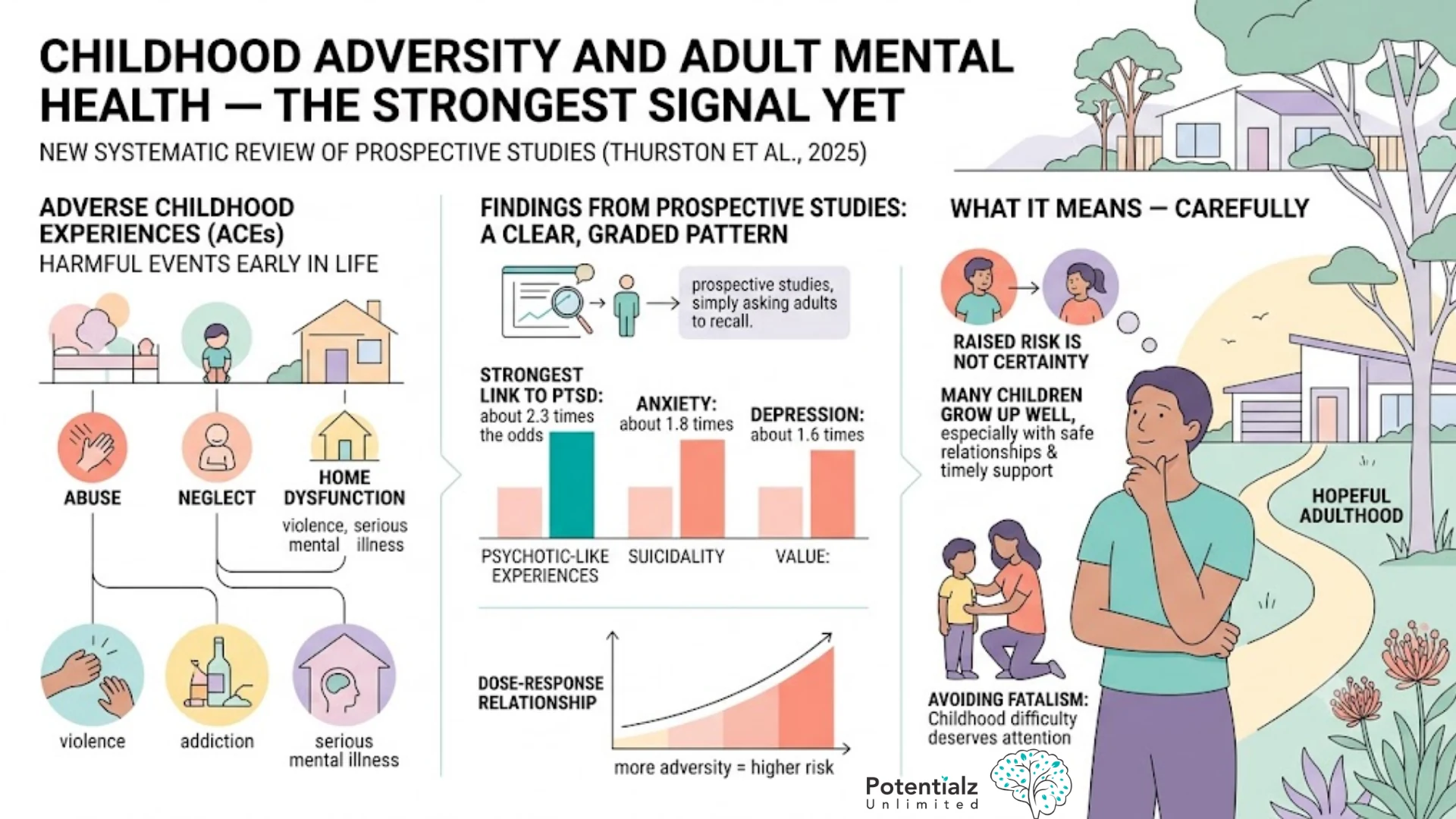
The second study looks at where a great deal of adult distress begins: childhood.
Adverse childhood experiences (ACEs) are hard or harmful events early in life — abuse, neglect, or a home affected by violence, addiction or serious mental illness. A new systematic review in Trauma, Violence, & Abuse pooled prospective studies — ones that followed people forward over time, which is a stronger design than simply asking adults to recall their childhood (Thurston et al., 2025). The pattern was clear and graded:
- The strongest link was to PTSD (about 2.3 times the odds), then anxiety (about 1.8 times), depression (about 1.6 times), and smaller but real links to psychotic-like experiences and suicidality.
- The relationship was dose-response: the more adversity a child faced, the higher the later risk.
What it means — carefully. This is important, but it must be read with care, because the headline can frighten parents. Raised risk is not the same as certainty. Many children who face hardship grow up well — particularly when they have at least one safe, steady relationship and timely support. The value of a study like this is the opposite of fatalism: it tells us that early, trauma-informed help genuinely matters, and that childhood difficulty deserves attention rather than “they’ll grow out of it.” In children, that help often looks like play, not talk — which is why we use developmentally suited approaches described in how play therapy helps children heal from trauma and across our child psychology services.
3. Acceptance and Commitment Therapy: the skill underneath the relief
Not everyone wants to revisit a trauma memory directly, and not every difficulty is a single event. That is where third-wave therapies come in — and the best known is Acceptance and Commitment Therapy (ACT).
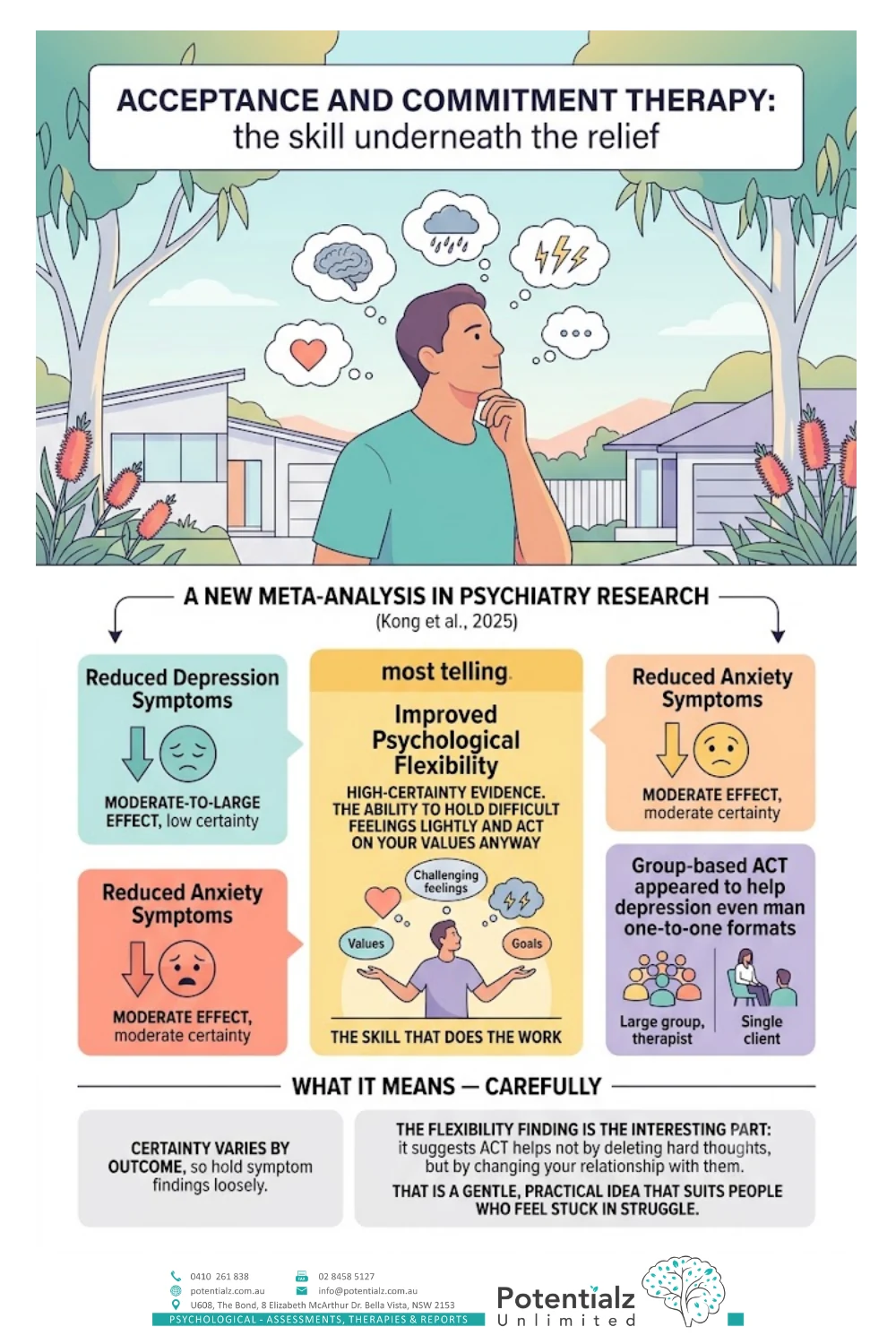
ACT does something different from older approaches. Instead of arguing with painful thoughts, it teaches you to make room for them while still moving toward what matters. A new meta-analysis in Psychiatry Research pulled together the trials (Kong et al., 2025):
- ACT reduced depression symptoms (a moderate-to-large effect, low certainty) and reduced anxiety symptoms (a moderate effect, moderate certainty).
- Most tellingly, ACT improved psychological flexibility — the ability to hold difficult feelings lightly and act on your values anyway — with high-certainty evidence. The authors point to this as the mechanism: the skill that does the work.
- Group-based ACT appeared to help depression even more than one-to-one formats.
What it means — carefully. The certainty varies by outcome, so we hold the symptom findings loosely. But the flexibility finding is the interesting part: it suggests ACT helps not by deleting hard thoughts, but by changing your relationship with them. That is a gentle, practical idea that suits people who feel stuck in struggle. We unpack it in plain language in ACT therapy: why accepting your thoughts can help you feel better.
The bottom line
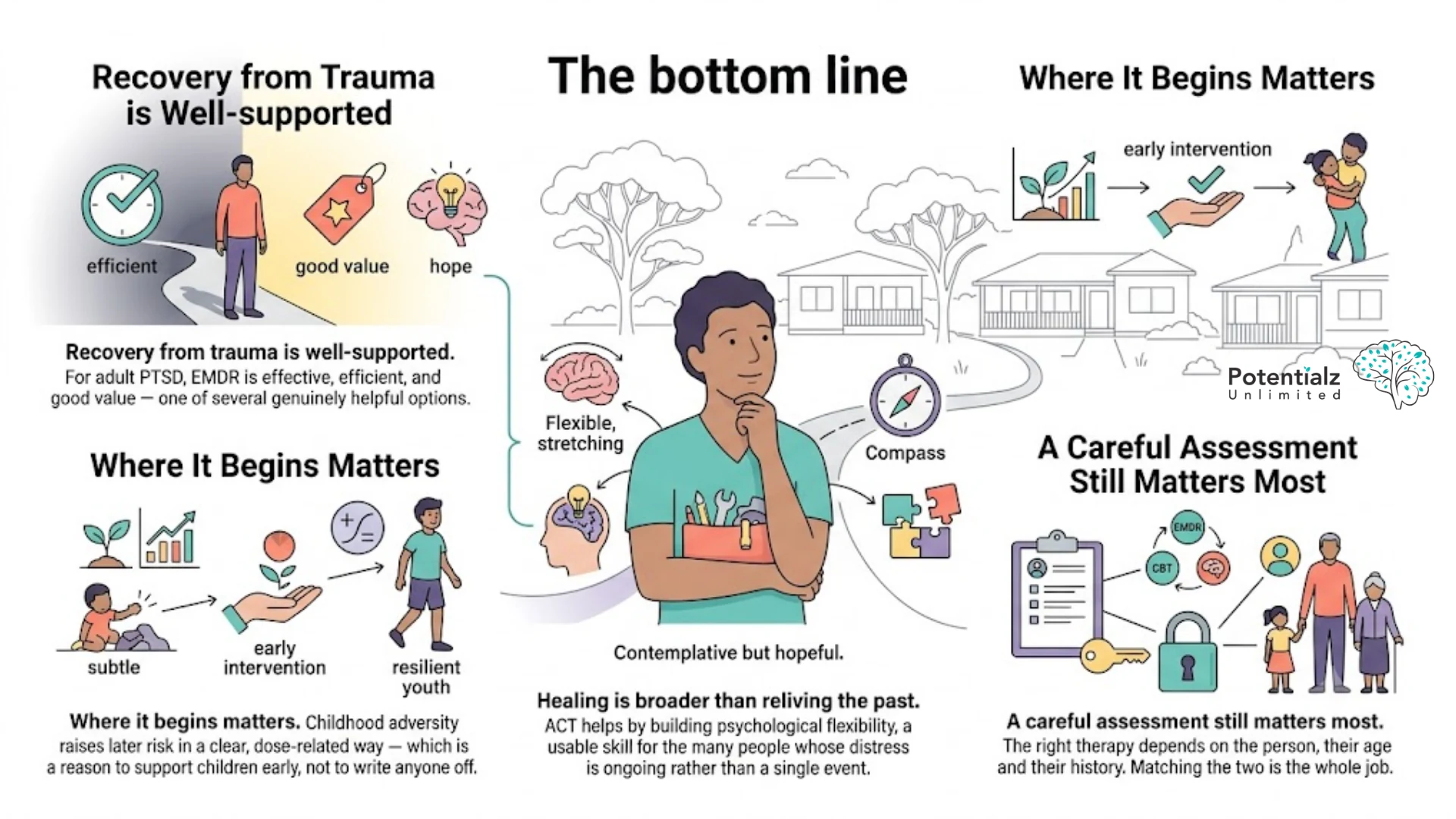
Read together, this week’s studies tell a coherent and hopeful story.
- Recovery from trauma is well-supported. For adult PTSD, EMDR is effective, efficient, and good value — one of several genuinely helpful options.
- Where it begins matters. Childhood adversity raises later risk in a clear, dose-related way — which is a reason to support children early, not to write anyone off.
- Healing is broader than reliving the past. ACT helps by building psychological flexibility, a usable skill for the many people whose distress is ongoing rather than a single event.
- A careful assessment still matters most. The right therapy depends on the person, their age and their history. Matching the two is the whole job.
If trauma — recent or long past, your own or your child’s — is shaping daily life, you do not have to work it out alone. Our team at Potentialz Unlimited in Bella Vista offers comprehensive, evidence-based trauma assessment and therapy for adults and children. You can get in touch here.
References
- Kong, Q., Yan, S., Huang, K., Han, B., Han, R., Jiao, Y., Yang, H., Pu, Y., Li, S., & Jia, Y. (2025). The efficacy of acceptance and commitment therapy (ACT) for depression: A systematic review and meta-analysis. Psychiatry Research, 352, 116701. https://doi.org/10.1016/j.psychres.2025.116701
- Simpson, E., Carroll, C., Sutton, A., Forsyth, J., Rayner, A., Ren, S., Franklin, M., & Wood, E. (2025). Clinical and cost-effectiveness of eye movement desensitization and reprocessing for treatment and prevention of post-traumatic stress disorder in adults: A systematic review and meta-analysis. British Journal of Psychology, 116(4), 1128–1149. https://doi.org/10.1111/bjop.70005
- Thurston, C., Murray, A. L., Franchino-Olsen, H., Silima, M., Hemady, C. L., & Meinck, F. (2025). Prospective longitudinal associations between adverse childhood experiences and adult mental health outcomes: A systematic review and meta-analysis. Trauma, Violence, & Abuse. Advance online publication. https://doi.org/10.1177/15248380251358223
Crisis and Support Resources
If you or someone you know needs immediate support, please reach out:
- Lifeline: 13 11 14 (24/7 crisis support)
- Beyond Blue: 1300 22 4636 (24/7)
- 1800RESPECT: 1800 737 732 (family and sexual violence)
- Kids Helpline: 1800 55 1800 (for ages 5–25)
- Emergency: 000
Disclaimer: This roundup is general information, not clinical advice, and summarises emerging research that has not necessarily changed clinical guidelines. Single studies should be read with caution. Dr. Gurprit Ganda is a Clinical Psychologist (AHPRA) and Practice Director at Potentialz Unlimited, Bella Vista. If you are experiencing significant distress, please contact your GP, a registered mental health professional, or one of the crisis services listed above.
Need Professional Support?
If you're experiencing mental health concerns, our team is here to help.