Key Takeaways
- Most modern “rest” — scrolling, passive TV, alcohol — does not actually restore the nervous system. The body may be still while the mind and nervous system remain in a state of low-grade activation.
- True relaxation operates on three distinct levels: physical, mental, and spiritual (or deep) — and most people are achieving, at best, partial physical relaxation.
- The parasympathetic nervous system — the body’s genuine recovery mode — needs specific conditions to fully activate. Simply stopping activity is not enough.
- Chronic inability to relax, even in sleep, is a significant signal that the nervous system is dysregulated and may benefit from professional support.
- Anger, worry, comparison, and rumination are energetically expensive. They deplete Prana (vital energy) even when you are physically still.
- A five-part right relaxation practice — preparation, body release, breath restoration, mental unwinding, and surrender — provides a complete pathway to genuine rest.
- Yoga Nidra (covered more deeply in the separate yoga-nidra post) is one of the most profound tools for reaching the third, spiritual level of relaxation — but daily relaxation practice is the essential foundation.
Introduction
When was the last time you were truly relaxed?
Not lying on the couch scrolling through your phone. Not watching television while mentally composing tomorrow’s to-do list. Not having a glass of wine to “wind down” while still half-present in the events of the day.
I mean genuinely, fully at rest. Body soft. Breath slow and effortless. Mind quiet. The kind of rest where you lose track of time, where the body actually lets go, where you come back to yourself feeling replenished rather than just less stimulated.
If you’re struggling to remember the last time that happened, you’re not alone. And it’s not because you’re doing something wrong. It’s because most of what we call rest in modern life isn’t actually resting the nervous system at all.
There is an old saying I return to often: “Tension is who you think you should be. Relaxation is who you are.”
Think about that. Tension is performed. It is the body braced for a world that demands something of us. Relaxation is what we return to when we stop performing — when we come home to ourselves. And many of us have forgotten the way home.
The Problem with Modern “Rest”
Let’s be honest about what most people do when they say they are resting.
They pick up the phone. They scroll through social media — an endless stream of information, comparison, outrage, and stimulation designed by algorithms to keep the nervous system slightly activated. They watch television — often intense, emotionally charged content (news, drama, thrillers) that keeps the body in a low-grade arousal state. They have a glass of wine or a beer, which produces initial sedation but disrupts sleep architecture and leaves the nervous system more dysregulated by morning. They lie in bed “relaxing” while mentally running through conversations that happened and conversations they’re dreading.
None of this is rest. It is activity that is less demanding than work. That is not the same thing.
The nervous system — specifically the sympathetic branch of the autonomic nervous system — is a threat-detection and mobilisation system. In genuine rest, the parasympathetic branch takes over: heart rate slows, breathing deepens, cortisol drops, digestion resumes, cellular repair begins. This is the state of genuine recovery.
For the parasympathetic system to fully activate, the nervous system needs input that signals safety. Not just absence of danger — active signals of safety. Slow diaphragmatic breathing. Stillness. Warmth. Quiet. A body that is consciously allowed to soften, not just temporarily still.
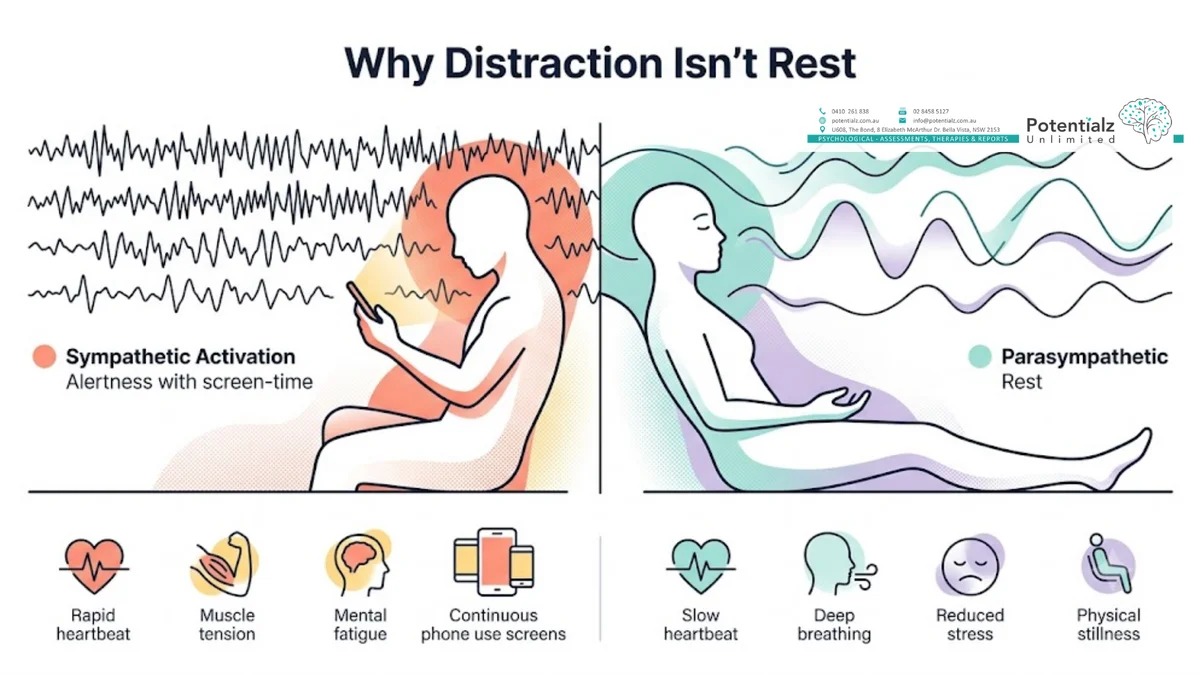
Scrolling does not provide those signals. The screen, the rapid movement of images, the micro-jolts of novelty and reaction — these are stimulating inputs. The body remains slightly alert, slightly braced, slightly in wait.
Gandhi wrote: “There is more to life than increasing its speed.” Modern rest has become faster rest — distraction rather than restoration. And the cumulative cost is enormous.
Why Many of Us Have Forgotten How to Rest
There is a deeper layer here worth naming. For many people, stillness is genuinely uncomfortable. When the external stimulation stops, what emerges is not peace. It is the backlog — the unprocessed anxiety, the unresolved worry, the grief that was too busy to be felt, the thoughts that have been waiting for an opening.
So we keep ourselves stimulated. Not lazily — often desperately. The phone, the screen, the noise, the busyness — they are not just habits. They are sometimes defences against the inner life that waiting silence would require us to meet.
This is important to understand. Because the path to genuine rest does not bypass this. It goes through it. Not by drowning in everything that surfaces when you stop — but by developing the capacity, slowly, to be present with your own inner experience without being overwhelmed by it.
This is part of what therapeutic work supports. Building the tolerance for stillness. Building the capacity to be with yourself.
The Three Levels of True Relaxation
The yogic tradition I draw from distinguishes three distinct levels of relaxation — and most modern rest, at best, touches only the first.
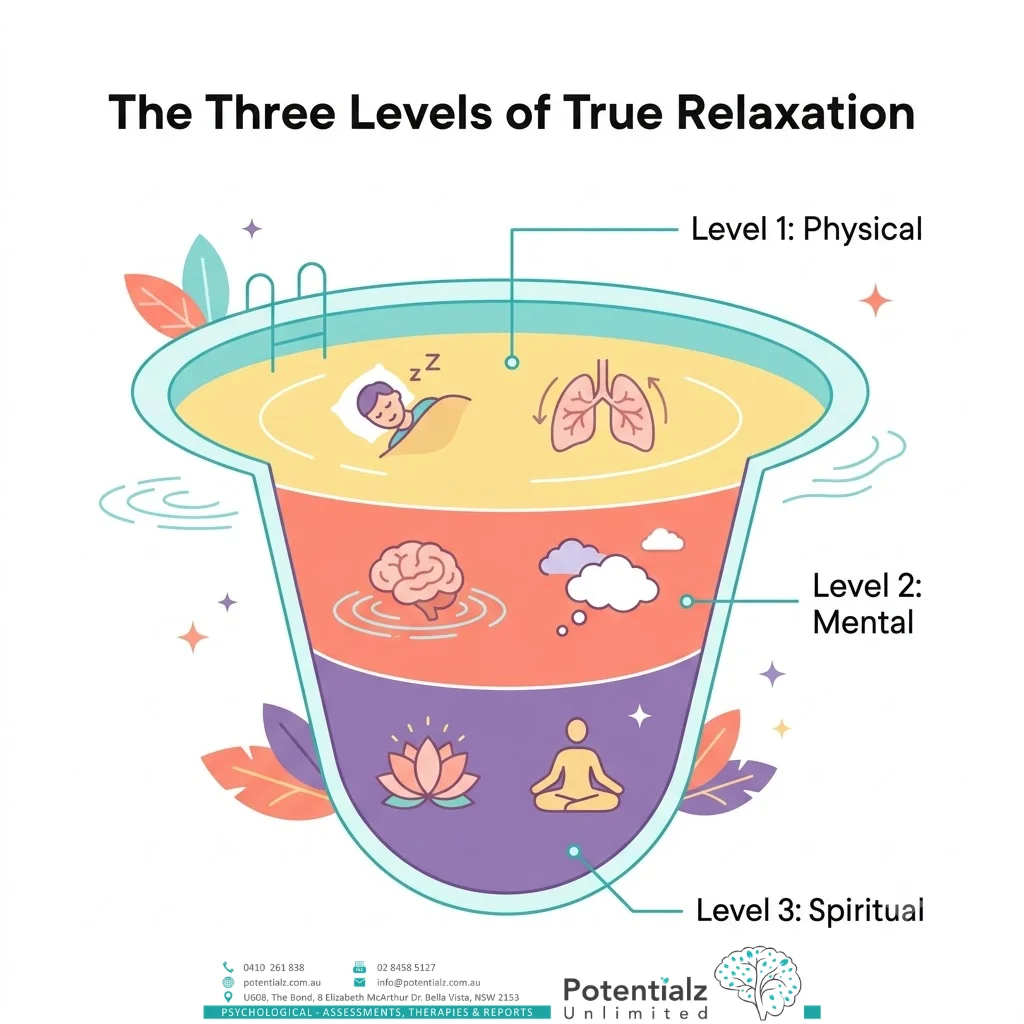
Level 1: Physical Relaxation
The first level is the one we most easily recognise. Muscular tension — the chronic tightening of shoulders, jaw, neck, hips, hands — releasing. The body becoming heavy and soft. Physical ease.
But here is what many people don’t realise: even when you think you’re physically relaxed, you often aren’t. Most people carry chronic muscular tension that has been there so long they no longer notice it. The shoulders that are always slightly raised. The jaw that is always slightly clenched. The belly that is always slightly held.
Progressive muscle relaxation — the deliberate tensing and releasing of each muscle group — is a powerful tool precisely because it helps people discover how much tension they were holding that they didn’t know about. When you consciously tense a muscle and then release it, the depth of release is greater than simply telling it to relax.
Physical relaxation also involves the body scan: moving your attention slowly and deliberately through each part of the body, noticing sensation without judgment, and gently inviting release where you find tension. This is not passive — it requires focused, gentle attention. And it is one of the most reliably effective tools for shifting the nervous system toward genuine rest.
Sleep is not the same as physical relaxation. Many people with chronic stress or anxiety sleep in a state of significant muscular tension — waking with clenched jaws, tight shoulders, and a sense of having worked hard through the night. The body needs to physically release before sleep can be truly restorative.
Level 2: Mental Relaxation
The second level is where most modern rest completely fails. Mental relaxation is not the absence of thoughts. It is the loosening of the mind’s grip — the shift from effortful, driven, evaluative thinking to a quieter, more spacious state.
The mind is not designed to be constantly active. Just as muscles need periods of genuine rest to repair and restore, the cognitive system needs genuine downtime. Not switching from one demanding task to a slightly less demanding one — actual disengagement from effortful mental processing.
The neuroscience of the default mode network (DMN) — the brain’s “resting state” — tells us something interesting: the DMN is not actually passive. It is active during self-reflection, meaning-making, creative problem-solving, and the consolidation of memories and learning. But it requires genuine downtime from task-focused attention to do its work well. Without that downtime, the DMN becomes dominated by rumination — the same thoughts cycling again and again without resolution.
Mental relaxation means allowing this shift to happen. Slow, rhythmical breathing is one of the most effective tools — when you deliberately slow your exhalation, it activates the vagus nerve and shifts the brain away from the task-focused prefrontal networks and toward a quieter, more integrated state.
Journalling — particularly expressive, unfiltered writing — is another powerful tool for mental relaxation. Not because it solves problems, but because it externalises them. When you write down what you are carrying, it stops circulating internally. The mind can let it go, knowing it has been recorded.
Mental relaxation is not the same as distraction. Television distracts the mind from its own content — it replaces internal processing with external stimulation. Genuine mental relaxation allows the mind to settle into its own deeper rhythms.
Level 3: Spiritual (Deep) Relaxation
The third level is the hardest to describe and the most profoundly nourishing. It is the relaxation of the deepest layer of identification — the release of the effortful sense of self that is always performing, always managing, always trying to be enough.
In yogic philosophy, this is the territory of pratyahara — the withdrawal of the senses inward, the turning of attention from the outer world to the inner. Not suppression of the outer world — but a voluntary, peaceful drawing of awareness inward, like a tortoise drawing its limbs into its shell.
At this level, rest is not the absence of something. It is the presence of something — a quality of peace that is not manufactured, not earned, not dependent on circumstances. It is what emerges when the layers of tension, worry, and performance are genuinely dissolved.
This is the state accessed by deep meditation, by Yoga Nidra (yogic sleep), and — in moments of grace — by genuine prayer or contemplation. It is a rest so deep that twenty minutes in this state can restore the system as effectively as several hours of ordinary sleep. Research by Bhanu Tripathi on Yoga Nidra has documented measurable neurological and hormonal restoration at this depth of relaxation.
This third level is accessible to everyone. But it requires the first two levels as a foundation — you cannot enter deep relaxation with a tense body and a racing mind. The path goes through the body, through the breath, through the quieting of the mind — and then, if those conditions are met, into the deepest rest of all.
Note: This post focuses on daily relaxation practices as a foundation for wellbeing. For a deeper exploration of Yoga Nidra specifically as a tool for sleep disorders and stress recovery, see the dedicated yoga nidra guide.
The Energy Cost of Emotional Depletion
One of the most overlooked dimensions of genuine rest is the relationship between emotional activity and energy.
We all intuitively understand that physical exertion is tiring. But emotional exertion — sustained anger, chronic worry, active comparison, ongoing resentment, unresolved grief — is equally, and sometimes more, depleting.
In yogic philosophy, this is understood through the concept of Prana — the vital life force that animates both body and mind. Prana is expended by physical activity, yes. But it is also expended — and often more dramatically — by emotional turbulence.
Think about the last time you were very angry for an extended period. How did you feel afterward? Not cathartic release — actual sustained anger. Exhausted. Depleted. Physically heavy, even if you hadn’t moved.
Or the last time you lay awake at night with a racing mind — worry looping, scenarios playing out. You were completely still in your body. But you were not resting. You were burning Prana as fast as if you had been running.
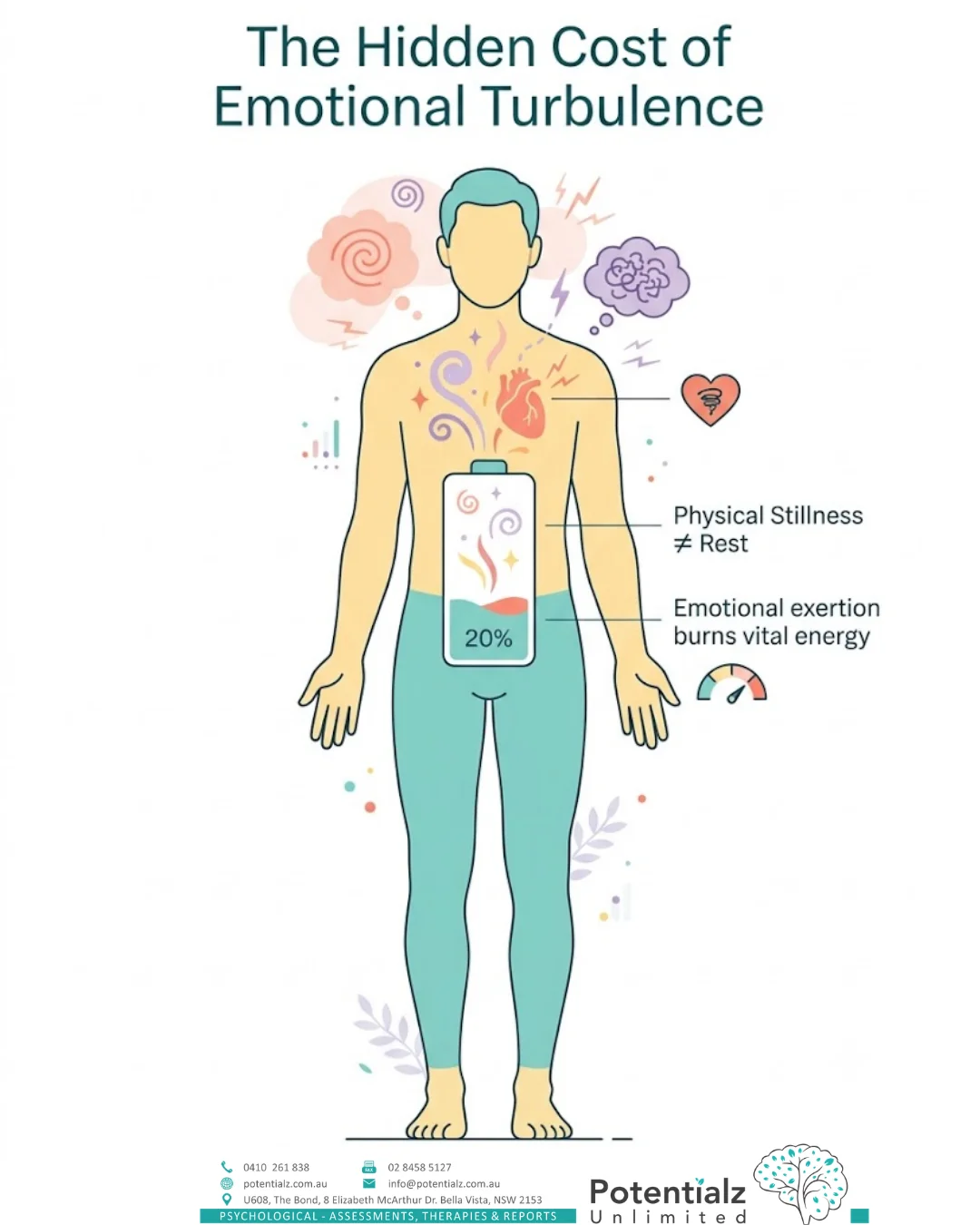
This is why the path to genuine rest is not just physical stillness. It requires emotional settling. Which means — among other things — developing a different relationship with the emotions themselves. Not suppressing them. Not performing them. But allowing them to be felt, acknowledged, and completed — so they don’t loop.
This is where therapeutic work becomes relevant to something as apparently simple as rest. Many people cannot genuinely relax because they are carrying unexpressed grief, unresolved anger, persistent fear, or accumulated worry that has nowhere to go. Until that material finds expression and integration, the nervous system remains on alert.
The Five-Part Right Relaxation Practice
Here is a complete, practical relaxation practice that I teach to clients and use myself. It addresses all three levels — physical, mental, and spiritual. It takes twenty to thirty minutes at full length, though even ten minutes of the first two steps produces measurable benefit.
1. Preparation — creating the conditions for rest (3–5 minutes)
Your environment matters. Dim the lights or turn them off. If possible, take a warm shower or bath — warm water relaxes the muscles directly and signals safety to the nervous system. Choose a piece of music at approximately 60 beats per minute (Baroque music, calm acoustic, or binaural beats all work well). Put your phone in another room or on aeroplane mode. These are not luxuries — they are the conditions under which genuine rest becomes possible.
2. Body release — physical relaxation (5–8 minutes)
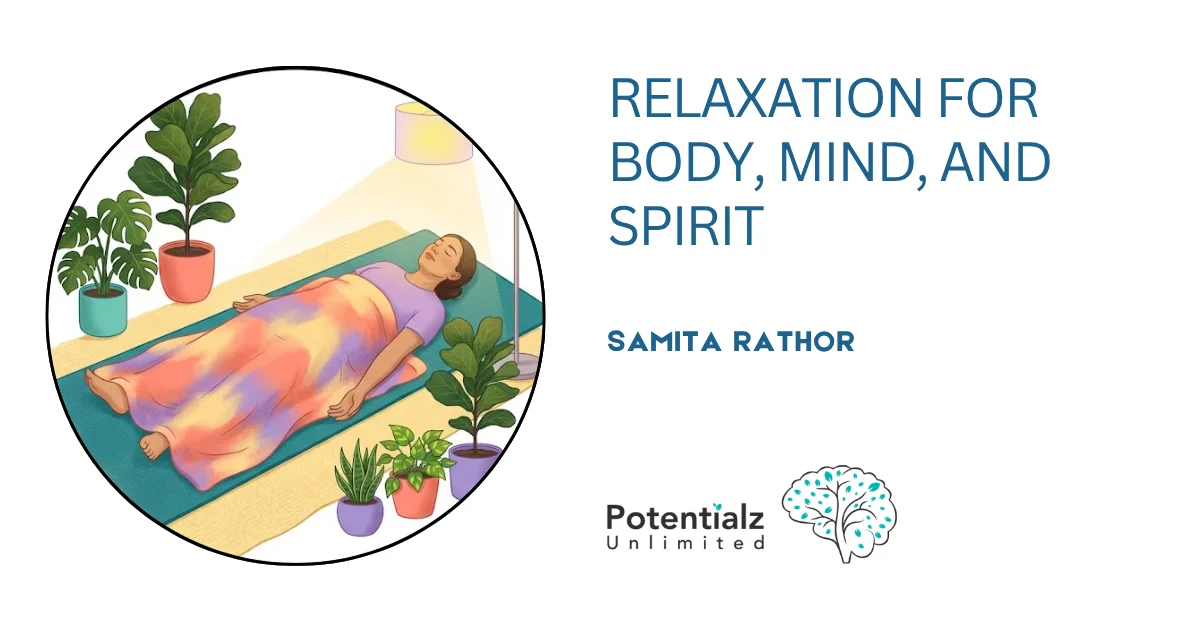
Lie down in a comfortable position, arms slightly away from your sides, palms facing upward. Begin a progressive muscle relaxation: tense each muscle group for five seconds, then release completely. Start with the feet, move up through the legs, hips, abdomen, hands, arms, shoulders, neck, and face. Pay particular attention to the jaw, the forehead, and the space around the eyes — these carry enormous amounts of chronic tension for most people. After the full body sequence, scan from head to toe and invite any remaining areas of tension to soften.
3. Breath restoration — shifting the nervous system (5–7 minutes)
Once the body is softer, bring attention to the breath. Do not force it — simply observe it for a few cycles, allowing it to deepen naturally. Then introduce a slow exhalation practice: breathe in for a count of four, breathe out for a count of eight. The extended exhalation activates the vagus nerve and reliably shifts the autonomic nervous system toward parasympathetic dominance. Even five minutes of this practice produces measurable reductions in heart rate and cortisol.
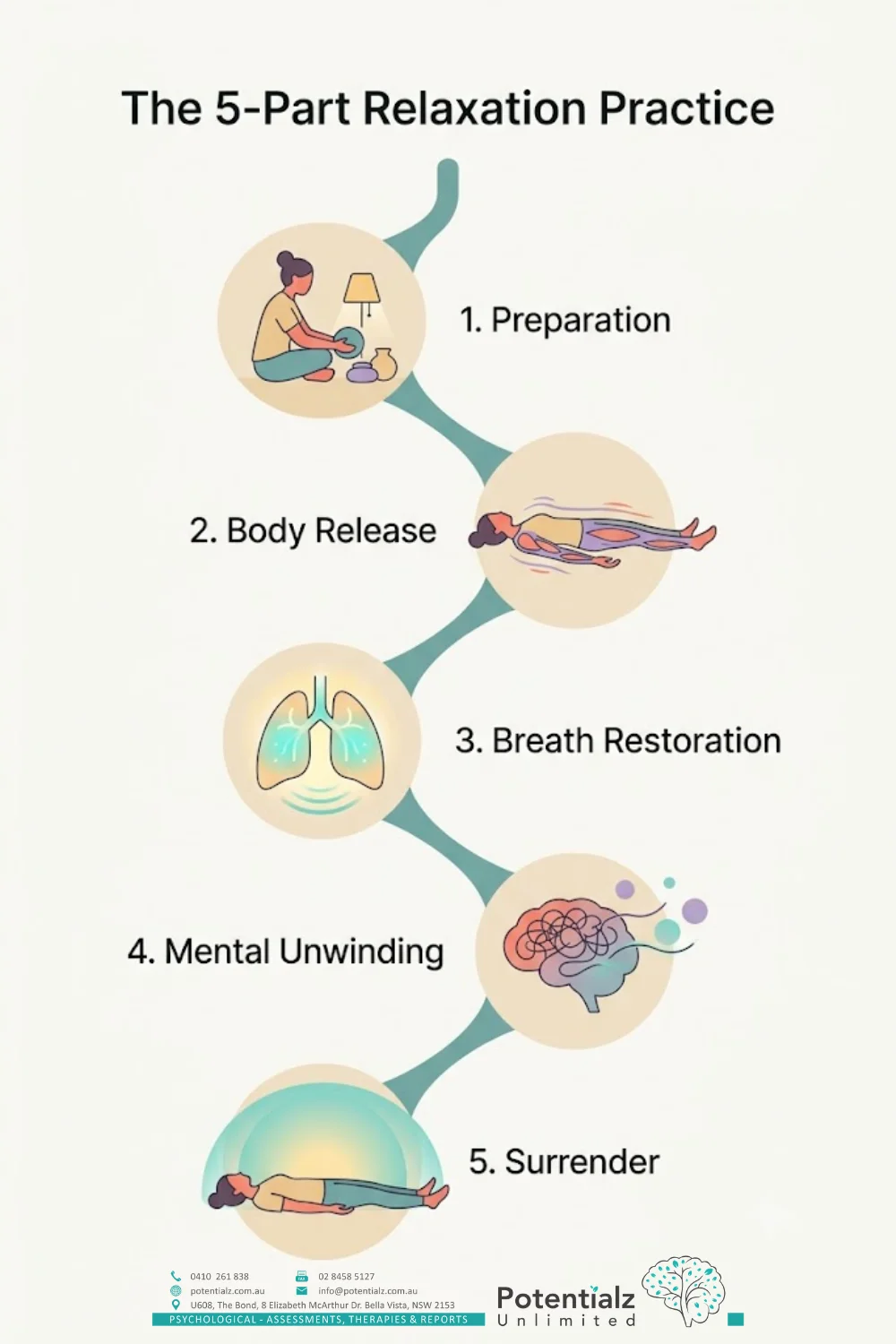
4. Mental unwinding — quieting the mind (3–5 minutes)
If thoughts arise — and they will — do not fight them. Simply notice them as you would notice clouds passing across a sky. You are the sky, not the cloud. Let thoughts arise and pass without following them, without engaging with them, without judging yourself for having them. If you find the mind persistently active, you can use a simple mantra (a word or phrase repeated gently, like “peace” or “releasing”) to give the mind a gentle anchor. Alternatively, a brief body scan — moving attention from the crown of the head to the soles of the feet — re-anchors awareness in physical sensation rather than thought.
5. Surrender — entering deep rest (5–10 minutes)
This is the invitation to let go of the manager. Let go of the one who is doing the relaxation, monitoring how it’s going, checking whether you’re doing it right. Simply be. Breathe. Receive. If this leads into Yoga Nidra — a guided practice of deep yogic rest — that is ideal. If it leads into natural sleep, that is the body’s wisdom. If you remain in a quiet, still, inward state for even a few minutes, you have accessed the third level of relaxation. That is enough. That is everything.
When Chronic Inability to Relax Signals Something Deeper
I want to name something important here. For some people, the inability to relax is not simply a habit or a lifestyle issue. It is a symptom.
Hypervigilance — the nervous system’s inability to disengage from threat-scanning — is a feature of anxiety disorders, PTSD, and trauma responses. If you consistently cannot relax your body, cannot quiet your mind, wake from sleep feeling unrested, and feel chronically braced against a threat you cannot name — this is significant information. It deserves professional attention.
Anxiety disorders affect approximately one in three Australians at some point in their lives (AIHW, 2023). The inability to genuinely rest is often both a symptom and a maintaining factor — because chronic stress depletes the nervous system’s capacity for regulation, which creates more stress.
If this resonates with you, I want you to hear something: this is not weakness, this is not failure, and this is not something you have to manage alone. For more on anxiety and its physical dimensions, see my anxiety support page.
How Potentialz Can Help
At Potentialz Unlimited, relaxation training is not an add-on. It is a therapeutic tool that I integrate into sessions for people managing stress, anxiety, burnout, insomnia, trauma, and chronic overwhelm.
In sessions, I work with you to identify what is keeping your nervous system activated, teach specific practices for physical and mental relaxation, and support the emotional processing that chronic tension often protects against. This is whole-person work — addressing not just the symptoms of stress, but the roots of it.
Many clients tell me that learning to genuinely rest was one of the most transformative shifts of their therapeutic journey. Not because it was easy — but because it opened the door to everything else.
Sessions at Unit 608/8 Elizabeth Macarthur Drive, Bella Vista NSW 2153. Monday to Friday 10am–7pm, Saturday and after-hours available. Telehealth via phone or Zoom.
Sessions in English, Hindi, Tamil, Kannada, and Urdu.
- Book online: live.potentialz.com.au
- Call: 0410 261 838
- Visit: potentialz.com.au
No referral required.
Quiz: Test Your Understanding
1. According to the post, most modern “rest” — scrolling, TV, alcohol — fails to restore the nervous system because:
- a) These activities are physically demanding
- b) They do not provide the sensory signals of safety that activate the parasympathetic nervous system ✓
- c) They require too much cognitive attention
- d) They are only effective for people without stress disorders
2. Progressive muscle relaxation works by:
- a) Gradually reducing the intensity of exercise over time
- b) Deliberately tensing and releasing muscle groups to achieve deeper release than simply instructing muscles to relax ✓
- c) A breathing technique that progressively slows the heart rate
- d) A mental practice of imagining muscles becoming lighter
3. The yogic concept of pratyahara refers to:
- a) A vigorous breathing technique for energy
- b) The withdrawal of senses inward — a voluntary turning of awareness from the outer world to the inner ✓
- c) The practice of progressive body scanning
- d) A specific yoga asana for relaxation
4. Anger, worry, and chronic rumination are described in yogic tradition as depleting because:
- a) They cause physical muscle strain
- b) They burn Prana (vital life energy) just as effectively as physical exertion, leaving the body depleted even without movement ✓
- c) They prevent adequate breathing
- d) They are associated with poor diet choices
5. In the five-part right relaxation practice, the breath restoration step involves:
- a) Rapid breathing to oxygenate the body and increase alertness
- b) Holding the breath to slow the heart rate
- c) A slow exhalation practice (breathing in for four counts, out for eight) to activate the vagus nerve ✓
- d) Alternating breathing between the nostrils
8-Second Script 1 — “Are You Actually Resting?”
“Scrolling isn’t resting. TV isn’t resting. Your nervous system is still activated. Real relaxation is something different — and it can be learned. Potentialz Unlimited, Bella Vista.”
8-Second Script 2 — “Three Levels”
“True relaxation happens on three levels: body, mind, and spirit. Most of us are only reaching the first — if that. Samita Rathor at Potentialz can help. 0410 261 838.”
8-Second Script 3 — “Tension vs You”
“Tension is who you think you should be. Relaxation is who you are. Come home to yourself at Potentialz Unlimited, Bella Vista. Book at live.potentialz.com.au.”
8-Second Script 4 — “Anger Burns Energy”
“Did you know that sustained anger, worry, and rumination are just as exhausting as physical labour — even when you’re sitting still? Your nervous system needs more than stillness. Call Samita at Potentialz — 0410 261 838.”
30-Second Script 1 — “What Real Rest Looks Like”
“When did you last feel genuinely, fully at rest? Not distracted — actually restored? Modern rest — scrolling, TV, a glass of wine — doesn’t activate your parasympathetic nervous system. Real recovery needs slow breath, body release, a quiet mind. At Potentialz in Bella Vista, Samita Rathor teaches a complete five-part relaxation practice that works on every level. Book at live.potentialz.com.au.”
30-Second Script 2 — “You Cannot Rest Your Way Through Tension”
“Many people cannot genuinely relax because they’re carrying unprocessed grief, worry, or emotional material that has nowhere to go. Until that finds expression, the nervous system stays on guard. At Potentialz Unlimited, Samita Rathor’s holistic counselling addresses the roots of chronic tension — not just the symptoms. Sessions in English, Hindi, Tamil, Kannada, and Urdu. Call 0410 261 838.”
2-Minute Script — “The Art of True Relaxation”
“I want to ask you something honest. When was the last time you were truly at rest?
I don’t mean distracted. I don’t mean asleep but still tense. I don’t mean the couch-and-phone version of winding down. I mean the kind of rest where the body is genuinely soft, the breath is slow, and the mind is actually quiet. Where you feel genuinely restored — not just less stimulated.
Most of us haven’t felt that in a long time. And it’s not because we’re lazy or doing it wrong. It’s because what modern life offers us as rest — screens, streaming, a drink at the end of the day — doesn’t actually restore the nervous system. It distracts it. And there’s a real difference.
True relaxation works on three levels. The first is physical — and even here, most people are carrying chronic muscular tension they’ve stopped noticing. The shoulders that are always slightly raised. The jaw that never quite lets go. Progressive muscle relaxation and body scanning can help you find what you’ve stopped feeling.
The second level is mental. The mind needs genuine downtime from effortful thinking — not replacement stimulation, but actual rest. Slow exhalation breathing activates the vagus nerve and shifts the brain into a quieter state. It works reliably, every time, within minutes.
The third level is what yogic tradition calls deep or spiritual relaxation — the state where you’re not just resting, you’re genuinely restored. Where twenty minutes does more for your system than hours of broken sleep. This is the territory of Yoga Nidra, of meditation, of genuine surrender.
One more thing. Some people can’t relax no matter what they try — because they’re carrying unexpressed grief, unresolved fear, or nervous system patterns that keep them braced even when they want to let go. That’s not a relaxation technique problem. That’s a signal to look deeper.
At Potentialz Unlimited in Bella Vista, Samita Rathor teaches right relaxation as a therapeutic tool — integrated into professional counselling that addresses both the practice and its roots. Because you deserve more than distraction. You deserve genuine rest.
Book at live.potentialz.com.au or call 0410 261 838. Telehealth available.”
References
Australian Institute of Health and Welfare. (2023). Mental health services in Australia. https://www.aihw.gov.au/reports/mental-health-services/mental-health-services-in-australia
Porges, S. W. (2011). The polyvagal theory: Neurophysiological foundations of emotions, attachment, communication, and self-regulation. W. W. Norton.
Benson, H., & Klipper, M. Z. (2000). The relaxation response (Updated ed.). HarperCollins.
Tripathi, B. N., & Singh, R. H. (2010). Yoga Nidra and its role in neuropsychological function. Ancient Science of Life, 29(4), 1–7.
Jacobson, E. (1938). Progressive relaxation. University of Chicago Press.
AHPRA Disclaimer
Samita Rathor is an Accredited Counsellor and Psychotherapist registered with PACFA (Psychotherapy and Counselling Federation of Australia) and ACA. She is not a registered psychologist under AHPRA. This information is general in nature and does not constitute clinical advice. If you are experiencing a mental health crisis, please contact your GP, call Lifeline on 13 11 14, or go to your nearest emergency department.
Crisis Resources
- Lifeline: 13 11 14 (24/7)
- Beyond Blue: 1300 22 4636
- Kids Helpline: 1800 55 1800
- Emergency: 000
Need Professional Support?
If you're experiencing mental health concerns, our team is here to help.