Key Takeaways
- ACT (Acceptance and Commitment Therapy) does not aim to eliminate difficult thoughts and feelings — it changes your relationship to them so they have less power over your behaviour.
- The goal of ACT is psychological flexibility: the ability to act in line with your values even when uncomfortable thoughts and emotions are present.
- ACT’s six core processes are acceptance, cognitive defusion, present-moment awareness, self-as-context, values clarification, and committed action.
- ACT is backed by over 1,300 randomised controlled trials and is APA-recognised for anxiety, depression, chronic pain, OCD, and workplace stress.
- Unlike CBT’s focus on changing the content of thoughts, ACT focuses on changing how you relate to thoughts — particularly when thought-changing feels like another exhausting struggle — the kind of depletion that also drives burnout.
- ACT and CBT are complementary, not competing — in my practice I draw on both, depending on what a client needs.
- Medicare rebates of up to 10 sessions per calendar year are available via a GP Mental Health Care Plan.

When the Harder You Fight Your Thoughts, the Worse Things Get
In my clinical practice at Potentialz Unlimited in Bella Vista, I regularly see clients who have been doing everything they can think of to manage their distress. They have challenged their negative thoughts. They have tried to think more positively. They have pushed away the anxiety, the self-doubt, the low mood — only to find that the more energetically they push, the more prominent those experiences become.
This is not a personal failing. It is actually the predictable result of a strategy that feels intuitive but that the research tells us consistently backfires. We are not able to suppress our thoughts by trying to suppress them. The famous instruction “don’t think of a white bear” always produces a white bear. The more effort we invest in controlling our inner experiences, the more real estate those experiences occupy in our minds.
This is the problem that Acceptance and Commitment Therapy — ACT — was specifically designed to address.
In my 20 years of clinical practice, including work across perinatal mental health, refugee and migrant communities, workplace stress, and complex presentations, I have found ACT to be one of the most genuinely useful frameworks I can offer clients. It is particularly powerful for people who are exhausted by struggle — who have been trying to fix their thoughts for years and are ready for a fundamentally different approach.
This post explains what ACT is, how it works, what the evidence says, and who it tends to help most.
What Makes ACT Different From CBT
The most useful way to understand ACT is in contrast to CBT — not because one is better than the other, but because they operate differently, and understanding the difference helps clarify when each is most appropriate.
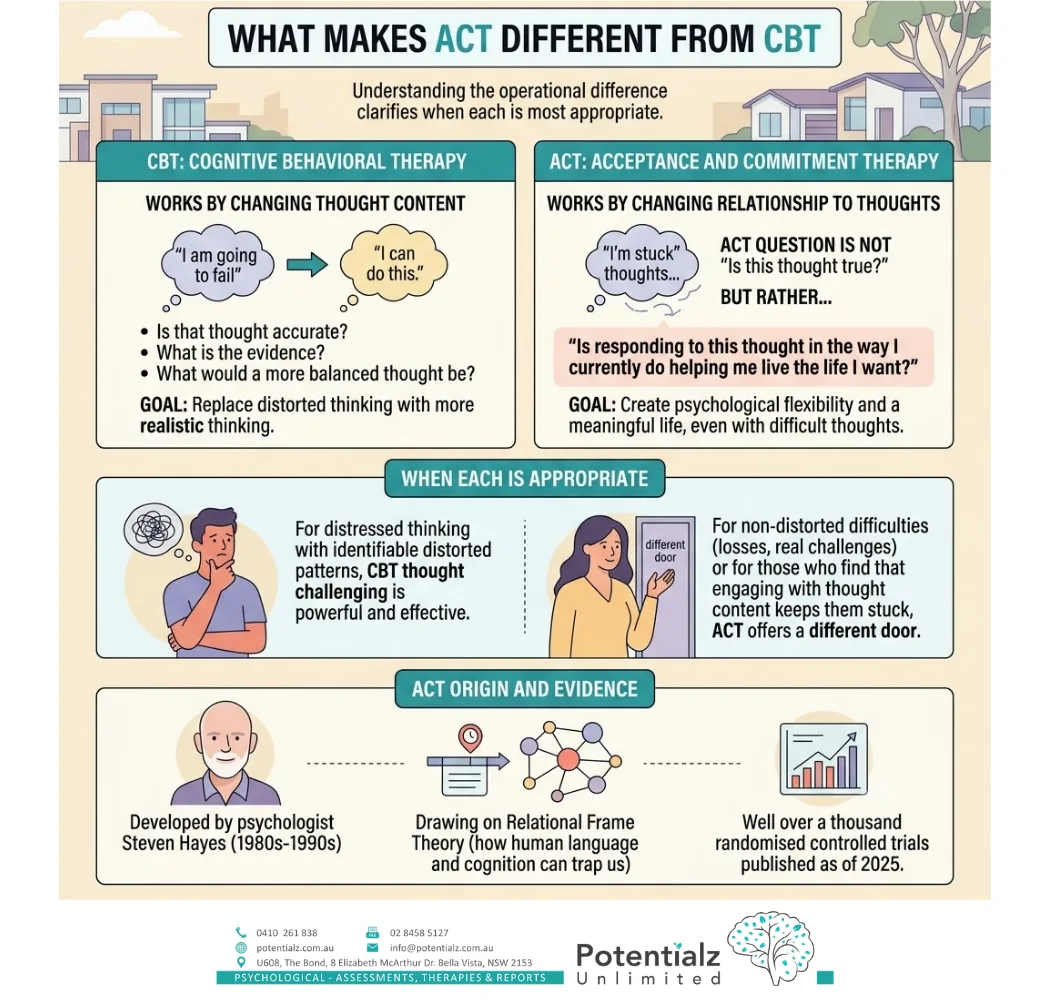
CBT works primarily by changing the content of your thoughts. If you have the automatic thought “I am going to fail,” CBT asks: Is that thought accurate? What is the evidence? What would a more balanced thought be? The goal is to replace distorted, unhelpful thinking with more realistic, adaptive thinking.
ACT takes a different approach. It does not primarily try to change what you think. It tries to change your relationship to what you think. The ACT question is not “Is this thought true?” but rather “Is responding to this thought in the way I currently do helping me live the life I want?”
This distinction matters enormously for certain clients. For someone whose distress is clearly driven by identifiable distorted thinking patterns, CBT-style thought challenging is powerful and effective. But for someone whose thoughts are not obviously distorted — who really has experienced significant losses, who genuinely faces real difficulties — or for someone who has been doing cognitive work for years and finds that engaging with the content of their thoughts keeps them stuck in the content, ACT offers a different door.
ACT was developed by psychologist Steven Hayes in the 1980s and 1990s, drawing on Relational Frame Theory, which describes how human language and cognition can trap us in unhelpful patterns. The treatment has been refined and researched extensively since then, with well over a thousand randomised controlled trials published as of 2025.
The Six Core Processes of ACT
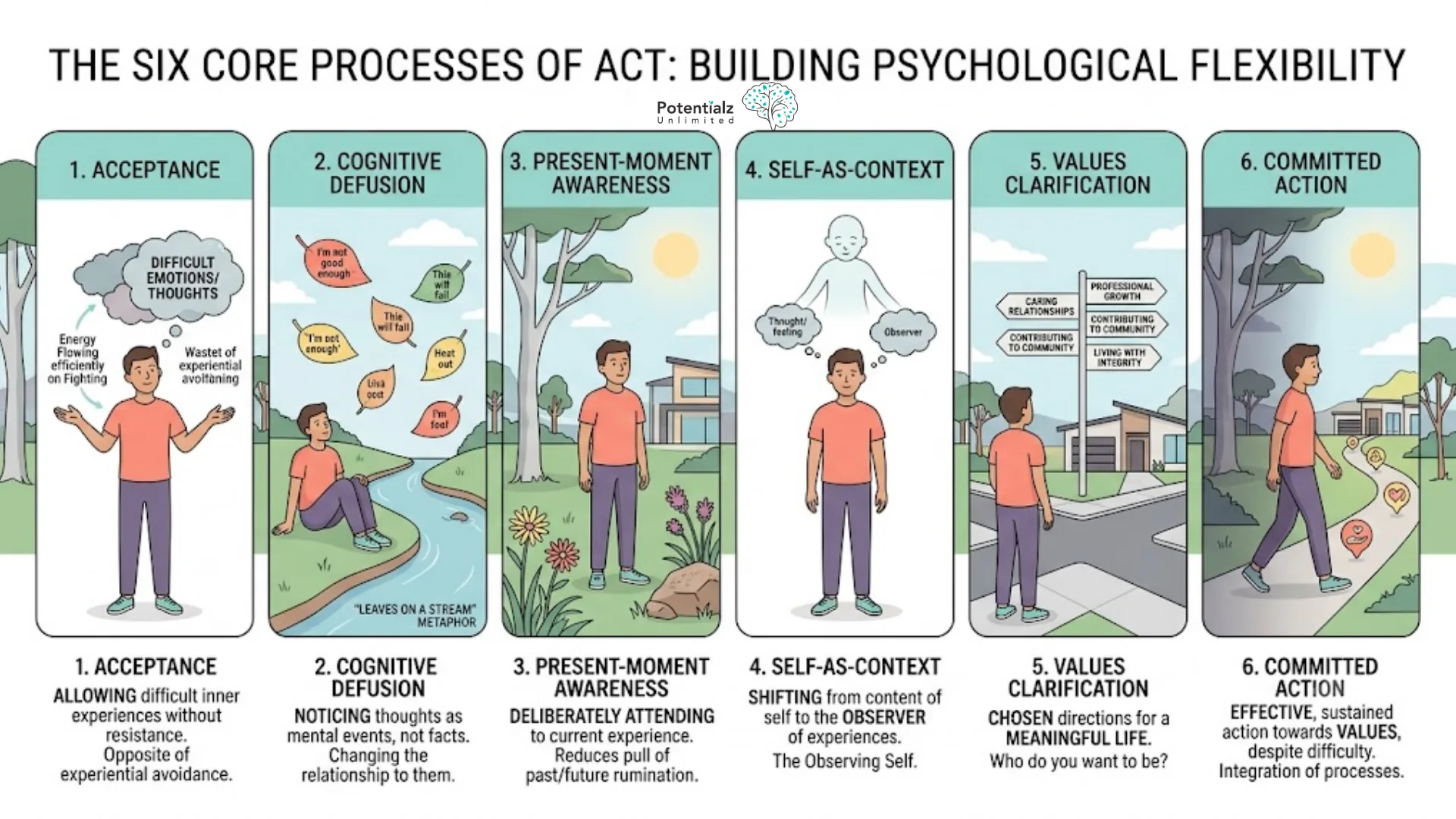
ACT is built on six interrelated processes that together aim to build psychological flexibility. I explain each of them in plain language.
1. Acceptance
Acceptance in ACT does not mean resignation or approval. It means allowing difficult thoughts, feelings, and sensations to be present without fighting them, avoiding them, or letting them dictate your behaviour. It is the opposite of experiential avoidance — the tendency to suppress, escape, or distract from unwanted inner experiences, which ACT research identifies as a central driver of psychological distress.
Acceptance is an active stance, not a passive one. It is choosing to feel what you feel, fully and without defence, because the energy spent fighting it is not serving you.
2. Cognitive Defusion
Cognitive defusion is the process of creating distance between yourself and your thoughts — noticing them as mental events rather than facts about reality. When you are fused with a thought — “I am worthless” — it feels solid and real, like a description of who you are. When you defuse from it, you notice: “I am having the thought that I am worthless.” You have not changed the thought, but you have changed your relationship to it.
ACT uses various techniques and metaphors to build defusion. One I find accessible and effective with clients is the “leaves on a stream” image: imagine your thoughts as leaves floating on the surface of a slow stream. You notice each leaf, acknowledge it, and watch it drift by. You are not the leaves. You are the observer on the bank.
3. Present-Moment Awareness
This is the ACT equivalent of mindfulness — deliberately attending to the present experience rather than being lost in rumination about the past or anxiety about the future. Most psychological distress involves being pulled out of the present: reliving regrets or anticipating catastrophes. Present-moment awareness is a skill that, with practice, reduces this pull and creates space for deliberate choice. It overlaps closely with the broader emotional regulation skills that help you respond to distress rather than react to it.
4. Self-as-Context
This process involves shifting your perspective of yourself from being your thoughts and feelings (content) to being the observer of your thoughts and feelings (context). ACT sometimes calls this the “observing self” — the part of you that notices your experiences but is not defined by them. This shift is particularly helpful for people whose sense of identity is heavily fused with their diagnosis, their suffering, or their limitations.
5. Values Clarification
Values in ACT are chosen directions — the things that matter to you most, that give your life meaning and purpose. Not goals (which can be achieved or failed) but ongoing directions: being a caring parent, contributing to your community, living with integrity, growing professionally. Values clarification asks: what kind of person do I want to be? What do I want my life to be about? These questions often cut through the noise of symptom-focused thinking to something deeper and more motivating.
6. Committed Action
This is the behavioural component of ACT: taking effective, sustained action in the direction of your values, even when difficult thoughts and feelings are present. It is the integration of all the other processes into actual behaviour change. Unlike avoidance-driven behaviour, committed action is values-driven — and this difference, ACT research suggests, produces outcomes that are more robust and more meaningful.
The Passengers on the Bus: A Metaphor That Works
One of the most accessible ACT metaphors I use with clients is the “passengers on the bus.” Imagine you are the driver of a bus, and your thoughts — including your fears, self-doubts, and difficult memories — are the passengers. Some of them are loud, rude, and intimidating. They threaten you, tell you to change direction, insist you pull over.
You have two options. You can argue with the passengers — turning around to fight them, letting the argument consume all your attention while the bus drifts off course. Or you can keep your eyes on the road, driving in the direction you have chosen, and let the passengers make noise in the back. They are still there. You have not silenced them. But they are not driving.
This metaphor captures something essential about ACT: the goal is not to get rid of the difficult thoughts. It is to stop letting them hijack the bus. The direction of the bus is yours to choose — and that direction is your values.
The Evidence Base for ACT
ACT’s evidence base has grown rapidly over the past two decades. As of 2025, there are over 1,300 randomised controlled trials supporting ACT across a wide range of conditions. Meta-analytic reviews indicate that ACT is significantly more effective than control conditions for anxiety disorders, depression, chronic pain, OCD, and workplace stress (A-Tjak et al., 2015; Hayes et al., 2006).
The American Psychological Association’s Division 12 (Clinical Psychology) recognises ACT as an empirically supported treatment for depression, chronic pain, and mixed anxiety. The Australian Psychological Society includes ACT in its evidence-based psychological interventions register.
A key finding from ACT research is that the mechanisms of change differ from CBT: ACT works by increasing psychological flexibility and reducing experiential avoidance, rather than by changing the content of cognitions. This means ACT and CBT can work through different pathways, and combining them can address more of the maintaining factors of distress than either approach alone.
When ACT May Be More Helpful Than CBT — or a Useful Addition
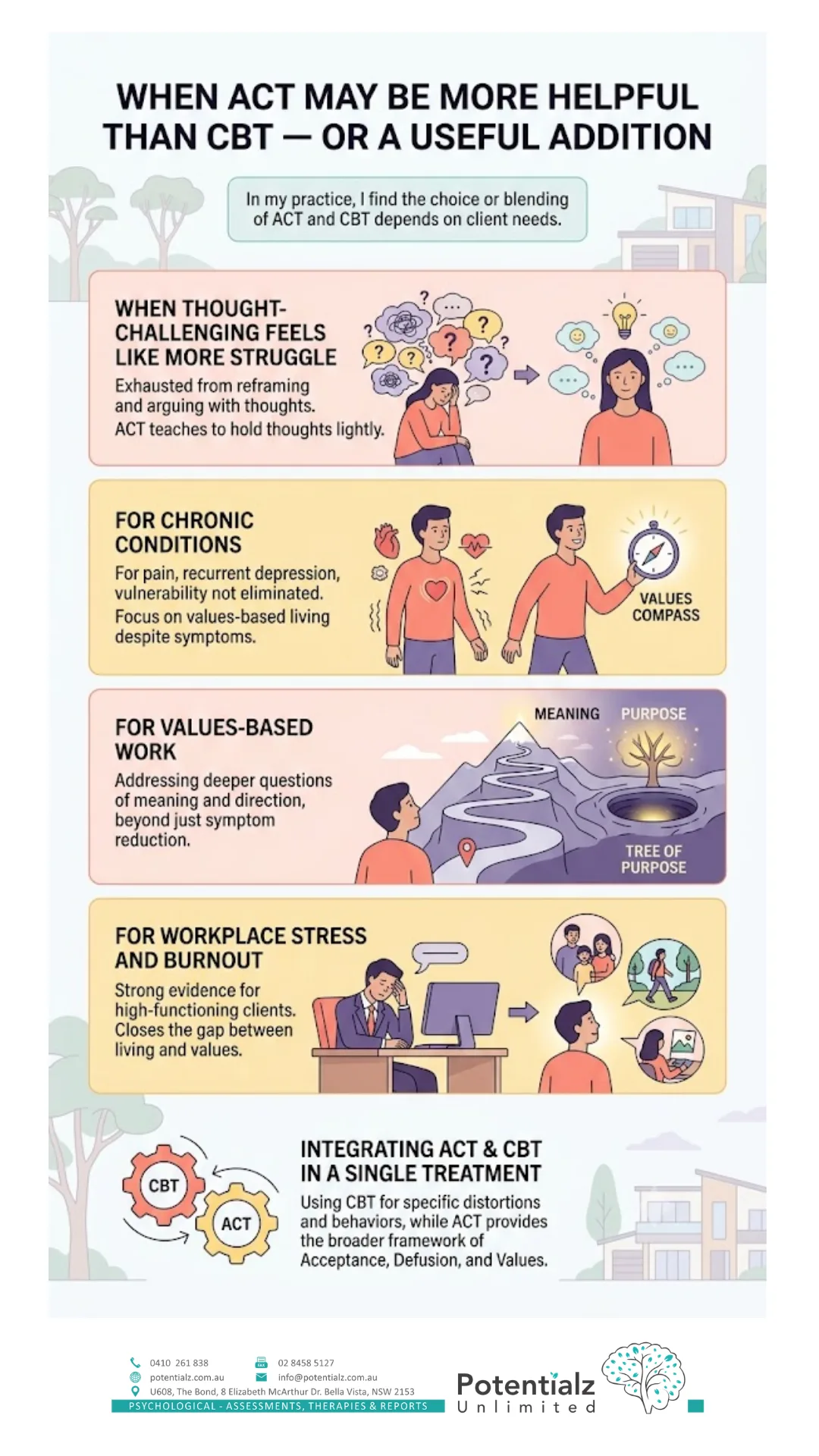
In my practice, I use both ACT and CBT, and I find that the choice between them — or the blending of them — depends significantly on what a particular client needs.
ACT tends to be particularly useful in the following situations:
When thought-challenging feels like more struggle. Some clients have been working on their thoughts for years, challenging and reframing, and find that the process itself has become exhausting. For these clients, a framework that does not require them to argue with every thought — but instead teaches them to hold thoughts more lightly — can be a genuine relief.
For chronic conditions. Where a condition is unlikely to be fully eliminated — chronic pain, recurrent depression, an ongoing anxiety vulnerability — ACT’s emphasis on values-based living despite the presence of symptoms is often more clinically appropriate than a goal of symptom elimination.
For values-based work. Many clients who present with clinical symptoms are also grappling with deeper questions of meaning and direction. ACT provides a structured way to address these questions, which CBT alone does not always reach.
For workplace stress and burnout. ACT has a strong evidence base for occupational stress and is particularly useful for clients who are high-functioning but struggling with the gap between how they are living and what actually matters to them.
For many clients, I integrate ACT and CBT in a single treatment — using CBT techniques to address specific distorted thinking patterns and safety behaviours, while ACT processes provide the broader framework of acceptance, defusion, and values-directed living. A brief, forward-looking sibling of this work — often used at the top of sessions and for defined pieces of change in around six sessions — is Solution-Focused Therapy; see our team’s post on Solution-Focused Therapy for older adults for how SFT combines cleanly with ACT’s committed-action step.
ACT in Practice: What a Session Looks Like
When I use ACT with a client, I begin by building a shared understanding of how experiential avoidance is maintaining their distress. This involves mapping out the strategies they use to avoid difficult internal experiences — distraction, rumination, reassurance-seeking, overwork, substance use — and the short-term relief and long-term costs of each.
We then work through the ACT processes in a way that is tailored to the individual. Values clarification is often an early focus because it gives the work direction and motivation. Defusion and acceptance work require practice — both within sessions and between them. I use exercises, metaphors, and short mindfulness practices to build these skills in a way that is accessible and grounded in daily life.
Sessions are 50 minutes. The work between sessions is as important as the work in session — practising noticing thoughts without fusing with them, identifying moments where avoidance is operating, and taking small committed actions in valued directions.
How I Can Help
If you are exhausted by fighting your thoughts and feelings, and are looking for a different way to manage your mental health — one that builds flexibility rather than more struggle — I would welcome the opportunity to work with you using ACT.
I use ACT alongside CBT and Mindfulness-based approaches at Potentialz Unlimited in Bella Vista, Unit 608/8 Elizabeth Macarthur Drive. I offer face-to-face appointments with after-hours and Saturday availability, as well as telehealth via phone or Zoom.
Medicare rebates are available via a GP Mental Health Care Plan — up to 10 sessions per calendar year. I accept WorkCover, NDIS, EAP/EPP referrals, and private fee arrangements.
I speak English, Hindi, Marathi, and Punjabi. Clients from South Asian and migrant backgrounds who would prefer to work in Hindi, Marathi, or Punjabi are warmly welcome.
To book, visit live.potentialz.com.au or call 0410 261 838.
References
A-Tjak, J. G. L., Davis, M. L., Morina, N., Powers, M. B., Smits, J. A. J., & Emmelkamp, P. M. G. (2015). A meta-analysis of the efficacy of acceptance and commitment therapy for clinically relevant mental and physical health problems. Psychotherapy and Psychosomatics, 84(1), 30–36. https://doi.org/10.1159/000365764
Hayes, S. C., Luoma, J. B., Bond, F. W., Masuda, A., & Lillis, J. (2006). Acceptance and commitment therapy: Model, processes and outcomes. Behaviour Research and Therapy, 44(1), 1–25. https://doi.org/10.1016/j.brat.2005.06.006
Hayes, S. C., Strosahl, K. D., & Wilson, K. G. (2012). Acceptance and commitment therapy: The process and practice of mindful change (2nd ed.). Guilford Press.
Bluett, E. J., Homan, K. J., Morrison, K. L., Levin, M. E., & Twohig, M. P. (2014). Acceptance and commitment therapy for anxiety and OCD spectrum disorders: An empirical review. Journal of Anxiety Disorders, 28(6), 612–624. https://doi.org/10.1016/j.janxdis.2014.06.008
Australian Psychological Society. (2018). Evidence-based psychological interventions in the treatment of mental disorders: A literature review (4th ed.). APS. https://www.psychology.org.au
Disclaimer
Sushama Sathe is an AHPRA Registered Psychologist (PSY0001370871) at Potentialz Unlimited. The information in this post is for general educational purposes only and does not constitute clinical advice or diagnosis. Please consult a qualified health professional for assessment and treatment tailored to your individual circumstances.
Crisis Resources
- Lifeline: 13 11 14 (24/7)
- Beyond Blue: 1300 22 4636
- Kids Helpline: 1800 55 1800
- Emergency: 000
Related Reading
- What Is Holistic Counselling and How Does It Differ from Traditional Therapy?
- Cognitive Assessment for Learning Difficulties: What WISC and WPPSI Actually Measure
- Generalised Anxiety Disorder: When Worry Becomes a Way of Life — psychologist Sushama Sathe on how ACT defusion and values work sit alongside CBT in treating chronic worry.
Knowledge Check Quiz
Test what you have just read. Choose your answer for each question, then submit to reveal the answers and your score.
Need Professional Support?
If you're experiencing mental health concerns, our team is here to help.