Have you ever reached a point where getting out of bed to go to a job you once loved feels almost impossible?
If so, you are not alone. Across Australia, burnout is quietly reshaping the lives of nurses, teachers, lawyers, managers, parents, and entrepreneurs. It does not announce itself loudly. It creeps in through cancelled social plans, a shorter fuse at home, and a growing sense that nothing you do makes a difference any more.
I see this pattern regularly in my practice. People arrive exhausted — not from one bad week, but from months of giving everything they had and getting nothing back. The worst part? Most of them have been telling themselves they should be fine.
This post explains what burnout actually is, how it differs from depression, who is most at risk in Australian professional culture, and what genuine recovery looks like — including holistic approaches that go well beyond rest alone.
What Is Burnout? The WHO Definition
In 2019, the World Health Organization updated its International Classification of Diseases to include burnout as an occupational phenomenon — importantly, not a medical condition or mental health disorder in its own right. The WHO defines burnout as a syndrome resulting from chronic workplace stress that has not been successfully managed.
That definition matters. It means burnout happens in the context of work — not because something is fundamentally wrong with you as a person.
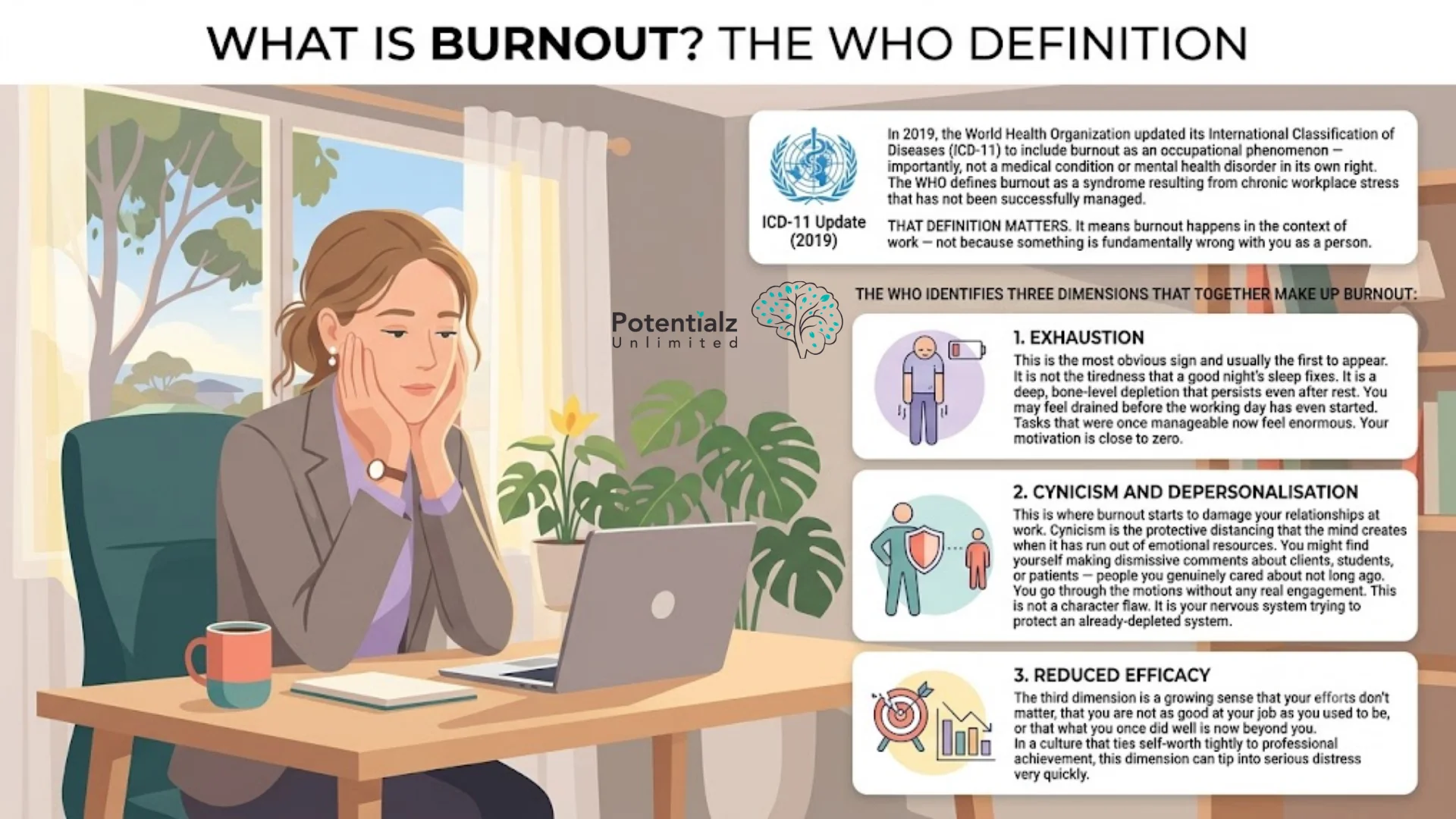
The WHO identifies three dimensions that together make up burnout:
1. Exhaustion
This is the most obvious sign and usually the first to appear. It is not the tiredness that a good night’s sleep fixes. It is a deep, bone-level depletion that persists even after rest. You may feel drained before the working day has even started. Tasks that were once manageable now feel enormous. Your motivation is close to zero.
2. Cynicism and Depersonalisation
This is where burnout starts to damage your relationships at work. Cynicism is the protective distancing that the mind creates when it has run out of emotional resources. You might find yourself making dismissive comments about clients, students, or patients — people you genuinely cared about not long ago. You go through the motions without any real engagement.
This is not a character flaw. It is your nervous system trying to protect an already-depleted system.
3. Reduced Efficacy
The third dimension is a growing sense that your efforts don’t matter, that you are not as good at your job as you used to be, or that what you once did well is now beyond you. In a culture that ties self-worth tightly to professional achievement, this dimension can tip into serious distress very quickly.
Burnout vs Depression: An Important Distinction
One of the most important conversations I have with clients in this space is the difference between burnout and depression. They look similar — but they are not the same thing. And conflating them can lead to the wrong kind of support.
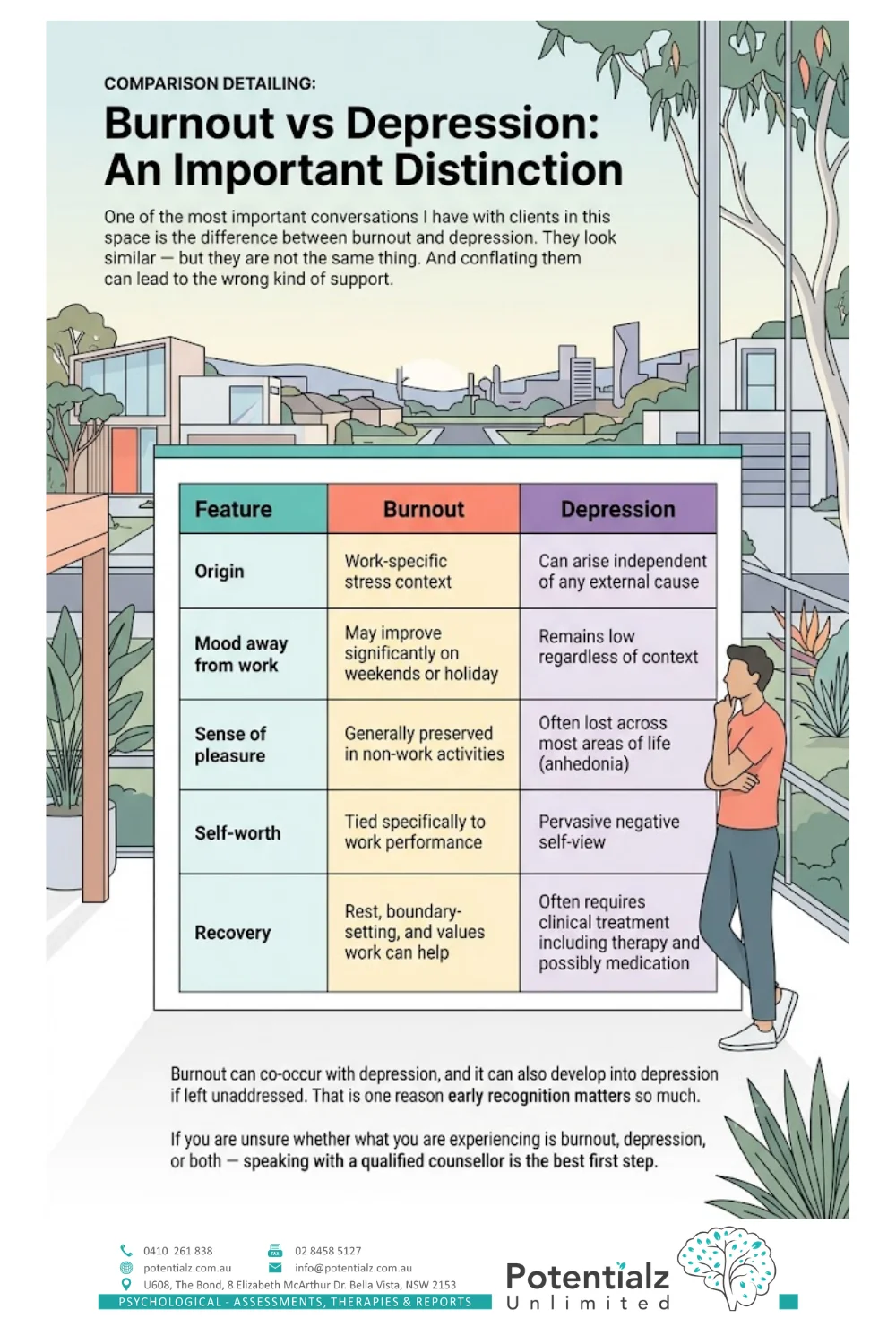
| Feature | Burnout | Depression |
|---|---|---|
| Origin | Work-specific stress context | Can arise independent of any external cause |
| Mood away from work | May improve significantly on weekends or holiday | Remains low regardless of context |
| Sense of pleasure | Generally preserved in non-work activities | Often lost across most areas of life (anhedonia) |
| Self-worth | Tied specifically to work performance | Pervasive negative self-view |
| Recovery | Rest, boundary-setting, and values work can help | Often requires clinical treatment including therapy and possibly medication |
Burnout can co-occur with depression, and it can also develop into depression if left unaddressed. That is one reason early recognition matters so much.
If you are unsure whether what you are experiencing is burnout, depression, or both — speaking with a qualified counsellor is the best first step.
Why Australian Professional Culture Creates Burnout Risk
Australia has a strong cultural emphasis on productivity, mateship through hard work, and the idea that pushing through is a virtue. In many sectors — healthcare, law, education, finance, and small business — the expectation is that you give more than your contracted hours, respond to messages on weekends, and perform at high levels regardless of what is happening in your personal life.
The pandemic years accelerated this. For many professionals, the boundary between home and work dissolved entirely. Research reflects this shift — surveys of the Australian workforce found significant rates of burnout across the board, particularly in high-responsibility roles.
Add to this the pressure of a high cost of living, long commutes across Western Sydney, and the identity investment many Australians place in their careers — and you have a context in which burnout is not just possible. For many people, without conscious intervention, it is almost inevitable.
Why High Achievers Are Most at Risk
There is a painful irony at the heart of burnout. The people most likely to experience it are often the ones you would least expect.
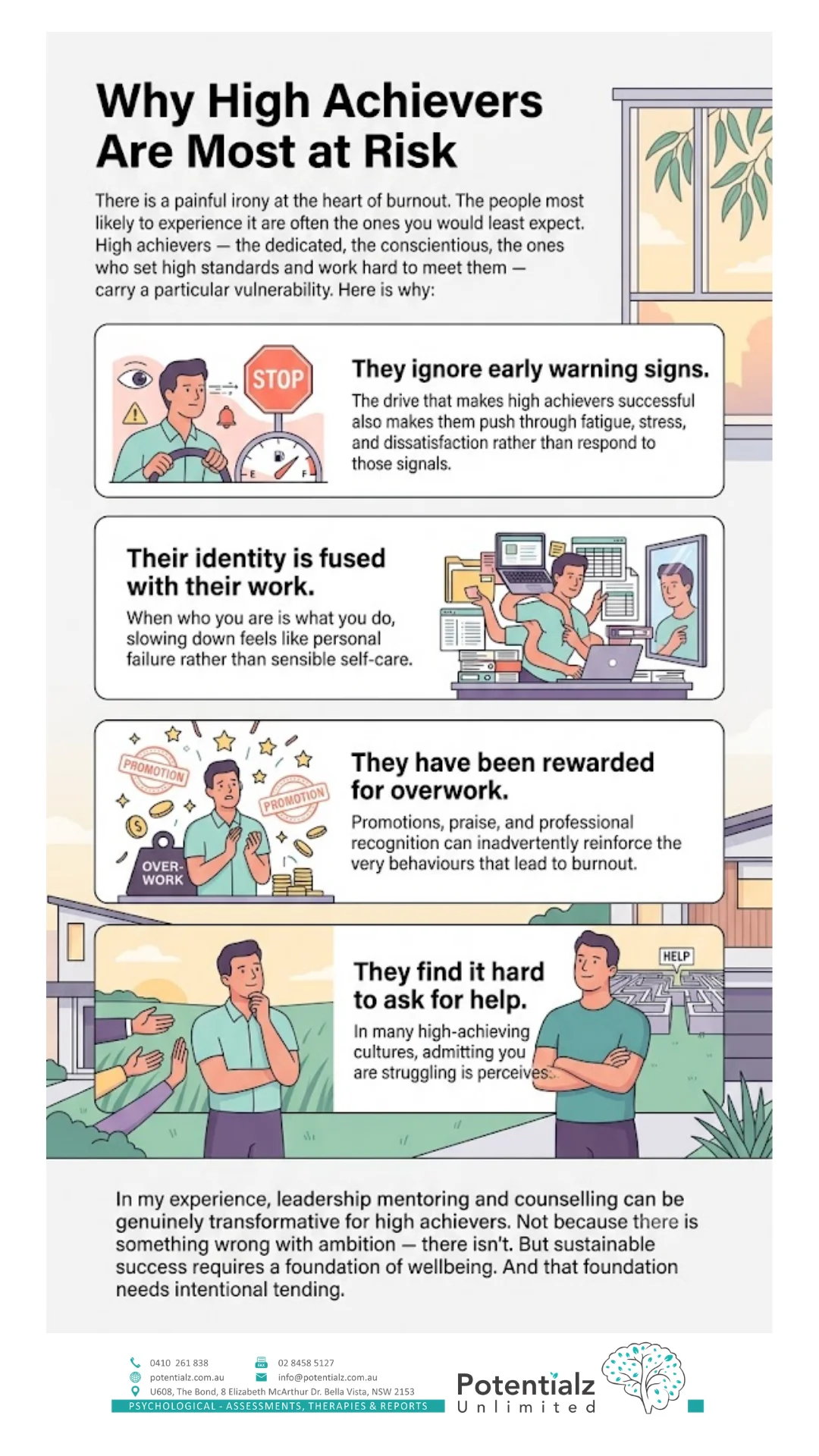
High achievers — the dedicated, the conscientious, the ones who set high standards and work hard to meet them — carry a particular vulnerability. Here is why:
- They ignore early warning signs. The drive that makes high achievers successful also makes them push through fatigue, stress, and dissatisfaction rather than respond to those signals.
- Their identity is fused with their work. When who you are is what you do, slowing down feels like personal failure rather than sensible self-care.
- They have been rewarded for overwork. Promotions, praise, and professional recognition can inadvertently reinforce the very behaviours that lead to burnout.
- They find it hard to ask for help. In many high-achieving cultures, admitting you are struggling is perceived as weakness.
In my experience, leadership mentoring and counselling can be genuinely transformative for high achievers. Not because there is something wrong with ambition — there isn’t. But sustainable success requires a foundation of wellbeing. And that foundation needs intentional tending.
Recognising the Signs: What Your Body and Mind Are Telling You
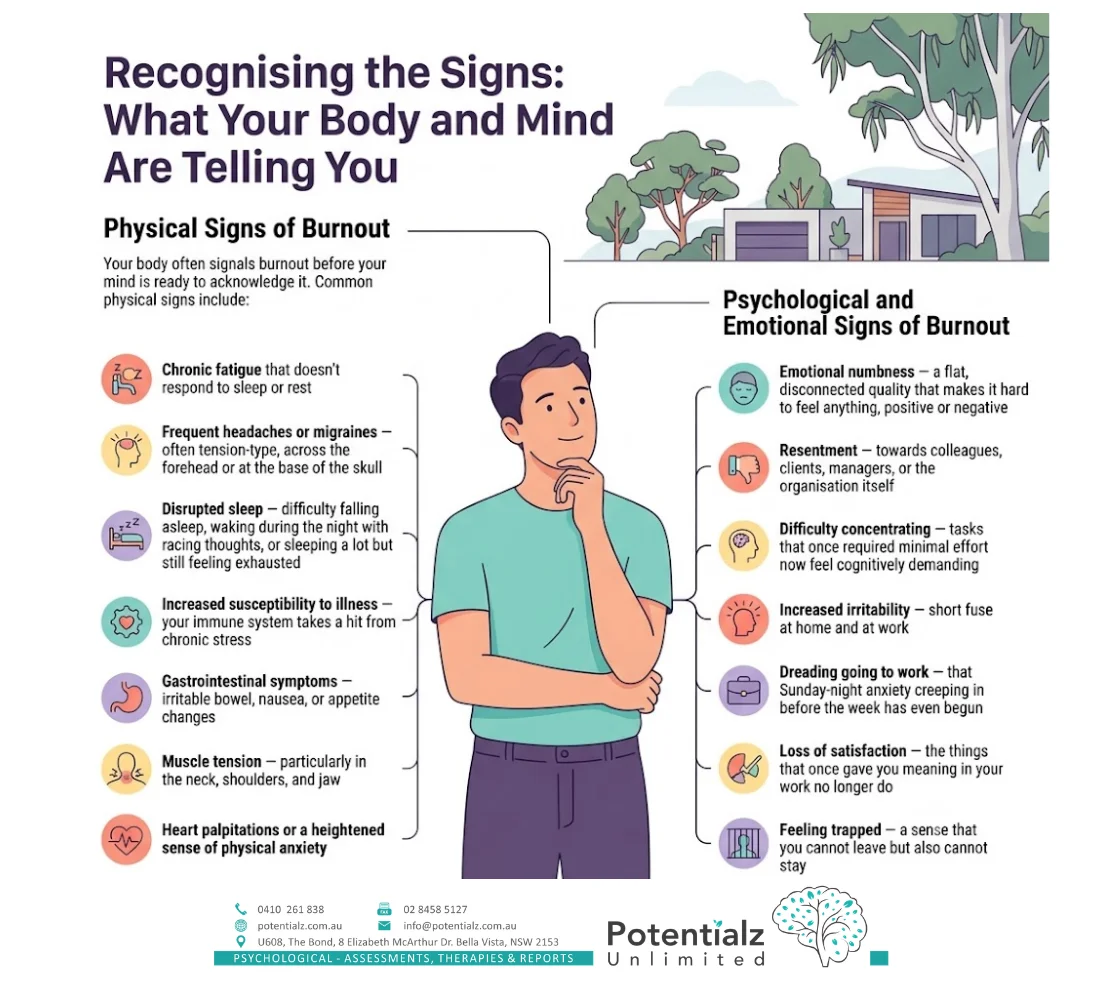
Physical Signs of Burnout
Your body often signals burnout before your mind is ready to acknowledge it. Common physical signs include:
- Chronic fatigue that doesn’t respond to sleep or rest
- Frequent headaches or migraines — often tension-type, across the forehead or at the base of the skull
- Disrupted sleep — difficulty falling asleep, waking during the night with racing thoughts, or sleeping a lot but still feeling exhausted
- Increased susceptibility to illness — your immune system takes a hit from chronic stress
- Gastrointestinal symptoms — irritable bowel, nausea, or appetite changes
- Muscle tension — particularly in the neck, shoulders, and jaw
- Heart palpitations or a heightened sense of physical anxiety
Psychological and Emotional Signs of Burnout
- Emotional numbness — a flat, disconnected quality that makes it hard to feel anything, positive or negative
- Resentment — towards colleagues, clients, managers, or the organisation itself
- Difficulty concentrating — tasks that once required minimal effort now feel cognitively demanding
- Increased irritability — short fuse at home and at work
- Dreading going to work — that Sunday-night anxiety creeping in before the week has even begun
- Loss of satisfaction — the things that once gave you meaning in your work no longer do
- Feeling trapped — a sense that you cannot leave but also cannot stay
If you recognise yourself in several of these signs, please do not wait until things reach a crisis point. Early support makes recovery significantly faster and more complete.
Holistic Recovery: What Actually Works
Recovery from burnout requires more than a holiday. While rest is necessary, it is rarely sufficient on its own. Genuine recovery addresses multiple layers simultaneously — physical, psychological, relational, and meaning-based.
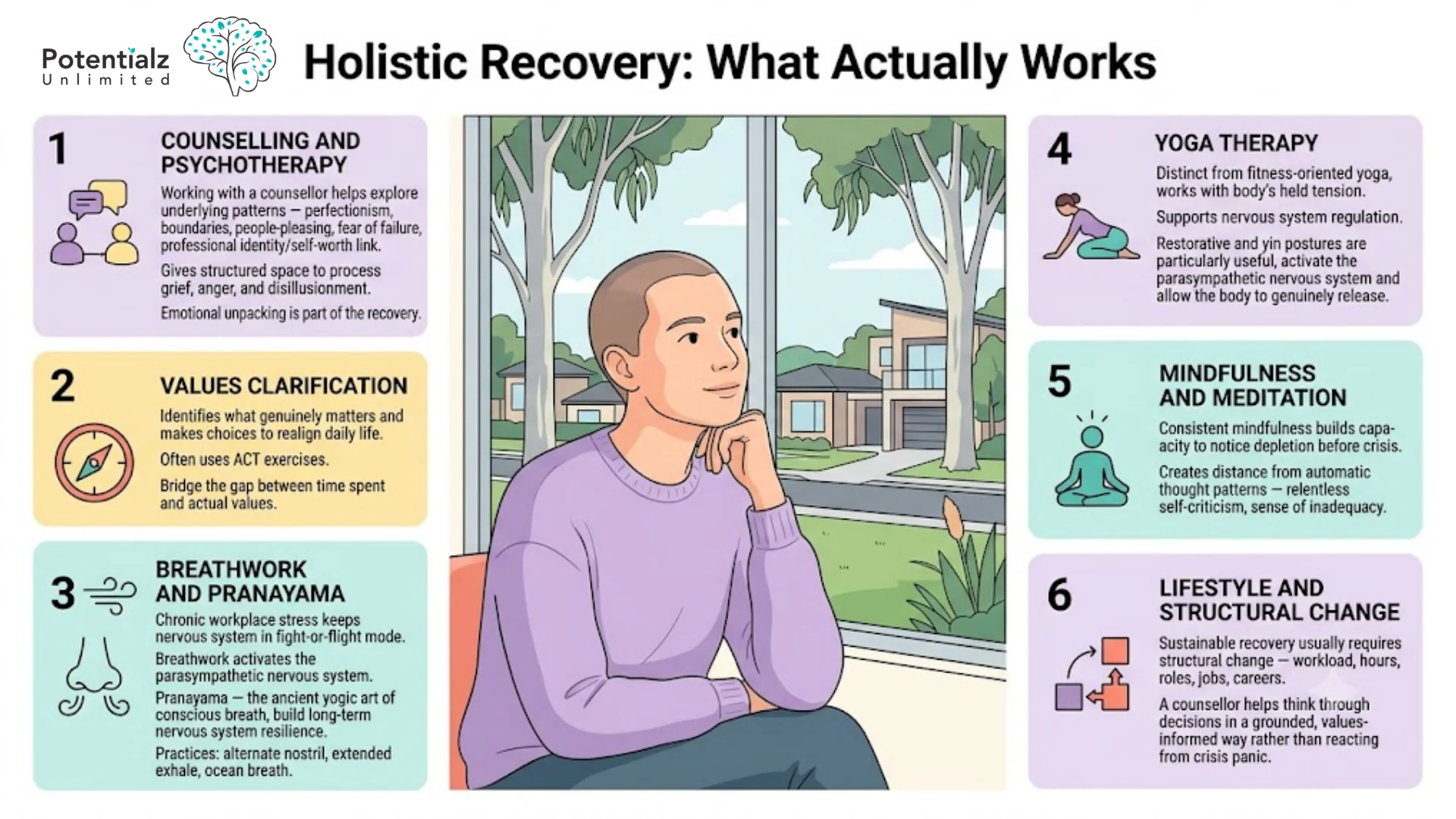
1. Counselling and Psychotherapy
Working with a counsellor helps you explore the underlying patterns that contributed to burnout — perfectionism, difficulty with boundaries, people-pleasing, fear of failure, and the ways your professional identity has become tied to your self-worth. If your inner critic is a big part of the picture, our guide to self-compassion exercises is a good companion read.
Counselling also gives you a structured space to process the grief, anger, and disillusionment that often accompany burnout. That emotional unpacking is part of the recovery, not separate from it.
2. Values Clarification
Burnout often signals a growing gap between how you are spending your time and what you actually value. Values clarification exercises — often used in Acceptance and Commitment Therapy (ACT) — help you identify what genuinely matters and begin making choices that bring your daily life back into alignment.
3. Breathwork and Pranayama
Chronic workplace stress keeps the nervous system in prolonged fight-or-flight mode. Breathwork — including pranayama practices from yoga therapy — directly activates the parasympathetic nervous system, bringing that stress response down.
Ancient yogic traditions called this pranayama — the art of conscious breath. Practices such as alternate nostril breathing (nadi shodhana), extended exhale breathing, and ocean breath (ujjayi) can down-regulate your stress response within minutes. Consistent practice builds long-term nervous system resilience.
4. Yoga Therapy
Yoga therapy — distinct from fitness-oriented yoga — works with the body’s held tension and supports the nervous system regulation that burnout disrupts. Restorative yoga postures and yin yoga are particularly useful in recovery. They activate the parasympathetic nervous system and allow the body to genuinely release what it has been holding.
5. Mindfulness and Meditation
A consistent mindfulness practice builds the capacity to notice when you are moving towards depletion — before it becomes crisis. It also creates distance from automatic thought patterns — the relentless self-criticism, the sense of inadequacy — that both cause and are worsened by burnout.
6. Lifestyle and Structural Change
Sustainable recovery from burnout usually requires some structural change — renegotiating workload, adjusting hours, changing roles, or in some cases, changing jobs or careers entirely. A counsellor can help you think through these decisions in a grounded, values-informed way rather than reacting from a place of crisis or panic.
When to See a Counsellor
You do not need to wait until burnout is severe before reaching out. In fact, the earlier you seek support, the more options you have and the faster recovery tends to be.
Consider speaking with a counsellor if:
- You have been experiencing the signs described above for more than a few weeks
- You are finding it hard to function at work or at home
- Your relationships are suffering
- You are using alcohol, food, screens, or other substances to cope
- You are having thoughts of leaving your career entirely and feeling panicked about what that would mean
- You are experiencing physical symptoms that your GP has not been able to fully explain
Key Takeaways
- The World Health Organization classifies burnout as an occupational phenomenon with three defining dimensions: exhaustion, cynicism, and reduced efficacy.
- Burnout and depression share symptoms but are distinct conditions that respond to different approaches.
- High achievers carry a particular vulnerability to burnout — the same drive that produces success can make it very hard to stop.
- Physical warning signs often appear before psychological ones — chronic fatigue, headaches, and disrupted sleep are early signals your body sends.
- Holistic recovery combining counselling, breathwork, yoga therapy, and values clarification works at every level of burnout.
- Seeking support early protects your career, your relationships, and your long-term health.
How Potentialz Can Help
If any of this sounds familiar, I genuinely want to hear from you.
At Potentialz Unlimited in Bella Vista, I offer individual counselling, psychotherapy, and leadership mentoring specifically designed to support professionals experiencing burnout. My integrative approach combines evidence-informed counselling with yoga therapy, breathwork, mindfulness, and values-based work — addressing burnout at every level: physical, psychological, and meaning-based.
I work with professionals across Western Sydney and offer Telehealth sessions via phone or Zoom, making it easy to access support even when your schedule is demanding. No referral is needed — you can simply reach out.
Book a session online: live.potentialz.com.au Call us: 0410 261 838 Visit us: Unit 608, 8 Elizabeth Macarthur Drive, Bella Vista NSW 2153
You can also explore our full range of services, or get in touch directly. Sessions are available Monday to Friday, 10am to 7pm, with Saturday and after-hours options also available.
References (APA 7th Edition)
Ahola, K., Hakanen, J., Perhoniemi, R., & Mutanen, P. (2014). Relationship between burnout and depressive symptoms: A study using the person-centred approach. Burnout Research, 1(1), 29–37. https://doi.org/10.1016/j.burn.2014.03.003
Australian HR Institute. (2022). HR Pulse: Burnout and the Australian workforce. AHRI. https://www.ahri.com.au
Maslach, C., & Leiter, M. P. (2016). Understanding the burnout experience: Recent research and its implications for psychiatry. World Psychiatry, 15(2), 103–111. https://doi.org/10.1002/wps.20311
Salvagioni, D. A. J., Melanda, F. N., Mesas, A. E., González, A. D., Gabani, F. L., & Andrade, S. M. de. (2017). Physical, psychological and occupational consequences of job burnout: A systematic review of prospective studies. PLOS ONE, 12(10), e0185781. https://doi.org/10.1371/journal.pone.0185781
World Health Organization. (2019). Burn-out an “occupational phenomenon”: International Classification of Diseases. https://www.who.int/news/item/28-05-2019-burn-out-an-occupational-phenomenon-international-classification-of-diseases
Related Reading on potentialz.com.au
- Self Compassion: The Foundation of Good Mental Health
- The Power of Breath: Achieving Mental Wellness with Conscious Breathing
- What Is Acceptance and Commitment Therapy (ACT)?
- Yoga Asanas vs Exercise: Which Is Better for Your Mind?
- Our Team
- Contact us
Disclaimer: Samita Rathor is an Accredited Counsellor and Psychotherapist registered with PACFA (Psychotherapy and Counselling Federation of Australia) and the ACA. She is not a registered psychologist under AHPRA. This information is general in nature and does not constitute clinical advice. If you are experiencing significant distress, please contact your GP, a mental health professional, or one of the crisis services listed above. The team at Potentialz Unlimited also includes AHPRA-registered psychologists.
Crisis support: If you or someone you know needs immediate support, please contact Lifeline on 13 11 14 (24/7), Beyond Blue on 1300 22 4636, or call 000 in an emergency.
Knowledge Check Quiz
Test what you have just read. Choose your answer for each question, then submit to reveal the answers and your score.
Need Professional Support?
If you're experiencing mental health concerns, our team is here to help.