You have watched your child at birthday parties and at the park. You know they want to connect — you can see it in the way they hover near other children, watching the play, wanting to be part of it. But something gets in the way. They don’t know how to enter the group. They say the wrong thing at the wrong moment. A game doesn’t go their way and everything falls apart. Other children drift away and your child is standing alone again.
Social skills do not come naturally to every child. For some children — including many with autism, ADHD, anxiety, or simply a more sensitive or quieter temperament — the unspoken rules of peer interaction are genuinely hard to learn. And the traditional advice of “just let them play” only works for children whose nervous systems and social instincts already know how.
Group LEGO® Based Therapy offers something different: a structured, purposeful, genuinely enjoyable context in which children practise the real skills of social connection — together, with support, through the medium they love.
What Is Group LEGO® Based Therapy?
LEGO® Based Therapy was originally developed by Dr Daniel LeGoff, a neuropsychologist working with autistic children, who noticed that LEGO® had a unique motivating power for children who struggled socially — including many who had little interest in people. By harnessing that motivation and adding a structured collaborative framework, LeGoff developed a systematic approach that has since been rigorously researched and widely adopted (LeGoff, 2004).
The approach was further developed and validated by researchers including Dr Gina Gomez de la Cuesta, Dr Gary Howlin, and Dr Simon Baron-Cohen at the Autism Research Centre in Cambridge, with multiple studies demonstrating significant improvements in social competence and reduction in autism-specific behaviours in children who participated in LEGO® Based Therapy programs (LeGoff & Sherman, 2006; Owens et al., 2008).
While the approach was originally developed for autistic children, it has since been used successfully with children across a wide range of presentations, including ADHD, social anxiety, shyness, and children who have experienced social difficulties for other reasons.
The Three Roles: Engineer, Supplier, Builder
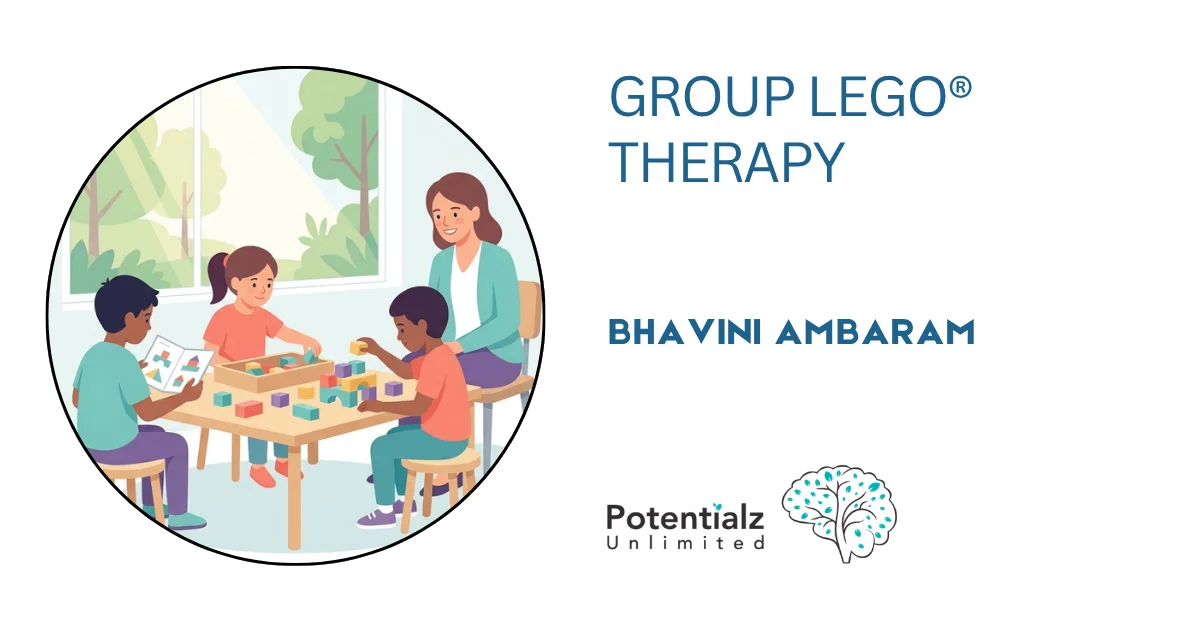
The genius of LEGO® Based Therapy lies in its structured role framework. Rather than simply placing children together with a pile of LEGO® bricks and hoping for the best, LEGO® Based Therapy assigns each child a specific, defined role within the collaborative build:
The Engineer has the instruction sheet or model plan. Their job is to describe what needs to be built — verbally, without gestures — and to direct the process. They cannot touch the bricks.
The Supplier has access to the brick collection. Their job is to listen to the Engineer’s requests, find the correct pieces, and pass them to the Builder. They must listen carefully and ask clarifying questions if needed.
The Builder receives the pieces from the Supplier and constructs the model according to the Engineer’s instructions. They work with their hands, ask for clarification when needed, and report back on progress.
Roles rotate during the session, so each child practises each capacity. And because the roles are defined and predictable, the social demands are structured — children know what is expected of them, which reduces the anxiety of open-ended social interaction.
What Social Skills LEGO® Therapy Builds
The role structure of LEGO® Based Therapy is not arbitrary. It is deliberately designed to build the specific social skills that are hardest for many children. These include:
Communication: The Engineer must learn to describe precisely and clearly. The Builder must ask for clarification rather than guessing. The Supplier must listen and confirm. All three roles require purposeful verbal communication in the service of a shared goal.
Perspective-taking and empathy: Working collaboratively requires each child to track not just their own task but the experience of the others. Is the Builder confused? Is the Supplier having trouble finding the right piece? These moments create natural opportunities for perspective-taking.
Turn-taking and patience: The structured roles require each child to wait for their input to be needed, to tolerate another child’s pace, and to manage frustration when things don’t go as planned.
Conflict resolution: When something goes wrong in the build — a wrong piece, a misunderstanding, a piece that was placed incorrectly — the group must solve the problem together. This is perhaps the most valuable social learning of all: how to navigate small ruptures and repair them.
Shared achievement: Completing a build together creates a genuine moment of shared pride and connection. This positive social experience — built around competence and collaboration rather than popularity or performance — is often novel for children who struggle socially.
Who Benefits from Group LEGO® Therapy
Group LEGO® Based Therapy is particularly valuable for:
Children with autism spectrum presentations: The structured roles and clear expectations reduce the ambiguity of social interaction, making it more accessible. The LEGO® medium itself is highly motivating for many autistic children.
Children with ADHD: The structured task, clear roles, and immediate tangible reward of the building process support focus, impulse control, and turn-taking — areas of specific difficulty for children with ADHD.
Children with social anxiety: The role framework provides a clear, defined way to participate — children do not need to improvise socially or manage unstructured peer interaction, which is often the most anxiety-provoking aspect of social situations.
Children who are shy, withdrawn, or have struggled with peer relationships for other reasons, including school transitions, bullying, or social isolation.
Groups of 3–4 children are ideal for LEGO® Based Therapy. At Potentialz Unlimited, I run small group sessions with a maximum of 4 children, which allows for the structured role framework and ensures each child receives adequate attention and support.
How Group Therapy Adds to Individual Work
Some children already attend individual play therapy sessions with me. Group LEGO® therapy offers something individual sessions cannot: the experience of real peer interaction, with real peers, in real time — with the support of a Practitioner in Therapeutic Play present to guide and facilitate.
The individual session builds the child’s internal capacity — their regulation, their sense of self, their relational safety. The group session provides the arena in which those capacities are practised and applied in the context they actually matter: with peers.
Many children make rapid progress in their individual social skills work once they have a group context in which to apply what they are learning.
What a Group Session Looks Like
A typical Group LEGO® Based Therapy session at Potentialz Unlimited runs for approximately 60 minutes. Sessions begin with a brief warm-up activity to help children settle and connect. Children are then assigned their roles, and the build begins.
I facilitate the session — supporting the children in staying in their roles, mediating when communication breaks down, and providing coaching on the specific social moments that arise. I do not control the session; I support it. The children do the work.
Sessions end with a brief reflection and a share of the completed build. This celebration of shared achievement is an important part of the experience — it anchors the positive social connection that has been built.
Siblings and children from the same school may not always be placed in the same group, as this can affect the dynamics. I make group composition decisions carefully to support the best possible social learning for each child.
Key Takeaways
- Group LEGO® Based Therapy is an evidence-based approach for building social skills, with a robust research base across multiple study designs
- The three-role structure (Engineer, Supplier, Builder) creates structured, purposeful social interaction that builds communication, perspective-taking, turn-taking, conflict resolution, and shared achievement
- The approach is particularly effective for children with autism, ADHD, social anxiety, and general social difficulties
- Group sessions complement individual play therapy by providing a real peer context in which skills can be practised
- Groups at Potentialz Unlimited are small (maximum 4 children), facilitated by a PTUK/PTSA accredited Practitioner in Therapeutic Play
How Potentialz Can Help
At Potentialz Unlimited in Bella Vista, I run Group LEGO® Based Therapy programs for children aged 5–12. Groups are small, structured, and facilitated by me as a PTUK/PTSA accredited Practitioner in Therapeutic Play and Certified Facilitator of LEGO® Based Therapy (2025).
Please contact Potentialz Unlimited to discuss current group availability and whether group LEGO® therapy is appropriate for your child.
- Initial parent consultation: $250
- Play therapy sessions: $190 per session
- Group programs: contact for current pricing
- NDIS self-managed plans accepted
Book a session online: live.potentialz.com.au Call us: 0410 261 838 Visit us: Unit 608/8 Elizabeth Macarthur Drive, Bella Vista NSW 2153 Hours: Monday to Friday, 10am–7pm | Saturday and after-hours available
References
LeGoff, D. B. (2004). Use of LEGO® as a therapeutic medium for improving social competence. Journal of Autism and Developmental Disorders, 34(5), 557–571. https://doi.org/10.1007/s10803-004-2550-0
LeGoff, D. B., & Sherman, M. (2006). Long-term outcome of social skills intervention based on interactive LEGO® play. Autism, 10(4), 317–329. https://doi.org/10.1177/1362361306064403
LeGoff, D. B., Gómez de la Cuesta, G., Krauss, G. W., & Baron-Cohen, S. (2014). LEGO®-based therapy: How to build social competence through LEGO®-based clubs for children with autism and related conditions. Jessica Kingsley Publishers.
Owens, G., Granader, Y., Humphrey, A., & Baron-Cohen, S. (2008). LEGO® therapy and the social use of language programme: An evaluation of two social skills interventions for children with high functioning autism and Asperger syndrome. Journal of Autism and Developmental Disorders, 38(10), 1944–1957. https://doi.org/10.1007/s10803-008-0590-6
AHPRA Disclaimer: This information is general in nature. Please consult a qualified health professional for individual advice.
Crisis Resources: If you or someone you know needs support, please contact Lifeline on 13 11 14, Beyond Blue on 1300 22 4636, or Kids Helpline on 1800 55 1800.
Knowledge Check Quiz
Test what you have just read. Choose your answer for each question, then submit to reveal the answers and your score.
Need Professional Support?
If you're experiencing mental health concerns, our team is here to help.