Welcome to This Week in Mental Health
Each week we round up the developments worth knowing about across psychotherapy, counselling, and mental health — translated into plain language, with a careful clinical eye and links to the original research. This week’s focus: anxiety and panic.
A quick word on how we do this. We only report from credible, primary sources — peer-reviewed journals, universities, and official health bodies — and we frame new research as emerging rather than settled. New findings are interesting and important, but a single study rarely changes clinical practice on its own.
Here are the three stories on our radar this week.
1. The largest brain study of panic disorder ever conducted
The headline research item comes from the ENIGMA-Anxiety Working Group, an international consortium that pooled brain scans to overcome a long-standing problem in psychiatry: individual neuroimaging studies are usually too small to give reliable answers.
Published in Molecular Psychiatry, the mega-analysis brought together MRI data from 4,924 people across 28 sites worldwide — 1,146 individuals with panic disorder compared with 3,778 without (Han et al., 2026). That scale makes it the largest study of its kind.
A few of the findings stood out:
- Age of onset mattered. People whose panic disorder began before the age of 21 later showed larger lateral ventricles (the fluid-filled spaces in the brain), with small-to-moderate effect sizes. The researchers suggest that atypical brain development and ageing processes may partly shape how panic disorder presents across the lifespan.
- There were also subtle reductions in cortical thickness and surface area in fronto-temporo-parietal regions, and lower thalamic and caudate volumes.
- Notably, these patterns were not explained by medication use, other co-occurring conditions, or symptom severity.
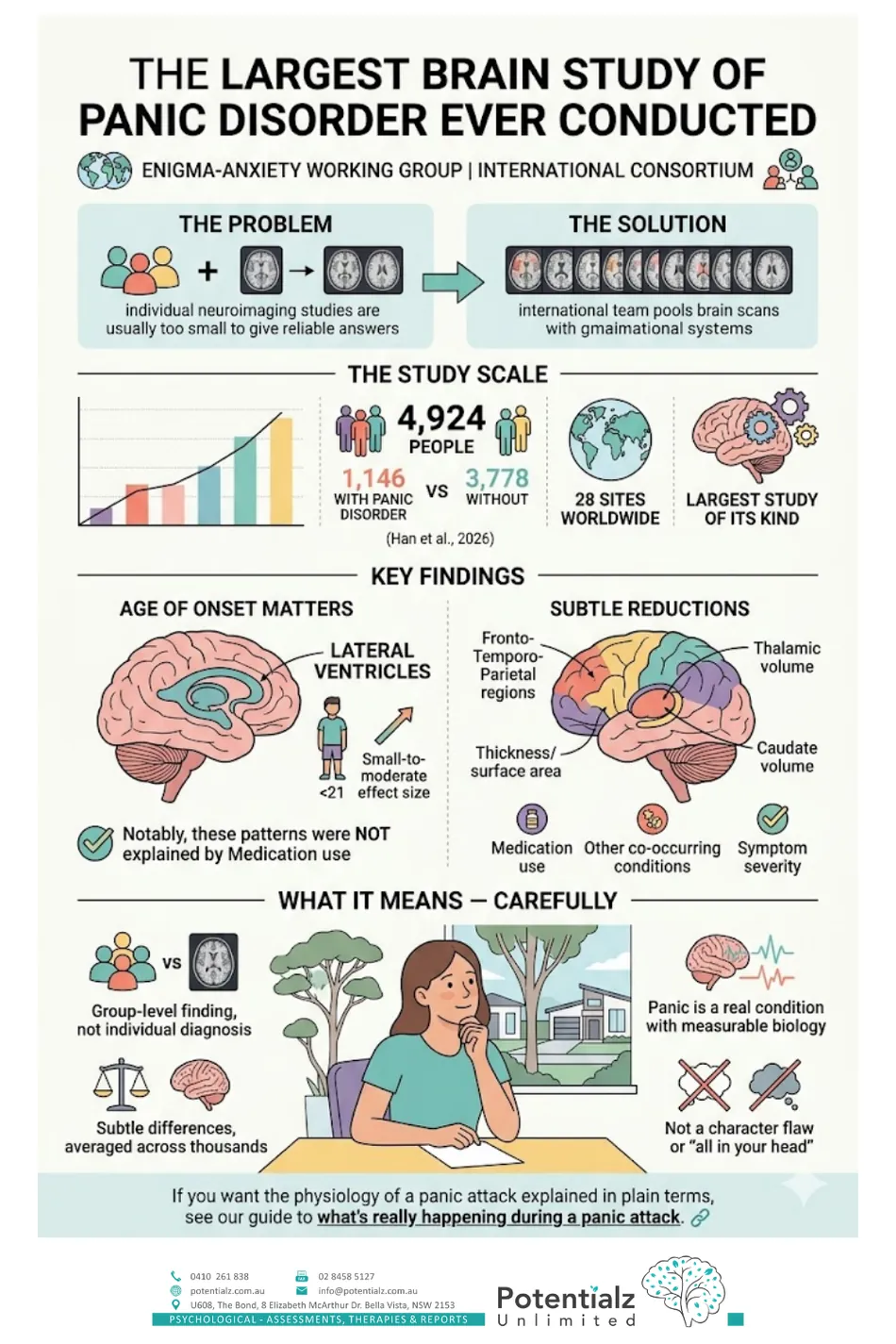
What it means — carefully. This is a group-level finding, not a brain scan you could use to diagnose panic disorder in any one person. The differences are subtle and averaged across thousands of people. What it does offer is reassurance many of our clients find genuinely helpful: panic is a real condition with measurable biology — not a character flaw or “all in your head.” If you want the physiology of a panic attack explained in plain terms, see our guide to what’s really happening during a panic attack.
2. Australia’s Medicare Mental Health Check In — easier access for anxiety
On the access side, the Medicare Mental Health Check In continues to roll out as part of Australia’s broader 2026 mental health reforms — and it is directly relevant to anxiety.
The service is free, available to anyone aged 16 and over, and does not require a GP referral or a formal diagnosis. People call Medicare Mental Health on 1800 595 212 for an initial conversation and may be offered a six-week, low-intensity treatment plan built around evidence-based techniques — much of it drawn from cognitive behavioural therapy (CBT) — for concerns such as anxiety and low mood.
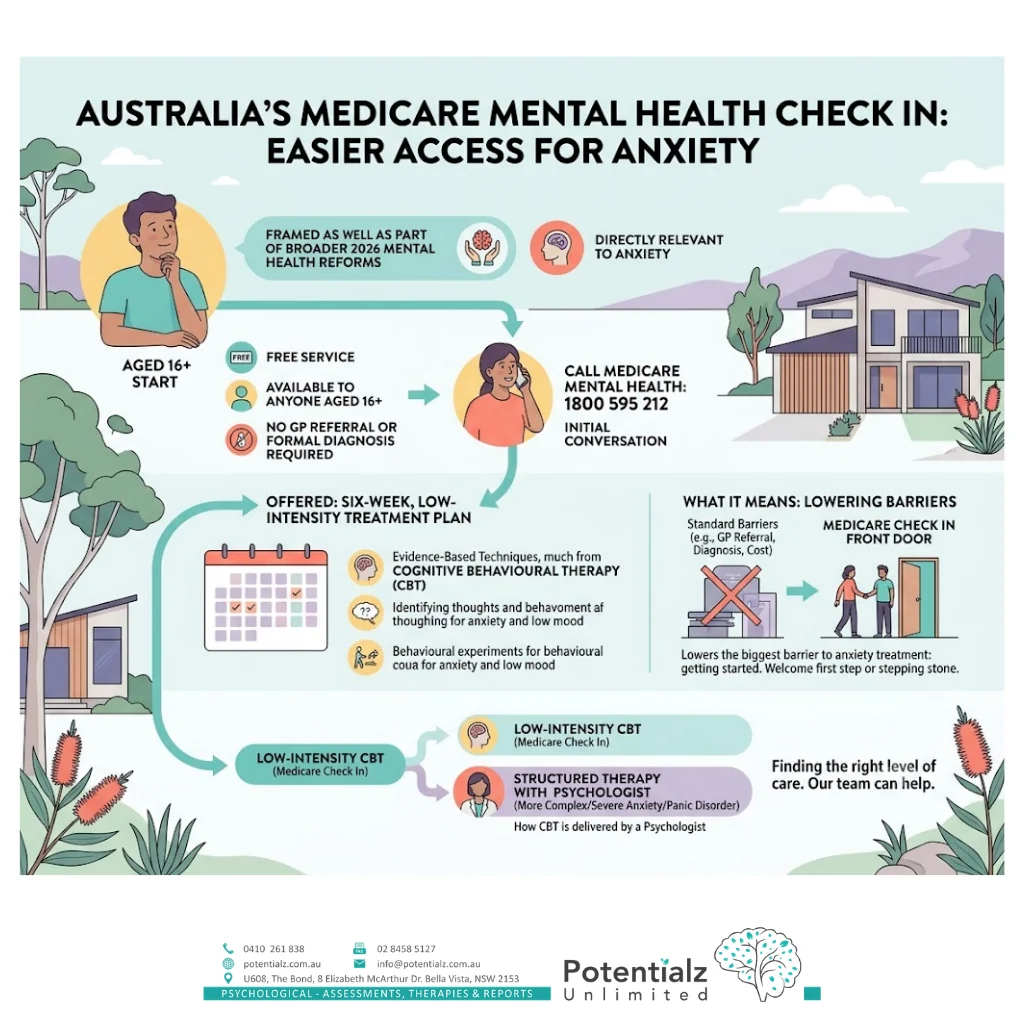
What it means. This matters because the biggest barrier to anxiety treatment is often getting started — the referral, the diagnosis, the cost. A no-referral, no-cost front door lowers that barrier considerably. Low-intensity CBT won’t be enough for everyone — more complex or severe panic disorder usually needs structured therapy with a psychologist — but as a first step, or a stepping stone, it’s a welcome addition. If you’d like to understand how the more structured version works, here’s how CBT is delivered by a psychologist, and if you’re weighing up your options, our team can help you find the right level of care.
3. The bigger picture: anxiety is “polygenic”
Rounding out the week, a landmark genome-wide study of anxiety — published in Nature Genetics in February 2026, analysing more than 122,000 people — reinforced a message worth repeating: there is no single “anxiety gene.” The study identified 58 genetic loci linked to anxiety, each contributing a small amount of risk. In other words, anxiety is polygenic — shaped by many variants, all interacting with life experience, stress, and environment.
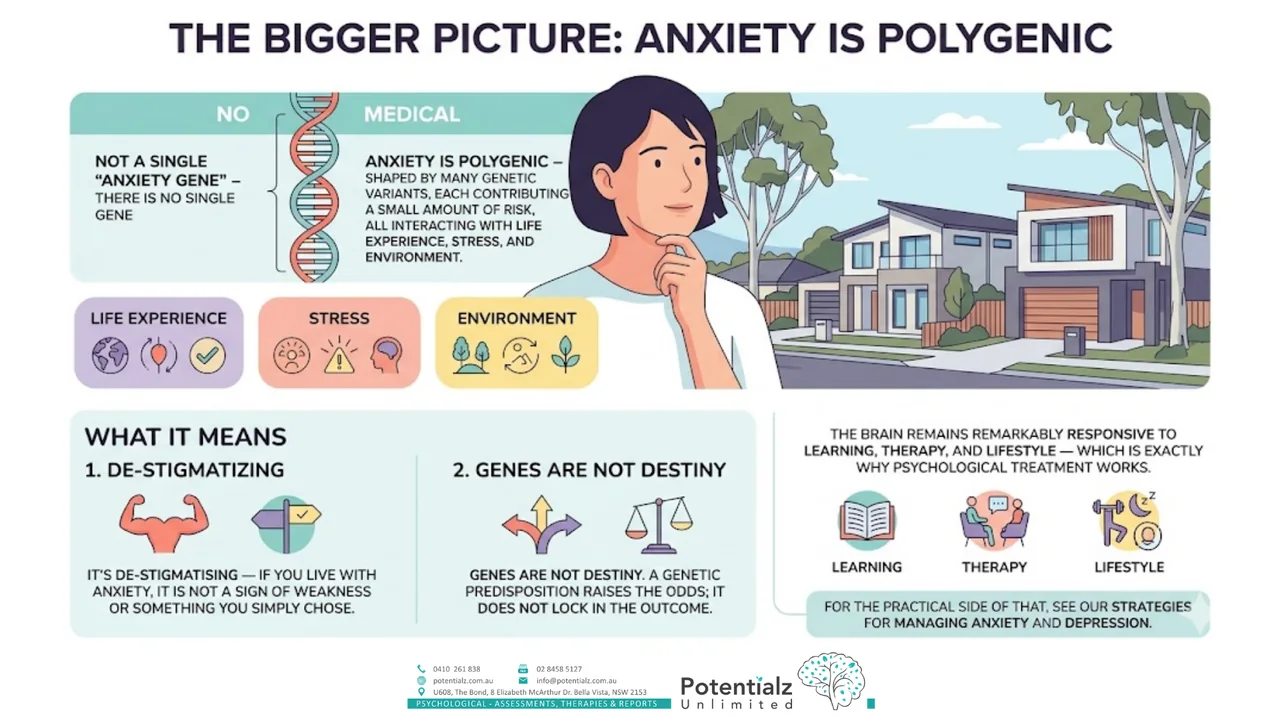
What it means. Two things. First, it’s de-stigmatising — if you live with anxiety, it is not a sign of weakness or something you simply chose. Second, and just as importantly, genes are not destiny. A genetic predisposition raises the odds; it does not lock in the outcome. The brain remains remarkably responsive to learning, therapy, and lifestyle — which is exactly why psychological treatment works. For the practical side of that, see our strategies for managing anxiety and depression.
What this means if you’re living with anxiety or panic
Pull the three stories together and a hopeful, accurate picture emerges:
- Anxiety and panic have real biological underpinnings — in the brain and in the genome.
- Those underpinnings are not a life sentence. Effective, evidence-based help exists.
- And in Australia right now, that help is more accessible than it has been — from free low-intensity programs through to structured CBT with a registered psychologist.
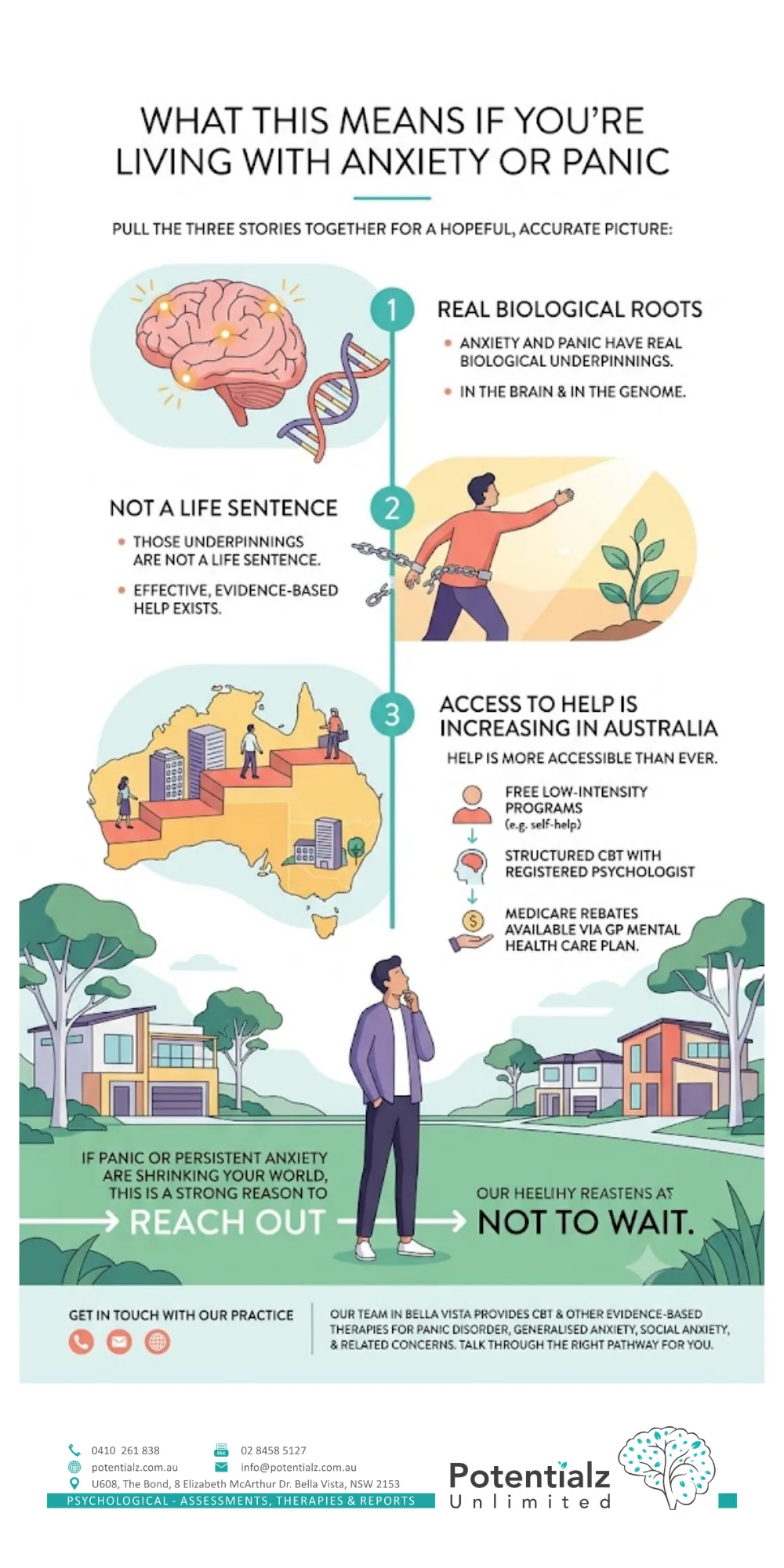
If panic attacks or persistent anxiety are shrinking your world, that is a strong reason to reach out — not to wait. As an anxiety psychologist in Bella Vista, our team provides CBT and other evidence-based therapies for panic disorder, generalised anxiety, social anxiety, and related concerns, with Medicare rebates available via a GP Mental Health Care Plan. You can get in touch with our practice to talk through the right pathway for you.
Related reading — more weekly roundups: self-compassion (12 June 2026) · connection, work and movement (3 July 2026) · sleep, work and emotional skills (10 July 2026)
References
Han, L. K. M., Bruin, W. B., Bas-Hoogendam, J. M., Groenewold, N. A., Hilbert, K., Winkler, A. M., … Aghajani, M. (2026). Structural brain differences associated with panic disorder: An ENIGMA-Anxiety Working Group mega-analysis of 4924 individuals worldwide. Molecular Psychiatry, 31(5), 2402–2417. https://doi.org/10.1038/s41380-025-03376-4
Leiden University. (2026, May 27). Panic disorder and the brain: The largest study ever conducted. https://www.universiteitleiden.nl/en/news/2026/05/panic-disorder-and-the-brain-the-largest-study-ever-conducted
Australian Government Department of Health, Disability and Ageing. (2026). Better Access initiative. https://www.health.gov.au/our-work/better-access-initiative
Hettema, J. M., Verhulst, B., et al. (2026, February 3). Genome-wide association study of major anxiety disorders in 122,341 European-ancestry cases identifies 58 loci and highlights GABAergic signaling. Nature Genetics. Press summary: https://www.eurekalert.org/news-releases/1116074
Crisis and Support Resources
If you are in crisis or worried about your safety, please reach out now — support is available 24/7.
- Lifeline: 13 11 14 (24/7)
- Beyond Blue: 1300 22 4636
- Medicare Mental Health: 1800 595 212
- Emergency: 000
This weekly roundup is general educational information curated and clinically reviewed by the team at Potentialz Unlimited. It summarises third-party research and policy and is not a substitute for individual psychological assessment or treatment. Research described here is emerging and should be interpreted with appropriate caution. Dr. Gurprit Ganda is a Clinical Psychologist (AHPRA). Potentialz Unlimited, Unit 608/8 Elizabeth Macarthur Drive, Bella Vista NSW 2153. Phone: 0410 261 838.
Related Reading
Need Professional Support?
If you're experiencing mental health concerns, our team is here to help.