Welcome to This Week in Mental Health
Each week we round up the developments worth knowing about across psychotherapy, counselling and mental health — translated into plain language, with a careful clinical eye and links to the primary sources. This week the studies cluster around three ordinary, unglamorous parts of a life: connection, work, and movement. None of them are novel ideas. But 2025 has been an unusually strong year for evidence that each of them, done well, genuinely helps.
A quick note on how we do this. We only report from credible, primary sources — peer-reviewed journals, universities, and official health bodies — and we frame new research as emerging rather than settled. A single study rarely changes clinical practice on its own, and effect sizes must always be weighed against the certainty of the evidence.
1. Digital tools for loneliness — helpful, especially when they connect people
Loneliness is not just an unpleasant feeling. It is now recognised as a genuine public-health risk factor — with links to depression, anxiety, cardiovascular disease and earlier death. Governments in the UK and the US have named it publicly. So when a large review of digital interventions arrives, it is worth reading carefully.
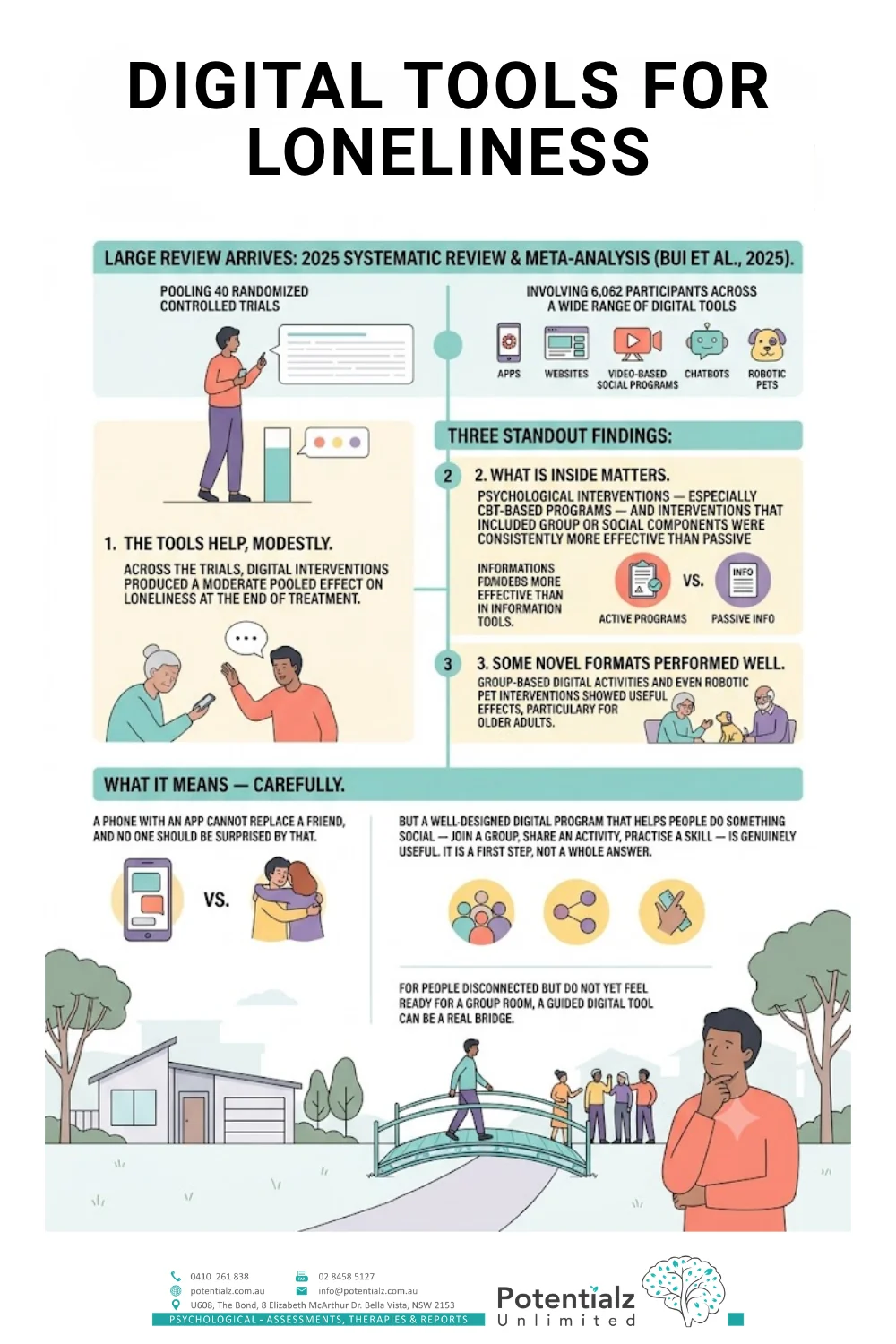
A 2025 systematic review and meta-analysis pooled 40 randomised controlled trials involving 6,062 participants across a wide range of digital tools — apps, websites, video-based social programs, chatbots, and robotic pets — for loneliness and social isolation (Bui et al., 2025). Three findings stood out:
- The tools help, modestly. Across the trials, digital interventions produced a moderate pooled effect on loneliness at the end of treatment.
- What is inside matters. Psychological interventions — especially CBT-based programs — and interventions that included group or social components were consistently more effective than passive information tools.
- Some novel formats performed well. Group-based digital activities and even robotic pet interventions showed useful effects, particularly for older adults.
What it means — carefully. A phone with an app cannot replace a friend, and no one should be surprised by that. But a well-designed digital program that helps people do something social — join a group, share an activity, practise a skill — is genuinely useful. It is a first step, not a whole answer. For people who feel disconnected but do not yet feel ready for a group room, a guided digital tool can be a real bridge. If you want to understand how loneliness sits inside broader distress, our post on social isolation and mental health walks through what we know.
2. A self-guided app for workplace burnout — real, if modest, gains
Burnout has moved from workplace jargon into the international disease classification — the World Health Organization’s ICD-11 lists it as an occupational syndrome. In Australian settings we see it constantly, especially in healthcare, education, professional services and small-business owners running lean.
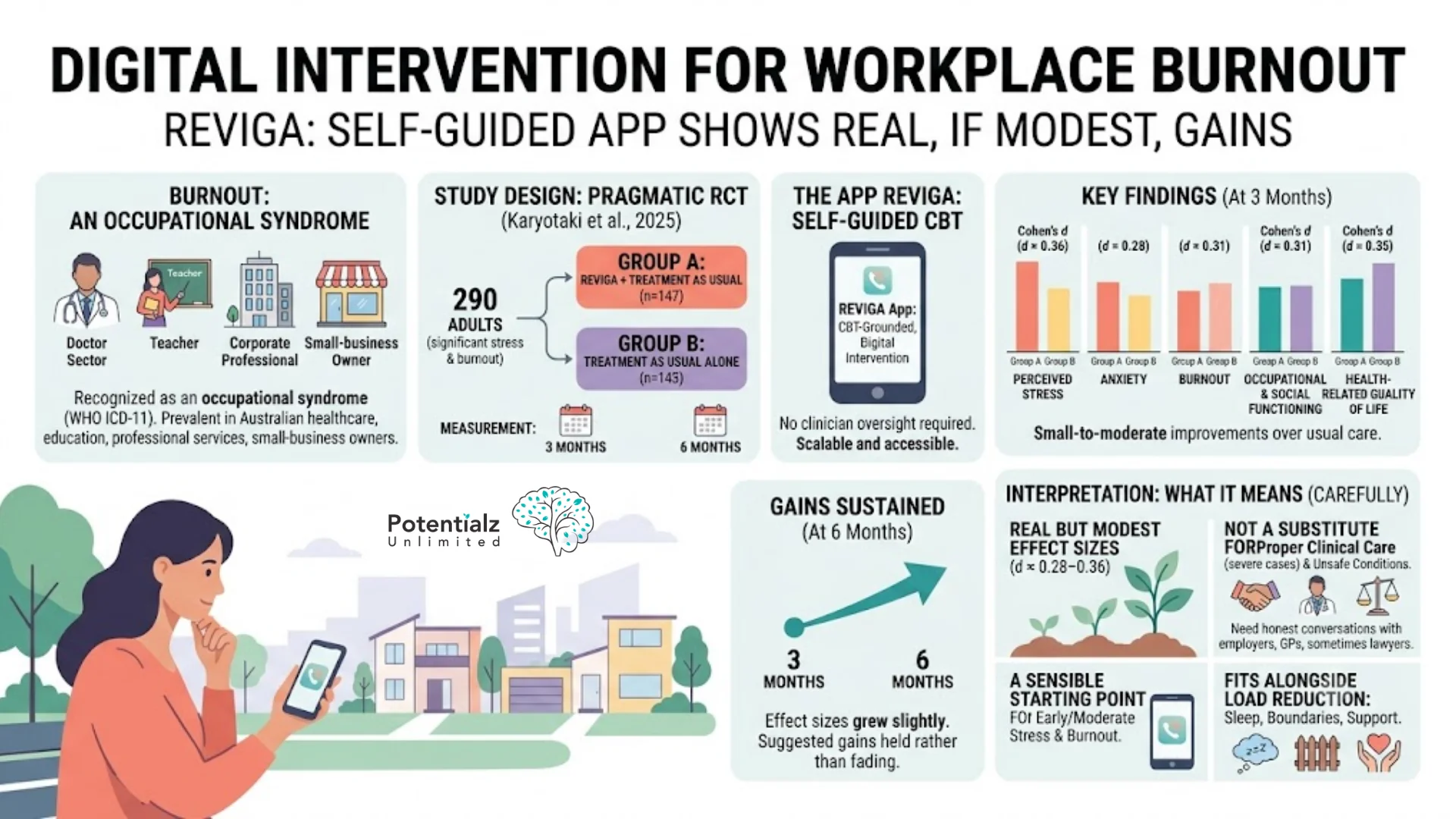
A pragmatic randomised controlled trial in npj Mental Health Research tested reviga, a self-guided digital intervention grounded in cognitive behaviour therapy (Karyotaki et al., 2025). The design was straightforward: 290 adults with significant stress and burnout were randomised to either reviga plus treatment as usual (n = 147) or treatment as usual alone (n = 143). Outcomes were measured at three and six months.
- At three months, the intervention group showed small-to-moderate improvements over usual care on perceived stress (Cohen’s d ≈ 0.36), anxiety (d ≈ 0.28), burnout (d ≈ 0.31), occupational and social functioning (d ≈ 0.31), and health-related quality of life (d ≈ 0.35).
- At six months, effect sizes had grown slightly, suggesting the gains held rather than fading.
- The intervention requires no clinician oversight, which matters when access to human therapy is limited.
What it means — carefully. Effect sizes in the d ≈ 0.28–0.36 range are real but not large. A self-guided app is not a substitute for proper clinical care in severe burnout or when work is genuinely unsafe — those situations need honest conversations with employers, sometimes GPs, and sometimes lawyers. But for early or moderate stress and burnout, a well-designed self-guided CBT program is a sensible, scalable starting point. It fits alongside — not instead of — the changes that actually reduce load: sleep, boundaries, and support. Our practical guide to work-related stress and how to manage it covers the workplace side; if you would like a clinical assessment, our Bella Vista team is here.
3. Exercise for depression and anxiety — the umbrella review that ties it together
If loneliness and burnout are the first two threads, the third is the one that pulls them together — because movement helps almost every angle of mental health at once.
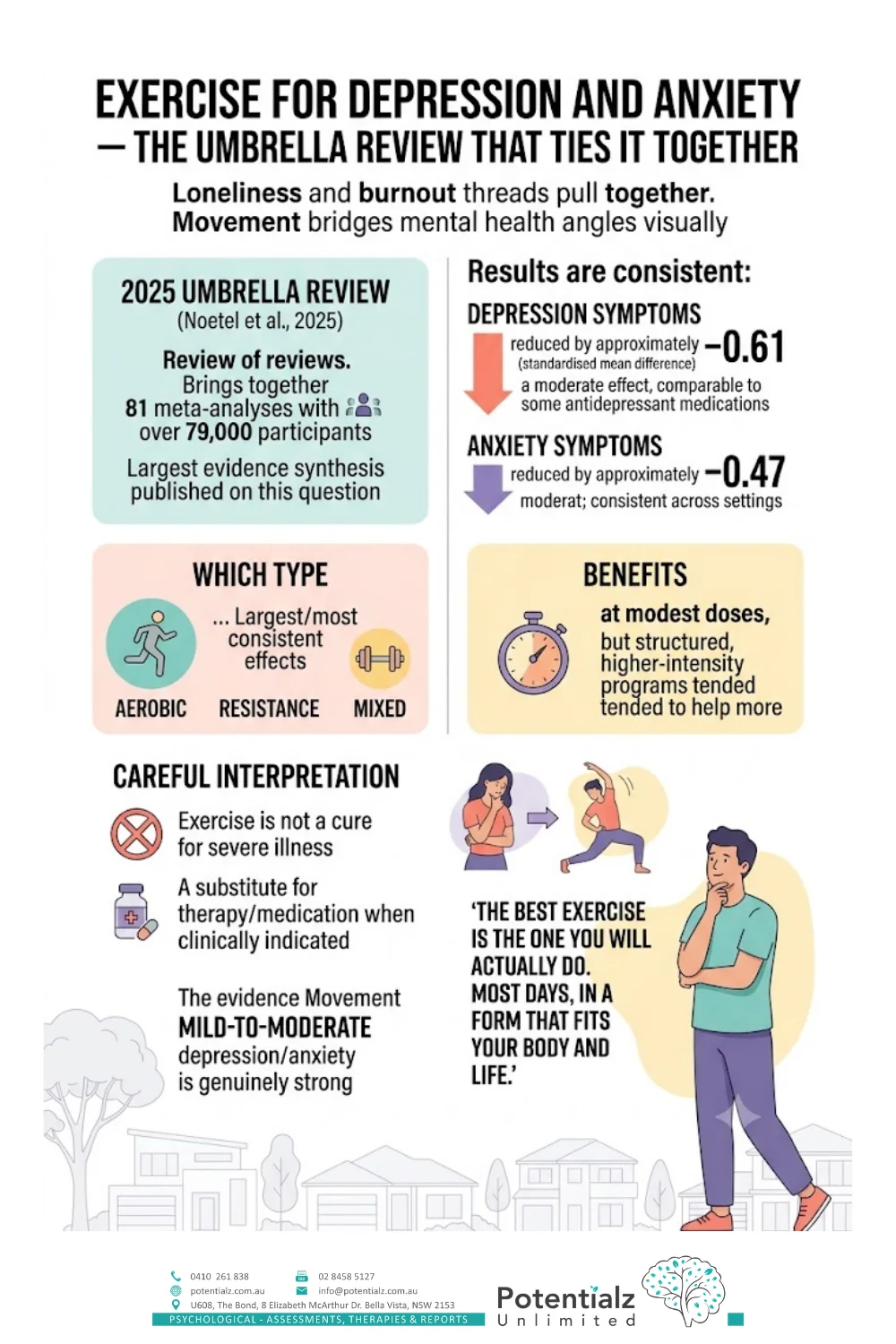
A 2025 umbrella review — a review of reviews — brought together 81 meta-analyses covering more than 79,000 participants on the effect of exercise on depression and anxiety (Noetel et al., 2025). This is one of the largest evidence syntheses ever published on this question. The results were consistent:
- Depression symptoms: exercise reduced depression by a standardised mean difference of about −0.61 — a moderate effect, comparable in size to the effect of some antidepressant medications in similar populations.
- Anxiety symptoms: exercise reduced anxiety by about −0.47 — also moderate, and consistent across settings.
- Which type: aerobic exercise showed the largest and most consistent effects, though resistance and mixed-modality exercise also helped.
- Dose: benefits appear even at modest doses, though more structured, higher-intensity programs tended to help more.
What it means — carefully. Exercise is not a treatment we can prescribe instead of therapy or medication when those are clinically indicated — and it is not a cure for severe illness. But the evidence that regular movement helps mild-to-moderate depression and anxiety is now genuinely strong. In practice, this matters most for people whose distress is real but not yet severe, who are looking for something they can do themselves alongside professional support. The best exercise is the one you will actually do — most days, ideally, and in a form that fits your body and life. If you would like to understand how movement sits inside a broader recovery plan, our post on finding serenity in the city — how therapy can help manage stress and anxiety is a gentle entry point.
The bottom line
Read together, this week’s studies tell a plain, useful story.
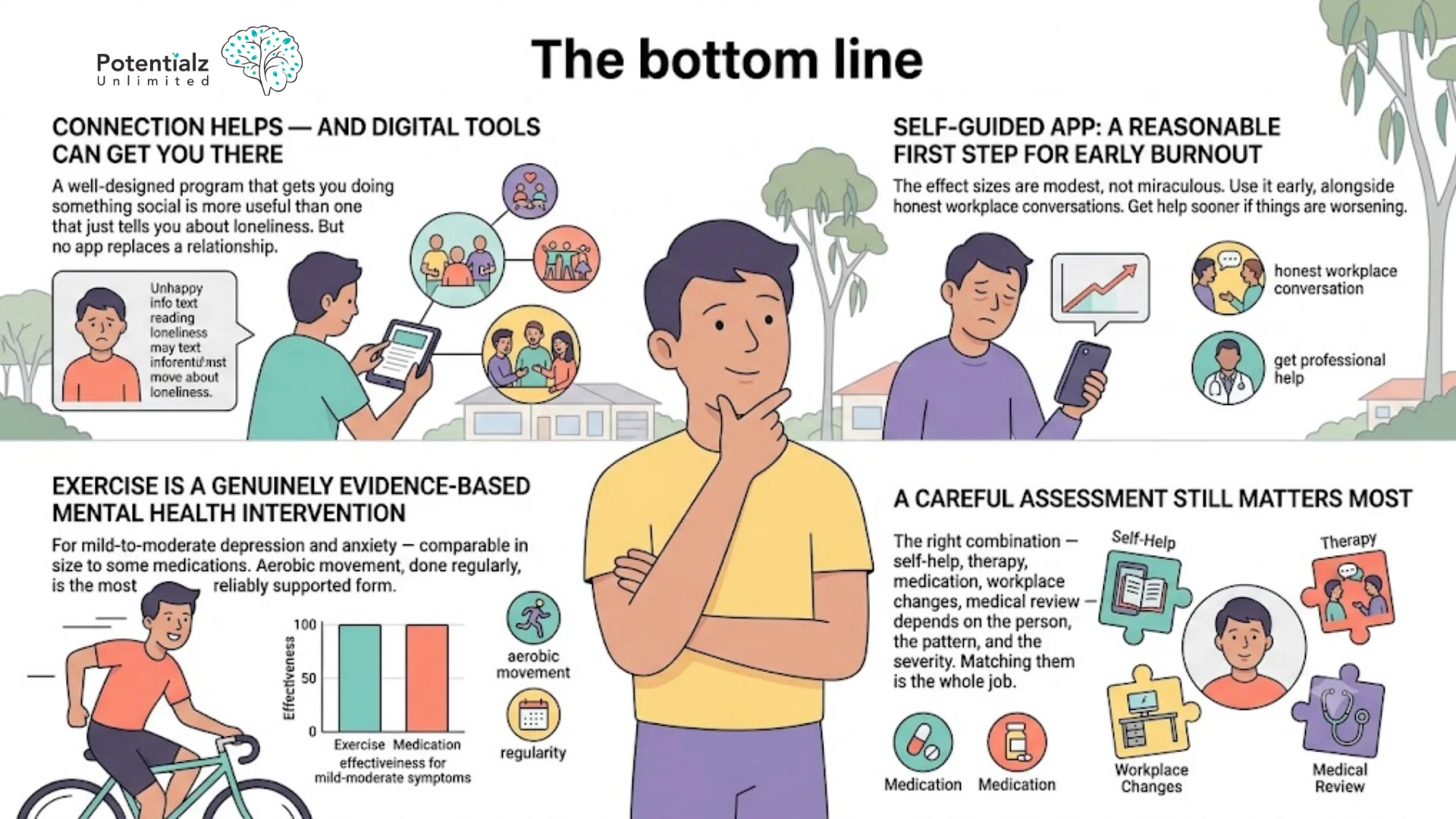
- Connection helps — and digital tools can help you get there. A well-designed program that gets you doing something social is more useful than one that just tells you about loneliness. But no app replaces a relationship.
- A self-guided app is a reasonable first step for early burnout. The effect sizes are modest, not miraculous. Use it early, alongside honest workplace conversations. Get help sooner if things are worsening.
- Exercise is a genuinely evidence-based mental health intervention for mild-to-moderate depression and anxiety — comparable in size to some medications. Aerobic movement, done regularly, is the most reliably supported form.
- A careful assessment still matters most. The right combination — self-help, therapy, medication, workplace changes, medical review — depends on the person, the pattern, and the severity. Matching them is the whole job.
If any of these are shaping daily life for you or someone you love, you do not have to work it out alone. Our team at Potentialz Unlimited in Bella Vista offers comprehensive, evidence-based assessment and therapy for adults and children. You can get in touch here.
References
- Bui, T. H. T., Chen, J., Chan, C. S., Tam, C. C., & Lin, C.-Y. (2025). Digital bridges to social connection: A systematic review and meta-analysis of digital interventions for loneliness and social isolation. PLOS Digital Health. Advance online publication. Retrieved from https://pmc.ncbi.nlm.nih.gov/articles/PMC12281013/
- Karyotaki, E., Cuijpers, P., Riper, H., et al. (2025). A randomized controlled trial of an interactive digital therapeutic for stress and burnout management. npj Mental Health Research, 4, Article 184. https://www.nature.com/articles/s44184-025-00184-0
- Noetel, M., Sanders, T., Gallardo-Gómez, D., et al. (2025). Effect of exercise on depression and anxiety symptoms: Systematic umbrella review with meta-meta-analysis. Retrieved from https://pubmed.ncbi.nlm.nih.gov/41667154/
Crisis and Support Resources
If you or someone you know needs immediate support, please reach out:
- Lifeline: 13 11 14 (24/7 crisis support)
- Beyond Blue: 1300 22 4636 (24/7)
- 1800RESPECT: 1800 737 732 (family and sexual violence)
- Kids Helpline: 1800 55 1800 (for ages 5–25)
- Emergency: 000
Disclaimer: This roundup is general information, not clinical advice, and summarises emerging research that has not necessarily changed clinical guidelines. Single studies should be read with caution, and effect sizes must always be weighed against the certainty of the evidence. Dr. Gurprit Ganda is a Clinical Psychologist (AHPRA) and Practice Director at Potentialz Unlimited, Bella Vista. If you are experiencing significant distress, please contact your GP, a registered mental health professional, or one of the crisis services listed above.
Need Professional Support?
If you're experiencing mental health concerns, our team is here to help.