Welcome to This Week in Mental Health
Each week we round up the developments worth knowing about across psychotherapy, counselling and mental health — translated into plain language, with a careful clinical eye and links to the primary sources. This week the studies gather around three parts of ordinary life that we wrote about all week here at the practice: sleep, work, and emotional skills. None of them are glamorous. All of them, done well, move the needle on how a person actually feels.
A quick note on how we do this. We only report from credible, primary sources — peer-reviewed journals, universities, and official health bodies — and we frame new research as emerging rather than settled. A single study rarely changes clinical practice on its own, and effect sizes must always be weighed against the certainty of the evidence.
1. Better sleep lifts depression and anxiety — a 54-trial meta-analysis
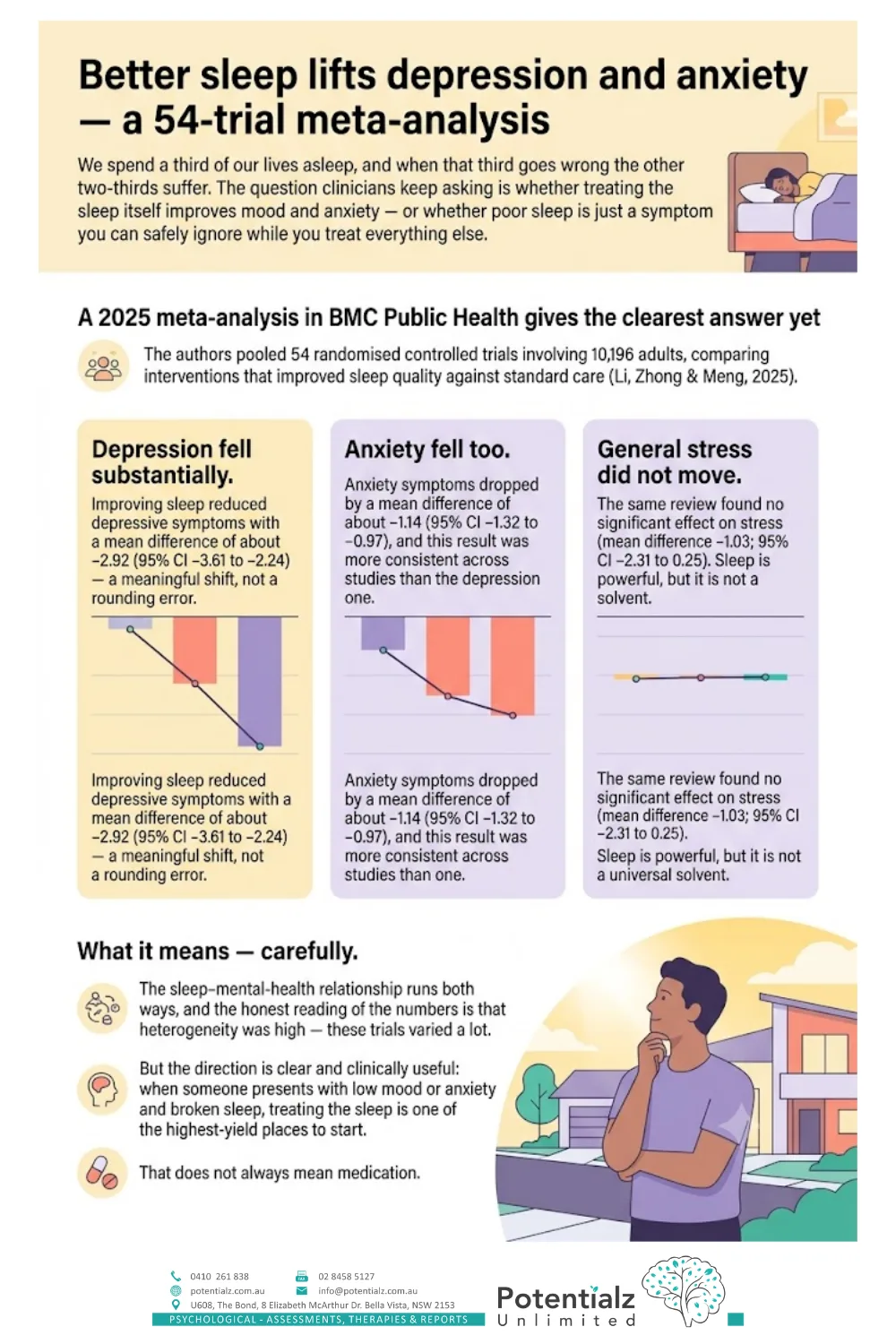
We spend a third of our lives asleep, and when that third goes wrong the other two-thirds suffer. The question clinicians keep asking is whether treating the sleep itself improves mood and anxiety — or whether poor sleep is just a symptom you can safely ignore while you treat everything else.
A 2025 meta-analysis in BMC Public Health gives the clearest answer yet. The authors pooled 54 randomised controlled trials involving 10,196 adults, comparing interventions that improved sleep quality against standard care (Li, Zhong & Meng, 2025). Two findings stood out:
- Depression fell substantially. Improving sleep reduced depressive symptoms with a mean difference of about −2.92 (95% CI −3.61 to −2.24) — a meaningful shift, not a rounding error.
- Anxiety fell too. Anxiety symptoms dropped by a mean difference of about −1.14 (95% CI −1.32 to −0.97), and this result was more consistent across studies than the depression one.
- General stress did not move. The same review found no significant effect on stress (mean difference −1.03; 95% CI −2.31 to 0.25). Sleep is powerful, but it is not a universal solvent.
What it means — carefully. The sleep–mental-health relationship runs both ways, and the honest reading of the numbers is that heterogeneity was high — these trials varied a lot. But the direction is clear and clinically useful: when someone presents with low mood or anxiety and broken sleep, treating the sleep is one of the highest-yield places to start. That does not always mean medication. If you want the full picture of why nights shape days, our post on sleep and mental health walks through the mechanism, and our newer guide to holistic approaches to better sleep covers what to try beyond a prescription. For the specific tangle of anxiety and sleepless nights, see the complex dance of anxiety and sleep disturbances.
2. Work-related stress — the fix is the job, not just the worker
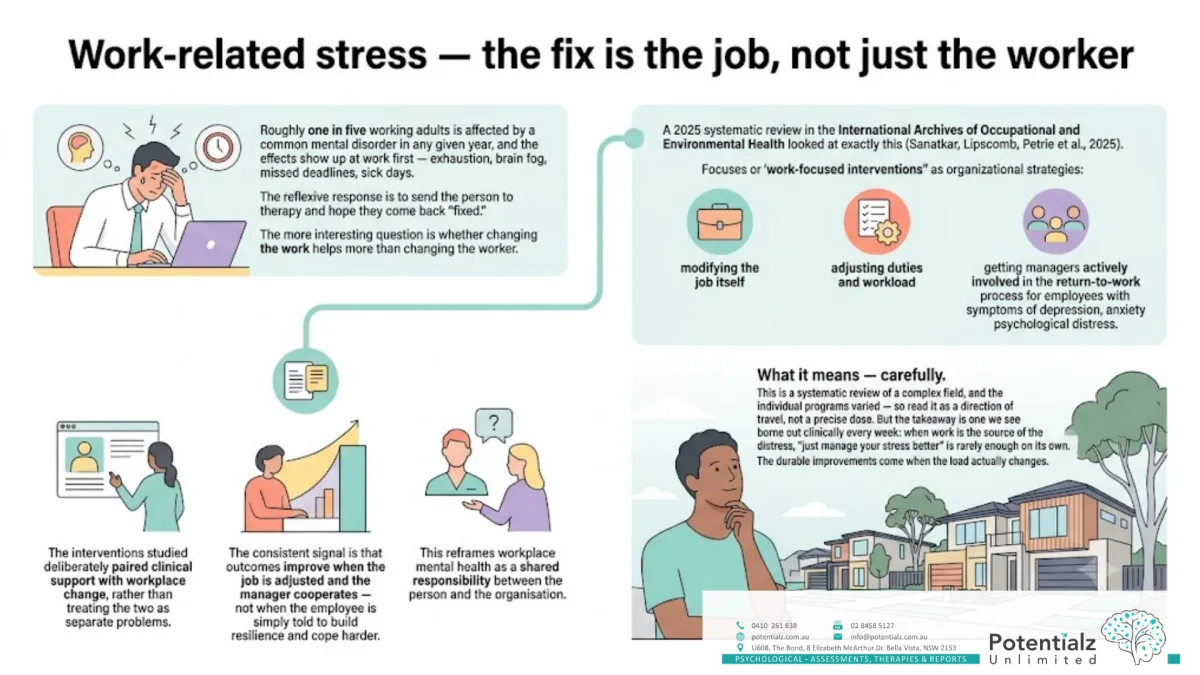
Roughly one in five working adults is affected by a common mental disorder in any given year, and the effects show up at work first — exhaustion, brain fog, missed deadlines, sick days. The reflexive response is to send the person to therapy and hope they come back “fixed.” The more interesting question is whether changing the work helps more than changing the worker.
A 2025 systematic review in the International Archives of Occupational and Environmental Health looked at exactly this (Sanatkar, Lipscomb, Petrie et al., 2025). It focused on work-focused interventions — programs that go beyond individual treatment to include organisational strategies: modifying the job itself, adjusting duties and workload, and getting managers actively involved in the return-to-work process for employees with symptoms of depression, anxiety and psychological distress.
- The interventions studied deliberately paired clinical support with workplace change, rather than treating the two as separate problems.
- The consistent signal is that outcomes improve when the job is adjusted and the manager cooperates — not when the employee is simply told to build resilience and cope harder.
- This reframes workplace mental health as a shared responsibility between the person and the organisation.
What it means — carefully. This is a systematic review of a complex field, and the individual programs varied — so read it as a direction of travel, not a precise dose. But the takeaway is one we see borne out clinically every week: when work is the source of the distress, “just manage your stress better” is rarely enough on its own. The durable improvements come when the load actually changes. Our practical guide to work-related stress and how to manage it covers both sides — the coping skills that help and the honest conversations with employers that often matter more. If work stress has tipped into constant health worry or physical symptoms, our post on health anxiety may also be useful.
3. Emotional skills — the landmark synthesis on how regulation drives recovery
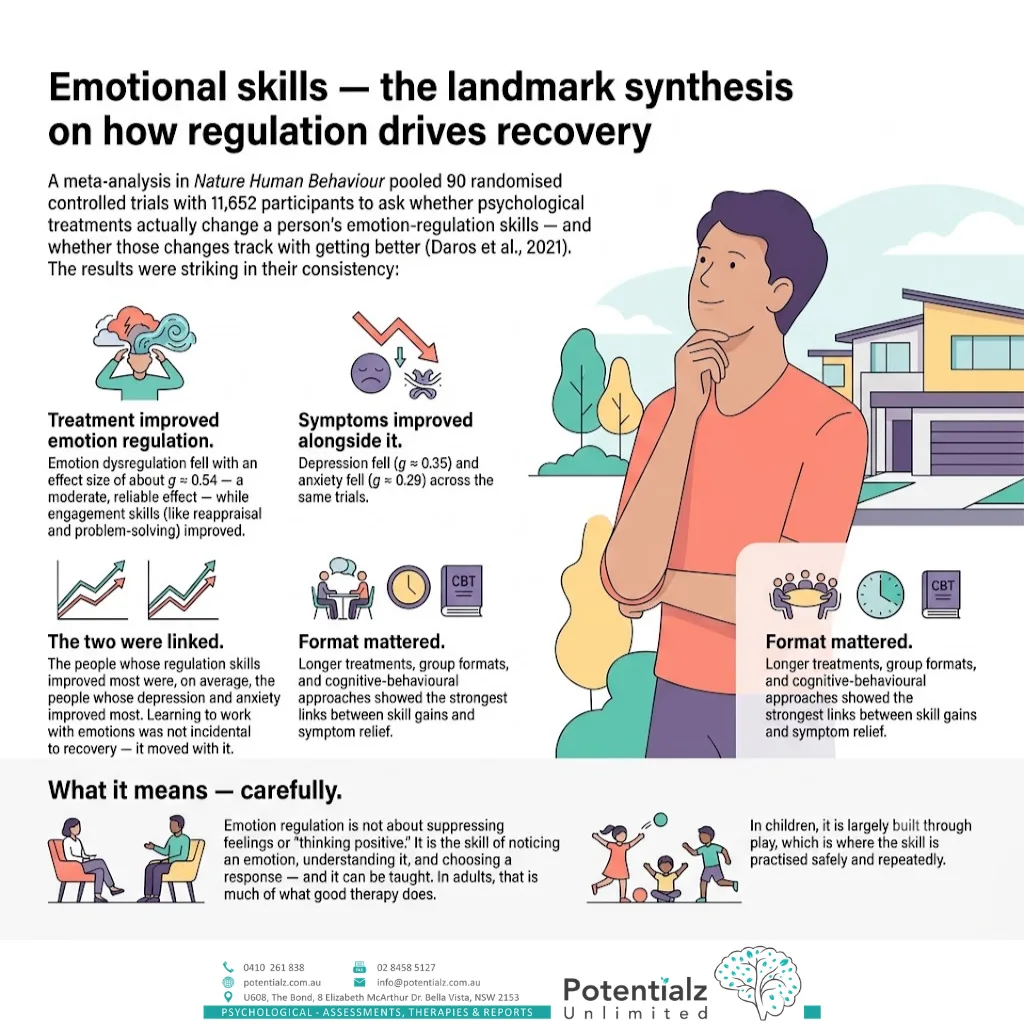
The third thread ties the first two together, because how we handle what sleep loss and work pressure throw at us is itself a learnable skill. This week’s evidence here is not brand new — it is an established, landmark synthesis that remains the clearest map we have of how therapy helps.
A meta-analysis in Nature Human Behaviour pooled 90 randomised controlled trials with 11,652 participants to ask whether psychological treatments actually change a person’s emotion-regulation skills — and whether those changes track with getting better (Daros et al., 2021). The results were striking in their consistency:
- Treatment improved emotion regulation. Emotion dysregulation fell with an effect size of about g ≈ 0.54 — a moderate, reliable effect — while engagement skills (like reappraisal and problem-solving) improved.
- Symptoms improved alongside it. Depression fell (g ≈ 0.35) and anxiety fell (g ≈ 0.29) across the same trials.
- The two were linked. The people whose regulation skills improved most were, on average, the people whose depression and anxiety improved most. Learning to work with emotions was not incidental to recovery — it moved with it.
- Format mattered. Longer treatments, group formats, and cognitive-behavioural approaches showed the strongest links between skill gains and symptom relief.
What it means — carefully. Emotion regulation is not about suppressing feelings or “thinking positive.” It is the skill of noticing an emotion, understanding it, and choosing a response — and it can be taught. In adults, that is much of what good therapy does. In children, it is largely built through play, which is where the skill is practised safely and repeatedly. Our post on emotional intelligence in children explains how play therapy grows exactly these capacities early — and why the skills laid down in childhood pay dividends for a lifetime.
The bottom line
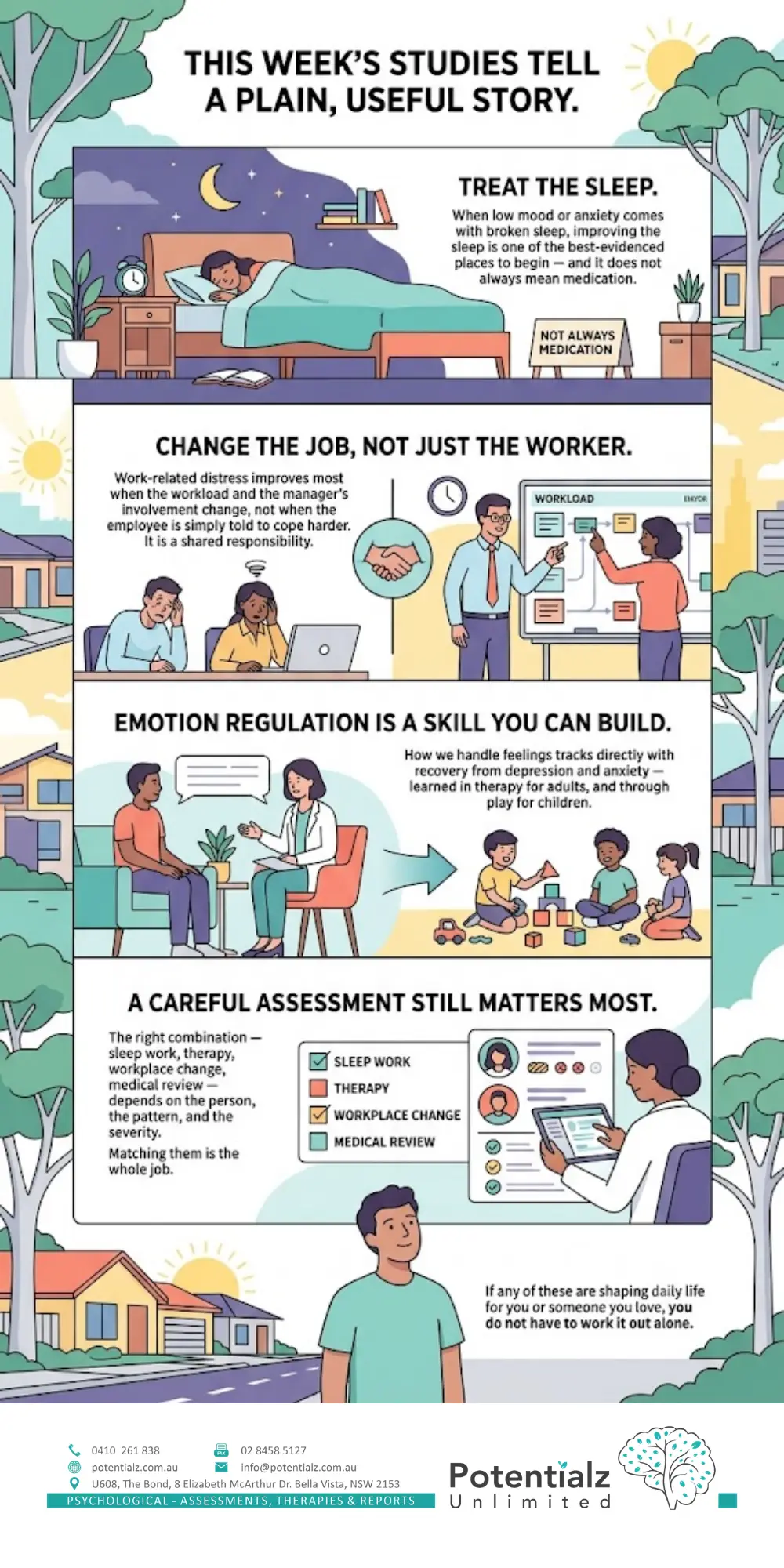
Read together, this week’s studies tell a plain, useful story.
- Treat the sleep. When low mood or anxiety comes with broken sleep, improving the sleep is one of the best-evidenced places to begin — and it does not always mean medication.
- Change the job, not just the worker. Work-related distress improves most when the workload and the manager’s involvement change, not when the employee is simply told to cope harder. It is a shared responsibility.
- Emotion regulation is a skill you can build. How we handle feelings tracks directly with recovery from depression and anxiety — learned in therapy for adults, and through play for children.
- A careful assessment still matters most. The right combination — sleep work, therapy, workplace change, medical review — depends on the person, the pattern, and the severity. Matching them is the whole job.
If any of these are shaping daily life for you or someone you love, you do not have to work it out alone. Our team at Potentialz Unlimited in Bella Vista offers comprehensive, evidence-based assessment and therapy for adults and children. You can get in touch here.
Related reading: Catch up on recent editions — This Week: Anxiety and Panic · This Week: Connection, Work, and Movement · This Week: Trauma and Recovery.
References
- Li, Z., Zhong, T., & Meng, X. (2025). A meta-analysis study evaluating the effects of sleep quality on mental health among the adult population. BMC Public Health. Retrieved from https://pmc.ncbi.nlm.nih.gov/articles/PMC12400548/
- Sanatkar, S., Lipscomb, R., Petrie, K., et al. (2025). A systematic review and meta-analysis of the effectiveness of work-focused interventions for employees with symptoms of depression, anxiety, and psychological distress. International Archives of Occupational and Environmental Health, 98, 859–882. https://doi.org/10.1007/s00420-025-02181-4
- Daros, A. R., Haefner, S. A., Asadi, S., Kazi, S., Rodak, T., & Quilty, L. C. (2021). A meta-analysis of emotional regulation outcomes in psychological interventions for youth with depression and anxiety. Nature Human Behaviour, 5(10), 1443–1457. https://www.nature.com/articles/s41562-021-01191-9
Crisis and Support Resources
If you or someone you know needs immediate support, please reach out:
- Lifeline: 13 11 14 (24/7 crisis support)
- Beyond Blue: 1300 22 4636 (24/7)
- 1800RESPECT: 1800 737 732 (family and sexual violence)
- Kids Helpline: 1800 55 1800 (for ages 5–25)
- Emergency: 000
Disclaimer: This roundup is general information, not clinical advice, and summarises research that has not necessarily changed clinical guidelines. Single studies should be read with caution, and effect sizes must always be weighed against the certainty of the evidence. Dr. Gurprit Ganda is a Clinical Psychologist (AHPRA) and Practice Director at Potentialz Unlimited, Bella Vista. If you are experiencing significant distress, please contact your GP, a registered mental health professional, or one of the crisis services listed above.
Related Reading
Need Professional Support?
If you're experiencing mental health concerns, our team is here to help.