Key Takeaways
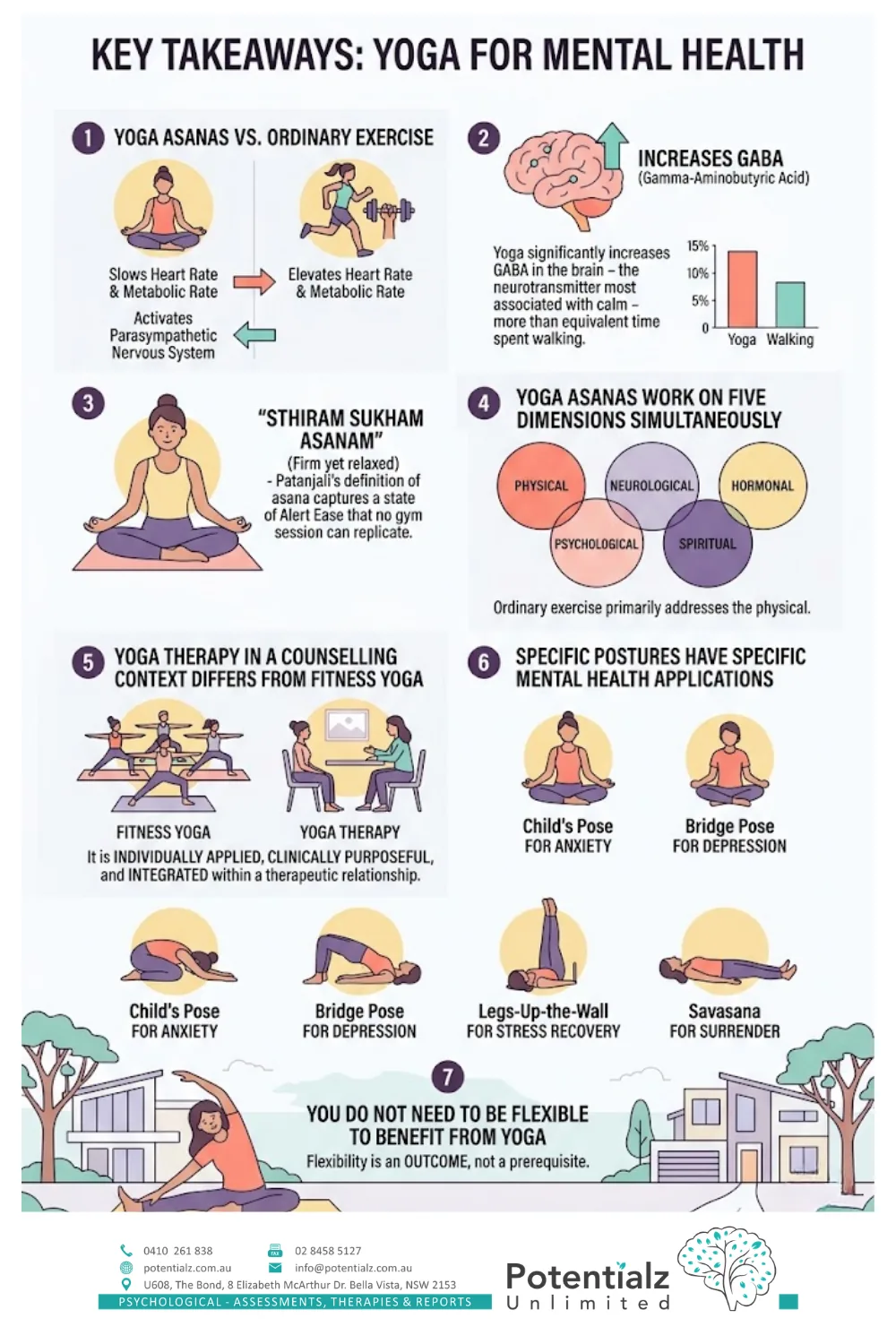
- Yoga asanas and ordinary exercise produce opposite physiological responses — where exercise elevates the heart rate and metabolic rate, asanas slow them, activating the parasympathetic nervous system.
- Yoga significantly increases GABA (gamma-aminobutyric acid) in the brain — the neurotransmitter most associated with calm — more than equivalent time spent walking.
- Patanjali’s definition of asana — “Sthiram Sukham Asanam” — firm yet relaxed — captures a state of alert ease that no gym session can replicate.
- Yoga asanas work on five dimensions simultaneously: physical, neurological, hormonal, psychological, and spiritual — ordinary exercise primarily addresses the physical.
- Yoga therapy in a counselling context differs from fitness yoga — it is individually applied, clinically purposeful, and integrated within a therapeutic relationship.
- Specific postures have specific mental health applications: child’s pose for anxiety, bridge pose for depression, legs-up-the-wall for stress recovery, savasana for surrender.
- You do not need to be flexible to benefit from yoga — flexibility is an outcome, not a prerequisite.
Introduction
Have you ever noticed how differently you feel after a yoga session compared to a hard run or an intense gym workout?
After vigorous exercise, you might feel exhilarated — heart pumping, endorphins flowing, a sharp sense of physical accomplishment. It feels good. And it is good for you.
But after a yoga practice — a real one, not just a stretch class — you often feel something quite different. Quieter. Clearer. Like the volume on everything has been turned down slightly. A sense of being settled in yourself that isn’t just tired-tired. Something more like arrived.
I have felt this difference my whole adult life. As a Yogacharya and as someone who went from a childhood disability to becoming an athlete, I have moved through both worlds. I know what exercise does for the body. And I know what yoga asanas do for the mind, the nervous system, the hormonal system, and the spirit.
The two are not competing. But they are genuinely different — and understanding that difference can change how you approach your own wellbeing.
What Patanjali Actually Meant by “Asana”
Most people, when they hear “yoga pose,” imagine someone bent into a pretzel on a mat. But the ancient definition of asana is far more interesting than that.
Patanjali — the father of classical yoga — defined asana in just three words: “Sthiram Sukham Asanam.”
Sthiram means steady, firm, stable. Sukham means comfortable, at ease, sweet. Asanam means posture or seat. So the full definition is: an asana is a posture in which one can remain firm, composed, and relaxed.
Think about that for a moment. Not straining. Not grinding. Not pushing through pain. Firm AND relaxed — simultaneously.
This is not a contradiction. It is a description of a very particular neurological state that most of us rarely access. In everyday life, we tend to oscillate between two poles: straining and collapsing. Working hard and crashing. Tension and exhaustion.
An asana asks you to find the middle path — the place where effort and ease coexist. Where you are alert but not braced. Present but not anxious.
This is the neurological foundation of everything yoga does for the mind. And it is why the experience of asana practice is so distinctly different from exercise. Exercise, by design, pushes the body to and beyond its limits. Asana asks you to find your optimal point — the place where you can be both firm and at peace.
The Physiology: What Actually Happens Differently
Here is where things get genuinely fascinating — and where the science confirms what yogic tradition has known for thousands of years.
When you exercise — whether that is running, lifting weights, cycling, or any other vigorous physical activity — your body responds predictably. Your breathing rate climbs. Your heart rate increases. Your metabolic rate rises to fuel your working muscles. Blood and oxygen are diverted from the internal organs toward the muscles that need them most. Your blood pressure elevates. Stress hormones — principally cortisol and adrenaline — surge.
This is the sympathetic nervous system doing its job. Fight-or-flight activated. It is healthy and necessary — and vigorous exercise is genuinely good for you.
But watch what happens in a yoga asana practice.
Your breathing rate falls. Your metabolic rate decreases. Blood and oxygen are redirected inward — your internal organs receive more nourishment, not less. Your blood pressure lowers. Your heart rate slows. The endocrinal (hormonal) system begins to rebalance.
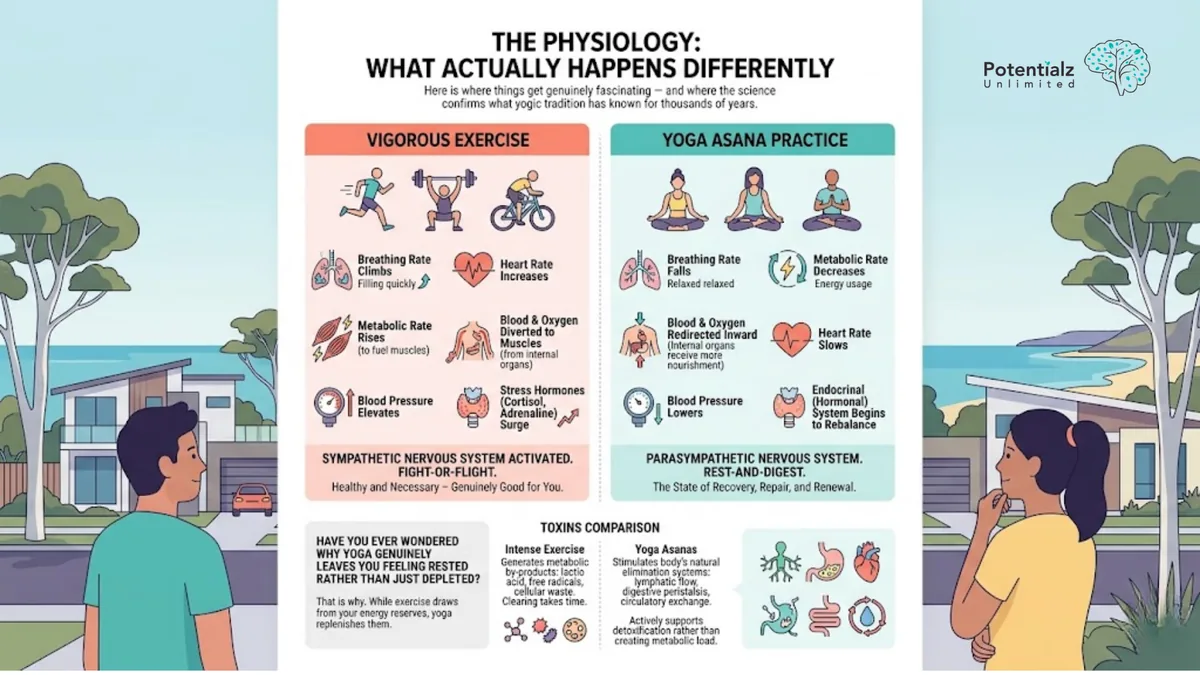
This is the parasympathetic nervous system. Rest-and-digest. The state of recovery, repair, and renewal.
Have you ever wondered why yoga genuinely leaves you feeling rested rather than just depleted? That is why. While exercise draws from your energy reserves, yoga replenishes them.
There is also the question of toxins. Intense physical exercise — particularly when taken to extremes — generates metabolic by-products: lactic acid, free radicals, cellular waste. The body clears these, of course, but the process takes time. Yoga asanas, by contrast, stimulate the body’s natural elimination systems — lymphatic flow, digestive peristalsis, circulatory exchange — actively supporting detoxification rather than creating metabolic load.
GABA, Cortisol, and the Chemistry of Calm
The neuroscience here is both compelling and specific.
GABA — gamma-aminobutyric acid — is the brain’s primary inhibitory neurotransmitter. In plain language: it is the chemical that turns down the noise. Low GABA is consistently associated with anxiety, depression, panic disorder, and insomnia. Many pharmaceutical medications for anxiety (including benzodiazepines) work by enhancing GABA activity.
A landmark study by Streeter and colleagues (2010) compared the effect of one hour of yoga to one hour of walking on brain GABA levels. Using brain imaging technology, they found that yoga practitioners showed a 27% increase in GABA levels after their session — significantly higher than the walking group. The yoga participants also reported greater improvements in mood and reductions in anxiety.
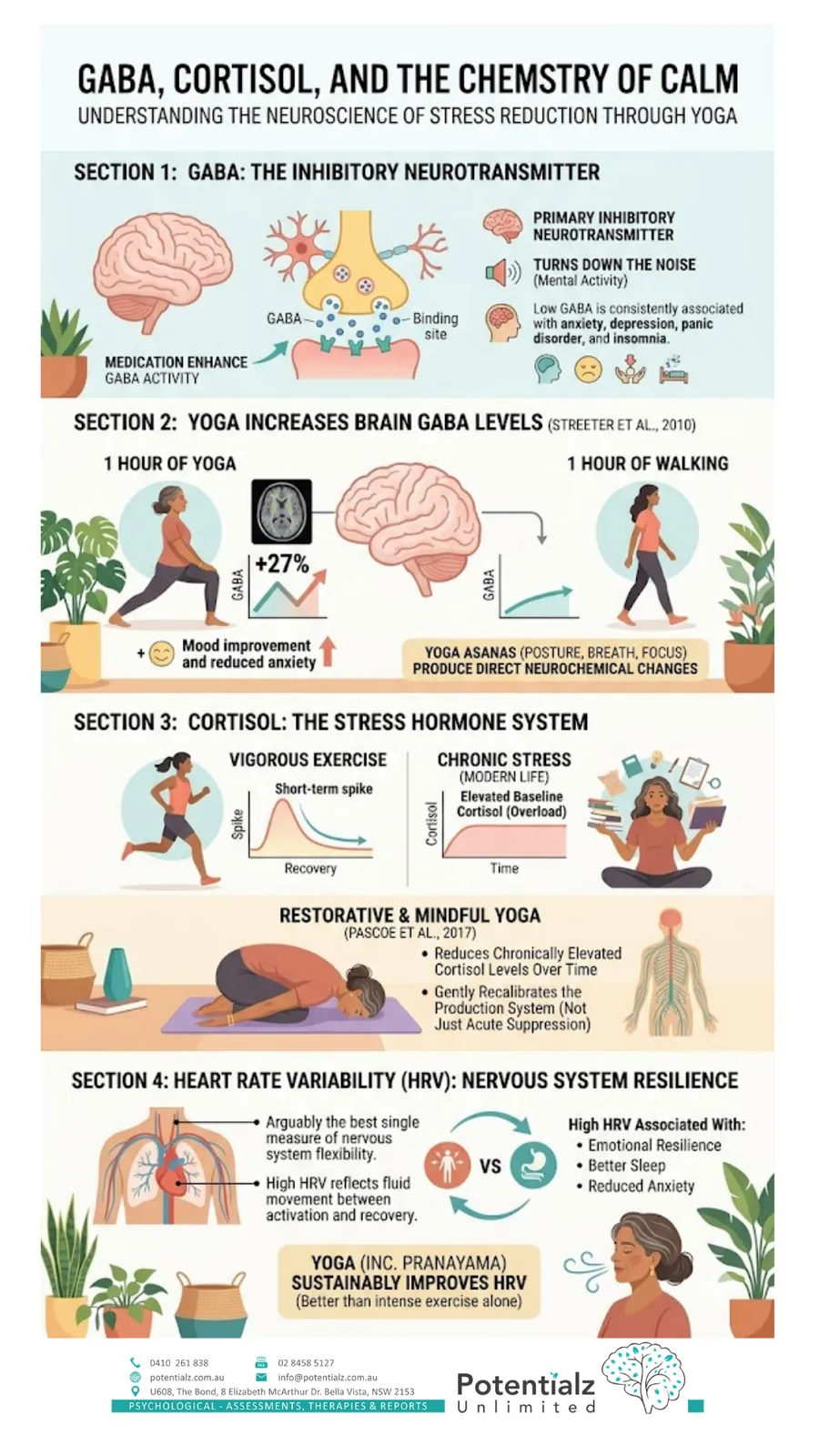
This is not a trivial finding. It suggests that yoga asanas — specifically the combination of posture, breath, and focused awareness — produce measurable neurochemical changes that directly support mental health. Not as a side effect. As a mechanism.
Now consider cortisol — the body’s primary stress hormone. Vigorous exercise causes a short-term spike in cortisol. This is usually healthy and self-resolving for most people. But in people who are already chronically stressed — and in modern life, many of us are — even the cortisol spike from exercise can feel like more stress layered on an already-overloaded system.
Yoga practice, particularly restorative and mindful yoga, has been shown to reduce chronically elevated cortisol levels over time (Pascoe et al., 2017). Not suppress it acutely — but gently recalibrate the system that keeps producing too much.
Heart rate variability (HRV) — arguably the best single measure of nervous system flexibility and resilience — also improves more sustainably through yoga than through intense exercise alone. High HRV reflects a nervous system that can move fluidly between activation and recovery. It is associated with emotional resilience, better sleep, and reduced anxiety. Regular yoga practice, including pranayama, consistently improves HRV across studies.
The Five Dimensions of an Asana Practice
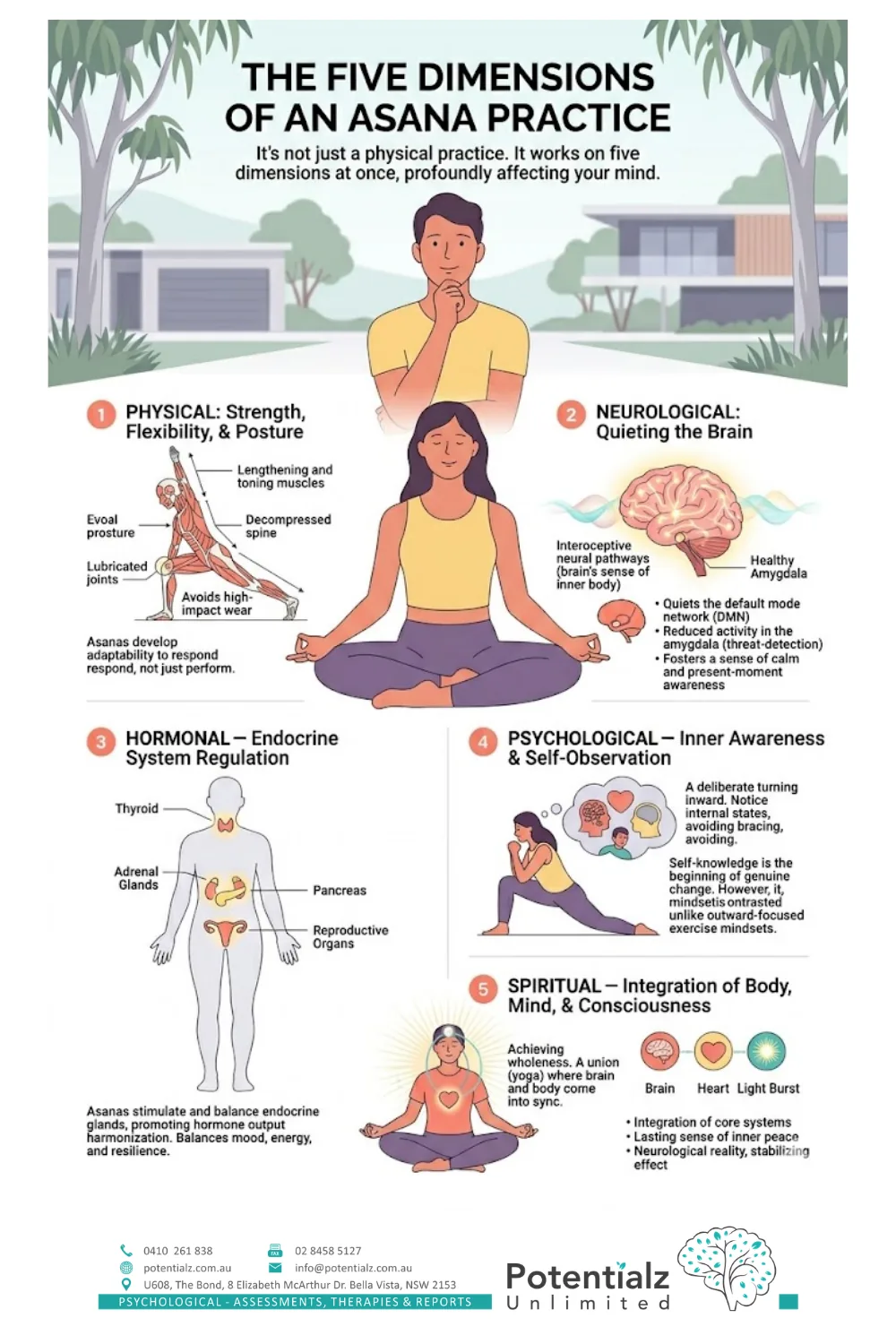
When I explain yoga asanas to clients, I often say: this is not just a physical practice. It works on five dimensions at once. And that is precisely why it affects your mind the way it does.
1. Physical — strength, flexibility, and posture
Yes, asanas develop physical strength and flexibility. But the mechanism is different from exercise. Rather than breaking down and rebuilding muscle fibre through high-load resistance, asanas lengthen and tone muscles, lubricate joints, and decompress the spine — without the wear on joints that high-impact exercise can create. The body develops what yogic tradition calls adaptability — the capacity to respond, not just perform.
2. Neurological — quieting the brain
This is the dimension most people don’t expect. Sustained asana practice, with breath awareness, activates the interoceptive neural pathways — the brain’s capacity to sense what is happening inside the body. This is proprioception deepened into inner awareness. The result? The brain’s default mode network — the part responsible for rumination, worry, and the inner critic — quiets down. Research consistently shows reduced activity in the amygdala (the brain’s threat-detection centre) following yoga practice.
3. Hormonal — endocrine system regulation
The endocrine system governs your emotions far more than most people realise. The hormones produced by the thyroid, adrenal glands, pancreas, and reproductive organs directly shape your mood, energy, resilience, and stress response. Specific yoga asanas stimulate, compress, or decompress specific endocrine glands — promoting what the tradition calls “harmonisation” of hormonal output. When your hormones are more balanced, your emotional life follows.
4. Psychological — inner awareness and self-observation
This is perhaps the most transformative dimension. In a gym or on a running track, the mind is typically either distracted (music, conversation, screens) or focused purely outward (pace, reps, performance). In asana practice, the attention is deliberately turned inward. You observe what you feel — physically, emotionally, mentally. You notice where you are bracing. You notice where you are avoiding. This is the beginning of self-knowledge. And self-knowledge is the beginning of genuine change.
5. Spiritual — integration of body, mind, and consciousness
I use the word spiritual carefully — not in a religious sense, but in the sense of wholeness. In yoga, the aspiration of asana practice is the union (the literal meaning of “yoga”) of body, mind, and consciousness. The brain and body unite and come into sync with each other. The felt sense of this is what I described in the opening: that quieter, more settled, more arrived feeling. It is not mystical. It is a neurological reality — and it has a profound stabilising effect on mental health.
Specific Asanas and Their Mental Health Applications
Let me be practical here — because yoga therapy is not abstract.
Balasana (Child’s Pose) — for anxiety and overwhelm
This simple forward fold, with the forehead resting on the mat and the body curled inward, immediately activates the parasympathetic nervous system. The pressure on the forehead stimulates the vagus nerve. The enclosed, foetal posture signals safety to the nervous system. When anxiety is high, this posture can shift the physiological state within minutes. I teach it as a “rescue posture” for clients who need something to reach for in moments of overwhelm. (The vagus nerve is central to this — see the vagus nerve and your nervous system.)
Viparita Karani (Legs Up the Wall) — for stress recovery
Gentle inversion reverses the blood flow, encouraging venous return to the heart without effort. The result is a profound sense of physical and mental ease. This posture is particularly useful for people in burnout, post-COVID fatigue, or chronic stress — those for whom even gentle active yoga feels like too much. Five to fifteen minutes of legs up the wall produces measurable improvements in heart rate and perceived stress.
Setu Bandhasana (Bridge Pose) — for depression
Mild backbends open the chest, encourage deeper breathing, and gently stimulate the adrenal glands and thyroid. For depression — which often manifests as a collapse of the chest and shoulders, a turning inward and downward — bridge pose is physically, neurologically, and symbolically opening. Research on physical posture and mood consistently shows that open, expansive postures shift emotional state. Setu Bandhasana is accessible even to beginners.
Savasana (Corpse Pose) — the art of surrender
Savasana is, paradoxically, the most challenging posture in yoga. It asks for complete stillness — not sleep, not distraction, not effort. Just presence. Many people find it deeply uncomfortable at first, because it confronts them with whatever they have been working hard not to feel. But practised consistently, savasana cultivates the capacity for genuine rest, genuine acceptance, and — ultimately — genuine peace.
Pranayama — the bridge between asana and meditation
Pranayama is not just breathing exercises. It is the deliberate regulation of the vital energy (prana) that flows through the breath. In the context of asana practice, pranayama is the bridge between the physical and the mental — it is what takes the practice from a workout to a mind-body integration. Specific pranayama techniques — nadi shodhana (alternate nostril breathing), bhramari (humming bee breath), and slow exhalation practices — each have specific effects on the nervous system and emotional state. You can read more in my guide to conscious breathing for mental wellness.
Why Yoga Therapy in Counselling Is Different from a Yoga Class
I want to be clear about something important. What I am describing — yoga therapy — is not the same as attending a yoga studio class, even a well-taught one.
In a yoga class, the sequence is designed for a group. The teacher cannot account for your specific mental health history, your trauma, your nervous system’s particular patterns, or the emotional material that might surface when your body begins to open.
In yoga therapy integrated with counselling, the practice is individually tailored and delivered within a therapeutic relationship. I know your history. I know what is happening in your life. I can watch what shifts in your body when a particular posture is held. I can work with what emerges — in words, in breath, in felt sensation. This sits alongside the other therapies we offer at the practice.
This is why yoga therapy in a therapeutic context can be genuinely transformative in ways that yoga classes — as wonderful as they are — sometimes cannot be.
If you are not experienced with yoga, please know: you do not need to be flexible. You do not need to be fit. You do not need a special body. Yoga is not about performing postures. It is about the quality of awareness you bring to your experience of the posture. A stiff person paying close attention will benefit far more than a flexible person going through the motions.
Who Benefits Most from Yoga Therapy
The people I find benefit most from integrating yoga asanas into their therapeutic work are those living with:
- Chronic stress and burnout — where the nervous system is stuck in overdrive and conventional talking therapy alone doesn’t quiet it
- Anxiety — particularly when it lives in the body (tight chest, shallow breathing, a constant sense of bracing)
- Depression — especially when it presents as heaviness, fatigue, or disconnection from the physical self
- Trauma — where emotions are stored in the body and not fully accessible through words
- Grief — where the body carries a weight that language cannot fully hold
- Emotional dysregulation — for people who are easily overwhelmed or find it hard to return to calm
Yoga asanas are not a cure. They are a profound support — one that works at a depth that ordinary exercise cannot reach, and that addresses the mind, the nervous system, and the spirit alongside the body. If you would like a broader view of what we treat, see our mental health conditions overview, or these evidence-based strategies for managing anxiety and depression.
How Potentialz Can Help
When I integrate yoga asanas into counselling at Potentialz Unlimited, I am not teaching you yoga. I am using the therapeutic tools of yoga — breath, posture, awareness, and deep rest — within a professional counselling context, tailored specifically to what you are working through.
You might come to me experiencing burnout, anxiety, depression, or a chronic sense of being unable to switch off. We talk. We breathe. We work with your body alongside your mind. Sessions are gentle, professional, and grounded in both psychological science and yogic tradition. You can read more about me on our meet the team page.
Appointments are available at Unit 608/8 Elizabeth Macarthur Drive, Bella Vista NSW 2153, Monday to Friday 10am–7pm, with Saturday and after-hours options. Telehealth is available via phone or Zoom.
Sessions are available in English, Hindi, Tamil, Kannada, and Urdu.
- Book online: live.potentialz.com.au
- Call: 0410 261 838
- Get in touch: contact us
No referral required.
References
Pascoe, M. C., Thompson, D. R., Jenkins, Z. M., & Ski, C. F. (2017). Mindfulness mediates the physiological markers of stress: Systematic review and meta-analysis. Journal of Psychiatric Research, 95, 156–178. https://doi.org/10.1016/j.jpsychires.2017.08.004
Ross, A., & Thomas, S. (2010). The health benefits of yoga and exercise: A review of comparison studies. Journal of Alternative and Complementary Medicine, 16(1), 3–12. https://doi.org/10.1089/acm.2009.0044
Saraswati, S. S. (1993). Asana pranayama mudra bandha (3rd ed.). Bihar School of Yoga.
Streeter, C. C., Whitfield, T. H., Owen, L., Rein, T., Karri, S. K., Yakhkind, A., Perlmutter, R., Prescot, A., Renshaw, P. F., Ciraulo, D. A., & Jensen, J. E. (2010). Effects of yoga versus walking on mood, anxiety, and brain GABA levels: A randomized controlled MRS study. Journal of Alternative and Complementary Medicine, 16(11), 1145–1152. https://doi.org/10.1089/acm.2010.0007
Streeter, C. C., Gerbarg, P. L., Whitfield, T. H., Owen, L., Johnston, J., Silveri, M. M., Gensler, M., Faulkner, C. L., Mann, C., & Jensen, J. E. (2017). Treatment of major depressive disorder with Iyengar yoga and coherent breathing: A randomized controlled dosing study. Journal of Alternative and Complementary Medicine, 23(3), 201–207. https://doi.org/10.1089/acm.2016.0140
Disclaimer: Samita Rathor is an Clinical Counsellor and Psychotherapist registered with PACFA (Psychotherapy and Counselling Federation of Australia). She is not a registered psychologist under AHPRA. This information is general in nature and does not constitute clinical advice. Yoga therapy is offered as an adjunct to professional counselling, not as a standalone treatment for clinical conditions. The team at Potentialz Unlimited also includes AHPRA-registered psychologists.
Crisis support: If you or someone you know needs support, please contact your GP, Lifeline on 13 11 14, Beyond Blue on 1300 22 4636, or Kids Helpline on 1800 55 1800 — or call 000 in an emergency.
Related Reading
Knowledge Check Quiz
Test what you have just read. Choose your answer for each question, then submit to reveal the answers and your score.
Need Professional Support?
If you're experiencing mental health concerns, our team is here to help.