Adult autism diagnosis in Australia is now guided by a single national framework — the National Guideline for the Assessment and Diagnosis of Autism (Autism CRC, 2nd ed. 2023, NHMRC-approved). A qualified clinician, usually a clinical psychologist or psychiatrist, leads a structured evaluation using DSM-5-TR criteria across two or more sessions, drawing on self-report, standardised measures, and — where possible — collateral developmental history.
”It Finally Made Sense”
There is a particular moment many adults describe after an autism assessment. It is not shock. It is recognition — a quiet sense that a lifetime of small confusions suddenly line up. Why social situations were so tiring. Why change felt harder for them than for everyone around them. Why a bright, capable person could struggle with things that seemed effortless for others.
Autism is a lifelong neurodevelopmental difference in how a person communicates, relates and processes the world. It is not an illness to be cured, and it does not appear in adulthood — it has always been there. What often changes in adulthood is understanding. And in Australia, the way that understanding is reached is now guided by a single, national framework.
This post explains, in plain language, how adults are assessed for autism in Australia — the referral, the assessment, the criteria clinicians use, and what happens after a diagnosis.
Why More Adults Are Seeking a Diagnosis
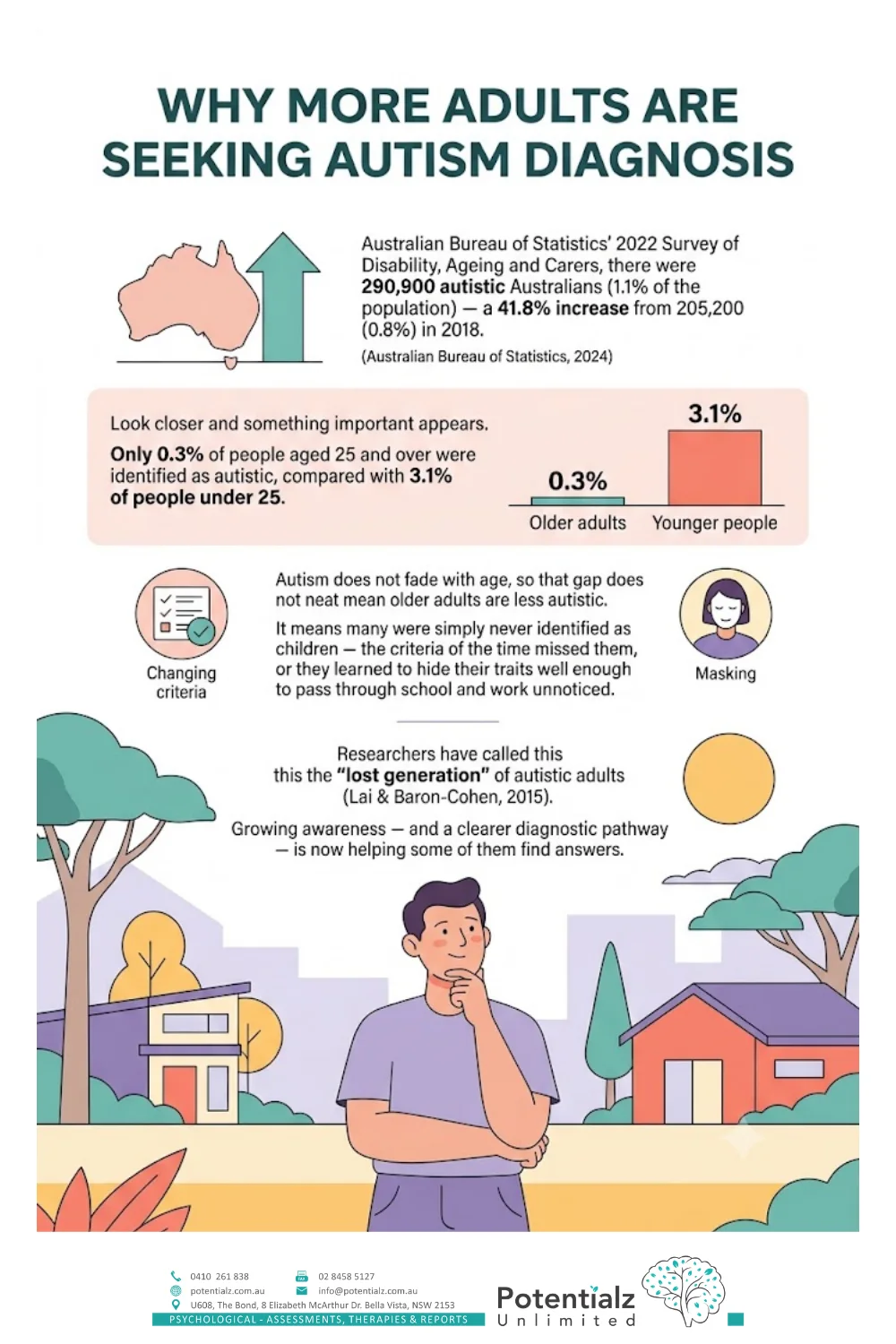
The number of Australians identified as autistic is rising quickly. In the Australian Bureau of Statistics’ 2022 Survey of Disability, Ageing and Carers, there were 290,900 autistic Australians (1.1% of the population) — a 41.8% increase from 205,200 (0.8%) in 2018 (Australian Bureau of Statistics, 2024).
Look closer and something important appears. Only 0.3% of people aged 25 and over were identified as autistic, compared with 3.1% of people under 25. Autism does not fade with age, so that gap does not mean older adults are less autistic. It means many were simply never identified as children — the criteria of the time missed them, or they learned to hide their traits well enough to pass through school and work unnoticed.
Researchers have called this the “lost generation” of autistic adults (Lai & Baron-Cohen, 2015). Growing awareness — and a clearer diagnostic pathway — is now helping some of them find answers.
What the National Guideline Is
Before 2018, autism assessment in Australia varied widely from clinic to clinic. Two people with similar presentations could receive different outcomes depending on who they saw.
The National Guideline for the Assessment and Diagnosis of Autism in Australia changed that. Developed by Autism CRC with funding from the National Disability Insurance Agency, it was first released in 2018 and updated to a second edition in 2023. Its recommendations are approved by the National Health and Medical Research Council (NHMRC) and were built from three converging sources: research evidence, clinical practice, and the views of autistic people and their families (Whitehouse et al., 2018).
It was Australia’s first unified approach to autism assessment, and it applies to children and adults alike. Its aim is simple: whoever you are and wherever you live, the process should be consistent, thorough and respectful.
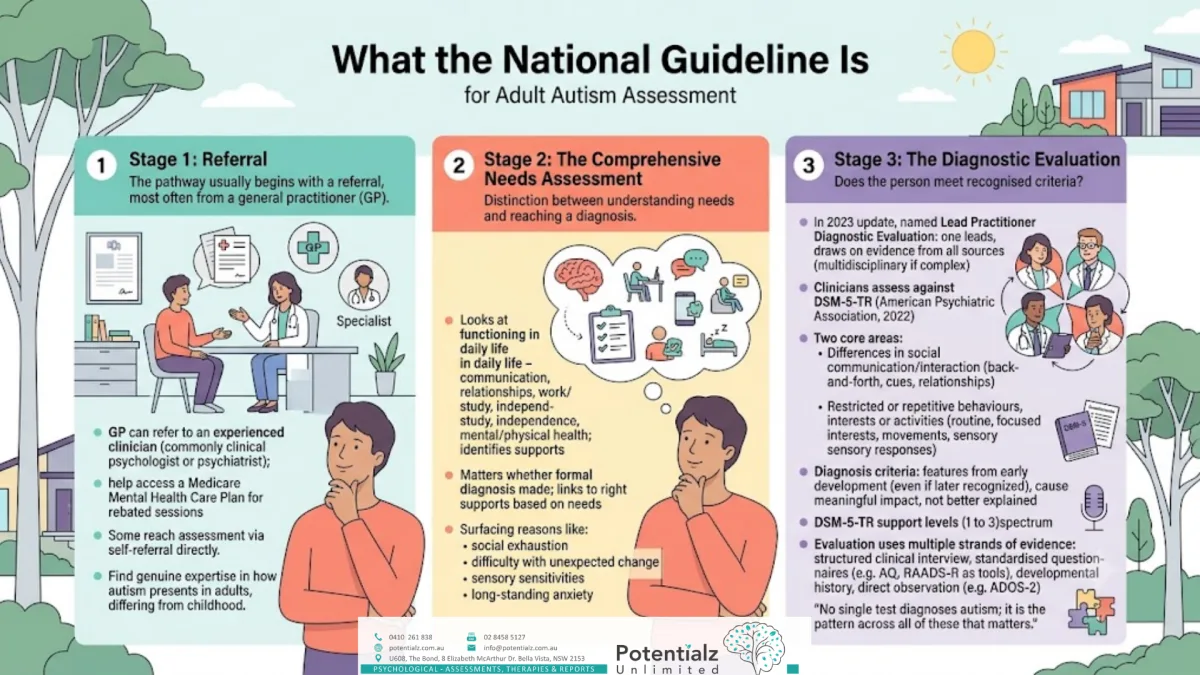
The Guideline sets out three broad stages.
Stage 1: Referral
The pathway usually begins with a referral, most often from a general practitioner (GP). A GP can refer you to a practitioner experienced in autism assessment — commonly a clinical psychologist or a psychiatrist — and, where relevant, help you access a Medicare Mental Health Care Plan for some rebated sessions.
Some adults reach an assessment through self-referral, contacting a suitable practitioner directly. Either way, the first step is landing with someone who has genuine expertise in how autism presents in adults, which can look quite different from the childhood picture many people expect.
Stage 2: The Comprehensive Needs Assessment
The Guideline draws a helpful distinction between understanding a person’s needs and reaching a diagnosis. These are related but not identical.
A comprehensive needs assessment looks at how you are functioning across daily life — communication, relationships, work or study, independence, mental and physical health — and identifies where support might help. This part matters whether or not a formal diagnosis is ultimately made, because it links a person to the right supports based on their actual needs, not just a label.
For adults, this often surfaces the reasons they sought assessment in the first place: exhaustion after socialising, difficulty with unexpected change, sensory sensitivities, or long-standing anxiety. Understanding these needs is valuable in its own right.
Stage 3: The Diagnostic Evaluation
The diagnostic evaluation answers a specific question: does the person meet the recognised criteria for autism?
In the 2023 update, the Guideline renamed the older “single clinician” pathway to the Lead Practitioner Diagnostic Evaluation. The wording is deliberate: one qualified practitioner leads the process, but draws on information and evidence from all relevant sources — including other practitioners — rather than deciding alone in isolation. Where a presentation is complex or uncertain, the lead practitioner can bring in a broader multidisciplinary team.
Most Australian clinicians assess against the criteria in the DSM-5-TR (American Psychiatric Association, 2022), which describes autism through two core areas:
- Differences in social communication and interaction — for example in back-and-forth conversation, reading or using non-verbal cues, and developing or understanding relationships.
- Restricted or repetitive behaviours, interests or activities — such as a strong need for routine, intense focused interests, repetitive movements, or heightened or reduced sensory responses.
For a diagnosis, these features need to have been present from early development (even if they only became obvious later, when life’s demands outgrew the person’s coping strategies), to cause meaningful impact on everyday life, and to not be better explained by another condition. The DSM-5-TR also describes support levels (1 to 3) reflecting how much help a person needs — a reminder that autism is a spectrum, not a single fixed picture.
A careful evaluation usually combines several strands of evidence: a structured clinical interview, standardised questionnaires (screening tools such as the AQ or RAADS-R are sometimes used as a starting point, not as a diagnosis), a detailed developmental history, and in some cases direct observation using tools like the ADOS-2. No single test diagnoses autism; it is the pattern across all of these that matters.
Why Assessing Adults Is Different
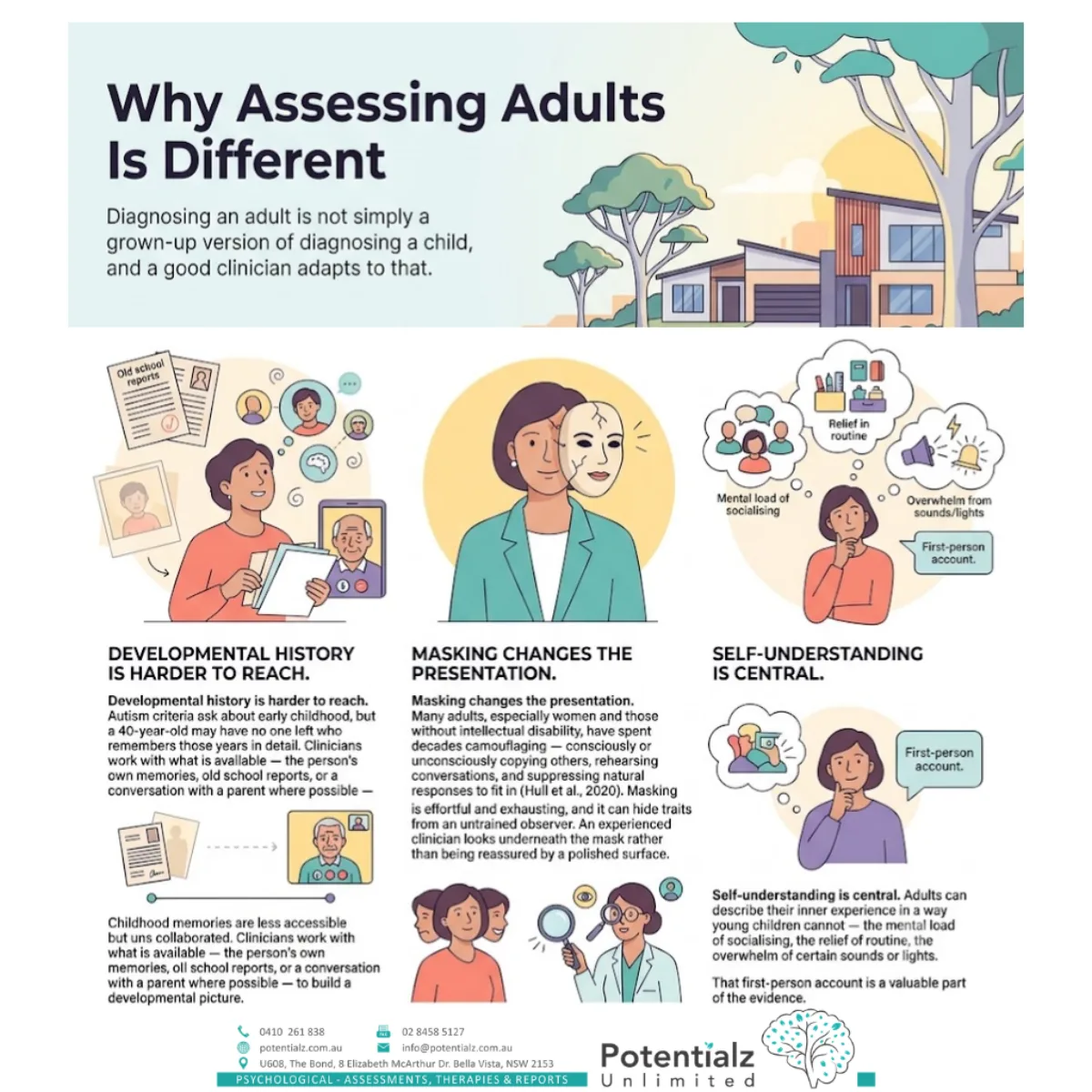
Diagnosing an adult is not simply a grown-up version of diagnosing a child, and a good clinician adapts to that.
Developmental history is harder to reach. Autism criteria ask about early childhood, but a 40-year-old may have no one left who remembers those years in detail. Clinicians work with what is available — the person’s own memories, old school reports, or a conversation with a parent where possible — to build a developmental picture.
Masking changes the presentation. Many adults, especially women and those without intellectual disability, have spent decades camouflaging — consciously or unconsciously copying others, rehearsing conversations, and suppressing natural responses to fit in (Hull et al., 2020). Masking is effortful and exhausting, and it can hide traits from an untrained observer. An experienced clinician looks underneath the mask rather than being reassured by a polished surface.
Self-understanding is central. Adults can describe their inner experience in a way young children cannot — the mental load of socialising, the relief of routine, the overwhelm of certain sounds or lights. That first-person account is a valuable part of the evidence.
The Conditions That Often Travel Alongside
Autism rarely arrives alone. A large meta-analysis found that co-occurring mental health conditions are common among autistic people, with anxiety and depression among the most frequent (Lai et al., 2019). ADHD also overlaps often enough that clinicians consider it during assessment.
This matters for two reasons. First, an adult may have been treated for anxiety or depression for years without anyone recognising the autism underneath — so the support never quite fit. Second, once autism is understood, therapy for those co-occurring conditions can be adapted to how the person actually thinks and feels, rather than applied off a generic template.
After a Diagnosis: What Changes
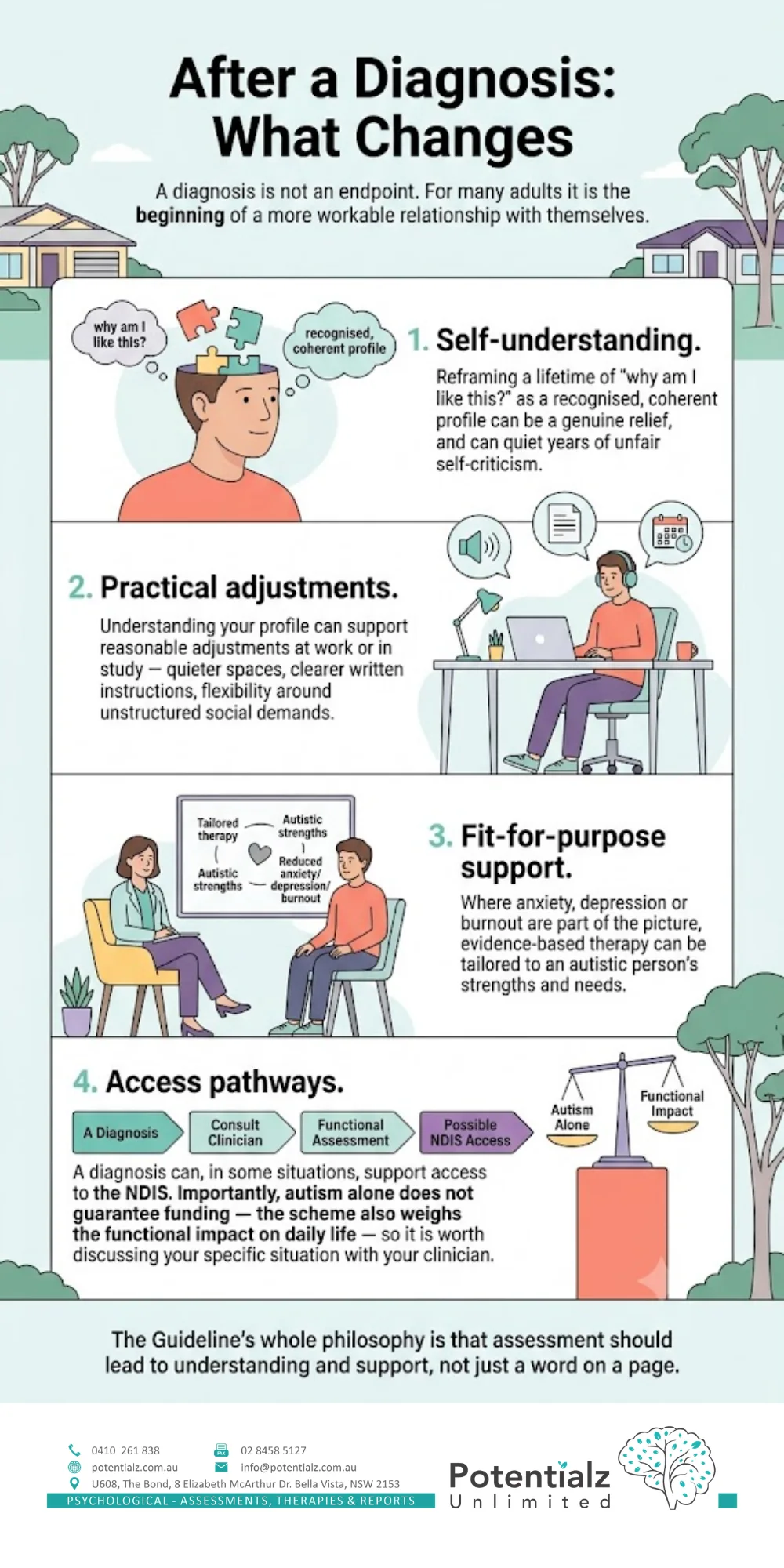
A diagnosis is not an endpoint. For many adults it is the beginning of a more workable relationship with themselves.
- Self-understanding. Reframing a lifetime of “why am I like this?” as a recognised, coherent profile can be a genuine relief, and can quiet years of unfair self-criticism.
- Practical adjustments. Understanding your profile can support reasonable adjustments at work or in study — quieter spaces, clearer written instructions, flexibility around unstructured social demands.
- Fit-for-purpose support. Where anxiety, depression or burnout are part of the picture, evidence-based therapy can be tailored to an autistic person’s strengths and needs.
- Access pathways. A diagnosis can, in some situations, support access to the NDIS. Importantly, autism alone does not guarantee funding — the scheme also weighs the functional impact on daily life — so it is worth discussing your specific situation with your clinician.
The Guideline’s whole philosophy is that assessment should lead to understanding and support, not just a word on a page.
Getting an Adult Autism Assessment in Bella Vista
If you are an adult in Sydney’s Hills District wondering whether autism explains your experience, you do not have to work it out alone. Potentialz Unlimited is a psychology practice in Bella Vista, serving Norwest, Castle Hill, Baulkham Hills, Kellyville and Rouse Hill. Dr Gurprit Ganda is a Clinical Psychologist with more than 25 years of experience, working within the National Guideline’s framework.
A good first step is a conversation. You can get in touch here, book at live.potentialz.com.au, or call 0410 261 838 to ask questions before deciding anything. An assessment is a considered process, and it starts simply — with someone who understands taking the time to listen.
Related Reading
-
Adult Autism Assessment: Recognising Autism Later in Life More from our blog:
-
The Rising Prevalence of Autism in Australia and Globally: A Matter of Concern
-
The Default Mode Network and Neurodivergent Profiles: Understanding Cognitive Flexibility
Services that may help:
References
American Psychiatric Association. (2022). Diagnostic and statistical manual of mental disorders (5th ed., text rev.). https://doi.org/10.1176/appi.books.9780890425787
Australian Bureau of Statistics. (2024). Autism in Australia, 2022. ABS. https://www.abs.gov.au/articles/autism-australia-2022
Hull, L., Petrides, K. V., & Mandy, W. (2020). The female autism phenotype and camouflaging: A narrative review. Review Journal of Autism and Developmental Disorders, 7(4), 306–317. https://doi.org/10.1007/s40489-020-00197-9
Lai, M.-C., & Baron-Cohen, S. (2015). Identifying the lost generation of adults with autism spectrum conditions. The Lancet Psychiatry, 2(11), 1013–1027. https://doi.org/10.1016/S2215-0366(15)00277-1
Lai, M.-C., Kassee, C., Besney, R., Bonato, S., Hull, L., Mandy, W., Szatmari, P., & Ameis, S. H. (2019). Prevalence of co-occurring mental health diagnoses in the autism population: A systematic review and meta-analysis. The Lancet Psychiatry, 6(10), 819–829. https://doi.org/10.1016/S2215-0366(19)30289-5
Whitehouse, A. J. O., Evans, K., Eapen, V., & Wray, J. (2018). A national guideline for the assessment and diagnosis of autism spectrum disorders in Australia. Autism CRC. https://www.autismcrc.com.au/best-practice/assessment-and-diagnosis
Knowledge Check Quiz
Test what you have just read. Choose your answer for each question, then submit to reveal the answers and your score.
Need Professional Support?
If you're experiencing mental health concerns, our team is here to help.