When a Memory Will Not Let Go
Most of us can recall a difficult event from the past and feel a manageable twinge — the memory is there, but it stays in the past where it belongs. After trauma, something different can happen. A sound, a smell, a tone of voice, or a quiet moment can throw you straight back into the worst day of your life. Your heart races. Your body braces. It can feel as though the event is happening all over again, even years later.
This is not weakness, and it is not something you should simply “get over.” It is how the brain can respond when an experience overwhelms our usual ability to cope. The memory gets stored in a raw, unfinished form — and keeps firing as if the danger is still here.
EMDR therapy was designed to help with exactly this. If you are searching for EMDR therapy in Bella Vista for trauma and PTSD, this guide explains in plain language what EMDR is, how its eight phases work, what the research shows, and what to expect in a session with a clinical psychologist.
What Trauma and PTSD Actually Are
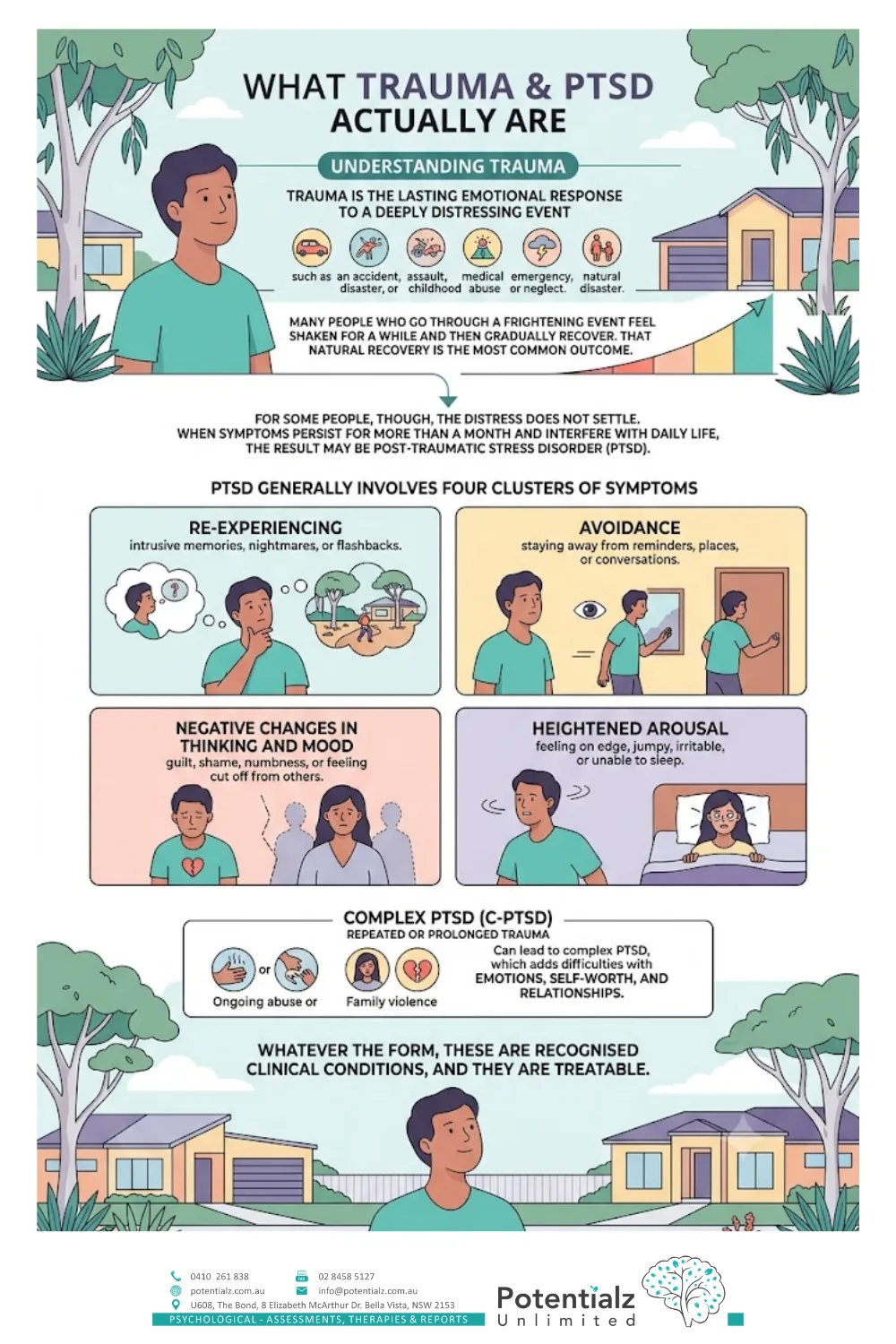
Trauma is the lasting emotional response to a deeply distressing event — such as an accident, assault, medical emergency, natural disaster, or childhood abuse or neglect. Many people who go through a frightening event feel shaken for a while and then gradually recover. That natural recovery is the most common outcome.
For some people, though, the distress does not settle. When symptoms persist for more than a month and interfere with daily life, the result may be post-traumatic stress disorder (PTSD). PTSD generally involves four clusters of symptoms:
- Re-experiencing — intrusive memories, nightmares, or flashbacks.
- Avoidance — staying away from reminders, places, or conversations.
- Negative changes in thinking and mood — guilt, shame, numbness, or feeling cut off from others.
- Heightened arousal — feeling on edge, jumpy, irritable, or unable to sleep.
Repeated or prolonged trauma — such as ongoing abuse or family violence — can also lead to what is now called complex PTSD, which adds difficulties with emotions, self-worth, and relationships. Whatever the form, these are recognised clinical conditions, and they are treatable.
What EMDR Is
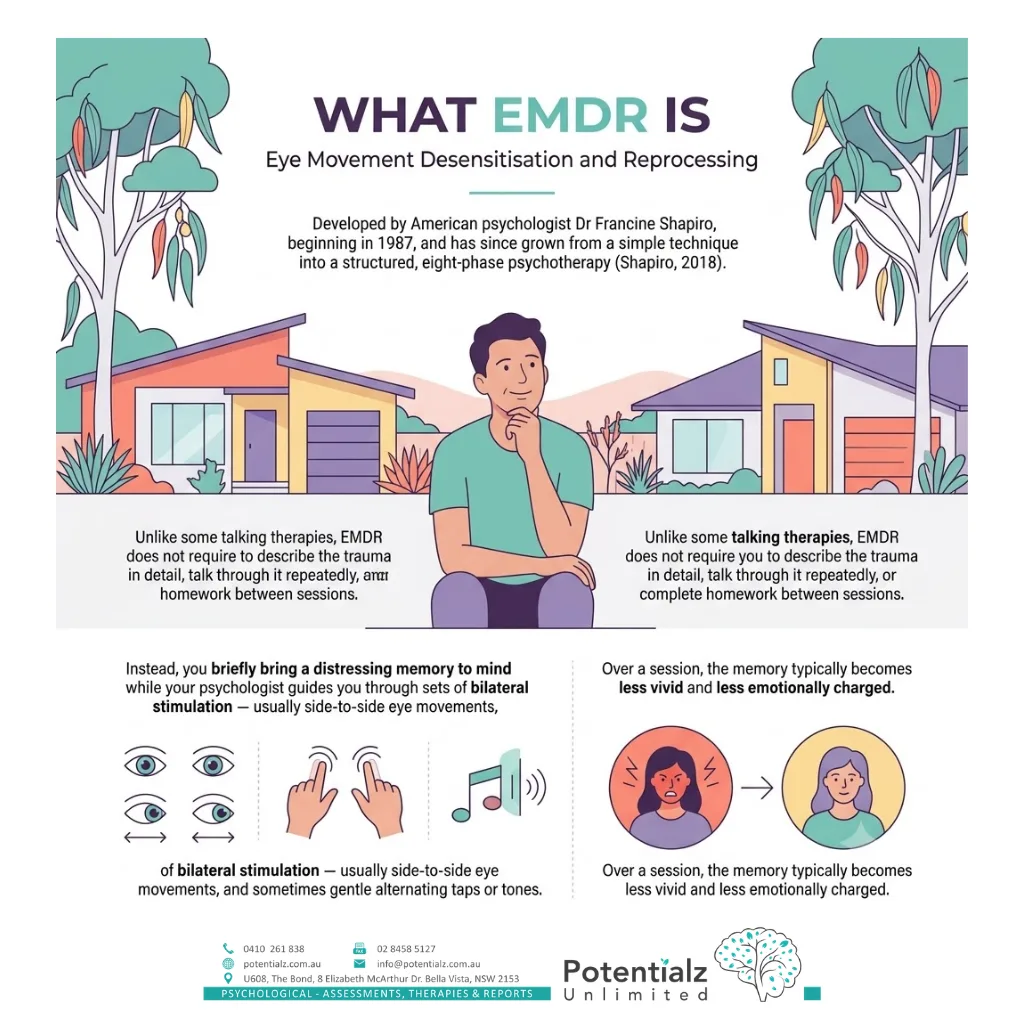
EMDR stands for Eye Movement Desensitisation and Reprocessing. It was developed by American psychologist Dr Francine Shapiro, beginning in 1987, and has since grown from a simple technique into a structured, eight-phase psychotherapy (Shapiro, 2018).
Unlike some talking therapies, EMDR does not require you to describe the trauma in detail, talk through it repeatedly, or complete homework between sessions. Instead, you briefly bring a distressing memory to mind while your psychologist guides you through sets of bilateral stimulation — usually side-to-side eye movements, and sometimes gentle alternating taps or tones. Over a session, the memory typically becomes less vivid and less emotionally charged.
EMDR is one of Dr Gurprit Ganda’s signature approaches at our EMDR clinic in Bella Vista, alongside CBT and ACT.
The Adaptive Information Processing Model
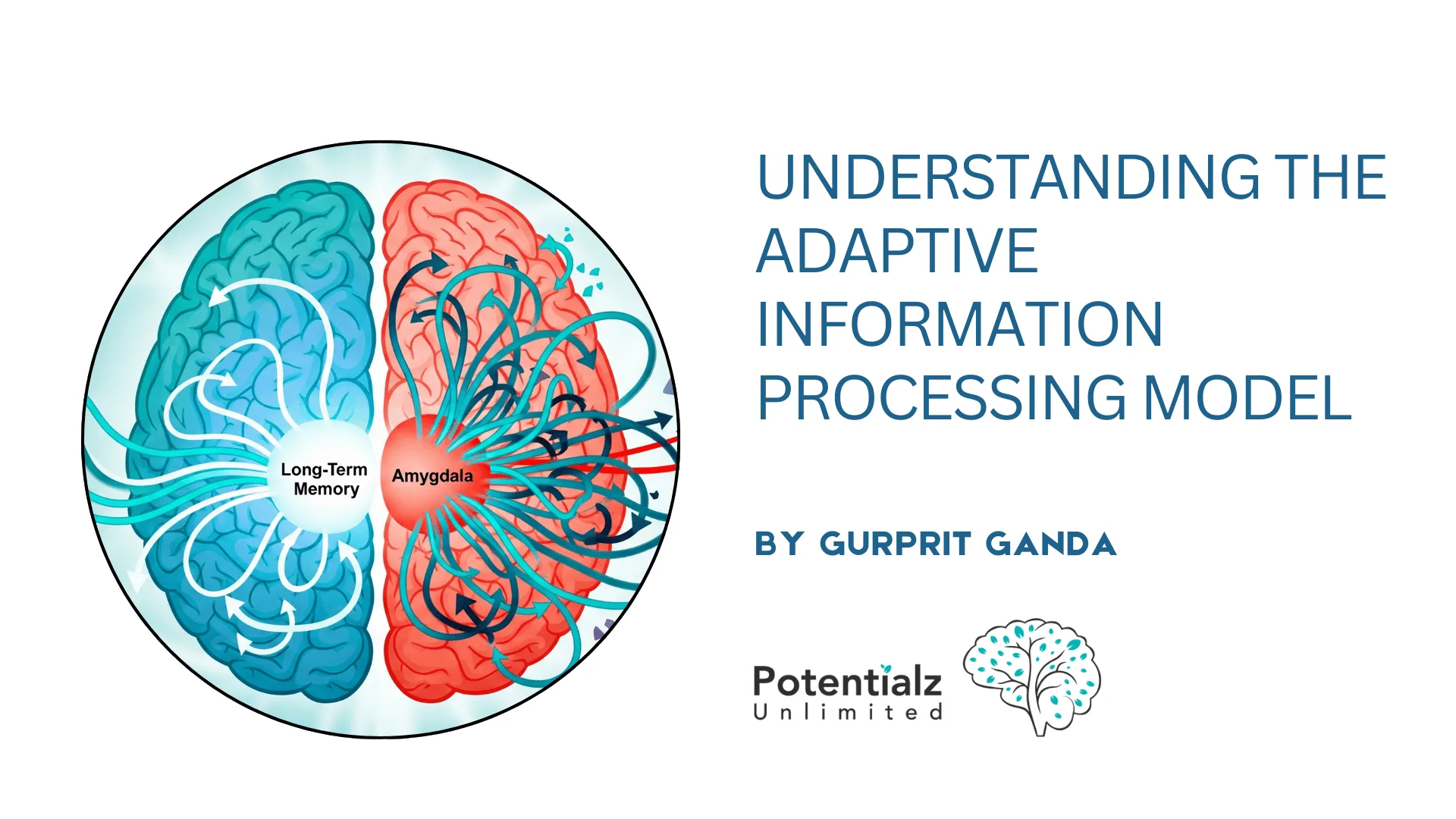
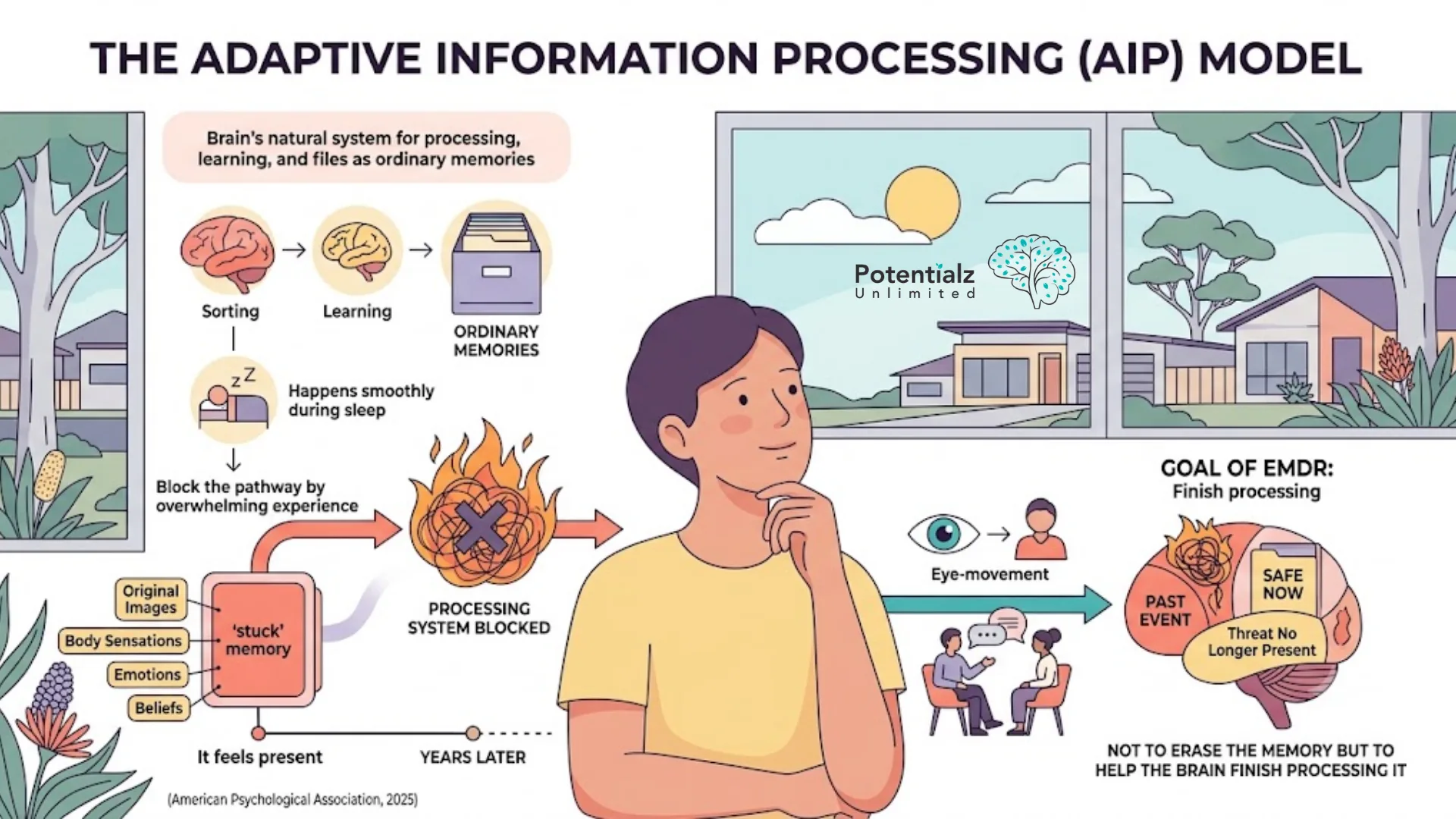
To understand why EMDR works, it helps to understand the idea behind it: the Adaptive Information Processing (AIP) model, developed by Shapiro.
The AIP model proposes that the brain has a natural system for processing experiences — sorting them, learning from them, and filing them away as ordinary memories. Most of the time this happens smoothly, often during sleep. But when an experience is overwhelming, that processing system can become blocked. The memory gets “stuck” in an unprocessed state — stored with the original images, body sensations, emotions, and beliefs still attached (American Psychological Association, 2025).
That is why a trauma memory can feel so present years later. According to the AIP model, the goal of EMDR is not to erase the memory but to help the brain finish processing it, so it can be stored like any other memory — something that happened in the past, rather than a threat in the present.
The 8 Phases of EMDR
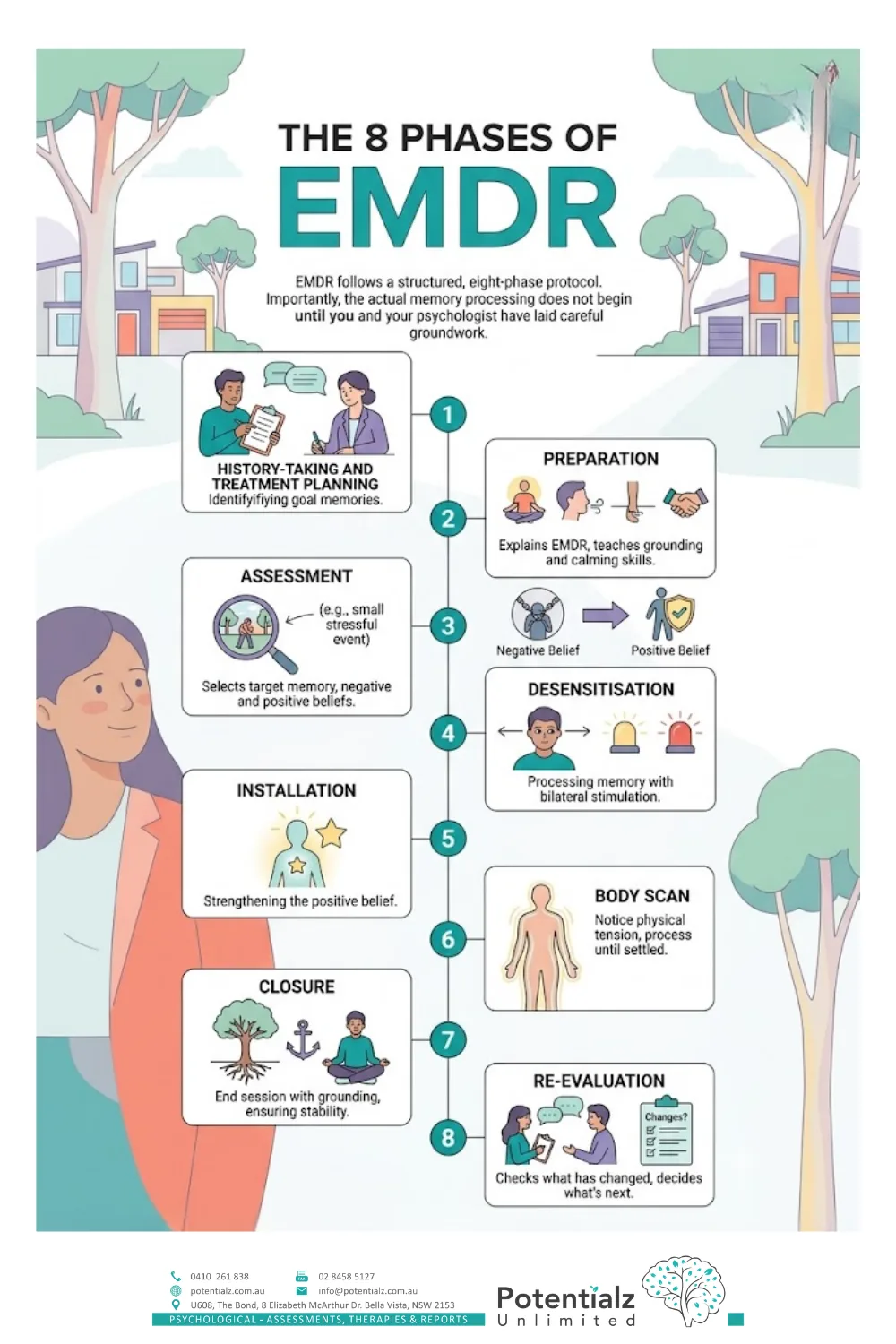
EMDR follows a structured, eight-phase protocol. Importantly, the actual memory processing does not begin until you and your psychologist have laid careful groundwork.
- History-taking and treatment planning. Your psychologist learns your history, understands your goals, and identifies which memories to target.
- Preparation. This phase builds trust and safety. Your psychologist explains how EMDR works and teaches grounding and calming skills you can use at any time. Processing only begins when you feel ready.
- Assessment. Together you select a specific target memory, the image that represents it, the negative belief attached to it (for example, “I am powerless”), and the positive belief you would prefer (“I am safe now”).
- Desensitisation. You briefly hold the memory in mind during sets of bilateral stimulation. The aim is to reduce the distress the memory carries.
- Installation. As distress lowers, attention shifts to strengthening the positive belief so it feels true.
- Body scan. You notice any remaining physical tension linked to the memory, and process it until your body feels settled.
- Closure. Every session ends with grounding, so you leave feeling stable — whether or not the memory is fully processed.
- Re-evaluation. At the start of the next session, your psychologist checks what has changed and decides what to work on next.
You can read a deeper explanation of this process in our article on how EMDR therapy helps in trauma recovery.
What Bilateral Stimulation Actually Does
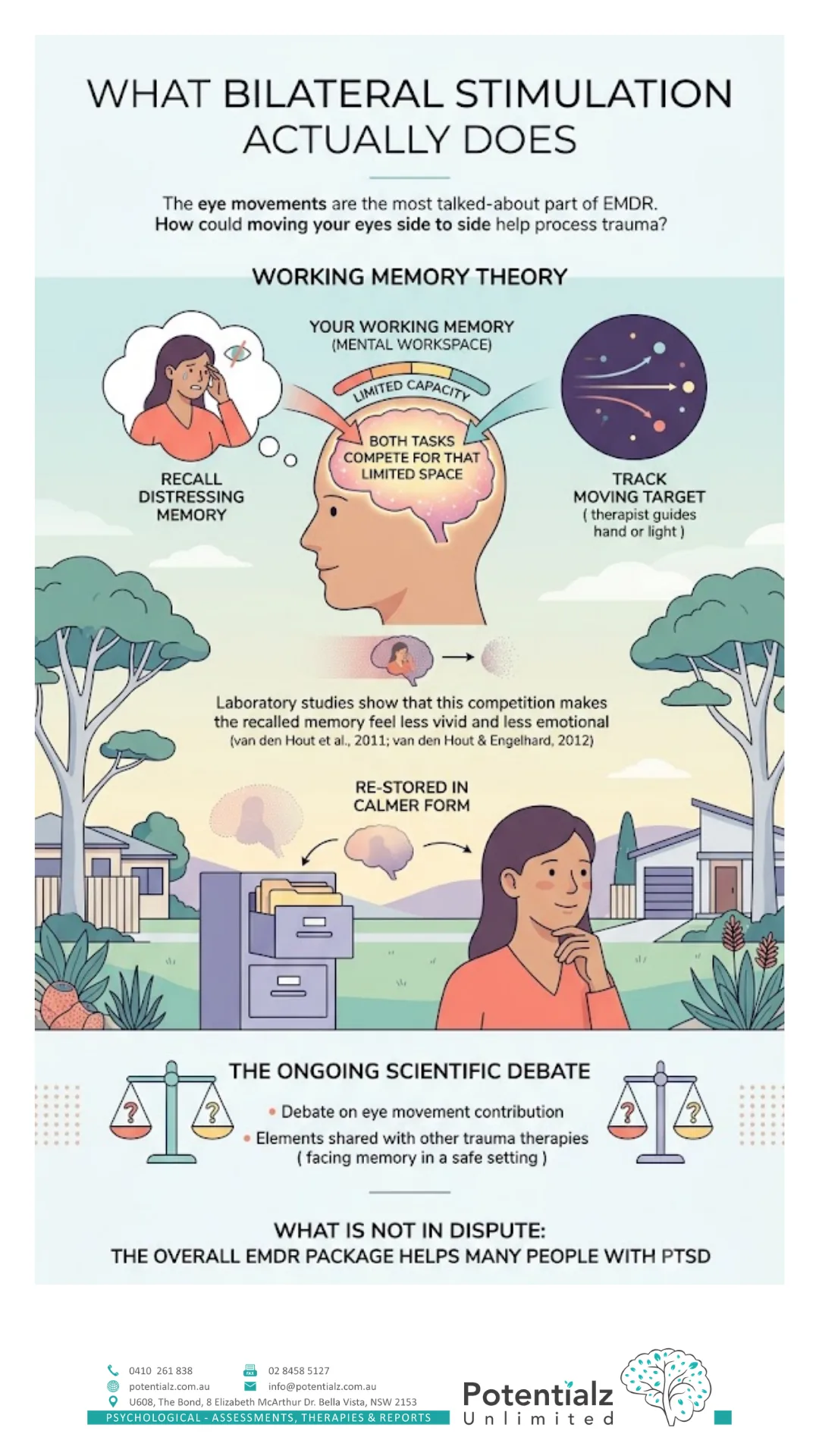
The eye movements are the most talked-about part of EMDR, and a fair question is: how could moving your eyes side to side help process trauma?
One of the best-supported explanations is working memory theory. Our working memory — the mental “workspace” that holds information in the moment — has limited capacity. When you recall a vivid, distressing memory and track a moving target at the same time, both tasks compete for that limited space. Laboratory studies show that this competition makes the recalled memory feel less vivid and less emotional (van den Hout et al., 2011; van den Hout & Engelhard, 2012). Over repeated sets, the memory can be re-stored in this calmer form.
It is worth being honest about the science. Researchers continue to debate exactly how much the eye movements themselves contribute, and some argue that EMDR’s benefits also draw on elements shared with other trauma therapies, such as briefly facing the memory in a safe setting. What is not in serious dispute is that the overall EMDR package helps many people with PTSD — which is why it is recommended by major guidelines.
What the Evidence Shows for PTSD
EMDR is one of the most widely endorsed trauma therapies in the world. Several leading authorities recommend it for adults with PTSD:
- The World Health Organization recommends EMDR as one of the psychological treatments to be considered for adults with PTSD (WHO, 2023).
- The Australian Guidelines for the Prevention and Treatment of Acute Stress Disorder, PTSD and Complex PTSD — developed by Phoenix Australia — recommend EMDR for adults with PTSD, alongside other trauma-focused therapies (Phoenix Australia, 2021).
- The American Psychological Association clinical practice guideline suggests EMDR for the treatment of PTSD (American Psychological Association, 2025).
- The International Society for Traumatic Stress Studies (ISTSS) also recognises EMDR among recommended trauma-focused treatments for PTSD.
These recommendations rest on a body of randomised controlled trials and reviews. In Australian terms, this means EMDR is considered a legitimate, evidence-based first-line option for PTSD — not an alternative or fringe therapy.
A note on expectations: no responsible psychologist can promise a cure, and outcomes differ from person to person. What the evidence supports is that EMDR is a well-established treatment that helps many people meaningfully reduce their PTSD symptoms.

What a Session Actually Looks Like
People are often relieved to learn how calm and collaborative EMDR feels. In a typical processing session, you sit comfortably while your psychologist guides sets of eye movements — for example, by moving their hand, or using a light bar or alternating tones through headphones. You briefly notice the target memory, then simply report whatever comes up — thoughts, images, feelings, or body sensations — between sets. There is no need to analyse or explain everything.
Throughout, you stay fully awake, aware, and in control. You can pause at any time. This is one key reason EMDR is not hypnosis — a misconception we address directly in Is EMDR Just Hypnosis?. Sessions usually run 50–90 minutes, and each one ends with grounding so you leave feeling settled.
Who EMDR Suits — and Safety First
EMDR can help with single-incident trauma (such as a car accident or assault), as well as longer-standing difficulties linked to past experiences. It is also used as part of treatment for related concerns, including some forms of anxiety, phobias, and trauma-related grief.
Safety matters. EMDR is generally well-tolerated, but it is not a one-size-fits-all technique. Before any memory processing, your psychologist completes a thorough assessment and, where needed, spends extra time building stabilisation and coping skills — particularly with complex trauma, dissociation, or current safety concerns. The pacing is always tailored to you. You can learn more about our trauma work on our PTSD psychologist Bella Vista page, and read about the wider picture in healing from trauma: understanding EMDR therapy for PTSD.
EMDR Therapy in Bella Vista and the Hills District
For people across the Hills District, access to skilled trauma therapy close to home matters. Potentialz Unlimited is based in Bella Vista, a short drive from Norwest, Castle Hill, Baulkham Hills, Kellyville, and Rouse Hill. This means you can attend EMDR sessions without a long commute into the city — which is especially valuable when you are working through something difficult.
EMDR at our practice is provided by Dr Gurprit Ganda, a Clinical Psychologist with AHPRA Clinical Endorsement and more than 25 years of experience, for whom EMDR is a signature modality. You can meet our practitioner on the our team page. Telehealth is also available across NSW for clients who prefer or need to attend remotely.
When to Seek EMDR and How to Get Started
It may be time to consider EMDR or another trauma-focused therapy if:
- Distressing memories, nightmares, or flashbacks keep intruding.
- You avoid people, places, or situations that remind you of a past event.
- You feel constantly on edge, jumpy, or unable to relax.
- You feel numb, detached, or stuck in guilt or shame.
- Past experiences are affecting your relationships, work, or daily life.
You do not need a formal PTSD diagnosis to seek help, and there is no need to wait until things feel unbearable. Earlier support is often easier support.
Getting started is straightforward. Your first appointment is an assessment — a chance to share what is happening, ask questions, and decide together whether EMDR is right for you. There is no obligation to begin memory processing until you feel ready.
We are located at Unit 608/8 Elizabeth Macarthur Drive, Bella Vista NSW 2153, close to Norwest Business Park, Castle Hill, and Baulkham Hills. Book a consultation by calling 0410 261 838 or visiting live.potentialz.com.au.
If you are in crisis or feel unsafe right now, please contact Lifeline on 13 11 14 or call 000 in an emergency.
References
American Psychological Association. (2025). Eye movement desensitization and reprocessing (EMDR) therapy. APA Clinical Practice Guideline for the Treatment of PTSD. https://www.apa.org/ptsd-guideline/treatments/eye-movement-reprocessing
Phoenix Australia. (2021). Australian guidelines for the prevention and treatment of acute stress disorder, posttraumatic stress disorder and complex PTSD. Phoenix Australia – Centre for Posttraumatic Mental Health. https://www.phoenixaustralia.org/australian-guidelines-for-ptsd/
Shapiro, F. (2018). Eye movement desensitization and reprocessing (EMDR) therapy: Basic principles, protocols, and procedures (3rd ed.). Guilford Press.
van den Hout, M. A., & Engelhard, I. M. (2012). How does EMDR work? Journal of Experimental Psychopathology, 3(5), 724–738. https://doi.org/10.5127/jep.028212
van den Hout, M. A., Engelhard, I. M., Beetsma, D., Slofstra, C., Hornsveld, H., Houtveen, J., & Leer, A. (2011). EMDR and mindfulness. Eye movements and attentional breathing tax working memory and reduce vividness and emotionality of aversive ideation. Journal of Behavior Therapy and Experimental Psychiatry, 42(4), 423–431. https://doi.org/10.1016/j.jbtep.2011.03.004
World Health Organization. (2023). Posttraumatic stress disorder (PTSD): Psychological interventions – adults. WHO Mental Health Gap Action Programme (mhGAP) evidence centre. https://www.who.int/teams/mental-health-and-substance-use/treatment-care/mental-health-gap-action-programme/evidence-centre/conditions-related-to-stress
Crisis and Support Resources
If you or someone you know needs immediate support:
- Lifeline: 13 11 14
- Beyond Blue: 1300 22 4636
- 1800RESPECT (trauma, abuse, family and domestic violence): 1800 737 732
- Emergency: 000
Knowledge Check Quiz
Test what you have just read. Choose your answer for each question, then submit to reveal the answers and your score.
Need Professional Support?
If you're experiencing mental health concerns, our team is here to help.