The Question Almost Everyone Asks
When people first hear how EMDR works — “you follow my fingers back and forth while thinking about a difficult memory” — a very reasonable thought follows: isn’t that just hypnosis? It’s one of the most common questions I’m asked, and it’s a fair one. Both are talked about in hushed, slightly mysterious tones. Both sound a little unusual the first time you hear them described.
But EMDR and hypnosis are genuinely different therapies, with different mechanisms, different research bases, and — importantly — a very different experience for you as the person in the chair. The short answer is: no, EMDR is not hypnosis. Here’s the longer, clearer answer.
What EMDR Actually Is

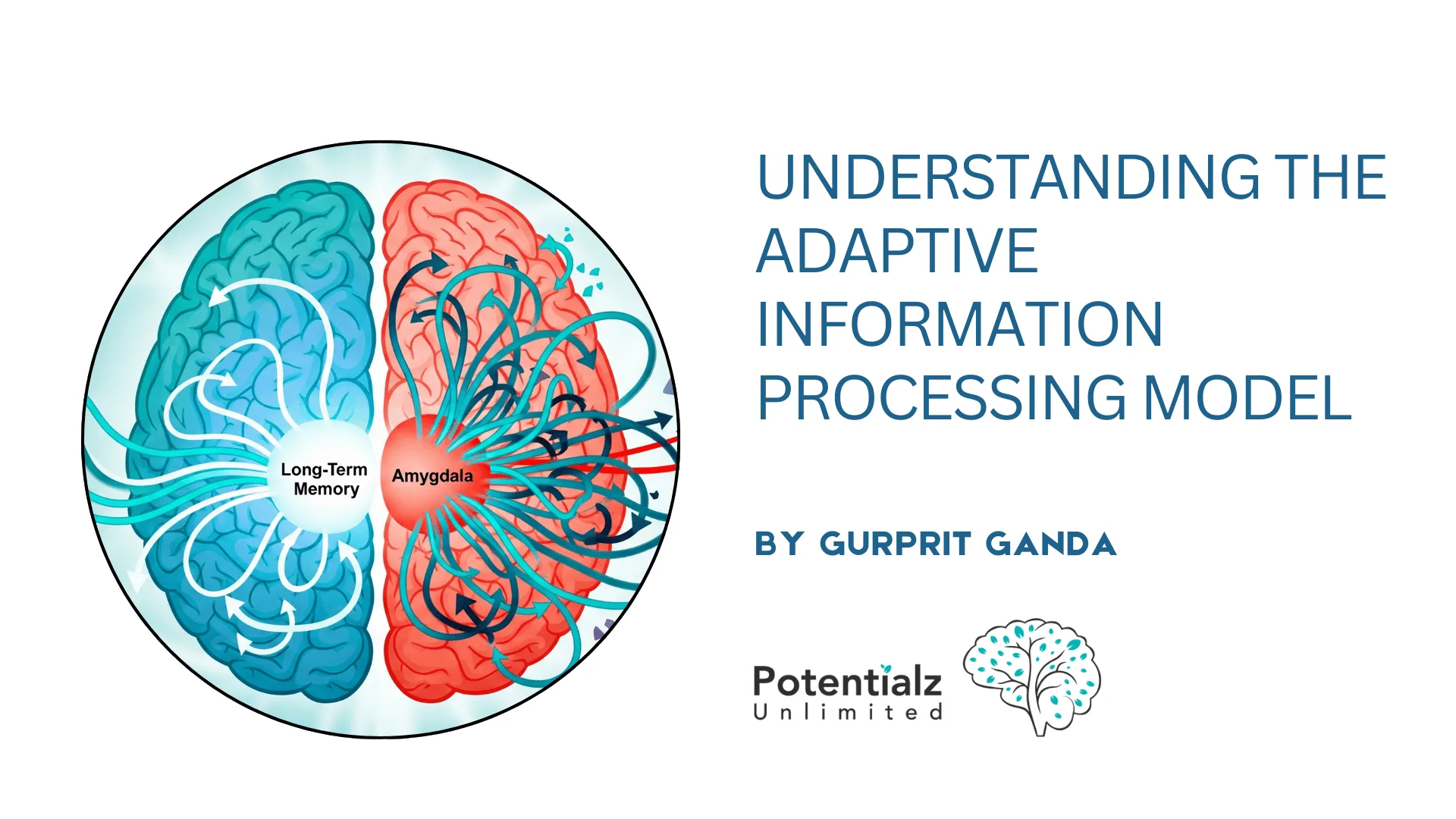
EMDR stands for Eye Movement Desensitisation and Reprocessing. It was developed by psychologist Dr Francine Shapiro in the late 1980s, and it’s built on an idea called the Adaptive Information Processing model.
The idea is this: your brain has a natural system for digesting experiences. Most of what happens to us gets processed and filed away as an ordinary memory — it loses its sting. But when something overwhelming happens, that filing system can jam. The memory gets “stuck” in its raw, unprocessed form — still carrying the original images, body sensations, and emotions. Months or years later, a reminder can trigger it as if it were happening now.
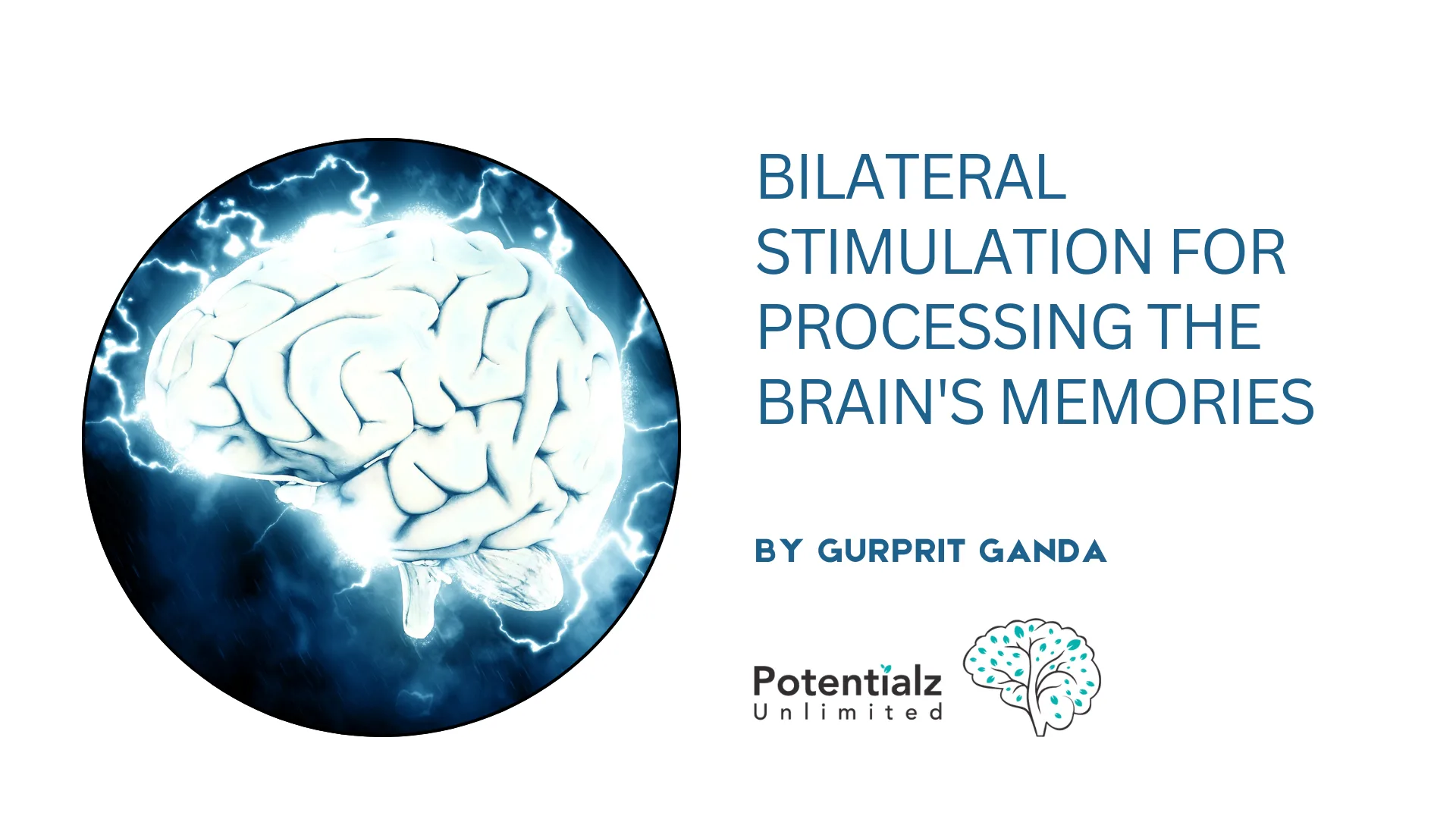
EMDR helps the brain finish the job it couldn’t finish at the time. You briefly bring the stuck memory to mind while following a bilateral stimulation — usually the therapist’s hand moving left and right, sometimes gentle taps or tones. In sets of a few seconds, you notice whatever comes up, then pause and check in. Over the session, the charge attached to the memory typically starts to settle. The memory doesn’t disappear — but it stops feeling like a live wire.
Crucially, you are wide awake the whole time. You know exactly where you are. You’re doing something psychologists call holding “dual attention” — one foot in the memory, one foot firmly in the safe, present-day room.
What Hypnosis Is
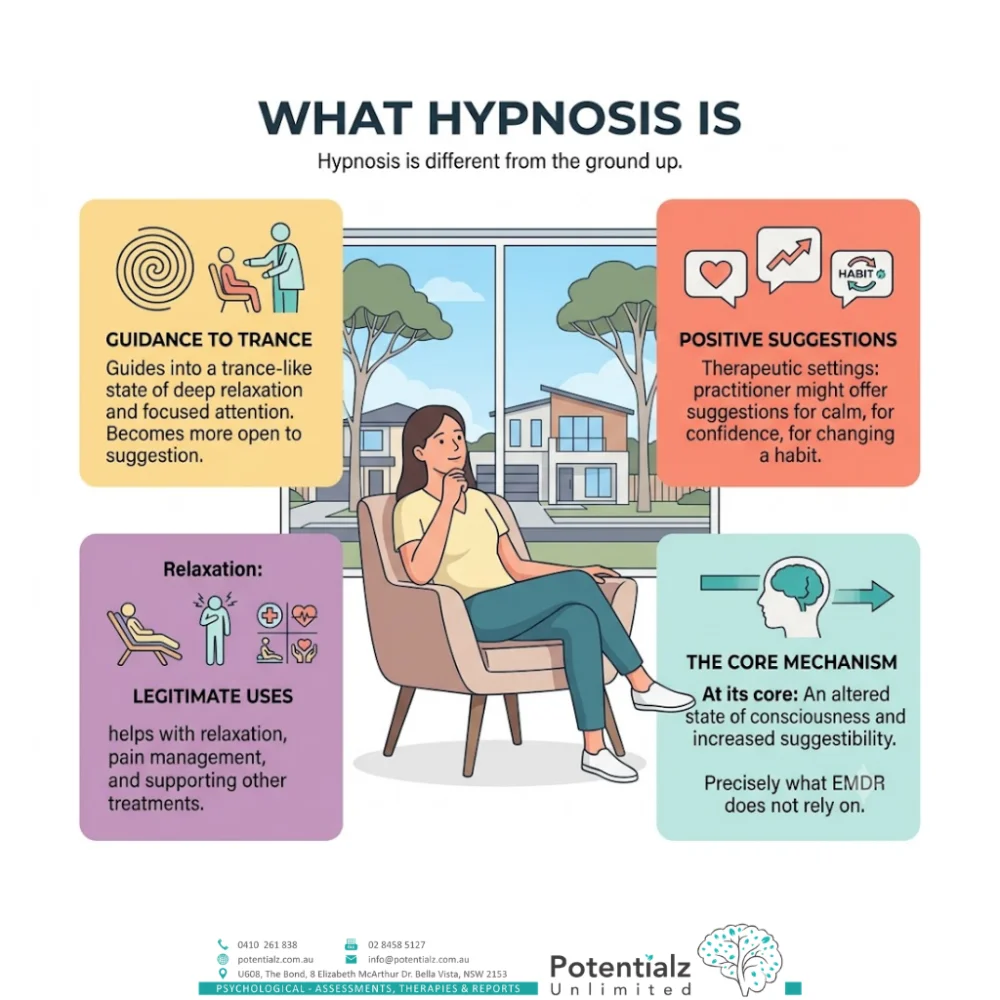
Hypnosis is different from the ground up. It works by guiding a person into a trance-like state of deep relaxation and focused attention, in which they become more open to suggestion. In a therapeutic setting, a practitioner might then offer positive suggestions — for calm, for confidence, for changing a habit.
Hypnosis has legitimate uses; it can help with relaxation, pain management, and supporting other treatments. But notice what’s at its core: an altered state of consciousness and increased suggestibility. That is precisely what EMDR does not rely on.
The Real Differences, Side by Side
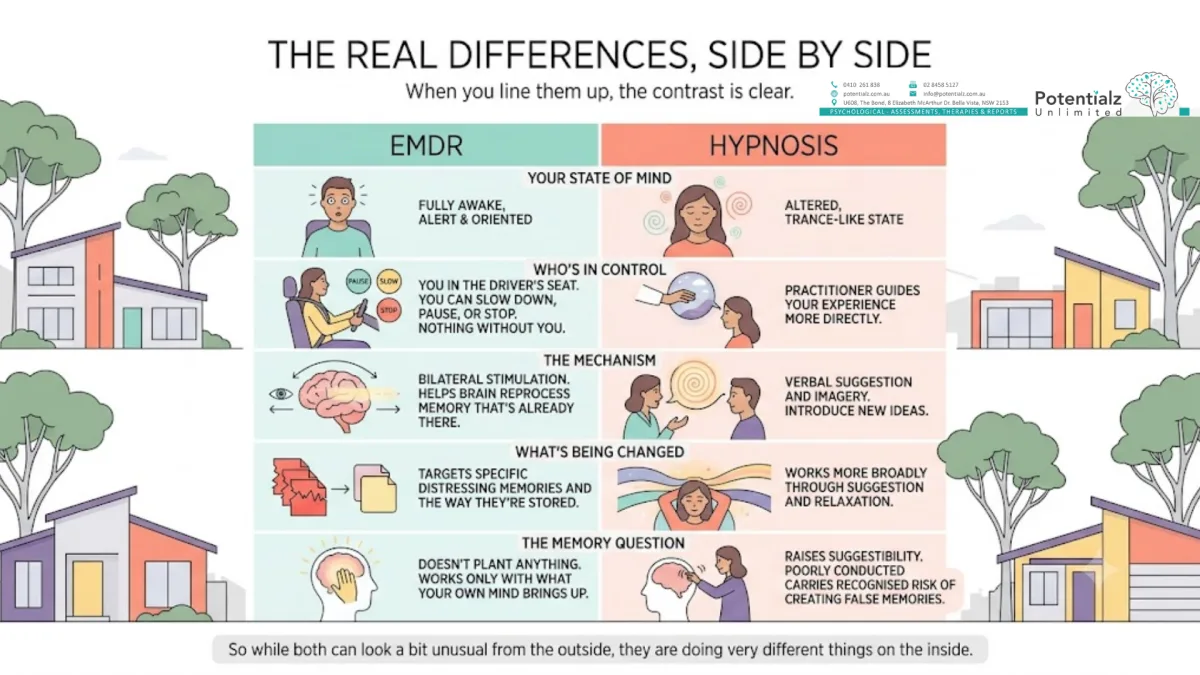
When you line them up, the contrast is clear.
Your state of mind. In EMDR you stay fully awake, alert and oriented. In hypnosis you enter an altered, trance-like state.
Who’s in control. In EMDR you are in the driver’s seat the entire time — you can slow down, pause, or stop, and nothing happens without you. In hypnosis the practitioner guides your experience more directly.
The mechanism. EMDR uses bilateral stimulation to help your brain reprocess a memory that’s already there. Hypnosis uses verbal suggestion and imagery to introduce new ideas.
What’s being changed. EMDR targets specific distressing memories and the way they’re stored. Hypnosis works more broadly through suggestion and relaxation.
The memory question. Because hypnosis raises suggestibility, poorly conducted hypnosis carries a recognised risk of creating false memories. EMDR doesn’t plant anything — it works only with what your own mind brings up.
So while both can look a bit unusual from the outside, they are doing very different things on the inside.
“But I Read That the Eye Movements Are Hypnotic…”
It’s an understandable mix-up — the rhythmic back-and-forth looks a little like the swinging-watch cliché of stage hypnosis. But the resemblance is only skin-deep. In EMDR the eye movements aren’t there to lull you into a trance; they’re thought to tax your working memory and engage both sides of the brain while you hold the memory in mind, which is what helps the reprocessing along. You stay sharp, not sleepy. Many people are actually surprised by how ordinary and grounded the process feels.
What the Eight Phases of EMDR Look Like
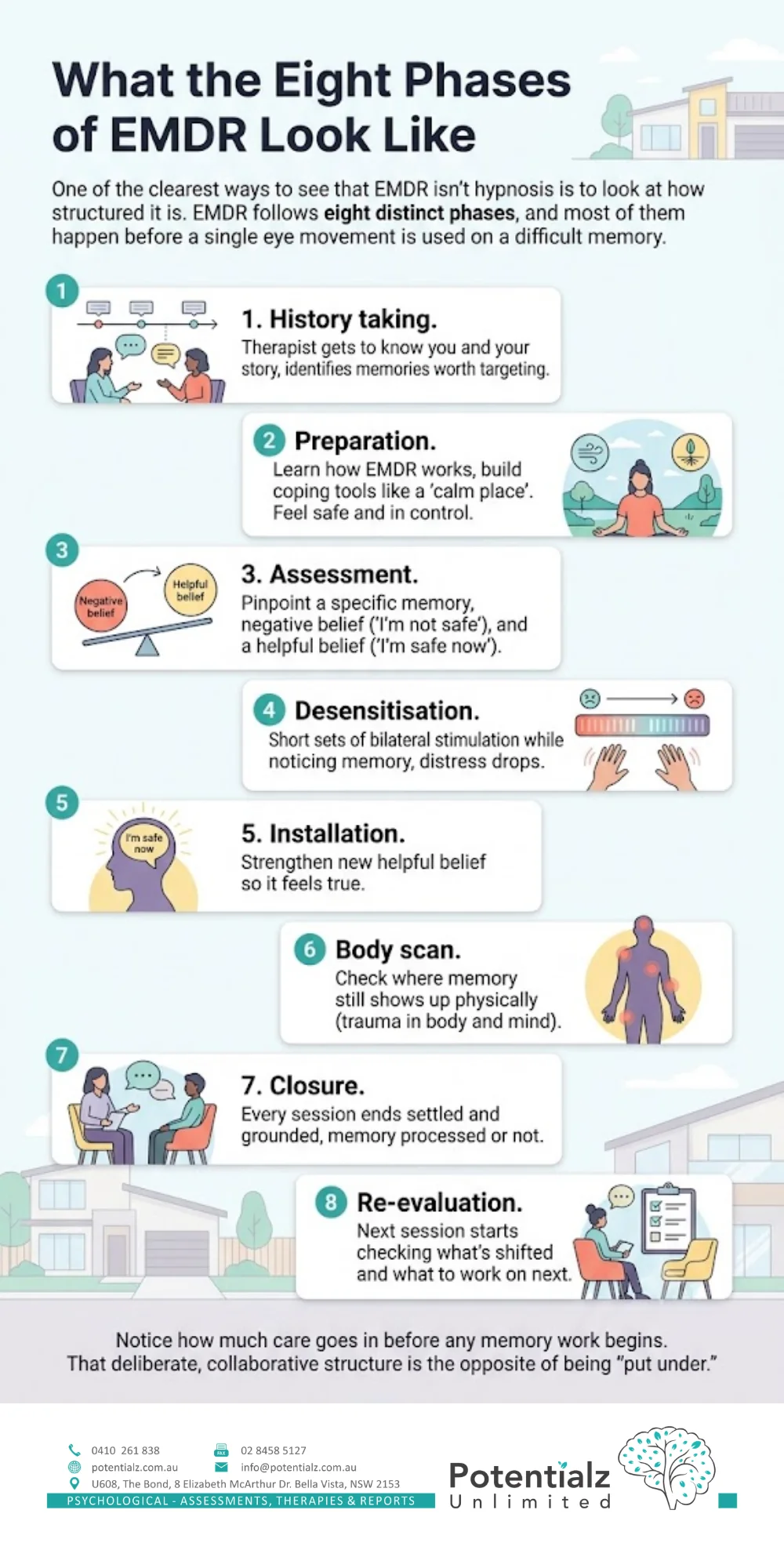
One of the clearest ways to see that EMDR isn’t hypnosis is to look at how structured it is. EMDR follows eight distinct phases, and most of them happen before a single eye movement is used on a difficult memory.
- History taking. Your therapist gets to know you and your story, and identifies which memories might be worth targeting. Nothing is rushed.
- Preparation. You learn how EMDR works and build practical coping tools — like a “calm place” you can return to. This phase is all about making sure you feel safe and in control.
- Assessment. Together you pinpoint a specific memory, the negative belief attached to it (“I’m not safe”), and a more helpful belief you’d prefer (“I’m safe now”).
- Desensitisation. This is the part people picture — short sets of bilateral stimulation while you notice the memory, until the distress attached to it drops.
- Installation. You strengthen the new, helpful belief so it feels true, not just logical.
- Body scan. You check where the memory still shows up physically, because trauma lives in the body as well as the mind.
- Closure. Every session ends with you settled and grounded, whether or not the memory is fully processed.
- Re-evaluation. The next session starts by checking what’s shifted and what to work on next.
Notice how much care goes in before any memory work begins. That deliberate, collaborative structure is the opposite of being “put under.”
Does EMDR Have the Evidence Behind It?
This is where EMDR stands on very solid ground. It isn’t a fringe technique — it’s one of the most researched trauma therapies in the world.
In Australia, the national PTSD guidelines — the Australian Guidelines for the Prevention and Treatment of Acute Stress Disorder, PTSD and Complex PTSD, developed by Phoenix Australia and approved by the National Health and Medical Research Council — recommend EMDR as a trauma-focused therapy for adults with PTSD (Phoenix Australia, 2021). The World Health Organization recommends it too (World Health Organization, 2013). Its research base for PTSD is broadly comparable to trauma-focused cognitive behavioural therapy.
Beyond PTSD, EMDR is increasingly used to help with other memory-linked difficulties, including some anxiety presentations and phobias. A trained EMDR therapist can help you work out whether it fits your situation.
What EMDR Feels Like — and Its Honest Limits
Because you stay awake and in control, EMDR can feel less strange than people expect. You’ll spend the early sessions preparing — understanding the process and building coping skills — before any memory is targeted, so you’re never thrown in the deep end.
It’s also fair to name the limits. EMDR can temporarily stir up distress as a memory is processed, which is exactly why a skilled therapist and good preparation matter. It isn’t the right first choice for every problem. And it works best inside a trusting therapeutic relationship, not as a quick trick. Done properly, though, many people find it gives relief where talking about a memory over and over hasn’t.
Getting EMDR Therapy in Bella Vista
If you’ve been carrying a memory that still feels raw — from an accident, a loss, a frightening event, or something further back — you don’t have to keep white-knuckling through it. Potentialz Unlimited is a psychology practice in Bella Vista, serving Norwest, Castle Hill, Baulkham Hills, Kellyville and Rouse Hill. Dr Gurprit Ganda is a Clinical Psychologist with more than 25 years of experience who uses EMDR for trauma and PTSD.
A good first step is simply a conversation. You can get in touch here, book at live.potentialz.com.au, or call 0410 261 838 to ask questions before you decide anything.
Related Reading
More from our blog:
- Understanding EMDR Therapy: A Comprehensive Guide to Healing Trauma
- EMDR: Answers to the Most Frequently Asked Questions
- Can EMDR Therapy Treat Anxiety? Exploring the Benefits and Effectiveness
Services that may help:
References
Phoenix Australia. (2021). Australian guidelines for the prevention and treatment of acute stress disorder, posttraumatic stress disorder and complex PTSD. Phoenix Australia — Centre for Posttraumatic Mental Health. https://www.phoenixaustralia.org/australian-guidelines-for-ptsd/
Shapiro, F. (2018). Eye movement desensitization and reprocessing (EMDR) therapy: Basic principles, protocols, and procedures (3rd ed.). Guilford Press.
World Health Organization. (2013). Guidelines for the management of conditions specifically related to stress. WHO. https://www.who.int/publications/i/item/9789241505406
Knowledge Check Quiz
Test what you have just read. Choose your answer for each question, then submit to reveal the answers and your score.
Need Professional Support?
If you're experiencing mental health concerns, our team is here to help.