When “Good Enough” Never Feels Good Enough
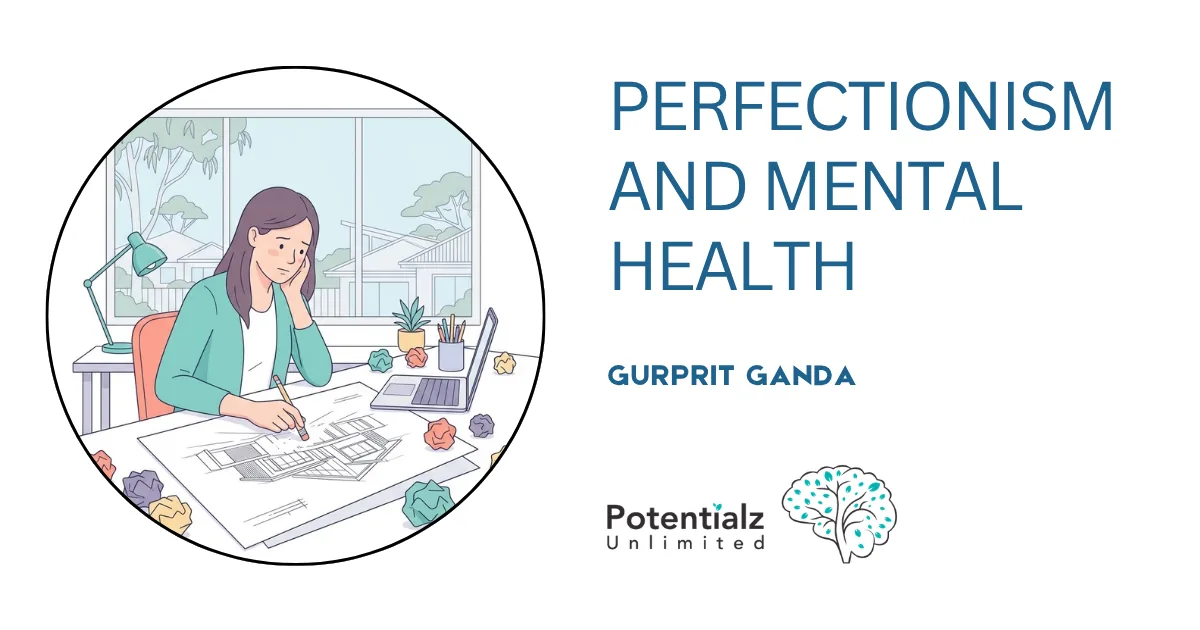
You check your email five times before sending it. You spend hours on a report that should take one. You apologise for things that are not your fault. You lie awake replaying a conversation, convinced you said the wrong thing. You set goals, achieve them, and immediately raise the bar — because the achievement never feels sufficient.
This is not excellence. This is perfectionism. And while our culture often celebrates it as a virtue, research increasingly shows that perfectionism is one of the most significant transdiagnostic risk factors for mental health difficulties.
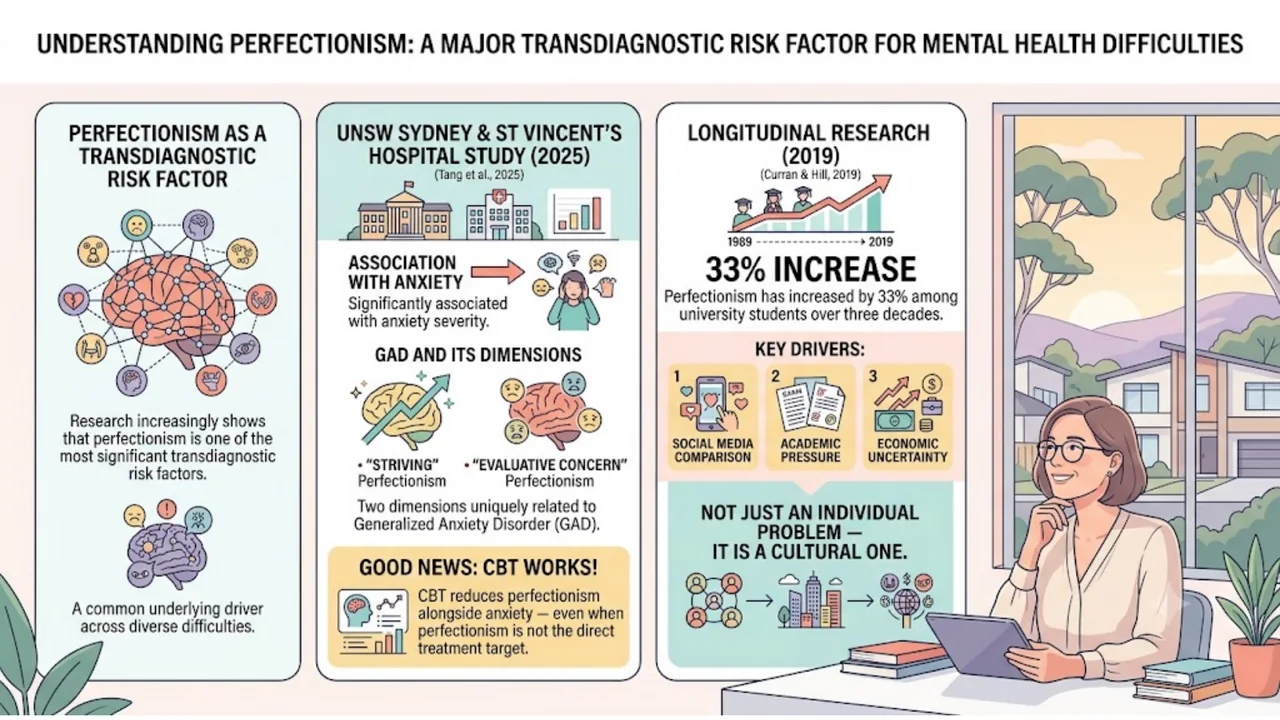
A 2025 study from UNSW Sydney and St Vincent’s Hospital found that perfectionism is significantly associated with anxiety severity, and that both “striving” and “evaluative concern” dimensions of perfectionism are uniquely related to generalised anxiety disorder (Tang et al., 2025). The good news from that same study: CBT reduces perfectionism alongside anxiety — even when perfectionism is not the direct treatment target.
Longitudinal research shows that perfectionism has increased by 33% over the past three decades among university students, driven by social media comparison, academic pressure, and economic uncertainty (Curran & Hill, 2019). It is not just an individual problem — it is a cultural one.
The Two Faces of Perfectionism
Research distinguishes between two dimensions of perfectionism. Perfectionistic strivings involve setting high personal standards and working hard to achieve them. In moderation, this can be adaptive — it drives excellence and achievement. Perfectionistic concerns involve excessive self-criticism, fear of making mistakes, doubts about your actions, and concern about others’ evaluation of you. This dimension is consistently linked to anxiety, depression, eating disorders, OCD, and burnout.
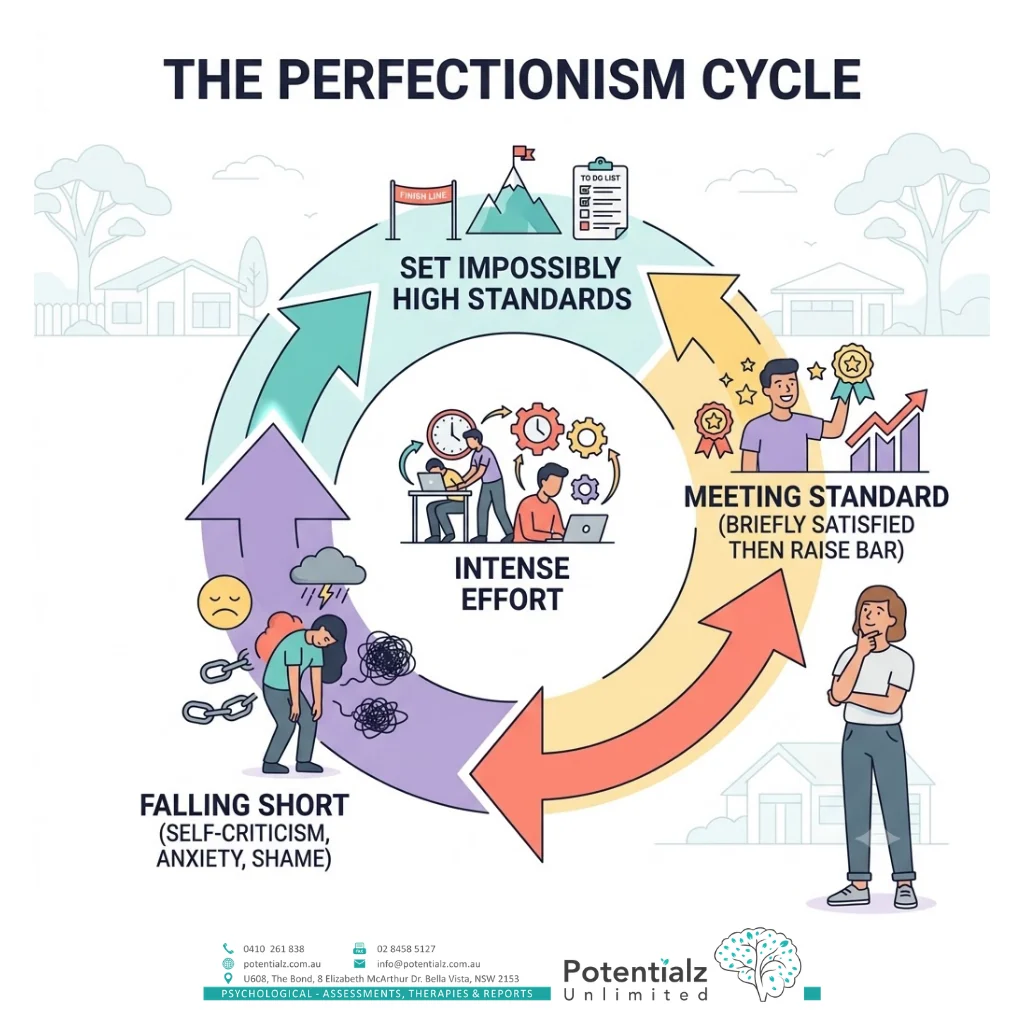
The problem is that these dimensions often co-exist. You set high standards (strivings) AND punish yourself ruthlessly when you fall short (concerns). The result is a relentless cycle: achieve, feel briefly satisfied, raise the bar, fail to meet the new bar, criticise yourself, feel anxious or depressed, try harder, repeat.
How Perfectionism Fuels Anxiety, Depression, and OCD
Perfectionism does not just accompany mental health difficulties — it actively drives them.
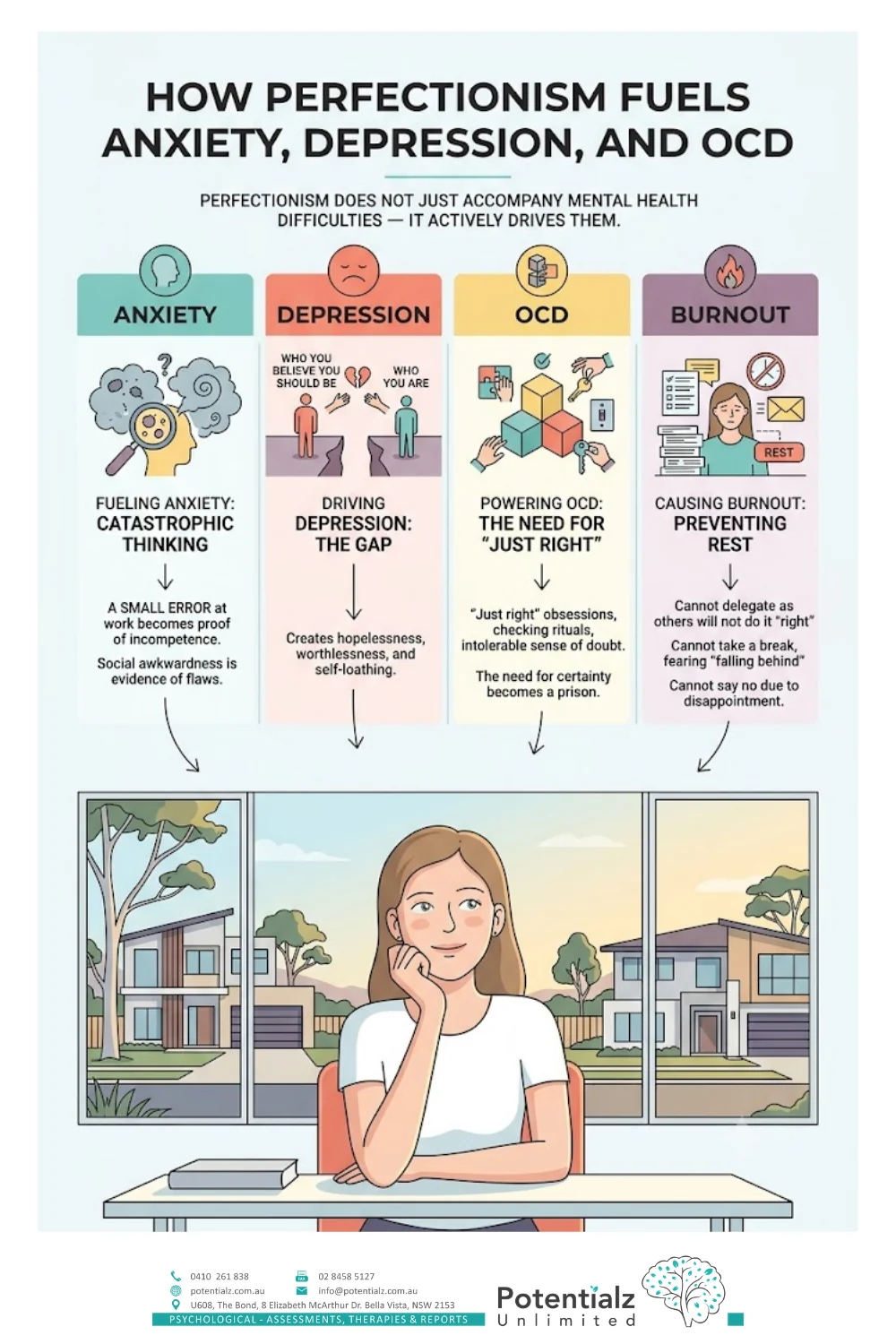
In anxiety, perfectionism creates catastrophic interpretations of mistakes. A small error at work becomes proof of incompetence. A social awkwardness becomes evidence of being fundamentally flawed. In depression, perfectionism creates a gap between who you are and who you believe you should be. This gap generates hopelessness, worthlessness, and self-loathing. In OCD, perfectionism drives “just right” obsessions, checking rituals, and the intolerable sense of doubt. The need for certainty and precision becomes a prison. In burnout, perfectionism prevents rest. You cannot delegate because others will not do it “right.” You cannot take a break because you will “fall behind.” You cannot say no because you might disappoint someone.
Research has identified perfectionism as a maintenance factor — meaning it keeps these conditions going even when other risk factors have resolved (Limburg et al., 2017). If this pattern sounds familiar, our guide to parental burnout and mental health explores one common way it shows up in everyday life.
Perfectionism in the Hills District — Cultural and Contextual Pressures
Families in the Hills District face particular perfectionism pressures. Academic achievement expectations, especially for children of migrant families. Professional success demands in competitive industries. Social comparison amplified by social media and community networks. Parenting pressure to raise “perfect” children. And the financial stress of maintaining a lifestyle in one of Sydney’s premium suburbs.
For multicultural families, perfectionism may be intertwined with cultural values around family honour, educational achievement, and social standing. These are not inherently unhealthy values — but when they become rigid, inflexible, and tied to self-worth, they can drive significant psychological distress. Where perfectionism tips into “just right” doubt and checking, it can overlap with conditions like relationship OCD.
Evidence-Based Treatment for Perfectionism
CBT for perfectionism is well-established and effective. A systematic review and meta-analysis by Lloyd et al. (2015) confirmed that CBT manages perfectionism with medium to large effect sizes and also reduces symptoms of anxiety and depression. Treatment includes identifying perfectionistic rules and assumptions (such as “if it is not perfect, it is a failure”), conducting behavioural experiments that test predictions (such as deliberately submitting “good enough” work and observing the actual consequences), challenging all-or-nothing thinking, building tolerance for uncertainty and imperfection, and developing self-compassion skills.
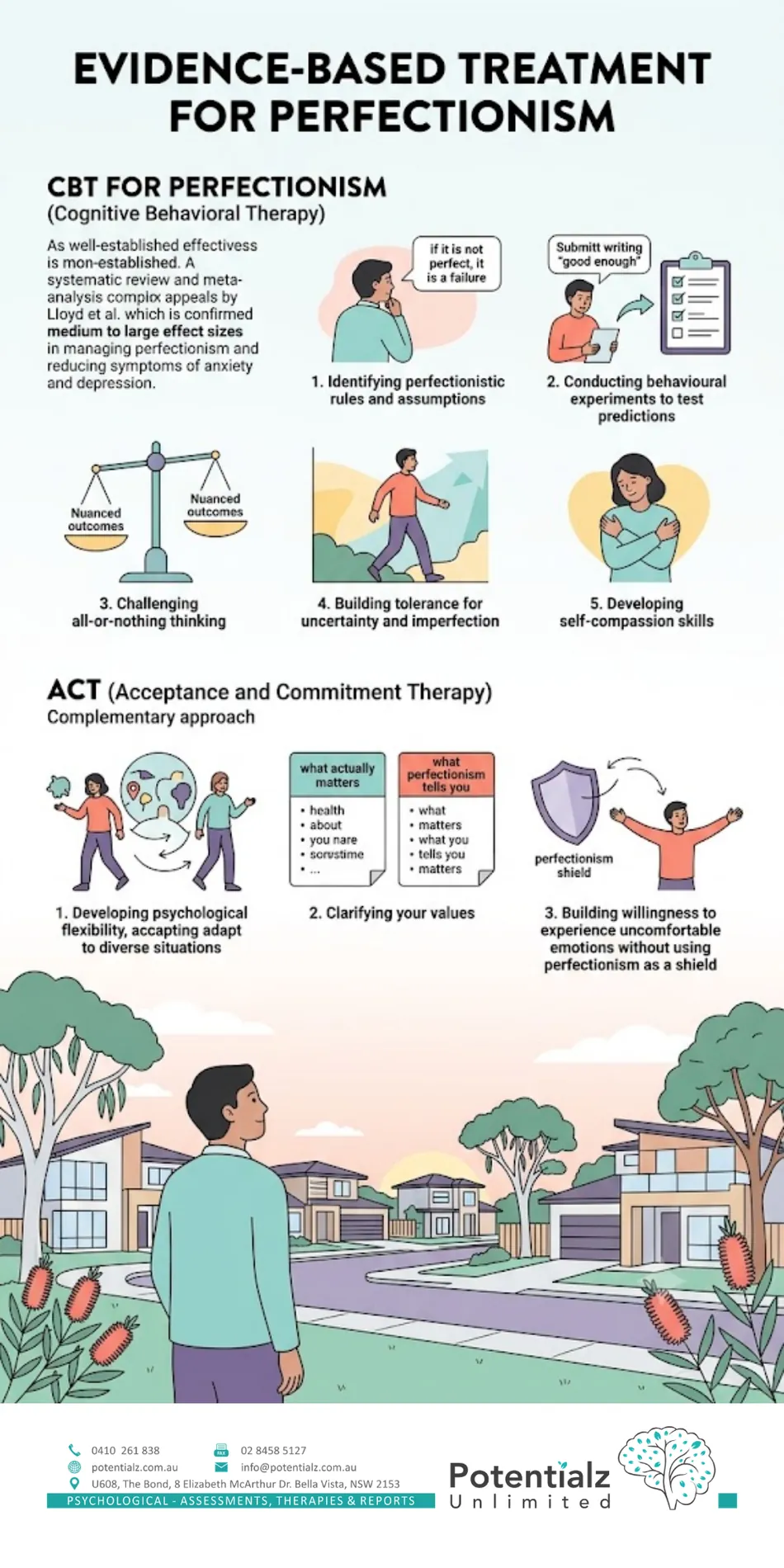
Acceptance and Commitment Therapy (ACT) offers a complementary approach, helping you develop psychological flexibility, clarify your values (what actually matters versus what perfectionism tells you matters), and build willingness to experience uncomfortable emotions without using perfectionism as a shield. You can read more about the evidence-based therapies we offer.
At Potentialz Unlimited in Bella Vista, Dr Gurprit Ganda provides therapy that directly addresses perfectionistic patterns within the context of anxiety, depression, OCD, or burnout.
When to Seek Help for Perfectionism
Consider seeking support if your standards are causing you more distress than satisfaction. If you procrastinate because the fear of doing something imperfectly stops you from starting. If you are physically exhausted from the effort of maintaining your standards. If your relationships suffer because you apply your standards to others. If you recognise that your self-worth is entirely tied to your achievements. Or if you suspect perfectionism is driving anxiety, depression, OCD, or burnout.
At Potentialz Unlimited, we are located at Unit 608/8 Elizabeth Macarthur Drive, Bella Vista, NSW 2153. Book a consultation — call 0410 261 838 or visit live.potentialz.com.au. Telehealth is available across NSW.
References
Curran, T., & Hill, A. P. (2019). Perfectionism is increasing over time: A meta-analysis of birth cohort differences from 1989 to 2016. Psychological Bulletin, 145(4), 410–429. https://doi.org/10.1037/bul0000138
Limburg, K., Watson, H. J., Hagger, M. S., & Egan, S. J. (2017). The relationship between perfectionism and psychopathology: A meta-analysis. Journal of Clinical Psychology, 73(10), 1301–1326. https://doi.org/10.1002/jclp.22435
Lloyd, S., Schmidt, U., Khondoker, M., & Tchanturia, K. (2015). Can psychological interventions reduce perfectionism? A systematic review and meta-analysis. Behavioural and Cognitive Psychotherapy, 43(6), 705–731. https://doi.org/10.1017/S1352465814000162
Tang, S., Mahoney, A., Dobinson, K., & Shiner, C. T. (2025). The relationship between perfectionism and treatment outcomes among people receiving internet-based CBT for GAD. Cognitive Behaviour Therapy, 54(3), 1–15. https://doi.org/10.1080/16506073.2025.2465737
Crisis and Support Resources
If perfectionism is tied to depression or thoughts of self-harm, please reach out — support is available 24/7.
- Lifeline: 13 11 14 (24/7)
- Beyond Blue: 1300 22 4636
- Kids Helpline: 1800 55 1800
- Emergency: 000
Dr. Gurprit Ganda is a Clinical Psychologist (AHPRA) with over 25 years of experience and a member of the Australian Psychological Society and the College of Clinical Psychologists. Potentialz Unlimited, Unit 608/8 Elizabeth Macarthur Drive, Bella Vista NSW 2153. Phone: 0410 261 838. This article is general educational information and is not a substitute for individual psychological assessment or treatment.
Related Reading
Knowledge Check Quiz
Test what you have just read. Choose your answer for each question, then submit to reveal the answers and your score.
Need Professional Support?
If you're experiencing mental health concerns, our team is here to help.