Key Takeaways
- “Play therapist” and “child psychologist” are two different roles. They overlap in who they help, but they are not interchangeable — and the fit for your child depends on age, presentation, and what you actually want to change.
- A play therapist works primarily through the language of play. At Potentialz Unlimited, the practice’s play therapist has a training background that includes Play Therapy International (PTUK/PTSA), Synergetic Play Therapy, LEGO-Based Therapy, and Parent-Child Attachment Play. That is a rich, developmentally-informed toolkit for children whose feelings are too big for words yet.
- A child psychologist works primarily through psychological assessment and structured therapy (CBT, ACT, emotion coaching, behavioural work), usually with children who can already put some of their inner experience into language. At Potentialz, our Registered Psychologist team sees children from age 8 upwards.
- A useful (imperfect) rule of thumb: children under 8 often do best with play therapy first; from around 8 onwards, psychology becomes a stronger option — but it depends on presentation, not birthday.
- Expressive, verbal children often do well with a child psychologist. Children who cannot yet put big feelings into words, or who have experienced developmental trauma, are often better served by play therapy — sometimes with both clinicians in tandem.
- The Potentialz advantage: our play therapist and Registered Psychologist team can (and do) work together on the same family when it’s clinically indicated. Play therapy for the child, psychology for the older sibling, parent coaching alongside — under one roof.
- Cost, session length, frequency, NDIS pathways, and rebate arrangements differ between the two roles. Please check with reception about current rebate arrangements when you book — accurate information beats a marketing claim.
- If you’re genuinely unsure which is right, you can book a free 15-minute triage phone chat with reception, and we’ll help you land on the right clinician (or the right pair of clinicians) for your child.
Why This Question Confuses So Many Parents
If you have an 8-year-old struggling — with big feelings, school worry, a hard year at home, a diagnosis in the mix, or just something you can’t quite put your finger on — one of the first questions parents ask the practice is:
“Do we need a play therapist, or a child psychologist? What’s the actual difference?”
It’s a really fair question. From the outside these two roles can look very similar. Both work with children. Both often have soft, warm rooms filled with toys, sand trays, art supplies, and books. Both are trying to help your child feel better and function better. Both take referrals, write reports, and speak to schools when needed. The websites can sound almost interchangeable.
But under the hood, they are two quite different professional pathways, with different training, different regulatory frameworks, different tools, and different ideas about what change looks like for a child. Neither is “better” than the other. They are different fits for different children — and often, for different moments in the same child’s life.
This post walks you through:
- What a play therapist actually does — and specifically what the practice’s play therapist does at Potentialz Unlimited in Bella Vista
- What a child psychologist does with an 8+ year old — and what a session with our Registered Psychologist team looks like at Potentialz
- How to think about age and presentation together, rather than just “how old is my child”
- What a first session for each looks like
- When you want both
- How the practical bits — cost, session length, NDIS, rebates — compare
- A short three-question decision framework you can use at the kitchen table
This is a Potentialz Unlimited editorial piece drawing on our clinical team’s experience. It is not a comparison piece designed to sell one clinician over another; it’s a triage piece. Sometimes the right answer is the play therapist. Sometimes it’s the Registered Psychologist team. Sometimes it’s both. And sometimes it’s someone else in the practice entirely.
What a Play Therapist Actually Does
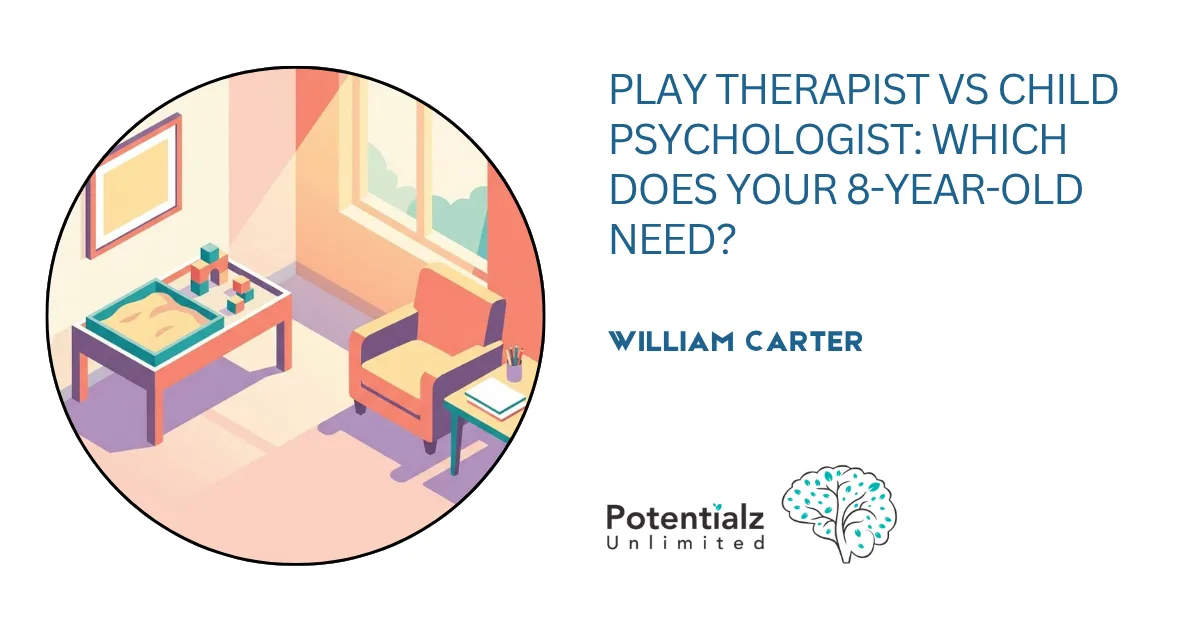
Play therapy is a specific therapeutic approach — not just “therapy that happens to involve toys.” It rests on a fairly beautiful premise: for children, play is the natural language of feelings. Long before a child can articulate “I’m anxious about starting Year 3” or “I feel unsafe when Dad shouts”, they can show you those feelings in the way they arrange the animals in the sand tray, in the story they build with the LEGO figures, in the repeated scenarios they act out with the dolls.
A trained play therapist is trained to attend to that language — closely, respectfully, without rushing to interpret it — and to work therapeutically inside it.
At Potentialz Unlimited, the practice’s play therapist has a genuinely rich training background. It includes:
- PTUK / PTSA (Play Therapy UK and Play Therapy South Africa) accredited training. These are internationally recognised play therapy accreditation bodies with clear clinical standards. This is the play therapist’s core professional pathway.
- Synergetic Play Therapy. A neuroscience-informed model developed by Lisa Dion that integrates attachment theory, interpersonal neurobiology, and mindfulness. It’s especially thoughtful about the therapist’s own regulation in the room as a support to the child’s regulation.
- LEGO-Based Therapy. A structured, evidence-supported model developed originally by Dr Daniel LeGoff for children on the autism spectrum, that uses collaborative LEGO building to develop social communication, joint attention, and cooperation skills. It’s beloved by many autistic and neurodivergent children — the structure of it is often soothing rather than pressuring.
- Parent-Child Attachment Play. A model that brings parents directly into the play work, coaching them in specific attunement, co-regulation, and connection practices that strengthen the attachment relationship. This is particularly powerful for families rebuilding after disruption, illness, separation, or early adversity.
What that means practically is that the play therapist has multiple ways in for a child who cannot, or should not have to, sit and talk about their feelings for 50 minutes. A child who is quiet, wary, wordless, big-feelinged, or simply young can enter therapy through the door that fits them — sand, figures, art, LEGO, structured connection games with a parent — rather than being asked to enter through the door of language they don’t yet have.
The play therapist works with the child, works with the parent-child relationship, and often works with parents in their own coaching sessions alongside the child’s work. Play therapy at its best is not a magic room where the child is “fixed” and returned to the family — it is a slow, careful strengthening of the child’s regulation, expressiveness, and relational safety, held inside the wider family system.
Across the practice, there is huge professional respect for play therapy work. It reaches children who cannot be reached as effectively with psychology alone, and it does things psychology training does not cover.
What a Child Psychologist Does With an 8+ Year Old
Here is the psychology side of it, honestly.
Our Registered Psychologist team members are registered with AHPRA. The clinical team at Potentialz brings experience across children and adolescent psychology, including school-focused assessment work, community and cultural-support contexts, and interdisciplinary child mental-health settings. At Potentialz Unlimited, the Registered Psychologist team sees children from age 8 and up, adolescents, young adults, and older adults.
The core tools the Registered Psychologist team brings to a child of 8 and above are:
- Cognitive Behavioural Therapy (CBT), age-adapted. With children, this doesn’t look like the classic thought-record CBT you might picture from adult therapy. It looks like helping a child externalise a worry — sometimes literally drawing “the Worry” as a character and figuring out what it is trying to keep them safe from. It looks like behavioural experiments graded to a child’s world (climbing the ladder from asking one question in class, to putting a hand up, to reading aloud). It looks like emotion literacy work — naming feelings, sizing them, noticing where they live in the body.
- Acceptance and Commitment Therapy (ACT), age-adapted. With kids this is often about values (“what kind of friend do you want to be? what kind of student?”) and about noticing thoughts as thoughts (“that’s your brain doing its worry thing again — thanks brain, I see you”). Steven Hayes’ team have developed lovely age-appropriate metaphors for children.
- Emotion coaching, particularly with parents. Evidence-based emotion coaching sits alongside the psychology training. A lot of what helps an 8-year-old is what the adults around the 8-year-old learn to do differently in the four or five hardest moments of their week.
- Psychological assessment. The team’s cognitive-assessment experience spans WISC, WPPSI, WNV, BASC, Vineland, and ABAS — cognitive, adaptive, and behavioural assessments used to understand how a child is learning, coping, and functioning. At Potentialz specifically, formal cognitive assessment work is coordinated through our senior Clinical Psychologist; the Registered Psychologist team’s role at Potentialz is therapy and formulation rather than assessment reports.
- Structured therapy for the common things that arrive in the 8+ age bracket. Anxiety. School refusal or reluctance. Low mood. ADHD-related difficulties (both the child’s and the family’s response to them). Autism-related regulation and social work. Bullying. Adjustment after divorce, loss, or a difficult year. Sleep. Screens. Sibling stuff. Grief.
Sessions with the Registered Psychologist team look, to a child, mostly like a conversation — with some drawing, some worksheets, some games, some movement, and a lot of parent-inclusive work where appropriate. It’s not talking heads. But it does lean more on language than a play therapy session does, and it typically expects the child to be able to sustain a fair bit of reflective conversation with an adult they don’t know yet.
Age: The Useful (But Not Absolute) Rule of Thumb
Here’s the rule the practice offers, with the disclaimer that it is a rule of thumb, not a diagnostic algorithm.
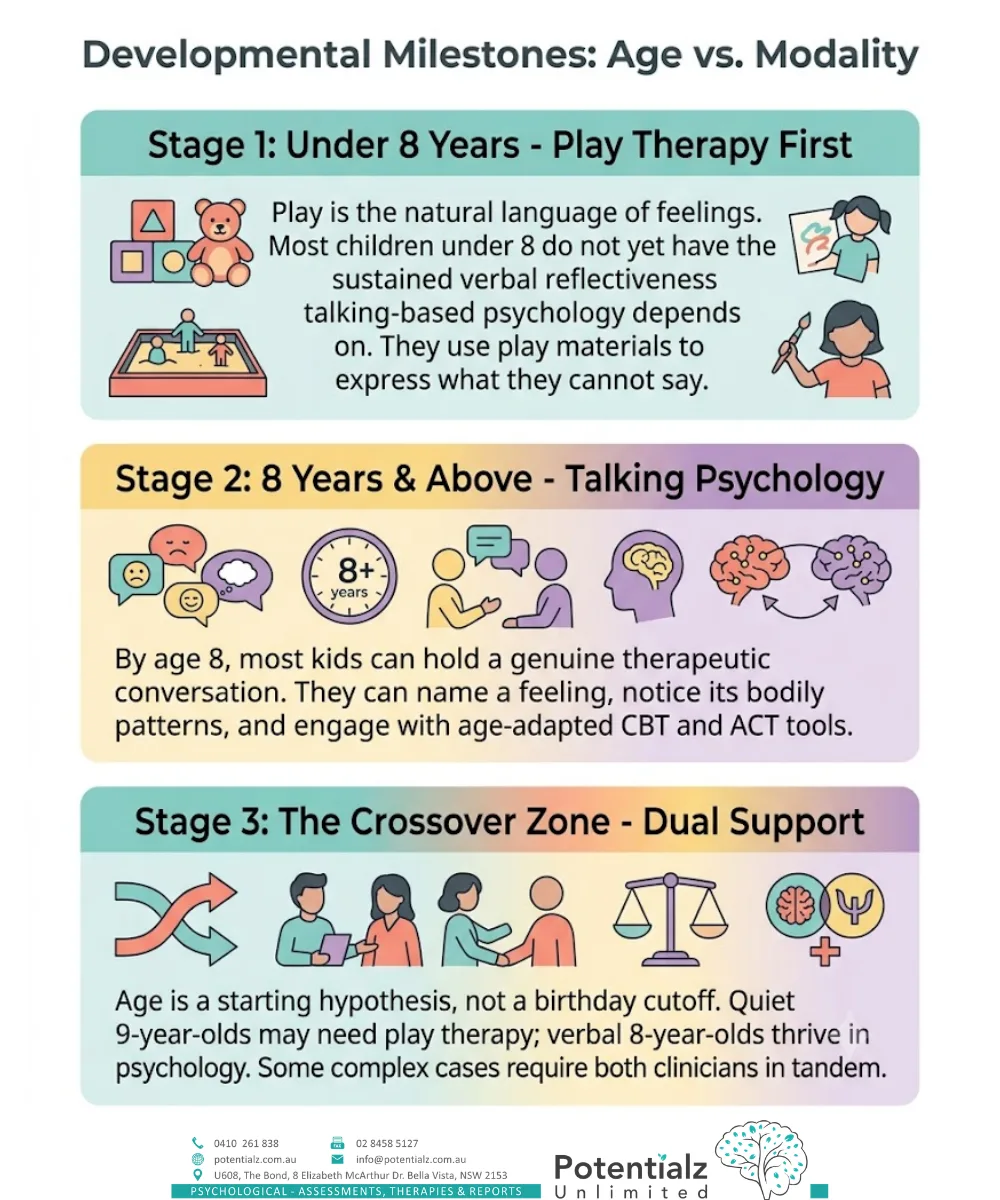
Under 8 — play therapy is usually the first fit. Most children under 8 don’t yet have the sustained verbal reflectiveness that talking-based psychology depends on. Their inner lives are enormous, but the road from feeling to word is still being built. Play therapy meets them on the road they already have. At Potentialz, if your child is under 8, the honest first suggestion is almost always to speak with the practice’s play therapist. That developmental range is her professional home.
8 and above — psychology becomes a stronger option. By around 8, most children can start to hold a genuine therapeutic conversation. They can name a feeling, size it, notice when it comes, and try a small experiment between sessions. They can use age-adapted CBT and ACT tools. They can be emotion-coached in a way that lands. This is roughly the developmental gate at which the Registered Psychologist team begins seeing children at Potentialz.
But — this is not a birthday cutoff. An 8-year-old who is a highly verbal, reflective, slightly-old-for-their-age kid may be a great fit for psychology. Another 8-year-old — quieter, still finding words for feelings, or with a developmental profile that makes verbal therapy hard — may still be a better fit for play. A 10-year-old newly working through significant early trauma may need play therapy alongside (or before) any structured psychology. A 6-year-old with a family in crisis may benefit from parent-focused work with the Registered Psychologist team while the play therapist does play work with the child. Age is a starting hypothesis, not a verdict.
Presentation: The Deeper Question
Age tells you where the child probably is developmentally. Presentation tells you what they actually need. Presentation almost always trumps age.
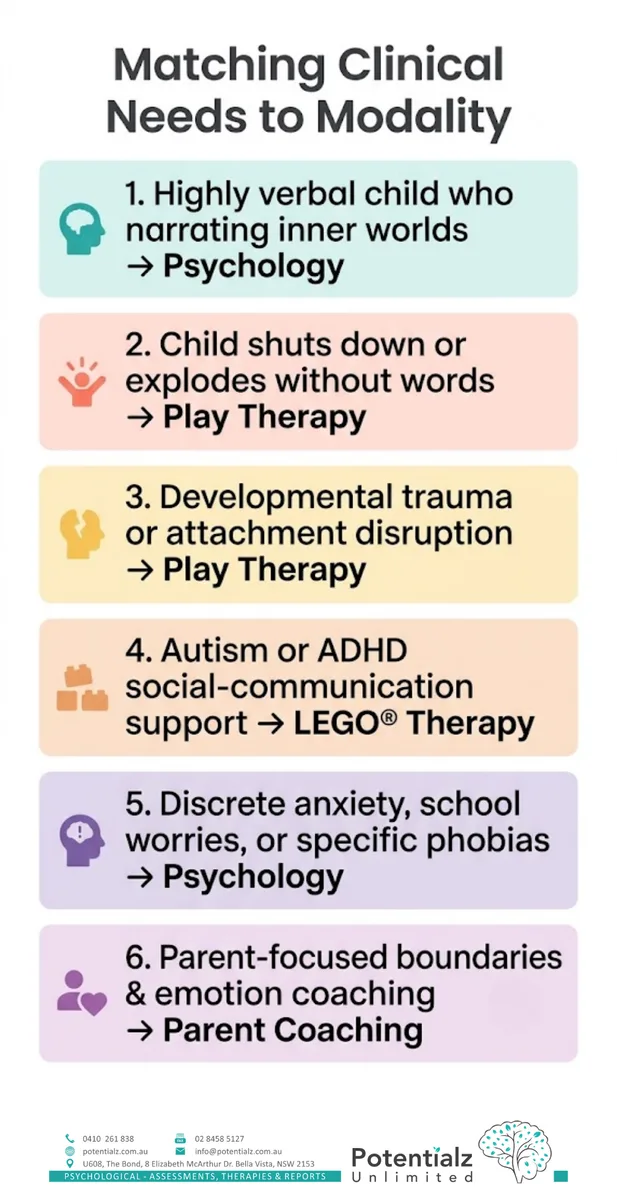
Here are the presentation-based patterns the practice has come to trust.
Highly expressive, language-heavy child. A child who is already narrating their inner world, asking big questions, and articulate about worry or sadness will often thrive in psychology. Talking works for them because talking is already how they think. This kind of child — even at 8 — can often meaningfully engage with CBT concepts like “brain tricks” and ACT concepts like “unhooking from a thought.” Psychology is a strong fit.
Child who can’t yet put big feelings into words. A child who shuts down when asked “how did that feel?”, who explodes without being able to explain why, who has an obvious inner life but no reliable bridge to language for it — this child is usually better served by play therapy. Pushing them into more talking therapy is often experienced as another place where they can’t do what the adult wants. Play meets them where they are.
Developmental trauma or attachment disruption. Where a child has experienced early adversity — significant illness, hospital stays, family violence, loss of a caregiver, adoption or out-of-home care, multiple moves, or chronic stress in early life — the felt sense of safety in the room comes before anything else. Play therapy models like Synergetic Play, and attachment-based models like Parent-Child Attachment Play, are often the more clinically appropriate first pathway. In these cases the practice’s play therapist is frequently the primary clinician, with the Registered Psychologist team involved as a secondary support around specific issues (e.g. anxiety symptoms at school), or not involved at all. When both are involved, they collaborate closely.
Neurodivergent children (autism, ADHD, sensory profiles). This is where the answer really is “depends.” Some autistic children thrive in structured LEGO-Based Therapy and would find sit-down psychology quite hard. Others love the predictability, structure, and directness of a psychology session and hate the ambiguity of open play. Same with ADHD kids. This is often a conversation on the phone with reception first, followed by trialling one clinician and being genuinely willing to switch if it’s not the right fit.
Discrete, well-defined, “psychology-shaped” concerns in a verbal 8+ child. School-related anxiety, sleep problems, worries and fears, low mood, response-to-diagnosis work, mild-to-moderate OCD, specific phobias, emotion regulation coaching. These are the kinds of presentations that fit psychology well and where the team would expect to see meaningful movement in 6–12 sessions of age-adapted CBT/ACT with parent involvement.
What Happens in a First Session
Because how the first session actually feels is often what determines whether a child returns, here is an honest description of both.
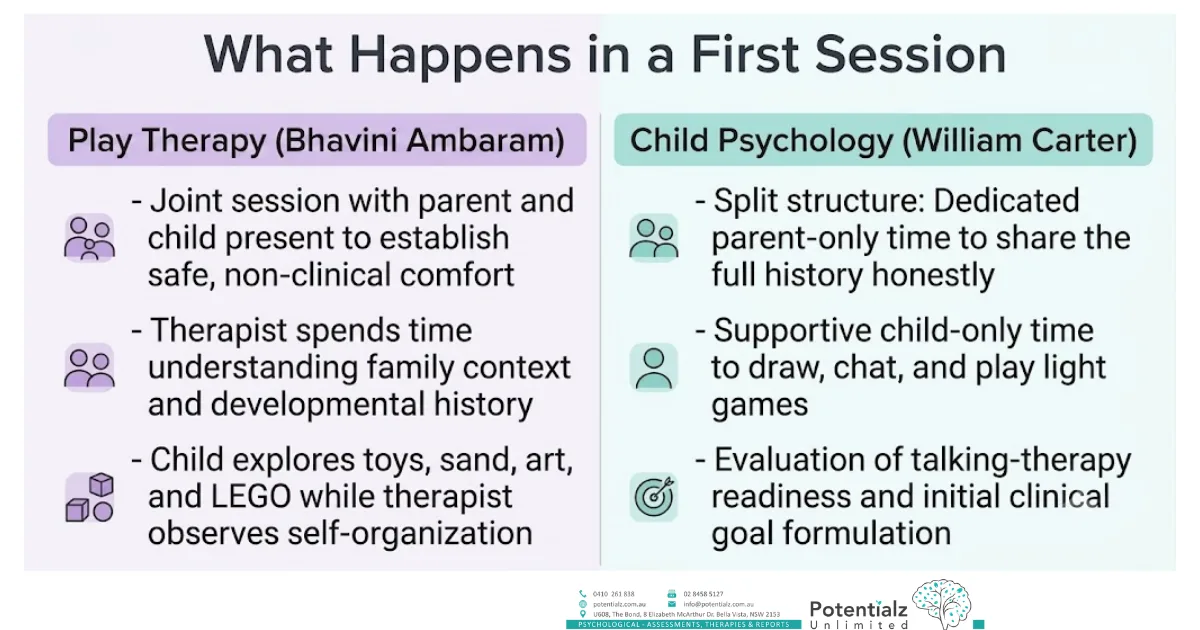
A first session with the play therapist
The first session is often a joint session — parent and child together — with a strong focus on the child feeling safe and the parent feeling met. The play therapist will typically spend real time with the parent understanding the child’s world, the presenting concern, the family context, developmental history, and what is being hoped for. She’ll usually spend some time with the child in the therapy space — showing them around, letting them get a feel for the toys, sand, art materials, LEGO — and quietly observing how the child moves through that space. She’s not looking for the child to “perform” therapy. She’s looking to see how this child organises themselves in a new environment with a new adult.
Depending on age and presentation, subsequent sessions may be child-alone, parent-child together, or parent-only. The rhythm is decided clinically and collaboratively. The play therapist is very clear with parents about what she’s noticing and where the work is going, without ever breaching the child’s therapeutic trust.
A first session with the Registered Psychologist team (child psychology, age 8+)
The Registered Psychologist team usually spends the first session mostly with parents and the child together — with a good chunk of it just the parents, so the clinician can hear the full story without the child sitting through a difficult adult conversation. Then some direct time with the child, at their pace. That might be drawing, chatting about school, playing a light game while talking, or working through a very simple “what would you like to be different?” conversation.
The clinician is looking at three things: how ready this child is for a talking-based therapy, what the presenting concern actually is (which is often subtly different from what the parents describe), and whether this is the right clinician for the job. If it isn’t, they’ll say so — usually recommending either the practice’s play therapist for play work, our senior Clinical Psychologist for formal cognitive assessment, or an external referral if the family needs something outside the practice.
From session 2 onwards, the shape depends on the child. It usually involves a mix of direct work with the child, parent-only coaching sessions every few weeks, and occasional joint sessions.
When You Want Both — The Potentialz Advantage
One of the honest advantages of Potentialz Unlimited being a multi-clinician practice is that the play therapist and the Registered Psychologist team can (and do) work together on the same family when it’s clinically indicated.
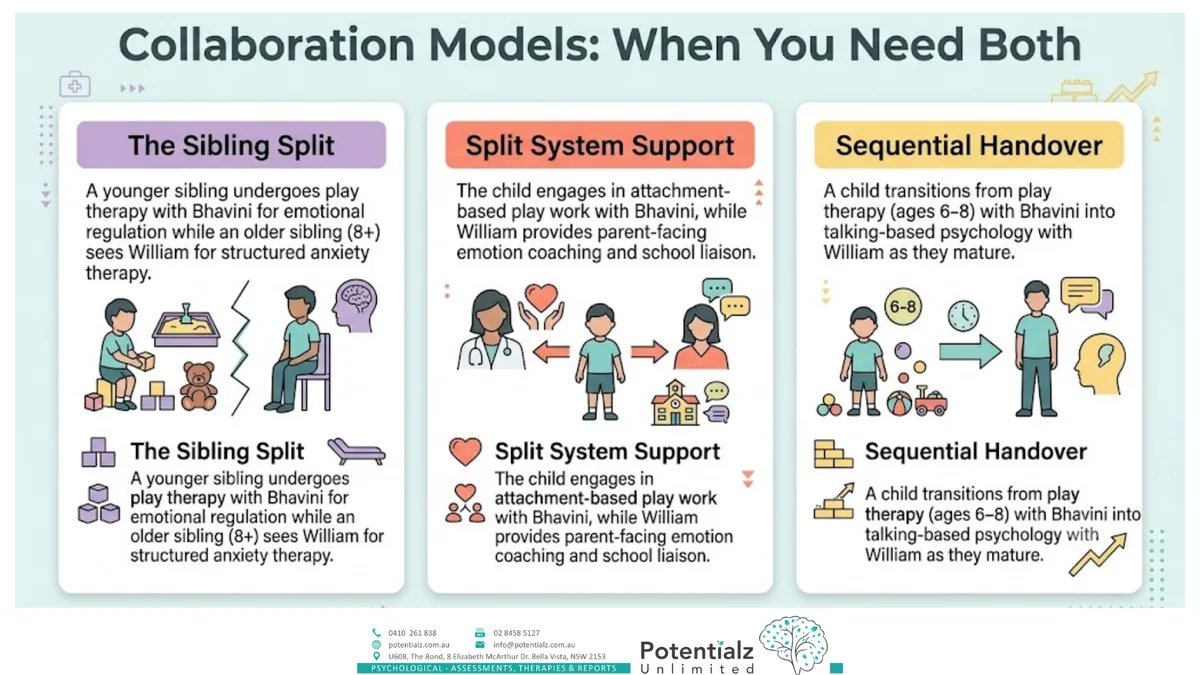
Some examples of what that looks like in practice.
A younger sibling in play therapy while an older sibling (8+) sees the Registered Psychologist team for anxiety. Two children in the same family, at different developmental stages, needing different modalities. The parents get one point of contact for both, and the two clinicians can talk to each other about the family system.
A single child, split work. Sometimes a child (often 7–9, right at the developmental cusp) does best with play therapy for the deeper regulation/attachment work, while the Registered Psychologist team runs alongside as a parent-coaching resource — emotion coaching, behavioural strategies, school liaison. The child has one primary therapist (the play therapist), and the Registered Psychologist team holds the adult-facing scaffolding around the work.
Sequential handover. A child in play therapy from age 6 to 8, transitioning as they mature into psychology work with the Registered Psychologist team for the anxiety piece that is still lingering. Same family, warm handover, no starting from scratch.
Complex developmental trauma with dual involvement. Where a child has experienced significant early adversity and now, at 8 or 9, is presenting with a mix of attachment-driven behaviour and psychology-treatable symptoms (like specific phobias, or ADHD-related struggles at school). The play therapist leads the trauma-informed play and attachment work. The Registered Psychologist team holds specific symptom-focused pieces. They consult regularly. The family is not shuttled between two disconnected clinicians.
This kind of collaboration is genuinely hard to arrange between independent solo practices. Inside Potentialz, it’s the norm — the clinicians share the same building, share notes appropriately, and have built the professional relationships to make it work smoothly.
Cost, Session Length, and Frequency — A Practical Comparison
This section is practical rather than promotional, and current information is best obtained from reception rather than an approximate number in a blog post. Here is what can be said honestly.
Session length. Both play therapy and child psychology sessions at Potentialz typically run 50 minutes. Some play therapy family sessions run longer by arrangement, particularly early on.
Frequency. Both usually run weekly at the start, moving to fortnightly and then monthly as things stabilise. Play therapy is often a slightly longer piece of work (particularly for developmental trauma), where the relational depth is part of the treatment. Structured psychology work for a well-defined presentation can sometimes complete in 6–12 sessions.
Fees and rebate arrangements. Fees for play therapy and for psychology are set differently, and rebate pathways differ between the two roles. Please check current fees and rebate arrangements with reception when you book — accurate, up-to-date information from the practice beats a stale figure in a blog. In particular, Medicare (Mental Health Care Plan) rebate status for the Registered Psychologist team at Potentialz is currently to be confirmed with reception; NDIS (self- and plan-managed) referrals are fine to talk about at the point of booking. The play therapist has her own arrangements which reception can walk you through.
NDIS. Both play therapy and child psychology can be funded under NDIS for eligible participants, typically under improved daily living or capacity building supports, depending on plan wording. Self-managed and plan-managed participants are usually easier to book; NDIA-managed participants may have more constraints. Reception can walk you through the specifics for each service separately.
“Check with reception” is not a satisfying blog answer. It is, however, the honest one — because rebate arrangements shift, and no one should book an appointment based on outdated information.
A Three-Question Decision Framework
If you’re stuck at the kitchen table trying to decide, these three questions will get you close to the right answer more often than not.
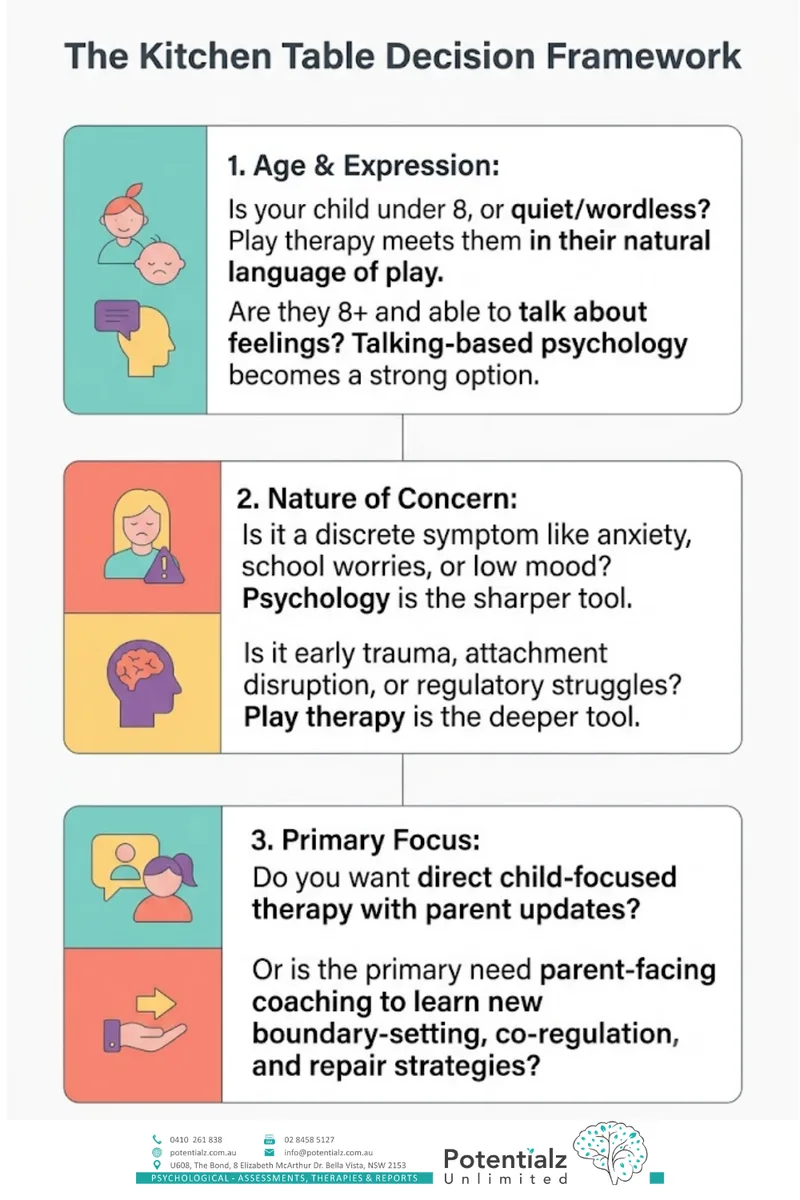
1. How old is your child, and how verbal are they about feelings?
Under 8, or a quieter, less verbally reflective child: lean towards play therapy — call reception about the play therapist.
8 or older, and generally able to talk about feelings when asked: lean towards psychology — book with the Registered Psychologist team.
2. Is there a specific, well-defined psychological concern, or a broader relational / regulatory / developmental picture?
Specific, well-defined: anxiety, school worries, low mood, ADHD-related difficulties, response to a diagnosis, a discrete phobia. Psychology is often the sharper tool here.
Broader picture: developmental trauma, attachment disruption, big-feeling regulation without a clear “diagnosis” shape, family-system pieces, early adversity. Play therapy is often the deeper tool here.
3. Do you want your child, or you-as-parent, to be the primary focus of the work?
If the primary work is with the child and you want to be looped in as a supporter: either play therapy or psychology can shape around this.
If the primary work is you learning to respond differently — emotion coaching, boundary-setting, co-regulation, repair after ruptures — say so at the point of booking. Both the play therapist and the Registered Psychologist team do parent-facing work; the shape of it is a bit different in each case, and reception can help you land in the right one.
If your answers to these three questions don’t converge, or if you’re just not sure, the honest recommendation is: book a free 15-minute triage phone chat with reception. Tell them what’s going on. They’ll help you land on the right first appointment — with the play therapist, with the Registered Psychologist team, or with a different clinician in the practice if that’s what fits.
A Word About Titles and Regulation
Because parents ask this often, and it does matter:
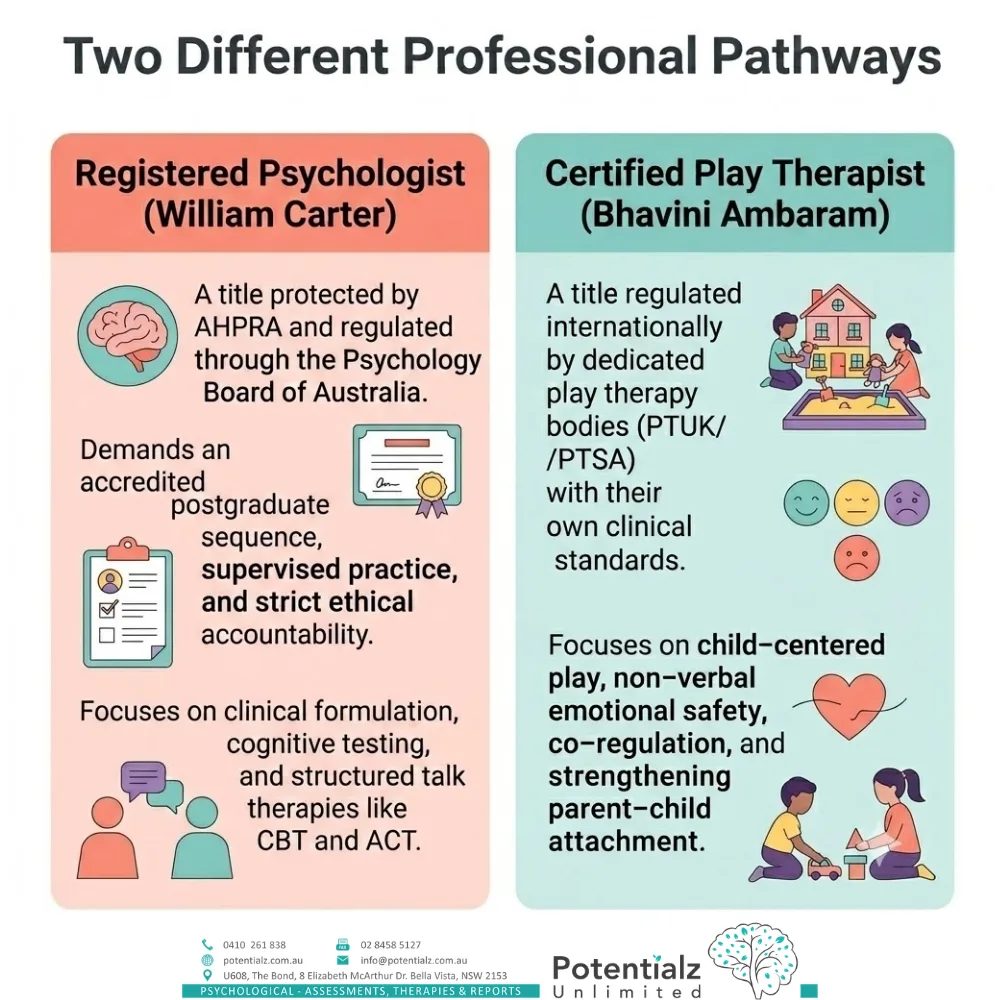
“Registered Psychologist” is a protected title in Australia, regulated by AHPRA (Australian Health Practitioner Regulation Agency) through the Psychology Board of Australia. To hold that title, a clinician has to complete an accredited postgraduate psychology sequence, complete supervised practice, and register with AHPRA. Continuing professional development, professional indemnity insurance, and ethical accountability are all part of ongoing registration. Members of our Registered Psychologist team hold this registration; “Clinical Psychologist” is a separate endorsement, held at Potentialz by our senior Clinical Psychologist.
“Play Therapist” is not, in Australia, a title regulated in the same way by AHPRA. It is regulated internationally by dedicated play therapy bodies — including PTUK (Play Therapy UK) and PTSA (Play Therapy South Africa), among others — which have their own accreditation frameworks, supervision requirements, and CPD standards. The practice’s play therapist trained within those internationally recognised bodies. This is a well-established profession with proper clinical standards; it’s just regulated differently to psychology.
Neither model is “more real” than the other. They are different professional pathways with different standards bodies. The right question is not “which title is more official” but “which practitioner fits my child’s actual need.”
What This Post Is Not
Two honest limits, named directly rather than left to be inferred.
This post is not a diagnostic tool. Nothing in it tells you what is going on for your particular child. That requires an actual conversation with an actual clinician, ideally with you in the room.
This post is not a comparison of quality between the play therapist’s work and the Registered Psychologist team’s work. They are not competing. They are clinicians in the same practice with complementary tools, and the honest answer to “which one should I book?” is genuinely “depends on your child.” The Potentialz model is deliberately set up so that you don’t have to pick a lane the first time — reception can triage, and the clinicians can consult with each other if the initial call is unclear.
How Potentialz Can Help
If the above has helped you see the shape of the decision more clearly — whether the answer is play therapy, psychology, or something else — that is the goal here.
If you’d like a warm, low-pressure way in, here are three options.
Option 1 — free 15-minute triage phone chat. Ring reception on 0410 261 838 and ask for a free 15-minute triage call. Tell them what’s going on for your child. They’ll help you land on the right clinician for the first appointment.
Option 2 — book directly with the play therapist. If your child is under 8, or if what you’ve read above about play therapy has landed for you, book straight in with the practice’s play therapist.
Option 3 — book directly with the Registered Psychologist team. If your child is 8+ and the psychology fit sounds right, book in with the Registered Psychologist team and the first session works out what you actually want to move.
Potentialz Unlimited’s Registered Psychologist team works with children (aged 8 and up), adolescents, young adults, and older adults, using Cognitive Behavioural Therapy (CBT), Acceptance and Commitment Therapy (ACT), and Solution-Focused Therapy, always grounded in a strong, non-judgemental therapeutic relationship. NDIS (self-managed and plan-managed) is fine; Medicare (Mental Health Care Plan) rebate status for the Registered Psychologist team at Potentialz is currently to be confirmed with reception at the point of booking.
- Address: Unit 608, 8 Elizabeth Macarthur Drive, Bella Vista NSW 2153
- Phone: 0410 261 838
- Book: live.potentialz.com.au
- Hours: Monday–Friday 10am–7pm | Saturday & after-hours available | Telehealth via phone or Zoom (for adolescents and adults; young children generally seen in person)
You may also find these related posts useful: Solution-Focused Therapy for Older Adults, Cognitive Assessment and Learning Difficulties, and When a Teenager Refuses Therapy.
References
Axline, V. M. (1947). Play therapy: The inner dynamics of childhood. Houghton Mifflin.
Bratton, S. C., Ray, D., Rhine, T., & Jones, L. (2005). The efficacy of play therapy with children: A meta-analytic review of treatment outcomes. Professional Psychology: Research and Practice, 36(4), 376–390. https://doi.org/10.1037/0735-7028.36.4.376
Kendall, P. C., & Peterman, J. S. (2015). CBT for adolescents with anxiety: Mature yet still developing. American Journal of Psychiatry, 172(6), 519–530. https://doi.org/10.1176/appi.ajp.2015.14081061
Landreth, G. L. (2012). Play therapy: The art of the relationship (3rd ed.). Routledge.
LeGoff, D. B., Gomez de la Cuesta, G., Krauss, G. W., & Baron-Cohen, S. (2014). LEGO-based therapy: How to build social competence through LEGO-based clubs for children with autism and related conditions. Jessica Kingsley Publishers.
Perry, B. D., & Szalavitz, M. (2017). The boy who was raised as a dog: And other stories from a child psychiatrist’s notebook (Revised ed.). Basic Books.
Ray, D. C., Armstrong, S. A., Balkin, R. S., & Jayne, K. M. (2015). Child-centered play therapy in the schools: Review and meta-analysis. Psychology in the Schools, 52(2), 107–123. https://doi.org/10.1002/pits.21798
van der Kolk, B. A. (2014). The body keeps the score: Brain, mind, and body in the healing of trauma. Viking.
Weisz, J. R., Kuppens, S., Ng, M. Y., Eckshtain, D., Ugueto, A. M., Vaughn-Coaxum, R., Jensen-Doss, A., Hawley, K. M., Krumholz Marchette, L. S., Chu, B. C., Weersing, V. R., & Fordwood, S. R. (2017). What five decades of research tells us about the effects of youth psychological therapy: A multilevel meta-analysis and implications for science and practice. American Psychologist, 72(2), 79–117. https://doi.org/10.1037/a0040360
Disclaimer
This article is a Potentialz Unlimited editorial piece drawing on our clinical team’s experience. It is for general education and information only, not clinical advice for your particular child. Potentialz Unlimited is a psychology practice based in Bella Vista NSW; our clinical team includes Registered and Clinical Psychologists (registered with AHPRA). Please consult a qualified health professional for your individual circumstances. If your child is experiencing a mental health crisis, contact your GP, call Kids Helpline on 1800 55 1800, or go to your nearest emergency department.
Crisis Resources
- Kids Helpline: 1800 55 1800 (24/7, ages 5–25)
- Lifeline: 13 11 14 (24/7)
- Beyond Blue: 1300 22 4636
- Parentline NSW: 1300 1300 52
- 13YARN (Aboriginal & Torres Strait Islander crisis line): 13 92 76
- Emergency: 000
Related Reading
- Book: Play Therapy at Potentialz Bella Vista → — play therapist near me for children ages 3–12 in the Hills District
- The Power of Internal Family Systems Therapy: A Journey to Inner Harmony
- Narrative Therapy: Rewriting Your Life Story
- Emotional Regulation: The Skill That Changes How You Handle Everything
- When Family Life Changes: Supporting Children Through Divorce, Separation, and New Siblings
Knowledge Check Quiz
Test what you have just read. Choose your answer for each question, then submit to reveal the answers and your score.
Need Professional Support?
If you're experiencing mental health concerns, our team is here to help.