Key Takeaways
- A cognitive assessment for children is a structured, standardised set of activities — not a test the child passes or fails. Most kids find it interesting, and a good clinician makes it feel closer to playful problem-solving than an exam.
- The main tools the practice uses are the WISC-V for children aged 6–16, the WPPSI-IV for children aged 2 years 6 months to 7 years 7 months, and the WNV (Wechsler Nonverbal Scale of Ability) for children who don’t yet speak English fluently or who have a language-based difficulty that would make the standard WISC unfair.
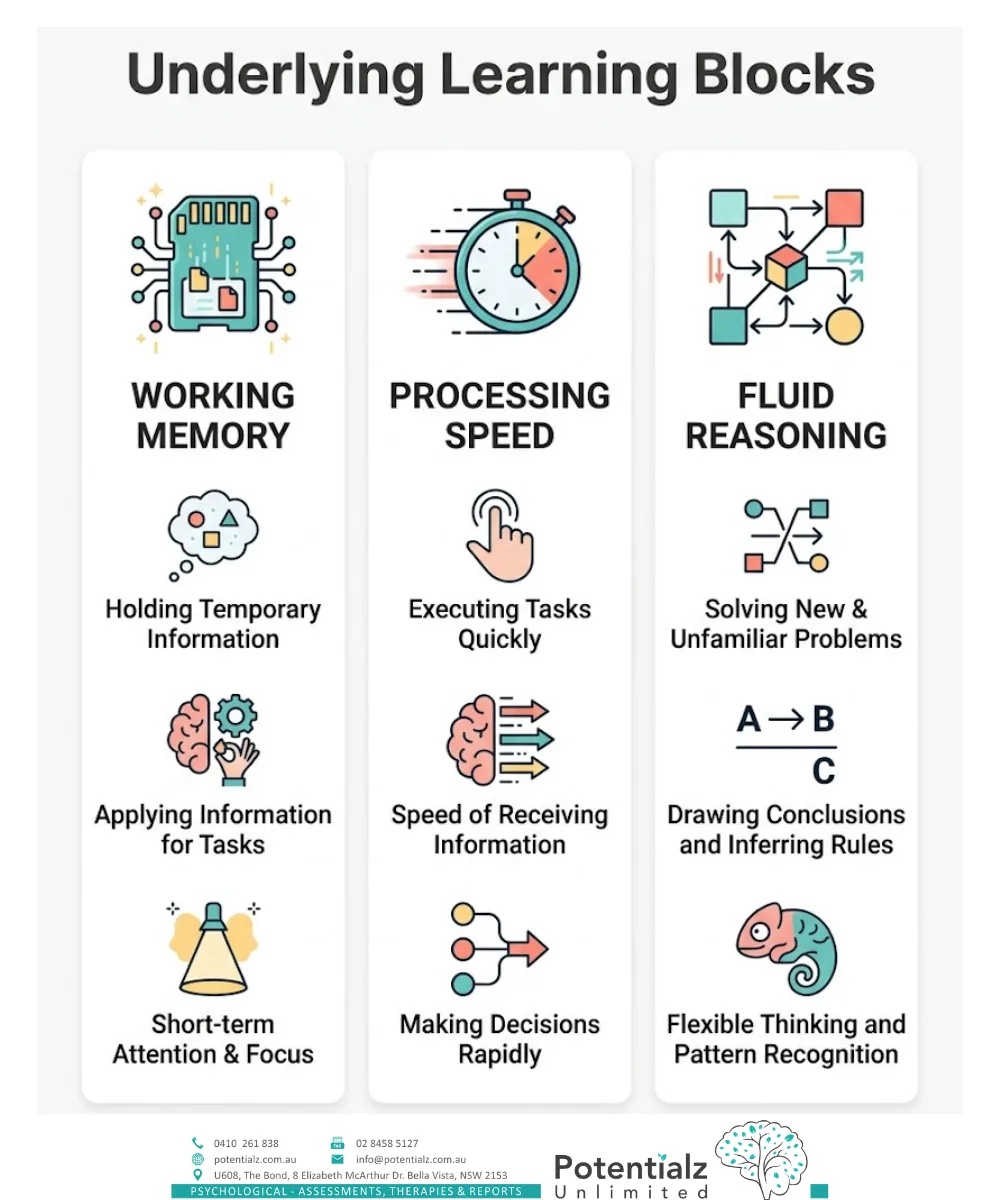
- The WISC-V measures five broad domains: verbal comprehension, visual-spatial reasoning, fluid reasoning, working memory, and processing speed. Each one tells us something different about how a child learns.
- Working memory and processing speed profiles matter enormously at school — they often explain the gap between “this child is clearly bright” and “this child is exhausted by homework and falling behind.”
- Cognitive assessment is one piece of a bigger picture. The practice pairs it with adaptive and behavioural measures — BASC, Vineland, ABAS — plus classroom observation, teacher input, and a proper developmental interview with parents.
- Assessment is not the same as ADHD assessment, but the two are often bundled — and there is a specific reading pathway for suspected dyslexia or specific learning disorder that draws on evidence-based structured literacy work.
- The assessment usually runs across 1–2 testing sessions (about 2–3 hours total), plus a feedback session where we sit down with the results together. Please check with reception about current NDIS, rebate, or private-pay arrangements.
When a Parent First Wonders If Something Deeper Is Going On
Most families the practice meets for a cognitive assessment do not arrive because they woke up one morning and decided to have their child tested. They arrive after a slow build-up: a note from the teacher, homework that takes three times as long as it should, a bright, curious child who describes school as “boring” or “too hard” — sometimes both in the same week.
In work with children and families, the clinical team hears a version of the same sentence often: “I know they’re smart — I just can’t work out why school is so hard for them.” Or the mirror image: “They seem to be coping, but I’ve got this feeling something is being missed.”
Both of those are worth listening to. Parents notice things long before the numbers do.
A cognitive assessment is one of the clearest, most useful ways to answer the question underneath that worry. Not to label the child. Not to slot them into a box. But to actually understand the shape of how they think — what comes easily, what takes more effort, and what a school and a home can do differently so the child stops working twice as hard for the same result.
This post is a Potentialz Unlimited editorial piece drawing on our clinical team’s experience — a plain-English explanation of what a cognitive assessment actually is, what the WISC and WPPSI measure, when to consider one, and how the results turn into real support at school and at home.
By the Potentialz Unlimited Editorial Team | Potentialz Unlimited, Bella Vista NSW
What a Cognitive Assessment Actually Is (And What It Isn’t)
Let’s start by dismantling the biggest myth: a cognitive assessment is not a test the child passes or fails. There is no fail grade. There is no “you got it wrong” moment. The tasks are designed so that every child gets some right and some wrong — that is how the tool works.
A cognitive assessment is a structured, standardised set of activities that a registered psychologist administers one-to-one with the child. “Standardised” simply means that the activities and the way they are scored have been tested on very large samples of children the same age as yours, so we can see how your child performs compared to what is typical for that age.
The activities themselves are surprisingly varied. Some involve pointing to pictures. Some involve arranging blocks to match a pattern. Some involve solving little puzzles or spotting what’s missing. Some involve telling the psychologist what a word means, or listening to a sequence of numbers and repeating them back — sometimes forwards, sometimes backwards. It looks and feels much closer to a set of interesting games than an exam.
That’s deliberate. If a child is anxious, tired, or fed up, the results will underestimate what they can actually do. So a real part of the psychologist’s job — before the test kit is even opened — is helping the child feel comfortable in the room. Introducing themselves. Chatting a bit. Making sure the child knows they can stop for a snack or a bathroom break whenever they need to. Some kids need five minutes of Lego to warm up. Some are ready to go straight in. The clinician follows the child.
The one thing we will not pretend is that the assessment is completely relaxed for the child. It requires sustained attention and effort, and most kids find it a bit tiring by the end. That is one of the reasons the practice usually splits it into two shorter sessions rather than hammering through in one long block.
The Tools the Practice Uses — WISC, WPPSI, WNV, and the Adaptive Measures
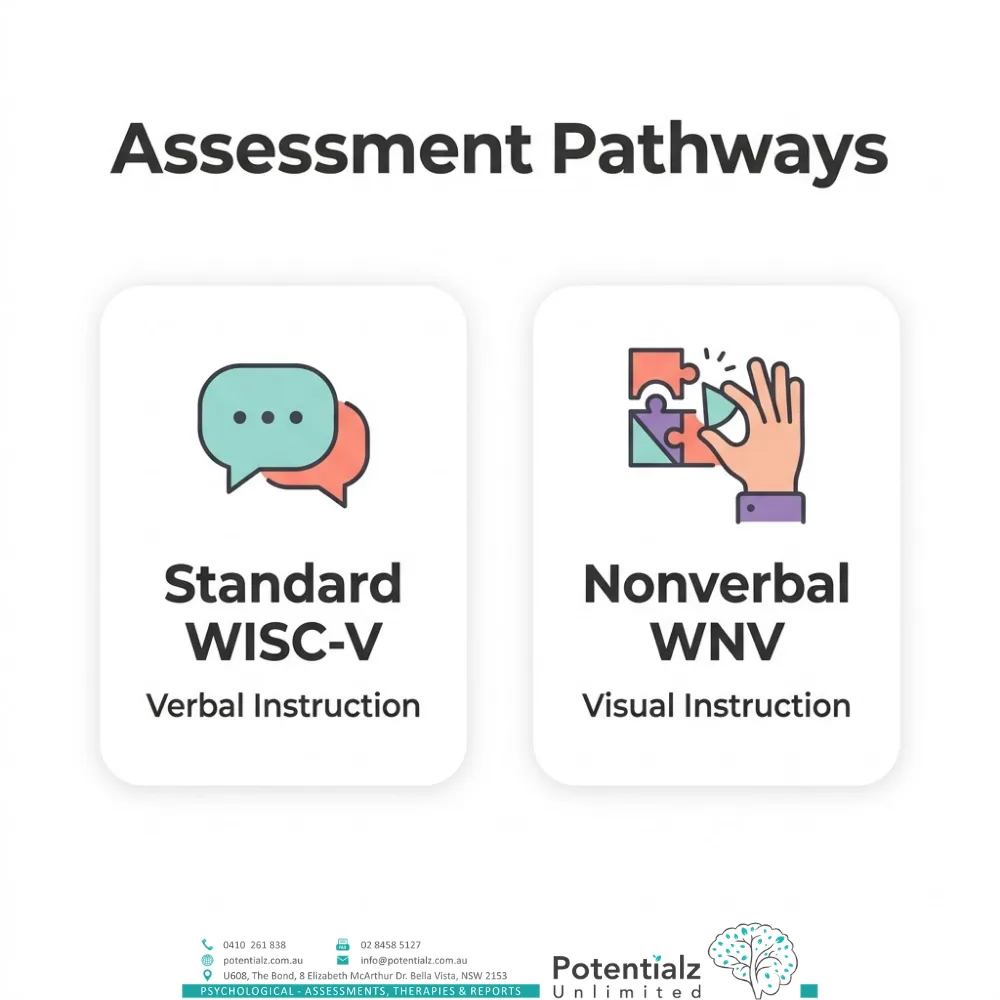
There is no single “IQ test.” There is a family of tools, and the right one depends on the child’s age, language background, and the question we’re trying to answer.
WISC-V (Wechsler Intelligence Scale for Children — 5th Edition). This is the workhorse for school-aged children. It’s designed for ages 6 through 16 years 11 months, and it’s the tool most schools, NDIS planners, and paediatricians will recognise. The WISC-V produces a Full Scale IQ score and five index scores — verbal comprehension, visual-spatial, fluid reasoning, working memory, and processing speed. We’ll unpack what each of those actually means in a moment, because the individual index scores usually matter more than the overall number.
WPPSI-IV (Wechsler Preschool and Primary Scale of Intelligence — 4th Edition). This is the equivalent tool for younger children, from 2 years 6 months up to 7 years 7 months. The tasks are shorter, more play-based, and more tolerant of the fact that a four-year-old cannot sit still for two hours. For children whose age falls in the overlap zone (6 to 7:7), the psychologist chooses the one that fits the child’s developmental stage and the referral question, not just their birthday.
WNV (Wechsler Nonverbal Scale of Ability). The WNV is important. For children who don’t yet speak English fluently — recent arrivals, children in EAL/D classes, children in bilingual families whose home language is dominant — running a verbal-heavy test in English would tell us more about their English than about their thinking. The WNV is deliberately nonverbal: instructions can be given by gesture and demonstration, and the tasks rely on visual reasoning rather than spoken language. Across culturally diverse groups, using the right instrument for the child in front of you makes the picture much clearer.
Adaptive and behavioural measures — BASC, Vineland, ABAS. These are questionnaires, usually completed by parents and often by teachers. They aren’t cognitive tests; they measure how the child is actually functioning in day-to-day life — communication, daily living skills, social skills, motor skills, emotional and behavioural patterns. The Vineland-3 and ABAS-3 focus on adaptive behaviour (how well the child manages age-appropriate real-world demands); the BASC-3 focuses on emotional and behavioural functioning. They matter because a child’s IQ number tells us very little on its own — a child can have a strong IQ profile and still struggle at school if their adaptive skills or emotional regulation are lagging. For any NDIS-related report or any assessment where a developmental condition is being considered, these measures are essential.
The practice also draws on observation and interview — the parent developmental interview at the start, and where possible some contact with the school or a look at recent schoolwork. Numbers alone don’t diagnose a child. They inform a formulation. That distinction matters.
What Each WISC Domain Actually Measures (In Plain English)
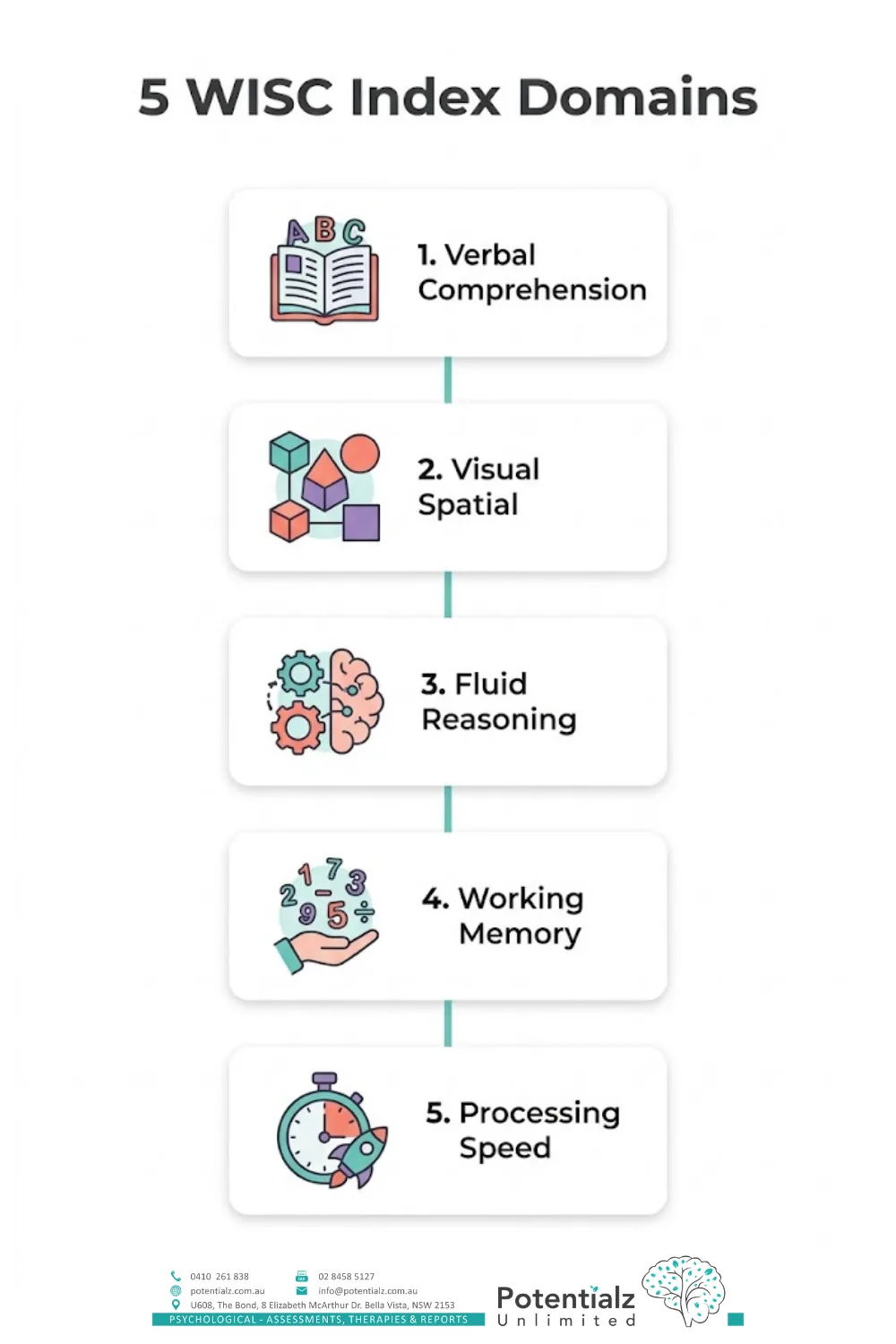
If you take one thing from this post, let it be this: the individual index scores matter more than the Full Scale IQ. Two children can have identical Full Scale IQs and completely different learning profiles — and completely different needs at school.
Here is what each of the five WISC-V index scores actually captures.
1. Verbal Comprehension Index (VCI)
This measures word knowledge, verbal reasoning, and the ability to use language to think through ideas. Tasks include defining words, explaining how two things are similar (“How are a piano and a guitar alike?”), and answering general knowledge and reasoning questions.
A strong VCI usually shows up in a child who is articulate, who enjoys conversation with adults, who reads a lot, and who “sounds smart.” A weaker VCI does not mean the child isn’t smart — it may mean their strengths are visual and hands-on, or that they’ve had less exposure to the kind of English-language vocabulary the test samples.
2. Visual-Spatial Index (VSI)
This measures the ability to see how visual details fit together — to work with shape, space, and pattern. The classic task is Block Design: the psychologist shows the child a pattern on a card, and they arrange coloured blocks to match it, against a stopwatch.
Strong visual-spatial reasoning shows up in kids who love construction, drawing, jigsaws, or Minecraft, and who are often the ones who can “see” how to do something before they can explain it in words. It’s the profile of many kids who go on to thrive in design, engineering, trades, architecture, art.
3. Fluid Reasoning Index (FRI)
This measures novel problem-solving — the ability to work out a rule you’ve never seen before from the patterns in front of you. Tasks include Matrix Reasoning (spot the missing piece that completes a pattern) and Figure Weights (work out which shape must go on the scale to balance it).
Fluid reasoning is often described as “on-the-spot thinking.” It’s less about what a child already knows and more about how they figure things out. Children with strong fluid reasoning often catch on to new concepts quickly, even in subjects they haven’t been formally taught.
4. Working Memory Index (WMI)
This is the one parents most often haven’t heard of, and it’s often the one that most changes how school makes sense.
Working memory is the ability to hold information in mind and use it — briefly — to complete a task. It’s what lets a child remember the teacher’s four-step instruction long enough to actually do all four steps. It’s what lets them hear a maths problem and hold the numbers in mind while they work out the answer. It’s what lets them keep track of the sentence they’re reading long enough to understand the paragraph.
Children with a lower working memory score often look, from the outside, like they are “not paying attention,” “not listening,” or “not trying.” In many cases, they are trying — extremely hard — but the information keeps slipping. They finish step one and can’t remember steps two, three, and four. They read a whole page and can’t tell you what it was about. They forget homework the moment they leave the classroom.
If working memory is a relative weakness, the intervention isn’t “try harder.” It’s things like: written instructions instead of verbal ones, chunking tasks into smaller steps, repeating back what has been asked, checklists on the desk, and reducing the load on memory so more of the child’s brain can be available for actual thinking.
5. Processing Speed Index (PSI)
Processing speed is the speed at which a child can take in simple visual information and respond. Tasks include copying symbols under time pressure or searching for a symbol among distractors.
A child with a low processing speed score can be just as capable as any other child — but everything takes them longer. Reading takes longer. Copying from the board takes longer. Finishing the test takes longer. So homework that “should take twenty minutes” takes an hour and a half, and by the end of it, everyone is in tears.
Combined with a lower working memory score, this profile is one of the most common — and most under-recognised — reasons that bright kids end up flagged as “lazy” or “not applying themselves.” They are not lazy. Their processing engine simply runs at a different speed. Once we know that, school and home can adjust: extra time on tasks, reducing the volume of written work while keeping the complexity, allowing typing instead of handwriting, and being much gentler about how long things “should” take.
The Full Scale IQ
The Full Scale IQ is a single number that summarises across all five domains. It’s useful for some purposes — NDIS eligibility for intellectual disability, giftedness screening, comparisons with population norms. But if the five index scores are very different from each other, the Full Scale IQ becomes almost meaningless as a summary. It’s an average of things that aren’t really the same. In those cases — which are common — the feedback conversation should centre on the profile, not the number.
When to Consider a Cognitive Assessment
You do not need a diagnosis to consider a cognitive assessment. You just need a question worth answering. The most common reasons families come in are:
1. The school has flagged it. A teacher, learning support coordinator, or school counsellor has raised concerns — a child seems to be falling behind, or working much harder than peers to keep up, or the gap between their spoken understanding and their written output is widening. Schools cannot access certain kinds of support without a formal assessment on file.
2. Homework is a nightly meltdown, well beyond what peers seem to experience. Every family has homework battles. That’s not what we mean. We mean the child is regularly in tears, or shutting down, or taking hours over what should take twenty minutes — and this has been going on for months, not weeks.
3. Suspected giftedness. Some children need to be identified as gifted to access appropriate extension — a mainstream classroom pace can be deeply frustrating for a child who is well above the norm, and disengagement, anxiety, and even behaviour issues can follow. Cognitive assessment is the standard tool for identifying giftedness formally.
4. A specific learning disorder is suspected — most commonly dyslexia. If a child is reading well below age level despite good teaching and normal effort, cognitive assessment is one of the pieces used to work out whether a specific learning disorder is present. (More on the reading-specific pathway below.)
5. NDIS eligibility or planning. For children being considered for NDIS support around intellectual disability or a developmental disability, cognitive and adaptive assessment is a standard part of the documentation.
6. Diagnostic clarification alongside ADHD or ASD assessment. Cognitive assessment doesn’t diagnose ADHD or autism on its own — those diagnoses use different criteria — but the cognitive profile is important context, and the two assessments are often bundled together (more on that below).
7. The parent’s own sense that something is being missed. The clinical team takes this seriously. Parents notice things clinicians and teachers can’t. If you’ve had a persistent feeling that the picture doesn’t add up, that is a legitimate reason to seek an assessment.
What the Results Tell You — And What They Don’t
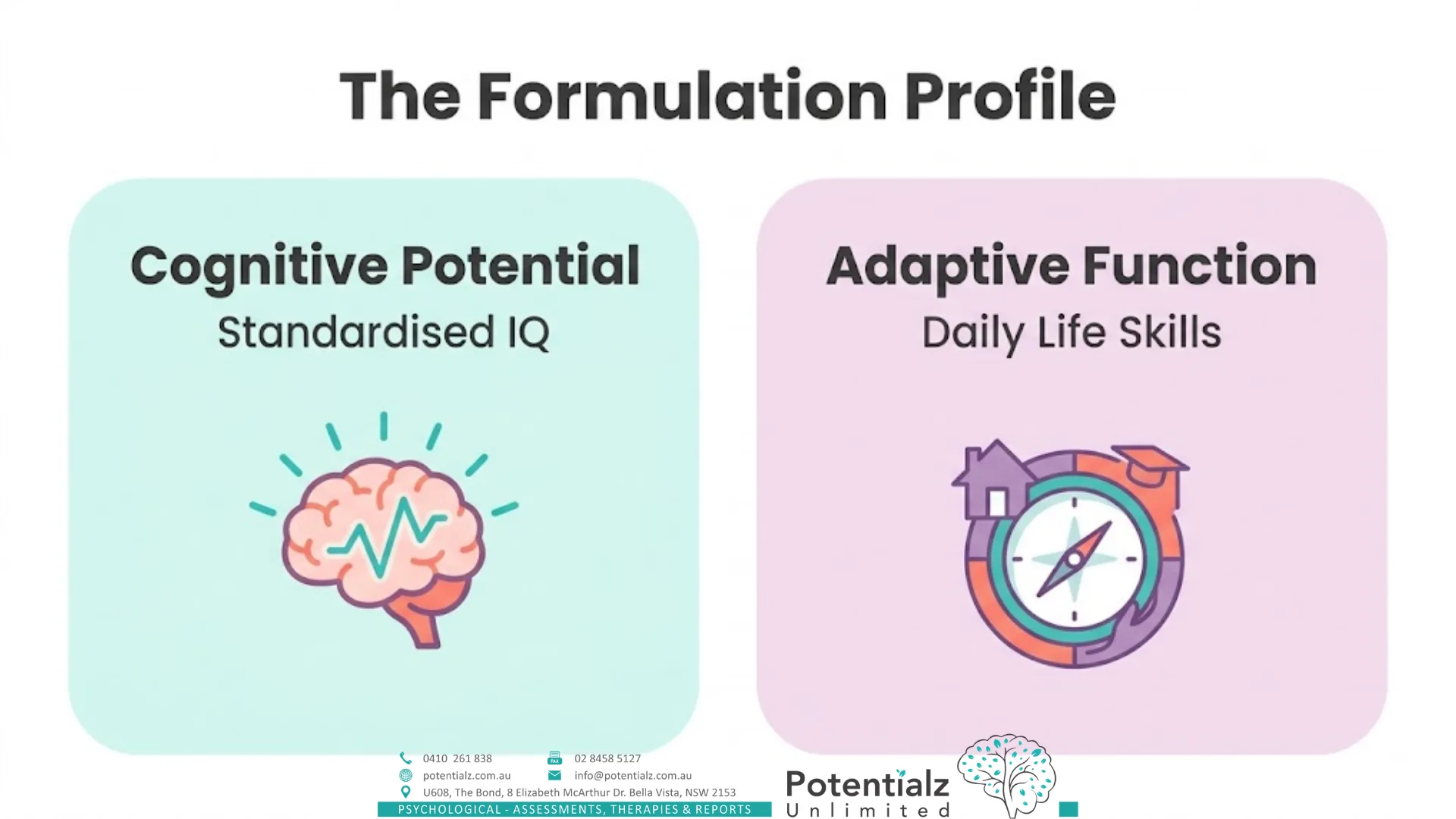
A cognitive assessment tells you a great deal. It also has real limits, and we’d rather name them than gloss over them.
What the results can tell you:
- How your child’s thinking compares to same-aged peers across the five domains
- Whether there is a specific pattern of relative strengths and weaknesses that explains what you’re seeing at school and at home
- Whether the profile is consistent with giftedness, intellectual disability, or a specific learning disorder (in combination with other evidence)
- What kinds of accommodations, teaching approaches, and supports are likely to actually help
- A shared vocabulary — for you, the school, and any other professionals involved — for what’s going on
What the results cannot tell you:
- Your child’s future. IQ is not destiny. Scores shift somewhat over childhood, and — more importantly — what people do with their thinking depends on far more than test scores: motivation, curiosity, relationships, opportunities, mental health, self-belief.
- Whether your child has ADHD or autism. Those diagnoses require different assessment tools and criteria. Cognitive profiles can be suggestive — for example, a large gap between fluid reasoning and processing speed is common in ADHD — but the diagnosis itself is made on other grounds.
- The whole of your child. A number is not a person. Feedback conversations always centre on the child in the room, not the child on the score sheet.
We say this to parents at every feedback session: the assessment is a tool to inform decisions, not a verdict on your child. The child you take home from the feedback session is the same child you brought in. What has changed is your understanding of them.
How Results Feed Into Real Support — At School and At Home
A report that sits in a drawer is useless. The purpose of assessment is to change what happens next.
At school
A cognitive assessment report — written properly — should give the school a clear, practical roadmap. That looks like:
- Learning support programs: many schools have targeted small-group programs for literacy, numeracy, or working memory, and a formal assessment often unlocks access.
- Classroom accommodations: extra time on tasks, chunked instructions, written instead of verbal instructions, allowing typing instead of handwriting, seating close to the teacher, movement breaks, quiet space for tests. These are not shortcuts; they are the reasonable adjustments that let a child show what they actually know.
- NCCD funding recognition: assessments that identify a disability under the Nationally Consistent Collection of Data may support the school in accessing funding for adjustments.
- Gifted and talented programs: entry into extension programs, opportunity classes (in NSW), or accelerated content often requires formal assessment.
- Transition planning: for a child moving to high school or from Year 6 to Year 7, a report gives the incoming school somewhere to start rather than a year of “getting to know” the child while things fall through the cracks.
If the school seems hesitant to take the report seriously, families are encouraged to ask for a meeting that includes the learning support coordinator and, if useful, the assessing psychologist by phone. Schools are generally very willing to work with clear, specific recommendations — vague reports get shelved; specific ones get actioned.
At home
The other half of the report is for you. The parent at the feedback session is often carrying months or years of low-grade uncertainty about their child, and the shift into clarity is real.
Practical things that often change at home once a family has a profile in front of them:
- Expectations recalibrate. If handwriting is slow because processing speed is slow, “just work faster” stops being the goal. The task becomes: get the ideas out (typing, dictation, drawing) and worry about presentation less.
- Homework routines change. Shorter blocks. Movement in between. Reducing volume, keeping complexity. Ending on a win rather than dragging past the point of exhaustion.
- The child’s story about themselves changes. This one matters most. Many children who arrive at assessment have already begun to describe themselves as stupid, or bad at school, or lazy. A feedback session where the psychologist sits down with the child (in language that fits their age) and explains their profile — what they are strong at, what takes them more effort, and what we’re going to do about that — can genuinely shift how they see themselves.
That last part is a lot of why the team does this work.
Cognitive Assessment and ADHD Assessment — Related, Not the Same
Cognitive assessment and ADHD assessment are different processes, but they are often done together, and it’s worth explaining why.
Cognitive assessment measures how a child’s thinking is put together — the WISC or WPPSI profile.
ADHD assessment looks at whether the child meets the diagnostic criteria for Attention-Deficit/Hyperactivity Disorder — persistent patterns of inattention, hyperactivity, or impulsivity that cause meaningful impairment across settings. That’s assessed through developmental history, standardised rating scales completed by parents and teachers (like the Conners or the BASC scales mentioned earlier), and — often — a paediatrician’s or psychiatrist’s involvement.
The reason they’re bundled is that cognitive testing gives real diagnostic clarity when ADHD is being considered. A child with ADHD often shows a very characteristic pattern — strong verbal comprehension and fluid reasoning, but a notable dip in working memory and/or processing speed — and that pattern helps the paediatrician’s diagnostic thinking. It also flags when something other than ADHD may better explain what’s going on: a specific learning disorder, an unrecognised intellectual disability, an anxiety-driven pattern, or a language-based difficulty.
If your child is on an ADHD assessment pathway, cognitive testing is very often the useful next piece. The practice frequently works in this bundled way, in collaboration with the child’s paediatrician or GP.
The Reading-Specific Pathway
A specific mention on reading, because it comes up so often.
Dyslexia — a specific learning disorder in reading — is common, under-recognised, and highly treatable when identified early. The typical picture is a child with normal-to-strong cognitive ability who is nevertheless reading well below age level, often with slow, effortful decoding, phonological confusion, and progressive avoidance of anything to do with books.
Evidence-based, structured literacy intervention shapes how the practice thinks about reading assessment. A cognitive assessment is part of the picture — we need to rule in or out an intellectual disability, look for the characteristic cognitive profile (often strong verbal comprehension, average fluid reasoning, and a marked dip in working memory or processing speed), and understand the child’s overall learning strengths. But it needs to be combined with specific literacy testing — measures of phonological awareness, decoding, single-word reading, reading fluency, spelling, and reading comprehension — to make a formal specific learning disorder identification.
Where a family comes in with a suspected reading difficulty, the practice will typically recommend a combined cognitive-and-literacy assessment, and the report will spell out concrete next steps for structured literacy intervention — whether through an evidence-based program (like MultiLit or Sounds-Write), a school-based intervention, or private tutoring with the right approach.
Structured literacy intervention works. Waiting doesn’t.
Cultural Fairness in Testing — Because This Matters
We want to say something about cultural fairness in cognitive assessment, because it isn’t often discussed and it should be.
Standardised tests are norm-referenced — meaning a child’s score reflects how they perform compared to the population sample the test was built on. That works well when the child comes from a background broadly similar to the norm sample. It works less well — and can seriously mislead — when the child comes from a very different background.
A test that asks a child to define words drawn from a suburban vocabulary, or answer general knowledge questions rooted in a particular cultural frame, will systematically underestimate the ability of a child whose knowledge is deep in different places. The number on the page can miss the child entirely.
The same care applies when working with migrant and culturally diverse families. Some children have arrived in Australia recently; some have grown up here but speak a language other than English at home. Running a verbally-loaded English test on a child whose English is still developing measures their English, not their thinking.
What that looks like in practice:
- The clinician defaults to the WNV for children whose English is limited or whose language history would make the standard WISC unfair.
- Verbal comprehension scores in bilingual and culturally diverse kids are treated with real caution — the score is real information, but it isn’t a straightforward measure of “verbal intelligence.” It’s a measure of verbal ability in the language and cultural context the test samples.
- The clinician leans more heavily on observation and parent/teacher interview for these children, and explicitly discusses the limits of the test in the report.
- No child is written off on the basis of a single number.
Good cognitive assessment is not just administering the tools correctly. It’s knowing what the tools can and can’t tell you about this particular child.
What the Assessment Process Actually Looks Like
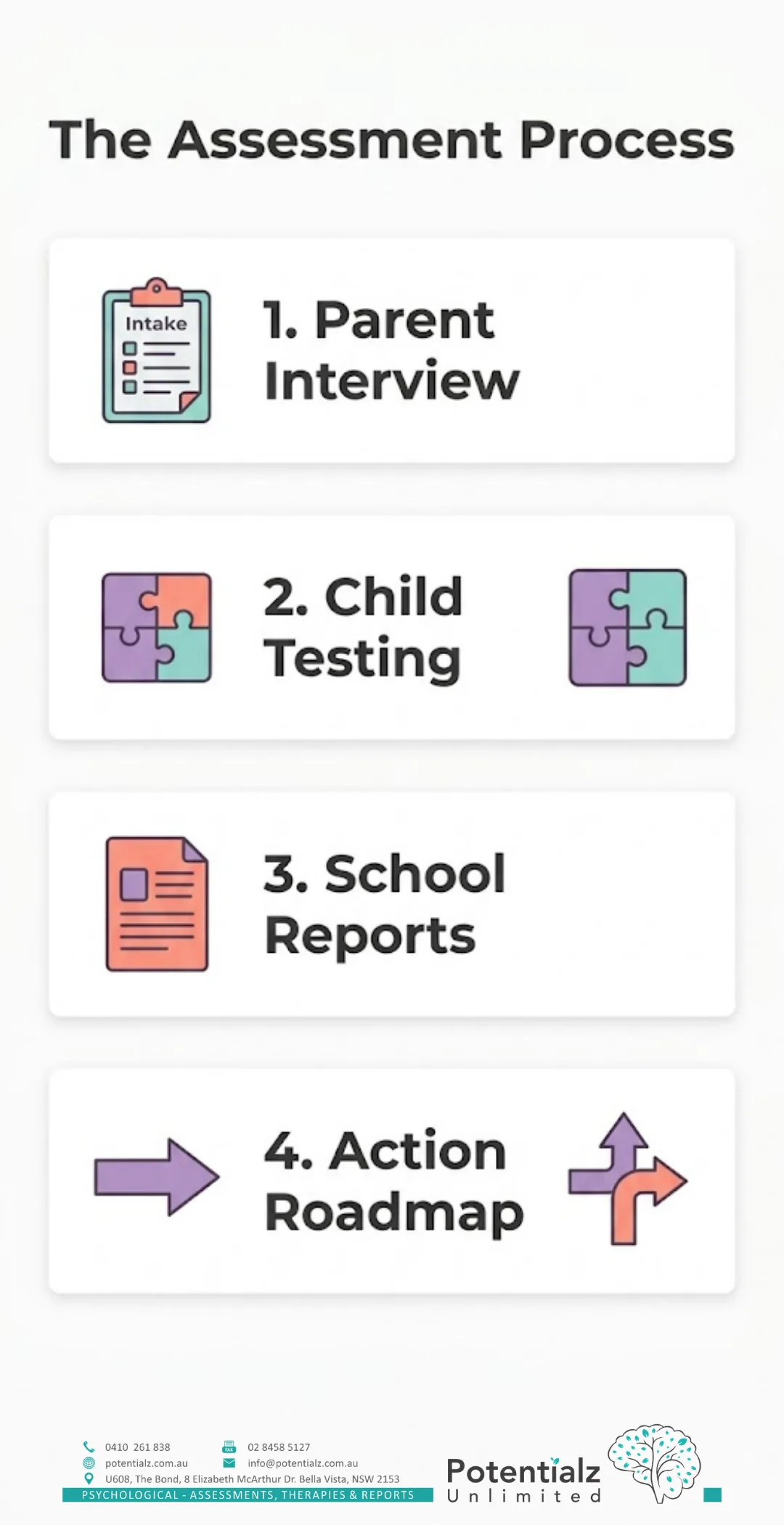
For families coming in, here’s what to expect from start to finish.
Step 1 — Intake and developmental interview (about 60–90 minutes). The psychologist meets with you (the parents/carers) — usually without the child — and takes a careful developmental history. Pregnancy, birth, early milestones, medical history, family history, school history, current concerns, what’s already been tried. This is genuinely important; the interview shapes what the clinician focuses on in the assessment and how the results are interpreted.
Step 2 — Testing sessions with the child (usually 2 shorter sessions of about 60–90 minutes each, occasionally 1 longer session of 2–3 hours). The clinician splits it where possible. Kids do better on the second half of any assessment when they’ve had a break. The child is always told ahead of time what to expect and given permission to ask for breaks.
Step 3 — Adaptive/behavioural questionnaires. You (and often the teacher) complete questionnaires — BASC, Vineland, or ABAS depending on the question. These can be filled in at home over a few days.
Step 4 — Optional school liaison. With your consent, the psychologist sometimes speaks with the teacher or observes in class. This is particularly useful for behavioural or attentional questions.
Step 5 — Scoring, interpretation, and report writing. The clinician scores the tools, integrates the interview, questionnaire, and observational data, and writes the report. This usually takes 2–3 weeks after the last data collection.
Step 6 — Feedback session (about 60 minutes). We sit down together and the psychologist walks you through what was found — in plain English, with the actual profile in front of us. Where developmentally appropriate, a short child-friendly feedback session is also offered with your child, so they hear it in language they can use. You leave with the full written report and specific, actionable recommendations for school and home.
Total contact time is typically 2–3 hours of direct testing across 1–2 sessions, plus the interview, questionnaires, and feedback session.
On costs and rebates: please check with reception about current NDIS, rebate, or private-pay arrangements — these change from time to time and it’s easier to give you an accurate answer over the phone than to publish something that might be out of date. NDIS-funded assessments (self- and plan-managed) are commonly supported at Potentialz.
When Another Clinician Is the Better Fit
Not every child who needs support needs the same clinician, and part of good assessment practice is knowing when to refer sideways within the practice.
- For a child under 8 (particularly under 6) who would benefit from play-based therapeutic work in parallel with any assessment, the practice’s play therapist does beautiful play therapy work. Younger children sometimes need the therapeutic relationship built through play before formal testing is workable, and there’s real skill in that.
- For adolescents’ cognitive assessments and adult ADHD work, the Registered Psychologist team is happy to see them directly.
- For complex trauma-plus-learning presentations — where a child has significant trauma history alongside learning difficulties, and where the formulation is genuinely complex — our senior Clinical Psychologist brings decades of experience in cognitive assessment across exactly that kind of complexity, including forensically-informed contexts.
The practice is set up to make these referrals easy. If you’re not sure who fits, call reception and describe what you’re seeing — reception will sort out the right first step.
How Potentialz Can Help — Child Cognitive Assessment at Potentialz
If any of what we’ve described sounds like the question you’ve been carrying about your child, you’re welcome to book a first conversation with the practice. Assessment isn’t the only answer for every child — sometimes a short course of therapy, or a well-targeted school conversation, is a better first step, and the clinician will say so if that’s the case. But where cognitive assessment is genuinely the right tool, it can be one of the most useful things a family does.
Potentialz Unlimited’s Registered Psychologist team works with children (aged 8 and up), adolescents, young adults, and older adults, integrating Cognitive Behavioural Therapy (CBT), Acceptance and Commitment Therapy (ACT), and Solution-Focused Therapy. The practice offers cognitive and adaptive assessment work drawing on the WISC-V, WPPSI-IV, WNV, BASC, Vineland, and ABAS.
The practice works with NDIS clients (self-managed and plan-managed) and takes private-pay bookings. Please check with reception about current rebate arrangements before booking.
- Address: Unit 608, 8 Elizabeth Macarthur Drive, Bella Vista NSW 2153
- Phone: 0410 261 838
- Book: live.potentialz.com.au
- Website: potentialz.com.au
- Hours: Monday–Friday 10am–7pm | Saturday & after-hours available | Telehealth via phone or Zoom
References
Elliott, C. D., & Grigorenko, E. L. (Eds.). (2007). Culturally sensitive assessment of cognitive ability. In Contemporary Intellectual Assessment: Theories, Tests, and Issues (2nd ed.). Guilford Press.
Kaufman, A. S. (1994). Intelligent testing with the WISC-III. John Wiley & Sons.
Kaufman, A. S., Raiford, S. E., & Coalson, D. L. (2016). Intelligent testing with the WISC-V. John Wiley & Sons.
Rutter, M., Bishop, D. V. M., Pine, D. S., Scott, S., Stevenson, J. S., Taylor, E. A., & Thapar, A. (Eds.). (2008). Rutter’s child and adolescent psychiatry (5th ed.). Blackwell Publishing. https://doi.org/10.1002/9781444300895
Snowling, M. J., & Hulme, C. (2012). Interventions for children’s language and literacy difficulties. International Journal of Language & Communication Disorders, 47(1), 27–34. https://doi.org/10.1111/j.1460-6984.2011.00081.x
Sparrow, S. S., Cicchetti, D. V., & Saulnier, C. A. (2016). Vineland Adaptive Behavior Scales (3rd ed.). Pearson Assessments.
Wechsler, D. (2012). Wechsler Preschool and Primary Scale of Intelligence (4th ed.). Pearson Assessments.
Wechsler, D. (2014). Wechsler Intelligence Scale for Children (5th ed.). Pearson Assessments.
Wechsler, D., & Naglieri, J. A. (2006). Wechsler Nonverbal Scale of Ability. Pearson Assessments.
Disclaimer
This article is a Potentialz Unlimited editorial piece drawing on our clinical team’s experience. It is for general education and information only, not clinical advice for your particular child. Potentialz Unlimited is a psychology practice based in Bella Vista NSW; our clinical team includes Registered and Clinical Psychologists (registered with AHPRA). Please consult a qualified health professional for your individual circumstances. If you or your child are experiencing a mental health crisis, contact your GP, call Kids Helpline on 1800 55 1800, or go to your nearest emergency department.
Crisis Resources
- Kids Helpline: 1800 55 1800 (24/7, ages 5–25)
- Lifeline: 13 11 14 (24/7)
- Beyond Blue: 1300 22 4636
- MensLine Australia: 1300 78 99 78
- Emergency: 000
Knowledge Check Quiz
Test what you have just read. Choose your answer for each question, then submit to reveal the answers and your score.
Need Professional Support?
If you're experiencing mental health concerns, our team is here to help.