
Key Takeaways
- Solution-Focused Therapy (SFT, sometimes called SFBT — Solution-Focused Brief Therapy) suits many older adults particularly well. It is forward-looking, respectful, and brief by design — meaningful movement is common in around six sessions.
- Older clients often come in navigating retirement adjustment, chronic health changes, grief and bereavement, loneliness, cognitive changes, or life-review questions about values, meaning, and legacy. SFT holds all of these without pathologising a lifetime.
- It flips the usual therapy question. Instead of asking “what’s wrong and where did it come from?”, it asks “what will life look like when this is a bit better — and what’s already happening, even sometimes, that’s a bit closer to that?”
- SFT was developed in Milwaukee in the 1980s by Steve de Shazer, Insoo Kim Berg, and the team at the Brief Family Therapy Center. Core tools include the miracle question, scaling questions (0–10), exception-finding, and coping questions for the hardest weeks.
- It respects older adults’ agency and life experience — you are treated as the expert on your own life, which is often a welcome contrast to health systems that can feel patronising after 65.
- It is not a stand-alone fit for severe unprocessed trauma, active complicated grief needing longer work, or significant cognitive impairment that needs a different clinical frame. Those often warrant EMDR-trained colleagues or a broader treatment plan.
- In the practice’s therapy work, SFT is rarely used in isolation — it is combined with CBT for stuck thought patterns and ACT for values-and-difficult-feelings work, particularly around loss and meaning.
- The evidence base includes multiple systematic reviews (Franklin, Trepper, Gingerich, Kim) supporting SFT across depression, anxiety, and adjustment-focused presentations across the lifespan.
A Different First Question — Especially If You’ve Lived a Long Life Already
Most therapies open somewhere near the problem. What’s going wrong. How long it has been going on. What it started with. That question makes sense — and for a lot of the work at Potentialz Unlimited, some version of it is exactly where the conversation begins.
But it is not the only way in. And for many of the older adults our team sits with, it is not the best way in.
If you’ve been alive for six, seven, or eight decades, you don’t need a young psychologist to explain to you how difficult life can be. You already know. What you may not have had, recently, is someone willing to ask a different question — one that assumes you are still the author of what happens next, not just the archive of what came before.
Solution-Focused Therapy — SFT for short, sometimes called Solution-Focused Brief Therapy (SFBT) — starts from a slightly different place. Rather than opening with “tell me about the problem”, it opens with something closer to: “if the next chapter went well from where you’re standing, what would you notice? And is any of that already happening, even sometimes?”
It sounds almost too simple. In our clinical experience, that simplicity is exactly what makes it work — especially for older clients who are, quietly, a bit tired of health appointments that treat them as a list of conditions rather than a person.
This is a Potentialz Unlimited editorial piece drawing on our clinical team’s experience — an honest walk-through of what Solution-Focused Therapy actually is, where it came from, the questions that sit at its core, why it suits older adults particularly well, who it doesn’t suit on its own, and how the practice typically combines it with other approaches — mostly CBT and ACT — in the therapy room at Potentialz Unlimited in Bella Vista.
Why SFT Suits Older Adults Particularly Well
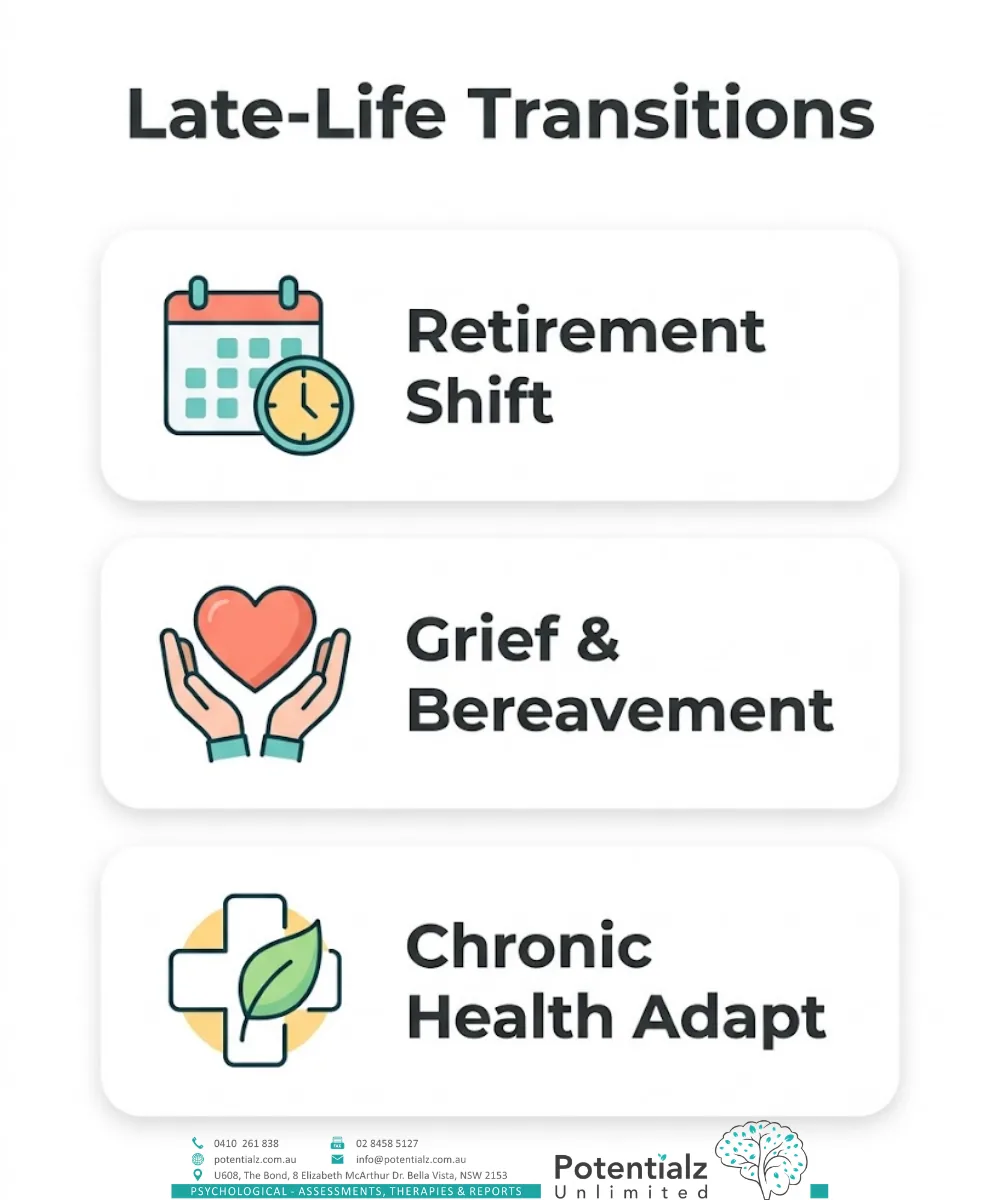
Before we get into the mechanics, it is worth naming why our team leans on SFT specifically with older clients.
It respects your agency. By your sixties, seventies, eighties, you have lived through more decisions, losses, adjustments, and reinventions than most therapy models seem to notice. SFT’s foundational stance — that you are the expert on your own life, and the clinician’s job is to ask good questions — often lands as a relief rather than a novelty. It contrasts sharply with medicalised care that can, unintentionally, position older adults as passive recipients of expert opinion.
It is quick, without being shallow. Many older clients don’t want, and don’t need, a two-year therapy relationship. What they want is a defined piece of work — six sessions, eight sessions, sometimes fewer — to unstick a specific situation and get on with living. SFT was built for exactly that shape.
It is forward-looking. For a client who is grieving, adjusting to retirement, or coming to terms with chronic health, spending most of therapy on the past can amplify grief rather than move through it. SFT holds the past with respect (via a real history and honest acknowledgement of loss) but centres the work on the life that is still yours to live.
It does not pathologise a lifetime. It does not require you to reframe your whole life as a case study. It does not turn seventy years of adaptation, love, work, and loss into a diagnosis. This matters. Many older adults have very good reasons to feel wary of psychology, and SFT sits comfortably alongside those reasons rather than dismissing them.
It is compatible with slower pacing, hearing needs, and physical constraints. SFT is a conversational, structured approach. It works well over telehealth (phone or Zoom) for clients who don’t drive as much as they used to. Its scaling questions and exception-finding are easy to hold in mind between sessions, and they are naturally sized for someone who wants clarity rather than complexity.
Where It Came From: Milwaukee, the 1980s, and a Team That Started Watching What Worked
Solution-Focused Therapy was developed in the 1980s at the Brief Family Therapy Center in Milwaukee, primarily by Steve de Shazer and Insoo Kim Berg, working with a team of clinicians and researchers over many years.
Their starting point was unusual for the era. Rather than starting with a theory of what causes problems and then designing a therapy from that theory, they started by watching sessions — hours and hours of sessions — through a one-way mirror. And they asked a slightly heretical question: when clients did shift, what actually seemed to move them?
Two patterns kept showing up. First, clients often already had partial solutions in their lives — moments, days, or contexts where the problem was less present, or where they were coping better than they had expected to. Second, the shift towards more of that seemed to happen not by analysing the problem in more detail, but by noticing those existing exceptions and building on them.
Out of that pragmatic, observational stance, de Shazer, Berg, and the team distilled a set of questions and moves that became Solution-Focused Therapy. It was designed to be brief on purpose — many clients moved forward in fewer sessions than long-term therapy typically expected. And it was designed to keep the expertise about the client’s own life firmly with the client.
That last bit still shapes how our team holds SFT sessions. The clinician knows psychology and knows what the evidence base says, but the clinician is not the expert on your life. You are. The job is to ask good questions.
The Flip: From “What’s Wrong?” to “What Will Better Look Like?”
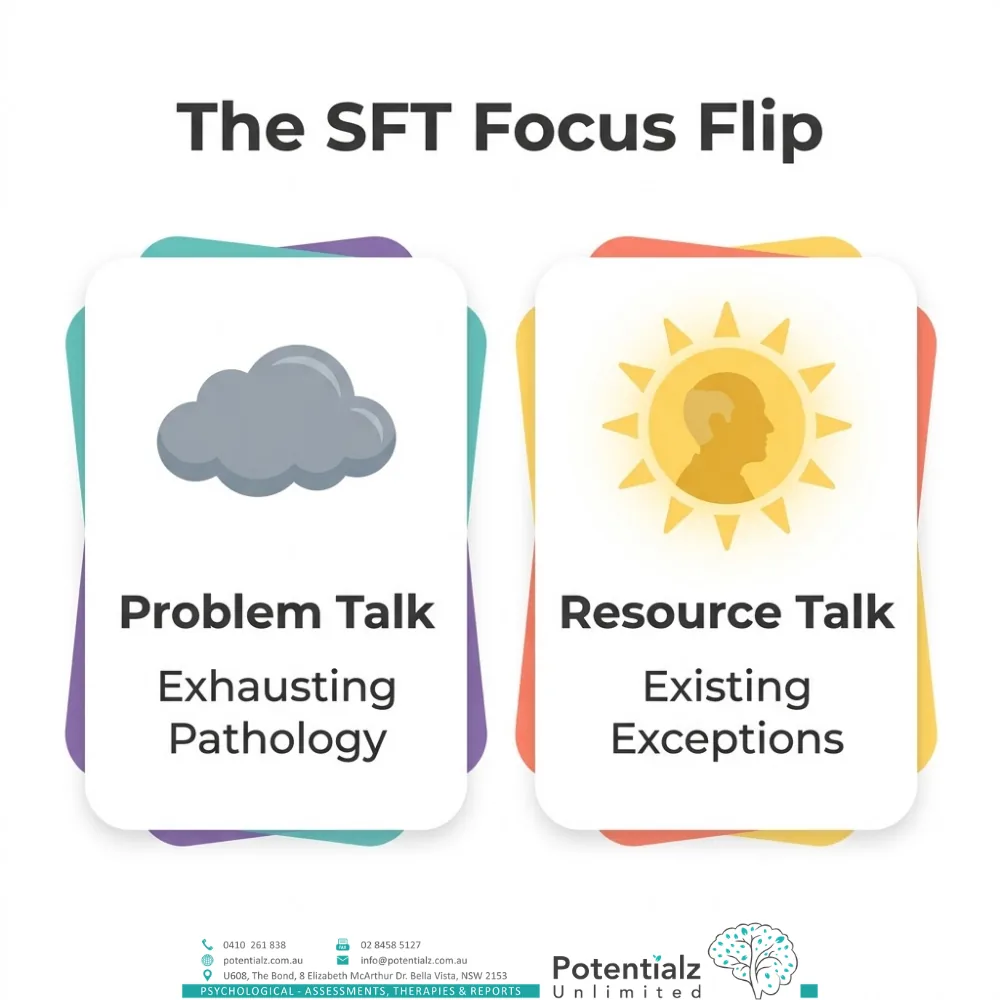
The single biggest thing to understand about SFT is the flip.
Most conversations about difficulty — inside therapy and outside it — spend a lot of time on the problem. What it is. Why it is. When it started. What triggers it. Who is involved. What has been tried. All of that is often useful, and the practice takes a genuine history with every client.
But SFT gently asks a different question, usually early: “if we were meeting in six months’ time and things had shifted in a direction that felt good to you — what would you notice? What would be different in a normal day? What would other people around you notice?”
It sounds like a fairly straightforward question. In practice, for someone who has spent months or years mostly thinking about the problem, it can be genuinely difficult to answer at first. That is not a failure. That is information. It tells us that a lot of mental real-estate has been given over to the problem, and part of the work is helping the person begin to see the outline of a preferred future clearly enough that they can move towards it.
Once we start sketching that preferred future, the next question is the one that often surprises people: “and where in your life right now — even sometimes, even a little — is any of that already happening?”
Almost always, some of it already is. Not all of it. Not the whole picture. But small fragments — a morning last week that felt manageable, a conversation with a friend that went differently, an evening where the anxiety didn’t dominate, a Tuesday where you actually made it to the gym. SFT is very interested in those fragments. Because they are already yours, they are already possible, and they give us something concrete to build on.
The Miracle Question
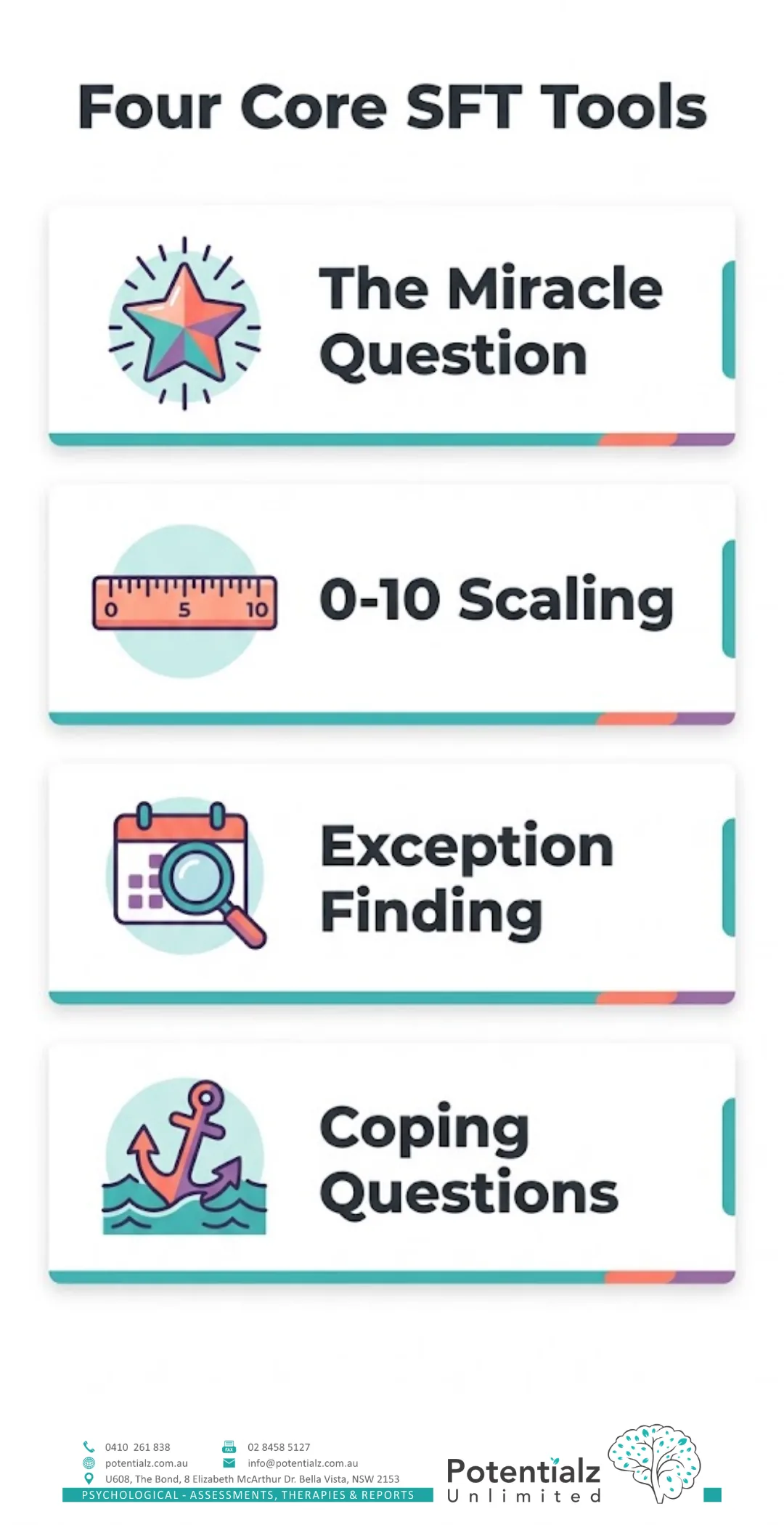
The most well-known SFT tool is the miracle question. It sounds a bit dramatic on paper, and clinicians usually introduce it with a small warning to that effect. It usually goes something like this:
“I’m going to ask you a slightly unusual question, and I’d like you to take your time with it. Suppose tonight, while you’re asleep, a miracle happened — and the problems that brought you into therapy were somehow gone. But because you were asleep, you don’t know the miracle has happened. What would be the first small sign, tomorrow morning, that something was different?”
The wording matters. Not “what would the miracle be” — that pulls people into abstract wishes. But “what would be the first small sign that something was different” — that pulls them into concrete, everyday detail. What time would you wake up. How would you get out of bed. What would breakfast look like. Would you check your phone in the same way. Who would you talk to first. What would be different about that conversation.
The point is not to promise a miracle. There is no miracle. The point is to help the client sketch a preferred future in enough sensory, behavioural, relational detail that it becomes something we can actually work towards. It stops being an abstract wish (“I want to feel better”) and becomes a set of specific noticings (“I would probably not feel my chest tight before opening emails; I would probably have the energy to reply to my sister; I would go for a walk at lunchtime instead of scrolling”).
Once we have that sketch, the rest of the therapy has somewhere to aim. And, tellingly, we can begin asking the exception question: “and are any of those little signs already happening, at least sometimes, in your life right now?”
Scaling Questions: 0 to 10
The second signature SFT tool is the scaling question. It looks small; it does a lot of work.
“If 0 is how things were at their worst — the point where you seriously thought about seeing someone — and 10 is the preferred future you just described, where are things today?”
Most people answer somewhere in the middle. A 3. A 4. Sometimes a 6.
Here is where SFT does the move that most other approaches don’t. Instead of asking “why aren’t you higher?” — which is a problem-focused question — SFT asks: “why not lower? What is it that has you at a 4 and not a 2? What is already happening, even a little, that puts you where you are and not further down?”
This is not spin. It is not positive-thinking. It is a genuine, curious enquiry into the small resources, habits, relationships, and choices that are already keeping the person functioning at the level they are. And most people, when they slow down and answer honestly, are quite surprised by what they find.
The follow-up question is the practical one: “what would it take for you to get from a 4 to a 4.5 in the next week or two? Not to a 10. Just half a step.”
Half a step is a lot more workable than “get better”. It is specific. It is often small. It is often something the person can start on before the next session. And because we know that half-a-step already includes things they can do — because we just spent five minutes surfacing what they were already doing at the 4 — it stops feeling like a leap and starts feeling like the next small foothold.
Over sessions, we track the number. Not obsessively, and not as a performance metric — but as a shared shorthand for progress that keeps us honest and keeps us practical.
Exception-Finding: “When Did the Problem Not Happen, Even a Little?”
Exception-finding is the third core SFT move, and honestly, it is the one the team uses most often outside of formal SFT protocols. It is that useful.
The question is: “when was a recent time the problem was less present than usual? Or when did it not happen at all — even for an afternoon, even for a conversation?”
For a client who has been describing a week of unrelenting anxiety, this can be a surprisingly hard question. The brain in a low or anxious mood tends to filter for confirming evidence — everything is bad, everything is anxious — and to skim past the moments that would contradict that story. Exception-finding is a slow, patient invitation to notice those moments.
Then the follow-ups: “what was different about that time? Where were you? Who were you with? What were you doing before? What was going through your head? What did you do differently? How did you know you were coping better?”
The point is not to make the client feel bad for having good moments they didn’t notice. The point is to identify the ingredients of those exceptions, because those ingredients are transferable. If Wednesday afternoon was noticeably lighter because they’d had a proper lunch, walked outside, and rung a friend, then we have three ingredients to consciously repeat. That is not shallow advice. That is the client’s own data being taken seriously.
Exception-finding gets used constantly across settings — inside CBT work, ACT work, and general check-ins. It is one of the most quietly powerful tools in the therapy room, from young-adult work to adolescent work to return-to-work assessments.
Coping Questions: When Things Really Are Stuck
Sometimes a client comes in and there just are not many exceptions. The week has been genuinely awful. The scale is at a 2. The miracle question feels like a cruelty. SFT has an honest answer for this too, and it is a favourite question in the whole modality.
The coping question is: “given everything you’ve just described — how have you kept going? What has helped you get this far?”
Notice what it doesn’t do. It doesn’t rush the client into positivity. It doesn’t argue with the difficulty. It doesn’t demand that they find silver linings. It simply, respectfully, points out that they are still here — still in the room, still trying, still willing to talk — and asks how they have managed that.
Most clients, when asked this genuinely, can name something. A person who has been checking in on them. A show they’ve made themselves watch to get to bedtime. A dog. A commitment to their kids. A small habit they’ve held onto. Sometimes just the fact of turning up.
That is not nothing. That is a survival strategy, quietly running in the background, and it is worth naming and honouring. SFT lets the therapist do that without turning it into a lecture on gratitude — which is not the point at all.
What a First SFT-Flavoured Session Actually Looks Like
Because our team rarely delivers SFT in isolation, here is what a first session shaped by SFT looks like in practice at Potentialz Unlimited.
We usually spend the first ten or fifteen minutes on the basics — what brings you in, how long it has been going on, what a normal week looks like, any current risk or safety issues, medication, previous therapy, what you actually want to work on. The clinician takes a real history. SFT does not skip that.
Then somewhere in the middle of the session, we shift. The clinician might ask: “if the therapy we do together over the next few weeks goes well from your point of view — what would be different, and how would you know?” That is a soft miracle question, and it opens up preferred-future work.
From there we scale — “where would you say things are today, on a 0–10?” — and we explore what is already at the current number. We might identify one or two exceptions in the previous fortnight. And we usually end with a very small experiment for the coming week: often just noticing when the problem is less present, and what is going on around it. Sometimes a small deliberate action, drawing on an exception the client has just described.
At the end of a session like that, most clients report feeling slightly clearer, slightly less overwhelmed, and — importantly — like they left with something to work with, rather than just having described the problem again.
SFT Is a Brief Therapy — On Purpose
Solution-Focused Therapy is, as the “brief” in SFBT suggests, designed to be short. In the original Milwaukee work, and in most subsequent research, meaningful outcomes were often seen within 4 to 8 sessions. Some clients need fewer. Some need more. Some come back for a couple of top-ups a few months later.
This has a few practical implications.
Financially, SFT can be very appropriate for people who want a defined piece of work rather than an open-ended commitment. If you have a specific concern you want to address, or a specific transition to navigate, SFT can move you forward without becoming a long-term therapy relationship.
Clinically, it is worth being honest about what “brief” does and does not mean. It does not mean easy, and it does not mean superficial. It means focused. If your situation is complex — significant unprocessed trauma, longstanding personality-level patterns, comorbid presentations that need careful formulation — then eight sessions of SFT alone is unlikely to be enough. That does not make SFT wrong. It makes it a component in a longer plan, or the right approach for someone else with a different presentation.
The practice tries to be transparent with clients about a realistic sense of how long the work is likely to take. Sometimes that estimate is wrong in both directions, and it gets revisited.
Who SFT Suits Particularly Well
In our clinical experience — and this lines up with the literature — SFT tends to be a strong fit for certain groups of clients.
People who are exhausted by problem-talk. If you have had previous therapy that spent a lot of time on origin stories, patterns, family systems, or symptom lists, and you’re at the point of feeling that you understand the problem but haven’t moved much on it — SFT’s forward-looking frame is often a relief. Clients often say, in a first SFT-flavoured session, “oh, I didn’t know therapy could feel like this.”
Adolescents who resist ‘digging into the past’. Many young people find a heavily reflective, insight-focused therapy quite alien and, honestly, quite boring. SFT’s practical, present-and-future orientation, and its treatment of the young person as the expert on their own life, tends to land much better. The scaling question in particular is often a hit with teenagers — it is concrete, non-preachy, and it treats them as capable of self-assessment.
Clients with clear practical goals. People who come in with something specific — “I want to feel less overwhelmed at work”; “I want to be able to sleep before 1am”; “I want to have a decent conversation with my partner instead of always arguing” — often do very well with SFT’s goal-directed structure. The work has a target.
Return-to-work and workplace-focused clients. In workplace and return-to-work settings, SFT is a natural fit. The task is often practical and time-bounded: what does a workable return look like, what is already going well, what small next step is possible this week. SFT gives us a clear structure for exactly that kind of work, without pathologising the person or ignoring the very real barriers.
Older adults navigating transitions. This is the group this post is really about. Retirement adjustment (particularly the first 12–24 months, when the loss of structure, colleagues, and role can hit harder than expected). Bereavement adjustment where the acute phase has passed but the shape of daily life still needs rebuilding. Chronic health diagnoses that require a genuine reorganisation of how you spend your energy. Loneliness after moving house, downsizing, or losing a partner. Values-and-legacy work — the honest question of what the next chapter is actually for. SFT’s preferred-future work re-opens direction without dismissing what has been lost. Life review can happen inside this frame, gently, without turning therapy into a memoir project.
People who feel they’ve lost track of what “better” would even look like. Sometimes clients come in saying they know things aren’t right but they’ve stopped being able to imagine anything else. The miracle question, done gently, is often the first time in months they’ve genuinely sat with the question of what they actually want.
Who SFT Doesn’t Suit as a Standalone Approach
We want to be equally honest about where SFT is not the right stand-alone approach.
Severe unprocessed trauma. For clients dealing with PTSD or complex trauma that has not been processed, jumping straight into preferred-future work can bypass material that genuinely needs attention. In that situation, the practice would not lean on SFT alone; the clinician either pairs it with a trauma-informed approach, or — where the primary need is specialist trauma processing — cross-refers within the practice to a colleague trained in EMDR. There is no ego in that: it is the right care for the person.
Complex clinical presentations that need longer formulation. Some presentations — significant personality-level patterns, complex neurodivergence with multiple co-occurring difficulties, longstanding eating disorder patterns, unclear diagnostic pictures — need a slower, more thorough formulation phase than SFT alone provides. In those cases, SFT questions still find their way into the work, but they sit inside a broader plan.
Active crisis or significant risk. When a client is in acute crisis, the immediate work is safety, stabilisation, and appropriate support around them. SFT is a therapy for building movement; it is not a crisis intervention.
Clients who genuinely want to understand origins. Some people, quite reasonably, want a therapy that spends time on how patterns developed, what family and early experience contributed, and what they mean. SFT does not centre that, and if that is the work you want, the practice might use CBT with a fuller formulation piece, or you might be better suited to a different clinician within the team. We would rather match you to what fits than sell you a modality that doesn’t.
Younger children. For children under 8, or for children whose primary need is play-based therapeutic work, the practice’s play therapist specialises in child play therapy and would be a much better first port of call.
Clients wanting a yoga-integrated or somatic approach. SFT is a talking therapy. If your instinct is that a body-based, breath-based, or yoga-integrated approach would fit you better, the practice’s somatic-integrated therapist offers exactly that.
How the Practice Combines SFT With CBT and ACT
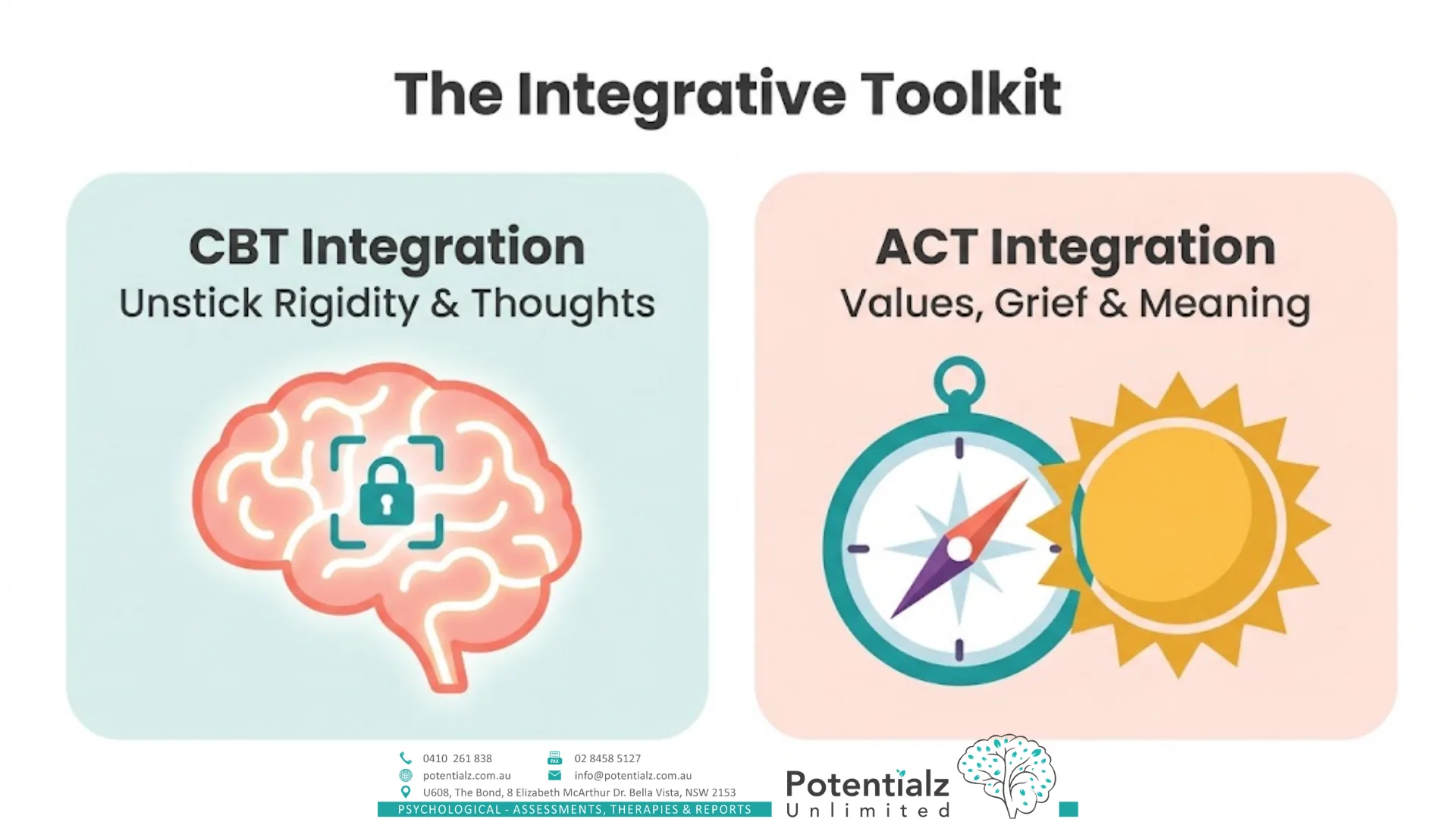
Almost none of the work at Potentialz is single-modality. What SFT gives us is a particular way of opening sessions and holding the direction of the work. The middle of the work usually leans on other approaches too.
We tend to use SFT to open and orient. The scaling question is often a check-in at the top of a session — “where are we today, and what has moved since last time?” — and the exception-finding question is a regular part of homework review. The preferred-future frame keeps the work aimed forward.
Where a client has specific, stuck thought patterns — catastrophising, self-critical rumination, black-and-white thinking about their own performance — CBT is often the sharper tool. Thought records, cognitive restructuring, behavioural activation for depression, exposure principles for anxiety: these are precise, well-evidenced techniques for particular patterns. For more on how CBT works in practice, see The Benefits of Cognitive Behavioural Therapy (CBT).
Where a client is dealing with difficult feelings that can’t just be reasoned with — grief, chronic pain, existential fear, values-and-direction questions — ACT tends to be a better fit. ACT (Acceptance and Commitment Therapy) works with the difficult feelings rather than trying to eliminate them, and it explicitly builds towards a values-directed life. In practice, ACT’s committed action step and SFT’s small-next-step step are close cousins, and they combine cleanly. There’s more on ACT in ACT Therapy: Why Accepting Your Thoughts Can Help You Feel Better.
So a typical piece of work at Potentialz might look like: SFT-framed scaling and exception-finding at the top of session; CBT-style work on a specific stuck thought pattern; ACT-style values check somewhere in the middle if the work is drifting; and an SFT-style small next step to close the session and shape the week between now and next time.
The through-line is that the person in front of the clinician is the expert on their own life. Every technique is only ever a scaffold to help them see it more clearly.
The Evidence Base
SFT has been researched over four decades now, and the evidence base is genuinely worth knowing about, though it is more mixed and nuanced than a marketing summary would suggest. We will try to be honest about it.
Multiple systematic reviews and meta-analyses have looked at Solution-Focused Brief Therapy across a range of presentations. Notable contributions include:
- Franklin, Trepper, Gingerich, and colleagues’ systematic reviews of SFBT outcomes across depression, anxiety, family issues, and school-based interventions.
- Kim’s meta-analytic work on SFBT effectiveness, showing small-to-moderate positive effects across a range of behavioural, family, and mental health outcomes.
- Gingerich and Peterson’s 2013 review of controlled outcome studies of SFBT, which found positive support for effectiveness across a variety of settings and presentations.
- Franklin, Zhang, Froerer, and Johnson’s more recent work extending the evidence into school and workplace applications.
What the literature broadly suggests: SFBT produces meaningful clinical improvement in a range of common presentations (depression, anxiety, family and relationship difficulties, behavioural concerns in young people), and it typically achieves those outcomes in fewer sessions than many longer therapies.
What the literature is more cautious about: SFBT is not established as a stand-alone treatment for severe, complex, or trauma-related presentations, where more specialised or longer interventions have stronger evidence.
That maps to how the practice uses it. SFT is a strong tool for the presentations where it has good evidence, and a component of a broader plan for the presentations where more is needed.
What About the Idea That SFT Is “Just Positive Thinking”?
This is a fair question, and it is worth addressing directly rather than pretending nobody asks it.
SFT is not the same thing as positive thinking, or reframing, or gratitude practice, or any of the well-meaning but sometimes irritating things that get thrown at people who are struggling. Done well, SFT does not tell you to look on the bright side. It does not tell you that your difficulties are not real. It does not skip past pain to get to solutions.
What it does do is ask, with genuine curiosity: given how hard this is, what has still been possible, and what would you like more of? Those are real questions with real answers, and taking them seriously is a form of respect for the client’s actual capacity.
If SFT is done badly — as a rushed cheerleading exercise — it can absolutely feel dismissive. That is a failure of practice, not of the model. When SFT is done well, the clinician spends as much time slowing down and honouring difficulty as surfacing exceptions. Both are part of the work.
What a Course of Work Might Look Like End-to-End
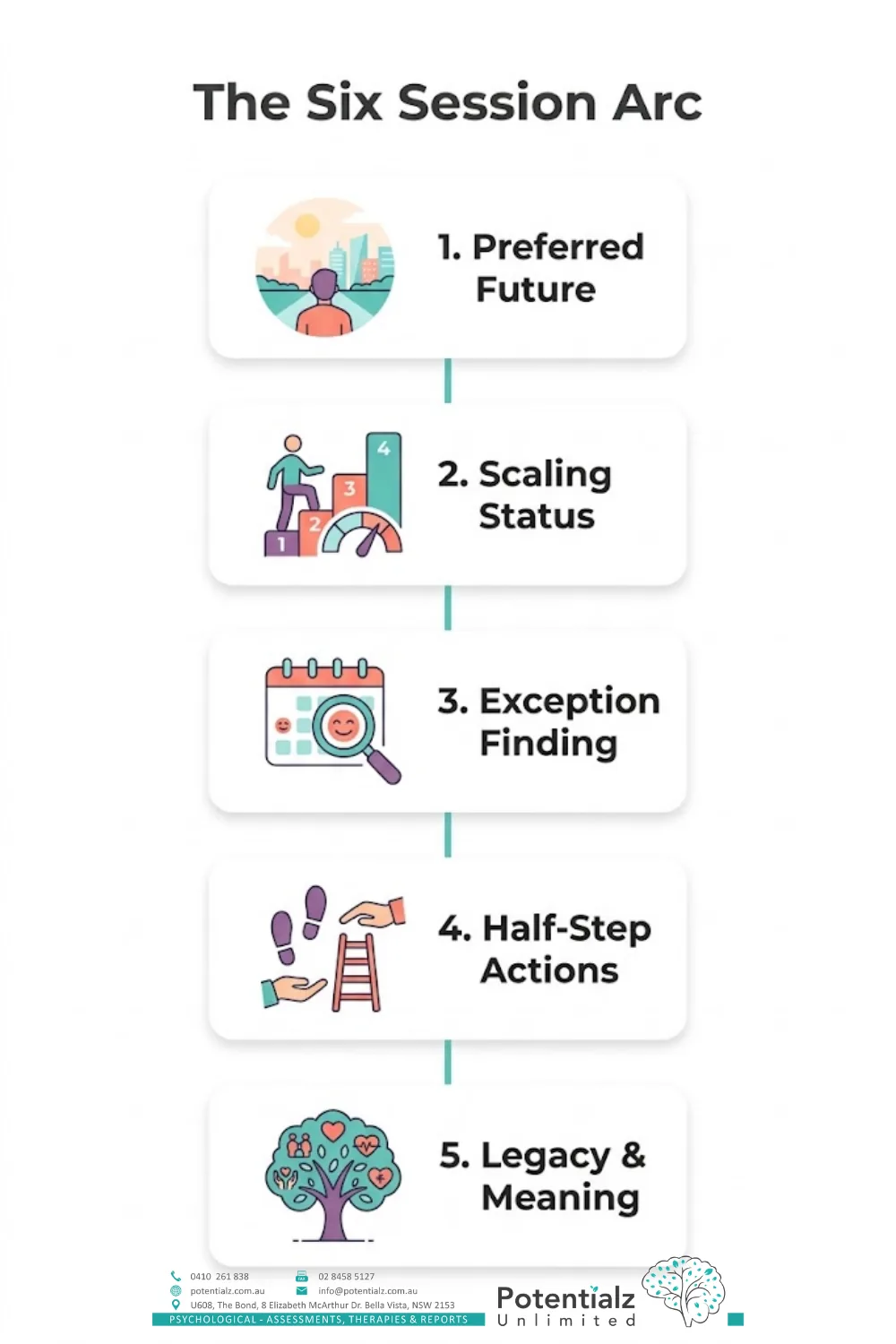
If a client came in with, say, six months of workplace anxiety after a change in role, a typical piece of work might unfold like this. This is illustrative rather than a rigid template.
Session 1. History-taking, understanding the presentation, checking for risk, sketching the preferred future (“if this got a bit better, what would you notice”), first scaling (“today, on 0–10, we’re at about a 3”), first exception (“there was one Wednesday last month where the meeting went okay — what was different?”), a small experiment for the week (“notice when the anxiety is less present, and jot down what was going on around it”).
Sessions 2–3. Reviewing the noticings. Identifying two or three ingredients that seem to make the anxiety less present (better sleep the night before, a five-minute walk before entering the building, a specific colleague nearby). Adding a small CBT-style piece on one of the stuck thoughts (“I’m about to be found out”) and running a proper thought record. Scaling has moved from 3 to 4.
Sessions 4–5. Building on ingredients. Introducing an ACT-flavoured piece around values (“what kind of professional do I actually want to be, regardless of whether the anxiety is fully gone?”). Committed action steps aligned with those values. Scaling somewhere between a 5 and a 6.
Sessions 6–8. Consolidating gains, relapse prevention thinking, deciding whether to space sessions out, and identifying what the client would do if the pattern re-emerged in the future. Often the client is at a 6 or 7 by this point and confident enough to pause therapy, with a clear plan for coming back if needed.
Not every course of work goes like that. Some are shorter. Some are much longer, and more complex. But it gives a shape.
Cost, Booking, and Practical Details
Sessions at Potentialz Unlimited run for 50 minutes. SFT-flavoured work fits comfortably into that structure, and 4–8 sessions is a reasonable ballpark for a defined piece of work — though the plan is agreed together and revisited.
NDIS (self-managed and plan-managed) referrals are accepted for eligible clients. Medicare (Mental Health Care Plan) rebate status varies by clinician — please check with reception when you book, and reception will be honest with you about what applies. Private-pay bookings are welcome.
Telehealth via Zoom or phone is available across NSW, which many clients find suits the practical, present-focused nature of SFT sessions very well.
How Potentialz Can Help
If any of the above resonates — the tiredness with problem-talk, a wish for a therapy that keeps its eye on where you want to be, a young person in your life who won’t engage with anything that feels like “digging into the past”, or a specific practical piece of work you’d like to move on — the practice would be glad to talk with you.
Potentialz Unlimited’s Registered Psychologist team works with children (aged 8 and up), adolescents, young adults, and older adults. The core modalities are Cognitive Behavioural Therapy (CBT), Acceptance and Commitment Therapy (ACT), and Solution-Focused Therapy, always grounded in a strong, non-judgemental therapeutic relationship.
In a first session the clinician will spend time getting to know what you actually want to work on. No one will push you into any particular modality — including SFT — until you’ve had that conversation and worked out what fits.
Where your situation calls for a specialist trauma modality like EMDR, the practice will happily cross-refer to a colleague trained in EMDR at Potentialz. If a yoga-integrated or somatic frame would fit better, a somatic-integrated therapist is available. For children under 8 or for primarily play-based work, the practice’s play therapist is a wonderful first port of call.
- Address: Unit 608, 8 Elizabeth Macarthur Drive, Bella Vista NSW 2153
- Phone: 0410 261 838
- Book: live.potentialz.com.au
- Hours: Monday–Friday 10am–7pm | Saturday & after-hours available | Telehealth via phone or Zoom
Book directly online, and we’ll take it from there.
Related Reading
More from our blog:
- Mental Health in Older Adults: Why Ageing Doesn’t Mean Accepting Depression and Anxiety
- This Week in Mental Health: Trauma and Recovery (26 June 2026)
- This Week in Mental Health: Self-Compassion (12 June 2026)
References
Franklin, C., Trepper, T. S., Gingerich, W. J., & McCollum, E. E. (Eds.). (2012). Solution-focused brief therapy: A handbook of evidence-based practice. Oxford University Press.
Franklin, C., Zhang, A., Froerer, A., & Johnson, S. (2017). Solution-focused brief therapy: A systematic review and meta-summary of process research. Journal of Marital and Family Therapy, 43(1), 16–30. https://doi.org/10.1111/jmft.12193
Gingerich, W. J., & Peterson, L. T. (2013). Effectiveness of solution-focused brief therapy: A systematic qualitative review of controlled outcome studies. Research on Social Work Practice, 23(3), 266–283. https://doi.org/10.1177/1049731512470859
Kim, J. S. (2008). Examining the effectiveness of solution-focused brief therapy: A meta-analysis. Research on Social Work Practice, 18(2), 107–116. https://doi.org/10.1177/1049731507307807
de Shazer, S., Dolan, Y., Korman, H., Trepper, T., McCollum, E., & Berg, I. K. (2007). More than miracles: The state of the art of solution-focused brief therapy. Haworth Press.
Trepper, T. S., & Franklin, C. (2012). The future of research in solution-focused brief therapy. In C. Franklin, T. S. Trepper, W. J. Gingerich, & E. E. McCollum (Eds.), Solution-focused brief therapy: A handbook of evidence-based practice (pp. 405–412). Oxford University Press.
Disclaimer
This article is a Potentialz Unlimited editorial piece drawing on our clinical team’s experience. It is for general education and information only, not clinical advice for your particular circumstances. Potentialz Unlimited is a psychology practice based in Bella Vista NSW; our clinical team includes Registered Psychologists and a Clinical Psychologist (registered with AHPRA). Please consult a qualified health professional for your individual circumstances. If you are experiencing a mental health crisis, contact your GP, call Lifeline on 13 11 14, or go to your nearest emergency department.
Crisis Resources
- Lifeline: 13 11 14 (24/7)
- Beyond Blue: 1300 22 4636
- Kids Helpline: 1800 55 1800
- MensLine Australia: 1300 78 99 78
- 13YARN (Aboriginal & Torres Strait Islander crisis line): 13 92 76
- Emergency: 000
Knowledge Check Quiz
Test what you have just read. Choose your answer for each question, then submit to reveal the answers and your score.
Need Professional Support?
If you're experiencing mental health concerns, our team is here to help.