Key Takeaways
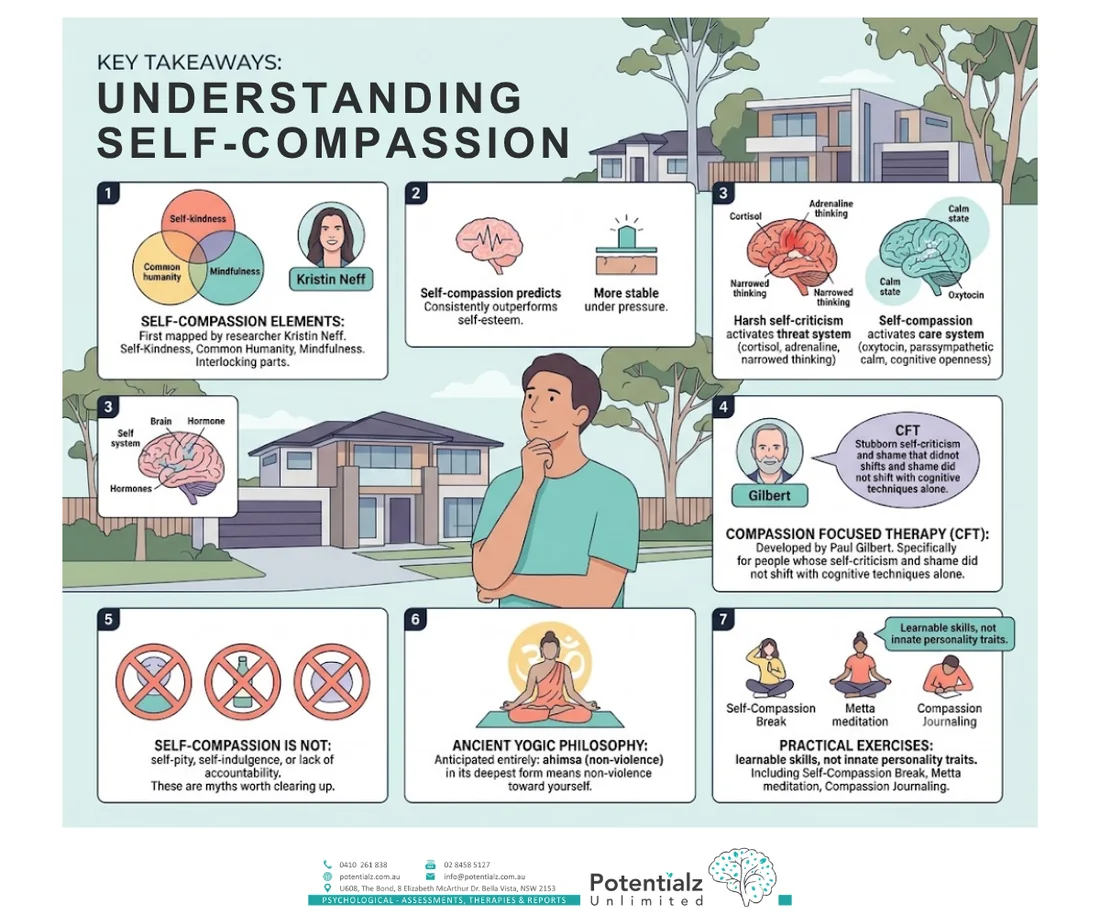
- Self compassion is made up of three interlocking elements — self-kindness, common humanity, and mindfulness — first mapped by researcher Kristin Neff.
- Research consistently shows self compassion predicts better mental health outcomes than self-esteem, and it is more stable under pressure.
- Harsh self-criticism activates the brain’s threat system (cortisol, adrenaline, narrowed thinking). Self compassion activates the care system (oxytocin, parasympathetic calm, cognitive openness).
- Paul Gilbert’s Compassion Focused Therapy was designed specifically for people whose self-criticism and shame did not shift with cognitive techniques alone.
- Self compassion is NOT self-pity, self-indulgence, or a lack of accountability. These are myths worth clearing up before anything else.
- Ancient yogic philosophy anticipated this entirely: ahimsa (non-violence) in its deepest form means non-violence toward yourself.
- Practical self compassion exercises — including the Self-Compassion Break, Metta meditation, and compassion journaling — are learnable skills, not innate personality traits.
Introduction
When was the last time you spoke to yourself the way you speak to someone you genuinely love?
Most of us have a huge capacity for kindness toward other people. We are patient with a friend who is falling apart. We forgive a colleague’s mistake without much thought. We understand that being human means getting things wrong, struggling, and sometimes completely falling short.
But the moment we turn that same gaze inward — toward our own failures, our own struggles, our own imperfections — something shifts. The voice that appears is rarely gentle. It replays mistakes on a loop. It tells us we are not good enough, that we should have known better, that everyone else is managing better than we are. And it does this with a conviction that feels like truth.
That voice is not your conscience. It is your inner critic. And it is doing far more damage than you probably realise.
Here’s what I want you to know before we go any further: self compassion is not about letting yourself off the hook. It is not weakness. It is not self-pity. It is the recognition that you — like every other human being — deserve the same warmth you so readily extend to others.
And the research is now very clear: learning to offer yourself that kindness is one of the most powerful things you can do for your mental health.
What Self Compassion Actually Is (and What It Is Not)
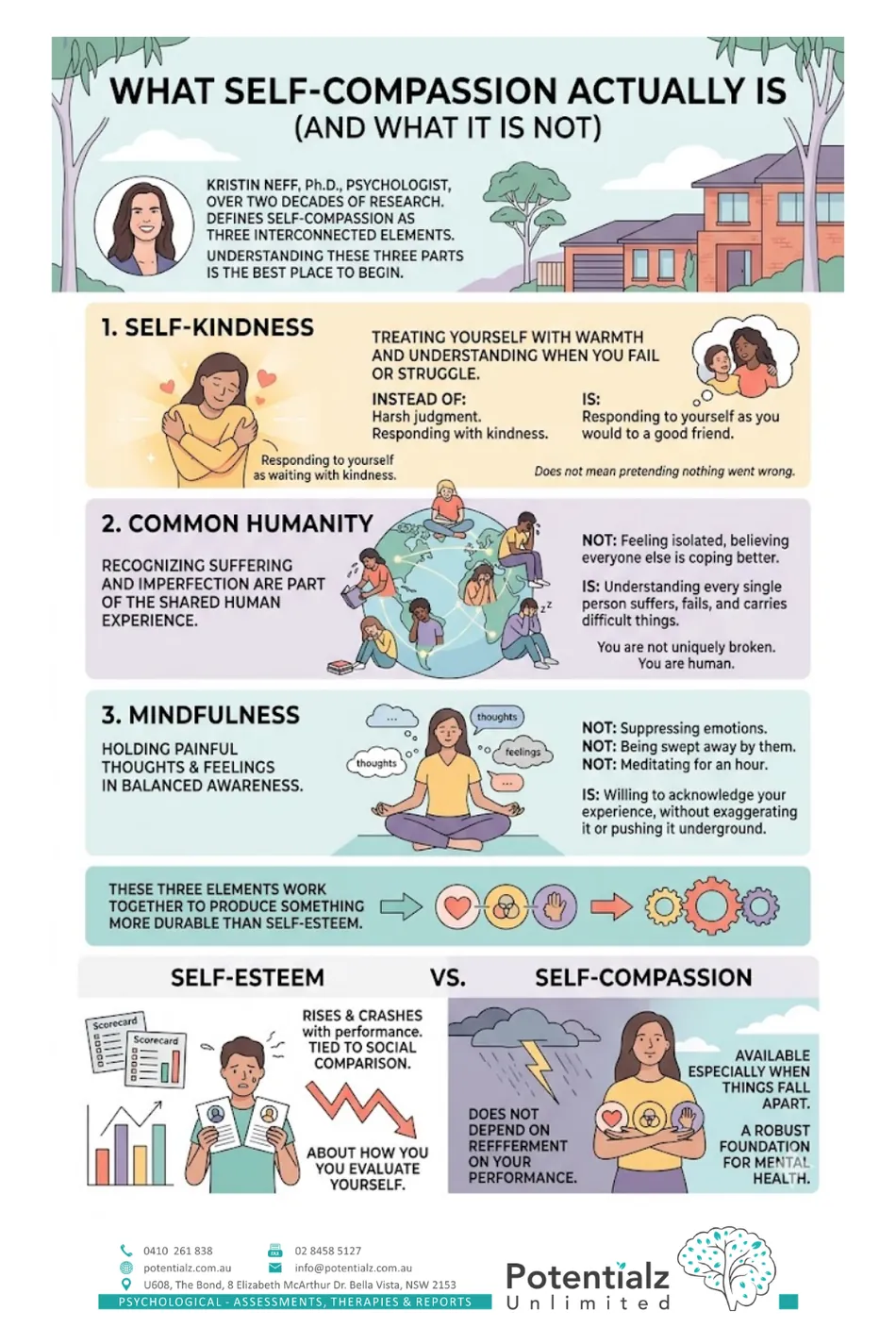
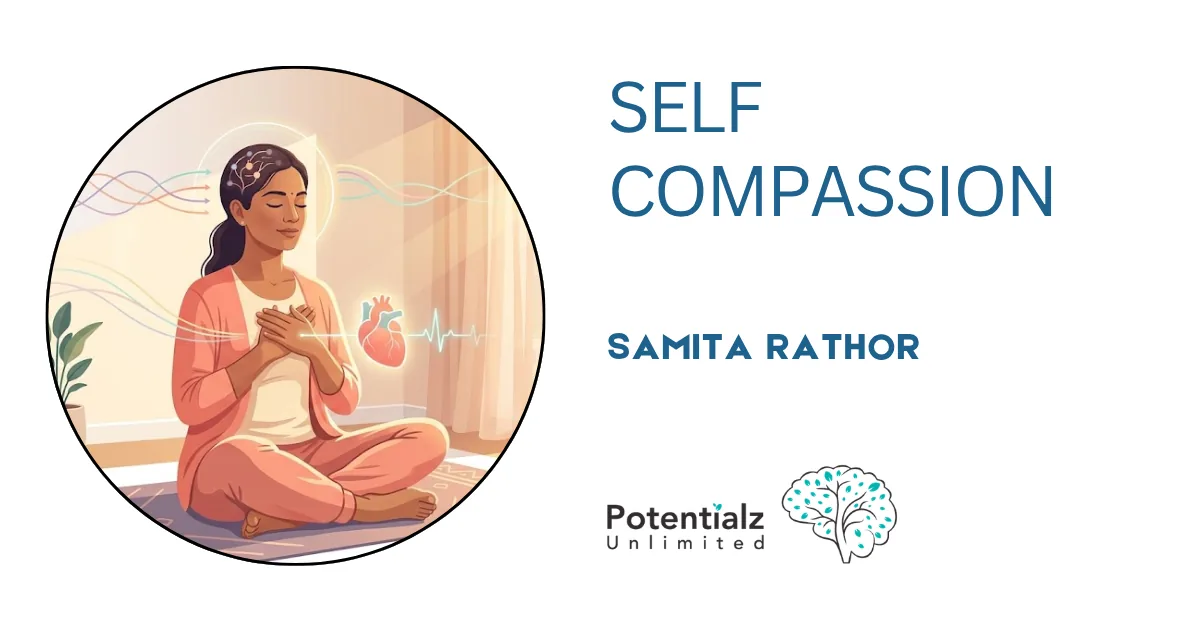
Kristin Neff, a psychologist who has spent more than two decades researching self compassion, defines it as three elements that work together. Understanding these three parts is the best place to begin.
Self-kindness means treating yourself with warmth and understanding when you fail, struggle, or notice something you do not like about yourself — rather than responding with harsh judgment. It does not mean pretending nothing went wrong. It means responding to it the way you would respond to a good friend in the same situation.
Common humanity is the recognition that suffering and imperfection are part of the shared human experience. When things go wrong, we tend to feel isolated — as though everyone else is coping better, managing more smoothly, living more put-together lives. Common humanity says: every single person on this planet suffers. Every person fails. Every person carries something difficult. You are not uniquely broken. You are human.
Mindfulness is the third element — the ability to hold your painful thoughts and feelings in balanced awareness, rather than suppressing them or being swept away by them. Mindfulness here does not mean meditating for an hour. It means being willing to acknowledge what you are experiencing, without exaggerating it or pushing it underground.
These three elements work together. And they produce something more durable than self-esteem.
Self-esteem is about how you evaluate yourself — how good or bad you feel about who you are. It tends to rise when things are going well and crash when they are not. It is also tied to social comparison — which means it is always at the mercy of someone else performing better, achieving more, or appearing more together.
Self compassion does not depend on your performance. It is available to you especially when things fall apart. That is what makes it such a robust foundation for mental health.
The Inner Critic: Where It Comes From
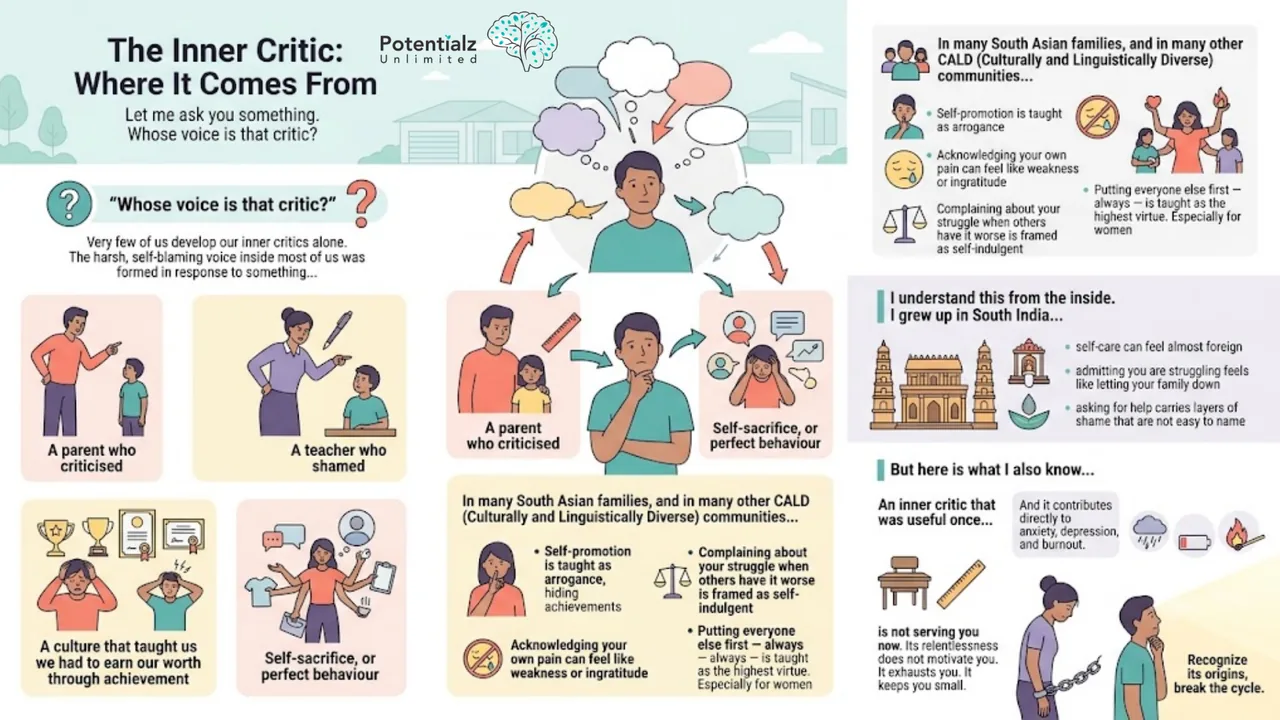
Let me ask you something. Whose voice is that critic?
Very few of us develop our inner critics alone. The harsh, self-blaming voice inside most of us was formed in response to something — a parent who criticised, a teacher who shamed, a culture that taught us we had to earn our worth through achievement, self-sacrifice, or perfect behaviour.
In many South Asian families, and in many other CALD (Culturally and Linguistically Diverse) communities, the inner critic can be particularly fierce. Self-promotion is taught as arrogance. Acknowledging your own pain can feel like weakness or ingratitude. Complaining about your struggle when others have it worse is framed as self-indulgent. Putting everyone else first — always — is taught as the highest virtue. Especially for women.
I understand this from the inside. I grew up in South India. I know what it is to come from a culture where the concept of self-care can feel almost foreign. Where admitting you are struggling feels like letting your family down. Where asking for help carries layers of shame that are not easy to name.
But here is what I also know — both from lived experience and from years of practice: an inner critic that was useful once, that helped you survive a critical environment or a school system that punished mistakes, is not serving you now. Its relentlessness does not motivate you. It exhausts you. It keeps you small. And it contributes directly to anxiety, depression, and burnout.
Understanding where the inner critic came from is not the same as excusing its cruelty. It is the first step toward changing your relationship with it.
The Science: Why Kindness Is Biological
Here’s something I love sharing with clients, because it takes the idea of self compassion out of the realm of “soft” and places it firmly in science.
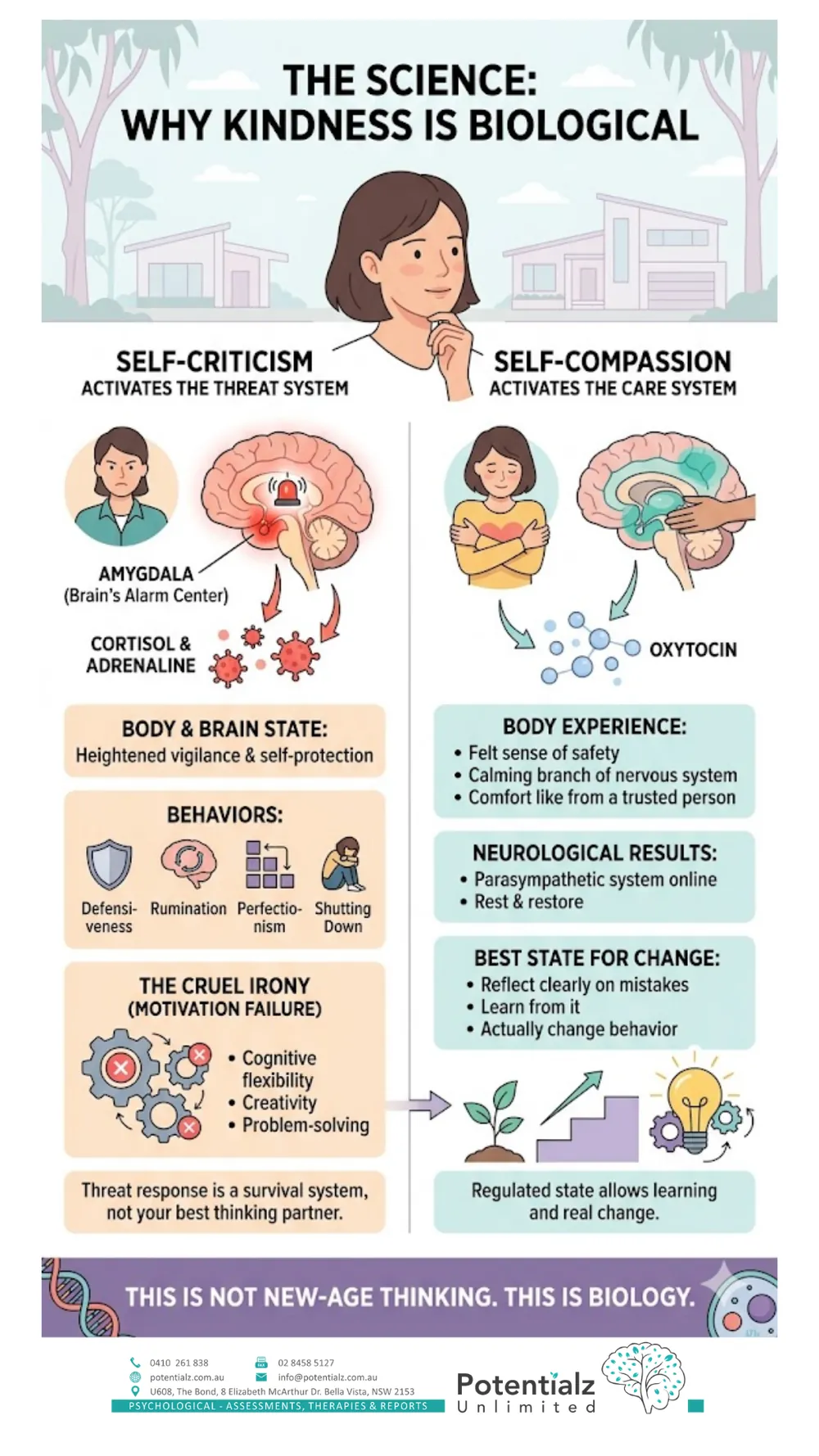
When you criticise yourself harshly, you activate your threat system. This is the part of your nervous system governed by the amygdala — the brain’s alarm centre. Threat responses trigger the release of cortisol and adrenaline. Your body and brain enter a state of heightened vigilance and self-protection. This looks like defensiveness, rumination, perfectionism, or shutting down.
The cruel irony is that we often use self-criticism to try to motivate ourselves, or to stop ourselves from making the same mistake again. But the threat system is not your best thinking partner. It is your survival system. Under threat, your cognitive flexibility, creativity, and problem-solving all narrow significantly.
Self compassion activates your care system instead — associated with the hormone oxytocin, the calming branch of the nervous system, and a felt sense of safety. When you treat yourself with warmth, your body experiences something similar to being comforted by a trusted person. The nervous system settles. The parasympathetic system — rest and restore — comes online.
From that regulated, settled state, you are far better able to reflect clearly on what went wrong, learn from it, and actually change your behaviour — compared to the state of self-flagellation. Self compassion does not let you off the hook. It puts you in the best neurological condition to do something about what needs changing.
This is not new-age thinking. This is biology.
Paul Gilbert, who developed Compassion Focused Therapy (CFT), drew on evolutionary neuroscience to map these two systems precisely. He observed that many of his patients had mastered cognitive therapy techniques but still felt little emotional relief — because shame and self-criticism required a different approach. CFT specifically targets the tone of self-talk, transforming harsh self-judgment into compassionate warmth. Multiple randomised controlled trials have since confirmed its effectiveness for shame, self-criticism, depression, and anxiety (Gilbert, 2010; Leaviss & Uttley, 2015).
Myths Worth Clearing Up
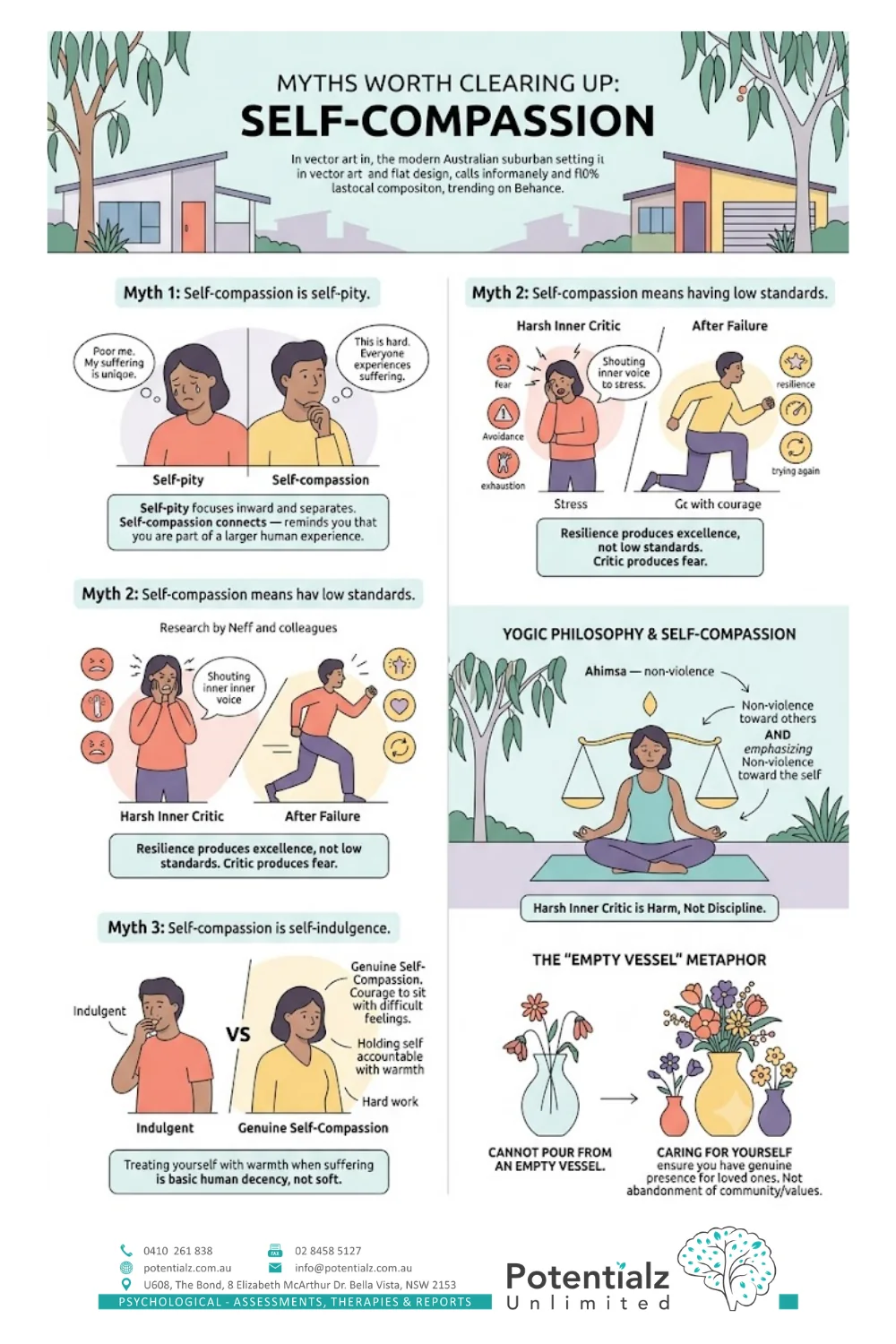
Before we get to the practical exercises, I want to address the three myths that most often get in the way of people taking self compassion seriously.
Myth 1: Self compassion is self-pity.
Self-pity says: “Poor me. My suffering is unique and worse than everyone else’s.” Self compassion says: “This is hard. Suffering is something every human being experiences.” Self-pity focuses inward and separates. Self compassion connects — it reminds you that you are part of a larger human experience. They are not the same thing at all.
Myth 2: Self compassion means having low standards.
Research by Neff and colleagues shows the opposite is true. People high in self compassion are not less motivated or less accountable — they are more resilient when they fail, more willing to try again, and less likely to give up after setbacks. The harshness of the inner critic does not produce excellence. It produces fear, avoidance, and exhaustion.
Myth 3: Self compassion is self-indulgence.
Treating yourself with warmth when you are suffering is not indulgence. It is basic human decency extended toward yourself. Genuine self compassion often requires courage — the courage to sit with difficult feelings rather than distract from them, and to hold yourself accountable with warmth rather than punishment. That is not soft. That is hard work.
Yogic philosophy anticipated all of this. Ahimsa — non-violence — is one of the foundational principles of the yoga tradition. We usually understand it as non-violence toward others. But in its deepest form, ahimsa includes non-violence toward the self. The harsh inner critic, in yogic terms, is not discipline. It is harm.
You cannot pour from an empty vessel. Caring for yourself is not abandoning your community or your values. It is ensuring you have something genuine to bring to the people you love.
Self Compassion Exercises You Can Begin Today
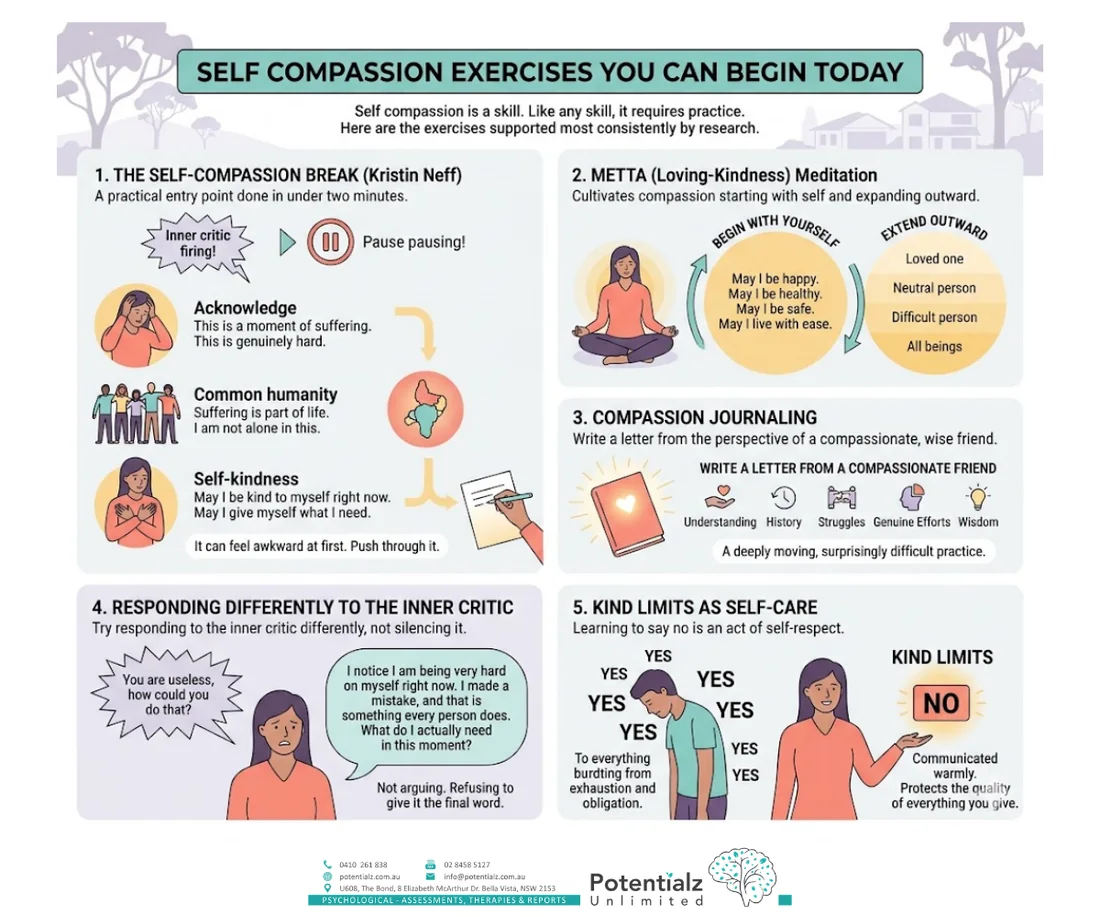
Self compassion is not something you think your way to through intention alone. It is a skill. Like any skill, it requires practice. Here are the self compassion exercises I use most often in my work with clients — and that the research supports most consistently.
Exercise 1: The Self-Compassion Break (Kristin Neff)
This is the most practical entry point — and it can be done in under two minutes, anywhere. When you notice the inner critic firing, or when something goes wrong, pause and follow these three steps (out loud or in writing):
- Acknowledge: “This is a moment of suffering. This is genuinely hard.”
- Common humanity: “Suffering is part of life. I am not alone in this.”
- Self-kindness: “May I be kind to myself right now. May I give myself what I need.”
It can feel awkward at first — especially if self compassion is unfamiliar territory. That awkwardness is completely normal and worth pushing through.
Exercise 2: Metta (Loving-Kindness) Meditation
Metta is an ancient Buddhist practice that cultivates compassion, beginning with the self and expanding outward. The research supporting Metta for wellbeing, anxiety, and depression is now extensive (Zeng et al., 2015). Sit quietly and repeat these phrases silently, directing them first toward yourself:
May I be happy. May I be healthy. May I be safe. May I live with ease.
Then extend the same phrases outward — to someone you love, then to a neutral person, then to a difficult person, then to all beings. Beginning with yourself is often the hardest step. And the most important one.
Exercise 3: Compassion Journaling
When you are struggling or have been harsh with yourself, write a letter from the perspective of a deeply compassionate, wise friend who knows everything about you — your history, your struggles, your genuine efforts. What would that friend say? What would they understand? What would they encourage?
Many clients find this practice deeply moving, and surprisingly difficult. That difficulty is important information about how rarely they have extended that quality of care toward themselves.
Exercise 4: Responding Differently to the Inner Critic
Rather than trying to silence the inner critic — which rarely works, and often makes it louder — try responding to it differently. When the critic says, “You are so useless, how could you do that?” — try:
“I notice I am being very hard on myself right now. I made a mistake, and that is something every person does. What do I actually need in this moment?”
This is not arguing with the critic. It is simply refusing to give it the final word.
Exercise 5: Kind Limits as Self-Care
One of the most misunderstood aspects of self compassion is that it includes learning to say no. Setting limits with others is not selfishness — it is an act of self-respect that also protects the quality of everything you give. When you say yes to everything from exhaustion and obligation, you are not giving your best. You are running on empty. A kind, clear limit — communicated warmly — is self compassion in action.
For more on the role of breathwork and nervous system regulation in self compassion work, see my guide to conscious breathing for mental wellness. And if you are exploring mindfulness as a companion practice, you may also find meditation for the modern mind useful.
How Self Compassion Changes Relationships
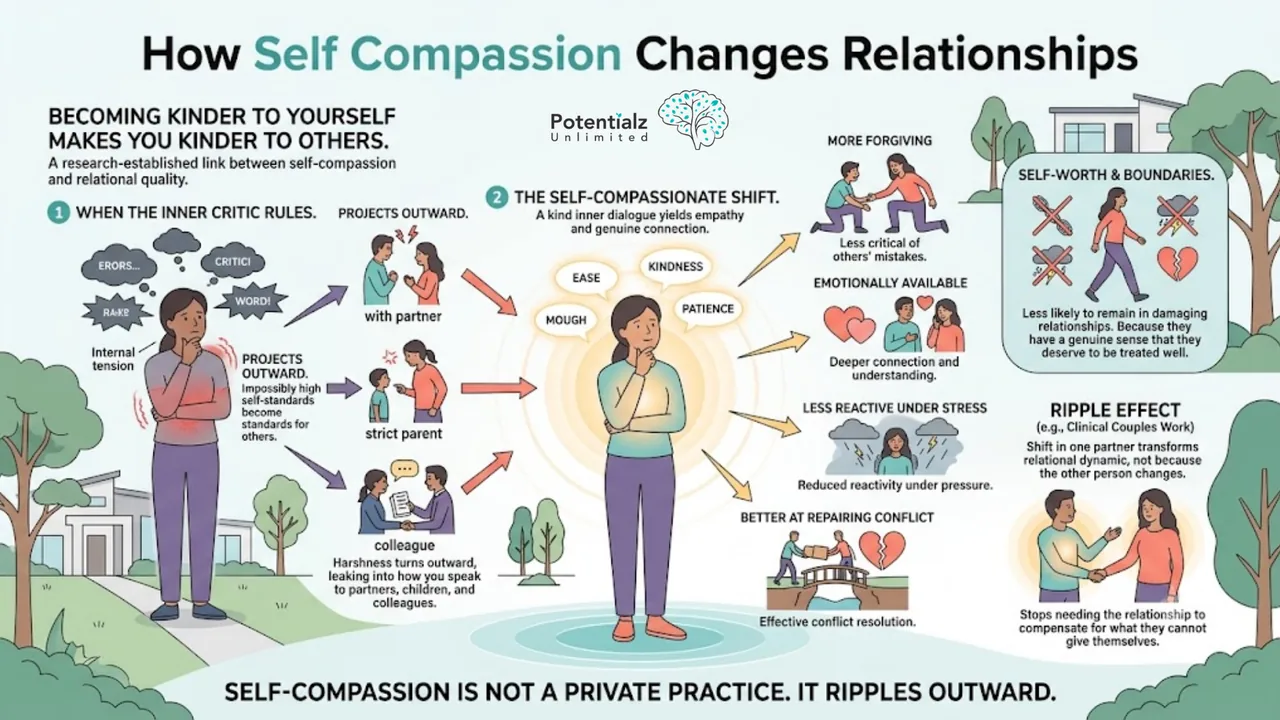
Here is something that surprises many people: when you become kinder to yourself, you almost inevitably become kinder to others.
The relationship between self compassion and relational quality is well-established in the research. People who score high on self compassion tend to be more forgiving of others, more emotionally available in relationships, less reactive under stress, and better at repairing conflict. They are also less likely to remain in relationships that are damaging — because they have a genuine sense that they deserve to be treated well.
The reverse is equally true. When the inner critic is running the show, it tends to project outward. The impossibly high standards you hold yourself to become the standards you hold others to. The harshness you turn on yourself leaks into how you speak to your partner, your children, your colleagues.
I have seen this shift in couples work many times. When one partner begins to cultivate genuine self compassion, the relational dynamic often changes — not because the other person changes, but because the first person stops needing the relationship to compensate for what they cannot give themselves.
Self compassion is not a private practice. It ripples outward.
When the Inner Critic Is Too Loud for Self-Help Alone
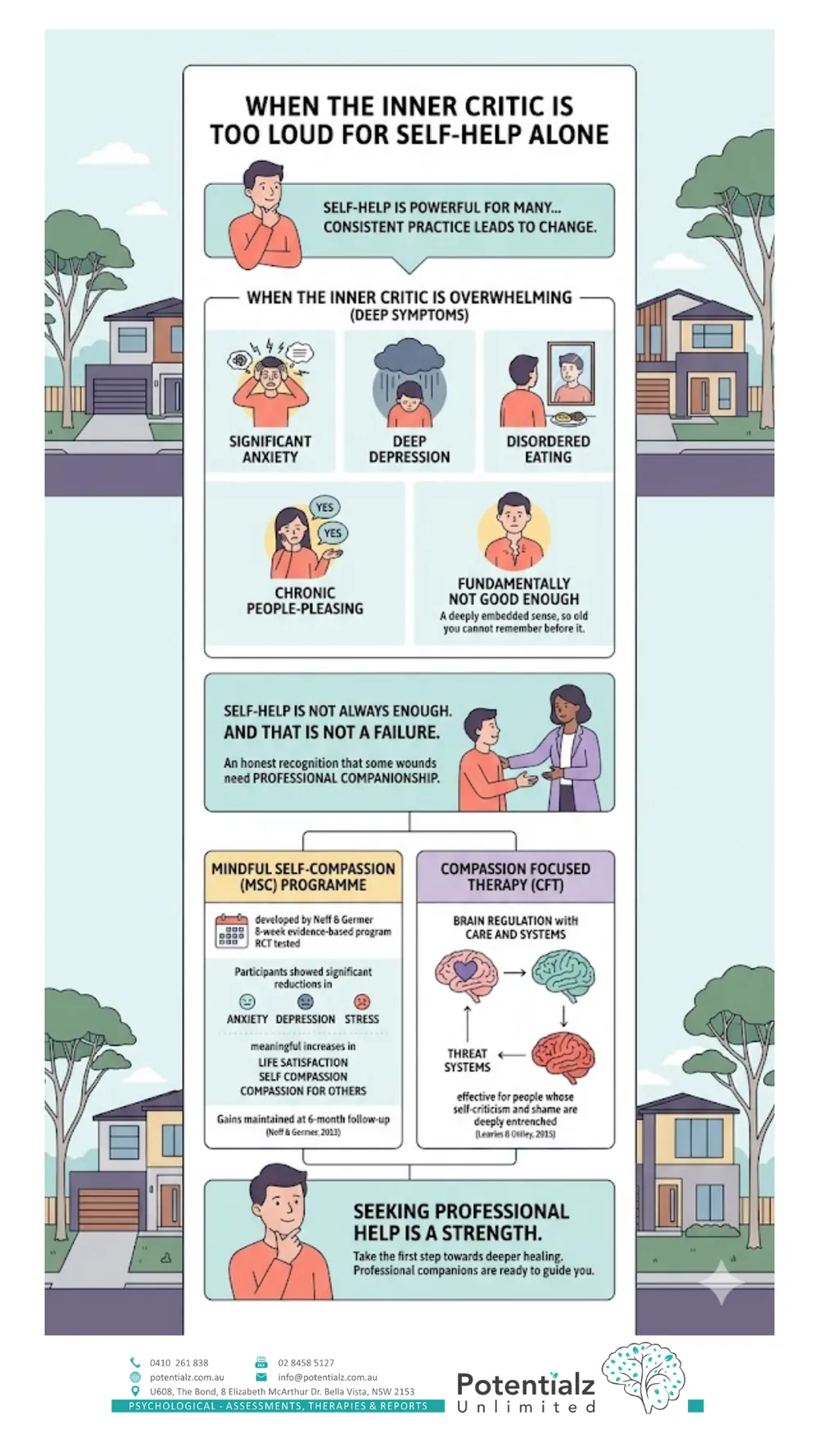
I want to be honest with you here. The exercises above are genuinely powerful. For many people, practised consistently with patience, they produce real and lasting change.
But for some people, the inner critic is not just loud. It is overwhelming. It is the voice behind significant anxiety, deep depression, disordered eating, chronic people-pleasing, or a sense of being fundamentally not good enough — a sense so old and deep that you cannot quite remember a time before it.
If that is where you are, self-help is not going to be enough. And that is not a failure. It is simply an honest recognition that some wounds need professional companionship.
The Mindful Self-Compassion (MSC) programme, developed by Neff and Germer, is an eight-week evidence-based programme that has been tested in multiple randomised controlled trials. Participants showed significant reductions in anxiety, depression, and stress, alongside meaningful increases in life satisfaction, self compassion, and compassion for others — with gains maintained at six-month follow-up (Neff & Germer, 2013). Compassion Focused Therapy (CFT) has similarly demonstrated effectiveness for people whose self-criticism and shame are deeply entrenched (Leaviss & Uttley, 2015).
In my counselling work, I draw on both these traditions — alongside yogic philosophy, somatic awareness, and breathwork — to support clients in building a genuinely kinder relationship with themselves. This is not quick work. But it is deeply possible. And you deserve support in reaching it.
A Local Perspective: Hills District and Norwest
The communities I work with in Bella Vista, Norwest, Castle Hill, Baulkham Hills, and the broader Hills District carry their own particular textures of self-criticism. Many of my clients are high-achieving professionals, parents carrying enormous invisible loads, and individuals navigating the gap between cultural identity and lived experience in the Sydney western suburbs.
The pressure to perform, to provide, to hold everything together — and to do it without complaint — is real here. The inner critic that feeds on that pressure is very familiar to me.
If any of that resonates with where you live and who you are, you are welcome at Potentialz Unlimited. You do not need to have everything figured out before you come. That is what the first session is for.
How Samita Can Help
If you have spent a lifetime being harder on yourself than you would ever be on anyone else, I want you to hear something clearly: that is not who you are. That is a pattern you learned. And patterns can change.
At Potentialz Unlimited in Bella Vista, I bring together evidence-based counselling, yogic philosophy (including the practice of ahimsa — non-violence toward the self), mindfulness, somatic awareness, and genuine warmth to support you in building a kinder, more sustainable relationship with yourself.
This work is particularly close to my heart. As someone who grew up in South India, navigating those same cultural expectations and unwritten rules about self-sacrifice and worthiness, I understand this territory from the inside. You do not need to explain yourself to me.
Whether your inner critic shows up as anxiety, perfectionism, chronic self-doubt, burnout, or a quiet but persistent sense that you are not quite enough — I can help. You can read more about me on the our team page.
Sessions are available in person at Bella Vista and via Telehealth (phone or Zoom) across Australia. I work in English, Hindi, Tamil, Kannada, and Urdu. No referral is required.
- Book online: live.potentialz.com.au
- Call: 0410 261 838
- Get in touch: contact us
References
Gilbert, P. (2010). The compassionate mind: A new approach to life’s challenges. New Harbinger Publications.
Leaviss, J., & Uttley, L. (2015). Psychotherapeutic benefits of compassion-focused therapy: An early systematic review. Psychological Medicine, 45(5), 927–945. https://doi.org/10.1017/S0033291714002141
Leary, M. R., Tate, E. B., Adams, C. E., Allen, A. B., & Hancock, J. (2007). Self-compassion and reactions to unpleasant self-relevant events: The implications of treating oneself kindly. Journal of Personality and Social Psychology, 92(5), 887–904. https://doi.org/10.1037/0022-3514.92.5.887
Neff, K. D. (2011). Self-compassion: The proven power of being kind to yourself. William Morrow.
Neff, K. D., & Dahm, K. A. (2015). Self-compassion: What it is, what it does, and how it relates to mindfulness. In B. D. Ostafin, M. D. Robinson, & B. P. Meier (Eds.), Handbook of mindfulness and self-regulation (pp. 121–137). Springer.
Neff, K. D., & Germer, C. K. (2013). A pilot study and randomized controlled trial of the mindful self-compassion program. Journal of Clinical Psychology, 69(1), 28–44. https://doi.org/10.1002/jclp.21923
Zeng, X., Chiu, C. P. K., Wang, R., Oei, T. P. S., & Leung, F. Y. K. (2015). The effect of loving-kindness meditation on positive emotions: A meta-analysis. Frontiers in Psychology, 6, 1693. https://doi.org/10.3389/fpsyg.2015.01693
Crisis and Support Resources
If you or someone you know needs immediate support, please reach out:
- Lifeline: 13 11 14 (24/7 crisis support)
- Beyond Blue: 1300 22 4636
- Kids Helpline: 1800 55 1800
- Emergency: 000
Disclaimer: Samita Rathor is an Accredited Counsellor and Psychotherapist registered with PACFA (Psychotherapy and Counselling Federation of Australia) and the ACA. She is not a registered psychologist under AHPRA. This information is general in nature and does not constitute clinical advice. If you are experiencing significant distress, please contact your GP, a mental health professional, or one of the crisis services listed above. The team at Potentialz Unlimited also includes AHPRA-registered psychologists.
Related Reading
Knowledge Check Quiz
Test what you have just read. Choose your answer for each question, then submit to reveal the answers and your score.
Need Professional Support?
If you're experiencing mental health concerns, our team is here to help.