The Person Who Finally Googled It at 38
You are 38. You have a good job, a family, a mortgage. You have spent most of your working life mildly ashamed of a private truth: that the amount of effort you put into looking organised is much larger than everyone around you seems to spend. Your phone is a graveyard of half-open apps. Your inbox is 4,712 unread. You started this article at 9pm on a Tuesday and by 9:03 you were already three tabs deep into something unrelated.
Something a friend said last month keeps circling back. She was diagnosed with ADHD at 42, and she told you it was like being handed a manual to a machine she had been trying to operate without one for four decades. You laughed. Then you did not laugh, because it landed.
If any of this is familiar, you are not alone, and you are not lazy. Adult ADHD is one of the most under-recognised presentations in Australian mental health. Many adults — particularly women, high-IQ people, and those with the inattentive presentation — grew up before ADHD was well understood, developed elaborate coping strategies to compensate, and are now hitting the wall of adult demand: multiple children, career progression, ageing parents, and a nervous system that never quite scales.
Why Adult ADHD Gets Missed
For most of the twentieth century, ADHD was understood as a childhood condition — hyperactive boys who could not sit still in Year 4. That picture was too narrow. It missed the inattentive presentation, which is quieter and easier to overlook. It missed girls and women, whose ADHD often shows as internal restlessness, chronic overwhelm, and social masking rather than visible disruption. And it missed the fact that ADHD does not evaporate at 18 — the symptom profile changes, but the underlying neurodevelopmental difference persists.
The International Consensus Statement on ADHD (Faraone et al., 2021) — endorsed by more than 80 international experts — is clear: adult ADHD is a valid, treatable neurodevelopmental disorder with substantial impact on functioning, mental health, and long-term outcomes when untreated. Prevalence estimates in adults sit around 2.5–4%, and a large share of currently symptomatic adults were never identified as children.
In my clinical practice in Bella Vista, the most common presentation I see is a professional in their 30s or 40s — often a woman, often the parent of a recently-diagnosed child — who has been quietly managing for decades and has finally run out of workaround. The child’s assessment held up a mirror. The mirror kept looking familiar.
What Adult ADHD Actually Looks Like
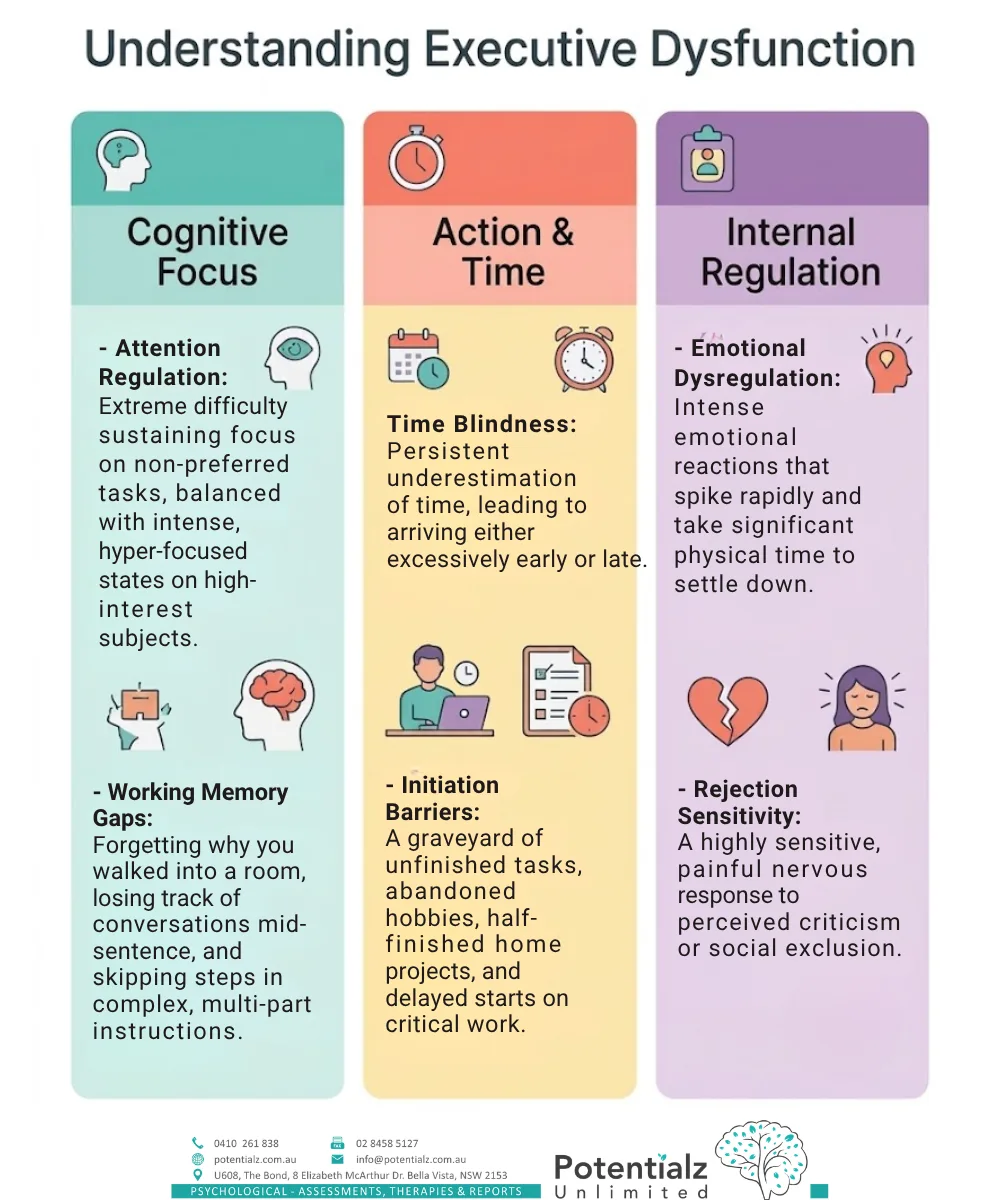
Adult ADHD is not “having a busy mind.” It is a persistent pattern of executive-function difficulties that meaningfully interferes with work, relationships, or daily life. Common features:
- Attention regulation — difficulty sustaining focus on non-preferred tasks, but sometimes hyper-focusing to the exclusion of everything else on preferred ones
- Working memory difficulty — losing the second half of a sentence, forgetting why you walked into the room, missing steps in multi-part tasks
- Time blindness — chronic underestimation of how long things take; either arriving very early or very late
- Task initiation and follow-through — projects started with enthusiasm and abandoned; a graveyard of hobbies, subscriptions, and half-decorated rooms
- Emotional dysregulation — intensity of feeling that arrives fast and takes a long time to settle; low frustration tolerance
- Rejection sensitivity — an outsized emotional response to perceived criticism or being left out
- Restlessness — often internal in adults, not the visible bouncing of childhood; a difficulty being still without a phone
None of these features on their own means ADHD. Everyone forgets a birthday. But when the pattern is lifelong, pervasive, and causing real impairment across multiple domains, it warrants proper assessment.
Assessment Comes First — Not a Checklist, Not a Cure
One of the concerns I hear from GPs, and from thoughtful patients, is that ADHD assessment has become a fast lane in some corners of the internet. It should not be. A proper adult ADHD assessment is careful, comprehensive, and takes time — because the diagnosis carries real implications and because so many other things can look like ADHD.
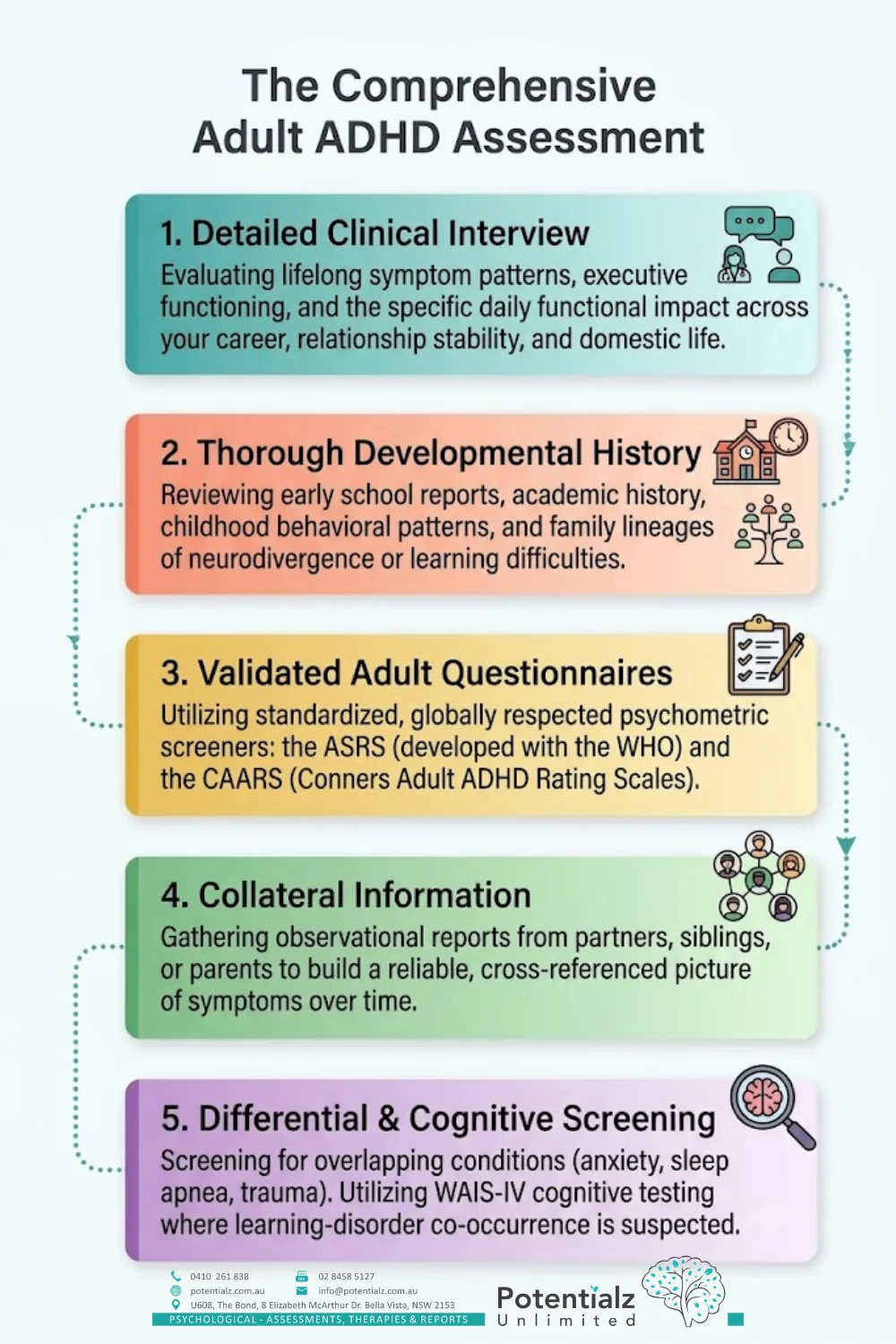
A good adult ADHD assessment includes:
- A detailed clinical interview covering current symptoms, functional impact across work, relationships, and daily life, and any co-occurring difficulties
- A thorough developmental history — school reports, patterns from childhood and adolescence, family history of ADHD or learning differences
- Validated adult questionnaires — the ASRS (Adult ADHD Self-Report Scale, developed with the WHO) and the CAARS (Conners Adult ADHD Rating Scales) are the workhorses
- Collateral information where possible — a partner, sibling, or parent whose view of you across time adds to the picture
- Differential and comorbid screening — anxiety, depression, trauma, sleep disorders, autism, learning disorders, and thyroid/iron/B12 all overlap symptomatically
- Cognitive testing where indicated — WAIS-IV for cognitive profile, WIAT-III for academic skills, particularly if learning-disorder co-occurrence is suspected
The output is a formulation, not a checklist tick. Some people I assess do not meet criteria for ADHD, and the assessment instead illuminates chronic anxiety, undertreated depression, sleep deprivation, or trauma sequelae — all of which are treatable, but treated very differently. For a step-by-step walk-through of the process, see what to expect from an adult ADHD assessment.
The Grief That Often Comes With Diagnosis
People sometimes expect diagnosis to feel like relief. Often the first response is more layered. There is relief, yes — a name for something long felt but never explained. But there is also often grief. Grief for years of trying harder and blaming yourself. Grief for the job you left, the relationship that ended, the degree that never finished, the mornings you called in sick because you could not face another day of feeling behind.
What I see in the room is that this grief matters. If it goes unnamed, it can turn into a low-grade anger at the systems, teachers, and parents who missed it — an anger which, unprocessed, chews through the energy that could be going into the practical work of treatment. Making room for the grief early — often within an ACT frame of values, self-compassion, and workable action — is one of the most important early moves in post-diagnostic therapy.
Multicultural context matters here too. In many South Asian and other cultural contexts, mental health language was scarce or stigmatised in previous generations. A child who could not sit still was often “naughty” and disciplined; a child who could not focus was often “lazy” and pushed harder. Many adults arrive at diagnosis carrying decades of that framing from parents and teachers. Naming that context, without blame, is part of the work.
What Actually Helps: Multimodal Treatment
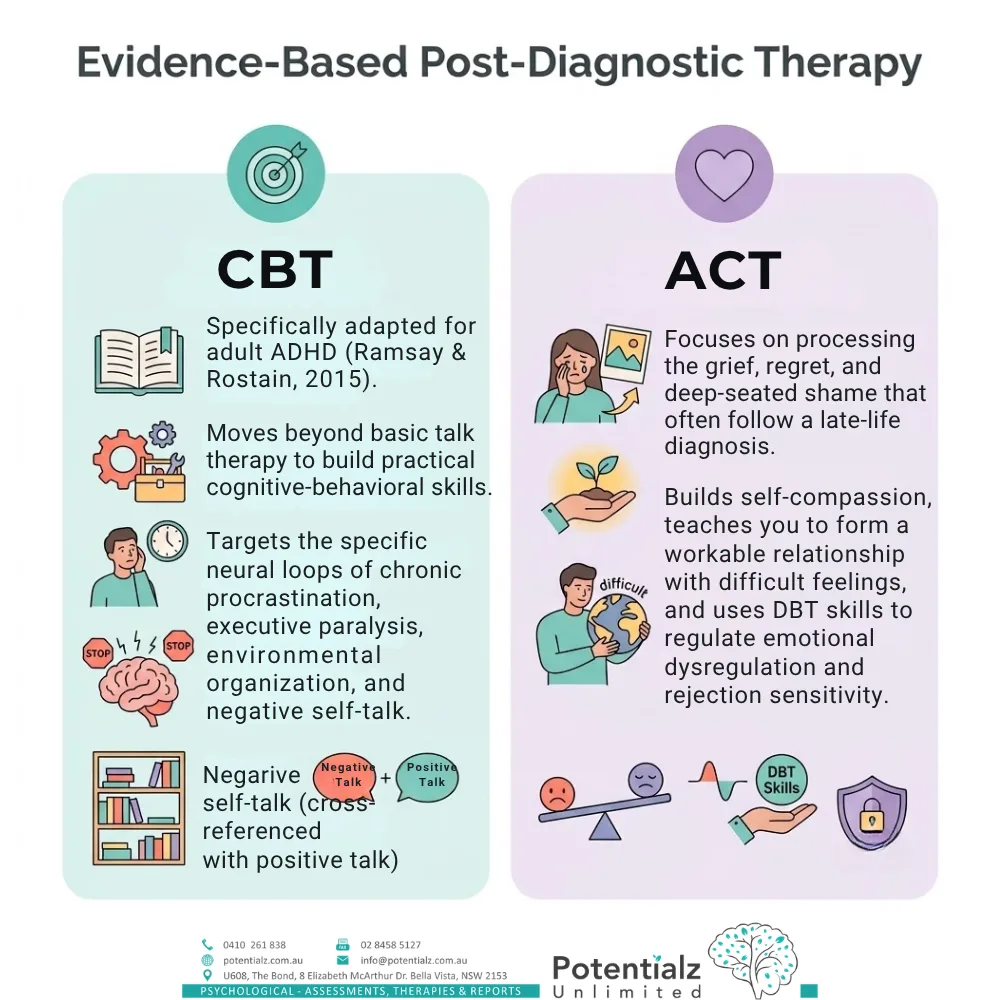
Modern evidence supports multimodal treatment for adult ADHD — a combination of pharmacological, psychological, and lifestyle interventions tailored to the person.
Medication. For many adults with ADHD, stimulant or non-stimulant medication (prescribed by a psychiatrist or paediatrician) is a genuinely helpful part of treatment. It does not “fix” ADHD, but it can materially improve the neurochemical baseline from which everything else — therapy, systems, sleep — becomes easier to build. Medication decisions belong with a prescribing doctor, not a psychologist.
Psychological therapy specifically adapted for ADHD. This is where I sit. The strongest randomised-controlled evidence supports CBT adapted for adult ADHD (Ramsay & Rostain, 2015; Knouse et al., 2017) — treatment that goes beyond generic CBT to target the specific patterns of procrastination, time management, organisation, and negative self-talk that ADHD produces. Metacognitive therapy (Solanto, 2011) is another well-evidenced protocol built specifically around executive-function skills.
Alongside CBT, ACT (Acceptance and Commitment Therapy) is particularly powerful for the shame and rigidity that often accompany ADHD — building values-based action, self-compassion, and workable relationship with difficult feelings. DBT skills (Distress Tolerance, Emotion Regulation, Interpersonal Effectiveness) add practical tools for the emotional dysregulation and rejection sensitivity that so many adults with ADHD describe. Where trauma is intertwined — and it often is, given the accumulated hits of a life spent feeling behind — EMDR can be added to reprocess specific trauma memories.
Environmental and lifestyle scaffolding. Sleep, exercise, and structure are not optional extras for ADHD; they are core treatment. The Noetel et al. (2024) umbrella review confirmed that regular exercise produces clinically meaningful improvements in anxiety and depressive symptoms — both frequent companions of adult ADHD. Consistent sleep, morning light, protein-forward breakfasts, external structure (visible calendars, single-task tools, timers), and reducing decision load all matter.
What Treatment Actually Looks Like in the Room
A typical post-diagnostic treatment journey I offer runs across roughly 8–15 sessions, longer if trauma or complex comorbidity is present. Early sessions focus on psychoeducation, formulation, and the grief work. Middle sessions build ADHD-specific CBT skills — task initiation, time estimation, environmental design, cognitive work on the “I am lazy / I am broken” story. Later sessions consolidate DBT emotion-regulation and distress-tolerance skills, and integrate any trauma work with EMDR where indicated.
Progress is not linear. A common pattern is a big early gain, followed by a plateau where the old habits reassert themselves, followed by a slower consolidation as new systems become internalised. I say this at the start so it does not feel like failure when it happens.
If your low mood ever brings thoughts of not wanting to be here, please reach out for urgent support now: call Lifeline on 13 11 14, contact Beyond Blue on 1300 22 4636, or in an emergency call 000.
Common Co-Occurring Conditions to Watch For
Adult ADHD rarely arrives alone. In my practice, I most often see it alongside:
- Anxiety disorders — generalised anxiety, social anxiety
- Depression — often reactive to years of underperforming relative to potential
- Sleep disruption — delayed sleep phase, insomnia, restless nights
- Substance patterns — self-medication with caffeine, alcohol, or nicotine
- Trauma — from bullying, academic failure narratives, or unrelated events
- Autism spectrum features — the overlap is meaningful and needs careful differentiation; where autism is suspected, a dedicated adult autism assessment may be warranted
Treating ADHD without treating the co-occurring conditions is like fixing one wheel on a wobbly car. The whole picture matters.
ADHD in Women — The Presentation Most Often Missed
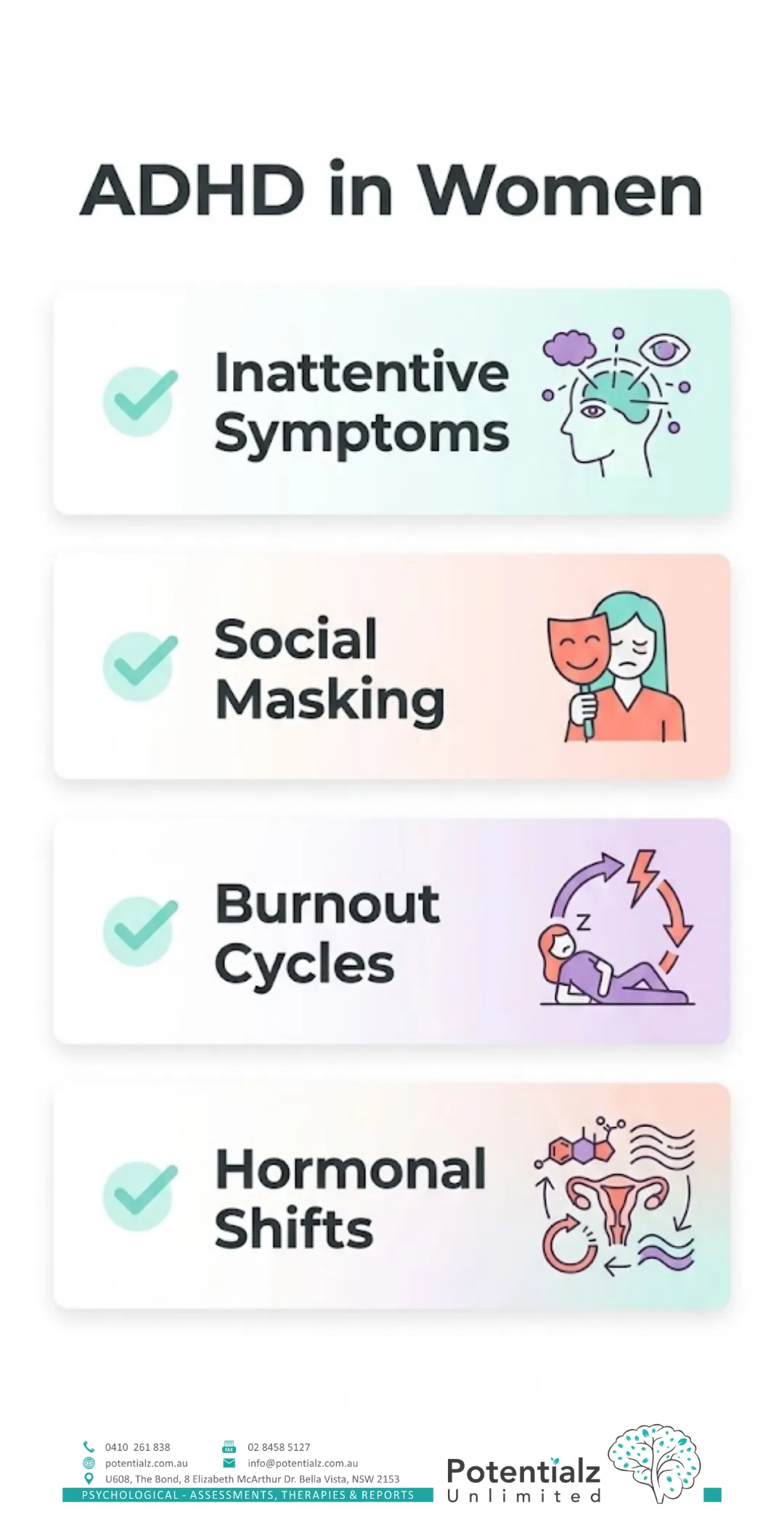
The under-recognition of ADHD in women deserves its own paragraph, because it is one of the most common patterns I see. The Females with ADHD expert consensus statement (Young et al., 2020) makes the point clearly: girls and women with ADHD are diagnosed later, treated less often, and more likely to be misdiagnosed with anxiety or depression alone. Several factors converge. Girls more often present with the inattentive rather than hyperactive-impulsive picture, which is less disruptive at school and easier to overlook. Girls tend to develop more sophisticated social masking earlier, camouflaging their difficulties with hyper-organisation, people-pleasing, and quiet over-effort. Hormonal shifts across the menstrual cycle, pregnancy, postpartum, and perimenopause meaningfully affect symptom severity — many women I assess in their 40s describe a distinct worsening of ADHD symptoms in perimenopause that finally makes their lifelong pattern impossible to hide.
The clinical implication is important. A woman presenting with treatment-resistant anxiety, chronic overwhelm, cycles of high-functioning burnout, or a child who has just been diagnosed with ADHD deserves a careful look at whether ADHD sits underneath. Treating the surface anxiety without recognising the underlying ADHD often means the anxiety keeps returning.
What About the Workplace?
Adult ADHD has real workplace implications, and the honest conversation about them is part of good treatment. Under the Disability Discrimination Act, ADHD can be a recognised disability, and reasonable workplace adjustments — flexible start times, quiet workspaces, written follow-ups after verbal instructions, meeting agendas circulated in advance — can substantially improve function. Whether and how to disclose is a personal decision, and one worth working through in therapy before acting on. Where ADHD co-occurs with a permanent, significantly impairing condition such as autism or psychosocial disability, formal support may also be available — see our overview of NDIS psychology and functional capacity assessments for what that looks like in practice.
Job fit matters enormously. Many adults with ADHD thrive in roles with variety, high stimulation, autonomy, and clear feedback — and struggle in roles with rigid routine, low control, and delayed rewards. Formulation-based therapy often includes an honest conversation about whether the current role is workable with adjustments, or whether a role change is worth considering. This is a decision the person makes, but naming it as a legitimate option is often part of the freeing effect of diagnosis.
Practical First Steps While You Book
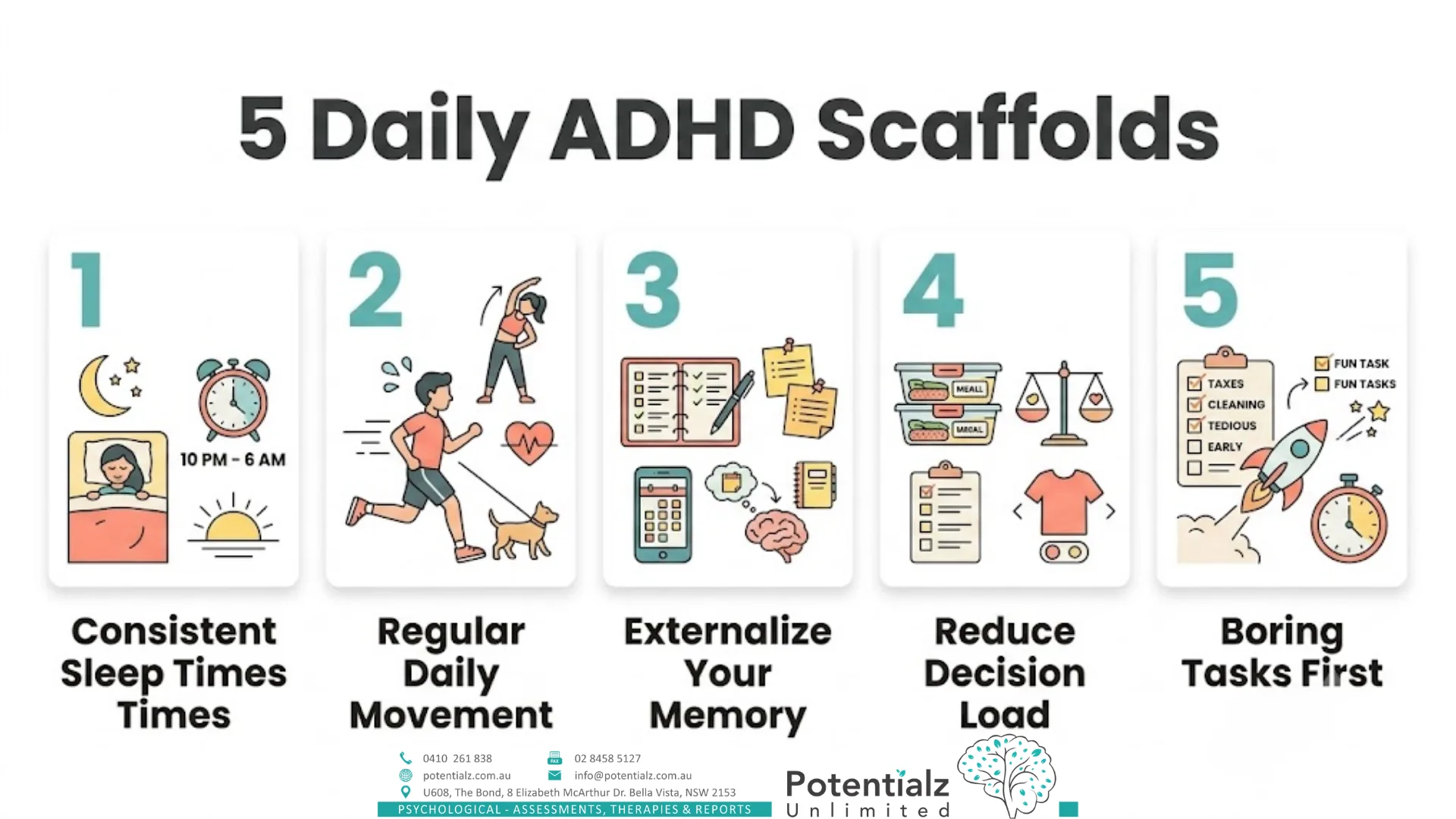
Whether or not you end up with an ADHD diagnosis, these are useful:
- Sleep first — consistent wake time, phone out of the bedroom, morning light within an hour of waking
- Move most days — 30 minutes of moderate movement, five times a week is the dose most trials use
- Externalise your memory — one calendar, visible; one list app, always open; timers for time-blind tasks
- Reduce decisions — outfit prepped the night before, breakfast on autopilot, protein at every meal
- The “boring first” rule — hardest / most avoided task in the first 90 minutes of the day, before the executive tank drains
- Track patterns for two weeks — a simple diary of energy, focus, sleep, and mood makes any assessment much more accurate
- Book your GP — for a Mental Health Care Plan referral and to rule out thyroid, iron, and B12 issues that mimic ADHD
How Potentialz Unlimited Can Help
Potentialz Unlimited is a clinical psychology practice based in Bella Vista, NSW, serving adults and families across the Hills District — Norwest, Castle Hill, Kellyville, Baulkham Hills, Rouse Hill, and Glenhaven.
I am Dr Gurprit Ganda, a Clinical Psychologist with over 25 years of experience in adult ADHD assessment and post-diagnostic psychological treatment. I offer comprehensive assessment (interview, ASRS, CAARS, developmental history, collateral, cognitive testing where indicated) and treatment integrating CBT adapted for ADHD, ACT, DBT skills, and EMDR where trauma is present. Sessions available in English, Hindi, Punjabi, and Urdu. Medicare rebates are available with a GP Mental Health Care Plan. You can contact the clinic or book directly at live.potentialz.com.au.
Related Reading
More from our blog:
- ADHD in Women and Girls: Why It Is Missed and What You Can Do About It
- Adult ADHD Assessment: What to Expect and What the Results Actually Mean
- Understanding ADHD and Tools for Accurate Diagnosis
Therapy services that may help:
References
Faraone, S. V., Banaschewski, T., Coghill, D., Zheng, Y., Biederman, J., Bellgrove, M. A., Newcorn, J. H., Gignac, M., Al Saud, N. M., Manor, I., Rohde, L. A., Yang, L., Cortese, S., Almagor, D., Stein, M. A., Albatti, T. H., Aljoudi, H. F., Alqahtani, M. M. J., Asherson, P., … Wang, Y. (2021). The World Federation of ADHD International Consensus Statement: 208 evidence-based conclusions about the disorder. Neuroscience & Biobehavioral Reviews, 128, 789–818. https://doi.org/10.1016/j.neubiorev.2021.01.022
Kessler, R. C., Adler, L., Ames, M., Demler, O., Faraone, S., Hiripi, E., Howes, M. J., Jin, R., Secnik, K., Spencer, T., Ustun, T. B., & Walters, E. E. (2005). The World Health Organization Adult ADHD Self-Report Scale (ASRS): A short screening scale for use in the general population. Psychological Medicine, 35(2), 245–256. https://doi.org/10.1017/S0033291704002892
Knouse, L. E., Teller, J., & Brooks, M. A. (2017). Meta-analysis of cognitive-behavioral treatments for adult ADHD. Journal of Consulting and Clinical Psychology, 85(7), 737–750. https://doi.org/10.1037/ccp0000216
Linehan, M. M. (2015). DBT skills training manual (2nd ed.). Guilford Press.
Noetel, M., Sanders, T., Gallardo-Gómez, D., Taylor, P., del Pozo Cruz, B., van den Hoek, D., Smith, J. J., Mahoney, J., Spathis, J., Moresi, M., Pagano, R., Pagano, L., Vasconcellos, R., Arnott, H., Varley, B., Parker, P., Biddle, S., & Lonsdale, C. (2024). Effect of exercise for depression: Systematic review and network meta-analysis of randomised controlled trials. BMJ, 384, e075847. https://doi.org/10.1136/bmj-2023-075847
Ramsay, J. R., & Rostain, A. L. (2015). Cognitive-behavioral therapy for adult ADHD: An integrative psychosocial and medical approach (2nd ed.). Routledge. https://doi.org/10.4324/9780203386095
Safren, S. A., Sprich, S., Mimiaga, M. J., Surman, C., Knouse, L., Groves, M., & Otto, M. W. (2010). Cognitive behavioral therapy vs relaxation with educational support for medication-treated adults with ADHD and persistent symptoms: A randomized controlled trial. JAMA, 304(8), 875–880. https://doi.org/10.1001/jama.2010.1192
Solanto, M. V. (2011). Cognitive-behavioral therapy for adult ADHD: Targeting executive dysfunction. Guilford Press.
Solanto, M. V., Marks, D. J., Wasserstein, J., Mitchell, K., Abikoff, H., Alvir, J. M. J., & Kofman, M. D. (2010). Efficacy of meta-cognitive therapy for adult ADHD. American Journal of Psychiatry, 167(8), 958–968. https://doi.org/10.1176/appi.ajp.2010.09081123
Sonuga-Barke, E. J. S., Becker, S. P., Bölte, S., Castellanos, F. X., Franke, B., Newcorn, J. H., Nigg, J. T., Rohde, L. A., & Simonoff, E. (2023). Annual Research Review: Perspectives on progress in ADHD science. Journal of Child Psychology and Psychiatry, 64(4), 506–532. https://doi.org/10.1111/jcpp.13696
Young, S., Adamo, N., Ásgeirsdóttir, B. B., Branney, P., Beckett, M., Colley, W., Cubbin, S., Deeley, Q., Farrag, E., Gudjonsson, G., Hill, P., Hollingdale, J., Kilic, O., Lloyd, T., Mason, P., Paliokosta, E., Perecherla, S., Sedgwick, J., Skirrow, C., … Woodhouse, E. (2020). Females with ADHD: An expert consensus statement. BMC Psychiatry, 20, 404. https://doi.org/10.1186/s12888-020-02707-9
Knowledge Check Quiz
Test what you have just read. Choose your answer for each question, then submit to reveal the answers and your score.
Need Professional Support?
If you're experiencing mental health concerns, our team is here to help.