Roughly one in five Australians aged 16 to 85 experienced a mental disorder in a single 12-month period, and anxiety was the most common group (Australian Bureau of Statistics, 2024). That is a lot of people carrying a lot of weight. Many of them are looking for something more than a single technique or a single appointment. They are looking for a way of living that supports the whole of them.
That is what the holistic mind approach offers. It is a way of caring for the whole person — mind, body and spirit — rather than treating the mind as if it were separate from the body it lives in.
This post explains what the holistic mind approach is. It looks at the ancient roots of practices like yoga, meditation, mindfulness and breathwork. It looks at what modern, evidence-based psychology adds. And it shows how the two can work together to support your wellbeing, without one replacing the other.
What Is the Holistic Mind Approach?
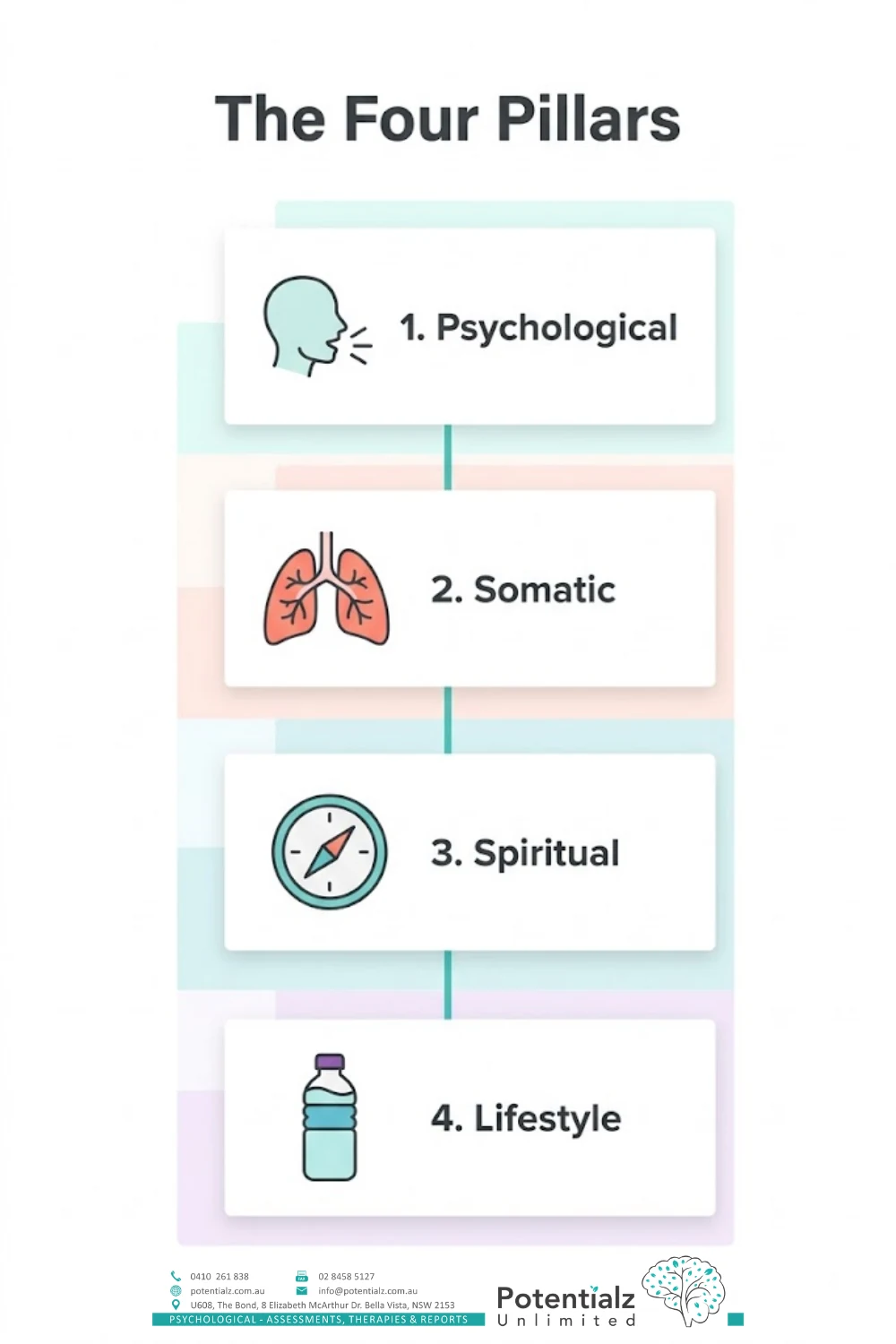
The word “holistic” comes from the idea of wholeness. A holistic mind approach starts from a simple belief. Your thoughts, your body and your sense of meaning are not separate compartments. They are all part of one connected system.
When you are stressed, your body feels it. Your shoulders tighten. Your breath gets shallow. Your sleep suffers. And when your body is exhausted or unwell, your mood and thinking are affected too. Mind and body are always talking to each other.
The holistic mind approach honours that connection. It brings together time-honoured practices and modern psychology so they support each other. Ancient wisdom offers practices that calm the body and quiet the mind. Modern psychology offers tools that are tested by careful research. Used together, they can help you understand yourself and steady yourself.
This is not about choosing between old and new. It is about weaving them into one cloth.
The Ancient Roots: Yoga, Meditation, Mindfulness and Breath
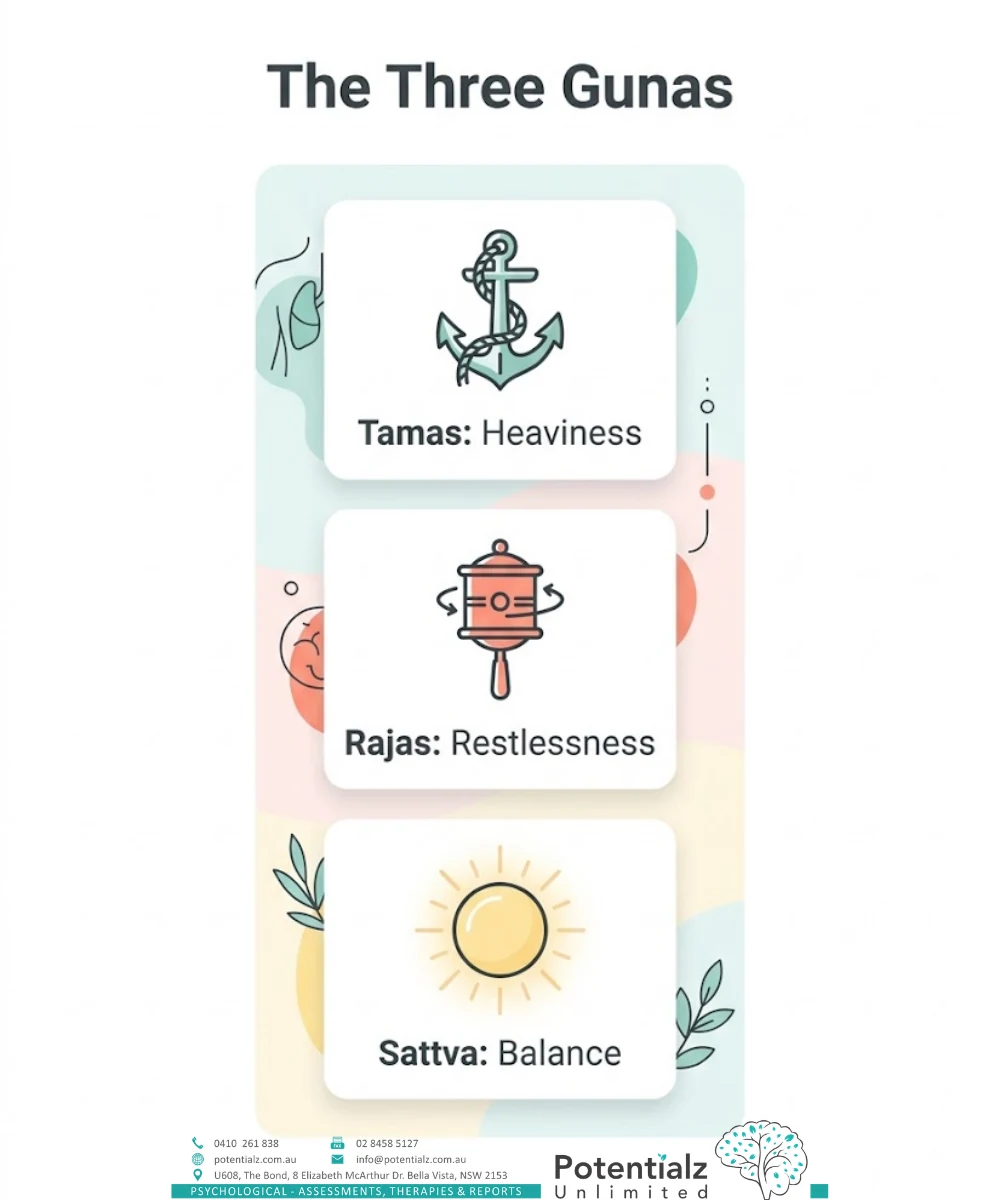
Long before psychology became a science, people across the world developed careful ways to care for the mind. These practices were passed down over thousands of years. They survived because they helped.
Yoga began in ancient India as a whole system for balancing body, mind and spirit. It uses posture, breath and attention together. It was never only about flexibility. It was about steadiness — a calm, clear inner state.
Meditation appears in many traditions, from Buddhism to Vedanta. Its purpose is to train attention and cultivate awareness. Over time, a regular practice can help a person notice their thoughts without being swept away by them. If you want to explore this side more deeply, meditation for the modern mind looks at both its calming and its reflective qualities.
Mindfulness grew out of these meditative traditions. It simply means paying attention to the present moment on purpose, and without harsh judgement. You notice what is here right now — a breath, a sound, a feeling — instead of being lost in worry about the future.
Breathwork, known in yoga as pranayama, uses the breath as a direct tool. Slow, conscious breathing has been used for centuries to settle the body and the mind. Our post on pranayama and breathwork for mental health explores how these ancient breathing practices work.
These practices share one goal. They help a person meet life’s difficulties with more awareness, more acceptance and more steadiness.
What Modern Psychology Adds
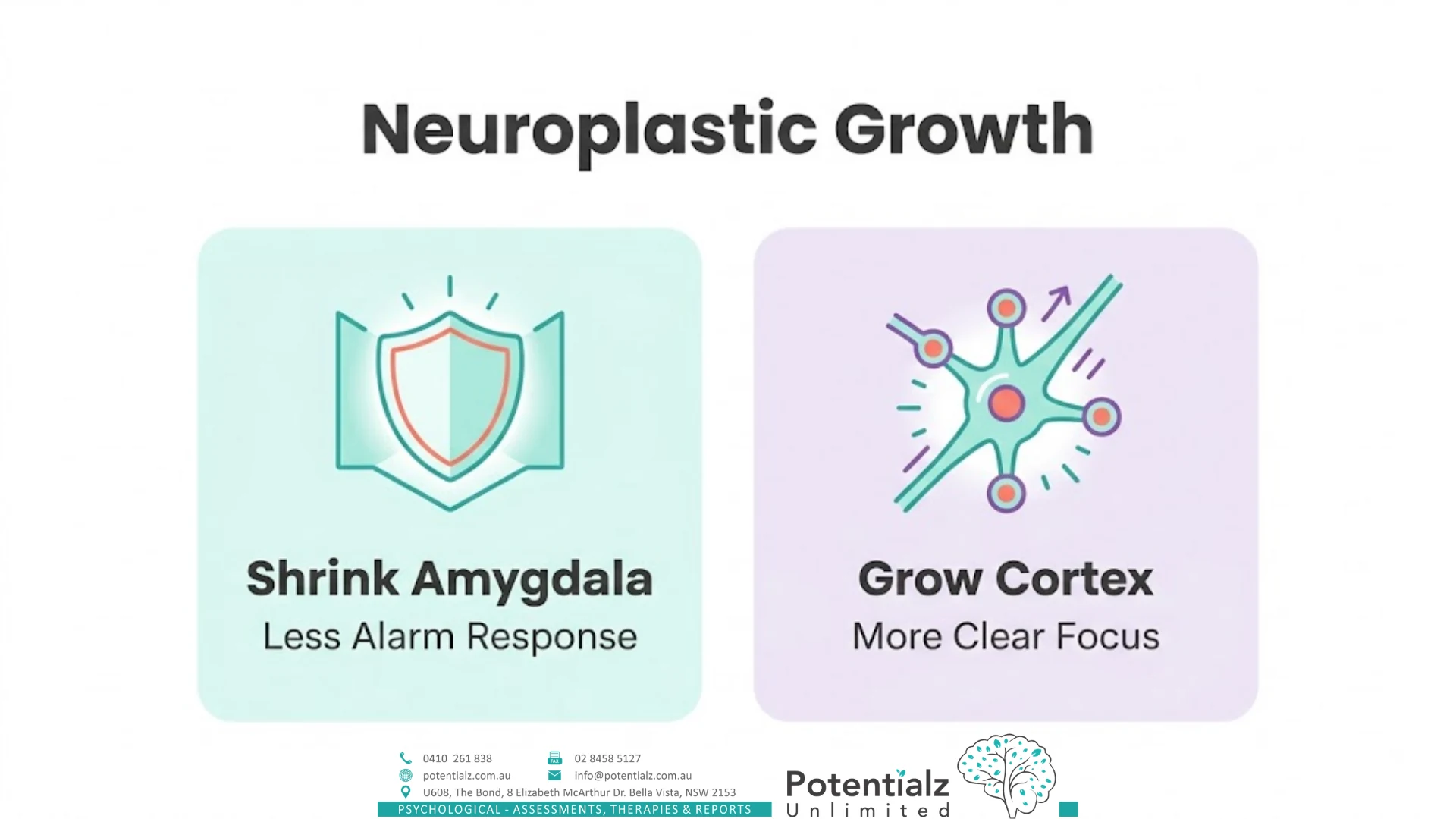
Ancient practices are rich, but they were not designed as clinical treatments. Modern, evidence-based psychology fills that gap. It brings careful testing, clear structure and accountability.
Evidence-based psychology means using approaches that have been studied in research trials. Therapies such as cognitive behavioural therapy (CBT) and acceptance and commitment therapy (ACT) have been examined in many studies. They give people practical, tested ways to work with unhelpful thoughts and difficult emotions.
Modern psychology also brings something important: proper assessment. A trained clinician can tell the difference between everyday stress and a condition that needs focused treatment. That distinction matters. It helps make sure a person gets the right level of care.
Interestingly, modern therapy has already borrowed from ancient wisdom. Mindfulness-based cognitive therapy, for example, takes mindfulness — an ancient practice — and places it inside a structured, evidence-based framework. If you are curious about how those two sit together, reconciling spirituality with psychology explores that meeting point.
So the two traditions are not enemies. Modern psychology gives structure and evidence. Ancient wisdom gives depth and daily practice. Each makes the other stronger.
Where Ancient Wisdom and Modern Psychology Meet
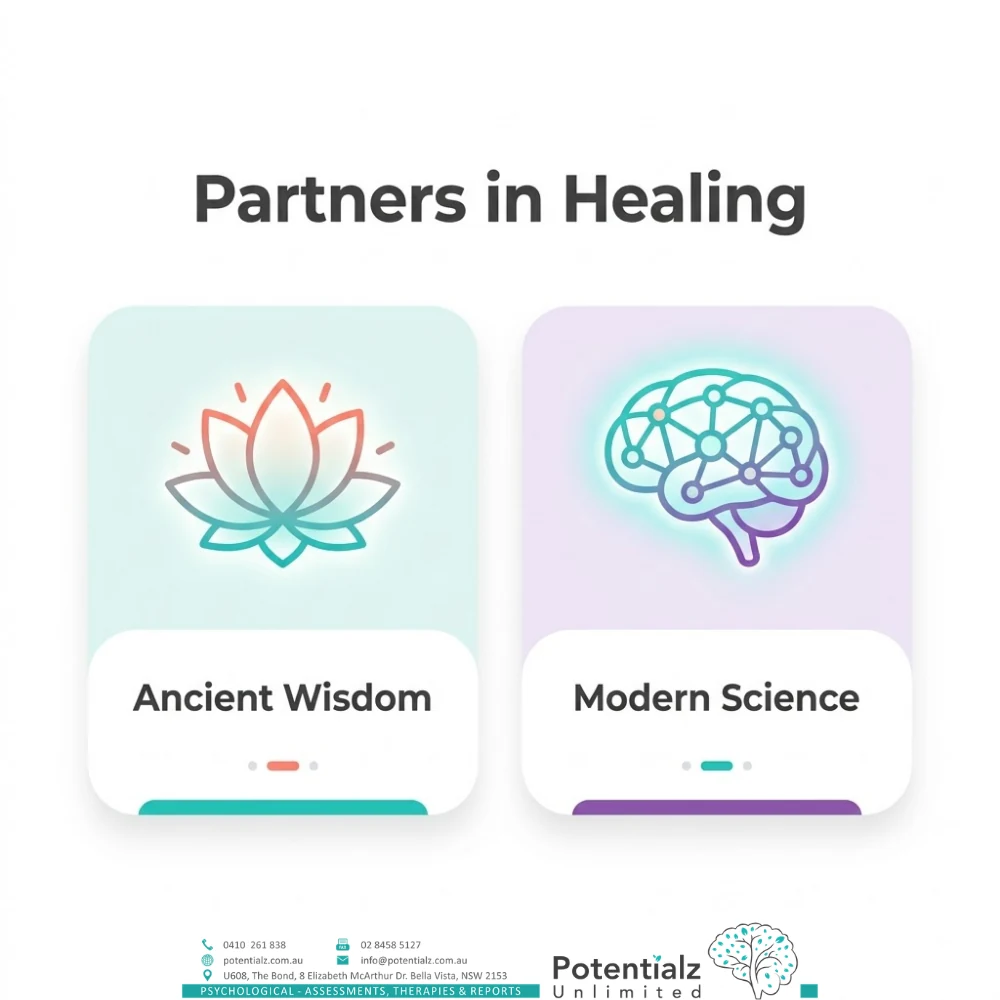
The heart of the holistic mind approach is the meeting point between these two worlds. This is sometimes described as a mind–body–spirit lens.
The “mind” part is about your thoughts and emotions. This is where modern psychology is especially strong. It helps you notice thinking patterns, understand your feelings and build practical coping skills.
The “body” part is about your nervous system. Practices like yoga and slow breathing act directly on the body. Research suggests slow, controlled breathing is linked to a calmer nervous system and better psychological wellbeing (Zaccaro et al., 2018). When the body feels safe, the mind finds it easier to settle.
The “spirit” part is about meaning and connection. This does not have to be religious. It can simply mean a sense of purpose, belonging or peace. For many people, this sense of meaning is a real source of resilience.
The science behind integrative counselling shows how these threads can be woven together in practice. When mind, body and spirit are all supported, a person often feels more whole and more resilient.
What the Research Says
It is fair to ask a simple question. Do these practices actually help? The honest answer is that research is promising, though not absolute.
Meditation has been studied closely. A large review published in a leading medical journal found that meditation programs produced small to moderate improvements in anxiety, depression and stress for many people (Goyal et al., 2014). The authors were careful. They noted meditation was not shown to be better than other active treatments. But the benefit was real.
Mindfulness-based therapies have strong support too. A comprehensive review of 209 studies found mindfulness-based therapy was moderately effective for reducing anxiety, depression and stress (Khoury et al., 2013). That is a large body of evidence pointing in a helpful direction.
Yoga has been examined for low mood. A systematic review found moderate evidence that yoga may help reduce the severity of depression in the short term, compared with usual care (Cramer et al., 2013). Again, the language is careful. Yoga may help. It is not a guaranteed cure.
Notice the pattern in all this research. These practices can support wellbeing. They may help many people. But results vary from person to person. That is exactly why a whole-person, individual approach makes sense.
Building Your Own Holistic Mind Practice
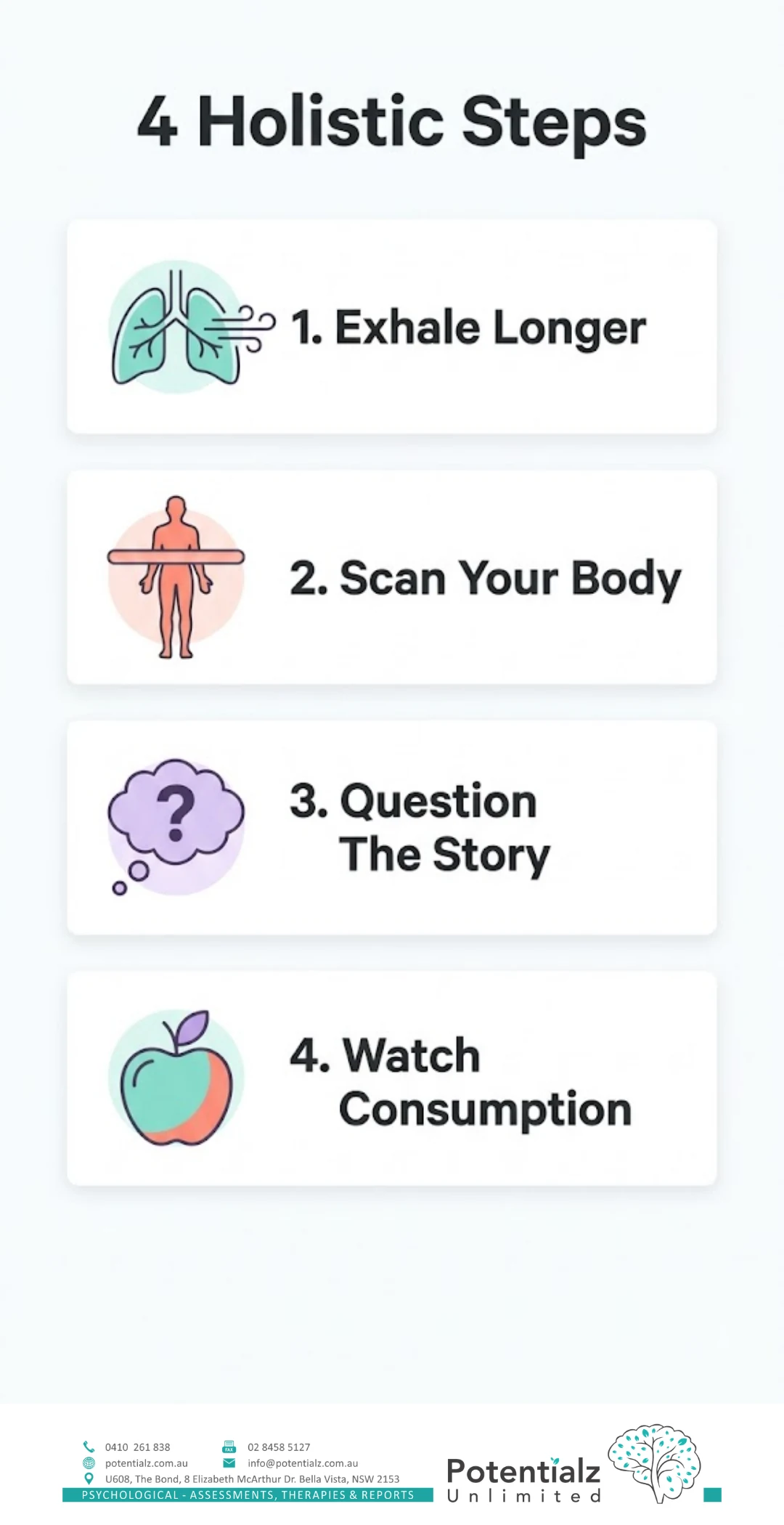
You do not need to be a monk or a yoga expert to benefit from this approach. You can begin gently, in your own life. Here are some simple starting points.
Start with the breath. Take a few minutes each day to breathe slowly. Try making your exhale a little longer than your inhale. This small habit can help settle a busy nervous system.
Add a short mindfulness pause. Once or twice a day, stop and notice the present moment. Feel your feet on the floor. Notice one sound around you. This trains your attention to return to now.
Try gentle movement. Even a few simple stretches can release tension held in the body. Movement and breath together can calm the mind.
Reflect on what matters. Spend a moment on what gives your life meaning. A short note in a journal is enough. This nurtures the “spirit” part of the whole.
One thing is worth repeating. What helps one person may not suit another. Some breathing and meditation practices can feel unsettling for people with a trauma history or certain health conditions. This is why individual guidance is valuable. A practitioner can match the practice to you.
How Potentialz Can Help
At Potentialz Unlimited in Bella Vista, I work with the holistic mind approach in individual counselling sessions. I bring yoga therapy, meditation, mindfulness and breathwork together with evidence-informed counselling, tailored to your needs and your pace.
My aim is to support the whole of you — mind, body and spirit — rather than one part on its own. For some people that means learning breathing tools to settle anxiety. For others it means gentle movement, reflection and a steadier daily rhythm. Sessions are available face-to-face in Bella Vista or via Telehealth across NSW.
To book, visit live.potentialz.com.au or call 0410 261 838.
Please note: Samita Rathor is a holistic counsellor and yoga therapist, not an AHPRA-registered psychologist. Counselling sessions with Samita are not Medicare-rebatable. For clinical depression, anxiety, or trauma where evidence-based psychological therapy such as CBT, ACT, or EMDR is indicated, our psychology colleagues at Potentialz can help.
This information is for educational purposes only and does not replace professional advice. If you are experiencing mental health concerns, please consult a registered psychologist or your GP. Individual results may vary.
If your low mood or worry ever brings thoughts of not wanting to be here, please reach out for urgent support now: call Lifeline on 13 11 14, Beyond Blue on 1300 22 4636, or in an emergency call 000.
Key Takeaways
- The holistic mind approach cares for the whole person — mind, body and spirit — rather than treating the mind in isolation.
- Ancient practices such as yoga, meditation, mindfulness and breathwork are framed as complements to clinical care, not cures or replacements for it.
- Modern, evidence-based psychology adds structure, careful assessment and tested tools; ancient wisdom adds depth and daily practice.
- Research suggests meditation, mindfulness-based therapy, yoga and slow breathing may help reduce anxiety, depression and stress for many people, though results vary.
- Practices work best when matched to the individual, which is why personal guidance matters — especially with a trauma history or certain health conditions.
References
Australian Bureau of Statistics. (2024). National study of mental health and wellbeing, 2020–2022. https://www.abs.gov.au/statistics/health/mental-health/national-study-mental-health-and-wellbeing/latest-release
Cramer, H., Lauche, R., Langhorst, J., & Dobos, G. (2013). Yoga for depression: A systematic review and meta-analysis. Depression and Anxiety, 30(11), 1068–1083. https://doi.org/10.1002/da.22166
Goyal, M., Singh, S., Sibinga, E. M. S., Gould, N. F., Rowland-Seymour, A., Sharma, R., Berger, Z., Sleicher, D., Maron, D. D., Shihab, H. M., Ranasinghe, P. D., Linn, S., Saha, S., Bass, E. B., & Haythornthwaite, J. A. (2014). Meditation programs for psychological stress and well-being: A systematic review and meta-analysis. JAMA Internal Medicine, 174(3), 357–368. https://doi.org/10.1001/jamainternmed.2013.13018
Khoury, B., Lecomte, T., Fortin, G., Masse, M., Therien, P., Bouchard, V., Chapleau, M. A., Paquin, K., & Hofmann, S. G. (2013). Mindfulness-based therapy: A comprehensive meta-analysis. Clinical Psychology Review, 33(6), 763–771. https://doi.org/10.1016/j.cpr.2013.05.005
Zaccaro, A., Piarulli, A., Laurino, M., Garbella, E., Menicucci, D., Neri, B., & Gemignani, A. (2018). How breath-control can change your life: A systematic review on psycho-physiological correlates of slow breathing. Frontiers in Human Neuroscience, 12, 353. https://doi.org/10.3389/fnhum.2018.00353
Related Reading
Knowledge Check Quiz
Test what you have just read. Choose your answer for each question, then submit to reveal the answers and your score.
Need Professional Support?
If you're experiencing mental health concerns, our team is here to help.