Key Takeaways
- Autistic children do not have social “deficits” — they have different ways of communicating and connecting that deserve understanding and support.
- Traditional social skills training often fails autistic children because it relies on rote memorisation of rules that do not feel natural or meaningful.
- LEGO® Based Therapy builds joint attention, turn-taking, and communication through a naturally motivating, structured activity.
- Synergetic Play Therapy supports nervous system regulation, which is foundational for social engagement in autistic children.
- Sensory considerations in the therapy environment are essential to creating a space where autistic children feel safe enough to connect.
- NDIS funding can be used for these therapeutic approaches by self-managed and plan-managed participants. Practitioners at Potentialz Unlimited are certified in both modalities.
When parents bring their autistic child for support with social skills, they are often carrying a lot — exhaustion, worry, and sometimes grief for the connections they watch their child struggle to make. They may have tried social skills groups, worksheets, or videos about “how to make friends”. And they have found that none of it quite sticks.
This is not because their child is not trying. It is because most conventional social skills training was designed without autistic neurology in mind. It teaches the surface behaviour — make eye contact, say hello, wait your turn — without addressing the underlying neurological and sensory experience that makes social interaction genuinely challenging for many autistic people.
This post explores why a different approach is needed, and how therapeutic play — specifically LEGO® Based Therapy and Synergetic Play Therapy — can support autistic children in building genuine social connection.
Rethinking “Social Deficits”
The older diagnostic language around autism was heavily focused on deficit — what autistic people could not do, what they lacked, what needed to be fixed. More recent neurodiversity-affirming frameworks take a different view. Autistic people do not lack social understanding or the desire for connection. Research suggests that many autistic people are deeply interested in meaningful relationships. The challenge lies in a social world that was not designed for their neurology (Milton, 2012).
This is sometimes described as the “double empathy problem” — the idea that social misunderstanding between autistic and non-autistic people is bi-directional. Autistic people communicate and relate differently, and non-autistic people often fail to recognise or respond to these different communication styles. Importantly, when autistic people interact with each other, many report significantly easier and more natural social engagement.
This reframe matters for therapy. The goal is not to make autistic children mimic neurotypical social behaviour. It is to help them build genuine connection, develop skills for navigating a mixed-neurology world, and find confidence in who they are.
Why Traditional Social Skills Training Often Falls Short
Traditional social skills training programmes — the kind that teach rules like “look at the person when they talk to you” or “when someone says hi, say hi back” — have a significant body of research behind them, but also significant limitations for autistic learners (Kasari et al., 2012).
The core problems are:
Generalisation: Autistic learners often learn skills in a specific context and find it very hard to transfer them to different situations. Learning a rule in a clinic does not mean being able to apply it in the playground or at a birthday party.
Authenticity: Many autistic children can learn to perform the expected social script — to make eye contact, to say the right things — while remaining internally disconnected from the interaction. This is known as masking, and it comes at a significant cognitive and emotional cost.
Motivation: Social skills programmes that use social scenarios as the vehicle for learning often feel abstract, arbitrary, and tedious to autistic learners who are deeply motivated by other interests. Engagement is poor, and retention suffers.
Nervous system state: If a child is in a state of sensory overload or social threat when they enter a social skills session, they are physiologically incapable of taking in new learning. Regulation must come first.
LEGO® Based Therapy and Synergetic Play Therapy address each of these limitations in specific, evidence-informed ways.
What Is LEGO® Based Therapy?
LEGO® Based Therapy (LBT) was developed in the late 1990s by clinical neuropsychologist Dr Daniel LeGoff, who noticed that the children in his waiting room who played with LEGO sets were naturally engaging in complex social interaction — negotiating, collaborating, problem-solving, and communicating — without being told to (LeGoff, 2004).
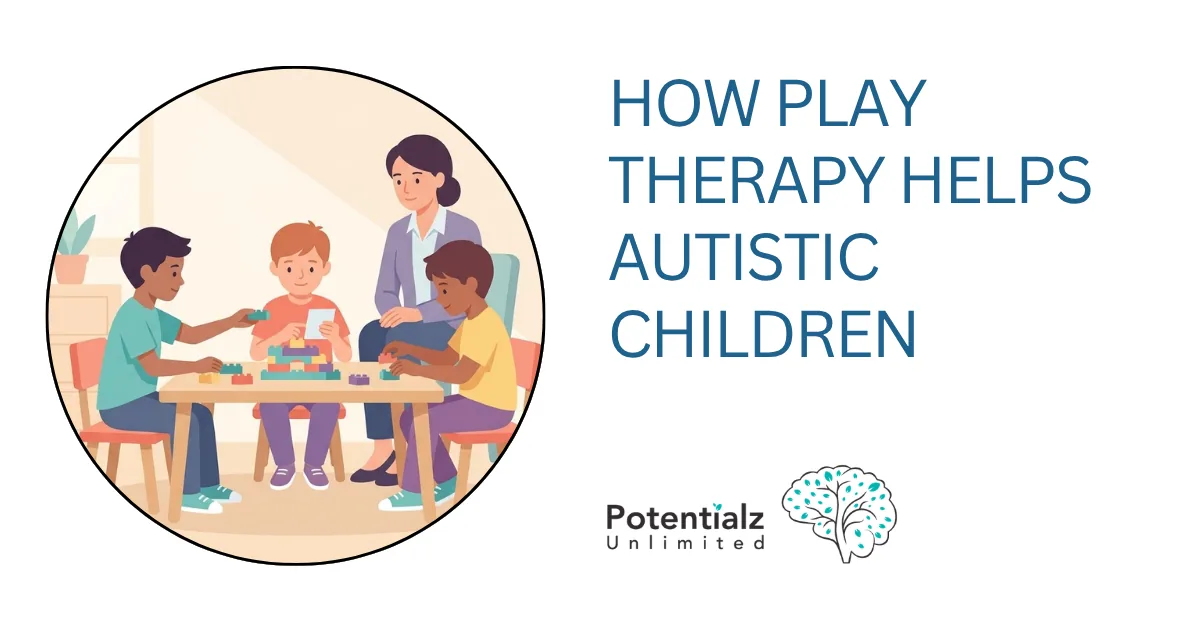
His insight was to formalise this observation into a structured therapeutic approach. In LBT, children work together in small groups (typically two or three) to build LEGO sets using a specific division of roles:
- Engineer: Reads the instructions and directs the build
- Supplier: Finds the correct pieces and hands them to the builder
- Builder: Assembles the pieces according to the engineer’s instructions
This division of roles requires:
- Joint attention: All children must attend to the same task
- Turn-taking and waiting: Each child has a specific role and must wait for the others
- Communication: The engineer must communicate clearly; the supplier must listen and respond
- Problem-solving: Mistakes happen, and the group must work through them together
- Shared delight: Completing a build together creates a genuine moment of shared accomplishment
Crucially, none of this is scripted. It is not “now practice making eye contact.” It is real social interaction in service of something the children actually care about. The social learning is embedded in meaningful activity.
Studies indicate that LEGO® Based Therapy produces significant improvements in social competence, peer interaction, and cooperative play in autistic children aged 5 to 16 (Owens et al., 2008). A controlled trial by LeGoff and Sherman (2006) found that children who participated in LBT showed gains in social ability that were maintained at follow-up, and also showed improvements in generalisation — the skills transferred to other settings.
This is why our practitioners are certified in LEGO® Based Therapy. It is used as a core tool for autistic children and other children who benefit from structured, motivating social learning contexts. You can learn more on our dedicated LEGO® Based Therapy page and about the wider range of approaches on our play therapy Bella Vista page.
What Is Synergetic Play Therapy?
Synergetic Play Therapy (SPT) is a more recent model, developed by Lisa Dion and grounded in interpersonal neurobiology, polyvagal theory, and attachment theory. Its central premise is that therapeutic change happens in the nervous system first — not the mind, not behaviour — and that a child must feel physiologically safe before any meaningful social or emotional learning can occur.
For autistic children, this insight is especially important. Many autistic children live in a chronic state of nervous system activation — what polyvagal theory describes as a sympathetic or dorsal vagal state. They may appear hyperactive and explosive, or shut down and withdrawn. In either state, the social engagement system — the neurological circuitry that supports eye contact, prosody (the music of voice), and facial expression reading — is offline.
SPT uses the therapeutic relationship, the play environment, and the therapist’s own regulated nervous system to create the conditions for a child’s nervous system to settle. When a child feels truly safe — physiologically, not just cognitively — their social engagement system can come online. Social connection becomes genuinely possible, rather than forced.
For autistic children, this means:
- The playroom is carefully managed for sensory comfort — lighting, sound, texture, scent
- The therapist does not push social engagement; they create safety and let it emerge
- Emotional responses in sessions are not corrected; they are understood and co-regulated
- The child’s nervous system learns, over time, that social interaction is not a threat
Research suggests that combining nervous system regulation with skill-based approaches produces better outcomes for autistic children than either approach alone (Gaskill & Perry, 2014).
Sensory Considerations in the Play Therapy Room
Sensory processing differences are a core feature of autism for many children. The therapy environment itself can be a barrier to engagement if it is not thoughtfully designed.
At Potentialz Unlimited, our practitioners consider sensory needs as a primary factor in setting up sessions. This includes:
Lighting: Harsh fluorescent lights can be highly aversive for autistic children. Natural light or soft, adjustable lighting is preferred.
Sound: The room is insulated from external noise as much as possible. Background music, if used at all, is chosen carefully and kept at low volume.
Texture and touch: Materials in the playroom are chosen with sensory tolerance in mind. No child is ever pushed towards tactile activities they find aversive.
Scent: Strong cleaning products, air fresheners, or therapist perfume can be overwhelming. Our practitioners are conscious of maintaining a neutral sensory environment.
Predictability: The structure of sessions — knowing what comes next, how long things last, and where things are kept — supports the autistic child’s need for predictability and reduces anticipatory anxiety.
These are not minor details. For many autistic children, they are the difference between a therapy session they can engage with and one they spend in survival mode.
The NDIS and Play Therapy for Autistic Children
Many autistic children in Australia have NDIS plans. Play therapy — including LEGO® Based Therapy and Synergetic Play Therapy — can be funded through the Capacity Building budget under Improved Daily Living (Support Category 15). The line item depends on your child’s age — 15_005_0118_1_3 (Early Childhood Intervention Professional) for children under 9, 15_056_0128_1_3 (Assessment Recommendation Therapy or Training – Other Professional) from 9 onwards. Self-managed and plan-managed participants can use this funding at Potentialz Unlimited; agency-managed (NDIA-managed) funding cannot be used, as Potentialz Unlimited is not a registered NDIS provider.
Useful goals to include in an NDIS plan for autistic children seeking social and emotional support through play therapy include:
- “[Child’s name] will develop skills to initiate and sustain cooperative play with peers.”
- “[Child’s name] will develop strategies to manage sensory sensitivities in social settings.”
- “[Child’s name] will build capacity for emotional regulation to support participation in social situations.”
For children with co-occurring ADHD, ADHD support may also be relevant to their plan. For children with elevated anxiety, our anxiety psychologist page has more information.
Our practitioners provide full NDIS documentation including assessment reports, progress notes, and progress reports. See our dedicated NDIS page for more detail, or read our full guide to NDIS funding for play therapy.
A Neurodiversity-Affirming Approach
It bears repeating: the goal of play therapy with autistic children at Potentialz Unlimited is not to make children “seem less autistic.” Masking — suppressing autistic traits to appear neurotypical — is associated with significantly increased rates of anxiety, depression, and burnout (Cage & Troxell-Whitman, 2019).
Our practitioners take an explicitly neurodiversity-affirming approach. They work to:
- Understand each child’s unique sensory and social profile
- Identify what genuine connection looks and feels like for that individual child
- Build skills that serve the child’s wellbeing, not just other people’s comfort
- Support parents to understand and celebrate their child’s neurology
- Create a therapy space where autistic children can be fully themselves
The evidence base supports this approach. Autistic children who receive support within a neurodiversity-affirming framework report higher self-esteem, stronger identity, and better mental health outcomes compared to those in approaches that primarily focus on behavioural compliance (Kapp et al., 2013).
What Parents Can Expect from the Journey
Social growth for autistic children — like all developmental growth — is not linear. There will be sessions where everything flows beautifully, and sessions where the child is in protective mode and little visible progress is made. Both are part of the process.
Our practitioners communicate openly with parents about what they observe in sessions, what the child’s nervous system appears to need, and what progress looks like for their individual child. They do not set unrealistic expectations. Research suggests that meaningful improvements in social engagement take time — and that the quality of the therapeutic relationship is one of the strongest predictors of outcome (Bratton et al., 2005).
If your child has recently been diagnosed with autism, or if you have been navigating autism for years without finding support that truly fits, please know that there is hope — and there is help.
How Potentialz Can Help
Potentialz Unlimited offers LEGO® Based Therapy and Synergetic Play Therapy for autistic children aged 3–12. Our practitioners take a neurodiversity-affirming, sensory-aware, and deeply individualised approach to every child they work with. You may also find our guides on play therapy versus talk therapy and how play therapy supports NDIS children helpful.
Potentialz Unlimited is available to private-paying families and to self-managed and plan-managed NDIS participants alike.
Potentialz Unlimited Unit 608, 8 Elizabeth Macarthur Drive, Bella Vista NSW 2153 Phone: 0410 261 838 Hours: Monday to Friday, 10am–7pm
Book online at live.potentialz.com.au or call 0410 261 838.
References
Bratton, S. C., Ray, D., Rhine, T., & Jones, L. (2005). The efficacy of play therapy with children: A meta-analytic review of treatment outcomes. Professional Psychology: Research and Practice, 36(4), 376–390. https://doi.org/10.1037/0735-7028.36.4.376
Cage, E., & Troxell-Whitman, Z. (2019). Understanding the reasons, contexts and costs of camouflaging for autistic adults. Journal of Autism and Developmental Disorders, 49(5), 1899–1911. https://doi.org/10.1007/s10803-018-3830-2
Gaskill, R. L., & Perry, B. D. (2014). The neurobiological power of play. In C. A. Malchiodi & D. A. Crenshaw (Eds.), Creative arts and play therapy for attachment problems (pp. 178–194). Guilford Press.
Kapp, S. K., Gillespie-Lynch, K., Sherman, L. E., & Hutman, T. (2013). Deficit, difference, or both? Autism and neurodiversity. Developmental Psychology, 49(1), 59–71. https://doi.org/10.1037/a0028353
Kasari, C., Rotheram-Fuller, E., Locke, J., & Gulsrud, A. (2012). Making the connection: Randomized controlled trial of social skills at school for children with autism spectrum disorders. Journal of Child Psychology and Psychiatry, 53(4), 431–439. https://doi.org/10.1111/j.1469-7610.2011.02493.x
LeGoff, D. B. (2004). Use of LEGO® as a therapeutic medium for improving social competence. Journal of Autism and Developmental Disorders, 34(5), 557–571. https://doi.org/10.1007/s10803-004-2550-0
LeGoff, D. B., & Sherman, M. (2006). Long-term outcome of social skills intervention based on interactive LEGO® play. Autism, 10(4), 317–329. https://doi.org/10.1177/1362361306064403
Milton, D. E. M. (2012). On the ontological status of autism: The ‘double empathy problem’. Disability & Society, 27(6), 883–887. https://doi.org/10.1080/09687599.2012.710008
Owens, G., Granader, Y., Humphrey, A., & Baron-Cohen, S. (2008). LEGO® therapy and the Social Use of Language Programme: An evaluation of two social skills interventions for children with high functioning autism and Asperger syndrome. Journal of Autism and Developmental Disorders, 38(10), 1944–1957. https://doi.org/10.1007/s10803-008-0590-6
This information is general in nature. Please consult a qualified health professional for individual advice.
If you or someone you know is in crisis, please contact Lifeline on 13 11 14, Beyond Blue on 1300 22 4636, or Kids Helpline on 1800 55 1800.
Knowledge Check Quiz
Test what you have just read. Choose your answer for each question, then submit to reveal the answers and your score.
Need Professional Support?
If you're experiencing mental health concerns, our team is here to help.