An IQ test is a standardised assessment that measures specific cognitive abilities — including verbal reasoning, working memory, perceptual problem-solving, and processing speed — and expresses the result as a number relative to others of the same age. The average score is always set at 100; roughly two-thirds of people score between 85 and 115.
Key facts about IQ tests:
- Average IQ = 100, with 68% of people scoring between 85 and 115 and roughly 95% between 70 and 130.
- Four core cognitive domains are typically measured: verbal comprehension, visual-spatial / perceptual reasoning, working memory, and processing speed.
- The most widely used clinical tests are the WAIS-V (adults 16+), the WISC-V (children 6–16), and the Stanford–Binet 5.
- Free online IQ tests are not psychometrically valid — a reliable IQ score requires a full assessment by a registered psychologist using a standardised instrument.
- A single number is not a life sentence — cognitive profiles across the four domains are more clinically useful than the Full Scale IQ alone.
What Is an IQ Test?
An IQ test is not a test of how much you know. It is a test of how your brain processes information. Rather than asking you to recall facts, a well-designed IQ test presents novel problems — patterns, puzzles, word relationships, memory tasks — to assess the underlying cognitive machinery.
“IQ” stands for Intelligence Quotient. Originally, the quotient was calculated by dividing mental age by chronological age; today, scores are derived by comparing your performance to a large representative sample of people in your age group, then scaling that result to a mean of 100.
What gets measured depends on the specific test and edition, but most modern batteries assess four broad areas:
- Verbal Comprehension — understanding and reasoning with language
- Visual-Spatial / Perceptual Reasoning — solving problems using images and patterns
- Working Memory — holding and manipulating information in mind
- Processing Speed — completing routine cognitive tasks quickly and accurately
These domains collectively index something researchers call g — general cognitive ability — which predicts a wide range of real-world outcomes including academic achievement and occupational performance (Deary, 2001).
A Brief History of IQ Testing
The story begins in early 20th-century Paris. The French government commissioned psychologist Alfred Binet and his colleague Théodore Simon to develop a tool for identifying students who needed additional support in school. The 1905 Binet–Simon Scale was the result — the world’s first practical, standardised intelligence test.
American psychologist Lewis Terman adapted Binet’s work into the Stanford–Binet scale (1916), introduced the IQ quotient formula, and began the tradition of large-scale intelligence testing that continues today.
The next major leap came from David Wechsler, a clinical psychologist at Bellevue Hospital in New York. Wechsler believed intelligence was global — not a single faculty but an aggregate of interacting abilities. His Wechsler–Bellevue Intelligence Scale (1939) introduced separate verbal and performance subtests, an approach that has shaped every major IQ battery published since. The current editions — the WAIS-V (adults) and WISC-V (children) — are direct descendants of his original design (Wechsler, 1939).
How IQ Testing Works in Practice
A clinical IQ assessment is not a self-scored quiz. It is a one-on-one session with a registered psychologist, typically lasting 1.5 to 2.5 hours depending on the battery and the individual. The psychologist administers a series of subtests in a standardised order, records your responses verbatim, and scores them according to published criteria.
Your raw scores are then compared to a normative sample — thousands of people your age who completed the same test under the same conditions. This comparison produces scaled scores and composite index scores, which are then reported and interpreted in the context of your history, presentation, and referral questions.
A good assessment does not stop at the number. The psychologist also looks at the pattern of scores across domains, any significant gaps between verbal and non-verbal abilities, how those scores align with your academic or occupational performance, and what it all means for you specifically.
Understanding IQ Scores
IQ scores follow a normal distribution (bell curve) with a mean of 100 and a standard deviation (SD) of 15. This statistical design makes scores comparable across age groups and over time.
| Score Range | Descriptive Classification | Approximate Percentile | % of Population |
|---|---|---|---|
| 130 and above | Very Superior | 98th and above | ~2% |
| 120–129 | Superior | 91st–97th | ~7% |
| 110–119 | High Average | 75th–90th | ~16% |
| 90–109 | Average | 25th–74th | ~50% |
| 80–89 | Low Average | 9th–24th | ~16% |
| 70–79 | Borderline | 2nd–8th | ~7% |
| Below 70 | Extremely Low | Below 2nd | ~2% |
Note: score classifications vary slightly between test publishers and editions. The above reflects Wechsler conventions.
A score of 100 means you performed exactly at the population average for your age. A score of 115 means you scored one standard deviation above average — better than roughly 84% of same-age peers. These comparisons are only valid against the normative sample used for that particular test edition.
One important caveat: the Flynn Effect — a consistent rise in raw IQ scores across generations documented by James Flynn — means tests must be re-normed every 10–20 years or scores will be artificially inflated (Flynn, 1987). This is why clinicians use the most current edition of a test wherever possible.
Main Types of IQ Tests
Not all IQ tests are designed for the same purpose or population. Here are the clinically validated batteries most commonly used in Australian practice:
Wechsler Adult Intelligence Scale — Fifth Edition (WAIS-V) The gold standard for adults aged 16 and over. The WAIS-V yields a Full-Scale IQ alongside index scores for Verbal Comprehension, Visual-Spatial, Fluid Reasoning, Working Memory, and Processing Speed. It is the most widely used adult IQ assessment in English-speaking countries. At Potentialz Unlimited, we use the WAIS-V for adult cognitive assessments in Bella Vista.
Wechsler Intelligence Scale for Children — Fifth Edition (WISC-V) Designed for children and adolescents aged 6:0 to 16:11. The WISC-V is the benchmark instrument for understanding children’s IQ results in educational and clinical contexts. If you’re wondering when to get your child’s IQ tested, the WISC-V is almost always the instrument of choice.
Stanford–Binet Intelligence Scales — Fifth Edition (SB5) Covers a wide age range (2 to 85+ years) and measures five cognitive factors — Fluid Reasoning, Knowledge, Quantitative Reasoning, Visual-Spatial Processing, and Working Memory — in both verbal and non-verbal formats. Useful when a broader age coverage or different factor structure is clinically indicated.
Raven’s Progressive Matrices A non-verbal reasoning test that minimises language demands. Useful when assessing individuals from non-English-speaking backgrounds, those with language or hearing difficulties, or when a “purer” measure of fluid reasoning is needed. Does not yield a full-scale IQ equivalent in clinical use.
For a deeper comparison of the two most commonly administered batteries, see our post on different types of IQ tests.
What IQ Tests Do — and Do Not — Measure
It is worth being precise here, because this is where public understanding most often goes astray.
What IQ tests measure well:
- General cognitive ability (g)
- Crystallised knowledge and verbal reasoning
- Fluid reasoning (novel problem-solving)
- Short-term and working memory capacity
- Speed of information processing
These abilities predict academic achievement and performance on cognitively complex tasks better than any other psychological construct we have (Neisser et al., 1996).
What IQ tests do not measure:
- Creativity or original thinking
- Emotional intelligence (EQ)
- Practical, social, or interpersonal intelligence
- Motivation, persistence, or self-regulation
- Domain-specific expertise or tacit knowledge
- How you will perform under pressure
This is not a flaw in the tests — it reflects the fact that intelligence is broader than any single instrument can capture. IQ tests were designed to measure cognitive efficiency, and they do that reasonably well. They were never designed to measure the full scope of human capacity.
Factors That Can Affect Your Score
A single IQ score is a snapshot, not a fixed biological truth. Several factors can push a score lower on a given day without reflecting true ability:
- Test anxiety — significant performance anxiety is known to suppress scores
- Sleep deprivation — even one poor night affects processing speed and working memory
- Physical illness or pain — draws on cognitive resources
- Cultural and linguistic factors — some subtests draw on culturally specific knowledge, disadvantaging test-takers from non-English backgrounds (though modern batteries have worked to reduce this)
- Motivation — if a person is not engaged or is actively resistant, scores will not represent their ceiling
- Medication — some psychiatric or neurological medications affect processing speed
This is why a skilled clinician considers the whole picture — not just the number.
Multiple Intelligences: A Broader Lens
Standard IQ tests measure a specific cluster of cognitive abilities. But researchers have long debated whether intelligence is one thing or many.
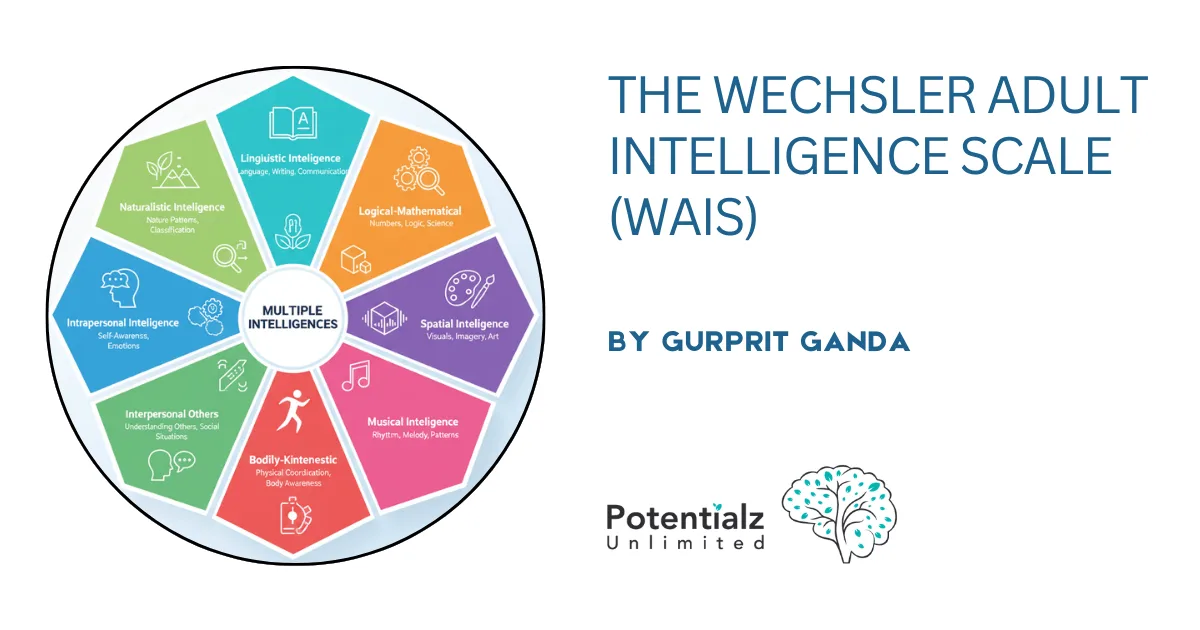
Howard Gardner’s Theory of Multiple Intelligences (1983) proposed that human cognition encompasses at least eight distinct domains:
| Intelligence | Core Capacity |
|---|---|
| Linguistic | Sensitivity to spoken and written language; learning new languages |
| Logical-Mathematical | Logical analysis; detecting patterns; deductive reasoning |
| Spatial | Perceiving the visual-spatial world accurately; mental transformation |
| Bodily-Kinesthetic | Control of bodily movements; skilled use of objects |
| Musical | Skill in musical performance, composition, and appreciation |
| Interpersonal | Understanding others’ intentions, motivations, and desires |
| Intrapersonal | Self-knowledge; understanding one’s own emotions and motivations |
| Naturalistic | Recognising and categorising natural objects and phenomena |
Gardner’s framework has been influential in education, but it is worth noting that mainstream cognitive psychology does not classify these eight domains as separate intelligences in the same statistical sense as g. Critics point out that many of Gardner’s intelligences are better described as talents or aptitudes, and that the theory lacks the predictive validity of factor-analytic models of intelligence. Even so, Gardner’s work has been genuinely useful in broadening the cultural conversation about what it means to be capable.
Robert Sternberg’s Triarchic Theory offers a more parsimonious extension: analytical intelligence (what IQ tests measure), creative intelligence (generating novel ideas), and practical intelligence (applying knowledge to real-world problems). Sternberg argues that successful people — in the broad sense — typically draw on all three, not just the analytical strand (Sternberg, 1985).
Savants: Exceptional Ability in a Specific Domain
Savant syndrome offers a striking demonstration that cognitive ability is not monolithic. Individuals with savant syndrome show extraordinary, often almost inexplicable ability in a narrow domain — mathematical calculation, musical performance, calendrical calculation, or artistic reproduction — alongside significant difficulties in other areas of cognitive or adaptive functioning. Many, though not all, have autism spectrum disorder.
Savant syndrome affects an estimated one in a million people. Their abilities remind us that the brain can develop remarkable specialised capacity in ways that standard IQ metrics were never designed to capture.
Should You Get an IQ Test? How It Works at Potentialz
If you are wondering whether an IQ assessment is right for you or your child, here are the most common referral reasons in my clinical practice:
- Suspected learning difficulty (dyslexia, dyscalculia) or giftedness
- ADHD assessment — cognitive profiling helps distinguish attention difficulties from processing speed or working memory differences
- Unexplained gap between effort and academic/occupational performance
- Neuropsychological follow-up after illness, injury, or trauma
- Legal or forensic purposes
An assessment at Potentialz Unlimited begins with a referral conversation, followed by a full clinical battery (typically WAIS-V or WISC-V), and concludes with a written report and feedback session explaining what the findings mean — and what to do with them.
Please be cautious about online IQ tests. The vast majority are not psychometrically validated, are not normed on a representative population sample, and are not administered under standardised conditions. They may provide a rough indication of relative strengths but should not be used for any clinical, educational, or legal decision.
For related reading, see our posts on how cognitive testing supports academic outcomes and whether the WAIS can identify ADHD.
Why IQ Tests Are Used
IQ assessments serve a range of legitimate purposes across settings:
- Educational psychology — identifying children who may need additional support or extension; qualifying for gifted programmes
- Clinical psychology — understanding cognitive strengths and weaknesses as part of broader assessment (e.g., ADHD, learning disabilities, autism evaluation)
- Neuropsychology — baseline assessment before surgery or treatment; monitoring cognitive decline
- Occupational contexts — some employers use cognitive ability tests in selection; these are not identical to full IQ batteries but draw on similar constructs
- Research — understanding the cognitive correlates of health outcomes, educational attainment, and wellbeing
Supporting Cognitive Development
IQ scores — especially g — are relatively stable across adulthood and are substantially heritable (Deary, 2001). That said, cognitive abilities are not fixed. The environment we provide, and the habits we build, meaningfully shape how cognitive capacity develops and is maintained.
Evidence-supported approaches include:
- Formal education and ongoing learning — the single strongest environmental predictor of higher IQ scores
- Reading widely and consistently — builds vocabulary, background knowledge, and verbal reasoning
- Physical exercise — robustly associated with improved executive function and memory in both children and adults
- Adequate, consistent sleep — working memory and processing speed are acutely sensitive to sleep quality
- Targeted cognitive training — Cogmed working memory training has shown modest but replicated gains in working memory capacity
What does not work: brief brain-training games that improve performance on the trained tasks but show little transfer to real-world cognitive functioning. The evidence for general “brain fitness” apps is mixed at best.
Conclusion
An IQ test is a precisely constructed tool for measuring specific cognitive abilities — and, like all tools, it is most useful when you understand both what it does and what it does not do.
A score tells you something meaningful about your cognitive efficiency relative to your age peers. It does not tell you your worth, your potential, or the ceiling on what you can achieve. In my clinical work, I use IQ scores as one piece of a much broader picture — alongside developmental history, learning and work functioning, emotional wellbeing, and the person sitting in front of me.
If you have questions about whether an IQ assessment would be useful in your situation, I am happy to have that conversation.
References
Binet, A., & Simon, T. (1905). Méthodes nouvelles pour le diagnostic du niveau intellectuel des anormaux [New methods for the diagnosis of the intellectual level of abnormals]. L’Année Psychologique, 11, 191–244. https://doi.org/10.3406/psy.1904.3675
Deary, I. J. (2001). Intelligence: A very short introduction. Oxford University Press.
Flynn, J. R. (1987). Massive IQ gains in 14 nations: What IQ tests really measure. Psychological Bulletin, 101(2), 171–191. https://doi.org/10.1037/0033-2909.101.2.171
Gardner, H. (1983). Frames of mind: The theory of multiple intelligences. Basic Books.
Neisser, U., Boodoo, G., Bouchard, T. J., Boykin, A. W., Brody, N., Ceci, S. J., Halpern, D. F., Loehlin, J. C., Perloff, R., Sternberg, R. J., & Urbina, S. (1996). Intelligence: Knowns and unknowns. American Psychologist, 51(2), 77–101. https://doi.org/10.1037/0003-066X.51.2.77
Sternberg, R. J. (1985). Beyond IQ: A triarchic theory of human intelligence. Cambridge University Press.
Wechsler, D. (1939). The measurement of adult intelligence. Williams & Wilkins.
About the Author
Dr. Gurprit Ganda is a Clinical Psychologist (AHPRA Clinical Endorsement) and Practice Director at Potentialz Unlimited in Bella Vista, NSW, with over 25 years of clinical experience. She conducts comprehensive IQ assessments using the WAIS-V and WISC-V, as part of broader evaluations for ADHD, learning difficulties, giftedness, and neuropsychological concerns. She offers sessions in English, Hindi, Punjabi, and Urdu.
IQ assessments at Potentialz Unlimited are conducted individually, scored and reported by a registered Clinical Psychologist, and include a written report and a feedback session. Medicare rebates may be available with a valid GP Mental Health Care Plan.
Ready to book a cognitive assessment? Visit potentialz.com.au/iq-testing-bella-vista or call 0410 261 838. We are located at Unit 608/8 Elizabeth Macarthur Drive, Bella Vista NSW 2153, and offer telehealth appointments across NSW.
Related Reading
- When Should I Get My Child’s IQ Tested?
- Average Score on the WISC Assessment
- Are There Different Types of IQ Tests?
- The Multifaceted Dimensions of Intelligence
- Enhancing Academic Abilities Through Comprehensive IQ Assessments
- Does the WISC Test for ADHD?
- Does the WAIS Test for ADHD?
- IQ Testing — Bella Vista
Knowledge Check Quiz
Test what you have just read. Choose your answer for each question, then submit to reveal the answers and your score.
Need Professional Support?
If you're experiencing mental health concerns, our team is here to help.